Lifewriting/Firedance Mastermind 11/18/22
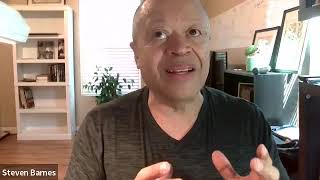
Steven Barnes leads a live mastermind with Shamika Cotton covering writing craft, martial arts practice, and career advice. Topics include flash fiction and screenplays, working with agents in Hollywood, and overcoming creative block. Barnes teaches a five-minute centering practice and uses martial-arts metaphors to explain mastery and flow.
Chapters
Yes. Very good, very good, very good. Oh, boy. Who's ready for Thanksgiving? We actually are.
Mostly.
Great. Great. I mean, we are mostly, but it's all. God, is that a chat? That's not a chat over there that somebody sent me a personal message from some political organization on Facebook. God, I hate that. Anyway, that's just. I guess it's better than war in the streets. Oh, my.
We.
So, you know, as said, this is. This is something. Something I'm really happy to be doing. This is very close to my heart talking to you guys about these things, having you trust me to spend an hour of your time with me. I do not take that lightly at all. So I really want this to be time that works for you guys. That works for you. Really. Well, whatever it is, I can do that. It has to do with those three arenas. Your self, love and love of others. Your fitness, health, vitality, or martial arts training or your career aspects, especially writing, because those are the three foundations that life is made from. Our hunting and gathering, our relationships, and our physical vibrancy. Given those three things, you have a foundation. And it is my belief that if you take care of those three things, you automatically begin to evolve the spiritual, which is just a matter of not defining barriers between yourself and other people, not defining barriers between yourself and the environment so that we are our communities, we are our families, we are our neighbors, we are our world, so that we care for these things. And if you start by loving yourself, then taking care of these other things and treating them kindly and with passion is natural because you're a passionate person who takes care of yourself, you're paying attention to the three gates. Is it true? Is it kind? Is it useful? And as you begin to expand your sense of self, you. You do that automatically with other people. And if that isn't spirituality, I don't know it is because it's the dissolution of the illusions of separation. So. And it's just, you know, just. It's just great. So, anyway, so welcome. We're getting started now. Welcome to the. The Life Writing Fire Dance Mastermind, where hopefully you guys are going to challenge me and ask me questions and say, oh, Steve, I think you're full of crap that doesn't work over here and stuff like that. And I will hopefully show you. Oh, yes, it does. Back off, Back off. This is. We're going to be doing this every Friday for hopefully the next year. And, you know, it's. It's only going to work if it is as sincere as possible and if every time we do this, I give you a little something to take away. So one of the things I wanted to give you today. What is qigong? You know, if. If I look at the Tai Chi movement and the morning ritual as being essential, the question of what Tai chi is, is a multi joint patterned qigong exercise. And what is qigong? Well, let's experience that. So I want to show you what is arguably maybe the most basic qigong exercise. And I'm going to do this standing up, just kind of showing off my new office. We just moved into a new house, and we're. I'm really, really happy. I finally got a space where I can, like, move around. Oh, Shamika Cotton entered the room. So this is great. We'll just welcome everybody. Oh, before I do that, please unmute yourselves and say hi to each other. Just like, you know, we're taking a little time on Friday, so you are surrounded by other people who. Who are the same as you. They're crazy, too. They're willing to take a little bit of time out of your day, and I'm willing to take time out of my day for us to spend a little bit of time together. So just kind of say hi. Just wave your hands and say hi. Hello. That's right. There you go.
I'm Ed Rodriguez from Palmer, Alaska, here.
All right, well, fantastic. I'm just delighted to see everybody here. So hopefully you can talk to each other in the chats. You can network if you find people who have similar interests to you. This is a place you might meet a writing partner or somebody to brainstorm about business or about health or somebody to hold each other accountable. This is great. The chats are right there for you, and I'm so glad everybody's showing your beautiful faces, your beautiful, beautiful faces. This zoom kept me alive during the pandemic. I. As you can probably tell, I'm a people person. I just. I love people, and not being able to see faces and get hugs was killing me. So we were doing parties, literally parties. During the pandemic. We had a dj. We were dancing and having fun. You know, I was doing virtual reality with my daughter, playing virtual mini golf. Walkabout mini golf on. On Oculus Quest. This is good stuff. That is a fantastic game. And it saved my heart because I couldn't go down to San Diego to see her, especially when she caught Covid. But, you know, she was, you know, walking, you know, germ factory. So I couldn't go see her because I might bring it back to the family. But we could still Oculus Quest, virtual mini golf every Sunday. And we could. We could give each other virtual hugs, and I could find out what's going on in her life and see if there's something I can do for her. And a very, very good friend of ours also joined us, and it was just like the four of us for two years in virtual reality, connecting, you know, I need to connect with the people that I love. Oh, Megan Lancaster is coming in. Megan Lancaster, one of my oldest and dearest friends. I'm so, I'm so delighted that she's joined. So delighted for all of you. Anyway, so just kind of with that preface, talk about the qigong exercise. Qigong is the energy system inside Tai Chi. So when you see people doing these patterned movements, there is a feeling that they are cultivating within those movements. It's not. The movements are like a glass, okay? They hold a particular energy. The glass is not important except in what it contains. So if you, if you specialize in that, if you will refine that energy and get in touch with that, you can use it to help you go to sleep. You can use it when you're meditating. You can use in any number of situations. And it. It's its own value. You can simply do the qigong exercise over and over again for 60 seconds or five minutes or a half hour or whatever. The more stress you're under, the more important it is to start what I would call the five minute miracle, which is where you are simply meditating or feeling that sense of peaceful centeredness for at least 60 seconds once every three hours during the day. If you're under a lot of stress, I would suggest you, at the top of the hour, take 60 seconds and you do a qigong exercise or breathing exercise, or you focus on your heartbeat or, or you meditate or whatever you want. You do pushups, Hindu pushups. You could do sit ups, you could take a walk. You could do anything you want. But for 60 seconds every hour, you are centering yourself, relaxing. That sense of relaxed focus is where excellence comes from. Relaxed focus equals excellence over time. Relaxed focus over time equals mastery. You know our definition of mastery, and this is what we're about. You know, you. If you think you don't deserve to be a master, ask yourself one important question. How long am I going to be dead? Armed with the answer to that question, do you not deserve to thrive? Do you not deserve to have just a hell of a good time to master the things that are really important to you? And, and what is mastery? It's not something that only celibate monks who can levitate over beds of spikes do. I've had a chance to walk with masters, and having achieved a certain amount of expertise in those three different areas of my life, I have access to people who are incredible martial arts masters, incredible masters of writing, grandparents who are still incredibly in love after 30, 40 years. These are masters. And asking them, what is it that produces this was very useful. And I'm going to preface this again, I'm going to say this again. I'll probably say it as often as I need to so that you get this. Mastery is not something out there somewhere. You are already masters in some arena of your life, I guarantee you. And what Musashi Miyamoto said in a book of five rings is no one thing, no, no 10,000 things. Or as Jerry Pornell, my writing mentor, my writing mentor, said to me, steve, once you've mastered anything, you know how to master anything else. So what is mastery? Let's get that definition. George Leonard, in his book Mastery, made the comment that most people never become masters and never get really good at anything because they can't handle the fallow periods. They can't handle the plateaus where it feels like they're not getting better. But the truth is that during those plateaus, that's when you're doing deep integration neurologically, physiologically, psychologically, and that's the foundation. So questioning yourself too much about that is like putting a souffle in the oven and constantly opening the door, saying, has it risen yet? And then slamming it when it doesn't look like it's risen. You have to give it some time. Now, I took that comment and I also asked my karate master who is beyond the level of grandmaster. The Chinese martial arts community considers him above the level of sifu, or teacher. He is what's called a sejo, which is a person who has developed their own movement system and he can promote people to grandmaster. Okay, I've got my certificate on the wall back there. You know, it's like being a bishop at a local church. You know, don't take it too seriously, except it's a really excellent church. It's a fantastic church. I treasure everything I got from it. But it's not about me being better than anybody else. I'm just better than I used to be. So what Steve said about mastery was fascinating to me. He said, and he's a very simply spoken man. So I am rephrasing what he said. He said, when you have the basics of your craft at the level of unconscious competence, such that you can create spontaneously under pressure. You are. You are a master. I combined these two statements into the following. For the sake of what we're doing here at Mastery plus Life writing, I ask you to accept the following definition. Mastery is a verb, not a noun. It is a path, not a position. And when you have learned the basics of your craft at the level of unconscious competence, such that you can create spontaneously under pressure, you are on the path of mastery as much as anyone else who has ever walked that path. The only question is, how far ahead of them are they? How far ahead of you are they? Or how far behind you are they? All there is is the path. If you get on the path and you commit to it, you're on the path of mastery. And that means that you already know how to master, because you are already masters. Look at your life. Once upon a time, you could not walk, talk, drive a car, ride a bicycle, make love, any number of those different things, and it was confusing to you, and it required work. Maybe you fell off the bicycle into the rose bush a few times and you wanted to quit. The hero's journey is the pattern of moving from ignorance to knowledge, is, you know, from one level to the next. It's nothing more than that. And you always go through the dark night of the soul. So what happens is that you mastered walking when you were a kid, but then as soon as you got it, he says, oh, that's nothing. Let me move on to the next thing. And you went through the exact same, same self doubts again. Oh, God, I can't do this. It's too complicated. It's too complicated. Somebody kind of even said, oh, I believe you. You can do it. And you did it. And as soon as you did it, you forgot how you did it. And the next challenge, you went through the exact same process. And the next time, you did the exact same thing. The exact same thing. All I'm asking you is wake up. You are already masters. Find the arenas in your life, who you are already masters. Ask yourself, how did I do it? How did I do it? How much frustration? How long did it take? Who was I modeling, imitating? Who supported me? What emotions did I go through in the process? If you will do that about anything in your life, anything in your life that you are trying to learn, you can take the exact same pattern. And like I said, look at the hero's journey. You have a young man. I always relate it to Star Wars. You have a young man or a young woman who's confronted With a challenge. Initially, they reject the challenge. So, you know, you know, come in Star Wars. Come with me, Luke. Learn the ways of the Force. He rejects the challenge. I promised Uncle Owen and Aunt Beru I'd work on the moisture evaporators. He's forced to. Or allowed to accept the challenge, you know, conveniently, Uncle Owen and Aunt Beru got toasted by the Empire, you know, so, you know, teach me the ways of the Force. I want to be a Jedi like my father. He sets out on the road of trials, you know, which is, you know, going from Mos Eisley Cantina, that wretched hive of scum and villainy, to, let's see, to the Millennium Falcon and then to Alderaan and then. Which have been blown up and then over here and then over there. Just the places that you go and meet allies and gain powers. Obi wan Kenobi and R2D2 and so forth and so on. And this is because in all the stories, if you. If you own. If you did not learn, if you're the same person you were at the beginning of the story, when you hit the main challenges at the end of the story, you'll get. You can't succeed. So if you dropped farm boy Luke into the. Into the trench warfare of the Death Star, he would have been killed within minutes or moments. So the entire story is, what does he have to do to either learn new things or draw forth from. From himself the capacities that he needs to succeed? Okay, so the powers. What powers did he gain? You know, it's, you know, learning to use the. Learning to use the Force, Lightsabers, flying, an X wing, you know, being a leader, stuff like that. There is always a dark night of the soul, or there's always a confrontation with evil in which evil wins. And I would say this is where. This is art, not science. So that the steps of the hero's journey, you don't punch them exactly in order. They're like the 88 keys of a piano. Each of them has a different feeling, a different meaning. And you hit them in different orders and different intensities, with different rhythms in order to produce effects in the audience. The same thing is true of storytelling. The same thing is going to be true with every challenge you have in life. I can tell you what is going to happen, but I. But I can't tell you exactly when it's going to happen, exactly how it's going to happen, what resource is exactly going to need. But we can step back and look at the overall patterns that much we can do, then you, if you will, overlearn those basic patterns and basic resources when things go sideways. And they always will, they always will. Every single time you set out to do something that is bigger than you, your ego dies, Your current self image dies, and it will try to stop you by throwing obstacles in your way, even if there are no external obstacles. But there probably are going to be external obstacles in general. If you could already do the thing, you'd already have the thing. So if you want to change, you better believe that you're going to have to grow and you're going to have to overcome issues. And. And because we have learned this thousands of times over the course of our lives. I mean, seriously, thousands of times, everything you ever learned, you went through this cycle. Why do we keep forgetting? Why do we keep forgetting? And that is. That's worthy of inquiry. Why do we forget the very process by which we've gotten everything we have? Why every single time that we set out to do something new, do we act like, oh, I've never been through this before. Nobody's ever been through this before.
Oh, boo.
Oh, nonsense. Wake up. Be an adult. The children can afford to do that. But children need adults who are awake and aware. Somebody's got to drive the car. Okay, so I've got the child part of my personality is very much alive, as I hope you can probably see. But somebody's got to pay the bills. Somebody's got to keep the schedule. Somebody's got to make me do my homework, because otherwise I'll just goof around. I just stay here and talk to you guys all day long. So you. You have an initial confrontation with evil in which you are defeated. That throws you into the dark night of the soul. I say that in Star wars, the. The. The confrontational evil which they were defeated was the death of Obi Wan Kenobi, because Obi Wan was supposed to take Luke to being an adult, to being a Jedi. Okay? And so when you rely on a master and the master suddenly dies, that's. It throws you up into, you know, into chaos. The dark night of the soul is the moment where it feels like none of your capacities are equal to the task at hand. And that is, you know, that is the attack on the Death Star. It looked as if all was lost. It looked as in the way I like to say that, you know, John Williams's music is, you know, is boom, boom, boom, boom, boom, boom, boom. And Grand Moff Tarkin is saying, fire up the laser. And Carrie Fisher with the Cinnamon buns on the side of her head. And the way through the dark night of the soul is called the leap of faith. The leap of faith is always faith in one of three things. Faith in yourself, faith in your companions, or faith in a higher power. And if you want to know why George Lucas is a billionaire, you better realize that he came up with a unique answer. It was all three at the same time. Because the Force flows through you, so it's under your control. It binds the universe together, so it is a higher force. And he trusted his companions. Han Solo comes diving it out of the sun. Great shot, kid. Let's get out of here. Brilliant. In one moment, he combined all three levels. That's genius. That's artistry. That's what you should be looking for in your art. To be concentric with different levels of reality. The personal, the social, the spiritual. When you can do that, when you can combine a concern that relates to your survival and being with your interaction with others, with your ultimate sense of what the world is, you're telling the truth. It is a personal truth. It is a social truth. It is a universal truth. If you can do that, you can make a classic piece of work. A classic piece of work. And this is what I encourage people who are in our various writing programs to do. This is what I encourage. It is a path. Because if you take that leap, then the next step is that you confront evil. And this time you're victorious. And the last step is the student becomes a teacher. So you're victorious, you blow up. The Death Star. Student becomes a teacher. You become a role model of possibility, which is what giving people medals is about. You're saying, this behavior is worthy of emulation. And the entire crowd applauds, you know, Luke Skywalker and Han Solo getting their medals. And poor Chewie just stands there and goes, where's mine? So that's how it relates to. To Star Wars. Pretty bald, pretty straightforward. But the trick is that it is probably not possible to write a story that will be recognized as a story unless you contain some aspects of this. That's the full 360 degrees. Most stories are just a few degrees of arc, or they just imply the story because they are talking to an educated audience that expects the story. So by withholding certain things, they're forcing your mind and your emotions to go there.
So.
So it's either the whole cycle, which is usually kind of childish, or it's aspects of the cycle, foreshortened aspects of the cycle, suggested aspects of the cycle, or you can Take it and scramble it and turn it around. And you know that the consciousness is trying to put it back together. And that energy is what allows you to do something special with it. So it's. You learn the basics and then you go beyond the basics. You use the ladder to get to the roof, then you throw the ladder away. The act of creation happens in the zone of unconscious competence. Art happens in the zone of unconscious competence. Flow happens in the zone where you are sufficiently engaged that you've got all the attention there, but you are relaxed enough that you can just kind of be. It is challenging enough to get your attention, but not so challenging that it creates fear that distracts you. A little anxiety is okay. There's nothing wrong with a little anxiety. But you have experienced the flow state many, many times in your life. Every night when you're going to bed, you go to a flow state before you go to sleep. If you're running dancing, you might, you know, put that line. She's in. She's gone into the danger zone where the dancer becomes the dance. Okay? That's the flow state. Okay? Making love the last few minutes or last few seconds before you reach an orgasm. The. The sense of there's me and her, me and him begins to dissolve. And there's just us. There's just it. The beast with two backs, as it were. There is just this thing that is happening. The subject object relationship is dissolving. And as with nuclear fusion, the dissolution of the subject object relationship releases energy. So knowing what you're doing, getting into the flow, getting so deeply into it that you can forget that you're there. You're just there. Everybody mute themselves. Or let me. Let me do the. Do the muting. I'll do the muting for you. Ah, boy. Participants. There we go. I'm just going to make sure we got this. And.
Good.
So we. Everybody hear me? Raise your hands if you can hear me. Excellent. Okay, good. So before we go into. Before we go into the qigong exercise. We having a good time? You guys digging this? Is this good for you? Because I love it. I love it, I love it, I love it. Once again, thank you for being here. Okay, so to give you an experience of this. Oh, Shamika gave me a heart. Thank you, sweetheart. I love you too. I do, I do, I do. What we're going to do is touch the theory of it and then we're going to touch the practice of it. So the theory is that when you're very relaxed and you're centered, that or let me Reverse that. What we want to do is to become like room temperature superconductors where all of the energy is flowing through us. However much life energy we have in the second before you die, you still have some life energy. So no matter how sick you are or where you are, there is something that is there. And just when you're tense, sometimes your hands feel really cold because you've reduced circulation. The same thing is true of your creative energy, your emotional energy. Tension, fear, anxiety. Constrict the hose, crimp the hose, and you're not flowing through it as much. I'm not using energy in the sense of physics. I'm asking you to expand the definition just a little bit so we have a term we can play. So play with. So if Tai Chi directs that energy, then exercises like the one I'm going to teach you is getting us in touch with what happens when we are both relaxed and focused. So I'm going to stand up and I'm going to move back here so you can see me. And the first thing I'm going to do is just kind of shake my. Shake my body. I just got to shake. Shake the tension down. Okay, good. Okay, good. Okay. So I'm going to rub my hands together until I feel heat. Okay, good. Now I shake my fingers out. And now I'm going to stand, my knees bent, my butt tucked under my head held as if by a string from above. And my palms get my palms close enough together that I can feel the warmth between my palms. So let me pause for just a second. Okay. I can feel the warmth. I can feel the tingle. The more relaxed I am, the warmer my right hand becomes, but also the more sensitive it becomes, the warmer my left hand becomes, and also the more sensitive it becomes. So it is both projecting warmth and. And sensing the warmth in the other hand. And if I do this right, and I relax enough and I focus enough, I can feel the warmth between my hands in what some people, you know, call a ball of chi, chi being just a term for that intrinsic energy. And the more relaxed I am, the further apartment I can get my hands and still feel that warmth, feel that tingling warmth. If I'm tense, sometimes I can't get them further than this. But right now, Yeah, right now I'm feeling. Okay. You guys are pumping me up so we can do this in a seated position as well. Just rub your hands together. Let me see you rub your hands. Come on, do it, do it, do it, do it, do it, do it. You come here with me. I Want you to play. Okay. Shake your hands out. Shake them out. Okay, now get your hands close enough together that each hand can feel the warmth from the other hand. You can do it this way. You can do this way. And relax. Inhale through the nose. And see how far apart you can get. Even if it's just a bb, a ball the size of a bb, that's okay. Relax and see how far apart you can get your hands while maintaining that ball of chi, that ball of warm air. And let's just hold that for 60 seconds. J. If I relax my face, it makes it easier. I can actually look at the. I can actually feel the tension in my face. And if I relax, gives me relaxation in the rest of my body. Okay. Not quite a minute, but it's good. And you, you will have access to this to be able to replay it. Who raise your hands if you were able to feel the warm air. Great. Fantastic. That feeling right there is what you would put into the Tai Chi form. That feeling right there is a feeling you would look for when you're trying to go to sleep at night. This kind of warm. A little bit of focus on the warmth. Because sleep in a lot of aspects of success, sleep is not like a dog. Dogs come when you call them. Sleep is more like a cat. It will come and, you know, come and take you when you're busy doing something else. A lot of success is like that, too. I'm going to put something in chat. I'm going to find. Find chat. I'm going to put. Okay. Oh, before I do that, any comments, questions or requests about anything that I've said so far. I want to stay engaged with you, Spartacus. You. Thanks for the invitation. Absolutely. Spartacus, I know who you are. I find it helps to close my eyes. Enhances my focus. I feel like I'm getting a sense of a ball of cool. Well, you know, if ordinarily your body feels kind of hot, and if hot represents stress to you, then coolness is fine. It's absolutely fine. You're looking for the language that allows you to understand your internal experience. And we're trying to develop a common language here. I'm not trying to force an experience or vocabulary upon you. I'm asking you to consider it. But then make a modification for this student. For Misty, it's cool as opposed to warm, perhaps. And we'll see how that goes as we go on. Bruce just popped in to say hi. I never expected a dark night of the soul over brush knee step right or left every time you start experiencing that. I suggest you go back to the earlier moves, Deepen them, slow down. Every single movement of the form is what is a power position. You could literally freeze in one power position. If all you knew is this, you could just flow through this over and over again. If all you had was this, then I could say, okay, all of my weight is supposed to be on the left. My right heel barely touches the ground. My left fingers touch the pulse point of my wrist. Let me turn my hips, let me sink. Let me just stay right here. And you work on the individual movements, working on the flow between those movements. As long as you can flow, you start feeling yourself getting confused. You start getting yourself feeling yourself getting frustrated. All you're doing is you are meeting the little gremlins that have stopped you from being excellent by asking you to be more than you actually are, by defining mastery and excellence and in ways that do not serve you. That way, your ego gets to keep you small. And the world needs you to not play small. Raise your hands if you have a question. Okay, hold on for just a second. I see one from Jamie. Jamie, unmute yourself. Ask that question, buddy.
Yeah, it's actually Jaime, and I'm the one who has the train wreck happening. I've got flow from the beginning of the form all the way through. White crane spreads its wings and holds the baby. And the moment I go into that seven star left, I have a mental train wreck. And I've been going over and over and over it for about a week and a half now, trying to figure out. We do seven star left, and then brush, knee, step right twice. Yeah, and then brush, knee, step left. Brush, knee, step right.
That's right. Yeah, it go. It goes just like this. I'll show you how it goes.
Yeah, but that's where. That's where it's like I get my left and right starts.
Just.
So what you do is, is start at the beginning, flow as far as you can. Start noticing that there are this stuff you're storing. All of athleticism is storing and releasing elastic energy. That's all it is. So look at where the energy is being compressed, and then look at where it expands. So look at this. So let's see. Okay, good. God, I love being able to teach this like this. This is, like, so cool. Technology is our friend, except when it's son of a bitch. So we're here at Brecht at seven Star. Right?
Right.
So I'm working on. All my weight is on the left. My right heel touches down here inhale. One. And then I repeat. Then I step forward and notice. Don't be too dogmatic. I'm close to the wall here, so I have to move back. So. So what? So I move back, move forward, and now it's on the left. And then I step forward, and I do it on the right. So you do it 2, 1, 1. Just practice that piece. So you do it smoothly as far as you can go. Then just start where you start and. And go over that piece three times. Then laugh at yourself. You're in the process. Congratulate yourself because you have taken another step towards mastery. You are on the path of mastery. Why? Because you got your basics. If you know the constant bear movement and, you know, rising hands, you've got your basics, okay? The rest of it is just explorations, expansions, contractions. If you can laugh and realize it's just chop would carry water, then this is the path that we're going down. All the voices in your head that tell you something different, those voices are not your friend. Clarissa. Unmute yourself.
Yes. So I just wanted to say thank you for doing this. And I had a question also about the hot seat. Right. I missed it, but when you were talking about ego, fear, and mastery the last time, and it compelled me to do. To respond to the hot seat, but I missed the last one. Okay, so be ready for the next one.
Hot seats are no longer being done formally, however. Okay, people who come to here, you come. You come and you play with me once a week here, and I will make hot seat room for you guys. See, because. Because your guys are like me. I would show up here, and I would be here. I would challenge the teacher. Okay, so, Clarissa, you p. Are you on Facebook?
I am.
Okay, so you PM me on Facebook, and I want to see a story from you. Very short, no more than about five pages. Okay, you write a piece of flash fiction for me, and we will workshop it right here, live. You know, just. You know, it's. It's in the way I workshop things, is we take a look at the hero's journey and characterization, and you're. And we're going to find out to what degree do you understand how your story goes into that structure and what is it you're saying about people, about. About human beings? So it's not about the quality of your work. The quality will come. Quality comes if you continually do the work along a valid path. You know, mastery is just. You find a valid path, a good teacher, and you stay on it and do what they tell you until you get gray hair. I mean, seriously, it's. It's not. It's not that complicated. You know, I just. And I like being on that path. I had lunch with Larry Niven yesterday, my writing mentor. And, you know, we're working on a book together. And I'm saying, you know, well, you know, we could do this, this, this, and this. And Larry, you know, whatever it is that you want, that's what I'm going to do. And he's just kind of. He just kind of looked at me. He said, steve, you don't need to do that anymore. I've told you for years, I don't have anything left to teach you. He is ahead of me on the path, both as it is honoring my teacher and the fact, truth is, he does still have things to teach me. His. His attitude about work. He is a grandmaster of science fiction. I'm just a master. Okay? I mean, seriously, you know, I'm on that path. I would like to be a grandmaster. I mean, now, having been guest of honor at worldcon, maybe that's what they're saying to me, but at the very least, they're saying I'm on the path. But if I just found out, I just wanted to put this in chat. Put something in chat here. Oh, yes. Yes, that's right. Washington Post just said that our graphic novel the between, is one of the top 10 in 2022. Now, this is wonderful. And we can celebrate and jump up and down and say, and then what's next? What do you do next? Because you have to stay on the path. If I pay too much attention, looking at what I did, that's like looking back over my shoulder while I'm driving. I've got to be here now. I've got to be in the moment. That the quality that you're looking for comes out of staying on the path, not cheering yourself on. So, yes, you acknowledge your wins, go out and have a good dinner, make love, hug your dog. You know, take a day, take 24 hours. It's kind of, you know, then it's back to it. So everything we're talking about here is the path, as opposed to stopping and looking at the mirror and looking at how cool you are or grieving about, oh, my God, I got rejected. Oh, my God, that didn't work out. Back on the path. Back on the path.
Eric, I'm sorry, just.
Oh, follow up question.
Yes. You said flash. Can you describe what flash fiction writing looks like to you?
Yeah. Flash fiction is a story that you write all in one Session. So a short story is generally about a single event that happens in someone's life, you know, so if you, if you're planning to write a novel, you could pick one moment out of that novel where something changes for a character, maybe a secondary character, and write about that moment. If you use Aristotle's unification of theme and time and place, then you have a play should take place in 24 hours. A short story like this should definitely take place within 24 hours. And maybe that short story takes place within one hour. What is the moment at which something changes? And what you want to do is read a lot of short stories so that you start getting a sense of how this works. You know, you should read 10 times as much as you write. At a minimum that that life writing pattern of writing a sentence today, at least one to four short stories a month. Finish and submit them for publication. Do not rewrite except to editorial request. Read 10 times as much as you write and repeat this process a hundred times. I may be modifying that last one. I'm thinking about it, maybe Repeat this process 50 times because I've noticed that almost no one gets past 25 before they start selling. If that's the case, and I think I can honestly say 50. But I'm looking at that because everything I say has to pass the three gates to the best of my ability. Is it true? Is it kind? Is it useful? So that answer your question, Sweeney? I think it did, Clarissa. Good. Okay, Eric, go for it.
Hey, thanks Steve. Great, interesting session so far. I hope you don't mind if I ask a question about a business process to get myself along the path.
This process doesn't work for unexpected questions. It does not work at all. So go for it.
Good point.
I've got professionally published stories in several venues, including three of the four Dell magazines. Asimov's never fell to me, but the other three did at least. I'd like to see if I can try to sell some of these puppies for other purposes, like adaptations. I'd like to write my own scripts for them, but also simply sell the idea. Do I need an agent for that? Or can I flog them around to individual production companies?
Do you live in a California in Hollywood?
I don't.
Okay, you need an agent and what you want to do is. Look, there are two things that you can do. One is try to get attention by writing the best friggin stories that you possibly can. Try to win awards, you know, publishing the highest profile magazines. And some, and quite often people will reach out to you and, and try to option something, but that is a little bit like trying to get struck by lightning. A better way to get electricity is to find a river and put a. Put a power, you know, put a turn wheel, you know, a paddle wheel underneath the water, so you're generating electricity. So you set up a pattern. And what you want is an ally. So it's, it's on the hero's journey. The road of trials is doing the work. But to get to where you're trying to go, you need allies and role models. You need to look at people who manage to do it, ask what they did. A lot of times it was chance. They wrote something, somebody saw it, called them up, said, we want to option it. The majority of these things happen from people who find allies who are on the inside of the industry. That is an agent, that is a manager. So you want to. Want to call the Writers Guild of America west coast and get a list of the agents who are willing to look at unproduced writers. They're not going to be the best agencies unless you have a list. If you have a best seller, then you might be able to go to CAA or something like this. You know, one of the, one of the biggest agencies. And you know, Stephen, Stephen King didn't need an agent. He could have done it with just a lawyer because people just come to him. So he didn't even have an agent anymore. But for most of us, you need somebody on the inside that's going to be an agent. So you write them. You say, listen, my name is Eric. I've been published at all these different magazines. I would like to write scripts and sell ip. You create really professional letters with your credits and so forth on them, and you send them out to a variety of agencies and see if you can get a nibble. If you can't do that, then you can write scripts and find out what production companies are looking at unsolicited scripts. Remember that they have legal problems. People are always swearing that somebody ripped off their ideas. So not everybody will do that, but they, but some of them will. And you could also write out a synopsis and elevator pitch of the idea that you have and include with that your qualifications. You know, where you have published and say you would love to have a conversation with them. Now, this is one person who is on the inside giving you an opinion. Based upon my perspective, what you want to do is talk to a dozen others. And what will happen if you talk to a dozen people is you will begin to see a common Theme and what they did. And that's what you're looking for, you know, only you know what your specific goal is and what your specific needs are. Emotionally, spiritually, in terms of your talent development and so forth and so on. So the people who you approach, the great reason to go to science fiction conventions, meet people who got over there and ask, how did you sell? They will say, well, it just came out of nowhere. Or, well, I put a script in a pizza box and delivered it to a production company. Or, well, my uncle worked for this. Or, well, I went to UCLA and there was a lecture and I talked to the lake. Or, well, I went to this seminar and I met this guy. It's going to be different every time, but you will begin to feel the common path that is modeling. So core aspect of life, writing. Find the people who have accomplished the thing you want and find out what they did, what they planned, and how they felt about it. Body, mind, spirit. My body. What are the things I did? Emotions, how did I feel about what I was doing? And mentally, what was my plan? What was my strategy? I'm very strategic about what it is that I do. I work very hard, so my body is engaged. I'm very strategic. But I try very hard to come from my heart because I made the mistake once of not doing so. And I wounded myself. And it took me a year to heal. And I promised that little boy inside me I would never do that again. And I have kept that promise for 35 years. But I really hurt myself. I thought that I could betray a sacred trust to my own creativity. You can't do that. You can't do that. You have to. You have to respect yourself. So you listen to. You listen to people. You make sure that it is with that what they suggest is within your ethics. You know, is it true? Is it kind? Is it useful? You never violate your ethics for external success. Never. There is nothing anybody can pay you. I remember one of my earliest, one of my earliest book signings. An older writer came to that book signing, handed me a business card. It said his name. And then freelance hack and literary mechanic. He was dead of alcoholism within a year. You cannot sell yourself out. There's nothing anybody can give you that's worth it. You hear me?
I sure.
That said, Hollywood is a fantastic, fascinating game. There is so much money and fun running around in Hollywood, and it's unbelievable. The problem is positioning yourself to get at it. And that takes strategy and connections and patience. So define the road where you know, who are you? I'm someone who's going to make it, I'm going to make it. See, this is the value of, let's say fire dance tai chi dropping into advertising mode for a second. Let's be honest. You know, where you know, in order to walk this path, you have to believe you can win. Because if you don't believe you can win, why are you going to bother doing it? So winning has to be a matter of being the person who can naturally do the things that will lead you to maximizing your chances of reaching the goal. So who is it you need to be? And if there's anything you say, oh, God, I couldn't do that for 20 years. Or I couldn't do that for five years. I couldn't pitch myself these people. Your affirmation should be things like, I am a successful Hollywood screenwriter. I get the jobs. I write the best scripts. I write unique scripts. There's no one like me. Heaven above, earth below, no one in the world like me. I could do this. No one has ever been born that is more honest who works hard. I will outwork anybody who's better than me, and I'll be better than anybody who outworks me. And you're saying this while you are moving physically, while you are walking or doing tai chi or running, if you really want to do it, you increase the physical intensity by, with tai chi, for instance, lowering your stance so it starts hurting a little bit. So now this represents the physical exertion that you're going to need to do the work to stay on the path to reach the takeoff speed so that you have a chance to win the goal. But you also have to define your path so that it's fun. Because the truth is, you might get hit by a meteor the day you day before you sign that big check, you know the check comes in the mail. I'm going to go to the bank. Boom. Meteor. Was your life a failure. Not if you had fun along the way. Not if every day you're having a good time. I have a good time. Anytime I'm writing, anytime I'm teaching, I'm having a great time. So it's, I set my life up so that I win every day, regardless of what's happening in the outside world. What's happening in the outside world does not matter to my internal state. I am going to win this game. How do I win? The Dalai Lama said that the meaning of life is to be joyful and of service. Joyful and of service. So if I'm happy and right now I'm serving you. I'm happily serving you. That means I am a success. Whether you guys go to lifewritingpremium.com and use the coupon code mastery to get a 20% discount, which you could do, which is only good until Sunday night, unfortunately. Huh? God, I'm adding time pressure. God, I'm learning this marketing thing. Whether you do that or not, the fact that you are here with me and I can talk to you honestly about it means that we're having a successful time. And if you define moving forward in your life and you perceive me as a potential role model, then your investment of this time with me means you are successful. You've had a successful day. This has been a great day. So if you start by having a great day and you define the exact work you need to do to move along that path to getting into Hollywood, I need to send out three letters a day. You know what? If you have to talk to a hundred different agencies and production companies to get a bite, it just. It's just a number. It's just a numbers game. You know, what if you had to ask a hundred girls out to meet the love of your life? Would it be worth it to find your soulmate? To get into Hollywood to have the body that you want? Are you willing to fail 100 times to have the success that changes your life? Anyone who's willing to do that, if you set it up right, my kind of people, my people, my tribe, you know, you are willing to fail and fail and fail and fail. And. And your attitude. My. You know, my karate instructor, Steve Muhammad, his thing is, failure does not exist in my fighting science. I will find or make a way. That is his philosophy. That is the philosophy of a winner, a warrior. You only fight for things you're willing to die for. And in that position, you find a way to win. In winning for me is if I die protecting my family. Sounds good. Can't think of anything better. In fact, that's my goal. I want to die working for my family, in my community, you know, my. My circle. So I'd love to. I'd love to die doing a zoom with you guys at the age of 120. That sounds great. All of a sudden. Steve. Steve, you okay? No. Steve died happy.
So if the flies start circling around, we'll disconnect.
You go, you know, call 911-something- little tombstone emoji. So, other comments, questions? Because we've covered a bunch of stuff. Even. I love personalizing this and being sure that. That I am serving you. You Know you have given me the honor of spending this time with me. You can't get that time back. So what can I give you in the time that we've. Okay, the website, the coupon code. Let me, let me type it into chat. Type it into chat. It's dot. And. There it is. And it's only good until Sunday night. What I'm going to try to do, I'm always going to try to do something special for you anytime you show up. I'm trying to teach you something. I want you to network. I want you to challenge me with questions. You know, I want you to share your successes. I want you to lean on my shoulder if need be. So you have. During this time, this, you know, this precious time that we have together, is there anything else I can do? Any comments, questions, requests about anything that I've been covering? Anything you would like me to cover in the future? Anything. I love the overlap of arenas. It's all the same thing. Do you get that? Do you get that? What we're about is mastery and we're developing mastery by asking for excellence in these three areas. And you take a look at how have I treated my body? How have I treated my career and finances. We do teach screenwriting. We have screenwriting classes that we do. The afrofuturism.com thing. Oh, life writing premium. Is. Dot com. Okay. HTTPs yeah, I'm not, you know, this is. I'm an amateur at this stuff. I'm trying to learn if somebody else would do the HTTPs and put it in there, I'd appreciate it if we can help each other. So I get to concentrate my attention on helping you and being present for you. The housekeeping things over here are very, very important. But I'm best at telling you my truth about this and to the degree that it is valid that you know, okay, so I have this high ranking in the martial arts and I have this, this career that has been. Got it. I got everything I wanted when I was a kid. You know, just, I feel, I feel so incredibly blessed. I have no words for it. I mean, really, when I stop and think about what I've been able to do there, it blows my mind. And I'm married to my soulmate. For 25 years I've been with the woman I was born to be with. And we just recently did a course on that too, the Soulmate process dot com. But all of these things that I've been teaching over all this time were descriptions of a mountain I've been climbing. I'm too Close to the mountain to see the whole thing. But if I talk about it from the direction of writing, if we talk about from the direction of relationship, if we talk about from the direction of the physical, through fire dance, tai chi, then you can glimpse the mountain through the mist. You know, it's like an ant on the back of an elephant. You can't see the elephant. You can't see the elephant until you get back from it. So this is the first time that we've had products in all three arenas. We've never had that before. So for the very first time, we can talk about the core thing, but also talk about the expressions of things. So screenwriting. The way to work on screenwriting is first be sure you can write a story because it's. It's a thousand times easier to sell a short story than to get a movie on the screen. I mean, more than a thousand times probably. So if you're sure that you can get that far, the difference, I mean, I actually write screenplays and teleplays before I write short stories. In other words, if I'm going to write a story, I will actually write the first draft as a screenplay. I use a piece of software. It's a free piece of software called writerduet.com hold on. Totally free. You know, you can like have three scripts on there for free, and it's very, very reasonably priced. Other than that, I don't get a dime from this. But it's. It allows you to collaborate with other people. It's online. Multiple people can write on it. So basically, I can work on it on my iPad, on my phone, my computer, my laptop. You know, it's anywhere I go. I can literally be, oh, Misty has to jump off. Thank you, sweetheart. Talk to you later. So the thing about writing a script as opposed to a story is that a script is just story and character expressed in dialogue with very little description. So if the story works in that form, I can literally write a whole book in a month in the sense of the entire story can be written in a screenplay format in a month for a book. And if it works there, if somebody can read it roughly and kind of say, well, yeah, I see the story worth. I believe those characters, the situations. That process seems to work. Then all I have to do is expand it out, change the tenses, and then polish. Seriously, it is, it. It's just a process that I found that Enable has enabled me to write perfectly saleable stories in just a couple days. You know, I spend one day or two days just Writing the script. Then I spend one day or two day, you know, transforming the script into text. And then I spend one day or two days polishing the text. When I wrote a Star wars novel in a month, was it Star Wars? No, no, no, no, no, no. Star Trek. Star Trek novel in a month. The first two weeks were nothing but writing a script. No, no, no, that's not true. That's not true. I will lie to you. The first two weeks were nothing but writing the first draft. I hadn't learned the script. Script process yet, this script trick, but I wrote it. I literally, from like 8 o' clock in the morning until 8 o' clock at night, I was doing nothing but typing. I did not worry about grammar. I did not worry about spelling. I did not worry about punctuation. Nothing. I literally just, you know, I knew what the story was. And then every day I simply kind of rolled my eyes up and went into alpha state and then typed until my fingers bled. Okay? And I did that for two weeks to create a first draft. The next week was just going over that to take out the basic mistakes, spelling, grammar, and to refamiliarize myself with what I'd done. Because I'd written it so fast I couldn't even read it. I didn't know what I was writing. And it's like I'd be going back through it during that week going, oh, that's pretty good. That's interesting. Oh, I didn't remember I did that. And then the last week was polishing, taking it up to professional standard. So by releasing your expectations that it has to be perfect, when you start, you get to do something very special, which is get more direct contact with your creativity. And there, that same creativity, I don't care if it's my cat wants to come up and play with me. I wasn't expecting that. Can I do something fun with the cat? My. My kid has a problem. I didn't expect that. Can I generate an idea or if he says, let's, let's play, dad. Or, you know, would you want to watch me work? Work out on the. On the heavy bag? Dad, I need to drop my. And go watch my kid work out on the heavy bag. Yes, sir. It's like, yeah. You have any idea how much I wish my father had seen me work out even once? Even once. So anytime my boy wants to have his dad watch him be strong, watch him learn these things or has a problem in any arena of his life. My dad did not teach me to catch a ball or write a Read or anything. You understand me? So what's important? I will drop all this other stuff to be with my family in that instant. Why? Because that is close to my heart. I am feeding myself when I take care of my family, the same thing. And once that's done, it's, you know, my writing, my martial arts, talking to you guys. I only market things that I would want, I would have wanted for myself when I was a younger person. It all passes the grandma test. Would you want your grandmother to use it? I'm sending messages in a bottle back to my younger self. That's all I'm doing. I will never offer you anything that I do not stand behind completely. And the more famous I get, the more money I make in Hollywood, the easier it's going to be for me to do this as just a game and just have fun with you and then give the money away, or a lot of it at Christmas. I give away thousands of dollars every Christmas just because I feel grateful to the world. I've been doing that for four years now, and hopefully I'll be able to do it again this year. We'll see. Anyway, have any more questions? Do you have any rewrite notes or script for your podcast episode? We do an outline for podcast episode. The only thing that's scripted in the podcast episode is the opening thing, you know, welcome to the Life Writing podcast for married authors, Stephen Barnes. And that we script that part. The rest of it is kind of generally, well, let's talk about our week. We don't script that at all. No outline. We know what our week has been. And then we try to relate our. What we're teaching to what is happening with us live in the week. That way we can say, well, I hit this wall, you know, so I'm going to try to do that every week, too. We're going to talk, talk about something that is actually happening. We got the Washington Post. How do I feel about that? Well, that was the result of these processes of writing that I'm talking about the commitment to being honest. Tananarive took the lead on that project. You could always tell which one of us takes the lead on a project by whose name comes first. The person whose name comes first in the title put it. And I don't have the books up here, so I can't. I can't show you. The person whose name comes first on the title did the primary work, which means that Tanari came up with an idea. We workshopped it together. One of us goes off and writes it. Both of us polish it. Okay? That's how. That's. That's what we do. And sometimes it's me, sometimes it's her. My honest opinion, and this is honest. I am not blowing smoke. Tananarive is a better writer than I am. And, you know, I have other values in my life. I'm a very good writer. I'm an excellent. I'm superb. I'm a master. She's better. And the reason I say that is because she is more congruent between the different levels of her being. Her stories come from her emotions. She does the physical work, so her heart is alive, but it starts there. She does the work and she has the structures and unconscious competence such that they naturally fit story pattern. I tend to start with ideas, Ideas, and then find the feeling. She finds the feeling and then explores the ideas. I think that that is a superior syntax. And I am actually trying to learn how to do that. You know, I am learning from her. She's certainly learning from me. But, yeah, anyway, I was just kind of going off. I have the blessing of being with a woman who compliments me. Beautiful. Beautifully. Just beautifully. We fight like cats and dogs sometimes, but not that much. And we always fight fair. Always fight fair. That was one of the very first things that we worked out when we got together. We knew we wanted to work together. So how are we going to do this and protect this love? Because we were in love from 72 hours after we met. I mean, it was just ridiculous. And so the idea, the rules we came up with, the relationship always comes first. Always comes first. We never go to bed mad. See, we have to be able to fight because an artist will fight with themselves about what to do. This color, this position, this fabric, this, you know, whatever it is you're doing, you fight with yourself, arguing. So two artists working together have to be free to argue. You can't be afraid that the relationship might be at risk. You can't have the abandonment fear. Oh, if I don't agree, they might leave me. That must never be there. We have made that commitment 100%. Neither of us is looking for the door. This is it. I'm never going to do better than this. If she got struck by lightning, I'd probably find somebody else to love. But if I messed this marriage up, I'd never find this level of quality again. Probably couldn't find that level of quality even if things went well. But it would be downhill from that point, and I know it. So I will do anything to protect the integrity of my love her and I feel that she is my queen and if I can be the king at her side, fantastic. But if I'm just her courtier, if I'm her night and my job is to protect and support her, I can live with that because I get to sleep with the queen. So it's. It's all good. Ain't no downsides here. Comments, questions, requests before we wrap this up? Because if not, I want to say you know again that the the coupon Code Mastery is for the year long Tai Chi Fire dance Tai Chi workshop where you can learn the moves in sequence as well as the philosophical context that makes them work and how to create a morning ritual. That ritual is the only thing I do every day, six days a week. It saved my life when my life was falling apart in Atlanta and I do it every day. It was the secret Tinanarive and I do a ritual together that bonds our love. We talk about that in the soulmate process.com workshop and when my son Jason was diagnosed with ADHD, we created a for him that we started doing with him in Atlanta when he was seven years old. Seven, eight years old every morning. So my ritual becomes the family ritual. How do you set yourself up to have the best day that you can so that all you have to do is chop wood, carry water? Everything that I'm doing, I want to help you develop the same thing. Whether you ever spend a dime in my store or not. Let me know what I can do to help you develop it in your way. You don't need to do Tai Chi. You can do these affirmations that they while you're walking, dancing, yoga, five Tibetans getting up and down off the floor. There are any number of different things you can do. It's not about anything other than physically doing something while you are present. Emotionally, while you're also focusing on what do I need to do today to stay on the path? Do that for just a few minutes first thing in the morning and you're setting yourself up for a fantastic day. So if there aren't any more questions, then I'd like to close this session with these the Sanskrit expression that means that says the divinity within me salutes and acknowledges the divinity within each and every one of you blessed folks. Namaste. Thank you so much for being here. Have a wonderful weekend, a wonderful Thanksgiving. See you next Friday to unmute yourselves and say goodbye. Bye.
Thank you.
Bye everyone.
Nice to meet you all. Goodbye.
See you next time.
Goodbye. Thank you so much. See you. Steve.







