Lifewriting Podcast Episode 3: Patton Oswalt
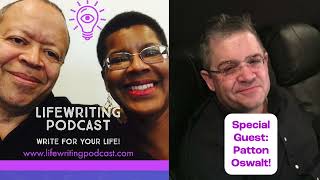
Lifewriting Podcast Episode 3 (hosts Tananarive Due and Steven Barnes) features guest Patton Oswalt. The episode opens with hosts discussing writing habits and managing stress during the pandemic (testing, masking, herd immunity concerns). Patton joins to talk about horror fandom (he contributed to Ghost Box), the overlap between horror and comedy, how speculative fiction can prepare people emotionally, and how stress relates to creativity. Guests and hosts also share personal practices for stress management (diaphragmatic breathing, meditation, VR workouts), memories of writers like Harlan Ellison, and reflections on race, gender, and cultural change. The episode includes a sponsored mention of the Life Writing Premium program.
Chapters
Welcome to the Life Writing podcast where married authors and screenwriters Stephen Barnes and Sanana Reeve do talk about writing during stressful times, breaking into Hollywood and balancing life. Every week we'll share more tips on how to build a better life while you create your dream projects, even if it's only one sentence a day.
That is the core of part of what it is that we do. If the six step process to writing a book a year starts with just writing a sentence a day, and the same things are true in, in terms of stress reduction, five minutes a day can get you started. In terms of fitness, in terms of relationships, checking in with your family. Find the minimum amount that gets you that's going to get you where you want to go and you'll start overcoming the resistance. So if you think I've got to write five pages that can feel just like an honor is burden, I'm rolling a gigantic boulder up a hill. But one sentence, you know, anybody can do that. And by the time you've done one sentence, you're ready to do more.
There it is. So this week, kind of some kind of good, you know, some kind of illness or bug running through the house. Yeah, I don't want to use a C word yet. I've done two rapid tests and so far negative. I'll get a PCR test on Friday.
Well, one of the things to remember is when you're under stress, the immune system starts breaking down. So you're going to get flu and cold symptoms even if you're not COVID positive. Just because we're under so much stress.
Well, that's what fooled me the first day because the first day I'm, I'm a hypochondriac, first of all. So I would be the first person running like to get a PCR test and trying to isolate. But I was attributing it the fact that I barely wanted to get out of bed Sunday. So the fact that I had worked so hard the previous week, I think so. That I had done a super, super tough workout two days in a row and it's happened before. So I didn't really think much of it. Although I did do that at home. Test.
Yes.
I don't play around and, but it's interesting how, you know, the pandemic continues to march on and it's changed. You know, I was thinking, well, if I did have it, it wouldn't be like 2020 Covid, it wouldn't be like delta.
Well, here's one of the things when people and I have to say unwise people. I'll be. I'll be generous. Try to say that, you know, what difference does it make? Everybody's going to get Covid. Well, you know something, it's possible, but I'd rather get Covid five years from now or two years from now. I'd ra us all get Covid at the same time and overburden the medical system. I'd also rather our doctors and scientists know more about it. The point is not to absolutely not get. It's to slow down the spread of the pandemic so we have a chance to get ahead of this and take a breath and think and be able to manage it.
The really insidious part. Well, it's good and bad with Omicron is that everyone talks about how mild the symptoms are.
Yeah. Comparatively.
Right. So a lot of people are fooled. They think they're having an allergy attack. They think they're just a little overtired. They don't even realize in a lot of COVID And that's not necessarily a problem for them because I'm double. I'm vaxxed and boosted, thank God.
You betcha.
And people talk about mild symptoms, but we have to remember we're in contact with people who have autoimmune disorders who have disabilities.
You know, it's like. It reminds me of the Monty Python routine that they will be lightly killed. People don't get the fact that it's. It's that Dunning Kreger thing. They don't know what they don't know. You know, I hate to give Donald Rumsfeld any credit for anything, but.
It is.
It is the unknown. Unknowns going on here. And I just, you know, put it off as long as possible. Give us some time. Let's have more time with the people that we love. More time for people to crunch this data. But.
And just a little compassion and empathy and, you know, politeness wearing a mask. Anyway, don't get me started.
Well, how many stories have you written? Because one of the themes that we have here is you take a well of deep emotion and you find some way to put that into the art that you're. I mean, emotion is the fuel for whatever it is that you're doing. So you've written on about pandemics multiple times.
True.
You know, so it's almost like there's a thing in the back of your head that was always worried about this.
I have a story called Herd Immunity that was in Light Speed Math magazine also. Right. And it's basically about, like one of the last survivors, wandering on a road, she meets a guy who's wearing a mask, and she's like, dude, why are you wearing a mask?
Right?
Obviously you're immune or you wouldn't have survived this long. Let's start a village. Let's start humanity over again. And he's like, ah, you know what? Keep your distance. We'll see about that, sister. She, while he's asleep, she sneaks and kisses him, and the next morning, he's got it. He's got it. And I think that is human nature. It's not that we want. Well, by we, I'm not going to lump myself in with people who are just really just strident. Anti mask.
Well, it's a.
It's a continuum, but it's. It's this really desire for human community, right? And human closeness. Like, why people like, we went to Atlanta. I was terrified on the plane. You know, it was my first trip.
Right.
After I heard all these reports where Omicron was sounding pretty insidious. And I was like, well, okay, universe, if we make it through this, I will be so good. And I am so good. That's the thing that also makes me kind of doubtful that it's Covid is I never leave this house. Like, I can pinpoint, oh, there was that time I went to the grocery store on the 11th to get my son's birthday cake. Could have been then when I was in there for 10 minutes. But, you know, it's just like. And we homeschool our son. There are just so few opportunities, you.
Know, for me, it's the assumption that at some point I will come in contact with it. I mean, I masked vaxxed, you know, the supplemental vaccine. Do everything I can, but also doing all I can to keep myself as healthy as possible, as energetic as possible. How do I raise my energy to the highest level so that if I do get it, I've got a reserve of strength and energy to fight it off. So it's do everything. It's a little bit like studying the martial arts. You know, you do everything.
Everything.
You don't walk down dark alleys. You know, you don't. Don't tug on Superman's cape, right? But in. In the case something. And if you can't run away, then you fight. So it's like, I don't want. I don't want this. I don't want to bring it home. I don't want to give it to you. I don't want to give it to Jason. And I don't want to give it to, for instance, my mentor Larry Niven, you know, who's in his 80s now, and his wife is in her 80s now. And about once a month, you know, I go over to their house and do all I can because they're starving for human contact.
And that's back to this thing. This is what's driving it is like, the whole point of herd immunity was that her desire for community was so strong that she just convinced herself that she knew what was best for him, what was best for them.
Right.
And I think that's what we're all doing. We're kind of, like, rationalizing, like, well, I would never do that, but if it involves, like, a loved one, you know. Yeah, obviously, I don't have Covid, so, sure, I'm gonna go. Well, it's.
It's. It's that barrier. How much isolation, how much does commerce matter? How much does human. Does a human hug matter? How many things will kill us besides the diseases? And if you. If you believe that this is a real thing, I mean, real, real thing, this is our generational plague, you still have to crunch that other data. The problem is that there are people who don't believe it who are crunching that data coming up. And they were. They were led by. Well, I. The. The Steven Seagal of politics is what. Donald Trump.
Oh, my gosh. You just brought up Steven Seagal and Amarosa. What are you doing?
And so that, you know, we. We have to try to find ways to find peace and art and love and connection in the midst of the chaos of life. So that's. That's life writing. You know, that's what we're doing. And we have a guest today. I cannot believe. How did.
How did you.
How did you do this?
Okay, everybody. Well, you know who the guest is, because it says so on the title of the podcast. That's why we've been being a little coy with it. But just so you guys know, it's like one of these social media things, I guess, because Patton Oswalt reached out to me on Twitter, I guess, is what I'm thinking, when he was compiling his horror anthology called Ghost Box, and I had no idea he was a horror fan.
So all the best people are.
And I just have to say we had literally just started the podcast. Like, we hadn't even recorded, I think, the first episode or hadn't uploaded the first episode.
Right.
When you brought up the podcast on The Roy Wood Jr. Podcast we did for the Daily show, and Roy Jr. Was like, oh, yeah, can I be on your podcast? We're like, what? And then Patton made the mistake of reaching out to me. I Twitter to tell me something about his podcast.
Everyone makes mistakes in life.
Well, I was like, well, what the heck, I'll just invite Patton. Want. We haven't even really started. And he said, yes, everybody. So right now in our green room. Well, coming out of the green room.
Come on out of the green room. Hi, Tananarive. How you doing?
We are doing so great. Thank you so much for doing this.
Thanks for having me. Well, when you say you are doing so great, that is a qualified so great. Because as you guys just outlined, there is a unshakable undercurrent of paranoia to every. To just every moment that we live in now. It is.
Yes.
Of the fabric of life, which is a weird thing. There are days I have to stop and make myself realize, oh, you normally wouldn't be having the thoughts that you're having right now, but you have to have them in terms of someone's coming over. Do you have a mask? There's all this stuff that. That very quickly became the norm.
Yes.
It's very weird.
It's amazing how much human beings can get used to, isn't Will.
Yeah. But it's also. It's kind of frightening how much human beings.
Yes.
Get used to. It's really hard. It'll be really interesting to see how the. These last 40 years and the pandemic affect pop culture and. And movies and books and art in terms of the nefarious government conspiracy, the way people react to a pandemic. All of those cliches, I feel like, have been kind of exploded because of how we've seen that people react.
Absolutely.
Yeah. I mean, people who watched movies, you know, where the zombies are coming and everybody. Nobody behaves in a sim. In a sensible way, so. Well, that's not realistic. Well, we had a chance to see what happens when tribal behavior is in conflict with common sense.
I mean, how weird is it now to rewatch that movie the Mist? And the most moment is when Andre Brower is going, I'm sorry, I just. I don't accept what's happening. And I'm going to walk out there and show you guys that you're. And people like, there are people covered in blood running out of the mist, screaming for help, and we're hearing weird monster sounds. And he's like, I'm sorry, I disagree. And it's my right to disagree. And he walks out there and is immediately Killed like that is so. That's the. That is so insanely realistic. The only thing that's unrealistic is in the reality that we've seen. Half of that supermarket would have walked out with Andrew.
Here's the frightening thing to me, Patton, the frightening thing is the possibility or actually almost inevitability that everyone does this. In some areas of our lives, there is information. We are deletion creatures, you know. You know, we don't. We have these ideas about life and once they get to a certain degree of solidity within us, contradictory information that comes in, it just bounces off. We don't pay attention. Where are we not noticing in our own lives? How do we become conscious? You know, that. That is terrifying. You know, if we can, when we come through this, hopefully we will have learned things. It will have modified our society in some useful and positive ways. I believe that human beings have been around for a long time. I don't think I just happen to be lucky enough to have a front center seat at Armageddon.
Well, let's hope not, but, you know, I.
Go ahead. Sorry.
Well, I was just gonna say I think that's related to our overall fear of mortality. Like these ways that we have denial about small things.
Yes.
Is a way of denying the fact that life is finite because we feel like we might just curl up in bed all day if we thought about death. I don't know.
Well, it's a much. It's a. It's a cosmic version of when you have a deadline or you have a project to begin writing and you will re alphabetize your bookshelves or you will, you know, go and get all the laundry folded because you. Your mind, it is such an amorphous task that is completely up to you, that you crave. Give me a task where there is a clearly a set goal that I know that I can reach. It's a weird. And it's a. It's an endorphin relief to have that to. To fill the dishwasher and start washing dishes. Well, I accomplished something.
Exactly. Not the thing.
Literally not a single letter on the page.
Yeah. Let me take out the neighbor's trash. Let me cut the cat's toenail.
Anything. Anything but this deadline. Actually, this is sort of a great transition to horror because we are living in a real life horror story. And I did not know you were such a horror fan when you reached out to me about Ghost Box. So I'm like wondering now. Well, first of all, there are articles that talk about how horror Fans were better equipped for the pandemic because we're always rehearsing for disaster.
I think, well, it's, you know, just fiction in general. There's research that suggests that people in emergency rooms and people who are waiting for the loved ones in emergency, who have. Are reading novels, cope better emotionally with the stress than people who are looking at nonfiction.
So, Patton, first, I wanted to ask you if you think that's true, do you feel like you were better prepared as a horror fan? And also, where did your love for horror come from?
My love for horror? Well, let me. Let me address the first question first, because what you're. What you're saying is absolutely true. And it goes back to something that Stephen King wrote about in his book Danse Macabre, his first wonderful book, where he said, you know, the kids I grew up with that watched monster movies and read famous monsters of Filmland and read Edgar Allan Poe and stuff like that, were able to deal with how quickly the world began to shift and get scary in terms of Sputnik and the Kennedy assassination. They had already imagined all these scenarios. Whereas he had a friend, and I've never forgotten the story, he had a friend who. I don't let my kid watch these horror movies. I don't want to mess him up. I don't want him to live in fear, blah, blah, blah. And the guy was a huge baseball fan. And the kid started having really serious nightmares. And they were. What were the nightmares about? And they were about a monster called the Twilight Double Header. And the kid had overheard his dad because there were no other stimuli in terms of monsters and scariness. And even when you're a kid, you sense that there's death and entropy and stuff, but you don't. You can't put a word to it yet, right? So he turned this thing that he overheard his dad saying, there's a Twilight doubleheader tonight, two baseball games, into a monster that he could then, you know, so, yeah, absolutely. People that I think that read just fiction, but especially horror and imaginative and speculative fiction, I think are so much better able to. I mean, we. Better prepared and better able to cope because you can imagine solutions and ways out of it.
Yes, You're. You're gaming potential problems. You're saying, if this happens, you can do this, this, this, this, this and this. And one of the things that I think is most important is to understand just because you can't think of a solution doesn't mean there isn't a solution. The limits of the universe are not the Limits of your knowledge.
No. And also sometimes the solution comes in the moments where you don't panic when you realize that there's no solution. If that doesn't freeze you up, then you have the breathing space to find the solution.
Yes, and I know that one of the things that I advise people is to take five breathing breaks during the day. Even if it's no more than 1 minute, 60 seconds of deep, slow diaphragmatic breathing every three hours, like 9 o', clock, 12 o'. Clock. What you'll do is you literally reset your body's stress response. I could talk about the physiology of it or the connection it is. It's an amazing thing. It absolutely works and no more, really. Five minutes a day and you can start getting control of our body's natural response to stress. Idiocy. You know.
That'S the one we really need.
Tea party madness, whatever it is that's causing you that stress so that it doesn't become strain and so that you can enjoy your life. Stress is non negotiable stress.
Strain.
On the other hand, you have, you have some say about.
Before I forget, I want to go back to that first, the second part of that other question though. Where did, where did your love for horror come from?
It just came from. I was a very, very imaginative kid. And when I first started seeing that, I think it's almost like because I was imagining. I was trying to imagine outside of the bounds of what I was seeing. Most monsters, Dracula, Frankenstein, Wolfman, are just an extension and a mutation of what the bounds of our being are. So, you know, Frankenstein, it's the human body but then kind of mutated and amplified and then, you know, Dracula looks very elegant, but inside there's this ravening beast. The Wolf man is hair growing, the creature from the black Lagoon. I just loved that someone had managed to personify this again, this thing that I couldn't articulate because I was so young. But the idea of isn't there more than what I'm seeing right now? Isn't there something outside of the bounds of what I'm seeing? And, oh, someone just personified that they figured out a symbol and a totem for that. So I was always drawn first. You're always drawn in by the monsters?
Yeah.
And I was very lucky that I was drawn in by the universal monsters. All of which. And I've rewatched all the movies this past Halloween because the Criterion Channel did a whole thing about Universal horror. And except for Dracula, all of the universal monsters are these tragic figures that Are like, I didn't ask for this. I'm trying my best to live and function in the world. And so it. There's this amazing level of pathos. And there are mo. Especially as a little kid when you're like, I didn't mean to cause the ruckus that I caused. I don't know any better. Like, Frankenstein is a giant five year old. It's a five year old with superhuman strength. That's all he is.
Yes.
And so there's moments where you really feel for the guy. So all those things, there are moments when you're growing up that you feel monstrous or out of place. And so that all just drew me in. And then I, you know, I think.
That the earlier you come into contact with the fact that there are unknown unknowns, that there's something beyond the limit. It's traumatic, but it gives you the time to adjust. The people who grew up in a world where everything seemed to fit, when they finally come in contact with chaos, if they're in their 30s, 40s, sometimes they just break too rigid. So those of us who got broken early, who realize, my parents don't know everything, the society does not know who I am, you know, and for me, it was like in first grade when they literally sorted me into the slow reading group because of my skin color, you know, and it's like I knew at that moment that the world was wrong.
Right.
You know, the. How do you know the adults, the very people who are supposed to give me passage through life, show me how the world's supposed to work, were wrong about something that essential? Yeah, it took me. Well, it took me. That was just the beginning of me feeling I don't belong here. Where do I belong? What is true? Who am I? Ultimately, I think it was very good for me, you know, but it. It sucked.
Yeah, I. My first. The first horror fan in my life was my late mother, Patricia Stevens du.
Really?
A civil rights activist. Yes. You know, I talked to a lot of black women, especially black men, too. They get their love of horror from parents, aunts, grandparents. And I like your story, Patton, because it seems like a gentler story. In my mom's case, she was like a police officer threw a tear gas canister in her face when she was 20 years old leading a nonviolent march, you know, to desegregate lunch counters in Tallahassee, Florida, as a student at Florida A and M University. And she wore dark glasses for the whole rest of her adult life, 80% of the time, because of her sensitivity to Light. So I say all that to say she suffered like a physical trauma during the civil rights era. And I used to think it was weird that someone with that background was so into horror. And I mean like so into it. But now I think it was because of that trauma that she was so into horror because she could confront her fear, her anger in the form of the monster where you can vanquish it or at least you can learn from it, or at the very least, it wasn't real. Okay. So whatever just happened on that screen is not as. Was not as real as her fear for her grandsons. Growing up in a society where being pulled over by the police might mean that your grandson gets killed.
Yeah. The very forces of authority that if you, if society supports you, the very forces of authority that you look to that you say, if I'm in trouble, I will go to. These people are forces of madness and potential murder. If you're the underclass, if you're not that. And it's. There's a dissociation there.
Yeah. That I never thought of it that way. That it must have almost been comforting and sometimes amusing for your mom to read the, these horror novels where the. Oh, I hope the police show up. She's like, I would love it if a mutated slime creature were running around and we were all united in trying to battle the thing rather than. Because you're right, her monsters were these amorphous, clean shaven members of the authoritative class.
Very fine people.
It's really interesting. Now I've really gone down a rabbit hole. Your book Ghost Summer really helped me. Also that short story that you recommended to me, Wet Pain.
Oh, good. Terence Taylor. Yes.
God. This whole. And it really came into focus me, I was listening to a lecture by N.K. jemisin and she was saying all of the, like, marginalized groups and you know, minority groups almost look at like there's a lot of white narratives about an apocalypse where society collapses and then you gotta survive in the wasteland with your mutants and your train dogs and your, you know, super powered car. But indigenous populations and minority populations actually have experienced apocalypses in. For real. Like we're actually living in a post. Your. Your nice world is our post apocalypse. Do you see? Like. And so we're starting to finally see those points of view and those narratives come through and it's really, it's really fascinating to see a lot of that. Like, look, I don't know if you guys watched the Falcon and the Winter Soldier on.
Yes.
Okay. I was stunned at how the the whole show is about, hey, all these last Marvel movies that you were enjoying with Captain America and an iron man, the weapon building industrialist. They actually were causing way more problems than they were solving. Like that's not good what they were cheering on. And then to have the friggin Neo Nazi on the show actually make a point about. He's like, you're on me for being into Super Soldiers. The only people I'm seeing using Super Soldiers is America. You used our techniques like I'm trying to destroy them. I at least saw that that's wrong. And he like, it was just so like, I can't believe that this is what this show is about. This is frigging awesome.
It really is. You know, in terms of, in terms of race and gender, I think those are the two major yes knots that we're trying to figure out. You know, I think race has had, you know, 400 years of misinformation and I think gender. We have had thousands of years of the human race behaving in one way, in my opinion, because it produced the maximum grandchildren. Didn't matter who was, whether anybody was happy. You know, you could throw lives away, you could throw dreams away. Just get those grandbabies out there. And now, since effective birth control, in essence, one of the, one of the great reproductive biologists who's a buddy of mine, Dr. Jack Cohen, said that prior to effective birth control, women were either lactating or pregnant all the time. Now we are literally changing that for the first time in human history. And we're starting to ask ourselves questions about, well, who are we really if we're not just concerned with survival? Because we've got enough, we don't need any more people. We're drowning in people.
Check that box, guys. Everyone calm down.
Who are we really, if black people? I think that the, the assumption was black inferiority. I mean, that's what said in the Encyclopedia Britannica, you know, Pope, you know, when I was about eight years old, I came across, yes, the Encyclopedia Britannica. Some friends of mine had an old Britannica and I looked at the race thing and they said it very clearly. It was like, you know, whites are the most intelligent, followed by Asians and black people are last. And it said that. I don't know what I had to do within myself to resist what the Encyclopedia Britannica said, but it's surprising that I did not become a criminal because you start rejecting what society says is right. Because if I believe society, I have to believe that there's something wrong with me. And I think that only the 21st century, as far as I'm concerned, is the first time we're starting to really question that little knot right there. And it's very uncomfortable for a lot of people.
I want to ask you another question, Patton. We actually had a chance to talk to Jordan Peele for our Sunken Place horror class that we teach online. And one of the things that, by.
The way, when I. When I saw his interview in Horror noir, I texted him because on the shelf behind him was the large format paperback of Stephen King's Dance Macabre.
I'm like, oh, there you go.
Another Dance Macabre. Like that was. That was such a formative book for me. So anyway, sorry, go ahead.
That's great. But this is a perfect segue to this question. He talked a little bit about the relationship between horror and comedy because I don't think it's a coincidence that he comes from a comedy background. And one of the things he talked about was how in both horror and comedy, you turn on subverting the audience's expectations. One for a scream, one for a laugh. And I was just wondering your thoughts on the relationship since obviously most people know you because you're a funny guy.
I have heard you talk about horrific incidents. A bar fight where a guy picked a guy up and dropped him on his head. One could have turned that into a horror story about mankind. And somehow you got laughs out of it. It's hysterically funny. How do you do that?
Because the mechanism for getting a laugh and a scream, it's the same mechanism. And you'll notice in the truly, truly horror mo, like genuinely scary to the bone movies like Jaws or the Exorcist, if you ever go see them in a theater with people, they are screaming and also laughing because they're so, like, there's laughter in the fact that, oh my God, we're so scared right now.
Yes.
Like, I can't believe after the big scream, then there's like some chuckles. Like, can you believe we just got taken to that point? Because the person use the exact same mechanism. And there are certain movies where it almost becomes blended. Some of the violence in the early Monty Python movies is. Is framed and filmed like a horror movie, but it's done so crazy over the top.
Yeah.
That you can only laugh at it. And especially the Final Destination movies there.
Oh, yes.
They're hysterical theater where you literally see what's being set up and you start laughing because you're delighted at what the filmmakers are like. Oh, they're really setting something really cool up here. And you know, by the way, if you watch old Roadrunner cartoons, there is. It's this perfect combination of like, there's Coyote, he's made this catapult, it's gonna fling, it's gonna hit the Roadrunner. There's horror in that. He's trying to kill this bird and then when he springs it, he just drops the rock on him and instead. And flazzle. Which is horrible, but also hilarious because that's not what was supposed to happen, even though it ends up. So, yeah, it's the exact same mechanism. And you know, Jordan, who, you know, Key and Peele was such a hilarious show that he knew that. And by the way, there are moments in especially get out that are a combination laugh. And also kind of like when Bradley Whitford goes, I would have voted for Obama a third time.
Yes.
Every white liberal in the audience, including me, was like, oh, shit, wait a minute, did I ever say that? Oh, fuck, I think I said that to someone.
You're touching something critical right there. I think that Jordan Peele started a conversation we have needed to have for a very long time. But it was a different conversation for white people and black people. It seemed that the conversation for black people was, is there anyone we can trust? Where do we find allies? Even the people who love us and sleep with us can be traced. Where is their tribe? And I think the conversation for white people seemed to be, have things gone to a point where we cannot communicate, where even if we have good intentions, it's in a context where we're not going to be trusted? How do we break through this? And I think that because Jordan is a world class comic that he knew exactly how to take you to the point where it's very uncomfortable and then make you laugh to release enough of the tension that you don't go into that. It's only a movie space. Let me, let me spill some tension here so I can keep you right here with this subject. And I think that to that degree, the socially conscious comedians or horror writers are performing a service that human beings are smart, we scream or we laugh to adjust our tension level so we stay in that healthy zone. Life can be nightmarish. Everything we love can be taken away from us. How do we find joy anyway?
Well, also the way forward through progress, you have to embrace the fact that it's going to be sloppy and uncomfortable and clumsy at first. And you have to, if you don't let that, if you don't let, if you can get beyond going, hey, you're going to be embarrassed sometimes. You're going to say some stupid shit. Trying to make a connection. Don't let that stop you. Just go. Just own when you screw up and go, oh, my God, I can't believe I said that. And then. But I think we live in a culture now, especially because that whole phrase, the Internet is. Is forever. Everyone is so afraid of making a mistake or looking stupid because they're afraid that'll be frozen and turn into a meme. And turn it. It's like, yeah, you fuck up all the time. It's okay. Just own it and go. Keep doing stuff. It's okay. Like, like, don't. Because that's gonna stop more progress wanting. I remember Chris Rock said comedians stop being funny when they start wanting to be cool. The minute you want to start being cool, you stop being funny. Cool is the enemy of funny. And I also think that cool is the enemy of progress. You're gonna fuck up and do stupid shit, but. But you're trying. That's okay. You know, it's okay. So you know that, that, that moment of Bradley, you know, Bradley Whitford's character is evil. If Bradley Whitford had been playing a more advanced and elevated character, he would have gone, you know, I would have voted for Obama. Third time. Holy shit. I can't believe I just said that. Did you did like that he. Then he would have, like, owned it and rolled with it. But that's. That's in a. That's not in a horror movie.
Well, it's not in a horror movie where the guy actually is there to kill this young man. Yeah, he was saying that because this is what, the kind of thing that will put him at ease. He's. He's thinking down at this guy. I wanted. We had a mutual friend, Harlan Ellison.
Oh, my God.
And I've known. I knew Harlan, you know, since I was a teenager. And I actually stalked him and started going to all of his. All of his interviews and all of his lectures and sit in the front row until he started noticing me there. And then we started talking and then we became friends. But I remember something he said about creativity. He said, the creativity emerges from the burning core. That was, that was the phrase that he used. The burning core of what we are. To me, I look at that and I look at, at fear and sex, death and sex as being the primary energies that drive humanity and that. That our creativity. You take a look. You know, Harlan did an entire anthology. Love ain't nothing but sex misspelled.
Yeah.
So much of his work came from a sense of human beings can be so much more than they are. And he was furious that people did not wake up. We did not love each other. We did not, you know, we did not really engage with the meat of our lives. And he just was this volcano of creativity at his peak. I mean, the man was insanely creative. And I just wondered, you must have had conversations with him about life and work and so forth. I just wondered whether you can touch on anything there.
Yeah, I would go to his house, up to the, the Aztec Temple.
Alice in Wonderland.
Alice in Wonderland, that's right.
He would open a sleeve of Ritz crackers for me and have put a pot of coffee on and we would just talk about, I mean, one of the things that he always was. And again, it's kind of what put him out of step with the Internet age is that. And there's a famous quote about himself, he goes, when I, when I think of myself, I'm a combination of Zorro and Porky Pig.
Jiminy Cricket too. He would say, Jimmy Zoro and Jiminy Cricket.
Some days I'm really wise, some days I'm a friggin idiot and, and embarrassing and clumsy. Some days I'm the suavest on the planet.
That's right, that's right.
All of those are me. And he goes, people spend so much time just trying to be the one thing and not owning the other parts of themselves and it freezes them, like you said, from reaching their full potential. You know, some of the stories he wrote were terrible. Some of them were great. Some of them were, Some of them were. He was writing short porn stories. You got to, got to pay the rent, man.
Like, hey, look, some of the things he said were terrible. Some of the things he said were so wise.
You know, I saw him, I saw him, I saw him do things that were so kind and so wise and so smart. And I also saw him do things that were cruel.
Yeah, me too. I also remember talking to him and I got really angry at him when this was before the 2016 election. And he's like, oh, Trump's absolutely going to win this country. Trump. Trump has, was going to win. Ever since America chose Nixon in the early 70s, they had a choice. They could have chosen somebody good and gone, but no, they wanted to the cheap used car salesman and they wanted Reagan. They wanted the cowboy. Absolutely. They're going to choose the funny guy that says outrageous things just to entertain themselves. And I was like, you're so you're so stuck in the early 70s. We're going to move beyond. And he was absolutely right. Like he was absolutely right. But at the time I saw it as nihilism and. And cynicism and it really pissed me off. So sometimes even in his nihilism and cynicism he was still. It could be illustrative or illuminating of something. Even the way that you're wrong is still teaching us something.
What you're saying about. About owning all you are. Harlan may have been the most Harlan human being I've ever met. He was more himself than almost anybody I've ever met. The guy, you know, when he said on his door, dig or split?
He just split.
This is just who he was. You know, it's like, do you like this? I happened to adore him. I just loved him and he knew it. And it was prickly because I know that people always wanted to be fast gun with Harlan. And I wanted to be fast gun with Harlan too. And I got shown the truth. I fucked around and found out.
Well, I just have to point out an instant of kindness. I met Harlan at my first Horror Writers association meeting when I published my first novel the between back in and a long time ago. And I gave him an autograph copy and I think two weeks later he somehow got my phone number and called me up to correct mistakes in the book. Typos errors. You know, I did not know this man. And then he asked me if I.
Was.
Having sex with Stephen Barnes, which was. That's not how he put it. That's not how he put it. But he. And I was just aghast and you.
Know, phrased it more viscerally.
I believe Isaac Asimov said about Harlan Ellison, he has the most intelligence and zero tact.
Zero. I think his goes directly from brain to mouth with no stop at common sense.
Yeah. So there's no sorting it. So sometimes the thing that goes from brain to mouth is brilliant and sometimes it is. I think, are we about to start fighting? Because I want to kill you right now. Literally like that.
All of that I remember.
No, my first wife and I took him to dinner and my. Within 10 minutes of the evening, my wife, I could tell she was like, I do not like this guy. Whereas I'm delighted and argue with. I took him to jar. Why would I. Why did I take him to a nice restaurant? I could have. I should have taken him to friggin Red Red Lobster. Because he complained about everything. We had a fight with a waiter. Oh my God. We got Crab, deviled eggs. You know, we got crab in the devil. How are you? How do you do that? Tell me how you do that. And I'm like, Harlan, they're just bringing, they just want to bring us food. You don't have to win, you don't need to win this encounter. Just order some freaking food and eat it. Shut the fuck up. Like, it was so, but it was, it was an evening with Harlan, so there you go. But yeah, I mean that, you know, there are again, Harlan was one of those guys. And this, this will always keep happening. Harlan is one of those people. And I think a lot of progressives can't deal with this and I've had problems with this too. But you also, I think I'm a little better at embracing it. Where, yes, he was very much on the forefront of a lot of things and he kicked a lot of doors open. And then sometimes a lot of the doors that you kick open then create a world that you paradoxically maybe don't fit into as well anymore because people have then moved beyond you in their realization. The analogy I always use is, you know, Joan Rivers, who basically laid on barbed wire so that female comedians could, you know, make the inroads that they did, then started getting a lot of shit at the end of her career for, you know, some of the stuff that she did that didn't age all that well. And, and I, I always wanted to argue, I'm like, treat her the way that John Wayne is treated at the end of the Searchers, where the reason that you're able to live in this more egalitarian, more liberal world was because someone a little more foul mouthed and brass bald had to kick these doors open for you, maybe acknowledge that the paradox of it, but don't throw her, don't have her go walk between the winds like that. She did what she had to do. There's plenty of people that unfortunately, I mean, if you look at, I don't want to, I don't want to go down like all these weird roads, but you know, a lot of, there's, there's, there's progress and then you have to keep in, keep in mind the times the people were making the progress in and maybe forgive them a little bit sometimes.
Absolutely.
I, you know, even when I'm doing readings sometimes of older stories, I come across words and phrases I literally will skip over in the reading because it, just like you said, it hasn't aged well, you know, and I grew. I was raised by civil rights activists. I have always believed in Rights for everyone. But I've made mistakes. Oh, yeah, Makes mistakes. You know, I have to retrain myself in language. I have to retrain. You know, there's a lot. There's a lot that I'm trying to embrace, and I embrace it happily. But even embracing it happily, I'm still going to make mistakes.
You know, it isn't just a matter of the world moving on. Sometimes it's. You brutalize yourself. If you're up against obstacles, the things that you do, you know, life is a Procrustean bed. It will cut the pieces of you off that don't fit the mold that you're trying to fit into. When Octavia Butler and I were the only black science fiction writers in the world for, like 20 years, I asked myself the question, how much did I compromise? How many compromises did I make that were not good for my soul? You know, and if it's true that I helped keep the doors open, there. There is that question. Do I fit in this new world right now? The. The. The opportunities are really there for members of the. That younger group who don't have those wounds. And they might very well look at the choices that I made and say, well, you know, you were a coward. You were a sellout. I could see them feeling that way. I wonder that about myself. I remember asking Ray Bradbury about that. I was just sitting at a table with him. He was speaking at my class at ucla, and I just opened my heart to him, just wondering whether or not I had sold so much of myself that I could not reclaim my spirit. And, you know, he looked, he said, well, you know, have you published? And I mentioned, oh, yeah, I published nine books, you know, at that time, and this, that, and the other. He just started laughing and he said, oh, you know, you will have no problem at all. Like another Harlan's friends, Leo and Diane Dillon, the artists. I said the same question. Yes, I had. I had lunch with them in Greenwich Village. They came out to meet with me, and I thought I was going to talk to them about my wife, at my first wife, who wanted to be an artist. But I realized that I was in the presence of real art, where one of them would stop a line, the other one would start it. They collaborated on their art, and that was what I saw between them was real, and it was something that I had never experienced. And I just started crying at the table. Just kind of gushed out, you know, is it too late for me? That sense of, you know, did the compromise I made to survive in the Business, numb me to my own sense of self. And they looked at each other and Diane Dillon reached across the table and took my hands and she said, one of the kindest things anyone has ever said to me in my life. She said, stephen, if you can even ask the question, it's not too late.
Great.
Yeah. That's what's great about the creative arts. There is no such thing as too late in the creative arts. There's just no such thing. And because you are always bringing a unique perspective to what you're doing because no one else is you. So as long as you're being true to yourself at whatever age you are, it doesn't matter. I know that Hollywood is all about. Youth is king. And that's because people have twisted the old, you know, it was either Greek or Roman thing about, oops, he froze a little bit Rosebud.
So people, you know, with some sort of, with some sort of a communication error or power outage, something. And we lost Patton. So hopefully we will continue that interview at a later time. You'll have an opportunity. Of course, he might always pop back on while we're wrapping this up. You just don't know.
So we only had a few minutes left and really the main thing I wanted to ask him was about the relationship between stress and creativity. I know he's worked out some stresses in his routines and also if he had any practices that help him stay centered.
So let's talk about our practices.
Yeah, we sure will.
So I mentioned the five minute miracle. Just stopping once every three hours and doing 60 seconds of deep, slow, diaphragmatic breathing. In five minutes a day, you can literally rewire your body's reaction to stress. It's not five minutes all at one time, it is five breathing breaks during the day. It's far better to break it up into smaller chunks. 60 seconds. And if you do that, just set the alarm in your watch for, you know, three hour bursts or 9 o' clock, 12, 3, 6, 9, for instance. Every time it goes off, you just be conscious of your breathing. Go on the Internet, look up diaphragmatic breathing, or talk to a yoga or a qigong instructor, sometimes even like an opera, you know, a singing teacher to give you an understanding of what proper breathing is. If you will do that, you will, you can save your life and your sanity and stay calm in the midst of, you know, you're, it's, it's an eye of the storm. You're, you're finding the eye in the center of the hurricane.
What's so funny is that during episode two, I think it was I mentioned at the top of the show the oh yeah, I realize I haven't been doing my meditation and I kind of brought it out to the public, but did I actually start my meditation after saying that? No, I didn't. So sometimes we're hiding from ourselves those stress coping mechanisms we know actually work. I actually use VR. I use an Oculus Quest, which in a program called Supernatural. This is not an ad, but I do work out to it a lot and it has a good meditation ad and I like to meditate to VR. I can also meditate with the Calm app. I also can meditate just by breathing, count of four in hold it for four, exhalation, count of eight. And like Steve said, that deep diaphragmatic breathing. So yes, I don't know if whatever the little bug in the house is stress related or if it's something viral, but in any case, don't give up on those practices, especially when things are going well.
My favorite form of meditation is actually just listening to my heartbeat. And if you get quiet enough, relax enough, you can feel the blood pulsing in your body. But you can also start by taking your pulse at the wrist or at the throat in order to feel that that awareness starts pulling you into the core of who it is that you are. If you have stress in your life, the idea is that you turn that stress into action. And in turning the stress into action, the action that actually helps to solve issues in your life, you don't get trapped in fear. So it's that you're using your fear, using that powerful emotion. Fear and love are probably the most powerful primal emotions. Put those to work, find things to write about, to sing about, to perform about that need those emotions and you put it there and you keep yourself from blowing up, from tying knots in your psyche so that you get burnout from all that energy. It's like becoming a room temperature superconductor. That energy is there to benefit you. These are the kinds of things that we teach about in the Life Writing Premium program, our year long program for people who want to live high energy, creative lives, especially writing.
Our sponsor, as a matter of fact, why we get to have these great conversations.
Yeah, we put years and years of work. Every week you'll get another email from us with videos and audios and assignments and lectures and things that you can do that week to move your career forward so that you understand the link between who you are and what you create. And that's@lifewritingpremium.com it's our best program and we're constantly looking for ways to make it even better. So when you join the program, you're actually joining a community of people who believe in the high energy, creative, successful, healthy lifestyle of an artist.
And if you're enjoying these conversations on the podcast and you're a writer, just imagine how much you'll enjoy those conversations when they're about the actual craft notes, characterization, world building, everything you can think of. Historical fiction, speculative fiction. We've got everything in there in lifewritingpremium.com so the.
Just to make sure that you want to stay on the list, once you're listening to this, just give us your email address over at Life Writing Weekly so we can keep you posted as to when we're posting something. We can have have those conversations with you. There's a. A group on Facebook, the Life Writing group on Facebook. We communicate with them and what we want is for you to succeed and have the healthiest, most creative and successful, happiest life filled with love and joy.
Thanks so much to our guest, Patton Oswald, I think, who was apparently was abducted by aliens is my story.
Hello.
He's here. He's here. Oh, and he's in the car. Oh, my God.
Oh, my God.
He went to your car. You're so sweet.
The power went out in my house. I had to go. I had to manually get the gate open. I got in my car, I drove down here. I'm in a parking lot of a Big five sporting goods store. I know, and I. I know exactly what happened. Someone. There's this power pole on the road behind our house, and I can hear all the. When I was driving away, all the rescue vehicles going up there, someone ran into it. They're always running into it. This happened last year. Literally. The power went out my house. I've been. I finally drove down. I found a signal. I'm so sorry.
No, no, no. We were talking about life gets in the way. This is life. Life is what happens while you're making other plans, bruh. I mean, it's like we have to. We have to roll with this. You. You are a delightful human being.
I cannot believe you went to all that trouble.
Well, you're a men.
While you're here. While you're here.
Yeah. What was the question you wanted to ask?
What is your relationship between stress and creativity?
How do you handle stress in your life? You know, obviously, laughter.
I used to be very. I would really, really get stressed out and wound up about things. And one thing that's been really eyeopening for me is there's a generation coming up that is rejecting that old model of you've got to grit your teeth and you got to like, no, you can take care of your health first. That, that whole, yes, the show must go on. Like, no, that's silly. Don't, don't wipe yourself out like, you, you, life is long. Take care of yourself. That's fine. And so there are moments when there are days, like you were saying at the beginning of the podcast to nunarive, that you Sunday, you didn't want to get out of bed. And some days when I don't want to move, it's my body going, I'm going to need you to lie down for a little bit to move. Because I got some stuff to fix. A couple years ago, I really threw my back out and I went to an acupuncturist because I could barely move and I had to act. I was performing something and she said, well, you know, the reason that your back is out, it's not because you did anything. It's because there's something wrong and you're body is trying to immobilize you so it can fix it. In other words, your back being flared up, is your body taking care of you? Just like when you get a cold, the runny nose and the nausea and the fever isn't the cold. That's your defense system trying to get rid of the cold. And a lot of times when you take the medicine too quickly, you just lock the cold in you longer.
Yeah.
So there's that thing of, like when your body is telling you something. Listen to it.
Absolutely. You know, I just. You start with that survival thing. Whether life is long or short, we live it one day at a time. We live in a moment at a time. Any day, any day that I do not tell my wife that I love her, that I do not tell my son that I love him, that I do not reach out and enjoy having had one more day of this existence. That's a wasted day. I will not waste my time on this planet. I will not.
Right. Do you have any rituals or practices patent that help you stay balanced?
I meditate twice a day, as much as I can.
What type of meditation do you use?
It's a transcendental meditation. I do. I have a. I have a mantra. I do it for 20 minutes. I find a quiet place if it's noise. Although lately, because I've been reading a lot about the roots of meditation, everyone thinks that meditation and the art of peace, where people up in the quiet mountains contemplating. The people that invented meditation were in busy urban centers that had to find a way to find quiet in the middle of all of this craziness. So a lot of times I don't mind having the sounds of life around me. That doesn't. As long as no one is addressing me. That becomes part of the meditation. That life is going. Even when life is going on around you, you can find a quiet space for 20 minutes. It's just 20 minutes. I've become very, very. Not bold, but just comfortable with going, hey, I need. Is there a room somewhere I can go and just meditate for 20 minutes? Like, if I'm somewhere and people usually accommodate you, that's great.
Today I was meditating, and my son came into the room to ask me something, and I used that as part of the meditation. It's like, let me. Let me stay peaceful and centered. This is my life. My son is not an interruption. He is my life. The cat that wants to crawl into my lap. This is my life. If I can stay calm in the midst of chaos, if I can find, you know, it's like the water running between the rocks. If you get your ego small enough, the obstructions in your life are interesting, but you can observe them rather than feeling like they're party. I have to deal with this right now. No, right now. You have to live right now. You have to.
I love that. I'm going to use that, too. Wow, that's amazing.
It's. It's a beautiful life. Is just beautiful. Every time I talk to someone like you who has taken something that you love and turned it into the thing that supports them, what I want to know is, how did you do it? How did you do it? You know, just sharing that. That's what I feel like we should give our children is.
Yeah.
Humanity spent most of its existence fighting for survival. I think we're getting a different set of options now. We can thrive. We can, you know, we can love.
And I, you know, the thing was I just. I loved what I was doing way before I was successful at it. So I was very fortunate that I loved the hang. I loved hanging out with comedians. I loved that life, even though I wasn't seeing any material gain. And to me, that is always the indication of the thing that you should pursue in the long run.
Absolutely. Well, we love artists, and it feels silly to use the word fan. I've admired your work for so long, and it's just storytelling, comedy, and the modoc the intelligence. Just thank you so much for everything you do. Thank you for the gift of laughter. Thank you for taking care of yourself.
I'm trying to, but guys, seriously, I'm sorry that I had to drop out of the way. This is life getting in the way. And we just illustrated it exactly right.
And notice how we dealt with it with laughter and love. Lightning in a bottle.
Thank you so much, Pat Noswalt. Have a great rest of your day. Thanks for being on the writing podcast.
Wonderful year. And hopefully we'll talk to you again one day.
Yes, you will. Thanks, guys.
Okay, take care. Bye.
Bye.







