Make your own movie --Tananarive Due and Steven Barnes
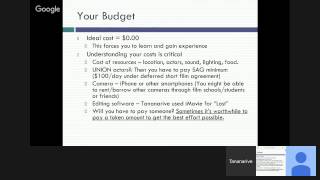
This is a webinar-style presentation (YouTube) by Tananarive Due and Steven Barnes offering a practical, experience-driven guide to making short films. They explain why short films are useful (training, festivals, industry access), give concrete writing advice (start close to the turning point; 1 page ≈ 1 minute; aim ~5–15 minutes), and cover low-budget production strategies (start as close to zero cost as possible, build a small crew or go solo, feed/compensate cast modestly). The talk also details storyboarding/shot lists, editing and sound (iMovie, stock music, Foley), distribution (YouTube/Vimeo, festivals), crowdfunding cautions, and announces a paid community/course (Screenwriting Machine via hollywoodloophole.com).
Chapters
Upstairs. Okay, that shows live.
It says six live out of 125 total registered. What does that mean, I wonder?
That's how many people.
Right now there's just six of them. Thirteen live.
Hello, people.
This is great.
This is the pre show. You can chat with each other and introduce yourselves to each other. We will be pretty much starting right on time. So I'm sorry if any of you were snowed in for the evening. That's no fun.
But maybe this Madeline said hi. Hello, Madeline. You are actually the first person to show up on chat and it is just delightful to see you. We are just really happy.
Yes. Welcome everyone.
Hey, Tanya. This is great. This is great. We are going to have a lot of fun over the next hour. And what I promise you is that we have just absolutely, we're not holding anything back. Our attitude is when we do one of these things, we want to just put it all out there. We're going to be hanging loose a little bit. We're a little bit loosey goosey here. We're at home. Our son is upstairs playing Call of Duty. Hello. Oh, wow. Look at all you wonderful people. This is great. This is great. Thank you so much for coming. It really warms my heart. Yeah, it's great to be here. We've had good news over the last couple of My book, Star Wars Saved My Life just got a five star review from the head of the Science Fiction Writers of America. So that's a good thing once we really get started because we'll really get started right on time. We have another larger piece of good news for you. Meanwhile. Hi, Diane here in Toronto. Hey, Tanana and Steve. Hello, Diane. Hello.
Diane Johnstone. She's a former coach and client actress.
And also film and Shama and Madeline and Sade and yeah, Louie and all you guys who love us and we love you and thank you so much for trusting us with your Friday evening. I'm just sitting here with my gorgeous, beautiful, incredible, brilliant wife.
Notice the camera's off, so you'll have to take his word for that.
Yeah, I'm looking scruffy, but she's looking hot.
I'm going to dinner.
Yeah, she's going to dinner. I'm going to hang out and watch TV and work on a book, I think. But yeah, we're here. Everybody's here. That's Ross there.
Lynwood Washington.
Lynwood Washington. Okay. Hi, Ross.
I love the chat function.
Yes. Yeah, the chat function is great. So basically you might hear some typing going on from time to time. Tananarive I might be answering a question that comes up in chat. We will try to deal with that. And then after we get finished with our presentation, we'll be taking questions and we'll answer any question we can and any question we can't answer, we will research and get back to you. So our intention here is to make certain that you get exactly what you need. So welcome to make youe Short Film. And we'll keep getting started in two minutes. Right on time. Sonya from Tallahassee.
Oh, hey. I was born in Tallahassee. What's up, Sonya? Australia. That's awesome.
Wow.
I'm from Sasquan. I had the best time at Sasquan.
Sasquan at the World Fantasy. Oh, right, right, right, right. Is there anything on your screen? What's on the screen is just make your short film, Cheryl. Can everybody see?
Let me see if I can see that. Oh no, that doesn't. Are you clicked on me?
Okay, so what you want to do is go to the bottom of your screen and click on the square that says Tananarive.
Yes.
You should see a screen that says make your short film Stephen Barnes and Tananarive Do.
Glad we remembered to tell you that. Click on the screen that says Tananarive and you will see the beginning of our presentation.
Actually, let's see. Let's give them the picture. Okay, so basically when you click on the screen, you click on the screen that has our picture on it and you'll be fine. It's Tananarive. Boom.
There we go.
Yeah, you do that and you will see and we will be fine.
Okay, we're at 6 o'. Clock.
We're at 6 o'.
Clock. The magic hour has arrived.
Okay, at the bottom of your screen should be little squares. One says Mycoria, one says Tananarive, one says Steve. And the one that says Tananarive has a picture of both of us.
So if you click on my box, you will see our PowerPoint.
It says nice looking Elizabeth. You don't see that? Cheryl. Cheryl, what do you see on your screen?
Yeah, just type it in for. Maybe Michael could chat with her and get that.
Yeah, okay. Michael, would you chat with Cheryl and help her with that so we can get started here? So basically, welcome. I'm going to go back to the beginning. We're at the make youe Short Film webinar. And I am Steven Barnes.
I'm Tananarib Dhu. Sorry, I got caught up reading the chat. That's what happens. It's so interesting over there. Anyway, and the reason you all are here is because you want to know how to make a short film. You want to either learn a new skill, you can show off to friends and family. Imagine inviting a bunch of people over to watch a movie. Or you really want to get your foot in the door of the filmmaking world. You want a seat at the table. Now listen, if you've been paying any attention to the news today, there was an exciting announcement out of the academy to increase diversity and race and gender in the academy. There's been some controversy about access in the film industry. And no matter what you think about the whole thing, one thing is certain. The film industry is hard for everyone to break into, period.
Let me give you a sense of how hard it is. Last March was it, we signed a contract for a movie. We've talked about this movie several times. We have to be oblique because we can't talk about the studio that we're working with or the network that. But it's a film for the network and we don't hear anything from them for months. In Hollywood, generally speaking, if you don't hear anything, what that means is your project is dead.
Yeah. So it had been a couple months, so we were like, okay, well that was fun. You know that's not going to happen. But just yesterday we were talking to our producer, really pitching him other projects, fully expecting him to say that our project was dead in the water. But instead he said that a writer had been hired to polish, which is what our last communication had been.
Yeah, that always happens in Hollywood. It's incredibly rare, when almost unheard of, when a script makes it all the way through the development process without more than one pair of hands on it.
I mean, I'm not gonna lie, there was a part of us that was like when we first heard that. But we were assured by our producers this was a good sign. That means they're doubling down on their commitment, they want to go forward. And. And sure enough, he said that writer had been hired and would be getting to work. So yes, it's a cable project, it's an adaptation of one of my books, but we can't say we actually had to sign a non disclosure agreement. So we can't.
So the point being that if you don't have feedback, it's almost impossible to improve. And this is true for professionals as well as amateurs. If you stepped across the line into being a professional, you'd think that you start getting a lot of feedback is just fine. But no, it's just not true. It's just not true. So what we want to do is to be completely honest with you about what our process is and what we've learned, and to suggest an alternate path. Whether you are interested in being an amateur and just having some fun, or you want to develop professional level skills, polish those skills, and actually have a chance of getting into Hollywood. But more and more people now are saying, let's find another way. And this was not even possible a decade ago in the way it is possible now. Right now it is possible to pull off something that's almost miraculous.
And let me tell you this, Steve, and I'll tell you a little bit about us. We're both novelists, but we're also screenwriters. Steve has a great deal of experience writing teleplays. He has a long list of credits on it.
Twilight Zone, Outer Limits, Stargate, three episodes of Baywatch. Don't hold that against me.
We've also worked together on several collaborations. We've sold screenplays to Fox Searchlight and this cable network. We can't discuss, but we were doing what I call the Hollywood shuffle, which is you do the pitch meetings, you try to go through the channels, and trust me, those channels are hard to get access to. But every once in a while, you get lucky. You get a meeting, you get someone's ear, you get someone's email address. We moved to Atlanta, and during that time we got that indie spirit. A lot of people around us were making short films. I had a short film festival when I was at Spelman College. And that and watching other people do crowdfunding online just really helped me make that psychological shift, which I hope all of you will be making today, which, first of all is to see yourself as a filmmaker, to believe you can produce a film.
And in doing scripts, somebody just asked a very, very good question they'll be answering. It has to do with how do you find out what script format? We absolutely have an answer for you. We're going to be able to answer all these questions in time.
Yeah. Forgive us. We'll wait until the end to answer most.
Some of them will be answered as we go. The question is, if what you want to do is to write scripts for Hollywood to produce, why make a short film?
Yeah, there's no money in short films.
No, there's no money in short films. But there is education in short films.
Yes.
So here are some of the different possible reasons to do a short film. It teaches you visual storytelling. You actually have to create a link between the words that you put on the page that the images in your mind and what ends up on the.
Screen to tell you, in all honesty, I know some of you have dreams of being filmmakers. Some of you may just be curious. Even if you don't think you see yourself with a future in the film industry, it's really useful to A, learn how to write screenplays, to learn visual storytelling, and B, watch your script being shot because you learn so much in the process as a writer, as an artist, really, you'll never be the same. So there are a whole lot of reasons to make a short film. It's a great training ground. Also for larger films. We'll read what's on the cards in case some of you can't see them.
Yeah, it might be blurry if your Internet connection is slow, but it should clear up if it sits there for a while. So you might try moving closer to your router.
Now, we made a short film called Danger Word. You can see that@www.dangerword.com, although not right now. It's 18 minutes long. When we made Danger Word, we actually got nominated for two awards at film festivals. One in Atlanta, one in la. And guess what? Whether you go with a, in this case, it was a $30,000 film. That's pricey. I know, we'll talk about that. Films don't have to cost that much. That's just what this one did. Whether it's a $30,000 film or a studio big budget film, if you're at the film festival, you're at the same table with the filmmakers, you're at the panel, you are getting that coveted access everyone talks about, but no one understands how to get. They say it's all who you know. Well, how do you get to know people? Simple. You go to the places where they are, you go where they're meeting, you go where they're congregating. And at film festivals, there's a very open feeling of sharing. You basically passed a test. You are serious, so they will take you seriously. They will stay after panels and talk to you. It's a great way to network. Obviously, the more you practice anything, the better you get. So you get great experience as a filmmaker. Just like people who make music videos roll into directing larger pieces, the same would be similar here. You get feedback from the audience. Maybe it's just not working. So how do you know that unless you put it up on the screen and someone can tell you that? And a film credit sometimes on IMDb.com Danger Word has a film credit on IMDb.com. it was really my first serious writing credit on IMDb and I could go through the process of getting my little teeny nine minute short on IMDb, but to be honest, it was taking so long.
It's an Internet movie database. It's basically the yellow pages of the entire film industry.
Yeah, get to know that stuff.
Basically, it's about if you've got the heart to do it, then we can give you the basic tools that you need. And that's what this time is about.
This is all about.
So it all starts with a script.
Many of you, I assume, are writers. And if you're not writers, then I'm assuming you're expecting to become a writer in a crash course. So either way, there are lots of writers who learn how to write. Writing screenplays, it's a perfectly legitimate way to learn how to write. But maybe you're a prose writer and you've never written a screenplay or you've been working for two years on a feature screenplay you haven't been able to finish. So let's back up now in the.
Same way that I have this thing that I call the machine, and it relates to fiction writing, prose writing, and people want to write books because that's where the money is. But I still encourage them to write short stories in the same way, short films relate to the skills that you need to do a large film.
Yeah, you shouldn't be shocked if you're lost or fresh with the long film project. I teach in the master's program at Antioch University, Los Angeles. I have this with a lot of my students. They want to write novels before they really polish themselves as writers or learned all their storytelling lessons. It is so much harder to learn how to write in a longer format than in a shorter format. And a lot of you may be thinking well, but I can't think of any ideas. Maybe all your ideas are coming to you as feature ideas. They're big. Guess what? The reason you're not getting the ideas is because you don't watch short films. They don't get distributed in movie theaters. That's the first step, is to figure out what is a short film. Take a look at some great short films. There's a short film called Cargo that you can find on Vimeo or YouTube. It has, I think I saw today, 10 million hits. It's a zombie film. Is it so popular?
It's a zero budget.
It's a great story.
I can promise you that the people who made that short film for no money have a Hollywood deal now. There have been many, many people who've gotten television series and attention from Hollywood, including deals from making zero budget films. You can do it just for the sake of learning. You can do it to have fun, you can do it to show it to your friends. Or you can do it because you have ambitions of working in Hollywood. What we've got here is a way for you to do an end run around the gatekeepers. And this is something that simply wasn't possible.
So in terms of what do I write? Once you've watched at least a dozen, but I would say more short films just to get a sense of what other filmmakers are doing, how much they're spending, what kinds of stories they're telling. A good rule of thumb is that a short film, like a short story, is about a turning point in a character's life. After this event, after what we're watching, life will never be the same for your character, whether it's in a little way or in a very big way.
Yeah, you start as close to the point where things change as possible. Aristotle in the Poetics talks about the unity of time, that a play should take place in no more than 24 hours. That is rarely true of a movie, but it can be true with a short film. It's best. The closer to real time you get, the better off you are. You start very close to the moment that things change. And you could take a look at any movie and you could find a moment from there that, oh, this could have been a short film. You could extract from a larger movie. Just a scene. By the time you've watched about 10 short films, you'll start getting a sense of what can be done.
Yeah, the momentum of the story. I just wrote a 30 page, which roughly translates to 30 minute script called Herd Immunity. Adapted from a short story I published. Really for a script sample in case I wanted to get work and TV or just for fun, just for practice. And it's a very simple story. A plague survivor is wandering a deserted highway, hint, hint, not that much budget, deserted highway. And she comes across another survivor and they have an interaction that will change her life. I don't want to say more than that.
Right, just say more than that.
It is a short story. You can find it out on the Internet. It was in Lightspeed magazine. But this was the moment she realized that her life was not what she thought. And we get to have that horrible revelation with her within this 30 minute span. So find a turning point in your character's life, but make it easy to.
Shoot, easy to shoot. This is one of the things. One of the reasons why it's important to do short films is so that you can start getting a sense of the difference between writing the planet explodes and making that work on the screen. By starting to make yourself think the way producers think, directors think, actors think, you are actually stepping into the position of. It's the same thing as well. If you write a short story, when you finish a short story and print it out, that short story is pretty much the same thing on that stack of paper as it is when you read it in a magazine. But a script is not a movie. A script is the blueprint for a movie. It's a blueprint for a movie. It's a template for a movie. Until you've seen the completed product, you don't know how your dialogue sounds. You have no idea of so many different things that an experienced screenwriter takes for granted because they've actually seen the process. So if you can do that and then start getting feedback from people, you can actually cheat. You can actually cut through the bs. So you want to avoid genres that imply large budgets, a big special effects. You do a scene, you do a movie that is outdoors, that you can do easily.
That's what I did for my short that I just shot on my iPhone. It's nine minutes long, called Lost. It was just outdoors at a park.
Or do something that's shot in one room. Here's what you do is you think about what you're writing in terms of a one act play. It's a one act play. You don't work downward from some big movie and try to make it small. You start with something that is very small and intimate so that it'll be easy, so you can concentrate on actually making it rather than concentrating on all the logistics or trying to figure out how to raise a lot of money. You don't want to worry about that, Steve.
And think of it visually. I just had an image in my mind when Steve said the world exploding. The world exploding doesn't have to be a big budget special effect. The world exploding could be a young mother who's having a conversation with a friend within maybe 10ft of her car. And when she goes back to her car and looks inside, her baby seat is empty. That's her world exploding. Her child is gone. Now I'm going to spend the next 10 minutes trying to figure out what the hell happened. That's a short film.
And we want you to concentrate on. On the emotional bomb. I mean a film, a piece of fiction, A nonfiction book is about information. Sometimes they want to move you emotionally. But a movie or a piece of fiction is about the emotional change that the audience goes through. There's an emotional journey you want them to go through. So in general, the last scene or the last chapter of a book, the last paragraph of a story, the last scene of a movie contains the emotional dynamite. Everything else builds up to that. So if you concentrate on the script, if you concentrate on what's my story, what's going on, what are the changes, who are these people? And we don't want you worrying about the formatting. So if you go to writerduet.com There is a free service there. You can get a free account to write scripts. It takes care of all the formatting, everything else. So you can concentrate on writing the thing itself.
Yes. And also, don't forget and let me speak to writer Duet. For years as a novelist, I was intimidated by the screenplay form because of format. Some of you may be in that same boat. I don't know, where do you put stuff? It's one of the same reasons I've never written plays, you know, as a formatting. So something like Writer Duet, which I think is far more intuitive than Final draft, by the way, which is much more expensive. It's a free program, it has easy to follow tabs. And you'll hear this a million times from us today. If you have trouble with it, watch a tutorial. Everything you have a question about has a tutorial. And that's just a part of our lives now.
So that's writerdoet.com and we will send out to the email list those of you who have registered, we will send out some resources.
And don't forget, when you're writing your script, read scripts. Don't just watch the short films. Unfortunately, you won't be able to in most cases see the screenplay for the short film watching. So that's when you have to go online again. You can find databases that have free scripts. Every year at Oscar season, the studios put up screenplays for consideration. And sometimes those end up just floating around on the Internet. Watch movies and read the script. See the relationship between the script and the film. Because the film is just a template. You don't have to say how many steps someone took forward. You don't have to describe everything. They're wearing prose writers. We have to drop all those bad habits of over describing and just use bare bones language to paint a scene.
So what's your team? What are you going to need? Because we're Going to be referring to the filmmaker's journey, which is relationship to the hero's journey. If you've been challenged with a problem, if you've dealt with the fear and the confusion, if you've accepted responsibility, then you set out on the road of trials. And one of the things you do is you have allies and powers. We'll get back to that later on. But the team that your allies could be you and just you. It's tough, but it's possible. Tanari made her movie Lost basically with no cooperation from me.
I was just obsessively leaving the house every morning and going to this hiking trail and getting hopelessly lost every day. But I was having a blast because I was shooting a film and I was starring in it. So when I say you can make it by yourself, I'm speaking literally. I used sort of a shaky cam approach, conceit, where my character was videotaping more or less footage and she gets lost and she ends up doing some direct camera address and some scary things happen to her. So you literally could just. If you don't want to be bothered. And sometimes as writers, we're anti social. There is a management component to putting a film crew together and you have to be, you know, honest with yourself about whether you have that temperament.
So maybe I don't want to be a director, but I was very glad to see what a director does to be on that set. I mean, I've been on Hollywood sets, movies and television, as well as the little film that we did. So I know what all these jobs are. But if you've never done that, especially, I think it's critical for you to be able to put on that hat so you can know, I know how a director thinks, I know how an actor thinks, I know how an editor thinks. What are the jobs? The bare bones might be a director, a director of photography who basically sets up the shots. A cinematographer person who's running the camera might be the cameraman, cinematographer on a small crew, someone to handle lighting, someone to handle sound. And then of course, once you've got your footage, you need an editor, somebody.
To put it together, and that may also be you. Let's go back to the smaller version of a team. It might be an actor, you as the person who's the director and who's running around making sure everything is where you want it and how you pictured it in the script. Someone who's willing to hold the camera for you. In one case, I was shooting a book trailer and my dad was holding the Camera for a scene. So you enlist whomever you can, all the people around you. If you're still scratching your head and saying, oh, my gosh, who could help me? Well, that's when you have to sort of reach out outside of your circle and approach a film department at your local community college, a filmmakers group on social media. You would be surprised, maybe perhaps even amazed at how many people love making movies, are willing to work for nothing or next to nothing, and would be able to help you. So, yeah, think about all those roles. Now. You are a producer. If you're making this film, you are a filmmaker. You are a producer. So get used to that word. Get used to calling yourself that. And producers produce. There are some producers who just have relationships that can bring people together. There are some producers who conceptualize and put it together from top to bottom. Some producers do all the budgeting and finance.
So, yes, if you decide to do it by yourself, here are things that happen. You're going to gain experience. You're going to value at all the different jobs. You might find out that you love something that you never knew about. And if you start networking with other people, this is where community comes in. You have a chance to learn from other people who have traveled this path before. We're sharing what it is that we know. You support other people, they support you, and you share information. This is really, really critical. It can lead to bigger projects because once you've done it, you might know something about how to raise money or how to borrow equipment or how to find actors. You start sharing these things and people will begin to invite you into their projects once you've made it known. If you love it, what people who make movies are looking for is other people who love making movies. Writers love hanging around with writers. There is nothing. If you take a look at the five people you spend most of your time with, you're going to be the average of those five people. So what you want to be as a filmmaker, it's critical. Hang out with filmmakers. And you can do that over the Internet now. So there are websites, chat rooms, Facebook groups who have these things, and we'll give you options for that later on.
Let me add this. Don't forget about your own household, especially if you have teenage kids or preteen kids. They already know more about your video camera on your phone than you do. They already know, in a lot of cases, more about video editing than you do. So use the resources that you have at your fingertips as far as you can. But then, yes, if you need More than that, reach out and build up your circle.
And in terms of resources, how much should you plan to spend on your first one? Well, I'll tell you, I think it should be nothing. You do it for zero, as close.
To zero as possible. I mean, let's face it, some of you may not even have smartphones, but if you do have a smartphone and a lot of smartphones have exceptional cameras, you've already spent enough. That's a $500.
Well, not only that, everybody knows someone who has a smartphone. So you write your script, you block things out, you do everything that we're saying, and then you borrow your friend's smartphone if that's all you can do, or a camera. So all I'm saying is that once you've made something, when you've made something that's actually watchable, and it may take a couple practices to do that, then you can show that to your friends and you can enrol them in helping you do something that's a little bit better every time you get better. What I heard was that if you want to make a 10 million dollar movie, make a million dollar movie. If you want to make a million dollar movie, make a $100,000 movie first. If you want to make a $100,000 movie, make a $10,000 movie. And then down to $1,000, down to $100. In other words, you start with as close to zero as possible and you don't use your own money. Once you get up past a few hundred dollars, you enroll other people in because now you're Lear.
A few hundred dollars obviously is a lot. When I made Lost, I think I probably spent about 60 or $75. I bought some fake blood when I didn't like the way that worked. I looked up some recipes online. I had to buy groceries to make other fake blood. I bought a Halloween costume that was a prison shirt. I bought sort of a demon looking doll. So there were a few props. Oh, a tripod for my camera cost me $10 at Walgreens because I didn't use Steadicam in every scene. I wanted to have some rooted shots on a tripod. So yeah, try to keep your costs down. But if you are determined to spend more money and you'd like to, maybe you've already done the no budget film and you'd like to move up to a bigger budget. Just be realistic about what those costs will be. For instance, now I want to talk about actors a little bit more later, but if you decide you're actually going to Use union actors. And again, don't be surprised if name actors are willing to take part in something if they believe in it. If they believe you're for real, then you have to pay them $100 a under their deferred short film agreement. You can find that online. That's what I did. I just looked it up online. How much does it cost? So it's $100 a day for your actors. Even if you're not using SAG actors, sometimes it is worthwhile to pay people, even a nominal amount. $50, $75, $25 even.
At the very least, buy them lunch.
Yeah. Craft table is a big tradition in Hollywood.
If you've got $100 to make a movie, you probably want to be spending it on food.
Yes, feed your people because you can't pay them. So make up. Make sure they're not hungry. We almost had an insurrection on our set for Danger Word. We tried to keep them happy, but it was cold. It wasn't our fault, but it was cold. So, yeah, spend the money to make people happy, to make people feel like you value their time, but don't spend more than you need to spend.
So in terms of actors, you could go to the local drama department at the local community college and find young actors who are dying to do something. They'd almost pay you to be part of it.
Or a call on Facebook could also go a long way if you find groups where actors congregate. It's really not that. Believe me, there are actors everywhere. But be careful. When we were making Danger Word, our director originally wanted to use a relative in the role of a little girl. And I was a little uneasy about that because in horror especially, but really in all films, but in horror, the acting is so important because there's a very thin line between horror and comedy. So a bad actor will absolutely kill a horror movie even faster than almost any other genre. But believe me, a bad actor will kill any movie. So don't set yourself up for a situation where you're kind of hoping they'll learn on the job or maybe they'll get better as they go. It is what it is. Get the best actors you can. Try to be objective about it. Have auditions, you know, for Danger Word. We had actors send us video clips where they read a script, a little portion of the script, and the little girl we hired, who actually had spent four years on One Life to Live and could cry on demand, got the part because she could do exactly that. She could cry on Demand. Boom. You're hired and don't be surprised again at the professional actors who would be willing to do it for art's sake.
Okay? So if you decide, especially after you've done a couple of small ones, get your chops. I recently had a conversation with someone who raised a whole bunch of money for a project and just blew through it, used it to pay their bills as opposed to actually creating the project. And then she's talking about trying to raise a half a million dollars for something. And I said, people are going to ask what happened to the last month that you raised? It never even occurred to her that people might care about where their money went. If you can make a movie out of nothing, if you can then talk to your friends and raise a couple hundred dollars and you make a movie for a couple hundred dollars and you're starting to learn how to budget, then you might think about crowdfunding, going to strangers and asking them if you've got a project that might appeal.
Crowdfunding is a huge topic. We could do an entire webinar on crowdfunding, as we could do an entire webinar on everything we've discussed so far. But in particular, I have a few cautionary notes in terms of crowdfunding. Be very conservative about how much you want to raise. I groan inwardly when I see some campaigns trying to raise $50,000 and they don't have a track record, they don't have brand recognition. It's a real tough road, especially if you're on a site like Kickstarter where you don't get the money unless you make your goal. We used Indiegogo. There were some glitches with Indiegogo too. If you look it up, it'll show that we didn't raise our funds, but we actually did. It's just that the people who donated the last $10,000 decided to do it through PayPal because they didn't want to wait for the bureaucracy of Indiegogo. But we were able to raise that money. So set a goal that is conservative. Be willing to do the work. It is a lot of work. It is every day. I remember one day I was about to do a Facebook posts and I was like, oh my God, again. People must be so sick of me begging for money. If you've never begged for money, it's not fun and it's not easy. But that very day, someone sent me $1,000 anonymously. So bam. Yes. And be willing to go to your email list. You have to really babysit a crowdfunding campaign. No one will make it work. But you. So that's your social media, your circle.
What I can promise you is that if you have created $100 film that shows that you know how to handle dialogue and you actually understand story so that you could actually put that on YouTube and then you're doing crowdfunding. You're doing crowdfunding and you can tell people to go to YouTube and see what you've done so they can see what you did with a much smaller budget. Now you've earned their trust. Now they realize, oh, these people are serious and they're going to. You did this for $500. Sure. If you're asking to raise $5,000 now, what you're saying is perfectly reasonable. They're going to be willing to do that. But if you've never done anything and you say, hey, give me your money, I'm trying to raise $50,000, you're looking.
To buy a house, you don't know what you're doing.
People on Kickstarter and Indiegogo and things like this are not stupid people. They're people who are interested in investing their money in something they believe in. Treat them with respect.
Yes. And absolutely follow through with what you say you're going to do with that money.
Absolutely. These people did wonderful things for us. So we really want to preserve the integrity of crowdfunding. One of the things you can do to make sure that that money is spent well is to plan your shoot. Watch episodes of Project Greenlight if you want to. To actually see what goes into a movie, all the planning that goes into it.
Don't be scared. They're always a disaster. But actually, that's kind of how it always is. I mean, the first rule of filmmaking is everything that can go wrong will go wrong.
Will absolutely go wrong.
We were shooting Danger Word and our director, Lucina Fisher was a meticulous planner, but she couldn't plan that. It was, you know, around the weather and it rained the whole first day of the shoot. So we had to shoot around the rain. We had to rearrange all the indoor scenes and pray it wouldn't be raining on the second day of the shoot. Because it was only a two day shoot.
That's right. We would have to have stayed up all night rewriting and we would have done it. Which is one of the reasons why writers are often on the set. But since you're making this yourself, it will be a good experience for you. You will absolutely hit moments where it feels like all is lost. Don't worry about that. That's just part of the process.
Having your script is really only the first step. When you have a script from that, you'll want to create. When you're ready to shoot, you'll want to create what's called a storyboard or a shot list. And a storyboard is pretty much like comic book panels that even if you're not a good artist, you kind of fill in shot by shot how you would like your movie to look. A shot list is very similar to a storyboard, except that it doesn't have the picture. Remember, filmmaking is a visual medium. So storyboarding is even, like I said, if you're a poor artist, it's an important step. So you can see, okay, I want to have a long shot of the road. So, you know, draw a replica of the road and then a close up on someone walking by the road or. Or a medium shot of someone walking on the road. Long shot is what it sounds like. It's from far away. Medium shot is closer. Right?
Close up is long shot. Medium shot. Close up shot.
Close up is right up in your face Again, this is where watching films, watching them, not as a consumer, but as a filmmaker. Now, how are other artists mixing it up in terms of their visual systems? I noticed on the show Criminal Minds, they are always lovingly hanging on these investigators faces every time they have a meeting. And that's the style of the show, is to make everyone kind of look like a model and to create rapport with that kind of intimacy. Because there isn't really much rapport. Otherwise they're on the case. It's not based on their personal relationship so much. Here's a sample shot list. I hope you can see it depending on your Internet connection, but it's just a list of shots. Not in the order that they're written in your scripts, but in the order you're going to shoot it. And those are two different things, two very different things.
If you storyboard, the storyboard is like a comic book of your movie. It's your movie in drawings. Every shot you need or every scene that you need, certainly every sequence that you need shot is the smallest unit. A scene is composed of a bunch of different shots and a sequence is composed of a bunch of different scenes. But your shot list says what you're going to be shooting in some particular location. Very few movies are shot in order where you shoot this scene and then the next scene and then the next scene. Most movies you go to a location and you shoot every scene in the movie that's going to Be in that location at one time. You don't move your camera people in and out. You have the actors change their clothes, you change the lighting. Whatever you do, you do it all. You do everything that you do in that one scene. Then you go to the next location and you do every single shot you're going to need in that location. So your shot list is day by day, where you're going to be, what shots you're going to need. Then later on you're going to take all those different shots and you're going to have to edit them together.
I saw a question, and I'm not answering all questions as we go, but it's a good question. How long should a short film be? Actually, in some ways as short as possible. But let's say five minutes is a good thing.
Five minutes to 15 minutes, seven minutes.
Danger word is 18 minutes, which feels pretty heavy once you get more than 20 minutes. Someone told me you might start to run into some problems with film festivals with length. So probably 20 minutes maximum. But like for instance, I just entered for a grant in a short film screenplay contest where they were willing to take scripts up to an hour. It really mostly depends on the purpose of your.
I would strongly suggest that you take about 10 minutes to 15 minutes. Long enough to. It's a short story long enough to have one major scene, one long scene of something important happening. This is why you want to watch a lot of short films. So you can see you're not thinking about taking a full length movie and cutting it down. You're thinking about taking a couple of scenes and building an emotional moment out of them.
And generally speaking, this is not always the case. But it's one minute per page of your screenplay. Now I found with loss that because so much of it was visual without dialogue, that those pages didn't exactly match.
But it's roughly, roughly one minute per page. So a typical movie is 120 page script between 90 to 120 pages.
So for a short film you would want to go from five to, let's say 20 pages.
That's exactly right. Now, once you've got your shots, that's where the editing comes in. You might have a chance to rerecord dialogue, add sound effects, add music in these things. There are free sound effect libraries, there are free music libraries, there are free apps that will allow you to add opening closing credits. If you have an iPhone or Apple or an Apple computer, Mac computer. Imovie comes standard with it. Imovie will allow you to edit and Add sound effects libraries, music libraries.
I use like a laughing demon child sound effect. Well, maybe it wasn't supposed to be a demon, but it was a laughing child that I turned into a demon sound effect. They have some of their music, but you might decide that if you're going to splurge on something, you'd like to splurge on the music. We found a great site called www.stockmusic.com stockmusic.com which is where artists basically offer their music for sale. And you can buy for 40 bucks 1 1/2 minutes of music. And believe me, that's all you'll need to make your film sound really professional. So, yeah, in editing, and this is the part where a lot of you may feel daunted. I had never really edited a full short before I made Lost just a few months ago. I had done some trailers using the Imovie app. I would suggest for a lot of you to practice the editing. Try shooting a trailer first. Imovie offers templates for trailers where basically it tells you, put a medium shot here, put a long shot here, so you can practice extracting the story from little images that you've shot. And they also, by the way, at the Apple Store will give you tutorials on how to use Imovie. So this is just a taste of it for you to sort of spark the idea.
Look, we did a trailer before we did our movie for Danger Word because after we had our footage, in order to raise, we had to raise another $15,000 after we did our footage. And so I designed a trailer from the footage that we had. We cut it together. It was gorgeous. And we were able to put that on the site. And that helped us to raise the rest of our money because people could see we, we were serious.
Basically, the trailer was just a little girl singing Amazing Grace in the background and a series of images that followed her singing. When you get to the editing, let's say past the technical part, like how do I do this? And we'll talk about that a little bit more. Some of the things that you can change in the editing is you can re record dialogue. When I made Lost, I heard an airplane noise that I hadn't heard before. All kinds of things that I could either erase from the footage or I could overlay new sound effects. Like I didn't have enough foot crunching sound effects. That's called foley. And that's one of those things that if you had a sound editor, they would do for you. But if you are your sound editor, just remember when People are walking, they have footsteps. It's one of the things that helps us remember we're in this world is that we hear these ambient noises. So maybe your recording isn't loud enough and you're not hearing the footsteps or you're not hearing the leaves crunching. You can actually literally go back and overlay sound so that the leaves sound that your phone is right next to the leaves crunching, or your footsteps are much louder.
What I really, really want is for people to be able to take the first step with the smallest number of tools and the smallest amount of investment. And for that, I think that the iPhone, iPad, Macintosh app, Imovie is great. Now here's a screenshot.
And by the way, there are other video editing tools that are not Apple. This is just the one we know and the one that I use.
But the truth is, a lot of have said that Macs are not great for certain kinds of business things. But when it comes to graphics, the machine works really, really well for that. So on a Windows machine, I'm sure that there are some applicable apps and programs that are really, really great. We're not stumping for Apple here. This just happens to be what we've used a lot.
Let me say this image here, and hopefully you can see it is not from the desktop version of Imovie. There's a desktop version of Imovie that has more versatility and usefulness. The pros go beyond Imovie to the pro level video editing tool that Apple has. But if you're a beginner, you'll want to stick with Imovie. Frankly though, I thought the phone, even with its limited kinds of functionality, there were a lot of limitations. A little more difficult to get the scenes cut. If you look at the photo, there's a line, a white line cutting across the leaves. You see the leaves kind of the bottom center, the page, that line. I would run my finger down and literally chop off the end. So maybe I'm deciding, oh, I have the scene of these leaves is too long, so I want to cut 2.3 seconds or some estimation. So you just run your finger down the line, snip, and it's gone, and just delete it. And I really liked that. I liked sitting with my phone literally in the palm of my hand, just sort of fiddling around. What you see between the shots is these little transitions. Some of them are just invisible transitions, some of them are fades. You get to decide with each transition how you want to transition between each scene. I added opening credits, some footage I shot of my son. There's a trick with the Imovie app because they do not have opening and closing credits built in. But here's a trick. If you shoot blackness, like you put the actual camera up against a black surface and shoot, shoot, let's say 40 seconds, you can use that black screen that you've created to then overlay their built in titles.
Look, whatever phone you have, if you have an iPhone, if you have a Droid, if you have a Windows phone, what you want to do is you want to go to Google. And remember that research is your friend. We cannot tell you everything you're going to need, no matter how long. If this was a year long class, we couldn't teach you everything that you need, need. But in an hour, there's no prayer that we can do that. So let this be the beginning. You take a look at these questions and Google is your friend. Research, research, research. What is the best filmmaking app for Droid? Just type that into Google, get the answer, and you will find answers. There are people out there doing this. This is a revolution.
Yeah. Whatever it is you're trying to do, someone else has either written instructions on how to do it or more likely has recorded a video tutorial on how. So YouTube was like another lobe of my brain when I was working. It's like, oh, I don't know how to make credits. So look it up, okay. Oh, that's how you make credits. Oh, I don't know this, I don't know that. That's just the reality we live in. But technology is changing so quickly that young people know this, they don't even bother to try to learn anything. A lot of times you hear people complaining about millennials. They don't expect to learn or know anything. They know they can just look it up. So that's what you'll have to do. You'll have to research as you go. And just remember, if you're starting to feel a little shaky, a little overwhelmed, this is about convincing yourself that you can do it, that the tools are there, that it's not by some magic formula that people become filmmakers. We became filmmakers because we decided we were tired of waiting for someone else to make our movies. And this quote from I Ching is something that got me through writing My novel, my soul to keep. Every daunting project I face, a journey of 1,000 miles, begins with a single step. Your single step today is decide, doggone it, I want to make a movie.
Movie. Now, this says your first film may suck. I say your first Five films will suck that you absolutely give yourself permission to produce sucky stuff. This is why you do them for zero. You don't dump a bunch of money into it. You have fun with it. You laugh about it. You have a good time with it. And meanwhile, you are learning. You keep a journal. You write down everything that you're learning.
You'll be like, oh, wow, Tanarive. And Steve will write about casting that actor. Oh, wow. Oh my goodness. I didn't light my film. Lighting. I mean, the most common issues that come up are poor lighting, poor sound. And sometimes you can go back and fix it in editing, but sometimes you can't. Sometimes it just has to be a learning project. New artists create learning projects. And your first couple of shorts, no doubt will be learning projects. Unless you're an absolute genius and maybe you are able to assemble a team. But even in our case. And we had a very good crew for Danger Word, but when we showed it at our house, we screened it for a bunch of friends. We got some feedback from someone that she thought it was slow at the beginning. She's a director. So we listened very carefully and what she said really stung. But it was so easy for the editor to go back and implement her suggestion.
That's right. That don't be afraid of pain.
She's right. All we had to do was cut out this stuff and go start here. And bam. It was a whole different movie.
If you know that the first couple of movies that you're making have absolute permission to suck, you're going to actually access your creativity more. The thing that paralyzes people is the feeling that it has to be good. Steven Spielberg has never shown his first movies to the world. Trust me, he was making them when he was a kid. And that stuff will probably never see the light of day. Maybe he takes them to show at a film school somewhere to reassure people that you start with crap. That's just the case. So you're going to need feedback. And in order to get that feedback, you want to post your film on YouTube or Vimeo and do not try to monetize it.
We had this discussion in the beginning. What if we charge 99 cents per view? So what? Well, as a matter of fact, Vimeo has just. I think YouTube might have this too. Has just started a pay per view for independent filmmakers. But here's why we say no. The point is to get it to as many people as possible. Not as many people who will pay you as possible. Those are two very different numbers. I can't Tell you how quickly I'll just click on a video. If I see short film, and especially if it's under 10 minutes, I'm in.
I'll watch it.
Science fiction. Yeah, okay. Or short film. So get it out there so people can see it, they can spread it, they can like it, give it thumbs up. And also, don't forget film festivals. This is, you know, really the crown jewel if you have something you think is actually good enough to show at a film festival. And sometimes, sometimes you don't know until you try. We entered Sundance with Danger Word, and we didn't quite make it, but try. Don't pay too many entry fees. You don't want to go crazy. A lot of film festivals do have entry fees, so you'll want to sort of scale according to how much you're willing to pay or the ones where there is no entry fee. But, man, if you get picked up at a film festival or nominated for an award at a film festival, how spectacular would that feel? And depending on your genre, it may not be that tough to get picked up. It might be a very specific kind of movie you're making. Women filmmakers, ethnic filmmakers, certain kinds of movies, certain themes. So just again, you go on the Internet, you research where can you send your baby and get some more feedback.
What we're doing is we're talking about how you do this, how you take it to where it is that you want to go. One of the things that you're going to want to do, like I said, said, if you want to know how far you're going to go, you find the five people that you're spending time with. If you want to lose weight, spend time around people who are dieting and exercising. If you want to make money, spend time around entrepreneurs, finding a community of filmmakers. There are communities online there, on Facebook, there are websites. You get together with your friends, you create Google circles with them, talk to other filmmakers. You're. Because you support them, they're going to be discouraged. Share information, because trust me, you're going to be down in the dumps and you're going to need them to support you.
This photo, if you can see it, hopefully it's probably from a film festival. It reminds me very much of the kind of discussion at a film festival or at south by Southwest or something like that, where this is a room packed with people who are all asking the same questions. Some have more expertise than others, others. But you are all an army of people who are trying to be good at making films.
So let's Go back to what we talked about initially, which was the hero's journey applied to filmmaking. So you're going to be confronted with a challenge to make your own films, because that artistic impulse inside you, initially you probably rejected that challenge due to fear and belief that you could not. It was just too complicated, too expensive. How in the heck are you going to get in the door? But if you're on this call, then if you're at this webinar, you have accepted the challenge. Maybe looking at what just recently got said concerning the Oscars and so forth, you're mad as hell and you know that you're not going to take it anymore. You set out along the road of trials. Now you're taking massive action, you're doing things you never leave the sight of a decision without taking action. Action. You're watching and listening to this webinar, you're taking notes and you're gaining the knowledge that you need. The fifth step is allies and powers. If you could already do it, if you already had the ability to do it, you'd probably already be doing it. So there are skills you're going to have to gather, people you're going to have to meet in order to get there. So you're going to keep learning and to find allies who can help you get there.
And by the way, looking at this chat stream, some of you are already, already creating partnerships and allyships and exchanging information with each other. And that's just what we're talking about.
Absolutely. You're going to confront obstacles of all kinds and it's going to feel horrible at times. I'm not trying to discourage you. What I'm doing is I'm saying that the feeling that it's not working is actually part of the process. It's actually part of the sign that you are pushing hard enough to make change. You simply cannot make change without going through that sense of it's all falling apart apart because your old world is falling apart. As you build a new one, you're going to feel that fear and despair once again. It is inevitable. Do not think that you cannot. A few months ago, I guess, is when we first started thinking about this, talking about this, what do we do? How do we do this? About the time that Tananari was making her own short film. We're talking about waiting months, almost a year to try to get something. We'd been pitching that story for months before we actually, before the contract came through.
It's been a two year process.
Yes, it's been a two Year process.
For, if we're lucky, it'll be out in the fall, which would make it a three year process.
Exactly. It's horrible. So how do you do this? I constantly search for allies, people who I can talk to about how to do things, how to accomplish things. I also love to teach. I'd done a podcast called the Writer's Roundtable, the Writer's Table, and one of the people who listened to me doing that podcast, his name was Art Holcomb. Now Art is one of the major. He's the story and craft columnist for Creative Screenwriting magazine. Creative Screenwriting magazine is one of the best writing magazines in the world. It's a webzine. You should go to it. He's a filmmaker. He's a screenwriter and he's a Hollywood script consultant. And the guy is brilliant. He wanted to interview me because he loved my podcast. So he. He came over to the house and we talked for hours about craft and story and what it is that it takes to get writers through this thing. It was that thing of, how do I gather the allies? How can I be an ally to young writers? Now this is me.
Well, let me just tell you, Stephen Barnes, my husband, is incredible. He is a great teacher, also a great writer. He has worked with people we can't even name because, again, of non disclosure agreements. But if you've heard about the Kevin Hart movie Ride Along 2, or you've heard of Everybody Hates Chris or Boondocks, he worked with Rodney Barnes.
No relation that I know of.
They're not even related. That's the funny thing. But Rodney came to him for coaching. And as a matter of fact, Steve was able to help him out. And he had this wonderful thing to say about him. He met him at a crossroads in his career. He wanted to reinvent himself in the industry. And he really credits Steve for helping to get him turned around.
That's a really great thing because Rodney was a highly, highly advanced writer. He's made far more in a year than I ever have. We'll just say that the beautiful thing is the feeling that what I know makes it possible for me to help people, even if they're considerably advanced. That leads me to a question. Art was convinced that he knew how to help people, but he was coming at it from his position. I was convinced that I knew how to help people, but I was coming at it from my position. The question that we had sitting at the table is, can we fill the gap between being an amateur and being a professional? What makes it possible is to create A community to support anyone who really wants to make films. Is it possible to do this? And the decision we came to is, yes, we can. The answer that we came up with, we call the Screenwriting Machine. It's adapted from what I created, the writing machine for short stories. You can't do that with movies. You can't just write. Like I said, a script is not a movie. A script is a blueprint for a movie. You have to go through the entire process. So what we decided was that if you adapted the idea of the screen, of the machine, to screenwriting and people willing to make short films, and they were willing to do that, they could then learn their craft at an accelerated path, an accelerated rate. It could be really wonderful if you had a community of people who were all committed to doing this, they could help each other. So we started designing this. What would it be? How would we do this? We would need constantly updated content. Actually, this webinar right here. The reason that this webinar is free and we're giving away so much of this webinar, frankly, frankly, is because this is going to be a module in this project, the Screenwriting Machine. So we're going to be doing that and creating all sorts of things. There are going to be free webinars and teleseminars and exclusive social media group. It's going to be absolutely wonderful. We're already starting to get people moving towards creating their dreams. To learn more about this, you go to Hollywoodloophole.com just Hollywoodloophole.com. what we're doing with this is just very, very simply. You might ask the question, if we're doing all of that, how much is this class? It's a very, very good question. Film schools cost tens of thousands of dollars, $50,000. Not unusual. The question is, can we create something that would give people that kind of experience? And the truth is, if you are willing to work, then yes, we can. If you're willing to follow our direction, then yes, we can. You might ask the question, does it cost $5,000? No. Does it cost $3,000? No. $1,000? $500? Not even close. For the first hundred dollars people who enroll in the Screenwriting machine, it's only $97, and that's no joke. It's going to be for the first hundred people, then the price is going to go up. Because what we're doing is we're trying to create the base of a community.
Well, that's the cheapest course I've ever heard you offer.
Well, it is.
We've done other webinars and screenwriting courses, and you've done other courses. $97.
Well, the reason it's that low is because. Because you guys are going to be teaching each other. We're going to provide you with all the basic tools you need. But this is building a community. This is actually giving you chances to share, to grow. And we only want people who are really interested in working, really interested in.
Making movies, learning and growing and making movies.
We can help you. We'll be able to help you. You'll be able to help us, and you're going to be helping each other. You're going to be sharing. There's so many different things that we're going to be doing with connection with this. And you have absolutely no risk, zero risk. You'll be able to join this for an entire year. And if you do not believe that we have lived up to our promises in every way, just drop us an email and we'll refund your money. No questions asked. One whole year. That's a screenwriting machine. So we've actually got more for you than this. It's more than just the value. It's more than just the absolute money back guarantee. You're going to be uploading your videos.
We want to see your short films.
We want to see them, and we want you to be able to share them with other people. So you're going to be uploading them to our exclusive YouTube channel. And the best of these, as measured by views and upvotes, will be evaluated. We're going to have a $1,000 short film contest. $1,000 for first prize, $500 for second prize, and $250 for the third prize. And the top films will be evaluated by working professional Hollywood producers and directors. This is no joke. We're putting everything in here that we know of that will help you, support you, take you to where it is that you want to go. And we're going to be taking suggestions as we go. So we're going to continue making it better and better and better. That's it. There you have it. It's the first complete road from nothing to everything. All the tools that you need to fulfill your dream. If you have the heart and the will to go all the way. So let's go back to the filmmaker's journey. You've got that sense of despair. You've got that sense of things aren't going to work. The way through the dark night of the soul is the leap of faith, and it's faith in yourself, that there's something within you that can fulfill your.
Dreams and that you can be a filmmaker. That it's not just some mystery behind a curtain where other gatekeepers determine you can do it.
It's faith in a higher power. You might say, your commitment to your culture, your country, your family, your ethnic group. A sense of wanting to create something. Or a sense that your creator, God, would not give you the impulse to be creative unless somehow there was some way to make it happen. And faith in your companions, the allies you're going to meet along the way. If you have not had anyone to help, if you've been toiling in this by yourself, what I can tell you is we, we're creating a community. We're going to be your companions, and you're going to meet other people. You've already met them right here on the chat room. This is just the beginning. For any of you who have the heart to do this, the next step after the leap of faith is you confront evil and win.
Evil Hollywood.
Evil Hollywood. Well, yeah, we could say that the evil is your own fear and confusion or the obstacles of the industry of Evil Hollywood. Okay, here's the trick and here's the promise. If you follow the path that we're marking out for you, you will make movies. And you will have that completed product to look at, to share with your friends, to start getting feedback from the public. And if you keep learning, you will get better and better and better, and you will have the chance to attract the attention of real Hollywood professionals. And if you got it, if you've got got that touch of magic, in addition to being willing to work hard, then you can move yourself into position to do something with the technologies that exist. The smartphone in your pocket, YouTube, things like that. To go completely commando, to go completely ninja on the usual linear, hierarchical. You have to get past this secretary to get to this associate producer, to get to this producer, to get to this studio head. And then some director has to come. In all those different steps, you can cut all of that out of the way and learn the skills that you will need one day to actually go through those steps. So it's at the same time you're taking control of your own fate to make movies, but you're also learning the things that you will need to actually interact with the industry. The tenth step is the student becomes a teacher. We want people who will not merely win, not merely work, but show other people how to work and win. And if you're one of those people, God, we really really want you to be part of this community. So go to hollywoodloophole.com if you're one of the first hundred people to join. It's only $97. You can't get any better than that. And you're taking absolutely no risk. And you have the chance to get into that $1,000 contest.
The Facebook page is already up and already active.
That's right.
There was a question about taking it at your own pace or are there sets of absolutely.
No, no, no. You're going to be able to take it at your own pace in your own time. We're constantly going to be upgrading information. There are discussion groups that we've got. You're going to be able to do this in your own way. Whatever it is that you need to succeed, we're going to be supplying it and we're going to be supplying it at just an unbelievable low price. If you see what we're giving you here for nothing, for free, just because we want you to succeed. What we're going to be doing over the next year, and we're not even going to start taking submissions for the short film contest until March, I believe it is. So you're going to have time to learn and absorb and experiment. And the contest does not close for much later than that. It's like the end of the year, I think is when the contest closes. So you're going to have plenty of time to start submit, no cost for submitting things. Our students are our students. Our students are our family. So that's our presentation and that's walking you through the filmmaker's journey. Total once again, the free screenwriting software. To be able to write your screenwriting, to write screenplays without worrying about where do you type and how do you indent? How do you do this? Just go to writerduet.com now some of.
You may use Celtics. You may have used Final Draft. I have to tell you, I like Writer Duet better than either one of them. Those and I thought Celtic started to go to a paid format. I don't know. I haven't used it since Writer Duet came on the screen. There's a pro version of Writer Duet, but we have written several scripts on the free version and I've never felt inspired to buy the pro version because they have so much value on the free version. I have a blog post if you couldn't see the slides. If you go to my blog, it's www.tananarivedu.WordPress.com. i'll spell it out for you in the chat section, I have a blog post on making your short film using imovie on your iPhone or iPad that will walk you through the process.
You asked about. Notes in terms of replays on this. Because this is going to be for our students, we're going to have this available on the website for everybody who registers. We'll be sending a PDF of this entire stack to all the students who register. You have no risk for this. Give us a chance to help you reach your dreams. Now let's go back to some of these questions that we've been getting.
Yeah, we have a little time left to answer some of the questions and if you've asked earlier, we might have missed it. So this would be a good time to ask again. But we would love to hear what your questions are.
Okay. Lance Keeble says it's funny, I used to Word or pages. I write left margin of the screen. You know something, you can use word and just write in play format. Make it very, very simple. But in order to submit a script to Hollywood, it has to look perfect. If it does not look perfect, they will know you are a rank amateur especially this was not quite as true before screenwriting software came up. But since they're screenwriting software, they make know that anybody, and I mean anybody who has any intelligence and any research at all can make a perfect looking script just by formatting through script software. Do not submit a script in Hollywood unless it is done through one of those pieces of script writing software.
If it's just for you, that's fine. If it's just for you and in fact that method where you replicate it in word, if you made a PDF and uploaded that PDF to WriterDoit, it probably would pretty closely replicate the screenplay formatting. And then you just have to fix a few glitches here and there.
I would absolutely suggest you use that software. It is what will make it look professional. There are also writers tools in there like outlining tools and a stack of virtual index cards and things like this that will simply make your process easier. You want to start thinking the way a screenwriter thinks. It's wonderful stuff and it's totally free.
Yeah, it's great.
So that is good. So give me another question. Let's see, what have we got here? Evil Temptation. Let's see. Okay, let's see who else has got questions for us? Let's see.
Don't be shy. This is your time to get our opinion. Can I speak to the major weight difference between prose and novel writing? Ah, that is a Great question. I lectured about this at Antioch. I did a whole two hour lecture. So I won't be able to give you everything. Here, here. But let's. In a nutshell, prose writers are not always as visually motivated. Very often, especially with my learning students, I find myself asking, where are we? I can't see this room. It's almost like the white space in the Matrix. And screenwriting forces you to write visually. And the second thing is you lose the interiority of your characters. That interior monologue where they're reminiscing about that terrible thing that happened when they're 16. Unless you're gonna shoot a whole scene when they were 16, which I usually don't recommend, then you have to find a way to convey this character's emotions that does not involve reading her mind. So it has to be what she's saying, what she's not saying, which is almost as important as what she is saying. The objects that define her in the room. For example, like if you look at the movie the Big Chill, I know it's been a minute for some you of. But the Big Chill in its opening scenes shows you everything you need to know about those characters by what's on their nightstands, what's in their room, what's in their house. So we see Jeff Goldblum, he's got a People magazine, a box of condoms. I forget what else. That's who that guy is. And you learn how to work visually. I think that's the biggest difference. One of the biggest misconceptions I think prose writers have about screenplays is that they're all dialogue driven. They're thinking of Quentin Tarantino, they're thinking of Aaron Sorkin with that quick fire dialogue. But in fact, that's plays that are dialogue driven. Movies are visually driven. And that's in a lot of ways the biggest lesson that prose writers learning how to write screenplays have to learn.
Now, somebody asked if Tananarive is an adjunct professor at what we call the screenwriting machine is what we're calling it. You couldn't keep her out of it. If I tried to build a wall between Tanana. But no, Tananarive is the other half of my brain.
Yeah. I get notifications that people want to join the Facebook page, and I let them in and I comment on them.
Tananarive drove the content of this particular webinar. I asked her what she wanted to do. She said she wanted to do something on making short films. I said, great. This is an opportunity for us to expand It. So, yes, she's going to be creating modules, she's going to be commenting, she'll be taking a look at the films as they start coming out. This is going to be the fun part of it. We're going to be doing other webinars, we're going to be doing teleseminars. The whole point here is to thin the wall to share with you the experiences that we're going through. Tia and I are one person when it comes to stuff. She does her writing, I do mine. But there's also the stuff we do together. The Hollywood stuff and the screenwriting stuff is a matter of our minds working together. So, yes, absolutely. Tanatary is absolutely a part of this.
There's a question about Scribner which I want Steve to address, but I want to address addressed the question, if I can remember what it was about. Is it more difficult to do a TV series, etc. Well, of course it's more difficult to do any sustained work. But if after you've made a couple of shorts, you feel like you'd like to do something like a web series pilot, or maybe you're feeling ambitious enough that you just want to go straight to web series pilot, in that case, I would definitely suggest that you find an actual crew to work with you then. Absolutely. The short form, like for instance, there's a. Oh my gosh, what's it called? There's a web series pilot that has 15. It's 15 minutes long and it's about some sort of a plague. And this woman is doing 15 minute episodes and it is great. And she's just putting it up on YouTube for free. I love it and I wish I could think of the name of it. I'll research it while Steve talks about Scrivener.
Well, I want to talk about Scrivener. I also want to answer the question someone asked if you have to make. Make short films. Look, the short films are to teach you how to be a writer. Most of the people who are part of this do not want to make movies. I do not want to direct movies. You want to make movies. You want other people to make them for you. I want to make it very clear is that this is to give you the skills you need to be a writer. It's not about becoming a director, producer.
Some of you may want to do that, some of you may want to be directors or producers. But I honestly, we found that we were forced to become producers because that was A, the best way to get our work produced and B, even having an 18 minute short like danger word or a 9 minute short like Loss gives me more energy when I have to face these pitch meetings where you may not hear back for months, or people string you along, or you think it's a go and then it's not. It is not a joke trying to work another way.
If you've never heard actors speaking your dialogue, you've. You don't know how to write dialogue yet. It's a process of learning. We're setting up a situation where nobody can stop you from learning anymore. Now the question of Scrivener. I have used Scrivener tremendously. If Scrivener was available for the iPhone and the iPad, I'd still be using it. I'd be using it every day as it is right now. I use it to organize books, I use it to organize notes. It's really, really tremendous. But I might be moving over to OneNote just because my business partner partners are working with it. So what we have to do then is look at these different tools. There are ways that Scrivener is almost ideal because of the fact that it allows you to break down scripts or books or projects or short stories into tiny little chunks and organize them any way that you want to and then build up and tear down and build up and tear down. So if you like Scrivener, I love Scriven, definitely. It has a tremendous number of tools that will be very, very useful to you.
I found the name of the web series. It's called Surviving. Surviving by Regan Gomez. R E H G A N Gomez. I wrote it on the chat side. Just go to YouTube, look up Surviving. Put Reagan or Gomez. It'll probably pop up. Really short episodes, really effective. And that's another way you can look at someone else's work to get an idea of how you might want to structure your own web series or your own own short.
So the deadline, the $97 price is for the first hundred signups and then after that the price is going to go up probably $100.
So we can't say when that will be.
Yeah, I don't know when that will be. We're just starting to roll this out and we haven't done any real advertising yet.
You would definitely be among the first students.
Yeah. So basically what's going on is the first people to find out about this are what we consider to be our family, people who are on our email list, people who are on our Facebook page.
Twitter. Is that Twitter?
But it's going to be going International Creative Screenwriting magazine in England is going to be a co partner with us on there. So that $97 price is going to be going bye bye pretty quick. But let's see. Do we have any other questions as a continuing work student educative life right now. Okay, good. All right, Good stuff, Good stuff. Any more questions? Had a chance to look this up yet? Okay, the beginning stages of using Scrivener. Listen to Michael. Okay, so let's see. If I wrote, an executive produced my trailer through a film company I did not want to direct, would be a better writer. Yes, OneNote is good. I use it with my editor for my novel. Okay, so let's see. How many will you take? Will it be personal, hands on? We're not going to be teaching you how to do it hands on. Not at this price. We wouldn't be able to do it. But what we will do is we'll provide you the information that you you need. And we'll also create a community where you'll be able to ask questions anytime you want. And then when you ask questions in those forums or on Facebook, anytime we get to answer a question for you. We're helping to teach other people too. So what we're going to be doing is we're going to be teaching you what you need to help each other as well as commenting on your films, commenting on what it is that's going on. We're going to supply you with those tools. The number of students we're going to take, the ideal number is about 1000. It really is. 1000 students is enough to actually be like a film campus. So we're building it. You guys are just among the first to do this. Needless to say, the longer you've been in, the closer to the ground floor you are, the better we're going to get to know you and the more we're going to be able to help you. So let's see. Community, kinder, safer. First audience. So basically, you're going to want to do multiple drafts before you do your film. And you're going to want to volunteer to look at each other's scripts. You're going to want to share information. One of the things that is very true is that as you become a writer and you're published, you will have your writing circle becomes more and more professional writers, more and more polished writers. If you are willing to share and you're willing to help other people, they're going to be willing to help you. So what we're doing is we're starting from scratch and we're teaching you everything that you're going to do need if you bring your energy to it, you tell us you need to learn how to deal with fear. You need to learn how to deal with completing projects. You need to learn how to research. You'll be able to ask those questions and by answering your questions, we'll help everybody.
Yeah, absolutely.
We are now we're reaching the end of our time here. Go to Hollywoodloophole.com Take a look. Like I said, there's absolutely no risk for you. We're accepting all the risk here in this situation. What we want to do is we want to help you. What we want to do is we want to create a community of people who are like minded and actually want to get things done. To finish the filmmaker's journey and turn around and be teachers yourselves. T Do you have any final words?
Yeah, I've been teaching prose for a long time. As I said, I teach in the MFA program to the point where I'm now beginning to see students make a real impact in the world. Daniel Jose Older, who writes speculative fiction and YA fiction, is becoming quite a sensation. I have a lot of students I'm very proud of. Diane Johnstone, who's on this call, has done really great things with her one Woman show we worked on. So I want to have that same impact in the film community. It's never been cheaper to make a movie. So whether you actually want to be a filmmaker or you just want to gain the tool so that you can help get your work adapted and get it over that line, this is the way to do it yourself. And that's why I'm glad we spent some time away from Hollywood actually, where we stopped pitching long enough to actually make a movie. And it made a huge difference for us. It's helped me as a writer, as a visual writer in my novels, and hopefully it would also help you whatever course you would like to take in the future.
I guess the last thing I'd like to say is that there were only three things I wanted when I was a kid. I wanted to be a writer. I wanted to be a martial artist. And I wanted to have a family to love. I wanted to have love in my life. I've been blessed to have all three. It is not that I do not have struggles. It is not that I have not fallen on my face more often than I succeeded. It's that I've kept getting back up. Every single time I've fallen down, I've gotten back up And I've kept asking people, will you help me? Will you help me? How do I do this? How do I do this? What we're creating here is what I wish I could have had when I was 25. People who are actually professionals. Art Holcomb is brilliant. He knows this stuff. He has a different perspective on these things. He's constantly on film sets and working with studios. So whereas Tananarive and I understand this from the ground up, he understands it from the top down. What we have here is something that you've never seen before. It's never seen before. And all we can do is to hope. Give us a chance. If what we're saying touches your heart, this is who it is that we are. We would like you to join us. And all I'll say is thank you so much for your time and attention and write with passion. The very best of luck to you no matter what, and have a great weekend.
We'll let the chat portion continue. Can it continue?
I think it could continue some time.
Yeah. You all say what you need to say. Speak amongst yourselves.
Okay? And we're out of here.
Thank you for being here. Okay, bye.
Bye.







