Meditation and Morning Ritual
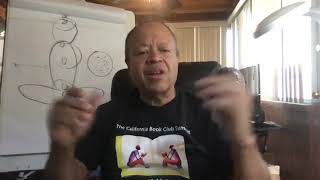
A short recorded talk by Steven Barnes explaining meditation as training attention and recommending both still (heartbeat) and movement-based practices (walking, Tai Chi) to build focus and emotional regulation. He describes a simple morning ritual—diaphragmatic breathing, heartbeat awareness, then brief visualization—to center energy for the day and improve capacity for flow. The talk closes with an invitation to ask questions and a plug for his book Chop Wood Carry Water.
Chapters
And good afternoon. Welcome back to Life Writing Live. I'm trying very hard to live up to my commitment to doing these more regularly and aiming at about noon, going to try to cluster them around noon. Once again, if you like this subject, what we're going to say today, be sure to share them with your friends because that's the only way that we know what's working for people and what isn't. So I've had several comments about meditation coming back today over the last few days, and I thought that I would address some of the concerns, some of the questions about it. This, this drawing is one that I did about a week ago. It's just a person sitting in a meditative position with their legs crossed. And it details the seven chakras or the three energy centers. Dealing with the three energy centers is a really good way to look at things because it's a lot simpler than trying to keep all seven in your mind. Same time. Let's define what meditation is, shall we? In general, meditation is the focus of the mind on something. You know, it could be on tension. It could be on relaxation. It could be on the breath, it could be on the heartbeat. It could be on a movement. It could be on a point on the wall or a sound, a sensation, a smell. You can. People have used incense. There are many, many different things they can use. But the point is to imagine that your consciousness is a continuum from totally relaxed here to totally hyped here. Okay? Every activity that you have during the day demands that your mind be in a very specific framework. You know, there is the. The level of attention and focus that you need to play with your cat is different from what you need to write a letter, which is different from what you need to help your kid with homework, which is different from what you need to drive on the freeway. Part of the point of life is to be appropriate, to be able to do at a particular moment what is appropriate at that moment. No more, no less. Why waste energy? Why spend more energy than you need to? Why invest less attention that you need to. So we had a principle called idea, instinctive designation of energy and attention. This is part of what you're doing there. It's learning how to be appropriate in the moment for what is next necessary. So that also includes thinking about the things that are important for you to think about at the moment that it's important for you to think about them. So if you got into an argument yesterday and you're still chewing it around in your head today, when you're supposed to be doing something else, like maybe enjoying a movie with your family. That is an inappropriate designation of attention, inappropriate designation of your focus. So meditating is learning how to focus. It's learning how to let go. It's learning how to put your attention where you need it to go. And that's so important for your emotions, too. Your emotions, the emotions that you experience over the course of the day are going to be the result of how you focus your attention and on what you focus your attention, the language that you use with yourself and the way you use your body. So if your emotions are the fuel that power your actions, and your actions are the vehicle that take you to your results, then I can't see any downside to refining over time your quality of attention, your quality of focus, your ability to let go when you need to let go, and you need to put your attention where you needed to go, where you needed to go. There. Now, there are people, there was a question today about somebody with ADD or ADHD who cannot focus, cannot sit and focus on something. I totally get it. And so for a person like that, they might want to focus on their breathing while they are walking. They might want to focus on. They might want to learn Tai chi so that every movement that you're making is being focused on every half inch of that movement. You're tracking every half inch of that movement. You're thinking about multiple things at the same time so that you, in order to go into flow state, you have to focus on what's happening right here, right now in your body, as opposed to what happened yesterday, what happened tomorrow, what's happening outside, what's happening. You know, all those things are important, but the more important they are, the more important the tasks in your life are, the more critical it is that you be able to use every bit of your energy for what you need it to be, rather than allowing time or other people to steal that energy away from you or your lack of attention. I think that the average person has more than enough energy to accomplish all the things that they're trying to accomplish in their lives, but they waste it on huge numbers of different things. I mean, just to ask you, you know, a very simple, possibly embarrassing question. How much more would you be able to accomplish in your life if you didn't waste so much time on social media, for instance? So learning how to set your attention is something that is worth focusing on, worth practicing, separate from the context in which attention is needed. So meditation comes in there. So let's talk about a couple different basic Forms of meditation and why to use them. There are a lot of meditations that have to do with focusing on shapes, colors, things of this nature. That's very mental. It's up here in your head, okay? And they're very popular, and they work. And if they work for you, that's fantastic. My personal favorite for years, decades has been on the heartbeat, heartbeat meditation. Sitting quietly, taking your pulse, perhaps at your wrist or at your throat, and just listening to, feeling your heartbeat. And we're talking about doing this for 10 to 20 minutes. The first 10, 12 minutes is probably going to be nothing more than junk, garbage, just stuff running around in your head, just all sorts of noises and voices. And the thing is that that's not failure, it's actually success because you're noticing that that stuff is there. And you don't try to fixate on it. You don't try to stop it, you don't try to fight against it. In general, you let it go. But you. You become more and more aware that you are observing the process rather than being controlled by it. And as you begin to observe it one day at a time, you will start noticing gaps between the voices, between the thoughts, between the images. And what you want to do is to relax and allow those gaps to expand. And you will start recognizing that there are quiet spaces in between the sounds or the pictures, the images, the memories. And as you relax and center more and more, those spaces will expand. And you will find that if you are doing. If you. If you're doing this to, let's say, increase your ability to go into flow state for writing or art, things like that, that as those gaps expand and the moments in which you're being, being taken off to this thought or this sound, this memory, your capacity to slide into flow state and perform at a higher and higher level increases. It's really a beautiful thing to see that the deepest and most intelligent parts of you are not the parts of you that are noticing things, thinking about things, remembering things, that there is a deeper wisdom, and that the first 10 to 12 minutes of any meditation are probably just going to be shaking loose the garbage. So don't take that personally. Don't think that means that you're failing about anything. It's just part of the process. It's actually part of what you're doing is trying to understand what's happening in my mind. There are forms of meditation that are contemplative, asking questions, who am I? What is true? And those are great. But if you don't anchor them in Your emotions first, you're just playing head games, more to the point. And the most valuable thing I think you can do, unless you have a meditation practice, is meditate in motion, do something that is moving. It could be as little as following your breathing. Following your breathing works great, there's no question about that, but so does Tai Chi. So martial arts done with the intent to connect with your movement, the intent to think about what you're doing. And you can do that by just returning to the breathing over and over again. You could do an entire class and your only intent is to keep your breathing smooth. If you were to do that, then your conscious attention is on keeping your breathing smooth and your unconscious mind is absorbing the information it really in what's called second attention. That works really, really great. It's fantastic. But you can also do it walking in your garden or walking down the street, just literally focusing on every inch of your foot, making contact with the ground, focusing on the breathing. You drop down to the basics. You drop down to the more physical, animal part of what you are. And you allow yourself to feel that for once again. 10, 12, 15 minutes. If you do this often enough, and let's say your total meditation time is 20 minutes, it's the last five minutes that are the sheer gold. You fight your way in by maintaining focus and maintaining discipline, then you will find quite often that you're in kind of a different space. It's almost as if you filled a glass container with rocks and then you pour water into the rocks. What you have to do is to get your ego small enough that it's smaller than the rocks and you can just slide between them in the water. There is pure water in there. You know, even if you put sand in there, gravel in there, there's pure water in the same way that there's pure space in your life in between all of the problems, in between the impressions, in between the emotional turmoils that you experience that we all experience in life. The trick is to become relaxed enough, centered enough that you're not being caught up in the impressions. That's, you know, the most important thing I could say right now is that if you will begin the process of meditating every day. You know, for me, I do it. I sit up in the morning and sit cross legged, not, not in a lotus position because my body isn't warmed up enough, and my tendons and knees and so forth, my will protest if I try to put myself in a lotus position. And then I breathe so I'm connecting first with the belly Brain. Okay? Then after I'm inhaling through my nose, using diaphragmatic breathing, visualizing, pulling it all the way down to the base of my spine. After a few minutes of that, and I can feel myself starting to wake up, feel myself starting to center, I will then start feeling my heartbeat. Okay, So I will do that second. So first is the body, then the heartbeat. After I'm connected with my heartbeat, I might connect. I might connect my heartbeat and my breathing. So it's almost like I'm seeing a little tube, and I can make a tube out of my entire body. And I will look at, like, glitter that's swirling around in there. That's just a metaphor. Visual metaphor. Visual analogy for the confusion for all the different things that are going on inside us. As I get more and more quiet, that glitter can begin to settle. Now, the truth is that if you will just do this, if you will just get in touch with your survival, drive, your physical, and then open up your emotions, that you've got it. You've got your reason. You know, the reason to, you know, the thing that you want is to experience life with joy. Okay? The. The reason to do that is that if you are experiencing your life with joy, you can share that with, you know, your family, your friends, your community. You've got power because you've got your physical. Your survival drive is your feeling of your right to be here, your right to endure, to breathe, to move through life unmolested. Your capacity to defend yourself, your heart. As your heart begins to open, then that expands so that you want that for other people. The last thing is to open your head is to ask yourself, you know, who am I? What is true? What do I need to do today? First, make contact with that survival stuff. Then open your heart. Then you might imagine, you know, a picture of what it is that you need to accomplish today to stay on track for this week, this month, this year. If you do this right, all of this can take as little as five minutes, where you start with breathing, then you move to your heartbeat, and then you move to visualizing what it is that you want to accomplish today. Or you can do more of a pure meditation, where you're simply breathing or simply following your heartbeat. It all depends on what it is that you need to move to the next level of your life. You're the one who's going to have to decide what you need and then find the resources to be able to help you get there. All right, so this is conversation about. About meditation. If you have questions about this or other things that have to do with how to live your life with joy and peace and contentment and harmony, please let me know. I will try to address them as rapidly as I can. Other than that, once again, if you've enjoyed this, please share it with your friends. If you have questions, send them to me. I'll try to answer them and see these thoughts apply to writing. Let's say you can find out more about that in the My book Chop Wood Carry Water. It's my book on writing. It's available at www.chopwoodwriting.com. you take care, guys. Bye bye.







