NK Jemisin
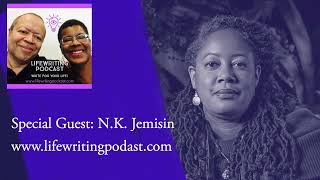
N.K. Jemisin talks with Tananarive Due and Steven Barnes about writing through grief and burnout, moving from novels to screenwriting, and staying creative during the pandemic. She won three consecutive Hugo Awards and a 2020 MacArthur Fellowship, and shares what actually helps: gardening, gaming, and stepping away from social media.
Questions this video answers
February 6, 2022.
First author in the genre's history to win three consecutive Best Novel Hugo Awards (for the Broken Earth trilogy).
2020 MacArthur Fellowship (MacArthur 'genius' grant).
nkjemisin.com (also 'nkjemisin' on Twitter).
LifeWritingPremium.com and LifeWritingWeekly.com.
Chapters
Welcome to the Life Writing podcast, where married authors and screenwriters Stephen Barnes and.
Tananarive Du talk about writing during stressful times, breaking into Hollywood, and balancing life.
Every week, we'll share major tips on how to build a better life while you create your dream projects, even if.
It'S only one sentence a day. Life writing is the application of tools of writing to life and the tools.
Of life to your writing. Hey, so episode number is this number five.
Now it's number five.
Holy cow. This thing just keeps lurching along. We have an amazing guest today that we'll get to in just a few minutes. NK Jemisin. So excited.
It's gonna be a great conversation. I can already tell, so be sure to hang on.
Yeah, so. But we just wanted to catch up, as we always do, on some things that have been happening in our lives.
Yeah, we may need to be artfully vague about a few of them, but we also wanna be really honest about what's going on. So pardon us if we're not always extremely clear about what a project is. There are politics involved.
So we've been working on a pilot for a major streamer that is an adaptation of one of my novels. Already made a lot of changes to the novel in our initial treatment, so it's a new territory. In some ways, the series picks up where the novel ended more so than being based on the events so much in the novel. So it's a reimagining already. And after turning in a couple drafts, the execs are still not sort of seeing where the series is going. They're not quite getting it. And we've been asked to go back and tackle another revision, which, you know, it's challenging. It's probably the most challenging part of screenwriting for me. So, you know, sort of walking into this thing with some, in all honesty, dread, because it's not so much that I haven't learned not to fall in love with every precious word as a prose writer. Transition into screenwriting. Hollywood will beat you out of that pretty quickly. But literally just sort of feeling like I didn't quite know what they want. And this idea of turning in a new draft, that will shock and awe them. Obviously it would have to go beyond, like, they'll say, trim out this, cut it down to this many pages, move this event up to the fourth act. But those were the kind of half measures that we did in the last revision, and. And it didn't work. So when Steve and I went into our story meeting Friday to talk about the treatment and we're going back to treatment with this pilot, too. It's not just looking at the old draft and moving things around. We are starting as if it's new. And Steve had the most amazing idea.
Well, the idea that I had comes from the realization that, okay, if I start with the assumption that the executives are just as smart as I am, but they're coming at the question from a very different direction. In other words, they're coming down from the money people, whereas I'm coming up from the dream. And what we're trying to do is kind of shake hands. They understand. They go to workshops by Robert McKee and John Truby and things like this to be able to understand story enough to be able to have conversations with us. But they don't understand story the way we understand it. They understand it from the outside in. We understand it hopefully from the inside out. So what they're really saying is when they give an idea, they're not really saying, do the idea. I said, they're saying, do something that serves the same purpose that that idea would have and. Or that I would have come up with if I had had your life experience and was spending as much time thinking about this. What they want is to be surprised. What they want is to be put into the dreamer space. In other words, to absorb your story and to go into a story trance. And it's like, oh, my God, I have to turn the page and find out what happens next. That's what they want. They don't want the thing that they asked you for. What they want is to be astounded and delighted in some way that they did not expect. That also covers the thing that they said. They haven't had the time to do that. So my thought was, what is it we can do in the first few pages that will have them have that, oh, my God, we're not in Kansas anymore? Toto reaction so that they are now in the story space. Rather than seeing something they've seen five times before in different stages, they're seeing that story told to a beat that they did not expect.
And without being too specific about it, we're basically taking an event that was going to happen in the last act or happened in the last act of the previous version, and moving it up to the end of the first act, which opens up all kinds of blue skies and green fields for us to reimagine this story, establish what the series is. That was the question at the end of this episode. How do I know what the series is? Well, we'll just start. We're going to start our series already in progress. Much less character development, but I think we can pull it off. We learned when we made our short film Danger Work with Frankie Faison and Saoirse Scott, that you don't need two, three scenes of development with the characters to grow to love them. I mean, we were just watching World War Z. They did it in 10 minutes.
So it's not that we have less character development, it's that we have less time for character development. Yes, less time, but in that sense, character development, like any other quality to work for it would be a cubic meter rather than, you know, so it's. It's like. So we have to go deeper, that the interactions, the words, the images that we choose have to be chosen more carefully because it's not going to have as many screen minutes in terms of duration. One of the real breakthroughs was the. And I have to be cagey about this, was the realization that because of something that has happened culturally, we have a shorthand for something that was extraordinarily complicated, the story. That because of something that has happened culturally, we can make references to something that used to be, you know, like, people roll their eyes, what are you talking about? And now it's more part of a common conversation. So it's. It's like, how. What is the language that we're going to use that the purpose of an image or a word is to trigger an emotion? You're trying to trigger a cascade of emotions. And if you have a concept that is so complicated that people have to stop and do a Scooby take, you've popped them out of the story. Suddenly they don't understand what's going on here. And as soon as they're thinking, what. Instead of feeling, you've lost them. That is the moment which the executive is reaching for the hook. So remember, these people are smart. They want to succeed. They want you to succeed if your success helps them succeed. So it's how can we do this? How can we use this person as an ally as opposed to an adversary? What do we need to do?
I consider it like a Rubik's Cube, really, for me, trying to figure out Hollywood, there's the how do you write a script part? There's how do you pitch that script part, and then how do you work within this community? Which is what it is, this whole village of people who have opinions, executives and producers and, you know, whomever else you're working with, to also hang on to that creative spark that gave birth to the project in the first place without just getting cynical or throwing it away or just doing as you're told, because that's never going to produce anything great. It has to come from within, not from without. But how do you do that? That's what we're figuring out. But I'm really excited, honey. I think we're going to start working laying that to paper today, and I'm really excited about it. Shall we introduce our amazing guest?
I think we should do that.
Yeah.
And this guest has probably won an award since this particular bio was written, but at the time of the writing of this bio, I don't think so. NK Jemisin is the first author in the genre's history to win three consecutive best novel Hugo awards for her Broken Earth trilogy. Her work has won the Nebula and Locus awards. She's a 2020 MacArthur genius grant fellow. Just like the late, great Octavia E. Butler was.
That's Octavia's house behind me.
Oh, I was trying to figure out what that was.
Absolutely. That's Octavia Butler's house. It was on West Boulevard near Washington, and that's where she lived for years. We lived within walking distance of each other, so we would get together for dinner and lunch and talks frequently.
And of course, it's fitting that that house is behind Steve because she was very close to Octavia and you, you know, appearing in the. In the genre and. Well, Our guest is N.K. jemisin, people. Nora, as her friends know her. I hope it's okay if we call you that.
Of course, of course.
Thank you so, so, so much for coming on the Life Writing podcast, and.
Thank you for inviting me. Wow.
You're our first novelist guest, so that's exciting. Yeah. We started with comedians.
Wow.
Okay.
I feel we started with Roy.
We started with comedians.
I don't know why. Ron Wood Jr. And then Patton Oswald and now you. It's the creative life, you know.
Well, I'm not very funny, so I.
Hope I'm not a comedian. Well, speaking of not very funny, we don't go funny. We can veer in the other direction. Let's talk a little bit. Just about as an artist or as a human being trying to work and thrive during a time of plague, Especially now, where we tend to be in sort of alternate universes as a country where some people are still in plague and other people are carrying on as if we're not in a plague. And I'm just wondering how it's affected you, your work, your mindset. Yeah.
I mean, I'VE been like a lot of writers struggling for the last couple of years. My last published book, the City We Became, came out at the beginning of the pandemic, like literally March 2020. And immediately like a bunch of reviewers kind of hopped on it to say, oh, this is a great pandemic book. It's talking about a figurative plague. Obviously I was not anticipating COVID 19. I was talking about, in the story, I talk about gentrification as a of symbolized plague. And that just happened to resonate with a lot of people, I guess, at that time. And so the, the catch, of course now is that now that I'm writing the second half of that duology is what it's going to be. Do I acknowledge Covid? Because it's my, my first set of novels set in the real world. And it was meant to be as realistic to New York as possible. Aside from the fact that I destroyed the Williamsburg Bridge with a tentacle of Cthulhu anyway, but that apart, it was meant to be kind of a realistic engagement with New York as it was. But New York has transformed, like completely in two years. It is a different city from the one I started writing about. And so I've had to kind of pivot to try and like, do I incorporate Covid and be dated at the moment that the book gets published? Because, you know, things that I write at this point might not still be there a year from now or two years from now when the book actually comes out and yada yada, yada, um, so. And honestly, just writing, the act of writing has been infinitely more difficult, particularly with this book that is set in the real world. I intended this series to be my light hearted palette cleanser after the Broken Earth because I needed that, because my mother passed away while I was working on that series. Because I was just dealing with a lot of dark stuff at that point, I wanted to write something brighter. And then the world turned real dark. And you know, like every artist, I try to write what's in my heart. What's in my heart right now is not lighthearted fun. And so I've had to continue working on the series that is supposed to be lighthearted fun when I'm just spiritually not there. So, you know, I mean, it's been a struggle. I've never had that much difficulty with writing any book as I have with this latest book. It's probably taken me a year longer than it normally would have. I've found myself just not wanting to write it, period. But of course I've Got to get it done.
I'm sorry. I'm just wondering if not wanting to write on this book also translates to not wanting to write, period.
No, the weird thing is that I've been writing fan fiction out the wazoo. You know, I don't talk about my fanfic. I don't. I don't want anybody to know where it is because it's just for me and friends. But I'm still writing. It's just that, like, what I'm writing outside of the commercial space is what my heart needs me to write, and I've been letting myself do it. Lest I fall out of love with writing itself. I need the writing to express my soul somewhere. And if I can't do it in my commercial fiction, then I need to do it somewhere else. So I'm still writing like crazy. Like, I've done two or three novels worth of fanfic since the start of the pandemic. I just also have to do a novel. Novel. So it's been. It's been a little awkward in that sense. But what I found is that doing this writing against my heart, I guess, is draining.
It's a question. So let's interrogate something. You seem to be operating with the belief that you need to write against your heart. In order to what, be commercial?
No, in order to write lighthearted. So, okay. Yeah.
So.
So you don't you. One of the things about comedy is the best comedies do have a foundation in a darkness, in a pain, that laughter, the gift that we have that allows us to contextualize pain. So to a degree, what your readers want to do is to identify with your struggles and then see you come out the other side. That if you determine that you're gonna let the dark portions of this book be as dark as they need to be, especially in your first draft, and then see whether or not if you express that darkness honestly, you can get to a point where you have perspective on it. It's not inside you anymore. It's on the page now. When you think about this, because you could write a comedy in the midst of the Russian Revolution, or there is somebody with cancer. There is no situation that is so bad that people have not found laughter, love, and hope in the midst of it. And I think that that's what people come to artists for, to a degree, is to speak their truth. They don't want your cleverness. They want your truth expressed through your cleverness. You know, so you have a unique perspective, and the voice that is genuinely you is, I think, why you're successful because there isn't another voice like you. There's no one who's ever been like you. You know, we're all unique in that sense. So I think that the thing. This could be the best book you've ever written because you're determined to take for it to be light, you're determined for it to be fun, but you're dealing with the darkness. And what all of us want is to move through our darkness into the light. So it could be that you're simply looking directly at the gift that you have to give to the world rather than an obstruction. It's just. It's just a perspective.
Go on you go.
No, no, no, no.
Well, I just wanted to acknowledge your grief and the loss of your mother. I lost my mother in 2012. It seems a lot fresher than that. And the novel that I finished writing during COVID the Reformatory, which hopefully will come out in the fall, was my difficult project. Probably took me seven years to write it. So that'll make you hopefully feel a little bit better about wherever you are. But I just wanted to stop and acknowledge that because it is a. It's a tough. It's a tough, tough, tough loss. And I'm very happy that you have found a creative, spiritual home in that fan fiction to sustain you.
Yeah. Yeah. Well, mom passed in 2017, and I did. I did go right into writing the City we Became, which probably was a mistake, but I was of the get back on the horse school of thought, which was not wise. I did finish the book, and I did channel more. More of that sort of dark feeling into it than I probably initially intended to. And then I fixed a lot of it in revision. The problem is I had just done that with the broken earth. I had just let all my dark flag fly with. With the broken earth. I just didn't want to do it in this case. And, you know, so we will. We will see what the end result is, and we will see what readers think of the end result. But, you know, I've got other projects brewing in my head, and those are probably going to be a little closer to where my heart actually is right now. The problem is that when you decide that you're going to write about the real world, you are then constrained by what happens within the real world. And our society has changed so rapidly in the last few years. Like. Like I said, New York's not the same New York. So, you know, it's just kind of difficult to wrap around that.
I would think that that's once again, serious fodder for writing because your readers are also dealing with future shock. Basically, the world is always changing, but right now, it's changing so rapidly that we can see it. And that, I think, is driving one part of the political spectrum nuts. I mean, there literally. There's been too much change too rapidly. And I think, once again, not to beat a dead horse, that that is part of the gifts that artists have. We feel, take the time to think these things through, feel these things through, and then we tell stories. And to the degree that those stories reflect and engage with the real world, we deserve the money that the people who dig ditches and repair the streets don't have the time to go into their feelings, but they're trusting that their artists will make me laugh, make me cry, make me think, let me scream, let me, you know, let me deal with these things to that degree. You know, artists, kind of professional feelers, you know, just not. Not bearing those feelings the way people often have to, just. Just to get through life, just to earn a living. And right now, New York is changing that rapidly. It. It is an opportunity as well as a challenge.
It probably will be more of an opportunity for me in a few years, because the sad and honest truth is that the change is happening so rapidly, and in the moment that it's. I'm still processing.
Got it.
So, you know, the difficulty of trying to, you know, articulate and focus what I'm feeling at a time when I'm feeling 10,000 different things means that my fiction is now feeling 10,000 different things. And, you know, what I really am kind of also kind of groping with is that I suspect I am dealing with some burnout. And since we're talking about, like, writing issues, you know, I'm gonna be real honest here, is that, like, I don't feel the joy in my commercially oriented writing that I used to. And some of that is just simply I've been doing too much of it lately. I haven't taken enough of a break. I did take a break after I did the City We Became. Took a year off before I decided to do the second book in the duology. But I feel like it wasn't quite enough because I spent that year in increasing stages of anger as I looked at everything happening to my society, to the world. You know, as I dealt with the aftermath of my mother's death. Of course, you know, anybody that's had a parent die knows just how much work that is. So, you know, it's been a lot it's been a lot, and I think I probably just need some time to kind of chew on all of it.
Is time the best healer for you?
Generally, yeah, if I have enough space to, like, time works for me. If I don't do anything, my problem is that I'm, you know, a little bit of a workaholic, so I can't stand not being busy. And, you know, when I give myself something like a year off to work on something, immediately my brain goes to, well, I need to do something in this time. I need to try something new. I need to travel, whatever. And, you know. But with COVID I haven't been traveling either, so one of my outlets is gone.
Ruins everything. I follow you on Twitter too, Nora, So I know that one of your coping mechanisms from time to time. Well, social media is both a coping mechanism because it represents connection. It gives us an opportunity to share information, but at the same time, we're bombarded with just so much negativity that I know that from time to time, you just step away.
Oh, yeah, yeah. I mean, I started doing that at the beginning of Trump's presidency because I realized this is a man who thrives on making people crazy, and I wasn't gonna let him do that to me, Right. So I started. And I realized also that I probably had a social media addiction. You know, I always thought of myself as someone who just used social media, like, just to talk with friends, you know, that kind of thing. But I started realizing that, like, I would click on Twitter when I was working on something else, just habitually, like, it wasn't even. I wasn't thinking. It was just like, you know, dah, dah, dah, dah, dah, dah, dah. Write a paragraph, do this other thing. Pet the cat, open Twitter. And I had to, like, kind of stop, like, because, you know, there's a whole dopamine cycle. There's addiction associated with this. So I started weaning myself off down to, like, an hour a day by, like, 2018 or 19. And now I'm doing, like, roughly an hour a week. So I pop on mostly if I've got, like, an announcement to make, like, I'm gonna be talking with Tananarive and Steven Burns in a few minutes. And, you know, on this great new podcast that they're doing, I'll give you details when I know more. And then while I was at it, I tweeted a bunch of stuff about, like, political headlines, and now I'm done. I've had enough Twitter for the day. I don't want to see any more Twitter.
So that's impressive. And by the way, if that, if what you described is an addiction, then we need a support group because that cycle of writing a paragraph and then clicking onto social media, especially when I'm on deadline, if that happens more than twice, I shut down my Twitter tab, but I have not taken it to the lengths you have. Like confining yourself to an hour a week, that is so super impressive.
It's not even a confinement. I feel better since I stopped getting on Twitter frequently because, you know, like, you can't look at headlines 24 7. You cannot process the 24 hour news cycle and stay sane.
You know, there are, you know, there's so many different ways to deal with stress. You know, stress is not the problem. Strain is the problem. Stress is, you know, pressure per unit area and strain is deformation per unit length. This is what hurts us.
He's crumpling up a piece of paper. Who are listening on audio.
It is when we take so much stress that our bodies, minds and spirits cannot healthily adapt to them. So if you feel like you're in an addictive cycle with, I've got to find out what's going on. I got to find out what's going on. Just kind of in a low level emergency state, you might take a look at the, the things that do help you and they're going to be in one of three arenas. It's going to be something you do with your body, something you do with your attention, or something you do with your language, the words that you use, what you focus on and the way you move your body. If you've ever liked dance or yoga or tai chi or anything and found that that helped you center yourself, then I would strongly suggest that at least once every three hours, you just set a timer and do that for 60 seconds. Put on a song that you like and dance that that's part of your ritual. You find something that brings you peace and you deliberately do it. And if, if you have, if it's a real problem, you do it once every hour for five minutes. You know, just, just to. This is, this is the time. It's you time. You know, you're going to connect with. You make a list of the things that you love, smelling flowers, looking at sunsets, looking at pictures of kittens. And deliberately do these things every few hours or every hour. You know, find something that works for you so that, that stress is healthfully adapted and you become stronger. Instead of it breaking you down, it'll break you.
I have found that I need to like do club tonight. Reeve in my bedroom every night with my lights going and dance to the music I grew up with dancing to in my, my late 20s, early 30s, out all night. It really not only takes me back to an earlier time, but it connects me with my body and music because I spend too much time, I think sometimes watching tv and I love, love, love music. So I'm trying to appreciate that in every moment. So hopefully you have that. I feel like you might garden or cook because there's so much gardening.
I've always done that. Yeah, I got a garden level condo unit a few years ago specifically because I fell in love with its garden. Like the rest of the unit is basically a shotgun house. But it's fine. It's great. But the garden was the thing that I wanted. And so I literally just today got some seeds from free heirloom seeds. And I was so excited that I have this heirloom variety of stuff, sunflowers that I'm going to be planting this year. Gardening is my thing.
So how about planting one seed every three hours?
I can't do it right now because there's a big pile of snow in my garden.
Or get yourself a little bonsai plant, a small plant that you could spend a little time loving every couple of hours. It's taking that back deliberately. It's deliberately breaking whatever the stress cycle is by putting your attention into something that you love, which will slow your breathing, bring you some joy and just get to the point and you do that thing until you notice that you stop thinking about the other thing, you stop reacting to the other thing and you just understand that you have the right to be happy, joyful, peaceful in life. You have that difficult. You have to grab that time. Life won't give it to you. You know, separate yourself into the little girl that creates and the mother who protects the little girl. She's been dancing as hard as she can.
Yeah. Yeah. Well, I mean, what I found is that indulging all of my favorite little pastimes that I've always thought of as, you know, a minor thing that, you know, I don't necessarily need to do. No, I do need to do it. I play video games. I am a 49 year old woman who plays video games. I love doing it.
What's your favorite video game?
Oh, God, there's so many right now. I've been really enjoying this super weird little indie game called the Eternal Cylinder where you play basically. Q. Bert, you play this little Creature with a little elephant trunk. And you're on a completely alien world and you are running from a giant evil rolling pin from space. I can't describe it anymore.
Sounds wonderful.
Yeah.
You can play that for five minutes.
We do VR.
I play for a few hours.
But here's the point that if you have one hour for meditation or stress reduction, you'll actually get more results by dividing it up into smaller chunks than if you do it all at one time. There are some very specific science behind that. It has to do with synaptic facilitation and some other things. But if so, if you have that hour, and so if you. It's five minutes on there, and that's the reward, you know, for. For spending two hours typing is you get to spend five minutes, ten minutes playing a video game. Just find something that breaks up your day. Because all. All successful people are. Are obsessive. We cannot get where we're going unless we become obsessive. And that obsession can hurt us. So become obsessive about being healthy and balanced and happy.
You know, I actually did something like that when I was working on the Broken Earth last few books because I was struggling then to try and get through my deadlines and things like that. But if I had a word count per day where I was trying to get up to 1500 every day, and then of course, when I'm in, like, crunch mode, I push that up to 3,000. But I rewarded myself every 500 words by going to play a round of whatever game I was into it.
Yes. Yeah, exactly.
That made the day pass a lot more easily, and it did take away a lot of the fantastic that I was feeling from like, oh, God, I've got to get to 1500. There's like 9000 more words left to go. But yeah, it definitely does help.
Instead of that is several more rounds of your game to go completely.
You are the instrument that does. You are the tool. You're the axe that you're using to chop down the world. And if you don't sharpen yourself and renew yourself, that axe gets duller and duller and you end up chopping more and more and getting less and less done. So it's simply time to sharpen your axe some. Relax, love yourself. You've worked so long and hard to get to where you are and to get the acknowledgement that you've gotten in. Like I said to you before, one other thing, I am so proud of you. You are exactly what I was hoping would come up and others like you that it is no illusion that you went through stress. It is no illusion that people have both responded to you and jumped on you, trying to hurt you and stop you and knock you down. You really are that person. You really are that. And you need to renew and protect yourself.
If I may, I think this might be a good time to sort of take you back to the beginning, Nora, because as I mentioned, this podcast is airing at the start of Black History Month, which made me think of your great short story collection in the title, How Long till Black Future Month. How about that? But also that essay you wrote about sort of inserting yourself in the fiction and making the decision to write even when you didn't feel that there was a market waiting for you, but just pure self expression. If you could go back and tell your younger writer self one thing, what would it be?
That you will not be alone. Because the great fear that I had when I. When I first started writing science fiction, that was probably like the 90s. I had been writing since childhood, but like, I first started seriously trying to get published in like the mid to late 90s. And at that time there were constantly mentioned in science fiction, the four black authors, never including Tananarive. I don't know why. I don't know. Like, they did. They just left you out.
I was just starting.
I knew who you were.
Okay.
Acted like they didn't. So anyway, giant fan of the Living Blood and all of that, like, how do they not know? Anyway, thank you, but. So science fiction Dom tended to just mention four names over and over again. Hopkins and Butler, Delany and Barnes. Hopkins, Butler, Delaney and Barnes. Say it four times fast and it makes it seem like there's a lot more than just four. I guess that was the idea. And so when I first started out, of course, my thought was, I don't think I have a snowball's chance in the world if they're only allowing this small number. Because I knew full well, like most people in my generation, we knew that there were plenty of black fans of science fiction.
Let me tell you something, sweetheart. There is. There was an attitude among editors that black people did not like science fiction. I actually had one female editor argue with me about it. You know, she knew. No, no, no. Black people are not interested in science fiction. The fact that there was, you know, I said you could go walk in any science fiction bookstore, look at the covers, and it's 99.9% white people and their imaginary friends. That's all that you see on there. And you think that that Kind of exclusion does not have an effect that the gatekeepers, the very people who don't notice the exclusion, are the ones who are supposed to be looking for inclusion. It was a long game and you were right to be worried, because if you had not been worried, you might not have developed the armor that protected you while you worked your way through the flak to a position where you found people who looked at you and said, oh my God, this is what we've been looking for.
Yeah, well, I mean, I've talked about it in that essay and so forth, but of course at first I ran into people who said the same thing to me. You know, literally as I'm a black person who was a giant nerd standing there with my entire history of science fiction behind me in a book presented to them as, please take my book. They were like, well, black people don't do that. I'm like, I'm doing it right in front of you. And they're like, you know, but black people don't do that. I knew a bunch of black nerds, we all knew that there was a disjunct between what the industry was accepting and what actually existed. It took Race Fail to even make it clear to me, because even in my case until the like early to mid 2000s, I still thought, well, we exist. I don't know what our numbers are. Race Fail illuminated the numbers and made it clear that it was right, that there were just massive numbers of us all. Children of Octavia, children of Nichelle Nichols, children of, you know, all these folks who came before and showed us that it could be done. For every one of those four names that they mentioned, thousands got inspiration and decided to follow in you guys footsteps. So, you know, that that was the thing that I needed when I was younger, was knowing that there were even just a few, few. For a long time, there was only one. I hadn't heard of Delaney for years and years. I heard of Butler. That was it. That was all I ever heard.
Chip and I found her by accident in the field. You know, Chip left the field for all practical purposes into queer fiction and academia because the field did not reward him. He did that, did not acknowledge his genius. Octavia was as poor as a church mouse until her MacArthur genius script. You know, and she. It's, you know, one step at a time, one step at a time. You know, it's. There are people who are going to stand on your shoulders, who are going to be astounding because you had the courage and the strength to take the bullshit and keep going.
I can't wait to see them in any amount of flack I can take that will make it easier for them. I am content to do that.
Absolutely.
And I can't wait to see Strong. Be strong, you're stronger. These people are. Are resisting because they are afraid to watch the world change. You know, it's. You know, be strong, be merciful and kind to degree, but do not let them. Do not let them change your. Your commitment to your art and your protection of your heart ever, ever, ever.
Yeah.
And I think, oh, no, you go, please.
No, I was just gonna say. And that's one of the things that I've. That I've had to kind of try and work on with myself is, you know, I've been angry for the last few years. I used to be hopeful. And, you know, without that general hopeful feeling, then, you know, the anger is on the brink of taking over. And I've had to step back for that reason. Like, I'm starting to do a lot more planful. Like, I just went on a retreat to the Highlights Foundation. You know, the people who make the children's magazines. Yeah, they. They have a not compound that makes it sound like some kind of creepy militia thing, but they have a facility out in rural Pennsylvania. And yes, I know rural Pennsylvania. Not the best place to be a black person. But anyway, it's a. It's a wild little thing where it's like this gorgeous campus in the middle of the woods. There's trails to hike along. You get a little cabin to yourself where there's no nothing to do but write. There's no tv. There's like crappy WI fi. You got rabbits to look at and dare and write. That's it. I mean, it was wonderful. And the fact that its individual cabins made it relatively safe. During COVID I and some friends who had been extremely careful drove down to this place. We had to drive with the windows open to kind of make sure we got the right air circulation and yada, yada, yada. But we drove down, we did our meals, takeout. They provide meals for you? They do. They have a personal chef there who cooks for the retreat people. So that was great. And it was one of the things that I kind of needed to remind myself that I am still into this, that I still genuinely enjoy it. I ended up breaking new ground on a new short story. I ended up kind of chewing on proto ideas for proto novels, Things that I have not done in years. I have not taken the time and the space to just kind of listen to my inner artist for years. So I need to do more of that.
I'm so glad you mentioned short stories, because that's a good segue. Yeah, it is. Right? Because I know you don't write them often and obviously you're on deadline for a novel and a lot of people know you, not just for novels, but for novel series which are so big in scope. But you started writing and publishing short stories and that's what we teach our life writing students. I taught in an MFA program at Antioch University for more than 10 years. And so often I would have learning writers come to me who are in the middle of planning or writing their second in a series when they haven't mastered scene composition or breath. Right.
Yeah. I look at it as A novel is like running a marathon. If you've never run around the block, you have no idea what you're in for. None. Zero. So people who do the, you know, short story writing is a completely different thing than novel writing. Well, as far as fiction writing goes. But if you step back from it and just say, well, just writing, it's close. And if you look at it as just the arts, it's almost indistinguishable. So it's as different or as similar as you choose to look at it. But it's my position that a hundred thousand word novel will teach you x and 100,000 words of short stories will teach you 5x, that you're going to learn one hell of a lot more by writing 100,000 words of short stories than you will by writing a 100,000 word novel. And part of what you're going to learn is the art of completion, the art of actually submitting your work and risking failure. It is the emotional components of the arts are as important as the technical or craft components of the arts. So you're learning about yourself, you're learning about the field, and then you're working on characterization and theme in your forward to your story collection. You talked about that a little bit. Would you tell us what it is that you discovered about the value of writing short stories?
Well, first to clarify, I wrote novels. Up until maybe early 2000s, nothing but novels. I literally was. As a child, I wrote novels. They were terrible, but you know, I wrote them. But so it was not until I went to viable paradise, which is one week, I think it's now two week actually. But it's a. It's a writing workshop in residence and it's similar in style and makeup to the clarions. It's Just one week instead of six. And while I was there, you know, I got encouraged by the instructors to just try writing short stories. I thought of myself as a novelist at that point already. I could not see the value in it. And then I started deliberately trying to write short stories. I spent a year, very planfully, I'm going to do nothing but short stories for one year. So I got subscriptions to FNSF and a couple of other science fiction magazines, started reading Strange Horizons and stuff like that. I joined a writing group, and then I wrote short stories, and I submitted them to the writing group. And when we were done with that, we submitted them to magazines. In fact, that was part of the goal of that writing group. We would get together every couple of weeks and we would talk. Not just about, you know, here's my new story and let's critique it. But I submit it to X, Y and Z this week. I just got these kinds of rejections back. What does that mean? Should I continue? Is it worth it? We were bucking each other up on the process of submitting and getting rejections and so on. So I would 100% agree with you that the. The. I don't know what you call it. Fireproofing that I think particularly marginalized writers need in order to go into this. You must be prepared for.
I hate to say that you have.
To be prepared for harassment, but you do. You have to be prepared for people maligning your intelligence, maligning your talent, maligning your qualifications, yada, yada, yada, all based on something as simple as what you look like. But, you know, going through the process of rejections somehow prepares you for that. Because there is nothing more personal than taking a chunk of your soul, putting it in a short form, presenting that chunk of soul to a complete stranger, and having that stranger go, wow, that's kind of ugly.
Not for me.
Or saying, here's some money, on the other hand. Or giving it to a complete stranger and having them say, here's some money. I would like to bet my mortgage on your talent.
That's a wonderful feeling.
It's a wonderful feeling.
It does take a while.
I gotta deal with the other shit first.
Yes. Yes, you do. You have to kind of keep your eyes on the prize. You want a stranger to give you money.
That's true.
Very few authors sell a story right out of the gate.
That's true.
I would say that the average writer submits, writes, and submits about 30 short stories before they get their first acceptance. Somewhere between 20 and 30 seems to be the average for really successful writers. But sometimes it's over 50, you know, I've seen over 100. Those are the people who. You can't keep them down. Anyone who's willing to write a hundred short stories and have them rejected, that is unstoppable. While we've got you, I'd love for you to discuss just a little bit. How do you conceptualize fiction? Just, you know, what to you are the components of a story. When you start to work on something, what is your problem? There is the process of writing. And specifically, what is story for you?
Huh? Well, that's the. How the heck do I define that? For me, what it all comes down to. I am a character focused writer. There are lots of different kinds of writers out there. People who like ideas, people who like the setting. I am primarily a character focused writer, which is kind of ironic because people kind of seem to love me for my world building, but I think of the world building just as a backdrop to character studies that are far more interesting to me. So, you know, when I start out with an interesting world and an interesting idea, it's still not a story for me. It's not alive. Even if I've got a plot, it's not alive for me until the characters start to live. And I want to know what happens to them. You know, I don't have to like them. In fact, many of my own characters I don't like, but I still want to know what happens to them. And that's the part that matters to me. So once I start caring about this person's story, then it becomes something to me. With short stories, I did have to make a significant adjustment because short stories tend to not be character focused, or at least not primarily. So usually you've got a good idea or a good, you know, setting or something like that. There's a hook, and the hook can be any number of things, but, you know, usually it's not a character hook. So I did have to kind of adjust that part of myself. But that's one of the things that I think was great about it. You know, that year of writing short stories and I actually wrote. I continue to write short stories. I just don't do it frequently. But that year of writing short stories helped me figure out how to put the story in the first paragraph or how to put the core of the story, the hook of the story, the most interesting part of the story.
Can you give me an example?
Oh, gosh. Well, I did a story some years ago called Non zero probabilities and I think it ended up being Hugo nominated. Yeah. Okay, so. And in the story, it's a modern day New York magic story where the laws of probability change slightly and things that are more extreme circumstances happen much more frequently. And the story is all about this protagonist. It is a character focused story. But it starts off with her starting her daily routine of she puts on a little locket with a four leaf clover. She does all these things to amp up her look, she wears her lucky underwear, you know, all of this stuff to sort of amp up her luck. Because just the commute to work has changed so wildly. You know, she can't walk under any ladders anymore, she's hesitant to step on a crack, you know, stuff like that. And so it's literally just the hook was that she prepares for work by doing all these luck enhancing things. That was the core of that story.
Right. And it's non zero probabilities luck. All of that is encapsulated just in that opening paragraph of your story. That's a great example, I think.
Yeah, that's what I. That's what I tried to do. So.
Thank you.
I kind of wonder whether or not with a novel you have more time to explore, kind of ramble around and you're looking for that character, you know, and so you know that if that character will eventually emerge and then you get to ask questions about, well, what sort of world would create that character and how would that character respond to the world. Whereas with a short story you've got to solidify that stuff fast. You gotta solidify it. It sounds to me like you were still character focused. It's just that you don't have as much time to kind of just explore the way you're kind of rambling around in a video game with a little character kind of looking at this, looking at that, you've got to come correct from the get go. So that's great.
I mean, I will say that writing short stories means that now with my novels, I try and include a hook. Like I didn't used to do that. I write my novels like short stories, you know, in the sense that I try and put the most interesting part of it on page one or within the first page or two. I am the kind of person who used to be, back in the days when, when bookstores were everywhere. I'm the kind of person who would go in and would like open a book and read like the first 10 pages before I would decide to buy it. And now I kind of think, well, a lot of people don't even go to 10 pages. Let's read the first three pages. And that's where my hook has to be. Sometimes they get upset if it's not on the first page. Like with the first book of, you know, the. The fifth season was mad that I couldn't destroy the world on page one. I managed to do it by page three. But page one is where I kept trying to make it go. No, I actually had to include some words first.
You said that it's crazy. If you could go back and talk to that younger writer self, the most important thing would be that she was not going to be alone. So that suggests that the emotions have been the most important thing, because that's what you went to more rapidly than a piece of career advice or a piece of writing advice. So I think that your fans and people listening to this need to understand that the emotions you bring to the day to be able to manage your fear, your sense of loneliness. My thing is that anger is a mask over fear. If you can figure out what you're afraid of and eliminate the fear, the anger always dissipates. So getting in touch with yourself, and in your case, it was that fear that you'd have to walk alone if you spoke your truth, the world would separate. It would not love you. You know, you'd have to struggle your whole life.
I mean, and I made the choice anyway.
Yes, you did.
Because at the end of the day, I have always written. I have been a writer since I learned to write. When I was eight years old, I published my first book, made with, like, cardboard and yarn on construction paper, you know, so the urge was always there. It was just a question of whether I was going to share that with the world or not. And, you know, could I could have just kept it to myself, been quietly nerdy and quietly writing all just for me.
Well, I think the world is a better place because you did not.
Thank goodness you.
Thank goodness matters. There is. There is a young writer, perhaps a woman of color, perhaps something else, listening to this right now, who you have given hope to. What message would you give to her or to him? What would you say to them? Because you're not in a world where you have to worry about being alone. But there are still challenges. So what would you say to yourself if you were only 15 today.
Apart from you won't be alone? I will also say it's hard, but it's worth it. I mean, seeing your own words in print, hearing people talking about them, knowing that you have added that tiny little drop to the zeitgeist and possibly help to shape the world in any kind of way, hopefully for the better, is worth it. So keep doing it. Just keep doing it. Butler, as Butler said, persist. Absolutely.
In fact, that's advice we all need to remind ourselves of. Not just when we're 15 year old writers, but as we, you know, as we move into new kinds of writing like Steve and I with the screenwriting and new challenges emerge and new rejection takes on a whole different dimension in some cases when it's like life changing money you're talking about with a project going well or badly. Yeah, yeah. Do it anyway, do it anyway, but find the joy, find the balance.
Yeah. You know, just kind of moving towards the way we always wrap up these shows is the notion that Tananariv and I are trying to leave a trail of breadcrumbs. Just what have we learned and what can we share as much as possible? So she teaches at UCLA and I've taught at UCLA and Seattle University and lectured at the Smithsonian and other things. But I think that there is a core of what we both teach, what we both share about this and, and that joint core is in our program, the Life Writing premium program. Just every week you get another lesson, another, another email, another visit, another, another lecture, video, audio, whatever, for an entire year, you know, and, and I. It's the best thing that we have. It's at LifeWritingPremium.com LifeWritingPremium.com you can check that out. And it's. I believe in the artist. I believe that the artist is valuable. I believe that we can have a dream of contribution and self expression and that you can make enough money to be able to not have to spend your time flipping burgers to support that. I can't promise you to get richer on the bestseller list, but with guests like MK Jemisin, she is showing you who she is that got there. It's a matter of being the best you can be, putting yourself out there and seeing how the world responds to you. T. What? Any thoughts?
You know, one of the things I love most about life writing is looking at the artist as the protagonist of a story. So, so often when writers come up against rejection and yes, they sting. They absolutely do sting. They absolutely prick the part of ourselves that feel like we have no right to to or we don't have the skill to actually be artists. We have to remember if we were writing a story about a character who had a setback, what actually creates the component of a story is what the character does next afterwards?
How do you recover from it?
How do you recover from.
That's what's compelling, right? That's what I want to see. Exactly.
That's what we're all trying to see.
So using that problem solving ability that you'd use in a story to look at the problems in your own life and say, if the meaning of life is to be happy and writing makes me happy and I want to spend as much of my time being happy as possible, I want to spend as much of my time writing as I can, how can I overcome the obstacles that stand between me and that life? The exact same skills you'd use writing a story about a writer are the skills that you can use in your life as a writer. That's all I'm saying.
So good listeners, especially those of you of course who are writers, check out www.lifewritingpremium.com we say that's the sponsor of our podcast because we are a self sponsored podcast. They are the sponsor. And go on and create your own life's journey and write the work of your dreams. Even if it's only a sentence a day. It doesn't have to be five hours a day. Just write in the creases if you have to. N.K. jemisin, thank you so much for joining us.
This was fun.
Yes. I haven't seen you since we were at the Folger Shakespeare Library. I forgot to mention that that was.
Oh my gosh.
We took part in an Afrofuturism event in 2019.
I want to say that was a long time ago.
It was a long ago.
Than that wasn't it feels like forever because.
No, I think it was about 2019. So that was. Feels like 200 years and I know and like to your point, things changing so quickly, we just have to sort of get our bearings in the world as artists too. But thank you so much for sharing your journey with us, for your candor. And I'm sure there are many writers out there listening who realize they are not alone, not just in the field, not just in the genre, but in their struggles.
Where can they find you? Do you have a website, a place that your fans and people can hook up with you?
I'm@nkjemisin.com they can still find me on Twitter, although not as frequent as I used to be. Honestly, that's about it.
Well, you're there at nkjemisin, correct?
Yeah, nkjemisin.com and nkjemisin on Twitter.
Great, thank you very. Do you have any last thing that you'd like to share before we close up?
No, not really.
Okay, great. It's been wonderful.
We talked about it all.
So t, why don't you give us a wrap up?
Thank you. Thank you. Thank you again for joining us on the podcast. Catch up on the previous podcast, if you missed them. Last week, we talked about Jordan Peele's surprise visit to my classroom at UCLA and how we turned that into an episode of the Twilight Zone. We had Patton Oswalt, we had Roy Wood Jr. And we have lots of exciting things coming up. So thank you for listening.
If you'd like to find out more about the podcast, you can put yourself on the mailing list@lifewritingweekly.com and, you know, just, it's always wonderful. And, you know, Tananari, thank you for being in my life and sharing this journey with me, Sweetheart.
Aw.
Thank you, baby. And thank you, N.K. jemisin. Let's all go and have a great writing day.
Take care and be the hero or heroine in the story of your life.
Bye bye.
Bye bye.







