Norwescon 45--Firedance in the hotel!
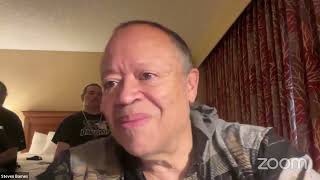
Steven Barnes and Tananarive Due lead a live qigong and Tai Chi session at Norwescon 45, mixing guided chi ball and heartbeat meditation with talk on emotional connection and writing craft. Barnes shares the five-minute miracle practice and offers a discount code (NorWestcon45) for his Tai Chi Fire Dance program.
Questions this video answers
Norwescon 45 live-streamed session recorded April 11, 2023.
Wu style.
NorWestcon45.
Yes — the meeting was live streamed (YouTube).
Chapters
Great. The meeting is being live streamed. Oh, that's so cool. God, I love when technology is working. Right. It actually helps bring the world closer together and I'm gonna record this on this computer. Yes.
Technology is absolutely wonderful when it works.
Yes. I'm happy it's working for us this time. Absolutely, absolutely. And I'm just glad you know that I don't know how many changing the time on this is part of my commit commitment to being with you every week and I'm glad for everybody who can be here and I'm, I'm always grateful. I don't. I think that you know, I might you know start a couple minutes early here because I've got some schedule stuff here so I don't see any reason to waste any time at all. So just you know, kind of. Welcome to the Norwest Con edition of Fire Dance. And you can see I have a couple of guests here. Introduce yourselves guys.
Scott McIntosh, Jim Early.
Yeah. So you know we will be able to. I didn't have a lot of plans for what I wanted to do except I want to rotate between working with the body, working with the emotions, working with the mind. So I think that this week is. Is emotions because the. For lots of different reasons. But before I go a little bit further here I would like to make sure to introduce my good lady wife Tananarive Due who's here is my co host. It.
Oh, who's almost ready. I will be turning on my camera in a moment.
Okay but just just you're there and we will just, just you just keep welcoming people in.
I am doing so.
So let's see. I guess at. I'll just Talk for another 60 seconds and then let me, let me. It's like I've got a couple students here so let me work with them on let's say the Cheet ball exercise. I can, I can work with you live with that. That, that'll be great. You got it. Fantastic. This is why God made more than one of us here by the way. I heard, I heard some people saying some things about you that were so positive. You are so loved and respected, sweetheart.
Okay, there I am.
There you are.
Looking too much light.
Too much at all.
Oh, let me turn this light off. Hello everybody.
Hi there.
Oh, good to see you.
This is, this is great. Families together. More people be coming in. But I'm at the Norwest kind science fiction convention this weekend. It is my favorite convention of the year and I had not been able to attend it for three years and so this is like a homecoming for me. And it's, you know, making sure to support the convention because these are good people putting on a good con. I've always had a lot of fun here and I, I, you know, I've been coming to this convention for 40 years and being here is a little bit like visiting a younger version of myself. Just kind of remembering who was that guy who started going to NorWestcon and with all his hopes and dreams and insecurities and NorWestcon was a welcoming place and I made friends here, you know, and lovers and companions on the path. This is, it's so critical, those emotional connections that we make with the people who can accompany us on the journey of life. You cannot overestimate the importance of the companions you make along the path of life. You cannot. The fastest way to improve your life is to improve the quality of the people you associate with. The fastest way to tear your life apart is to associate with the wrong people. They can lift you up or tear you down. The ability to create bonds with other people is not just a natural skill. It's also something that you can learn. And I believe that the way to learn that is to start by being really comfortable with yourself and knowing that you can take care of yourself or you're willing to defend yourself emotionally and spiritually as well as physically. And then once you have that security, it's possible for you to start dropping your ego barriers and start seeing yourself and others. And it's safe to do that. That you, you know, when I, when I see my, my wife, I see my own soul. I see how we're the same, born into different lives, different families, at slightly different times, different genders. And those deli, those differences are absolutely delicious and wonderful. But it's the feeling that we connect that, that she sees me and then I see her, that is the precious thing. Who does not wish to have someone in the world who you feel really gets you or at least really cares about getting you in? And I have that with her, and I have that with my family, and I have that with my friends, and I have that with my Spanish community, and I have that with my martial arts community. It's just like I've got these different tribes of people and by interacting with them, I can be of benefit to them and also receive from them. So we're going to go into that. So the, the ability to feel connected to yourself. Let's take that question of what is qigong? Qigong is becoming sensitive to your own energy and also sensitive to the Energy of life and the energy of the world. So you start with something that is more gross in terms of less refined, like physical energy, physical heat, for instance. So we talk about the chi ball exercise. So just rub my. Rub my hands together and then shake my fingers out like this. Okay? And then I put my hands close enough together that each palm can feel the heat from the other palm. Okay. It doesn't have to be something esoteric. We can start with just the heat. And what I'm going to do here is I'm going to work with two people right here. So I'm going to ask you guys to stand up. I don't. I'm going to try to frame this properly here. And if it doesn't quite. If we can't quite do it, then t. Would you. Would you put my image up front and center so I can get a clearer view of. Of how. Of. Yes. Okay, Good, good, good, good. So what I would like you guys to do is to bend your knees just a little bit. So I'm here. I'm seeing bending my legs a little bit and here, here. So. And then what I'm going to have you do is I'm just going to correct you. You stay there. You stay there. I will move you. Okay? So tuck your butt under just a little bit. Slight contraction of the lower abdominal muscles. Slight contraction of the anal sphincter head held as if by a string from above. So you're being suspended. And now relax until you can see how far apart you can get your hands and still feel the warmth. Don't take them further than you can still feel the warmth.
Okay, Tuck your butt under a little bit.
Slight contraction with anal sphincter head held as if by a string from above. Relax your shoulders. Relax. Chin parallel to the ground. Okay, good. Now if you want to put. You know, you could. You could bend your legs more if you wanted to put more stress on yourself, or you can come up if you need less stress. So you always work your edge, okay? And your edge will change from day to day. The point here is you are feeling. You're becoming sensitive to your energy. How is my energy today? How am I feeling? I'm. You know, there are times when I'm under a lot of stress in my body. You know, I have to get my hands just like this before. Before I can feel the warmth between them. Other days, I'm very extensive. You know, it's like all the energy is just. Is raging and my. I can get my hands like this and I. Whether I can Feel it or I hallucinate that I can feel it in one way.
Doesn't matter.
I'm not interested in processing that stuff. What matters is do you feel connected to your life energy? So you find it, and then once you feel it, you develop the ability to kind of expand that ball. Expand until you can step into the ball. Now that energy is all around you, and that is the bubble, what one martial arts called your wingspan. That's the space that you're in that you move through life in. So you start by just kind of breathing, listening to your heartbeat. Find your energy. See how you need to relax in order to expand it. Slight smile on your face. That's right. There you go. Tiny little smile. It's the slightest uptick. Slightest uptick. Tuck your butt under a little bit. And good. And now relax. Shake it out.
Good.
Let's give him a hand. So jazz hands.
Yes, hands.
So, okay, guys, so this is a good time for me to talk about getting in contact with your own heart. The heartbeat. Meditation is my go to tool for getting in touch with, with the life force inside you. And what you do there is you get very, very relaxed. And you can start by taking your pulse. So you feel your heartbeat. And what you're trying to do is to, without taking your pulse, relax enough that you can feel the blood pumping in your body. When you relax that much, it's like, it's a little. It's a little bit of the same version of the. Of the QI ball, where you're getting sensitive to your own warmth and stepping inside it, you are. Your body is pulsing every second. To get relaxed enough to feel that pulse puts you every inside the flow of the energy in your life. And from that point, many things are possible. But, but listening to your heartbeat. So what I'd like you guys to do for like about 60 seconds, relax, take. You can take your pulse first at your wrist or at your throat, then take your hands away and see. Can I relax enough that I feel my pulse? So I'm going to do that right now. Yeah, I'd like you to do this with me. I just felt it right at the edge of my jaw or at the edge of my, my cheekbone. Rather.
Good.
Now I'm starting to feel it over more of my body. I'm feeling in my fingertips, cheekbones. Inhale and exhale slowly, smoothly, gently. You have to be gentle with this. If you were to do this as your five minute miracle doing diaphragmatic breathing, and in the process of the diaphragmatic breathing, Feeling your heartbeat, that would be a very powerful and a very good thing. Taking you into your heart, remembering the heartbeat of your mother that you felt in the womb. Getting relaxed enough and centered enough to feel the forces of life moving through your body. There's a very positive, powerful, restful thing. You. As you release tension in your body, it's easier and easier for you to feel that heartbeat. This is definitely a way in, and it's one of the doors into your inner world. So given that. Does anyone have any comments, questions or requests about anything that we have been discussing here? Hands. Any comments, questions, or requests? I'm not seeing any. How about from the guys in the room? Any comments, questions, or requests? What can we talk about today that would be useful to you?
You've been going over all the same things you discuss in your panels, so it's. It's interesting to hear your uniformity of your message. It's very nice to, to be one.
Of the people who.
Oh, yeah, I've heard this before. I know that story. But for me, it's. I just want to learn the form itself.
Okay.
To the best of my ability.
Okay.
Which is difficult to do in a combined space.
It's, you know, it's a little bit difficult to do. So why don't you, you know, ask me a question forum and so we can actually. I can actually tilt this so that people. So that other people are benefited. So what is it that you'd like to know?
It's one of the, One of the more recent transitions and one of the recent moves.
So show me. Tell me what you, what you got.
So we've got.
Huh.
And it's, it's in the last few moves, last recent modules that you've done over here. Is this, Is this.
Okay.
So you've done this then? Is it all the way around?
Well, let me, Let me go through the. The first few minutes. I'm not sure where you are in the form, so let's. Let me kind of go through and you tell me, you tell me what, where, where you are. So. And I'll have to move around just a little bit because of the confined space. So, you know, I beg your pardon on that. So. Exhale. Shift my weight to the right. I've kind of started at a diagonal, which kind of throws things off just a little bit, just for the sake of. The camera talked. Right. Then I lost myself. Open the door, please. Hold the baby. Turn. Seven star. Brush, knee twist. Up. Brush, knee twist. Step, repeat. Step forward. Step back. Play guitar. Step forward again. Reverse punch under punch. Apparently closing up. Embrace tiger, return to mountain. Brush knee to the corner. This is this close to where you wanted to where you know, we're much further along. Okay, turn around. Brush knee. Absolutely. Take a seat. Where else? Diagonal, single whip.
I missed a move there.
Yeah. Single lip. Okay, now from here, fist under elbow. The pulse the monkey. One, pulse the monkey. Two, repulse the monkey. Three, brush knee twists, step. Shoulder forward. White crane spreads the wings. Hold the baby. Twist up, find needle at sea bottom. First punch. We getting closer now.
A little further along, getting closer.
About hands warned. Now, in order to not go out of the frame, I'm gonna. I'm gonna fake it here. Cloud hands, two, three. Okay, And we're into the most interesting part of the whole form, the kicking sequence. So here. So we'll start like. This is north. Okay, so we'll just. We'll do. This is north. Okay, so we're gonna start. Or this is 12 o' clock. And we'll go to 7 o'. Clock. IPad on horse split. The horse split the kick. And now we're at like 10 o'. Clock. I bet a horse split. The horse split the kick, drop the leg back. Now we're three o'. Clock. Kick, thrusting, twist up, kick, cross one, twist step, twist up low punch still in frame. Kind of sort of. Okay, I'm back over here too. So that's 12. So we're back over here at like 7, 7:30. Double fingers, double palm, double punch. This is it. Okay. Is that enough? Yeah. Okay, good.
Thank you.
You bet. So we just had another tananarive. Are you there yet?
Yes, I'm here.
Okay. We have somebody who would like to meet you. Oh, all right. Yes. Come over here, dear. And your name again is? Lydia Valentine. Lydia Valentine. She is a new friend.
She's a.
She's a writer.
Hello. How are you? Lydia? I have. Oh, wait, is it Lydia?
Lydia? Yes.
That's your sister named Lydia?
Yes. To put your fate. Can you. Can you put the camera on, sweetheart, so you can see?
Oh, I have to unpin you for that.
That's the problem.
There we go. Here I am. Nice to meet you, Lydia.
So nice to meet you. I'm fangirling very hard. I don't even know what to say. So.
Hi. Are you a writer?
I am.
Oh, wonderful.
Currently the Tacoma Poet Laureate, but.
Oh, fantastic.
Thank you.
I'm a playwright and essayist.
Wow. A skilled writer at that.
Yes, skilled writer on the way up. Lovely person.
Well, very nice to meet you.
I want to get her in this. In this circle so that we can. We can know you. I would love to be. Yeah. Included. Fantastic.
Very nice to meet you.
Join in. If you have any questions, you know, there's. There's nothing that's off the table, people. If any questions that you have that would be of use to you, please ask them. Let's say I'm over here on Facebook. There's some. There might be some people on Facebook tried to getting on Zoom, getting the message you have another meeting in progress. Oh, I'm sorry. I don't know what created that. I'm on now.
So we're good.
Okay, good, good. Okay, great. Wonderful, Wonderful, wonderful, wonderful. So go ahead. You can go ahead and pin me again. T. And take a look. Are there any people with questions about any aspect of this, especially creating a morning ritual so that every day you are. You are preparing yourself to go out into your life and act with courage and conviction and confidence? And because you know that you can handle your fear, you get to address the world with love, you know, because when you deal with the fear, all that remains is love. And I. What a world that would be if we all handled our own weight on that in that sense. So any questions that you have about any aspect of this would be. I'd be delighted to answer them. Would you bring me my backpack over there? Yeah, I want to get something out of it. Yeah, that's not my backpack. I ain't that strong, I can tell you that.
Ah.
So, T. Are you seeing any Hands up?
Oh, two hands up.
Okay, so let's. Let's get the. Let's get those questions.
Speak.
Go on and. Go on and speak up if your hand is up, because. Oh, Kathy and Jamie have their hands up. I don't know what the order is.
Fantastic here. Hi, everybody. You put. Put their face up so I can see them, please.
Resonating with what Stephen was sharing at the beginning about the family at NorWestCon. I just had a Zoom meeting for two hours before this one with some of the people that I helped organize the 1993 March on Washington for LGBT equal rights. Because April 25th of this year is the 30th anniversary of that event. And it resonates so much with what we're doing here in terms of facing problems with love.
Yes.
And the work that we did at coalition building and the progress that we made because of that event 25, 30 years ago now, and the backlash that is happening today is because of the progress we made. But reconnecting with that family Today for two hours put me in such a place of that love and centeredness and work that we've been doing here that to go from that meeting to this meeting, I'm in nirvana right now and I just wanted to share. Getting that focus points in a very clear direction from this day forward in the rest of 2023. It's brilliant and thank you so much.
Oh, you're so welcome. And you said something very, very important. A lot of the stress that we are experiencing socially right now is because so much progress has been made. And while being strong and protecting yourself and protecting your tribe, it's possible to feel a little compassion for the people who are losing. The illusion of primacy in the universe hurts. It triggers fear. It triggers fear of tribal extinction to the degree that first take care of yourself and then your family and then your tribe. But if you can do that and find a way to extend compassion to the people who are freaking out a little bit while at the same time being the stern protective parent. So first trigger your survival instinct. I'm all about survival, but once you've got that, there's room to love, there's room to say, you know, you don't need to be afraid. We're not going to come and get you. You know, we're not going to hurt you. Your children are safe. We're trying to make the world a better world for everyone. They don't understand that, so they're responding with fear. Anger is a mask over fear. So first protect yourself, but then open your heart. Wait a minute. Right, that's the syntax. First protect yourself, trigger. Get in touch with your survival drive, your warrior self, then open your heart. The people who are the most open hearted often aren't connected with their own survival drives and they get hurt by life. And I hate seeing. Those are my, some of my favorite people. Just open hearted, loving people who forgot to engage their survival drive. I get that. Completely engage your survival drive, then open your heart. Okay, great. So we had another question. Oh, actually we had a question from Facebook. It was how to start writing any drills you can share. We'll just go over the six step life writing process again. Test tried and true. Write at least one sentence every day. Write one sentence a day. You just make that commitment. Write one to four short stories a month. Finish and submit them. You know, finish, polish and submit them. Don't rewrite. Once you've, once you've sent it out, do not rewrite except editorial request. Read 10 times as much as you write and repeat this process. A hundred times. So in the process of. If you're going to write short stories, one short story a month, that means you're going to read 10 short stories a month. If you can't have any ideas, just type out one of those stories. Or find something in a story and say, well, how could I begin this story differently and end up at the same place? Or how could I begin it the same way and end up at a different place? You know, you take a character and say, well, how does this story look like from this character's point of view? In other words, do springboards off the work of writers you already admire. The fastest way to learn anything is to imitate how other people do that thing. And by doing that, you will come to your own way. So first imitate the teachers, the mentors, those who are above you. Then find your own way. And the better you are at imitation, the faster you're going to find your own way. It's like a little kid pretending to be Fred Astaire in front of them. You're putting on top hat, dancing along with it. Eventually he's going to come up with his own moves. He's going to come up with his own way. Don't be afraid of that. So that would be one suggestion. But while we have a world class writer that I have the pleasure of living with on the phone who also teaches writing. Tananarif. Do you have any prompts? Microphone?
I only added in the chat that before you send it out, get advice from beta readers. So consider rewriting the part of the writing, because rewriting is definitely a part of writing. But, but once you've sent it out, don't keep fussing over it until you've gotten feedback from.
You have a prompt, you have lots of prompts, you know, just, just, you know, name a couple prompts that your students.
I don't actually have a lot of prompts at the top of my head. I mean, I get inquiries from editors and they'll give me prompts like I'm writing a post apocalyptic story about the end of the world. So, you know, a lot of the way I approach writing is specific to horror. And I don't know how many of you are horror writers or if the person who asked that question is a horror writer. But assuming it's any kind of speculative fiction, be clear on what your premise is. Find. If you're writing horror, find a premise of something that scares you, something that was from real life. Like a fungus was growing in our shower that turned into a whole Big story, because it was disgusting. But. But giving it higher. Giving it higher significance, obviously, than just something that broke through the tile. It, like the fungus, means something. And who's the best protagonist to interact with your premise? Who has the most to learn, lose or gain from interacting with your premise? And what is the trauma or transgression that has opened the door to the supernatural?
Would you go a little bit deeper into that? Because that is a concept of yours that I love, and I think it's hella useful.
Yeah. Well, I'll pick something that a lot of you are familiar with, which would be Stephen King's the Shining. This is a novel about a haunted hotel. And of course, very famously, lots of terrible things happen there. But what opens the doorway, in my point of view for the supernatural terror is. Starts with the human terror of child abuse and alcoholism that this father is suffering, experiencing. So that's what opens the doorway to the true horror, is not just that the ghost has possessed him, but that he laid himself open for possession because of his rage, because of his alcoholism. And he already had a history of hurting Danny, so it wasn't really a big stretch that he would be chasing him through the hedge maze at the end of the movie. It's just taking what was really rotten within him already and turning it up to 11. And that's kind of what all heightened sort of horror storytelling is, is. It's something that's rooted in human horror. But you turn it up to 11 and find a new way to express it or make it paranormal. Like, people aren't just a holes, They're a holes because they're possessed. That actually makes more sense than real life. Oh, my God. Finally I get it. I mean, think about how many people. It would explain if you could just know, oh, but you know what? That person is possessed. And then you're like, oh.
One is tempted to suspect that stories of lycanthropy and zombies are our attempts to understand twisted human psychology.
But, honey, you.
You can't see it. I'm sorry to interrupt you.
Go ahead.
Sort of. No, you can't see it, but two hands are still up. Kathy's hand has been up for a while, and now Tom sand is also up, so I'm gonna.
Good.
Yeah, exactly. Good. Kathy, what's up?
Kathy?
Hello. Good afternoon. I have Survival Mode fully engaged. I had a lousy last week. But my question for you, Steve, is I'm a believer that if there's something I normally do, my normal process and everything I enjoy, but this day I'VE got commitments, I've got to get moving. We talked about not having any zeros, so making sure to at least get a one in there. If I've got this commitment and I've got to get going and get moving and I can't do my diamond hour.
You can do five minute miracle.
Just, just that, like I was thinking five or 10, I was thinking of five or 10. What else could I put in there?
A one. So you just do your five minute miracle. You got a one.
I know. Yes, I understand. But for five or 10 minutes, I was thinking, what else could I put?
Oh, I would say that you do five or ten minutes of your morning ritual. So you walk while you're chanting and doing your affirmations and visualizing the role model who could, whatever your task is that day, somebody you know of could kick the hell out of it and have fun doing it. Somebody you know, some role model that you admire from, from real life is someone who, you know, if you had her or you had him at your side, this would be a dawdle. It would be just fun. Okay, so who is that person? And let them. And then while you're doing that, keep your eyes on that person. How do they walk, how do they talk, how do they move, how do they breathe, how, what's their facial expression? What might they say to you? But do it while you're moving. And if you've got five minutes, 10 minutes, that's enough time to do your Tai Chi. You know, I, I can go through the Tai chi and I rarely do Tai chi as slowly as it's supposed to be done. Ideally, it should take about 20, 25 minutes to go through the whole form. Usually the way I do, it doesn't take me more than 10 to 12 because I'm, I'm not trying to be a Tai chi guy. You know, I've got Tai chi. I'm, I'm, I'm, I need to do other things in my life. I'm looking to develop a Tai Chi form, flow through my life. So it isn't the form. The form is interesting, but my life is a lot more interesting. So, you know, you find smaller versions. Maybe you go through a few of the five Tibetans and you do, and you do that. You, you ask yourself, what is the 20% of your, of your life that gets you 80% of the results? Focus on getting that 20% done. If you don't have any time, what's the 20% of the 20%? And you keep doing that till you're down to the five minute miracle. The five minute miracle should be, you know, the best of the best of the best. You never miss that. You know, in some ways, I'm doing, I'm breathing all day long, you know, because I've, I've, I've changed my breathing, right? My breathing is no longer what it was before. So I'm doing it all the time. But I like to think about it from time to time. Probably about once an hour. I think to myself, how am I breathing? How am I feeling? You know? You know, do I need to make a little correction here? So it's, it's, you know, if you really want to do this right at the top of every hour, just do a quick check in, bottom to top. Nobody at the, you could be in the middle of a meeting. Nobody in the meeting has to have any idea what you're doing. But suddenly you're just, you're working on your posture a little bit. You know, you're breathing a little bit better. You make sure you got a little tiny smile on your face because the neurology of your face, the way you're, the way your face is, triggers positive or negative sensations in your, in your body, mind. So by putting a tiny little smile, just a little, just a tiniest little smile on your face, nobody's gonna notice. But you're keeping your, your, the edges of your mouth from going down. You wanna keep the edges of your mouth from going down. You want them to be at least even, but preferably just the slightest little Mona Lisa smile. You know, you do that. If you can do that and then breathe smoothly, somebody could be screaming in your face. And so you don't have the smile. You keep yourself as neutral as possible inside you're breathing and you saying to yourself, what are they afraid of? You know, poor baby, I'm sorry, they, they think that I'm responsible for their emotions. I'm not, but I will extend some compassion to them. But you keep yourself from feeling threatened because if you feel threatened, then their fear becomes your fear, your fear becomes their fear. And you're in an inner, a downward spiral. You're spiraling down into hell. Okay? So you be the peace in that room. You be the calm in that room. And you can do that simply by checking your neurology. Okay, thank you. Does that answer your question? Yes. Superb. Great question. Great question. I love good questions. I love hard questions. You know, that's, that's, that's, that's where the rubber meets the road. When we're really, it's like. Okay, we're. We're motoring now. What you got for me? Okay.
Tom.
Hi.
Good morning.
Good morning, good afternoon, whatever it is. What's the name of the form, the Tai Chi form that you were working on?
Wu style. W.
What doesn't. So that whole form is known as. Is that all of Wu style?
Yes, there's Yang style style. There's lots of stuff. Wu style is one of the three major styles of Tai Chi. Most people practice Yang. That's the most popular style. You know, I learned the Wu style from. From Hawkins Chung back many years ago. Does that answer your question?
It does. Wanted to mention Marlon Perkins. Remember Dr. Perkins? Marlon Perkins from Mutual Wild Kingdom?
Yes.
He.
I was in Broadcasting in St. Louis. He was retired from the St. Louis Zoo. He came on my show one day to talk about the wolf sanctuary. And he mentioned that he thinks the foundation of all of our lycanthropy myths and fears and terrors are how people used to deal with the mentally ill.
I believe it.
They. They would only let the suffering person out at night on a rope, on a leash. And they didn't have highly developed language, and so they would. The person would be howling at the moon, other people would hear it. And that could have been the foundation of a lot of the myths. It makes. Kind of. Makes awful sense to me.
I. I kind. I kind of think that that is true, but that also it's, you know, serial killers, people, you know, finding the body of a human being that has been absolutely savaged by a Jack the Ripper sort of thing. It's easy to imagine. Human being couldn't do this. They must have been infested by a demon. They must be part animal. How. How is this. It's. It's an attempt to understand misanthropy at a deep level and pathology, at that deep level and homicidal impulse and things. It's. How do we make sense of the world? We create these stories. And part of the reason those stories are effective is that, you know something. There are people you cannot reason with. There are people who will not respond to kindness. You do. There are people. And I think that looking at serial killers, it's not that this is a psychological position, but my position is that they are animals in human form. Their. Their hunting instinct is. Is disproportionate to their mercy and their empathy. That if you watch a cat torture a lizard, it's very obvious that that cruelty exists in the animal kingdom and that it is probably an outgrowth of the ability to have no empathy towards the thing you're. You're hunting and killing because your family must survive. So to a certain degree, the person who's going to be the most successful hunter is going to enjoy the kill because the things that we enjoy, we practice more. So. But how much can you enjoy the kill without that pleasure? Having the risk of getting out of balance. And now you're hunting for the pleasure of hunting as opposed. Yeah. What. But somebody said, wow. And I just.
That was me.
Okay. But at any rate. So that's just kind of the way I represent it. And to remind me that some of the people I encounter are not going to be capable of being reasoned with. There are people who would get you into a conversation and then cut your throat while you're thinking. You know, imagine such as, oh, what do I think? There are people who will do things like that. Not often, but often enough that when you're around strangers and you don't have any help, I like to stay in condition yellow. I like to have some part of me aware of the distance and the timing and where I am and what's around me and is anything behind me? Because I would like very much to stay alive to come and talk to you again next week. So at any rate, does that answer your question to.
Pretty much. I've been doing the joint mobilization and the chanting during the joint mobilization.
That works.
And that's been. I think there's an effect.
Yeah. And the more intense the movement and the more intensely you speak, the stronger the effect. So if you want a stronger effect, then do it while you're walking on a hill, pumping heavy hands. Every day and every way of getting back or whatever it is that you're doing, you increase the intensity of the physical activity or the intensity of the chanting and, you know, and so forth. And so that you're creating a neurology of power that is focused around a positive way to address the world. And you can change your. You can change your emotions in a heartbeat, and you can program that in so that it lasts all day, if you will do that for 10 to 20 minutes at a time. And, you know, the. The people who this. My approach to this comes from about a dozen different teachers and a dozen different cultures. But Tony Robbins, who was one of the people who talked about this, talked about how when he was trying to change himself, he would go running on the beach for an hour chanting this, you know, and he. And that's how he changed his mind to his success mindset, because he Found the part of himself that was capable of running and exerting himself and at the same time speaking what it is that he wanted to be in the world and that he learned. He called that part of himself Tony Robbins. That's the real Tony Robbins, is the person with that energy. So if you look at who is the part of yourself that you would need to bring forth or to be in order to write, in order to deal with a family emergency, in order to deal with your finances, what is the part of you that can deal with your challenges with grace and courage and power? Give that part a name. I. I have a part of me that I named that is responsible for my poor behavior, you know, my cowardice and my sloth. His name is Mortimer. Yeah, it's like, okay, Mortimer's back.
Well, yeah, you know, in the fantasy, the play, the fantastics, the musical, there's a character called Mortimer, the man who dies. That's his job. He's an actor whose specialty is dying. In the scene.
Yeah.
Yes.
Mortimer lets fear stop him from everything, and he makes jokes about it to cover up that fear. You know, he's. He's a good guy. I. I love Mortimer, but I cannot let him have control of the car. I cannot let him drive. He can sit in the back seat, you know, and. Oh, my God. That's right. Shut up.
We're getting the trunk.
Yeah, that's right. When you put him in the trunk, there are times, you know, so at any rate. Anyway, thanks for the question, Tom. Any other hands up, team?
I don't see any hands.
Okay, great. So how about you guys and, you know, just, you know, questions for me. You just.
You mentioned the Wu, Chen, and Yang.
Yeah, I mentioned Wu. Check. Okay, speak up a little bit so they can hear you.
You mentioned the three different styles of Tai chi. Can you briefly cover what differentiates them or what?
No, it's hard. I mean, some of them are very, very, very fluid. Some of them punctuate movement, and there's a little explosions. There are. There are times when they're jumping movements and shifting. It's just. What. You know, it all came apparently from Yang style. And then each teacher has their own interpretation. Each student of that teacher does it a little bit differently. And when they go off and start their own schools, they will add their own flavor. I try very hard to stay within what it was that I was taught. There are some little modifications that I. That I make along the way for my body, my interest. But I. I try very, very hard to keep it the way it was. But there's no way, because I can't do it the way Hawkins did it. Not only that, but it is inevitable that errors creep in. There's nothing I can do to stop errors from creeping into what I'm doing. It was 30 years ago that I studied this stuff, okay? So what I can do is I can be sure that the energy of Tai Chi is present in what I'm doing. And it's the energy that's more important than the movement. It is that. That. Since. Look at the movement between the movements. Movements, okay? That's where it is. What are the transitions between the movements? You. You would. The more slower you get, the more difficult it is to disguise the flaws in your motion. So when I. When I slow this down using shoes that have crepe soles or rubber soles on a rug, there is no way for me to turn my foot without friction on the ground. I've got to hop a little bit. I've got to change. You're going to see some imperfections in there, some wobbles. Just part of life does that not. Is that not a metaphor for our lives? We try to move through life smoothly, but when we're transitioning, this catches our tipping squirrel, you know, Or. Or we run into this problem where the kids are screaming or this or this again. In the midst of all this, it's like having a beaker full of rocks, and you want to be the water that you pour in there between the rocks. You want to be like a little teeny submarine, you know? Let's say you put in rocks and you put in pebbles, and then you put in sand, right? Then you put in water. If you get your ego small enough, you can be like the submarine traveling the water between the grains of sand. So you. You. You see the obstacles, you deal with them, but just don't get attached to it. Just, you know, let me just. Let me just flow. Let me look for the space between the trees when I'm riding a bicycle through the forest. Let me look for the water between the rocks when I'm doing whitewater raft. Let me focus on where I can move through and enjoy the trip. Because it's short, you know, if it lasts. If we lived 10,000 years, it would still seem short. We lived a million years, it would still seem short. By the time we got to the end of it, it's like, gone in an instant. So enjoy. I went off on a slight tangent there, but did that answer your question? Okay, great. Comments? Questions? Requests? Yes. Good. I Am horrible at writing short stories because I feel like, no, there's so much more to go. There's some. This arc is not finished. How do you rein yourself in? Did you guys hear that question that the lady is. Is. Has a hard time writing short stories because she can always see that there's so much more to do. First of all, how many short stories do you read? That's where you start. That's. That's why it's baked in. Start reading short stories. Get a collection of short, short short stories. Read through them and you'll see that most of those stories are about a moment. But I would like very much to have Tananarive address this.
Oh, and look, I'm. I'm actually here. Hello, Lydia. I can remember your name because that's my sister's name. Yeah, I tell my MFA students this all the time because I required them to write short stories or short films if it was screenwriters. And the most common complaint is that they don't think in short stories, so they can't come up with ideas or like you said, they just feel like they need to go on and absolutely, the answer is to read more short stories. And you are in luck because there is a heck of a lot of great speculative fiction in the short story format right now. So many anthologies. I don't even know where to tell you to begin. The People's Future of the United States is a good one. Has a lot of great writers in there. I mean, honestly, there are so many. There's really never been a time like this where there's just. I don't think where there's just such a great variety of speculative fiction from so many kinds of writers. Oh, if you like horror. Other terrors. The Horror Writers association did that anthology. That's a really good one. You know, sometimes you skip ahead when you're listening and there were not that many opportunities to skip ahead in that one. So. So yeah, depending on your taste, just find the anthologies that are showcasing the best of that you might just like to write. Read Contemporary Realism. You know, Best New American Short. You may not just want to read genre short stories. So there are so many. And just, you know, one trick is to put an anthology in the bathroom and just read it in short visits.
Or if you have constipation, you can put War and Peeps.
So there you are, you're getting all kinds of advice here, not just how to write, how to go to the bathroom.
So anyway, audience in the room and I start getting silly.
You know, it's just.
I'm just so happy to be around students again. You just actually. The physical presence. But what I'd like you to do is to take a step back from the specific suggestion and ask, how does that relate to the general principle? She says, and I said, you model. What do you want to do? You find people can already do it. Model them. So you read a bunch of short stories and you find, oh, my God, Joyce Carol Oates is a fantastic short story writer. Use her as a model. Bring her into your morning ritual. See her, read interviews with her. What does she think about writing? Bring these people in and actually build avatars of the people who can accomplish the things that you want and visualize them every day. You know, it's like, you know, when I. It just works. It just works. You extend your imagination to create a synthetic version of the person who you'd like to. Whose work you'd like to follow. I wish I had this person. I wish I could talk to Edgar Allan Poe. I wish I could talk to Octavia Butler. I wish I could do this. I wish I could do that. Study them. Bring them into your life. Deliberately imitate their work. Take a short story by somebody who you admire and type it out or write, go ahead.
And by the way, it's fine if the ending of your short story continues to suggest a world that can continue, a scenario that could continue. But you have created. Created a complete arc for your protagonist. In this story. I have short story premises I have returned to again and again, you know, with different characters experiencing different moments or that same character at different stages of her life. But it's like Steve said, usually short stories are typically about a moment of significant change or decision. Or in the case of horror, you almost just died.
Not only that t, but once you find a thematic that touches your heart deeply, you could build an entire career on a single thing. You know, Edgar Rice Burroughs told the same story over and over and over again, changed the field, built an empire off of basically one idea. The primitive human being, you know, in conflict, the conflict between the primitive and the civilized man. You know, that. That once you touch one of those and you honestly enjoy that, write it over and over and over and over again. Because there are going to be people out there who are going to be interested in your constant exploration of. Of the same theme in different directions. Does the Cheesecake Factory worry about making something other than cheesecake? I mean, do they? Well, we've been making cheesecake long enough. Let's do pies. No, there are people who want cheesecake every day they're going to be. And there'll be different people, but it's enough to build a career. You know, the. The. What you want is to spend your life doing something you enjoy that also is of service to people so that they will give you money. You know, it's, it's. It's so uncomplicated once you look at. Find something you enjoy and get good at it enough that other people see the value and give you money. And then in terms of. I'm worried about, you know, worried about AI. I'm worried about this and just be in the 20% of your field. You don't have to be in the best. Just don't be in the bottom 20%. The bottom 20% are always going to be worrying about stuff like that. The people at the top, they're always going to be working, you know, and maybe they'll get to the top 10%. But all it takes to be in the top 10% is beating the people who are lazier than you. Getting into the top 1% is a lot harder, and it requires luck and maybe something innate. And getting into a fraction of the top 1%, that's where you're probably going to sacrifice other things in your life to get there. But you can make a perfectly good living just being in the top 20% of almost any field. And you can have a life and do this thing and live longer than the people who are beating themselves up to try to get to the top. There's nothing at the top. There's nothing at the top except fear of being at the bottom. You know, that Prince in the gold album has a great song about what it's like to get to the top of the mountain and find out there's nothing there. Don't sacrifice your love, your life, your health, your family, your integrity to beat out the people who are willing to sacrifice everything to get to the top.001%. That's nice, but, you know, I made it into, well, probably just the top couple of percent in terms of ranking and things like that in the martial arts, just by being a tortoise, just by just doing it every day. And there are all these people are better than me and faster than me. And some part of me kind of said, well, well, that's. That's wonderful. I mean, look how fast he is. Yep, that's wonderful. I wish I could be that fast. I guess I'll just plot along, you know, 20 years later, you know, I go to the reunion and they've all got big bellies and they're gray and they're out of shape and they're talking about their glory days. And I'm still doing it. Well, I guess everything worked out the way it was supposed to. Well, that's the Mortimer voice, actually. Mortimer shirt. What'd you say.
Thomas?
Okay.
Yes. My hand is up again. You mentioned the wisdom of finding the writer, the short story writer that you want to emulate and going so far as to copy to, to copy and write their story.
Yeah.
This used to be a. And it works. This used to be a, a well known teaching method for composers, for, you know, people back in the days when everything was handwritten, before it was easy to typeset music. When everybody learned composition skills from church organists. And they would sit you down and say, okay, here's something by Ramo, here's something by Bach, here's a short piece by Handel. Copy it out.
Yes.
When you finish that one, I'm going to give you another one to copy it out. And we're going to talk about what you saw as you copied it.
Yes.
And what you heard as you copied it and what you played when you played it from your own manuscript.
As far as I know, every artist learns by copying the art of masters. Every comic artist starts by drawing out Jack Kirby, you know, or Steve Ditko or whatever. You draw that and that's how you learn. Children understand this, but adults are thinking, well, if I do that, you know, I'm going to accidentally be Rembrandt. What, are you kidding me? How much ego does it take to think you're just gonna accidentally be one of the masters? No, no, no. Along the way, you'll find your own way. That's all. You know, you do every. At my karate school, all the brown belts look just like the teacher, but all the black belts look different. That was the kinesthetic keyhole, the cookie cutter they had to get through first. Show me you can do it my way, then show me your way of doing it, you know, and, and in my own life, you know, I, my, my, my master and I will talk about dealing with a technique and his way of dealing with it, my way of dealing with it are totally different. And I'm always a little nervous that I'm doing that very, very differently. And, you know, and maybe I'm not doing it right, but his attitude is like, you know, Steve, you did exactly what I wanted you to do. You went way out there and discovered other stuff and then you brought it back home. So you do these movements differently. And I get ideas from looking at you, you know, Larry Niven, I can't write like Larry, but I can write with Larry. And I actually, I'm not gonna say I can't write like Larry because I just. A couple of times I have deliberately. I have deliberately aimed at imitating the way he writes just because it was fun, you know, and it works. It works. Okay. I don't have the way his mind thinks about the way stories evolve. He's unique, but I have some grasp of what it was that he was doing. I know that he will find the crazy idea and then find the way to justify the crazy idea. That's not terribly dissimilar to what Brian Fuller was doing in the writer's room. Having a vision. And then does it feel right? And then can we justify this, this idea? So he would go from a. A picture to, you know, of, oh, that would be cool. To a feeling. Oh, that would feel really good in the story. To the logic of, can we justify this brick in the wall? Can we support it? Do we have to move these other bricks around? And are there too many bricks to move around? And it's a great idea. We'll use it another time. Or it's just good idea. Not for this project. So, you know, they're learning the basics of your craft or your discipline under a master. You slavishly imitate the master until the master kind of approves what you're doing. Then it's time for you to go off and start doing your own things. And you change it and you evolve it. Then you bring it back to the master. This is what I did. And if it's a good master, he will say, wonderful. Teach me. Show me what you've learned, you know, show me how you're doing it. Every student I have, I ask them, learn to write this particular way. Now go out and dazzle me. Do something new. Do something I've never seen before. So we got a couple. Just a couple more minutes here. I just want to make sure you guys are here at 1:30 instead of 12. So I want to make absolutely sure that I'm. I'm being of service to you, that I'm. I'm thanking you for being part of my life and for. For being here. I just, I love having people live here where I can see your smiles and I can actually make adjustments on your bodies. So. So give me. So when I'm with what how was. Tell me how it might if it did feel different, how is it different to. To work on a move movement here as opposed to in, you know, over zoom or whatever because you might be able to help somebody make the transference.
I learned visually, so yeah, put pin.
Me back on the screen T. Okay.
I learned vision. So for me it helps to really be able to see what you're doing.
While you're doing it.
Watching the videos is great, but sometimes your backs to the camera and I can't really see what's going on in front of you.
Yeah.
So if I can move and see what you're doing, that really helps me to get a feel for what you are doing. And it's, it's different in person. You can feel it differently.
I know.
So the energy, you know, you can get a feel of what you're doing. To me, that's it. It just helps to be present.
Yes.
Unfortunately, it's not practical.
It's not practical. But what I'm going to do is, you know, when I attend a convention, you know, I'll make sure I have a gathering specifically for, for finance students or you can ask me anything you want. You know, if you were in the LA area, I might have gatherings at my house from time to time. You know, I will. I'm trying to find ways and as the group expands, then there'll be people who might want to take a leadership position, you know, and you teach what it is that you know. And then, you know, you come and see me and I make corrections and so forth and we all learn together. You know, just what are your discoveries? What are your discoveries? You know, what are you doing? How have you applied this? But anyway, thank you. What about you? Anything in particular that you wanted to comment on?
I guess I'll mention it. I was going to save it for.
The.
Altered alternate history world building thing for later. Yeah, you kind of touched on it.
When you're.
Do you. It's like I've got ideas for worlds.
And stories that go in them, but you want. I want to write the short stories, you know, especially after what we've been talking about today to build up my skills.
Do you.
Do you change the world to fit the stories or do you try to make the stories fit what you're going to be?
I would say that if you're writing stories to explore a world, you change the story to fit the world. Now if you're writing a story and you come up with an idea that changes the world, then go ahead and change it. In other words, your primary audience is you. What do you want? You know, You're. You might never sell that story, so you might as well have fun writing it. Yeah, that's, you know. Yeah, it absolutely is. And if you will honestly write to, To. To match what it is that you wanted to read, there are going to be other people who feel the same way, that, honestly, you can run out of clever, but you can never run out of the truth. Just bring your truth to us. This is honestly my perspective. I honestly feel this way about sex or death or martial arts or love or friendship or child rearing or whatever it is. You know, these are. These are my honest opinions. Opinions that are expressed in the structure of the story. Your feeling about reality is expressed in the structure of the story because the structure of the story tells what you think, how you think the universe responds to our behavior. So the characters represent what you think human beings are. The. The world of the story is just the canvas, but what happens in there, you know, do you think that. That life is fair? Is fate malign? What is the ethical structure of the universe? What are you saying about the universe? And you don't have to believe it. You can also, if you're really clever, you could be like Robert Sheckley. Just every time he writes a story, it's a new well, what if the world was like this? What if the world was like this? He was more interested in asking the questions than he was in saying, this is what I really believe. Okay, so in. In. Sheckley was a hugely popular writer. So there are infinite ways to do this. Just pick a path and follow it with all your heart as long as that path feels good to follow. And when the way changes, change with it or change the way. You know, it's. It's, it's very. In some ways, it's extraordinarily complicated. Otherwise, it's just so simple. Just chop wood, carry water, get these basics, and then just do it every day and just keep doing it. And give thanks for the strength of mind and heart to take another step. And then when you've taken a step and you find a rock under the water that is secure, turn around and say to the person behind me, behind you. Follow me. This way is safe. You know, you'll get your feet wet, but you won't fall and get eaten by piranha, you know, so it's. This is. This is the way. In that sense, you do it with all your heart and then you share with your tribe. So we. We might be coming to the end of the time. Unless there are questions from anybody, let me Take a look over. What song were you thinking of? Yeah, all the Glitters Ain't Gold. I think that that was the song Eric, Eric asked me what, what song of Princes was speaking about being Going to the mountaintop. I'm pretty sure that it was gold. Yeah. That all the glitters ain't gold. That it's the quality of the journey and the quality of your companions and the integrity of your actions. And that the. The stories and the money and the fame and the awards are byproducts, not products. You keep the results in your peripheral vision and you keep your foveal vision on the path. I'm going to do this. And so many teachers, you know, the spiritual teaching, for instance, one of the things that happens as you become more spiritually advanced is you get sexier, people start desiring you. And the number of spiritual teachers who have fallen off the path by mistaking the admiration of their female or male students. What the students are hypnotized by is the energy of someone walking the path. To misinterpret that as them interested in you is a core error. And when you exploit that, that is as bad as child abuse. My students are my children. My students are my children. And the integrity of my relationship to them is sacred. That I used to go in front of a class and I know that I had hit the right frequency when all the guys in the class were just a little scared of me and wanted to be my friends. And the women in the class were starting to wonder what I'd be like in bed. That when I hit that, I knew that their neurology was open and I could communicate to them on a deeper level. But to abuse, that would be a sin. That, that would be, like I said, child abuse. So I. That energy of life is the thing that you want. You want to crack open their head so that you have access to their hearts. But once you're there, be very gentle and be very careful with it. That is. That is the way I look at it. Any closing comments, questions or requests from the attendance here? Any closing comments, questions or requests from the students in attendance there, Then what I'd like to say is that at NorWestcon we have a discount. There's a discount coupon for $10 off the TAI Chi Fire Dance program. And I'll put it in the chat. And the discount coupon, the Coupon code is NorWestcon45. No, I'm sorry, Norwegian. No, Westcon45. I'm going to do this to everybody, everyone in meeting. And that Is your discount code. We would love it if you wanted to join us on this journey. So it's easier for me to coach you because there's a phrase of movement and a phrase, particular set of philosophies that you then can have questions about it by bouncing off of me. It's easier to communicate things that can't quite be put into words. Those of you who have seen me teaching the same thing from different perspectives know that what I'm trying desperately to do is communicate something that cannot quite be put into words. We can dance around it, but the thing itself, it's like, you know, I cannot describe a sandwich thoroughly enough to nourish your body. I can tell you how to make a sandwich. You know that before, when you're a virgin, you can have all the fantasies you want about what sex is going to be like, but a no comparison to the first time things actually happen. We can prepare you, we can show you how to get there, but the experience is the thing. The same thing is true about writing, about love and relationships, and about caring for your physical body. There are things that we could put into words. But the most important things, you know, jazz is what happens between the notes. Poetry is what happens between the lines. Until we meet you again next week. Have a wonderful, wonderful week. We would love for you to join us in the fire dance program. But just come here on Saturdays and share your energy with us. And you are doing a wonderful thing. So I'd like to close this to nanarive. Do you have any closing words, sweetheart? Hello? Oh, she might have gone off to do something. That's fine. Then I would like to close this time with the Sanskrit expression that says that the divinity within me salutes and acknowledges the divinity within each and every one of you. Namaste.
Namaste.
Namaste yourselves. And everybody say goodbye to everybody. See you all next week, normal time. Have a great week, everybody.
We'll see you soon.
Take care. Love, love to all of you. I'm so glad. It makes me so happy to see your faces. So happy. So I'm gonna say goodbye right now and get on to the rest of my day here. Bye. Bye.







