Octavia to TChalla 12/17/17
A recorded Facebook/YouTube Live conversation (hosts Steven Barnes and Tananarive Due) introducing Afrofuturism: its relation to science fiction, its role in reclaiming Black mythologies, and its power to reshape cultural representation. The hosts discuss Octavia E. Butler as a central influence (themes: hierarchicalism, fear, empathy), connect Afrofuturist ideas to contemporary films (Get Out, Fruitvale Station, Creed, Black Panther), and close by promoting a 10‑week digital Afrofuturism course (includes bonuses on self-care and creative entrepreneurship).
Chapters
Testing, 1, 2, 3, 4. We'll be getting started in just a moment, but meanwhile, just glad to see people out there. Steve and Tananarive here.
Hello, everyone. We're just getting set up for you so we can have a great show. There it is. Live.
There it is. You got that? Okay. Okay, cool. You can share it and. All right. Share it. Okay. We have all the little housekeeping things that we're doing, but it's all for you. And we're just so excited about what we're going to be talking to you about today. What an incredible year this has been. It really has. So we'll be with you in just a moment. How are you doing, T?
Incredible can be good and bad.
Incredible can be good and bad. That's the truth. It's three o'. Clock.
Are we ready to go? I know. Yeah, I guess. Let's go.
All right, let's go live. And testing, 1, 2, 3. And we are live.
Hi, everybody.
Hi there.
I'm Tananarib Duke.
And I'm Steven Barnes.
Welcome to afrofuturism live, our broadcast on Facebook Live, where we talk to you about the wonderful world of black speculative fiction, also known as Afrofuturism.
Afrofuturism. We're going to define it. We're going to show you how you can be a part of it. We're going to tell you why it's important. We're going to have, you know, a wonderful time here today. We're having fun and we're always glad to see. Let's see who's propped up this. Joshua and Howard and Rochelle and Michael and Angela. Thank you, everybody. And they're, you know, all the people that are watching now and are going to be watching later on. We love you. We're just delighted that you're here. And let's kind of.
Now I'm back. I've been doing a little bit more housekeeping.
But as always, by the way, if you like what we're doing here, be sure to share because that's how we know. That's how we know.
So hope everyone is doing very, very well. We are very happy to be here with you to talk about afrofuturism, which we both have a pretty long history with, just so maybe we can introduce each other. Let me see if I'm. If I don't mess it up. He's published over a million words of fiction. I don't know.
I just. Over 3 million.
I don't know how he's counting that, but he counts that.
I counted every Single word.
He is. Stephen Barnes is an author, a screenwriter, a master teacher. He has really crowning work is the alternate history Lion's Blood, which posits what would have happened if Africans had colonized the Americas, bringing European slaves and all kinds of mind bending premises like that. He has lectured at Mensa, he has taught many, many, many places. ScreenWriting Expo at UCLA. Stephen Barnes.
Yes. Thank you. Thank you. And this is Tananarib Dhu. And she is in many ways the world's preeminent black horror writer. The creator of the Black Immortals series, which the crown of which is my soul to keep, as well as many other things. And teaching at ucla. Winner of the British Fantasy Award, winner of the NAACP Image Award, which we share, which we shared for mystery novel. So what it's. It's kind of fun, you know, to think about that stuff. I have to kind of look over my shoulder to do that. And it's more fun to look ahead and see what's coming next.
What an amazing time, by the way, for Afrofuturism, not just for independent artists like ourselves, but in terms of the franchises. We're seeing so much more diversity in the Star wars franchise than we ever did. We have Black Panther, we have a wrinkle in time. We have almost an embarrassment of riches. And we want to talk a little bit about why that matters, why that's so important and how exciting it is to be alive right now.
And also just to give us some perspective, to see how far we've come.
Yes.
You know, I think it's not that there are not still challenges. Oh my gosh, yes, of course there are. But I think that this generation of young people, you know, black people and their allies, and there are so many allies out there. Thank you. Thank you. We could not have done it without you. And we still need you. And just we need there. There's so much good that can be done. Now, whether you're talking we're looking at race, gender, sexual orientation, freedoms in general, just America's place in the world. What's happening with artificial intelligence. There's so many things to look at, so many questions that tie into that. You know, who are we and what is true about the nature of the world that we're having these conversations on a deep level right now. And Afrofutur, I wanted to define what afrofuturism is. In order to do that, you first have to start by defining what science fiction. And it's difficult in some ways, but one of the definitions is one that I really like it was first attributed to Robert Heinlein, who is a great science fiction writer. Starship troopers and so forth and so on. And that is that there are three questions. What if, if only and if this goes on, you know, what if, what if we develop it faster than light drive? You know, if only Lincoln hadn't been shot. If we continue to pollute the earth, what will become of us? What if only Lincoln had been.
Parable of the Sower is a great example of if this goes on. Looking at social trends and extrapolating out.
A few years, social trends, technological trends, you know, things that are plausible technologies as well as quote unquote impossible technologies. You know, what if I had a time machine, I could go back in the past and do this, that and the other.
I was just saying that this is the first time in my life I kind of wish I had a time machine.
What would you do if you had one?
Go back pre November 2016 or even further, even farther back when my mom got sick. But you know, I never did understand the fascination with time machines because, you know, as a black woman, it's hard to imagine an earlier time period that would have been better. But on a personal level, yeah, there's some things I wouldn't mind going back for at this point.
So if that's science fiction or if that is one way of looking at science fiction, then the what if, if only, if this goes on. Science fictional premises and questions and queries and perspectives applied to the African diaspora. You know, what happened with the, with colonialism in Africa, what happened with slavery, slaves being brought here. And it certainly started and the primary mover has been black Americans. We've been searching for our mythology, our culture, trying to create. That's a big chunk of what was specifically taken away from us. You take away the names, religions, culture, language, history, mythology, and you end up with a blank slate upon which you can impress, you know what I call Slave 1.0? The software which is relatively incompatible with Freeman 1.0 software. So there's a problem once you finally let these people out. And I think that black people, like all groups of human beings, are to ask the questions, who am I? Who are we? What is true about our place in the universe?
Science fiction does, by the way, so many lies that have been told about us. So not only we are trying to find out who we are, we're trying to shed the lies. Yes, that a lot of us have even internalized.
Well, I mean, you can't. If slave masters needed to keep people oppressed in order to keep them as servants. They're going to be very specific sets of mythologies. And I remember very, very clearly when I was in first grade and I enter into first grade and the teachers break us up into reading groups. And I went to one reading group, a lot of the other black kids were in that reading group. My friend Howard Kokobun went into the reading group with the white kids and the Asian kids. And I thought, hey, you know, I'm smart. You know, Howard didn't get into the smart group like I did. Then as soon as they heard me read, they turn around, they put me in the group with Howard and white kids. They assumed because of my skin color that I would, that I'd be in the slow reading group. That's part of that mythology that we're talking about. It's a lot to crawl out from underneath. And science fiction is the mythology of the 20th, 21st century. It is saying, this is who we are. We are creatures of mind and heart. And up until we're going to get into that. But that's just as a basis to.
Get started with Afrofuturism. The black speculative arts, you may call it, is the science fiction, fantasy, horror, magical realism of the black diaspora. And yes, dreaming a better world. And as a matter of fact, that reminds me, speaking of dreaming a better world, I am the daughter of civil rights activists. I don't know if my father, John Dew, is watching, but if you are, hi, dad, I'll see you soon. And my late mother, Patricia Stevens Dhu, who died in 2012. Now you see her pictured here during protests in Tallahassee, Florida, where she was arrested many times. On the right, you see her in a theater protest in 1963. My father's picture is. You can see his profile, if you know what he looks like. Right under When Mars invaded Earth sign. But on the left, here she is being dragged away again after an arrest. Now, notice she's wearing these dark glasses because she was tear gassed at the age of 19 during a protest march. And from that time on, and I mean, the whole time I knew her, she was wearing dark glasses to protect her eyesight. And, and my mother was one of these people. You can see she was willing to put it all on the line. All on the line, facing arrest, facing beatings. My aunt Priscilla Kraza got kicked in the stomach during a protest. They were willing to put it all on the line to build a better future. And that's the way she was because, you know, when she was a kid, all she really wanted, like all kids do, was to believe that she was. Well, first. All kids like to believe they're special, number one. But at the very least, the world beats that out of us. We want to believe we're equal. You know, we're human. Right? We're human. And in 1954, when the Brown versus the Board of Education decision came down, she just knew integration was going to happen immediately. And she started working from the time she was in high school to prepare her school for integration. Well, she never actually got to see an integrated school. Brown never reached where she was growing up in Florida by the time she graduated and went to college. So basically she decided since change was slow, she was going to create change for herself, which is what led to starting that core chapter, the Congress of Racial Equality, with her sister and starting these protests. And I'm telling you, it was only my mom and her sister and a handful of people who started the movement that turned into those big crowds, crowds that you see in that picture in the right. And the way she processed her trauma from being manhandled by police, from being tear gassed, from being called the N word, and I'm sure at times from losing hope really was through the arts. She was a huge horror fan, so it's not a coincidence that her daughter Tananari would also take up horror. You know, writing horror.
I have a question for our audience.
Sure.
How many of you have used fiction, movies to music to process powerful emotions? If you've ever had that experience where you just, you. You're feeling something that is so horrible or in some cases so positive that you need to do something to get out of yourself. If you've experienced that with, with fiction, with books, movies, just give us some likes and let us know that we. That you also understand that. That art can be a doorway through which you can express or escape your emotions.
And my mother told me when I was growing up, thank you for the likes coming in. Told me when I was growing up, I went to jail so you wouldn't have to, which, frankly, I've still taken to heart. It's really one of my life goals not to go to jail. I'm terrified of the kind of encounters that she had. But she, she used horror to de stress. She taught me to use horror to de stress. And in becoming a part of that black speculative fiction world, I was introduced to Afrofuturism and the wider meaning of what that is. It's not just like, for instance, with horror, you can take the trauma of fictitious characters to sort of Leech out your own personal trauma or make sense of your own personal trauma. But when it comes to futurism, that real life world building my mother was doing as an activist and that is a very, very specific goal, that is a very specific objective. And in this photo you see me with the great Angela Davis.
That's amazing.
And I met her earlier. I met her in 2016 at a conference called Black Women Rise in Florida. And she talked a little bit about Afrofuturism within the context of being an optimist. Because here's the thing, Angela Davis has more reason. She's been arrested, she's been accused of murder, she's been considered a radical. I mean, her is full of reasons to be pessimistic. But instead when you meet her, she is just so gracious and gentle and full of light. And I asked her about this at the Black Women Rise conference and she said, it's not that I'm optimistic because I see the world through rose colored glasses. It's that if the work that you've done for so many decades and years would make a difference in the future, we have to be able to imagine a different future, even though there are no guarantees. But in order to do the work we do, however we do it, whether as artists or activists, we have to believe a different kind of world is possible.
This has been part of what human beings have done in terms of creating mythology since the very beginning of the human race, that we make stories about what the moon is, what the earth is, what death is, what birth is, what the relationship between human beings and animals are. Every group of human beings on this planet has their own mythologies, saying, this is who we are. Except one group, black Americans, had all that taken away from us. So from the very beginning we started making up stories about what we were. They started with just folk tales and they moved onwards from there. The Afro futuristic movement is over a century old.
It was only named in the 90s.
That's right.
It's definitely been around when we have.
Been here, you know, so it's like my experience with Afrofuturism is, you know, sure, I guess I would start with watching science fiction movies on television. Movies like, you know, When Worlds Collide. And I would notice that, okay, so this planet is going to strike Earth. And they built spaceships to rescue all the people worthy of being saved. And all of those people, every single one of them is white, none of them look like me. And when I mention this to people, they kind of say, oh well, that's just the time. You know, it doesn't have anything to do with being put into this little reading group when I'm in first grade.
It has nothing to do with certain segments of the American population wishing there were no people of color here at all.
That's right.
It's literal wish fulfillment, I would think so.
They're basically saying, we wish you weren't here here. We wish we did not have to mess with you. And you know, it's, it's not, you know, why, why don't they want us to compete? Why don't they want us here? Well, I remember and I've talked about this before. The first time I realized that there was a serious problem and that certain people were not going to see the problem. Now let me make sure I understand that I express something. I don't think that because I believe in human equality, I think that all of the problems here are, are related to basic human issues. Not that one group has particular problems more than another group. It's just our history has created certain things with us. However, that said, I remember going to the movies and seeing a movie called Damnation Alley. I've mentioned this before, that Paul Winfield and Jan, Michael Vincent and George Peppard are traveling in a nuclear powered Winnebago across an atomic wasteland. And they are traveling. I saw this with a friend of mine named Dan, white guy. And there's a scene where they come to the wreckage of Las Vegas. And out of the wreckage of Las Vegas comes the last woman in the world, and she's white. And I turned around and I looked at my friend and I said, they're gonna kill Paul Winfield. And he said, why would you say that? I said, well, look, there's a woman. They're not going to pretend he's not interested in her. They're not going to let him compete for her. The only thing they can do that's left is kill him. And Dan said, you are so cynical. And about five minutes later, he was eaten by giant cockroaches.
Giant cockroaches screaming and bleeding in pain.
Dan didn't know what to say. And I went home and I was thinking to myself, not only does this happen, not only does this happen with monotonous regularity, but the people who are doing it aren't even conscious of the fact that this is what they're doing. That and I, you know, I remember seeing, you know, images like Uhura and Star Trek.
Yeah, this is probably, I'm trying to think of it, my first exposure to science fiction, period. Not just on tv, but in literature or whatever, was probably Star Trek. And Lieutenant of Hora, played by the wonderful, talented and beautiful Nichelle Nichols, became that image of a potential version of me in the future, sitting on the deck of the Starship Enterprise, the communications director.
Now, look, they made fun of her in the movie Galaxy Quest. You know, the Sigourney Weaver character was sort of the Nichelle Nichols character. And she's complaining that she never does anything except repeat the captain's orders, right? But when Nichelle Nichols got sick of repeating the captain's orders and she complained about it, Dr. Martin Luther King encouraged her to stay on that show. Why? Because representation matters. Images matter.
And I'm so glad she did stay on the show. She has inspired, inspired so many people, sometimes to create, sometimes to actually join the space program. The thing about art is that once you put it out in the world, you don't know who's touched by it. You don't know where it can go. It takes wings and it takes flight. And it really is, on one level, like the oxygen we breathe. People who are not in a situation where they don't see themselves represented every day, day in, day out, over and over, really understand what it feels like when you're on the other end of that. No, they have no concept when you're invisible, when you're unaccounted for and invalidated.
And so, I mean, one of the things that I think is really important to do is to ask yourself if you see yourself as part of a marginalized community. If you look at this as a thing that human beings do, it's smart for you to look around and wonder who you are marginalizing, Right? I know that I do it, and I am. So I'm sorry about it. I can't spend all my time thinking about it. I'm not going to spend my time there, But I'm going to think about, are there disabled people? Am I depicting women in a respectful way? Am I depicting gay people in a respectful way?
People speak with derision about the age of political correctness. But when people raise concerns to me, I really want to listen because I know how painful it was for me to be left out, for me to feel invalidated and invisible. So, yeah, I think that's very important.
Invalidated, invisible, or killed. I mean, literally wiped out. The fantasies of the other group is, we wish you would die. Or at the very least, you are not worth surviving.
We wish you would die saving us.
Yes, we wish you died.
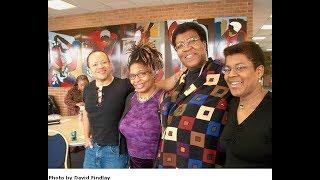
So one of the titans to address this obviously the tallest one. And Nalo Hopkinson is also a titan, but Octavia E. Butler, the tall one in this photograph. And this is a photo by David Fenley. I always want to give the photo credit. We took this picture at Howard University. I don't remember what year, but, boy, did we feel like we were in the middle of a party that would not stop. It was the growth of Afrofuturism. And we had a road show.
People.
I cannot tell you how many times we would meet and other artists would be there. Nnedi Okorafor came along later. Did she ever appear with us? And Octavia, maybe she was a little bit. I'm not sure.
I don't think we were all together.
We would have gotten a picture a little too late. But the late La Banks was. If not in this event, she was in several. So we had this road show where we would talk about black science fiction. We didn't actually ever call it Afrofution.
No, we didn't.
We didn't use the term. The term was in use, but we were not using it.
You know, you shine at horror fantasy. Although she has been in a best of the year anthology for science fiction because she's just that kind of writer. I went specifically into aiming at the science fiction field, and I wrote for Outer Limits and Twilight Zone. I wrote multiple novels with Larry Niven and Jerry Parnell. Many of my own have been nominated for Hugo and Nebula. But, you know, I could feel that for most of my career, I was shying away from talking about certain issues. Not doing.
You're still shying away from talking about certain issues. What certain issues is that, honey? What certain issues? Oh, all right.
I was literally certain ages. I was literally scared that if I addressed race directly, I mean, almost 20 years, I was the only race, say, the secret way, the third rail. I was literally afraid that if, as being the only black male science fiction writer in the world for almost 20 years, as far as I could possibly determined, I was scared that if I, you know, specifically attempted to address my negritude, that the white audiences who I counted on to pay my bills, buy my books, keep, you know, be able to keep a roof over my head and my food at my daughter's table, that I wouldn't be able to survive. So this led to feelings of being inauthentic, feelings of betraying myself, feelings that, you know, I might as well be one of those guys that set the roaches on Paul Winfield, you know, because I was not being true. I was not being honest. But I was scared. I was actually scared if I do this, if I kind of come out of the closet as it was. I was Stephen Barnes, science fiction writer, who happened to be black.
Right.
But if I did this, I would be Stephen Barnes, black science fiction writer.
And was there even an audience? That was the question when you started. Now, by the time I came along, I was so fortunate, having been published on the heels of Terry McMillan, that black commercial fiction was taking off on its own, whether or not it was speculative. And as a speculative fiction writer, I got caught up in that, and I met the. The winds of Octavia's rise among feminist readers and black women readers. And, you know, Octavia, whether or not she actually felt fearless, there is such a fearlessness in her writing and in the way that she confronts issues. Often it feels like it's issues of race. But really, we talked to Octavia about this and give us some likes if you've read Octavia Butler's work, if her work has changed your life, because we're.
Going to discuss her a little bit. Let's just go a little deeper into Octavia. Yeah. Thank you. Thank you. Yeah, that's right. We love her, too. Love to see that.
Thank you. But what she was dealing with, her biggest fear. You see these themes coming back again and again in Dawn.
Well, let's just talk. Let's give a little bit of her history first. She also saw a lack of representation. She would see movies like Devil Girl from Mars, and she didn't see any little black girls in this movie. But she also looked at Devil Girl from Mars and said, I can do better than that. Not just I can represent, but I can literally take what they're doing and do it better. So she began to. To do her own writing. And she was. She attended one of the Clarion science fiction workshops because she didn't know any black science fiction writers. At which one of the teachers. Harlan Ellison.
Harlan Ellison.
The wonderful scholarship, I believe.
But her teacher, I believe, was Samuel R. Delaney.
Oh, really?
Yes.
Okay, cool. So Harlan Pater went in. Samuel Delaney was her teacher.
And great pioneers, by the way.
Amazing. Absolutely amazing.
Someone asked the question, what category does Samuel R. Delany fit genre wise? Well, science fiction at that time. Absolutely science fiction. He's branched away from science fiction now, but he is one of the great pioneers and masters of science fiction, regardless of race.
Yeah. His use of language and imagery is on the level of a James Joyce. He was the James Joyce of science fiction. He was there, and the field did not welcome him. They literally tore him apart until they realized what a genius he was, at which point they all put him on their shoulders and say, see, we're not prejudiced. We'll accept a genius as being our equal.
So that Samuel R. Delany was Octavia Butler's teacher, and that was where she had her first exposure to a science fiction workshop. And of course, the rest is history in terms of Octavia Butler and her work. And we see in her themes over her works, as I was going to say, and dawn, it's post nuclear annihilation. Several human survivors have been brought aboard a spaceship ship, and a black woman has to decide who will go back to repopulate the Earth. And all the issues that she has to deal with, not just with the alien species, but with the humans, that's always a component of Octavia's work. There's the science fictional premise, but there's also the human premise that comes together kindred. Also this idea of a of kind contemporary black woman who is in an interracial marriage and what was then contemporary in the 1970s whisked back in time thus, who needs time machines to the antebellum slavery period, where she gets caught up with literally having to save her white forebear who is going to rape her black forebear to create her family line over and over again, which makes her actually complicit in the events in a way that's very emotionally complex.
Well, if you can think about how deep her humanity had to be in order to conceive of a story where she was taking responsibility for the humanity of the people involved here. That is. That's a level of honesty that most people frankly can't rise to. What Octavia was most afraid of, specifically, she said the thing that most bothered her about human beings was two things.
Do any of you know? Do any of you know.
Okay, there were two things. One is our hierarchical nature.
Ding, ding, ding.
And the second is our tendency to place ourselves and our tribe higher on that hierarchy than other people.
Yeah.
In other words, it is exactly this tendency that leads to racism, sexism, homophobia, nationalism, almost any ism you can think of. I think it relates to childhood stuff. It relates to, you know, my dog is the best, my daddy's the strongest, my mommy's the prettiest. If you don't grow out of that, it gets to, my neighborhood is the best, My street is the best, my school is the best, my state is the best, my nation is the best, my gender is the best. On and on and on.
You see that theme threading through so much of her work, you can probably think of other examples with dawn, it was that the alien species considered itself. While it thought it was not hierarchical, it actually lorded over humans as if they obviously did believe that they were superior.
In the Pattern Master trilogy, the stronger and weaker telepath. That's right. Anyanwe and Doro, you know, just. Doro felt that because of his strength, he had the right to control. You know, I have the. I have the right to control these. These people. They are cattle.
You see it in Fledgling, her last novel, with the. The young black vampire who can walk in the day because of her. Her melanin. Rather than this girl feeling like she's superior, the other vampires feel superior to her because she's a mutant and they're basically trying to kill her and everyone she knows.
So can you see how. How Octavia would take her concerns that have to do with race and gender, then turn them and then exaggerate them. These are vampires. These are aliens. These are immortals. And she exaggerated those concerns, but it's right there. It's that, what is it going to take for human beings to get along with each other? At what point will we stop hurting each other, stop killing each other, stop dominating each other? And she took these ideas and she grounded them in science. She studied biology thoroughly. She. She was writing about, you know, biological species, you know, plants and animals should actually take a trip up the Amazon to do field research.
Right.
You know, I have just so much respect for a mind that operates that way. She would ground it because she has this passionate urge, why do we do this? To find out why we do this. How do we get out of this? Because she can see how we can destroy the Earth. Human beings over plants, human beings over animals, human. How we can destroy other nations. America against other nations. How men can dominate women, how women can manipulate men. How straight people can force gay people to stay in the closet. How whites can dominate blacks. If we ever turned that around, we'd be doing the same thing. And I wouldn't mind an opportunity.
Did I say that out loud? That's what a lot of people are afraid.
Of course that's what they're afraid of.
But, you know, the truth of the matter is, when people have equality, they just want to live their lives generally.
Well, I think. Well, I think that if you ask yourself that question, there are only two basic questions to ask yourself. What. What am I? Or what is it? What is humanity and what is the world that we see? And I tend to believe that, you know, Maslow's hierarchy of human needs says that as soon as the fear is removed, when you stop being hungry, when you stop worrying about a roof over your head, you start thinking about emotional connection. You start thinking about, you know, that the things that we really want on the other side of fear are joy and love and connection. So most of the violence, most of the ugly things that happen, happen because people are afraid.
And, you know, Octavia, we talked about this with Octavia, that her work wasn't always coming from a place of optimism. In fact, no, we talked to her.
It most certainly was not.
You've been. Some people have labeled you somewhat pessimistic, and she was like moi, but she knows, or she knew. It's really hard even to still talk about her in past tense. She knew that she was working out her own fears, not for herself so much, but for humankind in her work, hopefully holding up a mirror to us through all these different kinds of stories so we would stop in our tracks and think and maybe not ruin the planet. We can talked about climate change.
Well, we talked about politics and philosophy.
Philosophy. She really worried for our future, for all these. Well, and a lot of those worries, some of them anyway, have come to pass.
We can see.
Wow, she was right. And in fact, if you read Parable of the Sower, which is supposed to be near future, it feels nearer and nearer every day. In fact, there are some communities that are probably already living halfway in the world of Parable of the Sower, depending on where you are.
We're right back to the question of what science fiction is, because that's that what if. If only. And if this goes on, if you want to know how to do what it is that Octavia did, then you start with the powerful emotions. You address some particular thing. You use the powerful emotions to exaggerate it, extrapolate, push it into the future, make it bigger, and then you tell a story about that bigger, clearer world. You do that. And the majority of the science fiction that people have praised over the years has in some way or another asked questions about what the universe is or what human beings are. Now. Science fiction has often been criticized because it spends too much time thinking about the machines, not enough about the people. Octavia was deeply humane.
It's all about the people.
Deeply humane, all about the people, all about, what are we? Where are we going? What are we doing to each other?
So who are we when we're telepaths? Who are we when we're slave owners? Who are we. When we're in interaction with an alien species, or we are the alien species, I mean, who are we?
If you think about that, then there are different things you can do with that, with the question of what. What science fiction is, what afrofuturism is. You can imagine the future in which things get worse, and you can address that, or you can think about the future in which we've gotten past it, and you can help us see how we did it. So whether. If you're a pessimist, then put that pessimism out there. If you're an optimist, show us how we got it right. Octavia tended to give us more warnings than anything else, but she was always giving us a sense that if we can connect with each other emotionally, that love and connection is a way out of this trap that we've got. That trap being these basic perceptions that we have that force us to say this, not that. That binary thinking. This is not that. This is better than that. This is worse than that. This is higher than that. That is one of the core ways of thinking that most people fall into. If you look at Facebook and look at all the political arguments on Facebook over the smallest things, you cannot look at that without seeing people just think that their point of view, their tribe, their. You know, their. Their group is not just different from, but better. And that the amount of death and suffering and slavery and just the horrible things that we have done to each other out of fear and out of saying that other people are less than us cannot even come close to being calculated. So that's what I see as what scared Octavia more than anything else.
Yeah. And luckily, we have art to help us process all of this. If art has saved you over the past few months, let's say some likes and some hearts, if art has made your life better, your ego evenings better, your days better. I know it has for mine.
Oh, my God, yes. Absolutely. Without being able to turn on a movie, open a book, or write, actually create something, it's like that creation is massive for me, you know, just. We're going to talk a little bit about creation, but we've talked about the fear that Octavia felt, and I think I wish so much that she were here now that we could have conversations about what is happening now because of people like you, because we can do shows like this, and there are podcasts and shows and books. The fact is that from that original group of just a few of us, there are now so many creators that I can't even come close to Keeping track of how many there are. And it is a. It's so wonderful. It's hard for me to even tell you how much it matters to me. We're talking about get in touch with those emotions. Get in touch with those emotions. A very simple model of how to accomplish the things that you want to accomplish in your life. This will all go into how fear can be turned into power. In the middle, you see what. What is it that you're trying to accomplish to the right? It says, why? Why do you want it? Why do you want that thing? The why? The emotions are the energy. They're the fuel. It's like I'm talking to my son. He says, I want him to do his homework. Well, why does he want to do his homework? When you're a kid, you do your homework because you don't want to get spanked. In other words, it's an avoidance of pain. But what the education process hopefully does. The thing that I want for him more than anything else is he'll get clear on what he wants to accomplish in his life and find his own reasons to want to do these things. Because only after you are clear on what it is you want and why you want it does it make any sense to ask the how. So now let's take a look at that hierarchicalism and the fear that Octavia had. We're going to show you how somebody has. Is creating a bridge to the future, a positive future with that one.
Somebody. I mean, now this. You know, obviously, you saw the protest photos, if you were here earlier, from my mother in the 1960s. Well, our protests haven't ended. The NFL players have had protests. There are young people, Black Lives Matter, still having protests because. Well, there are a lot of reasons, but most famously is the police violence and police shootings against unarmed black men, women, even children. And not just blacks. Native Americans are very high risk for these kinds of police shootings that doesn't get the same publicity. But POC in general. POC in general.
And what's the most horrible thing to me is not just people saying it's not happening. It's people trying to say that these black people protesting don't even believe it's happening, that they're not even willing to grant that we are being honest about our fear. They don't have to agree that it's happening, but they actually will tell us that we don't mean it, that it's just political theater, that the denial is so deep, the inability to wrap their minds around the possibility. Well, maybe These people do believe that they're being threatened. Maybe these people do believe there's something to threaten them that's a step in the right direction, because then you can at least ask, is it a legitimate feeling? But if you're just going to say you're lying about, you can't even ask the next question. So the danger is that the underlying hierarchicalism in a community will lead to differential valuing of lives. That is why black lives matter is important, because of the very hierarchical that Octavia Butler was afraid of. This is that fear in the flesh. In the flesh and blood draining into the gutters in our cities and people saying not just it's not happening, but saying you don't even believe it's happening.
Right. And there's such a misunderstanding because there's so much ignorance about those statistics. There's so much ignorance about the wealth gap and educational gaps and all sorts of ways that institutional racism really does continue to suppress blacks, that when they hear black lives matter, they hear only black lives matter. When in fact, if you know anything about what's actually happening, you know it's black lives matter, too.
That's right. Black lives also matter. They pretend not to understand that. That's what's being said when you say blue lives matter. We know blue lives matter because if a cop is killed, there's a parade, you know, they will actually stop the world and honor the worst and highest charges.
And they won't rest until they find you.
That's right.
Whereas you could be an unarmed kid like this poor child in David, in Texas, leaving a party and shot just for literally no reason. And it's hard to get justice. I think in that case. That's Jordan. His name is Jordan. And I believe that there will be justice in that case. But it's there.
So look, so what we're saying is that you start out, you feel fear, you feel anger, you feel outrage, and you say to yourself, what do I do with this? And you can. You can just support art or political causes that relate to this, or you can do what a very.
And. Or.
And. Or what an amazing young man named Ryan Coogler did, which is he created a small film called Fruitvale Station based.
On the police killing of Oscar Grant. And in the Oakland area.
Now, what is this coming into. This goes directly to that question of hierarchicalism. It is saying, let me humanize this young man. Let me put some heart in there. He's not just a thug. It's not just an act of. This is a human being who Was cut down.
It was loved and had a future that he was entitled to see.
This is what art does. Art is a communication from one person's heart to another person's heart. And if you write a story about this, you and the person on the other end of the story feels what you wrote, then your work of art has been successful. Well, Ryan Coogler created a little movie. And the trick with working up into Hollywood is you start with tiny movies and you move up to short films and small films before you go for major films. But what he did was he took his passion, he took his fear, fear for himself, fear for his children, fear for his family. And he put that passion with the skills necessary to make an award winning.
Small film, Fruitvale Station. And it really did help open a lot of people's eyes who were in fact, in some cases, completely unaware that we had this problem of police violence. In this case, it was Metro Police. But, you know, anyone with a gun can be a threat to people. If that person with the gun is afraid of you literally on sight.
Now, what he did was, he took that in that question. How do you stop the violence if the violence is based on a hierarchy that says that you are less human than me, you create images that humanize. He did an amazing thing. He took his win with Fruitvale Station and he created a heroic image that was connected to one of the most dominant cinematic mythologies in American history, Rocky. And he created Creed. Now, Creed was not just hugely successful, it was also the first movie in Hollywood history where a non white male lead had a love scene where the movie earned over $100 million. $100 million is a standard, is the standard measurement of success. It means it has crossed over. The entire culture has embraced it. When he created an image of humanity and heroism, it was so powerful that people were willing to identify with him across racial lines because there was no way for black audiences to make that movie successful by themselves, that successful by themselves. When he did that, he created a meme saying, we're here too. We matter too. When you cheer for somebody in that movie, you are seeing their humanity. And it would be my guess that if the cop who shot that guy, Fruitvale Station, had seen Creed the night before and loved it.
Yeah.
That he would have been less likely to pull that trigger.
Not more likely. I'll grant. He would not have been more likely.
Yeah, he would not have been more likely. It had to have a positive effect. Now, here's the thing where it becomes beautiful.
You know what we're working up to. Yeah, because you guys know what we're working up to.
Because.
Shout out if you know what we're working up to. Hello, Black Panther.
That's right. Because Ryan Coogler took the success of Fruitvale Station, took that into Creed and took the success of Creed and turned it into Black Panther.
Powerful, powerful images of men and black men and women in an independent nation that has never been colonized. Its resources have only been its own. Own resources. He makes a big deal about that. The Chadwick Boseman who played Black Panther has even talked about how they talked about the. The accent that he could not. Now, some Africans have some complaints about.
The accent, no doubt.
But. But in terms of what they were trying to do, and he's just an actor, was. He could not go with an English accent or some accent that would make it sound like he'd been educated in Europe, which so often happens. No, this is an African structure. This is an African nation. And you have both the ancient in a lot of the imagery and the technological with Shuri, who is, in fact, beyond Tony Stark in terms of her technical capabilities.
Now, what happens when you do this? Not only are you saying we're human, not only are you saying we can be heroes, you're saying we have courage, we have intellect, we have beauty, we have culture. I expect that Black Panther is going to be a massive worldwide success because there is a gap between the lie that slave owners promoted about what we were and the reality of what we are. Anytime there's a gap like that, I'm speaking to the artists out there. Anytime you see a lie in the culture, anytime you see something that people believe that is not true, you take your anger about that, your fear about that, and you turn it into work, you turn it into art. Or if you're not a creator, teach somebody to create. Or if you don't, if you're not a teacher or a creator, then just support the art that is speaking the truth that you feel in your heart and speech.
Speaking of fans, which. Those of you that would describe you, this. This is not a real Wired cover. I wish it were, but it's a mock up by an artist named Darian Robbins, who's done a lot of fan art surrounding Black Panther, and we thank you for that image because that is so electrifying. Again, to feel honored, to feel recognized, to feel seen. That's a word I hear young people using a lot. I feel seen.
Yes.
And that's what we're striving to do in Afrofuture.
It's like you're saying, I'm here, and.
Not just I'm here, but really that we can lead. We can lead because any population that is willing to cut off the voices of a huge percentage of its own people and the very people who have been dealing with struggle, the very people who have the tools for struggle. When it's time for you to struggle and you're not listening to those voices, guess what? Your struggle fails, your struggle falls short. We need all hands on that.
Well, it's not only that, but any group of healthy people thinks that they're. You know, to be enlightened is to see the interconnection. But before enlightenment, when you're just chopping wood, carrying water, you should think your family is something special, your group is something special. You can't be equal by thinking you're equal. You have to be equal by thinking you're better getting out on the track and competing with everything you've got inside you. And then afterwards, you can say, you know, you ran a good race, too, but when you're running, you don't run to come in equal. You run to be beat them. Look, before we get to Black Panther, there's that question, can it succeed? Will it possibly succeed? Well, think about something for just a second.
Vicki Bean wrote Get Out. Hello.
That. Thank you. Sink into the floor.
Jordan Peele's $250 million hit Get out is not shying away from the question of race and race relations. It is not pretending that it's about something it's not about. It is going right down the line at the problem, to the point where Jordan Peele told my class at UCLA he was worried when he was writing the script that it would seem too confrontational, that people wouldn't get it. And it just so happened that it came out during the Trump era when people like, oh, yeah, we get it.
But also that he had. He had a supreme skill, the ability to take fear and turn it with laughter when you need it to.
Yes.
So he. See, he's bringing that skill to it, but the raw emotion, the fear that he will not be seen, that he will not be loved, that there's no one to trust. Understood. See, that's the fear at the core of American racial issues. Black people feel that toward white people. Can we, you know, we can't trust you, can we? White people saying to black people, can you trust us? Will you ever be able to trust us? Trying to work together. Art can bridge that gap. Communication bridges that gap. Honest opening of hearts, bridge that gap. I say that America is ready for Black Panther. I really believe that get out showed us that the country and the world is ready for images like this. We are ready to say, well, if you're not, this will be here. Who are you? And the people who step up and can do that with real power and passion and skill are going to make a killing. They're going to do great.
Yes.
You know, and so that's what we're praying for, is that there are people out there like you will take this time on a Sunday afternoon and learn a little something.
And I want to shout out also some of the independent Afro futuristic artists because we've talked a lot about the franchises with say, Black Panther.
Absolutely.
But you have artists like John Jennings out there, Milton Davis with his black speculative fiction, Beljean Jeffers, who are my Facebook friends and who are holding it down. There's a whole Afrofuturism group here on Facebook. So this is a large community of creators. We're talking about some of the creators that everybody knows. But I also believe that the more success a project like Black Panther has, the more it opens that that hungry audience for more, more, more, more, more. Because you can't have a Black Panther every six months.
No, you can't. And think you don't need to make, you know, a quarter million dollar movie. You know, you don't need to make a 5 million dollar movie or even a 1 million dollar movie. You need to tell your story to enough different people that they're figuring, you know, you're leading the way. You're saying something I have not heard. Let me say something. Support you.
Yeah.
An artist only needs 1000 true fans to make a living.
And if you're a true lover of science fiction, fantasy and horror and you have not been as exposed to Afrofuturism and some of these artists that we're talking about, what an opportunity to open that up for yourself. Right. Because as a true lover of the speculative arts, you want to be surprised. You want to find some. Something different. We don't want to see the same story rehashed and rehashed. We want new mythologies, we want new heroes and heroines and we want new stories. And that's what part of what I'm trying to do in my art is provide new stories. My African immortals. Well, is it, what do you call for? Is it quill Ology?
Quadrilogy.
Quadrilogy.
It'll be a quintoology.
Hart and Octavia's work. We're all trying to. Well, really, we're just trying to express our own truth. But in doing so, hopefully, we're also providing you with new voices, new faces, and new art that you can enjoy.
Well, that's fear. What Octavia was afraid of. Hierarchicalism, fear. This is how you take this. That fear, that emotion, and change the world. What do you want to do? You want to create art?
Yes.
Why do you want to create that art or enjoy art? So that you're. So that your children can live in a better world. So that you're not afraid walking down the street. So you can express the joy or the wonder you feel at the universe or whatever, but just make sure you've got this thing you want to do and you got this reason you want to do it. Now go out and work your butt off.
Yes. So there's the time, people.
This is. This is the time.
Never. I mean, I'm not. This is not hyperbole. There has never been a time to be a creator of speculative fiction, as a person of color or really probably anyone. Well, yeah.
I mean, you don't even need to. You don't need Hollywood to make movies anymore. The potentials are so huge right now. The technology has made it possible for you to go directly to the audience that you're trying to reach. But what you are going to need is. What?
What are you looking at, Black Panther? I didn't mean to interrupt. Sorry.
No, it's okay. You can interrupt me like that anytime you want. This is the time.
This is the time.
You know it is. We are the hope and the dream of this life. This is the time. And I'm not just talking to the black people out there. I'm talking to our allies. That means anyone who has that sense that we're all connected, that we're part.
Of one family, and that we can all build a better world together, which is really what this is all about. It's about creating healthier people who can create a better world. And that's really what Afrofuturism is to me and what it has meant to me, actually.
If you want that sense of creating a better world for your children than the one you were born into, let's see some likes and see some loves. I know that I'm willing to do anything for my family.
Yes.
My community. And you guys, those of you who believe in the equality of human beings, who are willing to put yourselves on the line, willing to support art, create art, teach people how to do art.
I want to be excited by new mythologies and new stories and new ways of Looking at the world, definitely we're all part of that same family.
Yeah. You know, I guess if you. If you feel that there are oppressors that have pushed against you, you're right. If you feel that there are people who've tried to keep you down, you're right. If you feel that you've tried really hard in the past to create and keep your mood high and things collaborated against you, you're right. But it's also right that this is the time there's more than hope, there's opportunity. And we wanted to talk to you about just such a thing right now. And it's the best opportunity we have ever, ever.
Now, speaking of no hyperbole, this is true. And by way of background, earlier this spring, we had a live afrofuturism class for 10 weeks where we met. And we did a lecture format like this, where we talked about whatever the homework was, whether it was reading by Octavia Butler or Samuel R. Delaney or Web Boys or Nnedi Okorafor. Whatever we were reading or whatever movie you were supposed to watch or whatever music you were watching, we did a lecture about it. And every week we also had a guest speaker who would come and we had interviewed someone who would come and share their wisdom with the class. So for week one, we started with a bang with Luke Cage showrunner Chael Hadari Coker as our guest. And we were talking about Intro to Afrofuturism with George Clinton and Luke Cage, and we went to Sun Ray. So we had guests ranging from mediocre for. You see her on the top left. She is a superstar.
Yes, she is.
Right now, my little sister, we talk about get out. And we had an interview with Reginald Hudlin, the director who did Boomerang and also did Django Unchained and a producer of Django Unchained.
Cosmic slop.
Cosmic Slop.
Space Traders.
Space Traders. We. We looked at Ava DuVernay's documentary 13th and interviewed real life superhero. You see her on the top right. Brie Newsome.
Yes.
Who, by the way, is also an artist and creator. She has a terrific short horror film.
Because you have to understand the history of America in order to understand how to create fiction that relates to that history that is rooted in who it is that we really are.
So it's a 10 week course and now it's all digital download. So you get the lectures and you get the interviews and you get the homework. You do it at your own, own pace so you don't have to worry. Oh, my gosh, My Schedule is too full. You'll have the links. Do it when you can. No one is going to push you except yourself. And in that course, what you get in that course is the 10 weeks of classes, the interviews with the artist, the recommendations for movies, books, short stories, art and music. All digital downloads that value would be more than $1,200 just for that course. A 10 week course.
And if you're wondering about, you know, what it means, what it feels like is Rory still said, I love this class. Afrofuturism has been a powerful tool in helping we as peoples of color, to quote Hamilton, write our way out of the oppression that would try to annihilate us. I must say that Tananarive and Steve are two of the most engaging teachers, mentors that I have ever. Oh, that's so sweet.
I can't even read that out loud.
It's too nice.
Well, I'm going to read the one from Mr. And obviously you can see she's one of our white students. So when we say Afrofuturism is for everyone, we mean that. Several of my friends asked me if I felt the class had been worth it, if I had learned things that I would apply in my own writing. My answer to both questions is an emphatic yes.
Now we go beyond just what afrofuturism is and how to create it as a technical thing because we go into what's called self care. For social justice writers, this is an emotional care kit. Whether your issue is finding, learning how to focus properly, learning how to go into flow state, how to heal yourself emotionally, how to deal with fear, how to summon creativity, how to relieve stress or banish insomnia.
Insomnia.
There are a number of different tools that I've created over the years that make it possible for me to have written 3 million words and over 30 novels without losing my mind in the process. And the collection of tools, MP3s. If you were to buy those things separately, it would be at least $240, probably more.
So that's our first bonus that comes with the 10 weeks of the afrofuturism class. There's another bonus which is one of my very favorite. Well, okay. This is a lecture. The three greatest mistakes new writers make. I teach at Antioch University in the MFA program. I teach at Bona Voices of Our Nation's arts foundation, the writing workshop for writers of color. And I work with a lot of beginning writers. So this is especially for new writers. But sometimes those of us who are older writers need to hear it again too. So that's my lecture. The three biggest mistakes new writers make.
Now we go worse. We go far more deeply into an issue that a lot of artists have problems with and that is how can you make a living creating art? And it can be a difficult thing because the artist creates from their heart and then hopes they can find a market. The business person finds a market and then tries to create something for it. So art for an artist, marketing can feel like prostitution. It can feel like you're not being true to yourself. But it's possible to create art ethically. It is possible to market ethically. And I went to a dear friend of mine who is a Sufi master and actually created a course that applies spiritual techniques to marketing. So that if you as an artist need to understand how this works from an internal point of view, that we actually can open the door to you being able to understand marketing and sales for an artist or person from a.
Spiritual perspective that gives you permission to succeed. So just to break it down, we have the 10 week go at your own pace digital download Afrofuturism course. We have the self care for social justice writers or warriors, however you want to call it, the three greatest mistakes new writers make, my MP3 and also the spiritual entrepreneur. So if you add all of that together, that would be more than $2,300. That's a lot of money though. That's a lot of money.
It really is. It's really. And here's the whole thing, I'm going to warn you ahead of time, we're not going to charge you that much money. We don't. I don't have the heart for it. And one of the things that we realized that if we charged what it was worth, only rich people would be able to afford what we're doing. We did not want to go in that direction. So what we have done is we've gone all the way in the other direction. So we have that. You know, we had two choices and our choice, our choice, even though it's worth over $2,300, is we're taking the second option right now. We're making this entire course available for only $99. You read right. And quite frankly, we. I don't feel like it's a good idea for us to offer as much in there as we're offering right now. But the fact is that that was the package that was with.
We've been offering that package at a higher price. Some of you have seen this webinar before.
So we were offering it for 249. We offered it for 297. We're offering it, you know, so this.
Is literally the lowest price we've ever had for this particular course on Afrofuturism. And by the way, there's another bonus. It's not even just the Afrofuturism, because we're including all the extras that people got at the higher price, including the Complete Revolutionary Writing Six Week course. Again, this was a live course. We did it for six weeks where we had students live, and we talked about all of the issues that writers face when they're trying to write specifically to create change in the world. So it could be about how do you use theme to amplify social justice issues while not losing the meat of your story and your character storytelling in general. Again, it was lectures and guests, and we had some great guests. We had Zach Stentz, who wrote Thor. We had Effie Brown, you know, that name from Dear White People. She was a producer, but from Project Greenlight, where she took Matt Damon to task. Daniel Jose Older, who's pictured on the far right. Some of you know him. Niecy Shaw.
Yes, Niecy Kate.
Tempest Bradford's book on Writing the Other. Say you want to be more inclusive, but you're afraid of making a mistake Writing the Other. They came to speak to us about that. And in the middle of the top, you see David Jerrold there, who wrote, by the way. He's a novelist and he's written many, many things. But some of you will still know him best as the writer of the Trouble With Tribbles episode of Star Trek. And he was speaking on LGBT issues in writing.
So we're doing all of this and the value. We're now talking. It's ridiculous. I look at this and I'm thinking, we've got to take some of this stuff out. It's too much. We're not taking it out.
Obviously, some of these, we might sell a separate.
Yeah, we will, after Christmas. What we want to do is we want to reach as many of you as we possibly can. And so that's why, even though the value on this is up to over $3,000, this is only $99. And you can get it over at afrofuturism webinar www.afrofuturismwebinar.com. please do yourself a favor. I can promise you it will never be cheaper than this. And in fact, as soon as we get through with the holidays, I'm pulling some of this stuff out. There's a lot. There really is. And we're very proud of this and there's a 30 day guarantee. If for any reason you don't like what we're, what we're offering you, just let us know. We'll give you your money back. We're just, we're just trying to do something good here, you know. Other courses can give you academic understanding of what's going on, but Tenonarive and I are actually in the trenches every single day creating Afrofuturism, creating dark fantasy, creating the things that connect our mythology.
I'm trying, I'm writing a science fiction story right now, you know, that is helping me process the political times that we've been living in. So, yes. Www.afrofuturismwebinar.com we have another testimonial from Denny Upkins.
Yes. After each class I felt galvanized to tackle my writing and as a result, I have made sales. If you're serious about taking your writing to the next level, then I cannot recommend this class enough. So, you know, God. And then Jenny Underwood, the 10, the 10 year old, her 10 year old is watching parts of the Afrofuturism class with me and already wants to write when she grows up. Thank you and Tananarivedu for helping me to teach my family. And we've gotten so many comments from people who think that the package is just amazing, that the price is just amazing. That has really touched my heart. I want to find the way going into 2018, I want to make sure that people who want to support the art, create the art, or teach other people to do it know how to.
Have that opportunity to do it. Because it's been such a huge, it's had such a huge impact on my life, my world, and certainly Steve, that's how we met.
It made my life.
We literally met through Afrofuturism. So we're creating the work and we're sharing the work, but we also want to help you either just further appreciate it or use it to inspire you to create your own work or your kids. Or maybe you have a student, you know, who's a standout and this will be the perfect gift if they've earned it. You know, if they turned in all their work and they did what they were supposed to do. But really that was what we wanted to share with you. We're really excited about this price. This is the first time we've lowered it to 99. And we love the idea that so many people get to experience it in that.
Please, please share, share this with anyone you know who is a writer who's interested in Afrofuturism. You know, it's worth more than 10 times as much as we're charging for it, I swear to God. But the beautiful thing about the electrical electronic media is that once we've broken even, once we're into the black, we can drop prices. Yeah, we can drop. We can do this for you guys.
We had a lot, I mean, a lot of preparation to do the 10 week course and it's a lot of time. But now that the course is basically in the bag and it's digital download, we can learn.
We're moving on to other things, so the other projects. But on this project, this is our way of saying to you, we love you guys. We want you to succeed. We want you to support the artists that are out there. Let us help you.
Www.afrofuturismwebinar.com thank you so much for spending your time with us. Go out and create.
Have a wonderful, wonderful day. Take care, people. Www.afrofuturismwebinar.com.







