Ray Bradbury Event 9-9-23
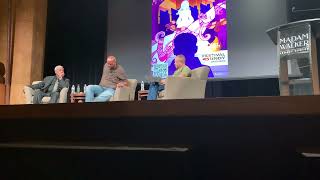
Recorded panel at an IUPUI Ray Bradbury–themed literary festival (September) featuring Steven Barnes and Dr. Charles Johnson, moderated by Dr. Les Etienne. The speakers reflect on Ray Bradbury's influence, creativity and craft, share personal anecdotes about mentorship and career paths, and discuss practices for maintaining a childlike sense of wonder; the session includes audience Q&A and a book-signing. The tone is conversational, celebratory, and reflective with recurring themes of mentorship, imagination, writing practice, and cultural memory.
Chapters
In the United States. It's also a small museum. We have recreated Ray Bradbury's space office with entirely visual artifacts. And we do offer tours to the public on occasion. So please follow us on social media if you'd ever like to come and see the collection. On behalf of the Bradbury center and the School of Liberal Arts, I want to welcome you to Our Literary Festival, Festival 4. We have events throughout the month of September to celebrate our literary heroes. Two of mine are going to be taking the stage in just a moment to encourage people. The festival encourages people to cultivate an active reading life and to celebrate the humanities. Our festival references Ray Bradbury's most famous work, Fahrenheit 451, a cautionary tale about the consequences of the cultural devaluation of literacy. His words, you don't have to burn books to destroy a culture, just get people to stop reading have only become.
More poignant and relevant today.
That's why we felt that a festival like Festival 4590 was necessary. So thank you so much for being here tonight and being part of it. Hopefully you picked up some note cards. As you're listening to the speakers tonight, please write down your questions. And I think these two aisles here, if I'm wrong, somebody will correct me. Okay, I got a thumbs up from the boss. So these two aisles here, you'll be able to approach a microphone and address your questions. Please stick around for the Q and A. Sometimes that's the best part. I think everything about tonight's going to be great. We also want to thank the A.W. cruise foundation for sponsoring tonight's event and for sponsoring the entire festival that lasts the entire month of September. Their generosity made this festival possible. In your programs tonight, there's a short survey. If you could fill that out and turn it into one of our team members at our information table in the lobby, that would be super helpful for us. We asked you a grant report for and your your response to the event tonight would go a long way in helping us craft that report and we definitely appreciate it. Before introducing our speakers, I want to share a brief land acknowledgement. IUPUI acknowledges our location on the traditional on the traditional and ancestral territory of the Miami, Potawatami and Shaw people. We honor the heritage of Native peoples, what they teach us about the stewardship of the Earth and the continuing efforts today to protect the planet. Founded in 1969, IUPUI stands on the historic homelands of Native peoples and more recently, that of a vibrant black community also unjustly displaced. Where we sit tonight. Madam Walker Theater is one of the last vestiges of that vibrant community. As the present stewards of the land, we honor them all as we live, work, and study at IUPUI Today, people in this state who teach about the injustices of the past are under attack. And I want to affirm tonight that we stand with our public educators, our public libraries and librarians. We honor their expertise. We will never correct the injustices of the present if we fail to acknowledge our past, especially the parts that make us uncomfortable. If there are educators and librarians in our audience tonight, would you please raise your hand so we can honor you? Thank you.
Thank you for what you do. You know.
Tonight, in part, we honor Roy Barbery, a great author who spent his life standing up for public libraries. Because knowledge should be free and accessible to everyone, no matter what, we stand against any attempt to whitewash our history. The old adage that those who refuse to learn history are doomed to repeat it rings true. But I would add, it seems clear that those who actively try to prevent history from being taught intend to repeat it. We will not let that happen. So tonight, the Ray Brad Pierce center is thrilled to partner with our friends at the center for Africana Studies and Culture and presenting a night with two legendary authors, Dr. Charles Johnson and Stephen Barnes. Tonight's event will be moderated by my dear friend and colleague, Dr. Les Etienne, executive director of the center for Africana studies and culture. Dr. Les, the stage is yours, my friend. Thank you for coming out.
Little Housekeeping before we get started because we are breathing rare fire here tonight. So I want to acknowledge in right in front here to also legendary writers, Ms. Sharon Skeeter and also Ms. Santa du Right here in front. Of and the staff and folks at the Bradbury center for putting this on and also giving us an opportunity to play a role in it. Some colleagues from liberal arts are sitting right there. Shout out to y', all, hello. And also our dean.
Oh, Robert.
Colleague.
But our dean is also in the house here tonight as well. Chair the Idol.
So.
So I'd like to bring up Mr. Barnes and Dr. Jason, if they can hear me, to come on up and we'll hit start.
All right. Welcome, welcome, welcome. Thank you.
Thank you both for being here. Greatly appreciate it.
I think it's.
It's always good to introduce folks to who we have. It's our best panel. We're here tonight, so a few to put in mind. Just get started. Jump right in.
But also, I think there are likely.
People in the house they would Want.
To know about who we are.
Our sitting is.
I'm always curious about who I'm sitting with. Sitting alone.
Exactly.
What you forget to say. Yeah.
In the house tonight as well. Yes, that's right.
Yeah.
Yes. So if you don't mind, I will start with the youngest of us. Because, you know, it's very important for us to understand the value in.
In the work you've done in the.
Literary world, but also, you know, and, you know, and some of these other, other places. If you don't mind, you can just give a brief, brief Bible a little bit about yourself.
Okay.
You got 30 minutes. First, I want to say this is a joyful occasion for me to be on State of this Gentleman, but especially after on the end. We have collaborated on a number of.
Projects in advance of a few support.
Did the Eightfold Path.
Yeah.
Which is a warm way, as it turns out. Graphic novel, all of it. All credit. Comes to see they're all histories. Sh. Okay. I came on and. And I. I mean I took the ride and it was like anything we do together. A great pleasure. We have a lot overlap. You know. I had a book in that 1988 called Being Embrace Black Writing Since 1970. And in the last chapter, it's a survey of black writers up to 1970. In the last chapter, I mentioned this guy I keep running across. He's a martial artist. He writes science fiction. And he's a black dude too. Too. That's me. That is me. But then, no, it's this character over here, Steven Barnes, who has been my. For a very long, very long time. My history, my journey into creativity had. It was truly influenced by many of this book. But I come to this from being a journalist and a cartoonist. That was my first love. My first passion was drawing. In high school, I became a professional illustrator. When I was 17, I did some illustrations for a magic company catalog in Chicago. And I saved that dog, by the way, to the lion. Credit for Strange.
I was.
I was going to use it because it was so broken grad school. I started out as a. As a cartoonist and a journalist and along the way read, you know, voraciously, of course, you know, cartoons a lot. So we can get ideas from all kinds of different sources. And around the time I was 18, I had those people philosophy.
These days I have a doctor in philosophy.
The lights I discovered is how much Breadbury admired Socrates and Marcus Aurelius. You know this. So my journey took me from drawing to scholarship and then to write. And at a certain point, looking at novel Short stories, essays and other things. One of the things I would emphasize, which I'm sure most of you already, but I remind myself of it repeatedly, is all of the. The liberal arts in the humanities are interconnected. One thing will lead you to another thing. You know, if you might want to get up one day and draw, but then the next day you might want to get up and start sh. And the third day, you might want to get up and write an essay on a question that's been troubling me about the mind body relationship. There is no reason why any of us should have to allow anybody to put us in a little box and say, this is all that you do. You know, if you see my mate crop up with something, we Charles down novels, but that's something. So all of these arts feed each other, you know, create creatively. And when I was young, Bradbury's movies, reading short stories, I felt that spirit, you know, of openness and the excitement that just got you doing something not, as Bradbury said, for money or fame. First, it's for the love of doing. You get money and fail later. If you did it, well, that's fine, but that's not your motivation. Your motivation is the fact that when you create, you're creating yourself with every canvas, with every novel, with every store, with every pull. You're realizing your own individual, inherent potential as a human being who can, through craft, give a gift to the world of truth, goodness, and beauty that men reach the lives of others. That's why I think we create, why we honor this guy.
I was relatively poor, K driven in a broken home in South Central Los Angeles. And I knew that the world that was presented to me was not the real world. I knew that there were some things that were said to me about who I was and what my potential was and what my people were that was not accurate. So as many people did. I think a large number of people in the science fiction fantasy famish community are people who grew up feeling like the world was not the world inside them that they connected with was not the same as the world that they saw. And they look to the stars, they look to the past, they look to other worlds and other ones to get a sense of, in some ways, what might be true. That science fiction is a fiction of ideas and concepts. What if, if only if this goes on, often anchored to physics, but sometimes about the human heart. But usually there are two questions that are central to philosophy. Those questions are probably who am I? And what is true? What is it to be Human and what is the world that human beings perceive? And science fiction approach it in one way, fantasy approaches it in another. Fantasy is not about the world of physics. It's about the world of symbols and the human heart and the way these things interact. It's about the poetry, what's happening, kind of between the atoms, kind of between the events. So whereas science fiction has to be both internally and externally consistent connected to physics, as I said, fantasy has to only be internally consistent. That within this, we are talking about human heart, human perception, and what are we? How do we feel this Bradbury drew my attention. I was reading voraciously at that time. I was looking for that question, who am I? What is truth? I slept in a bedroom with the walls lined with books and Ray Bradbury. It was interesting because he wrote, he was published in science fiction magazines, but he was not fighting about what if in that way. He wasn't interested in the physics of the situation. He was interested in the poetics of it, as if he were a fantasy writer. He was about where is the human heart involved. So the Marshall Chronicles were not. It was not what Voyager landed on or whatever it was that were our first ro. I forget what the name was. He was interested in Edgar Wright's Burroughs, Mars. He was interested in Marso, you know, he was not. He was interested in the poetics of science. And because of that, he touched my heart. He was a poet writing science history and published in science fiction magazines. But you weren't going to learn anything about science. When I read your graduate, what you were going to learn about was what is it to be human? What is it to see the stars? What is it to yearn for a meaning to our lives? You know, what are we in the vastness of the universe? And that really touched this young kid trying to figure out who he was. The vision of the universe nexus was so large that individual, individual, political or philosophical differences that deviled us on Earth are meaningless once you start backing up. You know, when astronauts talk about how when they were in orbit, they looked down at the world where there were no divisions of nations and they had a spiritual experience. They said the first day everybody was pointing out the city they came from. The next day when they were talking about the International Space Station, they were coming, talking about what nations they came from. The next day after that, they're talking about the continent. And then by the fourth day, they're looking at the world. And those individual differences dissolve when you look at the world in terms of a sound of Thunder going back 100 million years or forward into the future. The problems that we have right now politically and in terms of nations and family, the joining together, just different groups of people being separated by large amounts of geography, all that stuff disappears. The question of what is the difference between this civilization and that civilization? It might be a thousand years of development, but a thousand years of development is nothing in terms of 13.7 billion years that this universe is existing. It's nothing at all. Those differences dissolved. And that was the world that I wanted to live in, the world in which those differences that were necessary because the human mind works in terms of what is similar as opposed to what is different. That dualism created a lot of our.
Science and so forth and so on.
But ultimately getting caught in the middle of that, you are not this because of that. You are this because of this. If you get caught in that, then taking that larger perspective can feel like taking a breath of fresh air for the first time of stepping outside. Anything anyone ever said about who you were, what your potential was, and being lost in the poetry of experience. So my connection with Bradbury was that I saw the poetry in the mundane, the unusual in the daily. And he went there every time he went there. From his earliest stories, which were often what we're going to call biter bit stories, where somebody does a bad thing and they are destroyed by the consequences of their action. In these old, you know, pulp magazines, you know, in stories of ghastlies and murders and ghosts and goblins. I just aim that up because I would read him and I would read other people the same thing. But Bradburn was always about something more than the events and the actions. There we go. Absolutely, absolutely. So you know who I am growing up in the shadow of giants. One of who was the man that we come here to offer today is a kid who grew up in South Central Los Angeles, wanted to be a science fiction writer, found a great mentor in Larry Niven, one of the great science fiction writers in the 20s, too. Showed me how to do it, gave me opportunities. I was able to biblical life and published over 3 million words and here the New York Times bestseller list. And this will work out. That's all fine, but the important thing is I got to spend my life doing the thing I dreamed of as a kid. That was the reward. Just to be able to do that, to be able to every day talk to the little kid inside me and say I kept the faith. And then look at me and say, dad, you sure did. That is worth you. There's nothing I would exchange that for. And. And Ray Bradbury was one of the shining lights that said it's possible to get all the way there and never sell yourself out.
Yeah. Can I add something to that? Of course. One of the things Bradbury gives us, it gave me as a young person here that used to. Brad Baker gave it to you too. A sense of mystery and wonder about this existence in which we find ourselves. The whole thing. View from the sciences. Right from the solar system moving all the way out to galaxy is. Our problems seem so infinitesimally small and trivial and race so small and trivial when we get taken perspective. So science fiction is an intellectual discipline, allows us to dream. One of my colleagues, Russ, once pointed out. Yeah, yeah. At UW University of Washington, she once wrote that a woman wrote to her why she loved science fiction.
She.
She lived in a. In a kind of ordinary town, you know, very, very boring and conformist. But science fiction, what she really found appealing were the landscapes. The landscape so different from the ones that she was living in. Right. It opened up the imagination. Science fiction has always.
Well, you know, Ray Bradbury, if I may add to. All you're saying is that he might quibble with something that you said there. It isn't about developing your ability to dream. It's about remembering it. We all go quietly and say it every night, but we forget that. And that creativity to a certain degree is simply opening up a pore between our unconscious minds that dream every night and the conscious mind that performs it doesn't perform any part of our mind. The part of us that says, I am the child has that. And life keeps telling the child, be practical, stay here and we'll start shutting that down. Ray Bradbury never lost that thing. He never lost that connection with the child. And there are people who say that all there is in genius is maintaining the creativity with a child, with the disciplined knowledge of an adult. That if you can do that, if you can maintain a connection there, you are going to be performing at the highest level that you are capable of performing. It isn't gaining something that you don't have. It's remembering how you stumble. It's remembering the creativity and the aliveness and the sense of wonder, that sense of engagement that every child has that gets squeezed out of us by the adult world.
And that's what we want to keep alive.
Yes.
Bad shot. Bradbury also put a lot of emphasis on the importance of the subconscious too. So I'm glad you pointed that out. You know, we always have to think, how do we get back to that instance, that openness that we have as children before the world beat it out of us or before critics beat it out of us. And so that's one of the reasons that Sharon, Stephen and I are both practicing Buddhists. My practice at least gets rid of all. For all that condition, from childhood, voluntary parents to teachers, so. So that I can experience the world with that sense of newness and wonder and mystery.
You do have that. I've commented to people that one of the things I love about you is how easily you are astonished that it's hard. You're constantly discovering, oh, the world. Look at this. You know, even you still have that. You're not numb. It hasn't been scabbed over. Your nerves are alive. You're strong enough that you're not afraid to feel okay. And I think that when we lose courage, you know, fatigue makes cowards of us all. And as we age or as we get tired, as we shape our egos to fit into the different molds that people want us to shape into, we start forgetting who we are, that we started to see life, to enjoy it. That we want that sense of joy. Instead of that, we settle for not being afraid at best.
Yeah, we can't lose that. Yeah. A human being cannot lose that and still be fully alive. One of the things I like to think is my capacity. One of the things, at least in my work as a philosophical matter is I think that literature should liberate our perceptions, liberate our perception. Say, astonishment. I would like to be able to look at something.
Look at, you know, look at something.
As if I've never seen it before. It's often been said from very creative people. They look at something strange as familiar. And the familiar. As if that's strange. Right. So we're constantly working with consciousness and our perception at every moment that we're alive is. In every single moment is alive the past, as we want. Historical situations and so forth. The past is past. In the future, I'm not going to worry about it. Because it ain't come and never will. Because that's a horizon.
The future that we can never reach.
The only moment we have right here with each other is right here, right now.
Before I came over here, except for.
A little bit of meditation, I always do that. I would not meet a group or a crowd or do anything about until.
I have that chance to sit. It's only for 10, 15 minutes.
So I can be here, right here with all of you right now. And the only moment that exists in time. Not really. This or was a flight like getting us here with no sleep, you know, from Seattle. Right here, right here. New. Never had this before. You get up in the morning, wash your face, you got soap. Okay, that's what we're having. You might think I'm going to be routine. Not that soap, not that water, not.
That long and not that version of.
You and not that urine.
Can't step in the same piece of water twice because your foot is never the same and the water has changed. So it's. It's that awareness that the same where it is in the mundane, that it is in this moment. What I try to do is to center myself and then ask myself, what is the task to do next? The task may be to get out of bed and have breakfast. It may be to embrace my wife, it may be to counsel my son. It may be to play with a cat. It might be to answer an email. It might be to write a story. But all those not different people, when I do those things, I'm the same person playing different roles. So let me be appropriate. The question is, can I be appropriate in this moment? Can I be here with this moment and the demands of this moment, with the story that I'm writing or the person that I'm speaking to or the task that I have to do?
Be here totally right now?
Yes.
30% of yourself is attracting the past.
From memory or breading.
30% is not projecting to a future with your to do. You bring back all of yourself 100% to this moment right now. Whether it's writing, whether it's talking to your son or you talking to a grandson. You're total right at this point.
It's one of the reasons why the martial arts have. Are such a great tool for learning that because we're second and not thinking about right here. If you're getting hit in the head, you know, so there's nothing like a smack upside the head and waking you up. No, forget about the hamburger I had yesterday. My wife's going to say when I get home, this guy's going to knock my head up right here, right now, in this instance.
That's it.
And that, that sense of being there is consistent across all parts. And so this translation conversation can start.
To get in the zone.
Yes.
In the zone, right?
Yes. Well, no. It's the dissolution of the subject object, relationship. There is not a you and it. There is, there is a. There's something that is happening here and you're not observing yourself doing it. Because when you're observing yourself. Some of the energy that you would have put into that moment is put into creating itself to observe, observe. And what's even worse is when people observe themselves observing themselves. Now we're two steps and you lost all the energy you need to liberate your true self. So in one sense, society will try to keep you in place of observing yourself and judging yourself. Because that way you become dependent upon society to say that you're okay. Because if you're in the moment, you know you're okay. You're always okay when you're in the moment. You're not okay once you observe yourself and start judging yourself. But when you're there and it's just happening, that's when you're totally alive. And that's what we look for in sexuality, in driving on the freeway, in heavy traffic, in the rain, in fighting, in writing, in reading is a sense of total engagement in the moment. The eye is not observed. It is subsumed in the process of the interaction. That thing of the page opening up and falling in the page can happen only once. This component skills have been reduced to unconscious competence.
As you can tell, we talk a lot long conversations like this. But this gentleman here may have.
I was going to say this is the easiest job. And definitely the interesting thing is, you.
Know the, the one I think like.
The one time I got a chance to. I think Jason and I were on a zoom with you and a similar conversation happened and we were like in the chat, hey, let's just stay here. Let's just listen and, and get.
So.
So I also want you to miss by mention that I am affiliate Dr. Barbara Henry was ill.
If not maybe she would have been.
The person here today. So I didn't want to lift her up and mention that as well. So thank you, first of all. Thank you for that first that opening style.
Thank you everybody.
And.
And this is more specific. You certainly touched on.
And you.
You show us these.
Yeah, yeah. Lisa, I. I purchased some years ago the complete line of planet stories from late 30s to nearly 50s hinders the original wish. And they have Bradbury's original stories in them and a lot of other people too who became famous. But this is where he began with Paul. I don't even have the actual feel of that underneath my fingers. See, one of the beautiful things about Bradbury and the Paul writers to me they're prolific. They were not worried about am I writing something that would last 20 years? Agents. No, Bradner is getting 20 or $40 per story. He's making himself write a thousand words a day, a story a week. He's got to sell two a month in order to pay his bills. Okay. He is versed in the moment. These precede comic books, okay. By a few years. And the comic book artists were the same people, you know, he would run with the back. You were immersed in the moment of creation. You had a deadline to meet and. And you produced all this stuff not thinking that this would shape culture, that the characters that you created, from Eden Rice Earls to the Marvel characters, that these would be installed in popular culture 50, 50 years later so that even my grandson Yoms takes care of characters. Right. I. I admire artists who work like that who don't think that what they're doing is precious, but what they're doing is absolutely everything they can do at the present moment.
Yes.
And then you let it go and you go on to the next one. Yes. You go into the next and you're blessed to be able to have the opportunity to do that.
And that certainly was going to be, you know, kind of the next question.
I want to throw out there.
Very intercourse.
But just the idea of, you know, Ra you touched on.
Just think there was any particular specific. Oh, I absolutely can go. You can go first or, you know, I can go there or whatever. Whatever is appropriate.
I want to hear your stories about Ra. Okay.
Anybody want to hear my stories about. Because he was very important of mine. And I didn't not write this out because I know for a fact that I'm going to get choked up. So get ready for that. And I wrote down some dates just so I could get as precise as I could. But this is not a formal scholarly thing, so if any of the dates are wrong, apologies in advance. So I grew up and I had a dream of being a science fiction writer. A thing that I. I really loved to do because I didn't understand math long enough to be a science. So I did the other thing I could wrote, write poetry of the science. And so I was a little kid growing up South Central LA and had dreams of became a writer. And I was writing as much as possible. Everything around me told me that I could not bear. You know, my mom, my dad was a backup singer for Nat King Cole. And I was in the studio when they did the. The background vocals for Rambling Rose. I just watching dad, every time it's on the radio, I hallucinate that. I can hear my dad's very home and my dad's singing for ultimately floundered. And it led to A divorce. And so my mom was terrified that if I followed the arts that I would have a similar failure. And she would tear my stories up and burn because she was so scared that I would go down that path. But I here. I just kept going and kept going and kept going. And by the time I got to college, I had tried. I knew my mom wanted me not to write. And so I tried to step away from writing, but I was tricking myself. I'd take all kinds of other classes. I would take, you know, drama and composition and English and speech and stuff like this. Worked at a radio station. The things adjacent to writing without writing. And then finally they had a contest, a writing contest on campus where the winner would read a story to the alumni. And I won the contest, and I read the story to the alumni. And I watched them react to me. And I realized, this is who I'm supposed to be. That there is. I would rather fail as a writer and succeed. Succeed in anything else. So I dropped out of college. My girlfriend at the time, who later became my wife, and I were living together. She was an artist and I was a writer. And I was taking jobs adjacent to Hollywood, trying to work my way. And I was also writing sports. And I was starting to send him out. And I was, you know, getting rejected and rejected and rejected. And I. I think at some point I started getting like a fifth of a center word. And it didn't pay tricky copies. But I think before my first sale, I wrote a story, a Halloween story called Trick or Treat, about a guy who, when he was a kid, he. His candy is smashed by kids in the neighborhood. They were bullies. And when he becomes an adult, he starts, you know, the kids in the neighborhood, he's living in the same house, they're playing tricks on him. He plays tricks back. And the next year they play a nasty trick. And after that, he plays a nasty trick. I remember he goes back and forth and back and forth until one year he plays a trick and the kids. He accidentally kills the kid. And he knows the next year they're going to tell. And so this story is called Trick or Treat. And I found out that Ray Bradbury was doing a monographing at a bookstore. And so my girlfriend was a artist. So I created a. A Halloween card that contained the story and artwork. And we went to his son and we gave it to him in an envelope. And about six weeks later, I got a letter back from Ray Radberry saying he loved my story. And this was the first time a professional human being A person was doing the thing that I wanted to do, let alone somebody who I admired so much had said, yeah, kid, maybe you got what it takes. It meant more than I could possibly say and inspired me to keep going. So I kept going. I'm kind of writing and I'm trying to do this, I'm trying to do that. I'm still not succeeding very much. But I was starting to make a little bit of progress. My mom, who had always been terrified, finally realized that there was no way I was going to give it up. And so she kind of got on the bandwagon and she found a course. It was being taught at UCLA Extension by Robert Kirsch, who was the literary editor of the LA Times in about 1980, let's say 1975. 1975. And no, no, no, this is about 1980, about 1980. And so I took a class from Robert Kirsch and it was a strange class. It was a little blue haired lady writing astrological poetry and she's the guy writing. And I was writing these strange stories and I wrote one very strange story called Is your glass half empty? About a compulsive gambler who box his pacemaker. And George looked at me and he didn't know quite what to make of the story. He said, I've got a friend, I'd like to show this story. So would you mind if I did that? I said, sure, right in.
And about six weeks later I got.
A note, I got a letter from Ray Bradbury, who was Robert Curtis's friend right now, telling me he didn't remember the earlier story. He just said, hey, you know kid, you know, this, this is good. This, you know, that you guys are going for it. Don't ever give up. Do that, that great Brad. Very inspirational thing. I kind of said, I got two letters from it. This is cool. So let me keep going. I eventually met Larry Nevin and began working with him and started getting my careers going. And in about what year did you.
Publish your first story?
I published my first story probably about 1980, 1981, somewhere in there, maybe stepping on date somewhere in there. And it was like a fifth of a center word, you know. And then I finally, the first story that was published in a professional magazine was called called Endurance Bile about an athlete who accidentally discovers a meditation that triggers his ability to be more of an athlete. And he starts running and he can't stop. So I think that was my very first publication. And I was working with Larry Niven and I had the balls to walk up to Larry, you know, at the losses science fiction. Then I said, hello, this nigg. My name is Steven Barnes and I'm a writer. And he looked at me and said, all right, tell me a story. I found out from the way I come on to him. I had about 10 seconds to prove I wasn't an. Luckily I just put that story into class at 50 into the B that morning. So I was able to stumble out, you know. And that led to us eventually working together in my. In my working. He gave me a chance to work on an earlier story he hadn't been able to finish his satisfaction called the Locust, which was about a group of space colonists who go to a planet and their children begin to devolve to australopithecines and they don't know how to deal with it. Who would right biology or cryptozoology or physics or astrophysics. I would have been lost. But luckily the problem of the story was the psychology that Larry did not understand group psychology as well as I think he could have said that he did not understand the impact that it would have on that little colony if these things happen. He was underestimating the emotions involved. So that gave me an opening, a way that I could contribute something to story and if there's led to a Hebrew nomination in my first real publication, you know, with Lars, it was like, you know, wow, this was. I'm on my way. So one of the things that I was asked to do in this process was there was something called a planetary society in which I was asked to be a presenter, to be an announcer. So I introduced several luminaries that were there. Astrophysicist, they might have been an astronaut. So one of the people was Ray. Ray. So Ray walked up on stage. I mean, before he walked up on stage, I told my story about how I was. He was responsible for my getting published by giving me inspiration at the time when I was getting rejection after rejection after rejection, starting at 12 myself. And he walked up on stage and gave me a big hug. It was just a great program. Everybody was very nice. About eight years after that, I was teaching a class at UCLA and there was a symposium. And every week we had a different notable come up. And one week it was Ray Radbert. When I went to Ray's house, he came and talked at the symposium. He was one of the, I think, seven notables that we had coming. And before the class, I took him to dinner in west. And Larry, Nick had asked if he could keep me. But before Larry got there.
I.
For 20 years, I was the only black male science fiction writer in the world. So far as I can determine. Chick Mulaney had left the field. He gone into academia and queer fiction because he couldn't make a living in science fiction. I survived largely because. Because of my partnership, my mentorship with Larry, I do collaboration with him. I'd make better money to be able to keep food on the table with a roof overhead. But I was starting to wonder, was I losing myself? Was. Had I sold myself out? Was I losing my art? And I remember I had dinner with Leo and Diane Dillon. We were just talking about in Greenwich Village. And they were the essence of art. They were like, they did art together, where one would start on the line, the other one would finish it and back. So. And I was sitting at that table talking to them about the career in artists, thinking I'd get some tips for my wife who was interested in being professional artists. And I suddenly realized I didn't care about that. What I wanted to know was, had I sold myself? About had I sold out of my heart? When I sat there and I just poured my eyes out, I just started crying by. Because I was in the press there real artists here.
This.
This was. This was for real. And I felt like a fog. I felt like a phone.
I was.
I just, you know, I poured my heart out to them and I said, is it too late for me? And they looked at each other. Diane looked at each other husband. And then she reached across the table and she took my hands and she said, steve, if you can even ask.
That question, it's not too late.
Well, that helps. But I, sitting at the table, Brain Record, my childhood idol, who somehow I had choreographed an opportunity to. To be with him and bridge bread with him and speak with him.
And I.
It was pretty much the same question. It's like, you know, I've been hiding behind Larry and his partner, Jerry Cornell, and I'm writing these things and I've gotten these awards and made this money, so forth. But I feel like, I don't know, am I broken? You know, is it too late for me? Is can I still touch that part of me that is the sacredness? And he asked me, he said, have you published? And I said, oh, yeah, I published all these stories about six books and this day. But he just started laughing. He just laughs off, you are going.
To have no problem at all.
And hearing that in the second time is what made the difference. I was able to see that I was just on this road. I did not see Way again for many years. And then in maybe the end of 2011 or the beginning of 2012, I was asked if I would make a presentation at a. More at an acknowledgement who was very ill. He could barely speak. He was in his wheelchair. And it was held at the Universal Sheraton sometime late 2011 or early 2012. And I got up on the stage. It was so good to see him. And he was so diminished physically, but the child self was still so alive. His eyes were still so alive. And I told the story of how he had reached out to me when I was getting started. And he written these letters, gave me hope, helping me believe that maybe it was possible for me to have the life that I wanted.
How grateful I was for a chance.
To say thank you to this great man. After I finished, he held out his arms, gave me a hug, and I went home. Six weeks later. I can only repeat from here, telling me, thanking me for the words I said and how it reminded him of his own path, his own joy, and his gratitude for the life that he had had and the fact that he'd been able to touch others. And the last words in that letter were some of your tears on my uncle Ray Bradbury. And about six weeks after that, he passed away. And I just wanted to say this is no greater gift in life than being able to take a look at the child work and the dreams that they had and realizing you were actually able to live that life and that there was no possible way that you.
Could have done it alone.
And to begin to talk to other people along the path who said, you know, you're not remotely at their mom, not remotely. They don't care. All they care about is are you writing, are you reading, are you teaching? Where are you? What does the territory look like?
Where do you are?
And I just wanted to say that.
Everybody in this room has walked a path that others wish they could walk, has answered questions that other people can't even formulate yet. And you never know what a kind word or a kind act is going to mean. His actions meant the difference between life and death for a part of my soul.
And I could not be more.
Here were like the people who had been kind to me, who saw me and saw some potential within you and reached out their hair and said, you're going to be having a problem at all. And I thank you for the chance to come here and say publicly how much I know those people. And one specific man, one great man, great black man who changed and saved my life.
I Want to pick up on two things that you said to me. I know in my life there were individuals who encouraged me. I couldn't get that encouragement from anywhere else. And when you're young, you're 10, you know, you're in your teens, and, you know, I'm not gonna belabor, you know, those individuals who did that for me, but that's an extremely important thing for a young person, old person, too, to have somebody who gives you permission to go hand out and to trust yourself and to trust your passion.
That could be a teacher.
You've also written about a teacher in high school who, you know, positively gave me reinforcement. Yes. So those, those teachers are extremely important in our lives. And I had a. A separate, you know, when I was a cartoonist, and then the novelist John Gardner, when I started writing novels, and he led the engine book for Home. And then later, you know, when I was in philosophy, my dissertation director became a dear friend. He's actually passing away right now. But those teachers are extraordinarily important. But there's something else you said I'd like to know. I want you to say a bit more about. You work with me.
Yes.
Collaboratively. Yes. And you're wondering what's happening to me, you know, where am I? You know, so. So is that the only question that led you to, and to now read to Afrocentrism? Is that how you found.
Well, okay. Afrofuturism.
I'm sorry.
Afutur. Futurism. Well, all that happened is I worked with Larry Gethard and his partner Jared Cornell, and I learned the basics of my craft, and I already had the basics of my craft. I came to them with a certain amount of skills that were developed. Then they took me to being professional.
I remember.
You know, Jerry, I don't know how many writers in world history have ever had the experience of two world class writers, bestselling writers, more driven writers, sitting on opposite sides of the room, tearing apart their work at the same time. So I was working on a hope. Mel was taking great pleasure in this. Barnes. We're ripping apart Barnes's precious pros. Barnes, was your mother scared by a gerund? I mean, he would take. He took such glee in ripping me a new one every single time I would drive home from working with them, crying, sobbing, because, you know, just painting this barrel. But it was like. It was like in the ass Sparwin black belt class. You got your butt kicked every night, but you crawl off the mat. But, you know, if I can survive this, I'm going to be a Fighter. So I knew if I could survive this, I will learn things that are taught in no school in the world. Now, one of the things is that Jerry wrote stories that Jerry wanted to read. Larry Nick wrote stories Larry Nick wanted to read. So in order to be like them, I didn't. It wasn't writing like Larry Nimitt and Jerry Purnell. I had to write stories that Stephen Barnes wanted to read. What were those stories? And to a huge degree, there was that question, what was missing from the field? And what was missing was people who look like me. And it wasn't passive. It was active in some. Edgar Writes, Burroughs, who write stories, you know, in which. In which the burleson stories were. The core of Tarzan, was specifically racism. Specifically the idea that British. That an English lord, gentleman raised by age instead of a gentleman. And he made racism specific in one of his stories in the Jungle Tales of Tarzan, where he says, white men have imagination, black men have little animals have none. Adam was specifically. So you can't get away with it. But I needed those stories because I was trying to define myself as a man where I know humor. So as I once said to a group that I. I sacrificed my melanin and altered my testosterone. I mean, I. I wanted to be a man more than I cared about being.
Wow. I. I would have had somebody. You brought something to Arnell, and they didn't have.
Yes.
From your perspective, in your history, they did not have black orientation, any of that. No. But I don't know if that worked into the books.
Not that much. I mean, Jerry was. Was by his own statement to. Politically, to the right of the till of the Hun. So it was difficult to navigate that territory. One of the things I learned is how to argue with somebody smarter than you, because j. Smarter. Just. Jerry's brain had a rocket attached to it. Larry's brain had transport. A transport attached to it where, if I could understand how Jerry would consist, it was just an ordinary brain with a lot more information working a lot better. But Larry would dematerialize and materialize someplace else.
He's like, I didn't even know I got there.
So taking their lessons and then writing my own stories, demanding that I. I write from my own experience. So I'm then dealing with the fact that, you know, my. My first book was a book with Larry. My second book was a book with Larry. My third book was a solo book, and I wrote a black character. I specifically wanted to create a black keyword that's street, legal, free, lethal. Yeah. But the Book company ace put a white one. He's very clearly described as being as dark as a Zulu. They put a lot of time in the 90s. And my court editor called me up and she's in tears. You know, Ben Meachin was her name. Very nice lady. Not her fault. She said that they had done this. Susan Allison, who was the head editor. I don't have as good a feeling about her because she kind of blew it off. She went up and said, well, it's one of the things that happened. It was the marketing department. And I caught the marketing people are bundled of it. This is the advert is the art department. I talked to the art department. The art department said, well, it's the sales department. And the sales department said, well, the truck drivers who are going to take the book would think that this will shab his space. And so I realized at that point I could either hate white people. Did I say that? Alcohol. You did. I even hate white people. I consider that what's going on here is an example of how human beings think that human beings feel protected when they're trial. Almost all human beings are tribal. They happen to have that power. Everybody wants to rule the world. Everybody wants to feel that the world reflects who they are in the mirror. So this is. I'm just an unfortunate, unfortunate of this. What do I do with it? I can either use this and say the world kicked my ass, or I can say, this is where we are right now. My dad, working with Nat King Cole, performed in hotels in Las Vegas where he could not stay. The world has gotten better than that.
It's just not as good as I.
Would like it to be. How much longer will it take? And I projected trend lines in my mind. I thought it might take two generations, it might take two generations, it might Take another 30 to 40 years before the world is ready for the stories that I want to tell. Can I survive long enough to do that? And so I started a program of I'm going to stay in this field and I'm going to create my stories. And I'm going to do everything I can do because I'm going to make it. First of all, I'm going to write stories that the kid who started this path would have wanted to read. And I'm going to create a career path so that other people coming in will have an easier time than I am. Octavian Butler and I were the only black people working in the field. We had many conversations about this lid walking. Octavia was a level above me as A writer. She was often not happy with what I wrote because she felt I was not living up to my potential. She would write and they put green people on the covers of her books, but they wouldn't put black people, you know. So we had lots of interesting conversations about that. What do we feel about it? What are we going to do? I felt I. If I can stay in here and write the stories that I want, stories that would nurture the younger person I was, that no matter what happens, I've not been beat. And then I found out one day that there were scholars studying something called Afrofuturism. And I was interested in being an Afrofuturist. I didn't try anyone. I was just trying to write Stephen Barnes stories. And witnesses. You talk right in life. She's like my big sister.
You go back to her 20s and 30s and you got black. No, more like early. And then you fast forward a little bit and you got Chip Delaney. And yeah, he said he been nick. So he done incredibly elegant. Elegant. And then you have our Eggs T. Butler. And then, yeah, that's about it. And then we have. You guys are pioneers. Seriously, the pioneers, which is pretty quite incredible when you think back.
Remember, pioneers get arrows in the butt.
You know.
Trying to be the best writer that I could be and trying to survive, trying to take care of my family and trying to survive in Hollywood. I made mistakes. I made mistakes. I betrayed that little creative spark inside of me a couple of times, and it hurt. I mean, I was. You know, you can only sell yourself out so much. You know, what's even worse is if you try not to sell it out, and then one day you sell out nobody and buying it, you know, so that's even worse. But I remember one of my agents, I. I lost or walked away from one of my agents in Hollywood because I walked in there with my heart on my sleeve and I said, you know, I don't know what's going to happen in my career, but when I leave Hollywood, I believe my sense of honor intact. He looked at me and he said, yoah. And I realized at that moment, he. I do not understand each other at all. I need to find a new agent because I'm not going to sell my soul to do this. I'm going to do everything I can. I will not sell out, but I will rip myself. You know, I stretch as far as I can, but I'm always.
Yeah, I'm.
I'm kind of a hoe, But I enjoy my work. If I write an episode of Baywatch And I. I wrote four episodes of Baywatch. People say that's not science fiction. I said, you ever seen those silicon life forms running around a movie? I found something in every episode that I could actually care about. And there's another story I can go into that I might tell another time where he produces, then eventually end up turning hurting on me. But I got revenge.
But that's another story.
The first.
I think we can open up to.
A little bit of Q and A. But before we do that, of course.
We want to just really thank you for your words and.
Prepare with some conversations. Ladies and gentlemen, did you came preparedness of conference? Have you expressed what you wanted to express? I came prepared. You were almost going to write a talk to do this, but instead of. You were parents and confidence. I just wanted to be sure that. That Charles has had an opportunity to express himself.
I think it's probably a good idea. You want to move to that next?
Let's find these. So what, what we can do is.
You know, the, the aisles can be your pathway or if you search ins, you get to just kind of. I can't see because of the lights, so perhaps you might want to stand up or. Okay, they just raise the house. Yeah, they just did. So I can see, folks. So if you have a question, if you have a problem, please just raise your hand and I will catch you, not everybody else. And you'll have to project because I don't think we're.
Am. I.
Chris has got one over here.
Okay, ready?
Okay, think this one is for marketing. And so this person says that they.
Want to say that they appreciate that you both came out to speak with us this evening and they love hearing your story. The question is, is there a book that you wrote that holds the most significance to you? If so, would you be okay with sharing your thoughts on the story? And then there's a little statement at the bottom says, I. When life seems to be too much to handle with all that you do. Okay, that's the second question.
So let's go with the first question.
Is there a particular book that you wrote that holds the most significance to you? And if so, would you share your thoughts on the story?
I can do that either.
Okay.
Most significant book for me was my second novel called the Oxford Tale, which was objected to two dozen times. Nobody understood it. My own book, Nature, John Gardner, did not understand it and actually was afraid of the Buddhism that was in this novel, which is a form of a slave narrative, philosophical form of slave narrative with access to western and Eastern philosophy. And my editor didn't understand it from my first book and. But that was critical. Had I not done that book, all the other books that I've done done 26, I would not have done this. I had to do that book. And once I did that book, I understood think about myself. I. I wrote the book to free myself of my passion in reading Eastern philosophy and Buddhist from my teens. So I'm going to write this book, you know, I'm going to be free of it. Got to the end of the book. I lost. No, this isn't the case. So everything I know has been in a way reference back to Oxford Tale, which has a Bradbury connection because there is a soul catcher, a slave hunter in Cor. Who has tattoos. All the black people that he captures or kills, he gets tattoos on his body that. Where. Where is that going come from?
Except the ill spirit of the man.
Right in that. So that was a critical book for me, I'll say that much.
Yeah.
So that's my.
It would almost certainly be Lion's Blood. Lion's Blood, which was my statement on race relations in America. Basically. It was. It took me six years of research and I basically created all history in America that is colonized by Islamic Africans, bringing in this particular existence Irish slaves here. And so the story deals with a young Irish boy named Aiden O'Dare who was kidnapped by Vikings and sold in wars in Spain in Ottomus, who works and brought to Balala in the United States to the province of New Dute, Texas, where he confused Kai Ib Zaladin IBN Rashid, who is a young Islamic nomad. And the story covers their friendship for about 8 years traveling to the beginnings of the Belt and that. I don't know if I'll ever work that hard on a book again. I probably will not.
I remember what you said. You invited scholars to a party to ask them questions. Yeah.
I basically knew that I could spend 100 years researching still not touch one of what I needed to know. So I did one of the smartest things ever done, probably one of the 10 smartest things I've done in my life. I invited a room full of the smartest people that I knew. And people came from hundreds of miles in difficult. And we had a pizza party all day long. I picked a pizza and beer and I had graph paper and butcher paper on the walls and I passed out notebooks with the basic purposes of the world, the politics and the economics and so forth of this alternate universe. And I had a videographer following people around and all day long we theorized about this world that I was trying to create. They showed me everything. They showed me so many things that I had not thought of that by the end of that single day, I had enough research to begin the writing process. I had done six years of research and full before I did that. So I. My attitude is, you want to know enough to ask the right questions of experts. And if you can ask an expert the right question and they say, oh, yes, well, that's, you know, they go off, then you know enough to write your story.
And this is a perfect example of what they call world building. Yeah, world building. And you went on to do a sequel at Mormon.
Well, I. I get to a worldly. All right, so we have a good number of questions. Keep it short.
No, no, no, we're good. I think everybody here is enjoying being able to hear.
Is this okay? Keep Pray out of the house. But once I'm out of the house, I really want to serve. And this is your chance.
And then for anyone out here, if I misread anything, feel free to correct me. Given that we celebrate creativity, originality and the process of fantasy. Is naming things a reductive act?
Is naming things a reductive act?
Well, that's a big piece of logical question.
How would you answer that?
To name something that's given to nature. And certainly you could talk about this. To name something that's limited to whatever name you give given to. By the way, you take this. But naming can be extremely important. People who are Chinese have four or five different names, you know, worth it. I don't know what you feel that way.
It is reductive. But then again, all language is reductive. All language is a reification of something. All language is as simple as possible to stake the menu for the meal. You know, if you're kind of stepping into my kozinski for a second. But language is all we have. You know, we're communicating with people. And so you go in the other room and get. What do you say? You know, the salty thing, the thing that makes things taste sharper. You just use labels for things. The concept of taste. You use label. The concept of something that is bitter as opposed to sweet, as opposed to salty. All those things are like. All words are nothing more than that. And what you do with writing. I remember Chick Delaney in his book the Jewel Hidden Jar on writing. He talks about the fact that every word creates an impression. You know, the. Okay, this is definitely the boy. Okay, we get into that. The boy ran. The boy Ran in front. Oh, okay. Now we're getting a sense of direction. The. Just as music is what happens between the notes, poetry is what happens between the words. As you hear a word and your brain does what's called a trans. Derivational search. But the meaning of that word is the journey that people go on between the words that creates the impression of art. It's like this note followed by that note. What happens in between there, that negative space is when an artist is middling, where it's the thing we don't see. We see the words, but we don't see the space between the words. And we see the tree. The trees, but we don't see the space between them. But it's a space between them. The trees punctuate that space to create for us. So the labels that we use, we use not necessarily to define things, but to guide consciousness. You know, think about this now. Think about this now. Think about this. What is the journey you go on between the words? That's the thing that the artist plays with that people do not see. And that is in some ways, the most important thing. You only learn to get there by concentrating on the words. And at some point, you see the force that you have created with the use of those words, which is one of the reasons why the first draft is so important. Just as far as I said, just vomit it out. Your first draft should be trash. Just get it out. What Bradbury referred to running barefoot through the grass. Let your first draft be done from pure love. Then the rewrite process is where you're adjusting and playing with it. But just get that first draft out there. Don't try to make your first draft meaningful. Don't try to make it good. Don't try to, you know, make the work of the masters. Just write down the music that you're hearing and adjust it later.
And then rewrite and rewrite and rewrite, rewrite and rewrite.
That's right.
That's okay.
And so you keep mentioning Charles.
I'm sorry.
Okay.
I don't know, you know, I know who he is.
I read his Word, but I don't. I don't know.
So I'm sure you know.
Chicken.
Anyway, I'm.
Stop joking around here.
So this question is about Delaney. Why is Delaney out of fashion? And the person mentioned that they loved the reflection of light in water.
I would say simply because different styles of writing going out of fashion. Chick Delaney came into the science fiction field in the 60s, was called the New Way, where people to see the first generation of Science fiction were people who knew science and literature. You know, Jules Verne and H.G.
Wells.
The next generation of science fiction, Olaf Stapleton and people like that, knew the work of Wells. And the next generation after that, people like Robert Heinlein, they knew the Olaf Stapletons and so forth, they were doing the same thing. But by the time you get to the 60s, there was enough science fiction monitors that it actually started coming back around. That science mission in the 30s and the 40s was justifiably mocked by literary establishment because it wasn't interested in literary qualities. It was interested in ideas, big ideas.
To first Science Fiction Magazine, which is.
What if Analog astounded. No, no, no.
I see it earlier than that.
The whole purpose of it was to.
Teach young people science.
You talking about people. Gag. Okay.
Yeah, yeah. And that's where we get the term science fiction. It was to teach and be didactic.
Right.
However, the earlier guys, if I don't mischaracterize them, would give us a science. But they really work with certain things, like characters that you. Yes, and the virtues that go along with literature. By the time you get to the 60s, you see the shift from the hard sciences, physics, you know, and the chemistry and all that kind of stuff, to the soft sciences, that is to say, sociology and anthropology and blah, blah, blah. So you and my colleague Joan. Rosemary was part of that. I didn't. Yes, she was. I didn't her. Because we did a special issue of the Stabbing Review, which I was fiction for 20 years, who helped me to science fiction. So I interviewed them together in the office at the University of Washington. So. So I want you to finish this off. What happened to Chip Delaney?
What happened to Chip Delaney is that in the New Wave, people like him, Ted Sturgeon and Harlan Ellison, were playing with Lance. They started playing with language and deconstructing the relationship between language and consciousness to create effects in their work. So they weren't telling, you know, straightforward stories. Bradbury was an early person who was grounded in the pulse, but used that manipulation of negative space, emotionally and artistically, to create an example. You put down one of his stories and say, this wasn't science fiction, but somehow, you know, I want to look at the stars. Okay. Culaney was in some ways. Well, there were ways in which he was limited in writing about what he really wanted to write about, which was his sexuality and race. He could not write about those things at that time. So he would deconstruct language and concepts of race and consciousness and so forth. And he was Friggin brave. He won the very first, first if not the first black writer that John W. Campbell, who was the editor of a stamp that became Analog would publish because Campbell was a racist. I mean right there he knew. I know two people who have letters from his where he's standing straight out. You can't write about an advanced African civilization because Africans aren't smart enough to create one. That was. And he was with the foundations of the field. So ch. Hide who he was in order to write. So he hid in the world of the intellect. I would be so brilliant. I will people. People think chick. They will not think black. They will think brilliant. See, he deliberately expressed his intellect so that people wouldn't notice his skin color. But that wear. And that's my interpretation there nothing he ever said directly to me about. But that wears. How do you write stories for people and you feel in your heart they don't want to know who I really am. They. If they acknowledge my intellect, they're making me an exception. Oh, if they were all like chicken, you wouldn't have a problem then that eventually can turn to ashes in your mouth. Leaving asking questions of Ray Bradbury and Leo Diane Dillon. And he at some point jut on it. But. But the field moved on. That the 60s broke the box that Olaf Stapleton and Robert Heinlein and Arthur C. Clark and Isaac Asimov creed by asking us to do 60 more time of experimentation, drugs and love and peace.
And so forth and so on.
The generation that came after the 60s took all that for granted and they began exploring science fiction with simultaneously assistantly aesthetics that we to literature. And by the 80s and the 90s you actually had a body of science fiction where the best of the best had both mastered storytelling and the sciences and the capacity to create art. And so Chick Delaney was forgotten to a degree because we no longer needed what it is that he had brought to the field.
There was a recent issue of a magazine now remember what it was? Friend told me about it.
I didn't read.
It's a long piece on a long piece.
A genetic genius. He was a genuine genius. No question about. He was one of Octavian's teachers. And you know, so to. To him he. Octavian is the same Octavian. She's a good writer, sometimes better than others. And he's for real. You know, he really. Exactly. And both of them are above my level. But they what they were helped make the field what it is they become.
So let's get.
We got four more I think we can get to Them we will need.
To potentially move a little quicker, getting.
The signs, but I don't want to disrupt the flow of what's happening here. So this person says, growing up reading comics, there was plenty of violence, but now graphic novels have the power to push out. I believe it's saying, out peace. What are your thoughts on that?
Push out peace out. I don't even know what that means. If they mean that art is going to make the world more violence, I disagree with that whole. I think that violence comes from being, you know, it's like the Billy Bud syndrome. You know, the. The greater your vocabulary, the more ideas you can express in language, the less.
You have to hit people.
There is an inverse relationship in prisons between the size of vocabulary and the violence of the crime. It's been done many times by sociologists. So people who play with ideas don't need this diary.
Okay.
Thank you, Elvis, for sharing your wisdom with your stories. And the question is, how do you nurture the connection between your adult self and your child self?
Beautiful. How do you nurture the relationship between your adult self and your child self? You know, al meditation I've seen other people use. I don't know if anybody here meditates particularly visualizes. Visualize yourself as you mirror yourself. What. What do you have touch you could. This has been done in the movies. Go back and talk to yourself on a bad day when he or she just. Everything went wrong, didn't beat up and so forth. This. Visualize yourself giving yourself that kid and holding that kid for, you know, a breath or two and telling the kid, man, it looks pretty bad right now, but you don't know what's going to happen in the future.
See, that's perfect. You know, in. In my system, our kind of guys, we. We teach together with podcasts. You know, the Life Writing Podcast, www.lifewritingpodcast.com. and we talk about a technique called the Ancient Child.
What?
The Ancient Child. Okay. It is a technique. And it's like, imagine that one end of a string is the child that you were at. The other end of the string is the old, the elder. You're going to be on your deathbed. You know, just, just you're going to die tomorrow. Beyond all ego, beyond any need them look good or any of that nonsense. And all you're trying to do is move with integrity between the dreams of childhood and the knowledge of what values are real that you will have on your deathbed. The other side of ego. And if you use a meditation like you just suggested, and you Visualize a child self. You can ask the child what it wants you to do and you can also visualize the child and the elder simultaneously and then just sit back and listen to the talk together and they will express everything you need to live your life.
In the dairy I think it was very issue. It might be interesting but generally if you have difficulties with your parents, with your mom or dad, visualize them and also maybe when they were young.
Yes. Give them a love it. I had a pat tell about that. I love that.
That sound ritual to me that's multi generational healing. Yes.
That's great.
Yeah. No, I. I didn't admit that. It's. It's a limitation that people do in. In the Buddhist tradition. But also I do one with my younger self every time I meditate. I have younger me to hug.
Yeah, I do that. I've never done that with my parents though. And I'm going to do that within the next 24 hours. That's great.
I love it.
Fast people.
Last two very quick.
Very.
What do you read now or watching?
I'm studying a time and energy management system. I'm not reading any actually. No, I'm reading this Stephen K. And I'm studying time in system.
Okay. I'm on the plane from Seattle which left at 7.
Right.
So we got get up at 4 in the morning. I bed but I left from Seattle to Chicago. I read the essays in this the sin and the Arab writing.
Okay. And that.
That was.
It was great. Well from Atlanta to Indianapolis I read a story by one of the greatest living writers guy named Charles I. I.
Have a story that I just finished two, three days ago. That's right because he's my martial arts incident. I gotta show this to Steve. And.
You didn't.
Thank you for.
And one word, possibly one quick word.
And we're gonna bring Dr. Ockman back.
Up a one quick word for any inspiring graphic novelists, writers.
That was one of the questions. Okay. Don't be in just a second. I've got something specific I like to say a six step process that we teach in life.
Right.
And we learned this from Ray Radbeer and studying other people like this. The first step is write at least one sentence a day every day. Just make that commitment. Second step is write between one and four short stories every month. The third step is finish those stories and submit them. The fourth step is do not rewrite your story. Accept to editorial requests. Once you finish them, don't rewrite them. Go on to the next story. The fifth step is you read 10 times as much as you write. And the last step is Repeat this process 100 times. We teach this to our students and not a single person who's followed this advice has failed to publish by story 26.
Okay. One is a teacher at the University of Washington for 33 years. And I get my students assignments, but one of the things I got them to do do that I find extremely valuable is keep a writer's workbook. Do not let your day go by. But you have a thought perception, an image that comes to you and you don't put it down. You see an article that you might clip it.
This, these, these are treated.
I have writer's workbooks that cover three shells and go back to their old 70s. They're like me with memory is keep a writer's workbook. Blank pages. Put anything you want to on it. You know, like just descriptive passages. You see somebody that you run into and they're dressed in distinctive and interesting way. I think I got an interesting tattoo that goes, the world is yours. Process through perception. And you put that these scraps into your web work. I assure you that there will be a used to you when you're writing.
I see.
I thought about reading something on every subject under the sun literally since during the 70s. So it triggers my memory and I see my younger song, actually, because what is it you're paying attention to in the 70s? Different than the 90s. It's almost like a brachaology of your own consciousness, what you're focusing on during a particular decade. I just filled up one and I was. I was telling one of my friends here, I'd like to go by the bookstore to see if I can get another blank book because I have to have that. During the course of that, you put stuff in there, Is that it? Yeah, yeah, yeah.
Writers have.
If you want great examples of what.
They look like, look at Hawthorne, look at.
At Chekov, look at Sar. No, some of the great writers, we have their workbooks, they have plot outlines for stories they've never written. They have observations of people. Seven members.
And it just keeps this for you?
Nothing for anybody.
That if you like to raise. We've been talking about writing here. You might want to come to the screenwriting workshop my wife and I are doing. You can find out about it at www.hollywoodloophole.com. and what I would say is ignore the price on there. If you need a price. We just want good people. We don't care if you can afford the full price for people who we know Just write us a letter and say you need a break on the price. We'll take whatever you got. What we want is people come on 9-21-30 and we want to learn how to write and screenwrite. Www hollywood loot hole.com all right.
And folks, please make sure you go through your mix for the the Festival451.
Tomorrow at Can can theater will be.
Filming streaming hor with content editor Duke Wonderful. You have an opportunity for book signing in the back here.
Thank you.
Thank you. And is an opportunity to get your books signed by Steve Barnes, Dr. Charles Johnson, Sharon Steven and Tana Ruth do there are four tables up here at the front. Please put on your note cards what you would like them to write in your book. To my left, the aisle on the far left, your right. We're going to line up over here. We're going to pull the tables forward and we're going to get your boat flat. If you need to purchase a book important to have it signed. Book table is still up in the in the foyer to the back there where I'm pointing. And thank you all for a wonderful night. Thank you for such a a stimulated discussion and we love you.
Thank. You.







