Six High Performance Principles for Writers
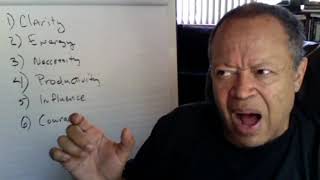
Steven Barnes applies Brandon Burchard's six high-performance traits to writing: clarity, energy, necessity, productivity, influence, and courage. Each one is learnable and lifts the others. Pick your weakest trait, practice it for a month, and watch what shifts.
Chapters
Hi, Steve Barnes here with Life Writing. Live as always, if you enjoy these talks, please be sure to share them. It's the only way that we know which talks are doing anything for anybody, which ones you enjoy, and what subjects and approaches you like the most. Many of you know who've been following me for a while that life writing is basically applying Joseph Campbell's model of the hero's journey to different aspects of life itself. In other words, the storytelling skill is largely a matter of defining problems and solving them according to a pattern. And I'm suggesting that you can simply apply the exact same thing to your life. That's what life writing is. So we're going to investigate a tool today. And that tool comes from a high performance expert named Brandon Burchard. And for the last two months I've been looking very closely into his work. I have this journal, have this journal that he does that you fill out every day. And it helps to guide your thinking in some very specific ways. Very interesting stuff. So I thought that I would apply it to the specific question of writing, because Jerry Pornell said to me once that if you master anything, you learn how to master anything else. So anything that is really useful in one arena should be transferable to other arenas. So he says that after studying 35,000 high performing people, he's discovered that there are a finite number of basic characteristics that these people have in common. Clarity, energy, necessity, productivity, influence, and courage. The thing that's interesting about these is that nobody is born with any of them. All of them can be developed. In fact, they must be developed. And that you don't find extremely high performing people who don't have these characteristics, or at the very least, people who have these characteristics can predictably outperform the people who do not. Now, it's an interesting experiment, it's an interesting theory, and you can perform experiments to test it. Is it learnable? Is it true that people have these characteristics? What, what happens if you don't have them? Et cetera, et cetera? In other words, are there people who are successful who are unclear on what they wanted to accomplish, you know, don't know what they're doing or why they're doing it? Probably. Are there people who are slugs, have very little energy, but still manage to succeed? Probably, you know, the Nero Wolfs of the world do need the Archies to go out and do their work for them. How about a sense of necessity? Are there people who are very, very successful who don't have a sense of urgency about what they're doing. Don't know why they're doing the things that they're doing. Probably productive. How about, are there very successful people who aren't terribly productive? Well, they're, you know, Margaret Mitchell only wrote one book that's not terribly productive. On the other hand, it was a hell of a product, you know, gone with the whim. How about influence? That's the ability to organize other people to, to get behind what it is that you want to accomplish. How many? You know, obviously the more people you can influence, the easier it is for you to get to organize them to accomplish things that you want also, or to influence people to help you in what it is that you're doing to allow you to model them. For instance, how about courage? Well, I know that in the, you know, are there people who've succeeded who are cowards? Of course there are. But let's take a. So we can dispose of the notion that it is impossible to succeed without these things. Let's take a look and ask ourselves in terms of this one very, very specific arena writing, are these things useful now? I'm juggling probably a dozen different creative projects right now, and they're in different stages of development. There's a movie deal that we just got paid for. There are proposals for movies at a couple different studios. Some other people that want us to create a television series for them. I've got, you know, a book coming out next year and I'm researching and structuring another one. And I'm in the middle of one with my mentor, Larry Niven. And then there are Short Friday. I don't have any short stuff at the moment, but I am formulating some ideas. There are ideas that are percolating. So clarity. For instance, let's say today's work. Am I clear on what I'm going to work on today? Yes, I am. I'm really clear. I'm going to work on my novel that deals with a time traveling serial killer. This is requiring some very careful structuring for what I call both horizontal and vertical integration. The horizontal integration or the recapitulation of structural elements that the structures have to mirror each other for each of the three different basic sections of the book. The, the vertical integration is thematic. The thematics of different. Of three different major structure sections of the book have to mirror each other. This is requiring. I put a lot of thought into it. I don't want to fix it in the mix, you know, with a time travel novel where it's like, oh, wait a minute, this happened and Then this happened and then did this person go back and this person. No, there's too much. So I have to be very, very clear. Which means, okay, let me get the ideas out on paper so I can look at them and evaluate them rather than trying to keep it all up in my head. So clarity is hugely important. Not just what the project is, but how to do the project, the aspects of the project, and what specifically do I need to do today to move that project forward? I know what that is. I'm going to go on to Google Docs, I'm going to work on a. I think it's about an eight page outline that I've been working on for months trying to boil this idea down. Critical part of the process. So what about energy? Well, you know, fatigue makes cowards of us all. I mean, and if you don't have energy, it's hard to even get out of bed. So, yeah, I would say that the energy that I have that enables me to actually think about all these different projects helps me to look at them as a game, as something that I'm going to. It's going to be entertaining to do rather than anything that's going to generate fear. In this, there's a sense of excitement. What about necessity? Why do I write? Well, part of it is that it's just what I am. It's just what I do. You are what you are. I write, I'm a dad, I'm a husband, I'm a martial artist. Those are things I have to address every day. Any day that I don't do those things, that's not what I am. I'm something else. So if I want to lose my identity, then fine, don't do those things. But once you define yourself as being a particular kind of person, you either do that or you lose your identity. So, for instance, in terms of writing, I must write at least one sentence every day. That's part of that formula that I've talked about many, many times. If you don't know that core formula that allows you to write a book a year with a sentence a day, just go to lifewritingcentence.com and I'll be happy to teach you all you need to know about that. But that I must write at least one sentence every day means that I will not let a day go by that I do not write at least one sentence. Period. End of story. I don't, I don't care what I'm doing, I don't care where I'm going, I don't care I just don't do it. Okay. There are similar things. I don't let it. Any day that I eat, I have to move my body every day. I have to connect with my family and let them know that I love them, that I don't let those go by. So that necessity thing is really important. And necessity gives you energy. Clarity gives you energy. Because one of the other things that he said is that each of these relates to the others. If you focus on any one of them, the others will get better too. Is that true? If I have more necessity, I'm going to have more energy. If I have the energy, then I can expend it on clarity. Maybe. I'm not sure. Okay, what about productivity? Well, obviously, in order to create a staying speed with your career, there needs to be a certain amount of productivity. Now, the path that I have gone says that you concentrate on short stories until you've got publications. Once you've got publications, you've been paid for it multiple times. You can go to longer works, but short stories are where you start. And what do you do? You write one to four short stories every month. That's a level of productivity. You fall below one story a month, you are no longer producing at the staying speed that enables you to move your career for it. If you don't do at least one sentence every day, at least one sentence every day, you have fallen below what the productivity necessary to make the system work. If you keep your. Your work above one sentence a day, above, you know, one cent, one story a month or above, now you're in the game. Okay, so productivity, it's necessity. Okay, I see why I need to be doing it. Do I have the energy to do it, to overcome things or maybe work a long day and still write at the end of it or whatever it is? Yeah. Okay. And clarity. Why? What is it I need to do? Why do I want to do it? How will this contribute to the other aspects of my life? Okay, we're pretty good. All right. Influence. Well, you know, if I'm writing something, I'm not a political writer, but I am a philosophical writer, and I want to convey my philosophy of how things go, how things work, what I have seen about these. And I know that there are people out there who my thoughts will influence, but I'm not political in the sense of trying to sway people's opinions. I'm perfectly happy to speak to people who already see things the way I see them. Is that being slightly disingenuous? I can understand somebody saying that I really Can't. But I can't think of anything I ever wrote trying to change anybody's mind. Not any piece of fiction. So I'm not trying to be political the way I define politics, but influencing people does matter to me. It's an interesting walk there, but let's put that aside. That's going to influence structure and theme and the way I do things and even maybe the way I cast the characters. Do I care about if this is something in here, Is it important for me to have women characters, black characters, white characters, gay characters, straight characters? I can think about those things depending on what representing in the story. Okay, it doesn't always matter. Sometimes it does. But aside from that, am I trying to influence readers to buy my books? Well, if I want to make money, sure. Am I trying to influence editors to want to buy my books? Sure. How about agents to want to represent my movie scripts and things like this? Sure. How about executives to want to buy those movie scripts? Absolutely. So. So I also need agents. I need agents, editors, fans, executives. All those different people are people that I want to influence. I want to enroll in the process of getting Steve's ideas out to the public. I need those steps, I need those allies. So influence matters a lot. And this is where marketing comes in, by the way. Marketing and sales. The single greatest mistake that I see artists making is not understanding how important marketing is. I don't think a day goes by that I don't see some writer, usually unpublished or self published, frankly, complaining about how the industry is against them and the world doesn't pay attention and it's not fair and all this stuff. And all I can say is there are thousands of people in the marketplace. Why should a stranger pay attention to you if you do not learn how to communicate the value of what you're doing to people so that they believe that trading their money for your thoughts and words is going to give them more pleasure than keeping their money in their damn pocket. You got a problem. As you know, I remember, I forget who was. Maybe Robert Heinlein said that a book needs to be at least as entertaining as a six pack of beer because they cost about the same, you know, if you're not giving people at least that much entertainment, you got a problem. And you can't expect people, you know, well, read the book. You know, it gets better at a hundred pages. Or just, you know, read my book. Tell me why I should read your book. You know, just, you know, you. That's. So you go out to conventions and you do signings and you learn how to use the Internet to spread the word about who you are. You study people who learn how to be influential or to sell their art, and you do what they do. And if you choose not to be a marketer, not to be an influencer, you do not have the right to complain. People don't give you their money because you never asked politely. Okay, courage. Last step. Courage. Well, I don't know about you, but. But every time I write anything that is difficult, and everything I write is difficult because I never. In terms of fiction, I never set myself an easy task. I never set myself a task, something that I've done before. I think that being on the tightrope is what people pay for. You know, let me see if Steve will fall off this time, you know, and beyond the shadow of a doubt, I've fallen off at times. And you have to pick yourself up and keep going. But before you ever get there, are you willing to write a hundred stories and send them out, and when they get rejected, send them back out? And are you willing to do that again and again and again? I mean, just all the way up to 100? Because if you are, my position is you can have a career you can sell, but you have to be willing to deal with the pain. You know, the pain of rejection. Fear that you're. Your dreams will always be out of your reach. The fear that people will laugh at you, that critics will mock you. The courage to change and grow, the courage not to hide behind excuses, to be willing to fail at something you care about. That can feel horrifying. It can feel absolutely horrifying. But you need courage to do that. You need to be able to say that the things that I'm concerned about, necessity, are bigger than my ego, that I am clear on why I want to do this and what it is that needs to be done, that I have the energy. Remember, fatigue makes cowards of us all. Productivity. I'm writing a bunch of stories. So if I get rejected on one that I wrote three months ago, while I'm already working on five stories later, then that rejection slip doesn't hurt as much as if I'd spent a year or two years or five years, for God's sake, working on a book, and then I send it out, it gets a rejection that feels like somebody has stabbed you with a fork in the guts and is raveling up your intestines like spaghetti. It feels terrible. So productivity protects you from fear, so does influence. You get a group of people around you, a reading circle friends, fans, who will tell you that it's okay, you know, that they love you anyway, they believe in you. So, yeah, it looks to me like these six characteristics do kind of tie together. And the nice thing, like I said, is that nobody is born with them, anybody can develop them. And all you need to do is choose the one that you consider to be your weakest, work at it for a month. Every single day, work on one of them, on your weakest one for a month. There are people who would work on their strongest one for a month. But if one of these is totally lacking, that could be problematic. On the other hand, he says that if you bring up the numbers on any of them, you bring up the numbers on all of them. It's a theory, remains to be tested. I would love to hear back from you guys. If you actually try this, if you try your using his journal or his book on high performance thinking and apply it to your writing or other aspects of your life. Let's take a look at this stuff. Anyway, that's all I wanted to talk about today. Clarity, energy, necessity, productivity, influence and courage. Interesting. Interesting. If you guys have enjoyed this, let me know and we'll talk about it some more. If you really like it, be sure to share this with your friends. That is the only way I know what works for people. Take care. If you want more information about these sentences. A day to write a book, a year. That's my. That's my pedagogy. That's my teaching method. Just go to lifewritingcentence.com and you'll get the free lecture on that. You take care, guys. See you later.







