"Star Wars Saved My Life" Orycon release Event
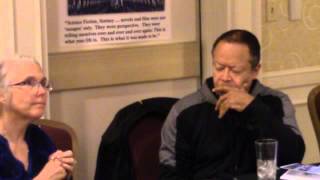
Recorded at Orycon, this panel is a launch/release discussion for Steven Barnes' self-published book "Star Wars Saved My Life." Barnes explains why he self-published (control, iterative updates), frames the book as an application of Joseph Campbell’s Hero’s Journey to everyday life, and uses Star Wars and other popular films as examples of stories that encode practical lessons (allies, failure and recovery, leap of faith). He shares personal anecdotes (30 published novels prior, martial arts background, teaching life-writing), practical exercises (the "ancient child" visualization), availability notes (book on Amazon, free workbook), and interacts with the audience (Q&A and giveaways). The tone is intimate, instructional, and celebratory.
Chapters
So I'd like to welcome you all to the release party for Star Wars Saved My Life by Stephen Barnes. Welcome, Steven.
Oh, thank you. Are we shooting? Are we live? We are really, really recording, yes.
We are not memorized.
So what we're here is we're here at Oricon and I flew in from Los Angeles yesterday and just wanted to talk a little bit about the new book that just came out on Amazon either yesterday or the day before.
The 17th.
The 17th, so. And we made it to number four, which is great, but basically it's still. This is my first self published book. You know, I've published 30 novels and done a lot of online classes and things of that nature, but I've never done anything quite like this before.
Why did you choose to do a self published book here?
Well, I guess the biggest reason I wanted to do it is that I wanted to have total control over what it was. And I also knew that once I got feedback from people, I was probably going to want to update things and continue to expand things. It's very, very difficult to do that with a traditional publisher. There's going to be an edition and then there'll be another edition. And this was very intimate. It's very personal to me. For years I've taught what I call life writing, which is Joseph Campbell's model of the hero's journey applied to planning your own life out in advance. And the most famous example of that pattern in the western world is the Star wars film because George Lucas actually tapped into Joseph Campbell's work to create the movie, that core mythic pattern. So I'd spoken about Star Wars a lot and watched science fiction dancing around these mythic images, you know, to a large degree. And I also watched the way people responded to Star Wars. I mean, Star wars hit like a. Hit the science fiction community like a bomb. I mean, before that movie you had to go to science fiction groups to talk about science fiction. After Star wars, everybody was talking about science fiction. So it actually legitimized it culturally. But at the same time there was a core group of people who are fascinated by it and completely committed to it. So over the years, as I've been writing science fiction and television and movies and books, I had seen that when you talk about these things and if you can create a link between these, these patterns here in these films that we love and our lives, that something positive could happen, that there were a lot of people who responded to that very powerful. So I knew I wanted to write something. What it was going to be exactly I wasn't sure, but like I said, I wanted to have some control over it. So I decided for the first time to do this one myself. And we'll see what happens. It's Princess Leia.
And the quote from the behind us. Science fiction, fantasy novels and film were not escapes only. They were perspectives. They were telling ourselves over and over again. This is what your life is. This is what it is you made it to be.
Well, are you asking what does that quote mean? Or why? Why?
Why did you choose that?
Well, because I believe that the hero's journey is not something that somebody created. It arose out of storytelling, and storytelling grew by accretion. Somebody would just say, I went out and I went hunting. And people would listen to that. And then over time, the stories became more complex. I went hunting, and this happened, and this happened, and these were the things of importance that happened. And the stories that lasted from generation to generation, I believe, are the stories that contain within them actual lessons about what life is. And if people listen to stories of heroes or battles or the tribe that traveled across the valley or whatever these stories are, if they died out in a generation, that's because there wasn't anything in there that anybody really needed any really wanted. If they lasted from generation to generation, it's because there was something that touched people.
So from your martial arts background, I kind of think of it as kata. Kata teaches you how to move through specific things in judo and teaches you the moves. And it seems to me that in some of your work, you've taken that idea of kata, of storytelling, of teaching.
Well, I think that I don't think there's any such thing as trivial entertainment. I think that either you're listening to a song or you're watching a movie or a play or reading a book to adjust your tension level up or down, which is critical to do, or you're doing it specifically to learn something. And the stories, once again, that last from generation to generation, they have powerful lessons in them. They may be lessons about courage or love or what it takes to survive loss or any number of these different things. But I think that human beings are smart. If we like something and if a lot of us like it, and if we like it for generation after generation, you can look into it and you can find things that are of real value there. We're not capricious in that way. We're actually looking for answers. We're actually asking ourselves the question, who are we as human beings? What is the world? What is life? How do we move forward how can we live together? These questions have always been important. I can't think of any myth patterns or stories that have lasted that do not speak to that. We are looking for answers. We want to know why are we here? Why are we alive? Why are we going to live or die? A movie like Star wars or the other movies that I touch on in the book, and these are just, you know, mock ups that we had done at Staples. They're not the real books. The real books are available on Amazon in ebook form, and they're going to be on print, on demand, and then we'll see what happens after that. We touch on the Matrix, on Aliens, on wizard of Oz, and of course, the original Star wars, each of which I believe was fantastically popular because it spoke to something they said, something. They were not just regurgitating stories that we'd seen before, but somehow through presenting a story and then presenting characters who are living through that story. They said, there's something here that you need to hear. There's something in this story, something in this book, something in this movie that has to do with your life. And in each instance of those different films, and we also touched on Independence Day, I believe that these things are popular not just because of the special effects. All the effects are great. Not just because of the action. The action's great, but because the filmmakers touched something. And I think that if you're a writer, for instance, it's important to have a sense of what your audience is really looking for such that you can try to create things like that. But even if you're not, if you're just a consumer of them, if you watch these movies and love these movies, and you wonder sometimes, why did this movie become so huge? Why do people love this movie this way? We're touching that. Yeah.
Why do people still love wizard of Oz? I mean, it was done way before I was alive.
Very simple story of a young girl discovering her power of someone ripped out of her ordinary home. You know, her ordinary home. The ordinary world of Kansas is black and white. Oz is in color. So it's a world realer than her world. And before she goes, we have Judy Garland singing this wonderful song somewhere over the rainbow. Traditionally, musicals, in the first 15 minutes or so, one of the characters will break out into a song that tells you the theme of the entire film. In this particular one, it's that she wants to go someplace that is realer than her world because she is not happy about her world. She feels, you know, she's being raised by her Aunt and uncle, I believe. And the mean old woman is trying to take her dog, Toto, and she feels like an outsider, that she doesn't connect to this world. And through a series of adventures, she is forced not only to bond to her companions, the Tin Woodsman, the Cowardly lion, and the Scarecrow, but she is forced to find her courage through a series of tasks and to confront her fear. And then, after all of that, spoiler for those of you who have the two of you out there who haven't seen the wizard of Oz, she discovers that she always had the power to go home. And not only that, she wants to go home, that there's no place like home, that the adventure was within her own heart, the ability to make the world color was within her own heart, the ability to engage with her world that deeply. So you take this internal journey of this girl who feels disconnected from her world, and you create images, you know, of intelligence and courage and emotion and tasks that we must do, the road that we must follow during life in order to find ourselves, in order to fit. And you combine this with songs and color and lots of laughs and so forth. But there's something underneath all of that. If it's a movie that has lasted or a book that has lasted generations, I'm telling you there's more going on than just the surface.
And I have to agree with you in that respect because it teaches the underneath. It touches something in our soul.
I think so.
And it's not painful. That's the other thing that I have found both in reading this and the other movies that you talk about, is that, yes, there's pain, but it's not destruction. It is not. It could be war, but it is. But there's always hope. You find the dark night of the soul is what you talk about.
Well, the dark night of the soul is one of the steps of the hero's journey. Basically, if you were to take a look at Star wars, you have 10 basic steps. And Campbell broke things down slightly differently. And if you read a dozen different books on the hero's journey, they will all interpret it a little bit differently. So there's a rhythm to it. The rhythm is outside the description of the thing. It's like if I could describe a path of a mountain. The path isn't the mountain. The mountain was there before you define the path, but the path can be useful. So there are, you know, with that, then I'm going to be. I'm going to be. I'm going to look at this without dogmatism My particular way of looking at these things is not the only way of looking at it, but I think it is very, very useful and has been for thousands of students for decades. So you have a character, a young man or a young woman who's confronted with a challenge. In Star wars, it was, you know, come with me, Luke. Learn the ways of the Force. Okay. The original Star Wars.
A New hope.
A new hope. Right. The character will initially reject the challenge, usually because they are afraid.
Yeah.
In this particular case, it was, I promised Uncle Owen, Aunt Brew I'd work on the moisture evaporators. Then the character is allowed to. To or forced to accept the challenge. In this particular case, it was Uncle Owen and Aunt Beru got destroyed by the stormtroopers, which both motivates Luke to act and frees him from his previous obligations so that he can overcome his fear and do the thing that he was born to do, which was to accept this challenge of becoming a Jedi like his father. You know, train me to be a Jedi like my father. Luke says to Obi Wan Kenobi. He sets. Luke sets out along way the. The road of trials. Now, the road of trials is just the gap between where you are and what you need to be, what it is that you want to be in your life. And it's just because if you had taken Luke from being a farm boy and you dropped him into that final battle on the Death Star, he would have been dead within seconds. So what the entire movie is about is how do you teach Luke Skywalker the lessons that he needs to be able to survive his final encounter? So that's the thing with life, that if you're going to change, you don't currently have the ability necessary to change, but you can set it up to learn the things that you need to learn. If you can organize your information, organize your time, organize your energy in an appropriate way. And I think that this is the information that is encoded underneath these stories. So he sets out on the road of trials, and he goes to Mos Eisley Cantina, you know, wretched hive Stumbling villainy. And he. Trav. Travels to Alderaan, which has been blown up, and he goes to the Death Star. So it's in a bing, bing, bing. It's literally, where are you going? In a heroic adventure, it's an external journey. In a more quiet film, it might be an internal journey where somebody just asks themselves, what do they really believe or what's really in their heart? An example I often use is Donald Sutherland in Ordinary People. Where he has to make a decision. Does he save his marriage or does he save his son's life? You know, he loves his wife. His wife hates his son. He can't save both of them. He cannot save the marriage and his son. In the entire film, he's a very passive character going through an internal journey such that he can make a terrible decision. A terrible decision. So along the journey, one of the things that you need in order to rise to the next level is you're going to need allies and abilities and capacities that you did not have before. If you already had those abilities, you already be there in essence. So either they're going to pull these things out of you, or you're going to acquire them along the way. And in Star wars, so he meets, you know, he meets Han Solo and Chewbacca and R2D2 and C3PO and so forth and so on. And if you take a look at the cycle of six films, even Darth Vader is actually an ally, because the movies are really about the Skywalker family versus the emperor, bringing balance back to the Force. So at some point, you're going to fail if you're going to try to aim at that higher level. One of the things that is absolutely unavoidable is you are going to fail. You're going to fall on your face. It's going to happen. Get over it, get used to it, Prepare for it. Before you get there. There's no way to avoid it. And every single person who has ever succeeded, the people you see that are more successful than you have also failed more than you. They just kept getting back up and trying again. So if you know before you get there that you're going to fail, then you can actually align your resources. You know, what are the emotional resources you're going to need? Who do you need to call you up and take you to the zoo or give you a hug or take you to the movies or take you out for ice cream, or can you write a letter to yourself? You know, put it behind glass to be opened only in case of emergency? You know, the next time you're seriously depressed, you open that letter and you read the letter that you wrote to yourself six months ago that is telling you, hey, I believe in you. We knew this was going to happen. Don't worry. You've been through this before. Because those sorts of problems. I've talked to women who've had children, and one of the things that they say and tell me, whether or not you find this is true. Angie, Princess Leia. One of the things they've said is that they don't tend to remember how bad the pain was. And I would say is that absolutely, you're just.
You're blissful in love with your child. Blissfully in love with your child. And the painful part, the part that you were just cringing about that whole time, that just goes away. Just goes away.
Now, the flip side is true as well, that the pain of birthing ourselves, we tend not to remember it such that the next time we encounter that pain, we think it means we cannot do something. In other words, we forget how many times we fell down when we were learning how to walk, how many times we failed learning how to talk, ride a bicycle, stuff like this. So that when you start trying to do a new thing and failure comes, you say, oh, this pain means I can't. This fear means I can't. This dark night of the soul where it feels like I have no chance to do this must mean I have no chance to do this.
So as a. I'm going to stop you there. Because I think that that is one of the greatest lessons in this book, is getting through that dark night of the soul. Because I watch students that I work with and part of our society, and a large number of the young people I work with have never failed. They've never been okay having failure.
Well, they don't remember failing. Everybody has failed, and everybody gets back up. But we forget that and we discount our previous successes. Earlier in life. I've seen people do that countless times. They'll say, I've never succeeded at anything. Nobody has ever loved me. They are lying to themselves. If they can walk and talk or ride a bicycle, they have succeeded. If human children who are not cuddled, held, touched will die.
Failure to thrive.
Failure to thrive. Absolutely. At some point in your life, people loved you, someone protected you, or you would be dead. So one of the secrets of success is being able to access the moments at which things went right and then bringing them forward into the times that things are going wrong. So the whole dark night of the soul thing, every single movie you ever seen where the hero had a triumphant success, there was some point at which they were broken, they had lost hope completely. That always happens. It's part of the pattern. Now, the way through the dark night of the soul is called the leap of faith. And the leap of faith is always faith in one of three things. It's either faith in yourself, faith in your companions, or faith in a higher power. And in the original movie, Star Wars, A new hope. It was all three at the same time. It was, you know, faith in himself that Luke was flying. He also. The Force. He was directing the Force, you know, so it's trust your feelings. Luke, he trusted his companions. You know, Han Solo dives in out of the sun and blows Darth Vader's people away. And faith in a higher power. The Force is this spiritual force that connects the entire universe together. So by trusting himself, he's connecting himself to the universe, he's trusting his companions. So John Williams theme music swells up and everything is great. So it's all three. So the next step after that is that you confront evil again. This time, you're victorious. And the last step is the student becomes the teacher. The movement to the higher level. In this particular case, it's represented confronting evil. And successful is the Death Star blows up. The movement of the higher level would be Luke being presented with a medal by Princess Leia, which is symbolic. Within many, many cultures, probably all cultures have some way of saying, this person's behavior is worthy of emulation. Do what they did. They give you medals or garlands or whatever. If you're a war hero or a sports hero, you've achieved something magnificent. They stand you up and they give you a medal, and they say to everybody, study hard. You can be like him. So at the end of Star Wars, Luke gets this medallion, you know, and Han gets a medallion, and Chewie gets nothing, darn it. And R2D2 gets nothing, darn it. But the audience stands up and applauds and the music swells and credits roll. So we've been through this journey, and all over the world, millions of people saw this, and they loved it, touched them. There was something there that they wanted to watch it again and again and again. I must have seen that movie seven times in the theaters.
I can tell you how long I stood in line, you know?
How long did you stand.
I stood in line for three days.
Yes.
Yeah. Watching with. And I was in college.
Yeah, see, that's.
And we swapped it up.
It was a big grin on his face. You know what I'm talking about? The kinds of movies that have that kind of impact, stories that have that kind of impact. This stuff is not trivial entertainment. It is giving us something that we need as human beings.
And I want to go to that, Stephen, because I think one of the great things about your book is that everybody has pain, everyone has challenges, everyone has something they aren't going through. And each of the characters in your book have a challenge. Have something that they're dealing with. And what you're doing is introducing each of them to their own hero. And their own hero is going to walk them through how to get through that challenge. Because they need that. They need that identity with that hero. You know, my hero is Luke Skywalker. So how, if I'm walking through this challenge, what would Luke do when he's confronted with that challenge? Did he reject the challenge? Yeah, originally he did. Okay, I reject some of those things that happened in my life.
We've all done that. Right?
Right. So eventually you accept that challenge and you go through that. We've got his companions. I found some companions of myself to help me through my journey.
Well, that's an important thing right there. None of us can make it alone. All of society, unless you want me to believe that you learn how to walk and talk and drive a car and ride a bicycle by yourself, then everybody is helped by the people around them. Human beings, individuals, our not much smarter than chimpanzees. The advantage we have is that we can share information with each other. In other words, I can live my life and I can turn around and say to my 11 year old son, this is what I went through. You are afraid. You are afraid of doing this. You are afraid. You can't do that. I was afraid too. He'll say, dad, you were afraid, but you've got a black belt. Actually, I have three, but it's irrelevant. What's important is that I remember distinctly driving down the street with tears streaming down my face because I was so scared to go back in that school. And if I could tell him that, and tell him that honestly and say that was my dark night of the soul, he said, well, how did you get through it, Dad? I got through it because I believed that somewhere inside me there was the strength necessary to do this. Because people I trusted told me that they saw something in me that was that convinced them that I could do this. That I was faster than I thought, stronger than I thought, braver than I thought. But all I saw was my cowardice. But all I saw was that everybody was stronger than me. My teacher looked at me and said, no, you have greatness inside you. Keep going, keep going. Same thing with my writing. I remember the first solo novel I ever wrote, and I sent it to Harlan Ellison, who was a friend, to read. And Harlan called me up and said, this book is not ready for publication. Withdraw from home. And it was already at the publisher getting ready to come out. And I was like, I was devastated. I Was devastated. It's like all my hopes and my dreams, everything. It was just awful. I remember just one of those moments where I was, like, curled on the floor, just like, God, you know, what am I going to do? And my whole life falling apart. And, you know, I got up and I kept moving. But the flip side of that pain is 20 years later, Harlan sees an Outer Limits episode that I wrote. And he told me he thought it was great. And because of that earlier pain, I knew he was telling me the truth.
Right?
And so it felt just. Is good. It's like, oh, yeah. Oh, yeah. This. It's okay. It's okay to hurt. It's okay to be afraid. It's okay to fail. In fact, you have to go through these things. If you don't go through these things, you will never learn.
I love that about this book because it doesn't just identify with one particular person like Luke Skywalker. It's every person who. Who has their own hero. Is it Dorothy from the wizard of Oz? Is it Luke Skywalker?
Is it Yoda?
Is it GI Joe? Is it hello Kitty? It doesn't matter, right? Who is your hero?
Hello Kitty is my hero.
Who is your hero? Who do you think about? And go, God, that person really spoke to me because they went through the hero's journey too. There's a reason that entity or whoever is your hero, and they can help you through your own challenges. That's what I love about this book, because it really walks through different characters, finding that within themselves, they find their strength, they find their passion, and they move through that.
It's incredibly well. All I know is that the science fiction community was my home. It was the first place that I found that I felt completely accepted as a human being. And there is this phrase, there's this term called gap eating, which basically means you get what you need from the science fiction community and then you leave. And I will never do that. The people here, the community here saved me in a lot of ways. Just like Star wars took my private obsession and made it public enough that now I'm not a horrible. I wasn't a horrible geek. I was just another person who loves science fiction. It actually is. It actually opened up. So when I say Star wars saved my life, the science fiction field gave me a way to connect to people. It gave me a way to take my dreams and to share my dreams and raise a family. A place for me to heal my heart. There were three things in the world that I cared about. I cared about writing. I cared about Martial arts. And I cared about my relationship with my family and friends. And so when I asked myself, what can I give back? I decided I would create this parable about a family of science fiction fans who have things that they want to accomplish in their lives and they learn to tap into the movies that they love the most. And I'm saying that the lessons that you need to live happy, a happy, healthy life, you've already got those lessons. They're right there in the movies you love, in the books you love, in the stories that you love. All you need to do is learn how to extract that. So what I did was I took 30 years of training in neuro linguistic programming and pan cultural shamanism and the martial arts and Ericksonian model hypnosis and all these different things. And I told them, I organized them in a way that if you just read this story and then hopefully maybe go back and watch those movies and.
Go find the workbook.
And go find the workbook. Which is free. Yep. You know, so like, this is available on Amazon Prime. If you have Amazon prime, you can borrow it for free. If you have, if you have the other Amazon thing, you can get it for, you know, you can borrow for free or you can get it for free. We're not doing this to make money, although we'll be happy. You know, we're pricing it as low as possible if you don't have one of those things. But it's not about the money. It's about what do people need to complete their lives. I went out and I found the things I needed to have a successful writing career, to be married to my soulmate, to have those three black belts, to be happy and healthy in my own life. And I believe that we can all be on that path. This is what I honestly believe down to my toes.
Well, I think that critical part is that a belief, faith, action, goals, and, and your goal is to see science fiction thrive and the people in science fiction thrive and be healthy because, well, they're family.
You know, you guys, you guys are my family. Anybody who knows me, who's known me in here, you know, for some, some, some of the people at this convention have, have known me for 30 years. You know, have I changed? Really? I'm pretty much the same, you know, I'm the same guy. Pretty much. This is the life I wanted. This is who I am. You can't fake that for 30 years, you know, you just can't. I love the people at these conventions, you know, I love, I love the dream. I Love the movies. I love the fun. You find smart, sweet, good hearted people who just love to play. You just love to play Leia slave girl. I'm just like, you know, oh, yeah, woof.
Carrie Fisher has nothing on me.
I'm just kidding, Carrie.
So, you know, that's, you know. Well, I guess that's kind of the basic framework for things if, you know, we're just doing this for, you know, we're going to put this up on YouTube and just to give people an idea of what the book is and what it is that we're doing. But if there are any questions about anything connected, because there are a lot of different technologies, a lot of different things in there and we actually, with a group as small as we have here, we can actually give a couple copies of this book away. Absolutely, absolutely. But you have to ask me a question. To get a book, you have to ask a question. What part of Star wars do you like? What part of Star wars did I like the most?
I used to like the action and the characters.
You know what I liked most about Star wars was the way this group of people came together to accomplish something that none of them could have done alone. Okay. I think that that was what. It's because we all have that sense of there's a huge world, world out there and there has to be some way I can fit into it to do something important. And we want some sense of meaning in our lives. And if we can find the right group of friends, the right group of companions, they can lift us up. I mean, in general, you're not going to get any further than the reference group of friends you're around. You know, the fastest way to grow it anyway is to change your reference group. The fastest way to fail is by changing your reference group. Being around people who are going to drag you down or lift you up. And in the case of Star wars, and every single one of those characters contribute to help Luke Skywalker become the hero he was born to be. You know, C3PO and R2D2, every single one of them, one piece at a time. And when you, when you look at that and what that means, what, what I see when I look at that movie was a magnificent expression of that core myth that you will find all over the world, in every culture in the world, they tell this story about someone who is at this point in their life who has this set of challenges and to save their village or save their heart or save their life or save their sweetheart, they move beyond fear and they move beyond Limitations, and they find some way to grow. And there is no one who hasn't been stuck. There's no one who has not felt, I can't change my body or I can't make more money, or I can't finish school, or I cannot find love. I can't save money. I can't do this, I can't do that. We all have that. And what I'm saying in this book is that the lessons that you need are right there. And for me, the biggest lesson, pick your friends carefully. You can't choose your family, but you can choose your friends. And you want to choose people who will lift you. You up when you stumble. Okay, so for me, that's what was in Star Wars. That just, you know, all the special effects and the music. I love that stuff. But what I really love more than anything else is Han Solo diving in out of the sun. Is Princess Leia, you know, with the cinnamon buns on the side of her head, trusting that Luke was going to come through. Was Obi Wan Kenobi willing to die to protect his pot of war. Who was going to bring, you know, balance to the force that these characters, you know, caring about each other, selling their lives dearly. It's a trivial little science fiction space opera, and it touched hearts all over the world. There are a billion people on this planet who have seen that movie and love that movie, and I am one of them. And here is your copy. Thank you. You bet. It's good to see you, too. Always good to see you. Always good to see you. Yes.
Joseph Campbell's work on the Hero's Journey had a big influence on Star Wars. Yes, and it has his. His studies show us that.
And by the way, make sure I need to sign that before you leave.
His studies show us that that story is universal. As you were saying, I was wondering if you had studied Joseph Campbell's.
Well, the Hero With a Thousand Faces. Sure. I've read Campbell. I read Campbell. Actually, Joseph Campbell was one of those major breakthroughs in my life. I was teaching a class at ucla, and it was on a writer's toolbox. You know, techniques for people to be able to write effectively. And one of the students in the class said, you know, Mr. Barnes, you've taught us all these wonderful techniques, but, you know, flow state management, outlining and brainstorming and so forth. But I don't think I'm going to be able to take advantage of because my wife doesn't really support me in my writing career and my kids are always bugs Me for my time. My job takes up so much energy and so forth. And there's an expression that from time to time, life gives you a cubic inch of opportunity, and you either grab it or it's gone forever. And I got one of those cubic inches. It was one of the four or five best ideas I ever had in my life. And I said to him, if you were a character in a story you were writing, and at the end of that story, that character got everything they wanted. What would you have that character do now? And the guy started coming up with his own ideas. He said, well, first his eyes crossed and smoke started coming out of his ears. But after that, he started coming up with some ideas. And he said, well, I could take my lunch to work, and that would save some time. And I could tell my kids that what it is that I'm doing is I want to write books. And they think that was really cool, and they'd probably support me in that. And I could exchange chores with my wife, give her some time to do some of her hobbies, take over some of her chores if she'll protect some time for me to be able. And I was sitting back saying, how could he have been stuck at this point and be a font of ideas at this point? Same guy, same brain. He hasn't learned anything else. What was it? So I tried it on the rest of the class, and people started coming up with their own answers, too. So I went home then night and asked my wife. I told her what it was that had happened in school. And I said, I think something important happened here, and do you think I should dig into it? She said, yes, you should. So I started doing research. And one of the things I researched was Joseph Campbell. And Campbell had a quote, something to the effect that cultural myths are the depersonalized personal dreams, and personal dreams are the personalized cultural myth that there is this connection between the dreams we have as individuals and the stories we tell each other as a culture. And when I saw that, I saw what that was, that I believe that the Hero's Journey and other stories are the older people of the village telling the younger people of the village, this is the way your life is going to be. What this quote is. Science fiction, fantasy novels and films were not escapes only. They were perspective. They were telling ourselves as a people, as a species, over and over and over again. This is what your life is. This is what it was made to be, what it was meant to be. This is who we are as a species, as individuals. Young man, young Woman. This is what it's going to take to grow up. This is what it's going to take to grow up with integrity, to deal with fear, to deal with death, to deal with aging, or to deal with failure, to deal with success. All the those different things. You can find stories about all those things. And the stories that are most cross cultural tend to be the ones with the least talk and the more visual representations of the stresses that we go through. So these trivial comic book movies and stuff like that, the reason these things are universal is because we look at the symbol of Thor or Captain America or Iron man or whatever it is, and these things, these symbols hit us on a level that more mature talk often does not bypasses us.
It bypasses our conscious brain.
That's right.
If you would have told me that I would have loved Iron man and I have seen every single Avengers movie, I would have told you you were absolutely nuts.
But they're doing something there.
But, but we're first in line.
Yes. And you know, I will say, see all this thing, it's like I've been watching James Bond movies since I was 12 years old and I saw Goldfinger. I mean, come on. James Bond lives in a two dimensional universe in which a single human being can change or save the world. He can fly any machine, bed any woman, drive any car, speak any language, on and on and on. This is a comic book, but it's a comic book to ask the question, what is a hero? You know, and just for a couple of movies that even entertain the question, what does it cost to be a hero? What does it cost to be James Bond? So Skyfall really went there for the first time ever.
It was amazing.
It was amazing.
I cried.
It was devastating. When you realize that this fantasy wish fulfillment that all these guys have, oh, yeah, I want to live the James Bond lifestyle. I want to be like, beat any man. I can do this. This is what it costs to empty out your heart, to have nothing except I will stand between my country and harm. That's all he's got. He has no friends, he has no future. He knows he's going to die alone in some alley and nobody will care. Moneypenny will come and put flowers on his grave. There's nothing glamorous about James Harden. There's nothing that any sane person would want, but it is. We all would like to believe that there is a James Bond or Modesty Blaze or Black Widow or within us, someone who could rise up and do what's necessary. If you have a sick Child. And you have to stay up all night to take care of that child. And then you have to go to work and manage group. Are you not a superhero? Your child certainly believes you are.
Absolutely.
The commercial that says moms don't get days off.
That's right.
Sick leaves. Dads don't. You know, I thought that was one of the most clever ads I've ever seen.
That's right.
Because that's the truth.
That's the truth. This is what our lives are. You get up when you have a family.
By the way, I'm gonna say the fact that you have a family in this.
Yes.
Was brilliant. Because it's a family and it's kids and it's. What do I want to teach my children?
And children go through pain too. Teenagers go through pain too. They need their heroes too. They need to know how to go through the adults out there that we're showing how these teenagers go through this path as well. And have their parents help them.
Yes. And they and their adopted aunts, I'll tell you that.
But can I take care of my adult responsibilities in the world and still keep that little kid alive inside me? Yes, you've still got your little kid inside. Oh yeah. You look beautiful.
You look so beautiful.
And you're having fun at a science fiction and you handle real adult responsibilities at work and you have a family that depends on you and you have the stresses and tragedies and issues that every adult human being has. But you have not lost that little girl.
The giggliness.
How important has Star wars been to you to help you do that?
Saved my life.
Saved your life. Absolutely.
Absolutely. That is not a joke.
Because you are a hyper competent human being.
Yes, I am very professional woman in real life.
Yep.
I can avouch for that since I work with her.
Another hyper competent person, you know. And I have. You still have fun though.
Life doesn't go away just because you have a professional life.
And not only can you have fun, it is critical to have fun. Life is not supposed to be just drudgery. Even though there is drudgery to be done. You have to do the tasks or else your children are not safe. The children of the world are not safe. But being an adult does not have to be this, oh God, I got up another day. No, it can be. Everything I do has significance. Every task I do has significance. Every person I contact is important. There are no unimportant people on the this planet as far as I'm concerned. I may not be able to spend equal Time with all of them. But they all have hopes and dreams and needs, and they all. When I create a story, I've written 3 million words of fiction. More than that now, in every single story, I was trying to say something that was important to me in a way that would touch them as well.
And you just said something, Stephen, I really, really appreciate. Everyone has hopes and dreams. It is so critical that every person listens to those hopes and dreams and not shut them down, ignore them, think they're stupid, think they're crazy. Because when they do that, there's a part of them that dies.
It dies.
It dies.
You actually can kill your heart. Kill the hope, kill the hope. So what? This, Grab it back.
No matter how crazy it sounds, no matter how crazy your family or your friends tell you to do this, it doesn't matter. It's your dream.
That's right.
Follow it. Pursue it. That will make you one of the things.
One of the things that I did in here, and I get paid a ridiculous amount of money to work with sometimes very, very wealthy and famous people who have emotional stuff. And I found a set of tools that work when I'm working with them. And one of those tools is, is there are probably dozens of different separate tools that are internested in this book, in the simplest, most direct story that I could tell that still had cohesion, internal cohesion, trying to tell the truth. But one of those tools that I'll just give to you right now is something called the ancient child. And what you do is you imagine there's several different ways to address this, but you visualize the child that you were when you started this path. The oldest child that you can visualize that is still happy and healthy and connected to his dreams, her dreams. And for many of us that might be about four or five years old, sometimes 10 or 11, but usually for most people, it's somewhere around six or seven years old. And you visualize that child and you make sure, does that child feel safe, safe, healthy? Because in a lot of ways, your only job as an adult is to create a safe space for that child to play. Just, you know, the child's your little boy, your little girl. Their job is to dance and play. As an adult, your job is to create a safe space. You know, build the fences, keep the bobcats out, sweep out the broken glass, prune the thorns off the roses, but just create a safe space for your kid to play. So you've got that K kid and you've got the adult part of you. And then there's another part, the ancient part, that is who you're going to be on your deathbed at the end of life. Beyond all need for ego, all need to look good and all need to worry about what anybody thinks about you and all the masks that we wear. That's your wisdom. The child part of you has all the aliveness and the energy and the creativity. The ancient part of you on your deathbed has your clearest values, what is really important. And if you don't, if you're not clear on that, read, look up the last words of famous people or just the things that people say on their deathbeds. Find out what is actually important to people. I guarantee you none of them said it wasn't going to work.
Or having a Ferrari or having.
That's right. I should have danced in the rain. I should have written poetry. I should have told my dad that I forgive him and that I love him more than anything in the world. I should have spent more time with my kids. I should have done this. I should have shared my heart. I should have told the truth. I should have had more courage. You look at the things that people say on their deathbed and you understand that you should live your life so that the last moments of your life will not be filled with regret, but with joy. Yeah, but with joy, With a sense of completion. I did the best I could. There may be tears, pain, whatever, but the worst thing in the world is a feeling of, oh, my God, I went down the wrong path. I lived someone else's life. You got to live your own life.
Okay, And I'm going to say, I'm going to interrupt you here because we have. And especially for those of you, because we have mostly women in here, we have an opportunity in today's world that was not given to our parents.
Absolutely.
And my grandmother is 109 and she's still active and she still moves. And she had so many limitations. And I just really encourage people, especially the young women I work with. And the reason I'm interrupting is because we're going to end up running out of time here.
Yeah. Well, I mean, what I want to say is that if you make clear contact with that child inside you and you make contact with the person you're going to be on your deathbed. All you have to do to have a good life is to your adult self simply has to find some way to take your childhood dreams and your deathbed values and navigate them in the adult world that you think you take a look at everything you're doing? Am I expressing the dream I had as a child? You don't have to be working at a job that makes you happy if the job enables you to support the things that make you happy. You can go down to the coal mine if you're doing it for your family. When you come home, your kids jump up in your arms and say, daddy, we love you. If you do that, you have a life that belongs to you now. There are many things in this book. Star Wars Saved My Life. It's one of those things where I finally decided to put put my thoughts about this down on paper in some way that would be effective. Hopefully effective and efficient. I hope that you will go to Amazon, take a look at it. Star Wars Saved My Life by Stephen Barnes. Like I said, these are mock ups. These are not the real books. We had them for Oricon here and give it a chance and then write to me. Let us know how you're using it, what you need more of, what you'd like me to emphasize and I will respond. I just, you know, I love you guys. You know, you saved my heart, you gave me a life and you enabled me to raise my family in a way that was in integrity with my dreams and my values. I have no way of saying thank you except to kind of empty my heart out in a way like this. And I hope you can feel how sincere I'm being here and, and how much I care. And I want you and each and every one of you to be able to live your own dreams. So we're just going to kind of wrap things up here. And my final comment is just that. Believe in your dreams. They come from some deep wellspring inside you. Don't ever let them go. Don't ever let anybody talk you out of them. And what this book is about is about a family of science fiction nerds who wants to heal their physical health, find love, build a career, and save money. The basic things all of us really, really need. And so these techniques are applied to that and it's a fun story. And if you read the book, you will get the result because you've already seen how to win a thousand thousand times. Thank you very much, Steven Barnes from Oricon. May the force be with you.







