The Five Minute Miracle Strikes Again!
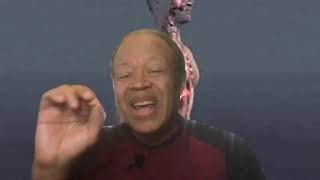
Steven Barnes explains the difference between stress and strain, then teaches diaphragmatic breathing and synaptic facilitation as free techniques to manage stress during difficult times.
Chapters
Hi, Steve Barnes here with Life Writing Live. We're going to be teaching you something very special today, something which I kid you not, could save your life. The lives of your family, people that you love dearly. The secret is, the thing that I'm going to be sharing with you is based on the fact that we've been told that stress is a killer. And that's not entirely true. And I'm going to make that very, very clear. What I mean, I know that that sounds like a drastic thing to say, but I will explain myself. First, let me tell you who it is that I am. My name is Stephen Barnes and New York Times best selling writer, martial artist, yoga instructor and human performance technician. I've been, I've lectured at UCLA and Seattle University, at the Smithsonian Institute. And this is what I do. I've been willing to drive a thousand miles to spend 15 minutes with someone who could give me a piece of information that was important to me or to my family. Of all my accomplishments, my family is the most important thing. My son Jason. My daughter Nikki. My beautiful, brilliant wife. It's an honorary due. My wife, my sister Joyce. Anything that helps me, that it can help me help them. It's something that I sought out at any cost, no matter what. And now I've got a body of knowledge that in this time of national emergency, I'm happy to be able to share. Now, I've sold this information for as much as a thousand dollars an hour, but I'm going to give it to you for free. Because what I want is for you to use it for yourself and for your family and for your community. So it's going to be. There are going to be three secrets that I'm going to tell you. Three secrets. And my little friend back there on Chroma Key is going to help explain these secrets to you so that you can use them as simply as possible, as efficiently and effectively as possible. Okay? Secret number one is the notion that stress is not the killer that people think it is. Stress is what life does to you. It is the structure of existence in some ways. If you walk outside and there's a car backfires, that's stress. But how you react to it is you. What you have to do is to prevent stress from becoming strained. The guy who created the concept of stress is a man named Hans Selye. And before he died, he said that if he had known at the beginning what he knew at the end, that he would have been known as the father of strain rather than the father of stress. Now, the difference between stress and strain is that from an engineering point of view, stress is pressure per unit area I'm pressing against this piece of paper, but strain is deformation per unit length. It's the way the paper reacts to the pressure. This is what you want to prevent happening to you. Now, if you can grasp that the difference between stress and strain and that strain is the thing you want to prevent, we can go on to secret number two. Now, secret number two is that there is a physiological. There are physiological reactions that trigger before stress becomes strain. This is why lie detectors work. If you're lying, the theory goes, you are under greater stress. And if you're telling the truth, and it will have effects in terms of galvanic skin response, pupil dilation, heartbeat rate, blood pressure, stuff like this. And they can measure it with a battery of instruments and determine when your stress level spikes, which then tells them that you are lying. The trick here is that if you can keep stress from becoming strained, if your body doesn't know that the stress is painful to you, then it isn't. It isn't. Now, we're going to go into Russian sports physiology here. The Russians say that any physical action is composed of three. Breath, movement and structure. That the breathing, each of these is creates. Each of these is created by the other two and influences the other two. So your breathing is controlled by your movement and your structure. Your body has to move around your spine and your ribs in order to create a diaphragmatic contraction which drives the air out. And then, then you have a relaxation. So the air pressure goes. Nature abhors a vacuum. Air pressure fills your lungs. That's a respiration cycle. Your posture is created by your breathing, your alignment created by your breathing. And your movement, your movement is created by breathing and structure. Structure, posture, the movement of your skeletal system, basically. So each of these is created by the other two. Now, this becomes really interesting because before stress becomes strain, or what stress does, that causes a real problem is it disintegrates the balance of body of motion, breath and alignment and skeletal alignment, structure. In other words, you know that when you are depressed, you have a hunched body. You know, it's like sad facial expression. You also, when you're scared your body's going to react much as if you got punched in the stomach, your diaphragm spasms. And instead of breathing deep and slow down here, diaphragmatic area, you're breathing up here in your chest, you're breathing up here in your shoulders, right? You literally are not getting the Air that you need. Now, babies do this naturally. Why do we lose that diaphragmatic breathing as we get older? I don't exactly know, but it could simply be accumulated micro trauma. It just keeps happening to us and happening to us and happening to us. And one day we no longer realize that we're hunched and breathing shallowly up here in our chest instead of down in our diaphragm. It's very unfortunate, but the good news is that the breath is the canary in the coma. It's the only process that's both voluntary and autonomic. Therefore, all world spiritual disciplines, and most of the disciplines that help us deal with stress and help us find peace and so forth, one way or the other, will work with our breathing. Yoga, Tai chi, Qi gong, martial arts, we'll all deal with it directly. Self hypnosis, meditation, so forth, will have the effect of slowing your breathing. In fact, if your breathing is still high and tight and rapid like that, we know that you're not relaxed. So we can relax you and that will have the result of slowing your breathing, or you can slow your breathing and that will have the result of relaxing. The feedback loop goes both ways. Now they talk about meditation. The ideal period for meditation being something like 20 minutes twice a day. Well, if you had 40 minutes a day, the chances are you wouldn't feel like you were under stress. That's the danger with stress, is it makes everything so imperative that you're running constantly trying to put out fires, or you feel paralyzed. You basically don't have any resources. The good news is that there's a way to cut the time frame that it takes to do this from 40 minutes or even 20 minutes down to 5 minutes. And that takes us to secret number three. Secret number three is another piece of Russian knowledge. And it has to do with super performance, high performance, and it's called synaptic facilitation or neurosynaptic facilitation. Now, what it is in the most basic way would be illustrated if you wanted, if you had an hour to practice playing piano, if you had an hour a day to practice playing piano, you would be better served by practicing piano for five 12 minute segments or 12 five minute segments, than you would practicing it for an hour all at one time. Why? Various reasons. One of them being that the focus of attention begins to wander after a few minutes. So if you can practice it all at one time within the focus of attention, before you start feeling fatigued, you're impressing images and patterns on your nervous system more Efficiently and effectively. Other things have to do with actually creating new habits. So with a piano, it's not the same way. But if you wanted the habit of posture, for instance, rather than practicing your posture for an hour at a time, if 12 times a day, you practice sitting up very carefully for five minutes, that would have an amazingly powerful effect. So this is what you're going to do. The secret of the five minute miracle. When you put all these things together, something really amazing becomes possible. The secret is that it's not five minutes all at one time. The secret is that it is five 60 second spans spaced out during the day. In other words, you might do it once every three hours. 9 o', clock, 12 o', clock, 3, 6, 9 o'. Clock. Or if you're under a lot of stress and so many of us are right now, you might do it at the top of every hour. Just every hour. Stop. Breathe deep, slow, diaphragmatic breathing, please. Google is your friend. Go to YouTube, go to Google, actually see the videos on how to breathe deep, slow, diaphragmatically. There's only so much I can give you right here. You have to take this and run with it. I'm not asking you to have faith. I'm asking you to be a scientist to perform the experiment. And if you do this just five minutes a day for two weeks, let's say six days a week, that's only an hour invested of your time. One hour to see whether or not I'm telling you the truth, that you can stop the negative effects of stress forever. And once you have learned how to do this, you can give it to your families. When your children come to you and say, mom, dad, I'm scared. If you have done this and experiment, you can say, look, here's a game we can play together. And you can teach it to them. When your neighbors, your co workers, members of your family say, I'm scared, I have nightmares, I can't sleep, you'll be able to say, here's something you can do. It won't just be poor baby and give them a hug. Say, poor baby, give them a hug. But then give them something that they can use to change their life. Lives. This. This works. I know that it sounds like magic. I know that you wonder if it works so well, why don't I know it well? The fact is that the component pieces of this have been scattered through multiple cultures. It's not your fault that you don't know this. And once again, Hans Selye, the guy who created the entire concept of stress, felt that he was wrong about what it was. So it's not your fault, but it is within your power to change things and to grab this little piece. There's an expression that from time to time, life gives us a cubic inch of opportunity. This sort of floats by and you either grab it or it's gone forever. This is your cubic inch of opportunity. This is your chance to change your life. And I'm hoping that after you've tried it, you'll come back to Mastery plus and you'll take a look at some of the other things that we have for. Because there are other secrets, other things that are even more powerful than this. This is just the most powerful one that is efficient, effective, safe, that I can teach you like this, that you can take run with it absolutely free of charge. I'm so happy to offer the five minute miracle to you. I'm hoping that you'll go further on the journey with us. But more importantly, I'm hoping you'll take care of yourself and you and take care of your family and you'll actually use this technique. This is Stephen Barnes saying, thank you so much for giving me a few minutes of your time. Be sure that it's an investment, not some time that you threw away. Actually use this. Actually do it. This is not a thought experiment. You actually have to experiment, experience it. Thank you so much. I'd like to close today, as I often do, with the Sanskrit expression that means that the divinity within me salutes and acknowledges the divinity within each and every one of you. Namaste. Take care.







