Making It, Episode 01: The Genesis of Ideas | Presented by Squarespace
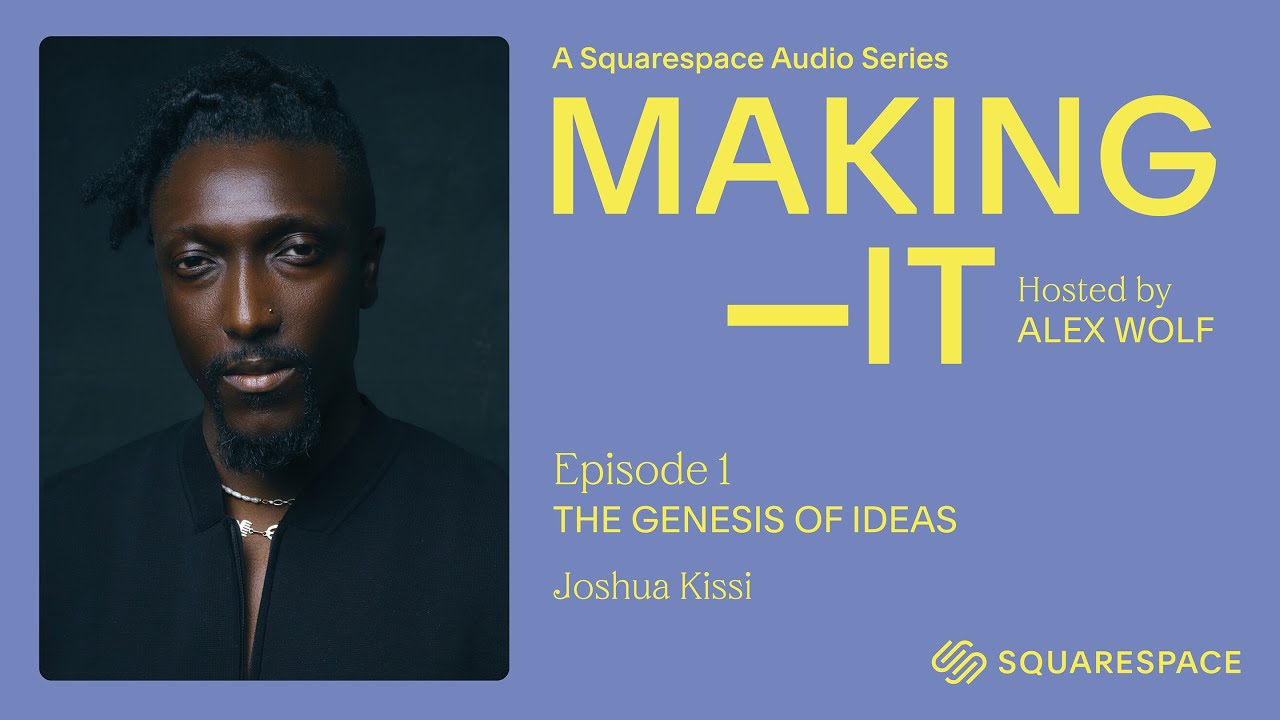
Joshua Kissi, co-founder of Street Etiquette, talks about discovering ideas through presence and natural light, building community on Tumblr in 2008, and the calculated risk of leaving a day job for creative work. He emphasizes a "me-to-we" philosophy and serving Black and brown audiences, finding contentment in relationships over perfection.
Chapters
The sun is a natural storyteller daily. So as long as you're staying present and staying within the vision of what you're creating, you can find inspiration anywhere. My creative process starts with light. Seeing the sunset is one of the most inspirational times for me because our bedroom honestly is right where the sun comes down at and seeing these Warm rays come through the window, hit the floor, just reminds me of back home in Ghana. And the colors from the sky always inform me to be present, but as well as to think, in this moment, what type of story can I tell?
That was Joshua Kissi, a self-described Ghanaian-American creative entrepreneur, photographer, and filmmaker. And this is Making It, an audio series from Squarespace about starting and sustaining a business today. I'm your host, Alex Wolff, and I believe that starting a business changes you. On Making It, I sit down with creators and entrepreneurs to explore how they got their ideas off the ground and kept them going. These are our stories. I launched my first business when I was 22 years old. I took a huge risk. Social media was still so new, but I learned a lot, brought a lot of people together, and I took an idea and turned it into something that had never been done quite like that before. What I learned from that experience was so much, but mostly that technology has the power to shape human behavior, which ultimately shapes society. And starting my business didn't just change my life professionally, it fundamentally shaped who I was. It made me ask myself the big questions like, What is my capacity? What are my real strengths? Where do I find contentment? And who am I doing this for? Years later, I've launched several small businesses, and I'm constantly talking to people who are standing on that precipice, asking themselves, am I ready? So I wanted to make a show to explore that question and how to sustain your vision as your business inevitably grows and changes over time. My hope is that this show will make you feel less alone and give you confidence to keep building your business even when things get bumpy. If you're someone with an idea you've been dying to get off the ground or want to take your project to the next level, this show is for you. This is the sound of Joshua Kisi getting out his camera. A familiar act that jumpstarts so many of his projects.
Camera shutter. Best sound ever.
Joshua is a multi-hyphenate creative, the kind of person you can't summarize in a noun or two. I knew I wanted to have him on the show for this, our first episode, because Joshua to me is someone who is an expert in beginnings. And how to take the seed of an idea and turn it into a reality, even multiple realities. Joshua took his love of the lens and co-founded the lifestyle blog Street Etiquette, an exploration and documentation of fashion in the African diaspora. He then turned the blog into a thriving agency, producing films, editorial, and campaigns in the same visual spirit. There's a lot of emphasis out there on finding an idea, but I think ideas are actually a practice. We have to know who we are, what we want, and then go for it. So in this episode, we're unpacking not just where our ideas come from, but how to channel them into a creative career. First, I'll be talking to Joshua about his journey, and then we'll speak to Brandon Stosy, the editor-in-chief of The Creative Independent. Brandon has interviewed literally hundreds of artists about what it takes to start and sustain a creative practice. But first, here's Joshua Kisi from Street Etiquette on the genesis of a great idea. Hi, Joshua. Thank you for coming onto the show.
Thank you for having me. I appreciate it. Thank you. Thank you.
I think some people would consider you a part of, like, the first wave of professional content creators, right? You started your blog Street Etiquette back in '08. Looking back, what do you remember most about that time?
Wow. Looking back to 2008, honestly, it felt like the internet was the wild, wild west. Hey, you have something to say? Say it. You have a certain vision or creative appetite for life? Just live it. And I was super blessed to live in New York City. So it wasn't just like scrolling, scrolling, scrolling culture. I was able to go outside and actually meet community, meet I was just finding the people that I feel like were aligned creatively with the artistic curiosity I had at the time. And me and Travis, who's a co-founder of Street Etiquette with me, we met in high school based off of streetwear culture. But it was a beautiful, just, curiosity, you know? That's what kind of brought us together, and that's what kept us in the game.
Going back to this time of '08, I think that's such a crucial time because, like you said, there was no infrastructure. It was just, like, cool kids doing stuff they were passionate about, compared to now where there's, like, and billion-dollar programs made specifically for creators. As someone who was a part of that first wave as well, I feel like we kind of paved that way.
Yeah, it was definitely different back in the day. You know, I think people started to realize that a lot of the images that you were inspired by from the '70s or '60s or '50s, if you didn't go to, like, art school, like, you know, that was a really hard thing to kind of just come across. So I think Tumblr helped to kind of build community as well. Which was incredible because it was just all about aesthetics, all about different garments, different photography. So honestly, I feel like I just went to the school of the internet, a.k.a. Tumblr slash anything you could find. That was kind of like the early artifacts of internet subculture that eventually got mainstream. But yeah, it started out back then.
Yeah, I love that point about the fact that if you didn't go to art school, you might have not been exposed to these types of aesthetic images. And on top of that, Tumblr is one of those platforms where, like, I mean, it could be one picture that just changes you forever.
There's definitely some images I remember coming across where I would just sit with it for hours and just wander, like, on the fact that, like, wow, somebody really created this. This is an idea they had and they brought it to life. That really inspired me to think through, like, how can I do that? What does that look like from my vision as well? So of course, a lot of photography. that I was just really just floored by and discovering on Tumblr because I didn't go to art school. Like, kid from the Bronx with just a lot of passion for telling stories. But that's kind of how it started for me.
I want to know when that moment came when it was like, okay, I think I can make a business out of this. What was on the line for you personally and professionally when you made that decision?
Well, personally, You know, I'm first-generation Ghanaian American. So being from Ghana, my parents are immigrants, of course. They've come to this country to reap all of the amazing opportunities that are here. So once they heard me say that, you know, I wanted to do something that was a little bit off the cuff and different from doctor, lawyer, engineer bucket, you know, they were worried. But I think by that time I told my parents, I was already like 2 years into like doing creative work with Street Etiquette. That they were like, okay, like we get what you want to do. And my dad was like, I'm going to give you a year. And if in a year time this doesn't pan out, you got to go back to school and like figure it out and we're going to pick out your major. And I was like, hell no. So pretty much I was like, I'm going to give this all I got. I'm going to figure this out to try to make this an actual career. And although it was scary at first, I just knew that the market would catch up to like what we were doing at the time. So I just kind of took a risk on myself, but as well as like knowing that things were turning. And I was like, this whole creative movement is happening. There's no way corporations, brands, clients, et cetera, aren't gonna respond to this. And I was like, I don't know what to call myself yet 'cause the title wasn't there. So it was like, oh, photographer, creative director, stylist, filmmaker, all these different words. And it's really hard to find the actual title 'cause I was like, people only understand things that are interpreted within this box-like form. And I was like, if I'm outside of the box, then it's gonna be harder for people to understand What I do, my skillset, what I bring to the table. So I just started to think around like, okay, how do I simplify that? So early on using that term creative director, at the time nobody really knew what it was. But as time went on, people started to kind of understand what that looks like now. But, you know, I also think it's beautiful that there's a 16-year-old kid in Atlanta or whatever wakes up and just be like, hey, I'm a creative director. And I was like, Absolutely. If you want to be, you know, and I think like I was blessed enough to work very early at the age of like 18. And this was like with no resume other than like an online platform and a story to tell. So that gave me like this, this real A to Z education of what these titles really mean, the work that's being put into them. And like, where does that leave me? At the core of it, I just knew I was a storyteller, whether it was through clothes, photography, whether it was through moving images. I was just like, I just want to be able to tell stories that help to build communities. So that's where it really started for me.
Now, for people listening, what would you say is a good position to take a risk from? Is there any word of advice you would give them to help them feel like now is the time, or is it just like you got to take that leap?
Yeah, I mean, it's hard. I would just say absolutely you have to take the leap, but more of a calculated risk. So if you are at a full-time job, like, You know, continue to work on the craft that you love to do when you're not doing that full-time job until it could pay for itself and like what you're making from there equals out. But that's not the scenario for a lot of people. Like for me, I'm a jump in first type of person and that's just kind of how I learn. But I think it's also knowing yourself. And I think that comes to a big part of like what you think your next creative path is. And I've had a ton of friends who try to figure out from their 9-to-5s to kind of navigate into the creative field. And I'm like, hey, like, if you want to do something creative, you could still figure how that— what that looks like within your path. So that might be working at an ad agency or working at a brand or working at a social media company. I think it's just trying to figure out like what you want to do. And after you know that, then you could directly pursue it. Like, how do I make sure I'm like having direct experience that'll be able to measure up against what I actually wanna do. And sometimes it's really hard to do that if you're seeing yourself within a box or not being able to express yourself how you would normally want to. So my advice is just jump in. But I think there's a lot of different ways on how you can jump in. And I remember I was looking up one day, like a couple years ago, just the word usage of creative. And it's like in the past 10 years, it's been used almost like 300% more than it was being used in 2010 compared to 2020. So I think people are getting a little bit familiar with what this word means. And it's kind of a catch-all for like whether you're a writer, graphic designer, producer, whatever it is, as long as you're creating, you're within this space. And there's pros and cons to that. But I don't want to just be creative with my craft. How do I be creative with the community I'm forming and what the message is? In 2008, we were doing work that looked like our community, which was mostly Black and brown folks. And I knew at the time Most brands weren't ready for that. They weren't ready to, like, fully deep dive into this culture and what that looked like.
What was the reaction?
We had a ton of challenges of people not thinking we were capable to do the things we were doing or kind of undermining what we were doing, or sense of ageism as well because we were younger. People just didn't understand why we were doing what we were doing. We're just like, hey, we're from the Bronx. Like, we're unapologetic about that. For me, it was just like, I'm going to stand by this because I'm of service to my community first. And as a storyteller, that's what I consider myself. And if I'm not doing right by those folks, then I'm not doing my job.
So I'm sure you experienced some of the culture shock. I did as well, because, man, you don't realize how rough around the edges you are until you walk into a corporate building.
Absolutely.
Yeah, we can relate on that note. So I want to talk about community. I feel like community is another one of those words that Community gets thrown around so much. Every company is trying to build community and the intentions are great, but I want to learn more about what roles you think really encompass a community that people can feel. And it's not just numbers on top of an Instagram page.
Totally. I think it takes having that real connection. And I know it sounds like corny or whatever, but it's like you actually have to care. Like, this may be a 9 to 5 for you and you're like, doing your thing, and then you're doing a job that encompasses a certain type of culture or community, then outside of that, you're like clocking out. But for some people, it's like living in it 24/7, where you're not clocking out of things or looking at things as checking boxes, I think is where you want to be at. For me, it's just like I have no job or career without community. From the beginning, I've always thought from this me-to-we concept of like, if I'm just creating for myself, it's not big enough. And community is always something that just held me accountable. And I think my dad is a pastor, my mom's a nurse. They're very empathetic people. And I think I just grew up in a household that just had a lot of people coming in and out. It was one of those things where it's like, how do you make sure you're giving like an overall impact to people outside of yourself, people you don't know? And that's honestly what started me on my career path.
You are someone who has created multiple companies and projects. Are you one of those people who have a specific place or method of generating ideas, or do they just kind of drop in from the sky? Like, how do your ideas happen?
I really don't know. What I try to do is be present, and I feel like being present informs your next best step. Having a son, having a newborn who's seven months old, you know, having a family, having a wife, and like all those different things keeps me curious. Now there's a baby boy that needs a nap, you know, needs a bottle, that needs tending to, and it keeps me curious as to like how he's seeing the world. So that's a whole other thing. But but honestly, it's it's just living life. I'm constantly speaking to people like on the street around. I'm just curious about everybody's story and what's our connecting point, because I'm like, obviously there's something you know that I don't know and there's something I know that you don't know. And for me, it's trying to figure out what those things are through our conversation.
Awesome. Now I want to know if, if you feel like there's something that you do in your routine that has the biggest impact on your success or productivity.
I fall in and out of routines. I get on it for like a couple of weeks and I feel good and I just Find something else that just throws it off. So when it comes to routine, the only thing I know is that I'm waking up, I'm thanking God for the day, kissing my wife and looking at the baby and just like going from there. Of course, like I make notes, you know, I'm always taking notes on my phone about what I'm seeing, movies I want to watch, books I need to read, photos that inspire me. I'll save and take notes on why it inspires me and things like that. To be able to get out some themes. But honestly, like, I don't have a specific routine when I'm approached with a job as a director or with a job as a photographer. I just need to know the people first. I'm just like, what is this trying to say? And who do I need to speak to to be able to, like, convey this idea? And like, what people would take away from this idea? But also, what do I need to say that eventually impacts people in a positive way or gets people to think differently?
So everyone listening, it's okay if you don't have a routine. We're just letting you know.
I mean, I love to work out. I love to run. I love, you know, those things. Just, I just do the things that's going to make me feel more like myself.
It sounds like you listen to your body, listen to your spirit. Like, what does, you know, what do I need today?
Literally, literally that. And I feel like as long as you're being present in that way, that next idea, the next thing will inform itself. But of course, like, When I'm not working, I love to spend time, I love to listen to music, I love to— but all these things are so mixed up in my life 'cause it's like personal time and art and work is all mixed into each other. So sometimes it's hard to even see like, oh, I'm doing this because of work. But it's like, nah, I'm doing this because this feeds me. Like, this literally fulfills me and it just so happens to impact the work that I'm creating.
So speaking of sort of listening to your body, I'm curious what you do when you're going through a funk. Like, what can you rely on to kind of get spirits back again?
I think there was a stint maybe 3 months ago where I kept losing out on jobs or like I wasn't like hitting it where I was supposed to. And I was just like, man, like, what's going on? Like, you know, trying to figure it out. And honestly, like, a lot of this stuff is just out of your control. What you can control within yourself is just what you should prioritize. So I just step away from the work. I just step into life moments, you know. So for me, it's just spending time with the family, spending time with friends, just like laughing. I'll listen to music that feels uplifting, tap into spiritual texts, Bible, Quran, whatever have you, and just being able to like just look deeper into yourself. I mean, again, I grew up in a very religious household with my dad being a pastor, and I tried to like just remove the ego a little bit because that usually helps me to like understand what the next step is within those moments where you just don't feel like yourself or just don't feel like the best version of yourself. And for me, I know what that is. I'm like, okay, if I'm not exercising or if I'm not reflecting spiritually inward, if I'm not being the best person that I am outside of the work stuff, I'm not in a good place. And honestly, like being affirmed by the people that surround you and having that support system is So amazing that I get to come home to an amazing wife and an amazing son who's happy to see me. So I'm like, even if no client wants to work with me, my son wants me. You know what I mean? I'm not even— I'm not even trying to be petty, but it really be like that as an artist. Like, everybody just wants to be heard and accepted.
Absolutely.
You know, when, when that's not the case, you got to figure out ways to be able to, you know, reaffirm that within your life. And for me, it's important to walk home to a family and that sense of peace. So I'm saying yes to a job, it means that you're either adding more to the peace that I have at home or I'm not doing it. That's just what it is.
That's so honest, and I love that. Having that support system makes a huge difference because you're right, this life comes with a lot of rejection. It comes with a lot of empty promises, you know, projects that go sour, and those are not easy to stomach. You definitely want to have a support system if possible. Okay, so I have another big question for you. Do you have a definition What is your definition of creativity?
That's so hard. My definition of creativity is just expressing what you feel, whether you get paid for it or you don't. I feel like it's expressing your inner being, you know, your inner godliness in a way to the world. And I think the best part of it is about sharing it. Keeping that to yourself is always the challenge of like, oh, I came up with this idea. I did this, I did that. I, I, I. But I think as long as you're able to put it out into the world, you never know who will be healed or inspired by seeing your works. You never know what's visual medicine to somebody else. When I have a creative block, it's just like, hey, I'm just going to put this out there. And honestly, I love all the work that I create, but I also understand when I may not love all of the work or all of the process, because I'm one of those people that it's not just about the product itself or the end result. It's about like, how did we create and who was there and how do we feel? Like, that's so much into the creative process for me, where it's not just about posting it and being like, oh, I did this thing. It's more about like who you did it with and like the feeling you had while doing it.
Like, like, how, how was the team? Like, did we have good teamwork?
Exactly.
Was stuff turned in on time?
Exactly. The process is so important. So it's not just the end result. So for me, like, I love all the work that I create, but I also will put out work out there that I feel, you know, maybe insecure about just to release that feeling. Like, oh yeah, I was sitting on this photo or film or whatever for a bit. I don't feel like it does this or that. 'Cause I'm like, yo, I can't live in perfection. What I can live in is being present. And even if I don't quote unquote love it in that moment, somebody else may love it.
Yeah.
And that's like the part of it for me that I feel like creativity happens in a cycle where you'll be able to like get to your next idea because you let this other idea that you was holding onto actually release itself.
Absolutely. That's self-compassion. Really, really big milestone in being a creative because you're gonna produce a lot of stuff that you might not love. And the only way to really embrace that is by being compassionate about it and being like, hey, it is what it is, you know? Sometimes, like you said, it's just being proud that you've done something. So the way we like to wrap up each episode is by asking, in your work, where do you find contentment?
Hmm. I feel a sense of satisfaction when I'm able to call people that I've worked with friends and family by the end of it.
Oh, I like that.
That's the biggest thing.
And that's community.
Yeah, that's, that's, that's the core of it. If I'm like, hey, whether you're a producer or art director, whoever, if we're able to walk outside of that job, outside of that idea or project and still like go have coffee, still talk, share family moments, support each other in any way we can, I feel like to me that's the greatest satisfaction.
Joshua, thank you so much for coming on to the show.
Thank you, Alex. I'm glad we're able to connect and I have so much respect for what you do. So thank you.
Thank you. Likewise. You can learn more about Joshua's latest projects on his website, joshuakisi.com. Reflecting on my conversation with Joshua got me thinking about how we hone our creativity and how the tools of today have change the way that we each channel our ideas. I wanted to connect with someone else who has thought deeply about this. Brandon Stosie is the editor-in-chief of The Creative Independent, a publication that's all about the work of creativity. From poets and directors to astrologers and inventors, Brandon has interviewed hundreds of artists and is a treasure trove of advice for sustaining a creative career and life. We hopped on a call with Brandon to meditate on creativity and what business owners can take away from a more artistic perspective.
Some of the questions we ask over and over are, what would you consider success? What would you consider failure? How do you avoid burnout? Are there certain tendencies you have to fight against in your creative work? When are you ready to show someone your creative work? Do you deal with creative blocks? Some things that people will come back to too is like, what are the most important resources for the work you do? You know, we interviewed the musician and he talked about how people kind of romanticize this idea of the tortured artist, but how whenever he's created, he actually needs to be in a really positive space. Even if his work may seem sad, he needs to be in a good spot to do it. It's complicated. It never gets easy for anyone to make creative work. We've interviewed plenty of people who say, yeah, I published a book and it was a bestseller, and now I need to write the second one, and I'm stressed out. I can't figure out how to do that. Or like, hey, I've had this album everybody liked, but I'm trying to figure out how to make it interesting for myself on this next one. We've never yet interviewed anyone who just says everything is perfect. For me, when I made music and realized I wasn't great as a musician, I had a friend named Ben. Who said to me, you know, you're much— you're okay as a musician, but you're much better as a writer. When he said that, I realized, you know what, the writing is the stuff I really care about and the stuff that I'll just work on endlessly and not get sick of doing. So it's sort of the thing that you can just keep going and going with, even if nothing's coming in and even if no one's seen it and no one's cheering you on. 'Cause it gets easier as you get more successful and people are, you know, commenting on your work or retweeting your work. Not starting something because you think this is the way to make money or get likes, but just you feel like a need inside yourself to keep doing it.
That was Brandon Stosy, editor-in-chief of The Creative Independent. You can find more of his work at thecreativeindependent.com. Talking to Joshua and hearing from Brandon made me think about how it's important not to pressure yourself into coming up with ideas. Let them come to you naturally. It also made me think about how crucial it is to focus on improving your creative process because it can be just as important as the final result. Thanks so much for joining us for Squarespace's Making It. I hope that this episode inspires you to have faith in your creativity and think about what's possible for your business. If you're commuting right now and not able to take notes, we've got you covered. You can find links, extra resources, and a way to communicate with us in our show notes. If tuning in today has taught you something, spread the knowledge. It'd mean so much to us if you'd take a moment to share your favorite episode with your friends. This show is produced by Work by Work and Squarespace. Scott Newman, Gemma Rose Brown, Jenny Mills, Emily. Kevin Abapor, Benjamin Shapiro, Kate Newman, and by me, Alex Wolff. The show is mixed by Sam Bair. You can find me diving deeper into conversations about the intersection of culture and tech on my social media. My handle is Alex Wolff. Thank you so much for listening.
More from Sue


Both Squarespace and Webflow Have Templates. Here's What Sets Squarespace Apart