AMAZING Sales Training For Life Insurance Agents!
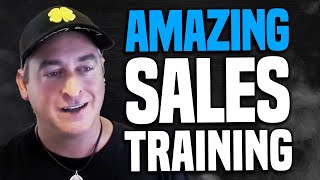
Excerpt from a Nate Auffort YouTube training session for life/mortgage/protection insurance agents. The trainer (Speaker A) demonstrates an in-home sales approach that uses deep, open-ended questions to surface customers' fears and needs; prompts prospects to "play the movie" (visualize worst‑case outcomes); inserts the insurance solution briefly at closing; and uses tailored tonality/personality-based messaging for recruiting and sales. Speaker B affirms and clarifies the trainer's method. The focus is on emotional storytelling, visualization, probing, brief product presentation (<5 minutes), objection handling, and adapting pitch to personality types for both selling policies and recruiting agents.
Chapters
So if I'm sitting down with Mary and Bob, right, and I'm selling mortgage protection, life insurance, whatever the case may be, right? All I got to do is a lot of agents will come out and go, so why did you fill out the form? Well, you know, in case something happens with Mary, I want to make sure she's protected. They go, okay, great. And they go right into their pitch like, I want that sale made before I go to my pitch. Okay, so when you say, in case something happens to Mary, what do you mean by that, Bob? Well, you know, if I die and, you know, something were to happen, it's going to be a little financial hardship on her. And I said, okay, Mary, so what does that look like? God forbid, Bob, you're not here. You died yesterday. What does that look like for you financially, Mary? Well, it'd be tough. Okay, so when you say tough, what do you mean by that? Would you like. Would you lose the house? Would you be able to keep the house? She'd be like, well, I probably wouldn't be able to keep the house. So how long would it take you to sell it? I never really thought about that. And what about the kids? Are they all in school locally here? Would they have to change? Would you be able to afford to stay in this neighborhood? She goes, well, probably not. And her husband, now, he's going to jump in and goes, we're not going to be able to stay here, Bob. You're dead, remember? You're dead, buddy. Right? Just hang on a minute, right? And then I'm back to Mary and I dig in deep. Is that what you want to do? She goes, no, that's not what I want to do. Okay, financially, makes about 100,000 a year. You make about 80. What would happen if you lost his income? Would you pick up a second job? Or would you be able to survive on the 80? Or how would that play out? And I make them sit there and play the movie in their mind of whether. So if it's health insurance, what happens if that catastrophe happens, right? And you. You can't afford your copay. If it's property and casualty, you can talk about whatever that part is. I make them live their life and they sit there and they play it out. Here's what happens. The husband's watching, and they emotionally go into a little bit of distress. I want. Sometimes the woman will start to tear up. Her eyes will start to. Well, I make it so visual because people are visual. When I say the word elephant, what do you guys immediately think of Think about it right now. Elephant. What pops into your brain? The word elephant or a picture of an elephant? Picture, picture, picture. You know, we got growing up reading bedtime stories, not bedtime facts. I don't think any of your mom or dad, if you did, you're screwed up, sat you down their knee and said, okay son, here's your, oh, Columbus discovered America in 1492. And let me recite the Gettysburg Address for you. And three plus three is sick. Like they read us bedtime stories, right? So if you think about it, people think in stories and so many people there's, there's higher levels of neuroplasticity. We're talking about the brain. We'll keep it simple. People think in stories and most people sell in words. And most people selling words, people don't think in words, they think in stories. They're visual beings. So I create this story, they're playing out the story. I'm not. Those words are coming out of her mouth. I'm not. And then all I do is insert my product, whatever it is that I'm selling or my service, and go, so what would it look like if, Bob, you died yesterday and there was a check for $250,000 that came into your hands, Mary, what would that look like for you? All that would help tremendously. How would it help? And now she's spending the money, isn't she? She's spending the money. So she goes, I'd be able to do this, I'd be able to do that, I'd be able to do this. And I'd flip it. Okay, Bob, situation. Mary, now you're dead. What would happen here? And I play out the whole thing, right? And then I very easily say, so I found out what their, what their, their whole entire life looked like without my problem. So if they tell me that my life sucks without it, my life would be great with it and they spent the money, how can they tell me no? So my question, I go, Bob, Mary, the only reason I'm here today is to establish one thing, that there is a concern that where something were to happen to either one of you, that you have some sort of protection put in place so it's not a financial hardship on either one of you. And I think that after what I just heard, we've established that, haven't we? And they say yes. How can they say no? Didn't we just establish it's concern? They say yes, the sales made, then all I got to do is tell them the process overcome. I want to think about it, and there's never what it is. And that's another thing. People go, well, I've been in homes, and people go, well, we just want to see what this was. Okay? In my business, most people open junk mail filled out, walk down in the mailbox, put the little red thing up, put the best time to call their name, their phone number, and mail it back in. They have a reason for doing it. I got a lot of junk mail. I never broke down and just decided to give Spectrum my DirecTV service because I got so overwhelmed with the letters I get in the mail. I never filled out one of those. Refinance your life for 25% interest rate monthly compounding. Like, I never filled one out because I got that letter in the mail and I went, oh, yeah, I wonder what 22% interest compounded on a monthly basis would look like for a loan. I think I'll fill it out. My mentor also taught me to get past people's bs, right? So sometimes I'll be sitting with somebody like, oh, I'd be fine. My back of my brain goes, if they would be fine, why did they respond to the lead? Does that make sense? Right? So I would just dig that out of them. I said, okay, well, great. If you'd be fine, I'd either talk to Bob or I'd talk to Marianne. And this is tough, Cody. A little bit, I think, because I don't know what industry they're in, and I'm only talking about what industry. My product that I sold and my service that I sold. But hopefully that helps. Whatever industry I'm not industry, whatever type of insurance you're selling, to be able to ask those questions and find out what the need is and the solution, and it creates the realization. Because in their mind, they're creating their own realization, man, we need this. Honey, I just made you tell me your life's great with it, and it sucks without it. How can you tell me you don't want it? I can do the same thing when recruiting, so. So I don't know if there's any questions you guys had.
Yeah, there's a couple. Also, I love that Nate does a phenomenal job of. I mean, as you can tell, like, when someone gives him an answer, he's. He's going deeper into that answer, right? He's continuing down that path. He's not just like, okay, great. It would help. Okay, awesome. Now, let me tell you about these benefits, right? Not totally pivoting, right? He's spitting his water out. But that's What a lot of insurance agents do. Like, we get an unbelievable answer and we totally just go off like, okay, perfect. I think term would be great. You know, a lot of, well, I don't know. You know, a lot of terms don't make it. And you really need this critical illness rider. And, you know, like, like we go off in a totally different path. He's continuing down the same path. When did he actually ever talk about the policy? He doesn't. And he doesn't even need to because.
It'S the last thing I do. It's my, my presentation is less than five minutes about the policy. Cause I'm not there for the policy. I'm there to see what is there a concern? They want to have protection put in place. And, and here's the process. We're going to take an application, we're going to submit it. It's not important we come up with the exact number tonight. We can always adjust. It easier to go down than it is to go up. It's easier to take things off and add them on. Right. And like, I don't want to go into that too deep. But yes. My cadence, someone asked me, is my cadence and tonality different in a home? Yeah, I don't talk this fast. And depending on the person I'm sitting down with. When you come to a SWAT training, there's four major personality types. I can identify within 30 seconds the personality type they are and deliver that information to them in a very simple way to the way that you want to hear about it. Right. And so if I'm talking to somebody that's quote unquote, an analytical. I don't do any small talk. They don't care about the emotion. They just want to see numbers. I'll take my computer, I'll turn around to them and I'll sit there and show them how I'm pulling up quotes for them on the computer. Because they love to see that crap. You know what I'm saying? I'm talking to a different personality and I'm pulling my computer around and showing it to them. It's scaring them, making them nervous. And they feel like, oh my gosh, I'm nervous. I don't understand this. I need some time to think about it. We need to sleep on it. Right. When I'm recruiting, if I'm talking about, you can go out and make a million dollars and I developed a million dollar a year agency and oh my God, that to some people is offensive. But I can very easily turn that into, hey, listen, you know, last month we literally helped over 934 families protect their future generations from financial hardship. And my goal is to figure out how I can help you. I mean, imagine if you started building an organization. How would you feel, Mary, if you are helping a thousand families a month, to not be in a financial hardship when the worst happens, if they die, get a heart attack, stroke or cancer. How would that make you feel, Mary? And see, that personality type will connect to that. And then over here I could be talking about, dude, listen, man, this is simple. Are you kidding me? People are sending in forms going, I need your help, I need your help. All you do is get on the phone and call them and you make anywhere from 800 to $1,000. How many times can you do that in a week, man? See my McLaren I just bought over there? I bought it cash. I bought it cash. In less than three years, this million dollar house I built, I bought it cash, built it for my wife. In less than three and a half years I developed. And that would get another personality excited and going, but at the same time, you could be offending someone else. So those are the skills I learned in terms of recruiting that allowed me to go, okay, great. How do I deliver my message to this person in the way that they're hearing? It's not manipulation because we do make a lot of money in this industry. Yes. And we do help people by doing it, don't we? So it's not me lying or making up for stories or manipulating. I just got to find out what's attractive to them. Because the definition, Tahira, of financial independence is very simple. Having enough money coming in, whether you work or not, to cover your basic necessities, that's financial freedom. It's not the jet that Cody's about to buy or the big piece of land that his wife bought for go karting and everything else. Financial freedom is having enough money coming in to cover your basic necessities, whether you work or not. That can be five grand a month, three grand a month, ten grand a month. Once that's covered, then great. Then where do you want to go from there? So my goal is, when I recruit people is I find out what is your financial freedom number. What is it, Steve? What is it, Joey? What is it, Terrell? How much money do you need to be making passively that's coming in, that's not coming from your own pen? If you're building a team that will generate you enough passive income where you don't have to work and you'd still get paid. Doesn't mean you quit working. But you have that there. And see, people get excited about that. I'll tell you what. When you help someone become financially free, they will be with you for life. There's no better feeling if you guys. Most of you know this feeling, probably, or if you don't. Wait till you do. When you get out of bed in the morning, you plant your feet on the ground and you realize, whoa, if I don't go to work today, all my bills are covered. That is a incredible feeling. And it could be as low as three grand a month if your bills are 2,800 bucks.
If you love this video, you know, I got another one that you're gonna love. I got a video just to your right, right here. Click on that. It's gonna be amazing. You're gonna love it. And I'll see you. Which objection do you think agents struggle with the most early in the call? I'm curious what you guys are thinking, by the way, too. You feel free to comment.
More from Nate

What If You Could Solve the 3 Biggest Problems Every Insurance Agent Faces? |




Inspiring Insights: Dallas S.W.A.T Insurance #shorts #events #dallas #business

Unleashing the Power of Insurance: Dallas S.W.A.T in June #shorts #events #dallas #business

Dallas S.W.A.T: Inspiring Insights from Insurance Experts #shorts #events #dallas #business