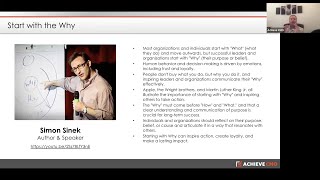
Taylor Baker explains Simon Sinek's Golden Circle framework and how Apple, the Wright Brothers, and Martin Luther King Jr. used purpose to inspire action. He connects this to a vision model with purpose, core values, and mission, then walks through the 5 Whys technique to help you find your own.
Chapters
High level, Simon Sinek, he's a renowned author, speaker. He— I don't think he— I don't know if he pioneered this, but he definitely brought it to the market. Um, just high level, the idea here: most organizations and individuals start with what, so basically what they do, and then they move outwards. Uh, he, he teaches that successful leaders and organizations start with the why and then move outwards from there, right? So they're start with their purpose or belief and then move into the what and the how. He talks about human behavior and decision-making and how it's driven by emotions that include trust and loyalty. People don't buy what you do, but they buy why you do it. Inspiring leaders and organizations communicate their why effectively. He gives a couple examples: Apple, the Wright Brothers, Martin Luther King Jr. They all illustrate the importance of starting with why and then inspiring others to take action. And again, teaches the why must come before how and what, and that a clear understanding communication purpose is crucial to that long-term success. Individuals and organizations should reflect on their purpose, belief, and cause, and then articulate in a way that resonates with others. Starting with why can inspire action, create loyalty, and make a lasting impact. So that was kind of the gist to start with the why. And we're going to start with the why here as well. And as we build on this why, we build this marketing plan and journey together, what I want to do is really start kind of focusing on what he calls the Golden Circle, right? Who's heard of the Golden Circle before? Raise your hand. Yeah. Or is this a new first time hearing about the Golden Circle? Okay. So basically, the Golden Circle is, hey, start with the why, put the why at the center, then the how, and then the what. Right? The what are the products or the services you sell. The how are the things that you make your product or service, what, what sets you apart from competition. And then the why is your purpose, cause, or belief, and it's why an organization exists. In Beyond Entrepreneurship, he kind of puts it in a different light. He calls it a vision, right? And in the vision, you have purposes, values, and missions. Right? So in this scenario, you're thinking of why, how, what. We're gonna rephrase that same kind of circle idea in the terms of a vision statement and a vision. Uh, we'll call it all a vision. All three of these comprise of the vision and it's the why, the who, the how, and the what of your business. So here's the framework that they, they, they give in this book, and I've got it right here in front of me too. Called BE 2.0, or Beyond Entrepreneurship. And what he talks about there is purpose, core values, and mission. So purpose is the fundamental reason for the organization's existence. It's like a guiding star that always work— you're always working towards this, but you never attain it. It should serve the company for 100 years. So think of it like, you know, if your company doesn't have a mission or a purpose statement, One, I would encourage you to create one, and we're gonna create one here as well, and, or at least get you started on that idea. But it's really that guiding star. It's like, why, why are you even existing? Why are you gonna dedicate a portion of your life to this thing? Core values. So this is the system of guiding principles and tenets, philosophy for business and life, principles that be held, to be held inviolate. And really it's an extension of your personal core values and the beliefs of the leaders of the organization. Your mission then becomes kind of this big, hairy, audacious goal. You have clear finish lines, specific timeframes. Once it's completed, the new mission is set. So we're gonna break this down. We're gonna do some exercises on this. So what is purpose? It's the why, right? It's the fundamental reason for your organization's existence. We talk about, it's like that guiding star. Think of it this way. You're gonna devote a significant portion of your life to this company. To the thing you're doing, to your job, right? We often spend more time in our jobs than with our family, right? We spend 8, 9 hours a day working on something. Why? What is it that is so special about the organization that makes you wanna dedicate your time, money, and resources to make it successful? That's the core of it. Now, sometimes you're like, okay, maybe I shouldn't be doing this, you know? But really, if we can align our purpose and our why to something that we strongly believe in and we're passionate about, we're going to go a lot farther with our business and also in our life. So why does it matter? So Elite Entrepreneurs, it's, uh, they do coaching and training. They, they talk about why does purpose matter. They said, well, one, it helps you attract the right people. It helps you tap into discretionary effort of your team. It creates meaning for your work. It injects energy and passion. It's the highest level filter for decision-making, and it helps you kind of overcome that clock-in, clock-out mentality. Why am I going to spend my time doing this? It's because I believe in it, right? So here are some example purpose statements that are out there. Our purpose is to make the world more secure, to enhance decision-making power. To be a company that gives unlimited opportunity to women. To help people with mental impairments realize their full potential. To provide solutions that protect the environment and improve the quality of life. To improve the quality of life through innovative human therapeutics. To be a role model and tool for social change. To enhance and disseminate knowledge that improves humankind. So you can see these are kind of— they're broader statements And really, it's the act of becoming. And in some ways, you never quite reach this, right? Will the world ever be totally secure? Maybe not, right? But we can make it more secure, and we can always strive towards that. Does that make sense? Okay. The purpose— like, your company's purpose is not about making money. Really, making money and the revenue is a side— a byproduct of your purpose, right? So as you think about your purpose and what your company exists to do, or even if you want to think about your own life, like, what is that purpose and what are you trying to do? This is the context in which we're talking about. It's something that's a guiding star for you. Okay, so we're going to take 5 minutes right now. Everybody got your piece of paper out? What I want you to do is to try to define your purpose. Now, you're probably not going to get it maybe right the very first time you do this. This could be an ongoing thing for you, but I want you to take and do this exercise right now. What is your purpose? What is your company's purpose? What is your personal purpose? If you need help kind of getting to that purpose, one of the exercises that you can do is, is called the 5 Whys. And we can start it with like this: what does your company do? Why do they do that? Why is that important? Why is that important to you? Why does that matter? Why does that matter to you?