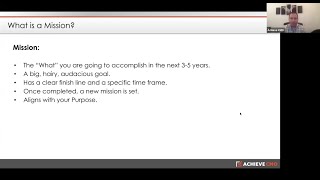
Jesse explains how a BHAG (Big, Hairy, Audacious Goal) works as a concrete 3-5 year mission. He uses examples like landing on the moon and training 20,000 pilots, then helps participants like Steve break their own BHAGs (one participant wants 1,000 to 10,000 English-teaching volunteers) into smaller yearly milestones.
Chapters
Okay, what is a mission? So we're talking about vision, we have a purpose, we have core values, and a mission, right? The mission here is the what. What are you going to accomplish? Let's just say the next 3 to 5 years. It's your big, hairy, audacious goal. It has a clear finish line, specific time frame, and once it's completed, you can set a new mission, right? But essentially, it's a thing that's going to help you get to where you're trying to go. So a BHAG— who's heard of a BHAG before? It's fairly common now. I didn't— you know, it's been around for many years in business books and things like that. It's a big, hairy, audacious goal, right? It's like a big mountain to climb. You have a clear finish line at the top, but your chances of succeeding are not 100%, right? It's going to require that you leap in your capabilities in the things you're doing today It's also compelling and galvanizing. It's easy to grasp. Think about it again in 3 to 5 years, right? It's that, all right, I'm going to go do this huge thing that I have no idea how to do. And it's usually aligned with your purpose, right? I'm going to give you some examples. We're going to put a man on the moon in the next decade. Well, that's pretty ambitious at the time, especially, right, that nobody had ever put a man on the moon. But it's a great example of BHAG. It's like, okay, I'm going to go do this huge thing and I'm going to do it in 10 years. So we've got to create all these programs, all these processes, all these things to go get the man on the moon. I'm going to provide life-saving training to 20,000 pilots annually by 2020. We're going to become the preferred power generation company by 2023. We're going to beautify over 660 spaces by the end of 2020. We're gonna impact 8,000 lives and collect 2,000 Ys by 2025. These are examples of BHAGs. I'm gonna go do this thing in a quantifiable way by this date. And again, it's gonna be so ambitious that it's gonna be really hard for you to do. Why does it matter? Well, a BHAG offers a challenge to employees and makes them grow personally. It inspires everyone and makes them work harder and more creatively. It also opens up possibilities you never considered. It's also clear and tangible. I'm gonna put a man on the moon in 10 years. It moves you away— it should be away— it moves you away from thinking small or settling for less, right? So it keeps our mind— remember, our purpose is this like 100-year thing that's never attainable. It's about becoming something. This mission is like, okay, what am I going to do, or what does that actual thing look like? And only think, let's not go 100 years, let's think 3 years, 5 years. What is that BHAG, right? So what we're gonna do, we're gonna take a few minutes. What is your company's BHAG? If you don't know it, your leaders probably haven't communicated this well enough to you, or if you're a leader, you haven't communicated this well back down, or maybe you never had one and this is the first time you're thinking about it. Think about it. You can think about a BHAG in terms of your company. You can think about a BHAG in terms of your department, of yourself, right? So let's take 5 minutes. Think about your purpose. How many, or people, how many people or companies can you impact? What is a goal so crazy that it would almost be impossible to achieve? What's your goal this year, next year, 5 years from now? So here's some things to think about. Let's take 5 minutes and formulate that idea. What is your BHAG? Ready, go. Steve, are you willing to share?
I actually thought you might ask me, Jesse. Um, this is a really, really good question because, um, even in our initial meetings and stuff, we were talking about, uh, meeting with like you and Jason and stuff. We were talking about possible possible, like, uh, large goals to look at. But honestly, like, um, the last question, what's your goal this year or next year? Um, uh, we were talking about having 1,000 volunteers in the world, um, teaching children English. Um, and I, I think that You know, I wrote down a bunch of different things here. You know, one of the things is I wrote down 10,000 volunteers per year. You know, I mean, it's interesting. I mean, the reality is there that if we found things that were duplicatable, that you honestly could grow to that. But I mean, I also understand it's important to keep things How do I say it? To plan to be responsible for those goals, right? So, so I really think, I really think that, that the things that we've talked about in the recent past of like 1,000 volunteers in the next, like per year in the next, like 1 to 2 years is, would be a pretty good BHAG right now for us.
Yeah, I mean, I love the, the bigger thinking. 10,000, man, that seems almost unattainable. Yeah, can I get to 10,000? What that does is it forces your mind to be like super creative about this. Like, okay, I— there's no way I can do this, is there? Wait, maybe there is a way, you know? Like, so I, I like the ambition. So it's a good job. Thanks for sharing that.
Sure.
So come back to the vision, right? The vision is really— this framework is like this idea of like, okay, I've got a purpose, I've got these values that are going to get me to that, and then I'm going to go on this mission to go and do that, right? And so that's kind of the exercise we went through. If you break down your BHAG and you can create these smaller missions, right? So let's just take that example of 10,000 volunteers because I love the idea of this. Like, man, it is so much bigger than where we are that I have no idea how I'm going to do it. But what it's going to do is it's going to require me to uplevel my capabilities, my things right now. We're not going to get there overnight, right? This is a 5-year mission. But what I can do is I can help define the mission points along the way. So let's start with mission number 1. Okay, let's think 1 year from now, right? And guess what? We're going to go and accomplish that mission. And I like this image because it shows us like Hey, it's gonna be hard, right? It's gonna like, we're gonna get to mission number 1 and then we're gonna set another mission and we're gonna like fall down and have to go through swim and go, you know, jump over these spikes. And like, that's the reality of business and life. And it's like this journey that you go on, right? So I wanna talk at, let's bring back, okay, we've got this huge ambitious goal. Let's say that 10,000 volunteers, right? Well, now let's bring it back to mission number 1. What's this year's goal? Right? So I love this question. If you could wave the magic wand and accomplish all your goals in 1 year from now, what would that look like? So we're not going to go, okay, I got 10,000. Let's bring it back to earth a little bit to 1 year. Okay, what is— what would that look like if I could go from now where I'm at to 1,000 volunteers as an example? Okay, does that align with my purpose? Right? Does that goal align with my purpose? So we're going to take another 5 minutes here. What is this year's mission? Wave that magic wand. You accomplished all your— this year's goals. What does success look like? What does that look like for you?