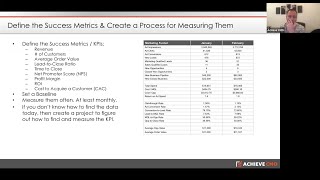
In this coaching-style presentation, the speaker walks business owners through the process of defining concrete success metrics for a one‑year revenue target, using a $1 million goal as a running example. The talk emphasizes that revenue is the sum of several underlying variables—number of customers, average order value (AOV), lead‑to‑close ratio, sales cycle length, profit margin, ROI, and customer acquisition cost (CAC). By reverse‑engineering the sales funnel, the presenter shows how to calculate the required number of leads, conversations, and clients to hit the revenue target. The speaker advises setting baselines for each metric, measuring them regularly, and identifying controllable levers (e.g., improving conversion rates, reducing CAC, boosting SEO or ad click‑through rates). The session also notes that success metrics differ by business type (e.g., nonprofits focus on impact, SEO‑centric firms track rankings, click‑throughs, cost‑per‑lead). Finally, participants are prompted to list their own key performance indicators (KPIs) that they can incrementally improve to drive the overall goal.
Chapters
Here, when you think about success one year from now, right, one of the important things you think about is you got to define the success metrics of what that looks like. So if there's a revenue goal, let's just say, hey, my goal is to make $1 million in a year from now, right? I want to make $1 million in revenue. Well, guess what? There's a lot of things that go into that $1 million in revenue. We might need to look at like, okay, how many customers does that mean? What is my average order value? What is my lead-to-close ratio? How long has it taken me to close? Um, you know, what's my profit margin, my ROI? How much is it costing us to acquire a customer, right? What we need to do is be able to set a baseline against that goal, right? So, and then measure them, right? So, okay, I've got this goal of making $1 million. Well, guess what? You know, I— let's just say my average order value is $100,000. Well, that means I need 10 clients, right? Okay, to get 10 clients, it means I need to have 30 conversations. To have 30 conversations, I need 100 leads, right? And so you can kind of work back in that funnel. If you don't know how to find the data today, that's okay. We can create a project to figure out and measure it. But let's think about this in a minute, defining the success metrics. You wave the magic wand. Congratulations, you just hit your goal a year from now. Let's break it down a little bit more. What does that actually mean from a metric perspective? How many customers, revenue, order value, margin? What are, what are those numbers, right? There's lots of ways in marketing that you can measure success, right? For most people, most companies, at least at the you know, business owner level, it's revenue, right? How much revenue did I bring in? Now that's not always true. If you're a nonprofit, maybe revenue is less important and it's about impact or, or things like that, right? Cost to acquire a customer, qualified leads, you know, what is your brand scorecard? You know, how do you measure SEO? If you're, if you're focused on SEO, what if, how do I measure ad click-through rates, conversion rates, or cost per lead, right? All of these things can be measured and impacted, and as you measure them, you get better at them, right? And so as you march towards that goal of 1 year, we need to understand the metrics that are kind of behind those. So we're gonna take a look at your goal again. How do you define success? What does that sales funnel look like? What are the things that are under your control? What levers can you pull to change that success formula? Right? Let's take some time, go through and write down your KPIs, your key performance indicators. What are those things that are gonna— if I could incrementally improve these things, what are those metrics? So let's go ahead and spend some time doing that exercise.