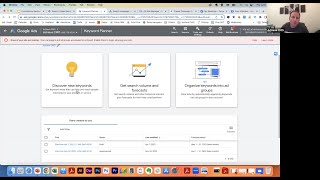
Google Ads Keyword Planner is a free tool for finding search volume, competition, and bid costs. Long-tail keywords are cheaper and easier to rank for than broad terms. Avoid mixing Search and Display networks, using broad match keywords, and overlooking Bing Ads.
Chapters
One of the great things about Keyword Planner is one, it's free. So there are a lot of other tools out there that can do keyword research. So like Ahrefs or SEOmoz, or there's a whole bunch of them out there and they can do it. Google's great. It's the source of the truth and it's often good enough for what you're trying to do. So I just like to use Google Ads. You don't have to pay money for it. You just have to create an account and you can use the keyword, right? So, you know, in this case, Um, Crystal, since I picked on you, right? If somebody's searching for whitewater rafting, that might be a keyword that you start with, right? And what it'll do is they'll give you a bunch of ideas related to that keyword. So in this case, you're seeing there's 10,000 to 100,000 searches. Now we're in the United States. We could filter that down to a specific area. Um, you actually see pretty low competition. And this is a really low top of bid ad. So it's going to tell you, hey, how much would it cost you to actually get on? And what's good about this, Crystal, on some of these keywords, by the way, they're pretty low cost bids. In fact, if there's no competition, you could probably even bid like 1 penny or 2 cents, and you might be at the top of the page because there's no other people bidding, right? But this gives you a really good list of keywords that you want to go after. This is relevant for SEO as well, right? So we can say, hey, there's a lot of people searching for whitewater rafting. If I can create a really good page around whitewater rafting, then I can draw people to my site without having to pay the ad dollars on top of it, right? In keyword research, there's what's called short-tail and long-tail keywords. So a short-tail keyword is is something like this, whitewater rafting, right? This might be a short tail, meaning there's a high volume of searches. It's not very specific. A long tail keyword might be something more like this, whitewater rafting Poconos, right? So this is more specific, right? Long tail keywords are usually easier to rank on, both on an SEO side but also on a paid side, they usually cost less. So if you're saying, hey, I only want to bid on that specific term, then you're gonna have a higher— and you can see even right here, see, this cost is 10 cents, right? Now what's interesting on this word, right? I mean, let's just take this as an example and we'll just go do a search here for a minute on whitewater rafting Poconos, right? So one, I see no ads at all here. Right, so there's no ads now. It's in Pennsylvania or whatever, but guess what? I could give them other options if I wanted to, right? I could have an ad that's like, hey, Poconos versus Moab, pros and cons, right? We know the person is searching for a whitewater experience. Would they be open to going somewhere else, right? And so what you could do is you could actually create an SEO page called whitewater rafting Poconos that might rank number 2 here, or number 3 on an organic search, right? Because it's optimized towards it. And then you could have it— you basically, what you do is you kind of hijack that search to be something you want it to be. So that's an example of maybe a competitive strategy of like, okay, they're searching for maybe my competition or something related to it, but I know they're in the market for the thing I'm offering. Can I convince them that there's another option, right? So that, that's kind of one example of keywords. One other mistake I often see inside of search campaigns is when they're setting them up, they use the Display Network and the Search Network together, right? So really the intent, and what we're gonna learn here, is the intent is very different on a Google search versus a display ad, right? When somebody is searching for a solution, they're actively in the buying cycle. On the display network, they could be anywhere, right? They could be doing whatever. We have no idea if they're actively looking, right? And so the strategy is more of a push strategy instead of a pull strategy. Google wants you to combine them because then they'll— then you'll spend more money. But The reality is don't combine them. It's going to cause you a bunch of problems and it's not best practices, right? So that's kind of one thing you can look at. There's a lot of strategies as you kind of pick, as you create a campaign and you go and launch the campaign. One is looking at phrase match instead of broad match. We're not going to go into all the details here, but there is There's definitely some art to setting it up and there's a few key mistakes that a lot of people make that have never done this before. One of 'em is this, one of 'em is using broad match words and, and you know, then you end up, you know, you know, somebody's searching for software, for example, and they have careers at the end of it and you're bidding and paying money on careers. That's not really what you want, right? So just pay attention to, to the setup and the way that you budget and everything else there. So that's a little bit about kind of Google Ads. Bing Ads is very similar to this setup. In fact, they basically just copied Google Ads on the back end. But a lot of people don't launch Bing Ads even though there's a good 20-25% of the market that's using it. So don't, don't say, hey, everything's Google. Reality is you have— it's— there's other players in the market, right? Okay.