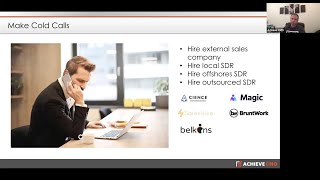
Cold calling outperforms LinkedIn and email for outbound sales. Four staffing models: external agencies ($5,000+ monthly), internal SDRs, offshore reps ($5-10/hour), or outsourced calling-only providers. One company scaled to 35 Philippine reps. Events work best when your target audience attends, and can accelerate deals by giving prospects a reason to follow up.
Chapters
You can make cold calls. Guess what, guys? Cold call is still the most effective outbound sales strategy. More effective than LinkedIn, more effective than email, more effective than the other, you know, texting, whatever. It's cold calls. Guess what? Calling people works. Um, so you can do a couple things. You could hire an external sales company like a Sales Hive or a Science. And they can do the whole motion for you and just get appointments on your calendar, right? Usually more expensive, you know, you're talking usually $5,000 plus a month to do something like that. You could hire somebody locally, you can hire just somebody on your team, a salesperson, and, uh, you know, SDR is a sales development representative, but they, they'd be an internal resource that just calls. You could also hire offshore SDRs. So there's tools like Magic or Gruntwork where you can go and find somebody in the Philippines for $5 to $10 an hour, and you can hire them to do the work for you. Now, in those scenarios, they actually work for you in the sense that you've got to give them the CRM and you've got to give them the call list and everything else. The difference is between a local and an offshore SDR is they're a lot lower cost, but you also might have language barriers or challenges with language or other kinds of issues that come with that. I've had a lot of success with offshore SDRs in the Philippines. Um, it works. And the other thing you could do is you could hire, um, an outsourced SDR in the sense that— so different between maybe an offshore versus an outsourced is offshore, they still work for you, and the outsourced, you're still gonna— you're gonna push that whole function back to them. But maybe they won't own the whole sales side, but they're just gonna own this little piece. And that's all they do. And they have their own tools, their own systems. And so they're more similar to maybe like an external sales company, but there's different variations and levels of these things, right? One of the clients that we had, we built, you know, we had 35 reps in the Philippines. We went from like going through a company and then we actually brought it all in-house. And so we'd hire them directly off of Indeed Philippines or Virtual Staff. We'd interview them, give them a software CRM, and it costs us between $450 to $650 a month per rep to go and cold call, right? Um, and so that's definitely a viable option. If you go through an agency like Magic or some other company, they're gonna charge you, you know, still fairly cheap between $4 and $10 an hour, it's still, you know, $1,000 a month. You know, you can do this really inexpensive. Um, on an outbound motion, you can also attend networking events, right? So if there are events that are related to the thing you're doing, you can go to those events. Um, you can also attend industry events and trade shows. So again, if your audience is at events and trade shows, then that's where you would want to go. If they're not, don't go there, right? Yeah. So that, you know, you can— I've seen a lot of companies spend a lot of money on events, building a beautiful booth and spending thousands of dollars to have all their reps go there on hotel and airline, and then they come back and it's like, what's the ROI on that event? And they're like, I don't know, I got 10 leads, right? There's more effective ways to do that. But if you have a high ticket value and your audience is at those events, guess what? You should be at those events. You know, Steve, I think of your company ILP, right? You guys do a lot of event marketing and they're at colleges, local colleges, right? And, and they're around those areas. It makes sense. Why? Because that's where they are, right? Your audience is there. Um, obviously you can host your own events too, right? So maybe there isn't an event that you like that your audience isn't going to. Guess what? You could create your own event. You could have a user conference, you could do a mastermind club, you could, uh, you know, sponsor a sporting competition. You know, you see these pickleball things or the, you know, whatever it is that's going to bring your audience together. And if they're, if they're your customer, events are a great outbound motion. Now, I'm sorry, you can do a customer appreciation, a lunch and learn, you could, uh, sponsor one of the social media groups you belong to and say, hey, let's all grab lunch, or let's go do this thing together. Um, and so you can host and you can bring your own— create your own event that brings people together that you're looking for as well. Okay, so what I want to do is take a few minutes here and I want to talk about your sales-driven outbound motion activities. What are you doing today Is there something that's more effective than another thing? Are there other ways you could push your way into market in a sales-driven motion? And how can you use events to help move deals forward? The other nice thing about events— I'll let you guys go, I'm just going to keep talking for a minute. Go ahead and do the exercise. The nice thing about events is you can also use them in your sales, um, funnel. So if you're already talking to a person You can invite them to an event, right? That can move the deal forward by having them come to event. Or even if they don't come, it gives you a reason to reach out to them, right? And so events are a good way to get people involved. Um, I've also heard of things like, um, call them love fests. You know, people that love you and your brand, can you get them together and have bring those people with people that aren't your fan. Hey, bring a friend, right? I've seen this, um, you know, there's a, there's a life insurance company that does this. They go and, you know, instead of spending money on advertising, they actually give money to the, the members to go put on events, and then they'll match dollar for dollar those, and they say, hey, bring a friend, right? The cost of admission is a friend, and so they can use that refer— use events as a referral marketing strategy as well to bring in that, that demand that's already there.