A branding workshop on the StoryBrand framework positions your brand as a guide helping customers solve problems across every touchpoint. It covers brand vision, identity, style guides, and personality traits like sincerity, excitement, and competence, then asks you to define your brand's current personality and where you want it to go.
Chapters
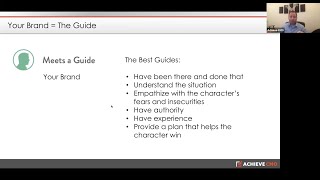
Right? So I wanna talk about the guide now a little bit. So we know we have these characters, these have problems, we've identified some of the problems. Now here's the thing, they're gonna meet a guide, which is your brand. And you know, the best guides are people that have been there and done that, that understand the situation, that empathize with the character's fears and insecurities. They have authority, they have experience. They provide a plan that helps the character win, right? So these are kind of the best guides. Now the question is, is your brand a good guide? Does your brand tell them how to get to the desired outcome? Yes or no? Let's, I'm gonna, I wanna go deep into branding for a minute and then we're gonna come back to StoryBrand here, right? Because your brand is that guide. And as you think about your customer journey and that plan that you're gonna present to them, every touchpoint in that customer journey, guess what? It represents your brand. So when we talk about what is your brand and how does your brand become a guide, what we're talking about is the entire experience and everything that your brand touches from the word of mouth that's going on behind, behind your back. To your website, to the email, and to the product packaging and the experience. All of that reflects your brand, right? And so as we think about brand, that's the context I want you— I want you to think about it. When we talk about branding, we're going to talk about brand strategy for a minute. So brand strategy and how do you like create a brand and how do you really make sure that brand is doing the things that you want it do, one of the things you have is a brand vision. Now we, we spent quite a bit of time last week talking about brand vision. We didn't call it brand vision, we just called it vision or a vision framework. But in the context of a brand strategy, that is, that's what we're talking about. Like, what is your purpose and core values of the brand? What's the mission you're trying to accomplish? In branding, a lot of times we often think about the name and the logo and the design and the personality as well. We also think about the experience. How do you position it? What's the story you tell and the journey and that consistency, right? So again, we're gonna— well, I went way faster than that. So what we're, we're gonna take a little bit of a divergent from, like I said, the StoryBrand, and I just wanna dive deep into this. What is branding and how do we create branding for what we're doing? So first of all is the, the vision framework. So the exercise we did last week really should define and help you understand What is the organization's purpose? Why do we, why did we come to existence? What are we trying to accomplish? What are the values that we want represented in those brand, right? So we're not gonna spend a lot of time here cuz we already spent time there last week. Brand identity. So how do you create a brand? So, and when you think about brand identity, I've kind of broken it down into 4 places. Your name, which I'm also gonna say your website, your URL. Your logo, which could also include a tagline or a visual symbol or trademarks. We also talk about the design, so the packaging and design elements of your website, your emails, your products or services, and also the personality of that, that brand. So some of the human-like characteristics and traits that associate with brand, right? These are some great examples of the name, logo, and tagline. Right? And so we know that the name of the company is an important decision. It can play a significant role in how your brand is perceived. When you guys see these brands, you immediately have reactions to these brands, whether positive or negative, and you know them. They become a mark, a symbol in your mind, in your brain, the emotion that it creates around those brands, right? And you can see here in these elements, there's a name, Walmart, there's a logo, there's a tagline, save money, live better. Nike, just do it. Coca-Cola, open happiness. Allstate, you're in good hands, right? And what they're trying to do is they're trying to say, hey, this is kind of my purpose a little bit. And, and it doesn't have to be your purpose statement, but in some ways it's saying, hey, this is the thing I want you to remember about it. And it can inspire them to take action, right? Part of branding is also brand style guide. Some of you have these, some of you don't, right? But as you think about it, it's like, okay, how do I want my logo and my identity used? What are the colors? You know, do I have a color palette? Do I have a logo and, and the brand that, you know, how do I use it in dark colors versus light colors? You know, do I— what's my font? What are the iconography? What's the button look like? You know, do I— you know, all of these things a brand style guide can really give clarity on. And then you follow that brand style guide to create a consistent brand experience from an identity perspective, right? The other thing is that product design should also align with that brand identity. Apple does a great job at this, right? We know that when you see an Apple product, you usually have kind of those, you know, those corners. It's, it's usually pretty clean. You know, they, there's a, a specific look and feel that those products have that also relate back to the brand, right? So that brand identity that we're talking about, uh, in a services-based business, this is a little different, right? But you could look at, you know, the, the proposal in which you give or the story that you tell, like, is it consistent with the packaging, the branding that you're trying to do? And is it all aligned, right? Your brand personality is a big part of this, that the way you use colors to reflect that brand personality. You know, in this case, here are some brand personality statements. It's sincere, it's, you know, sincerity, excitement, competence, sophistication, ruggedness. And so you might have breakdown of like down to earth, honest, wholesome, cheerful, daring, spirited, imaginative, updated, right? And then, you know, as you kind of define the personality, this is also gonna help you dictate the colors you use. You know, if you want order, you know, you might do more of a blue. If you're going ego, it's more red. Freedom, orange. Social, you know, there's different ways, and there's a whole bunch of color theory in all of this too. But really it's about creating a brand identity and personality around it. So what we're going to do is we're going to go through an exercise, and I want you guys to think about your brand personality. Now, maybe Maybe think about it in two ways. What is your brand personality today? And what do you want it to be? And is there a gap, right? So let's go ahead, take 5 minutes. We're going to go through this exercise of just writing down what are the personality traits of your brand. How would you describe the personality around in 3 to 5 words? If your brand were a person, how would you describe that charac— those character traits? What emotions or feelings do you want your brand to evoke? What adjectives or descriptive words align? So go ahead and think about your brand personality and let's write down 3 to 5 words that describe that brand personality. Okay, go.