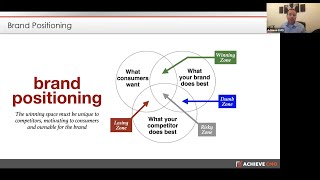
A brand positioning framework uses three overlapping circles: what consumers want, what you can deliver, and what competitors offer. The winning zone is where all three overlap. A positioning statement needs a target audience, market category, main benefit, and proof points, like Smart Cookie's promise of 100-calorie, great-tasting cookies backed by blind-test results.
Chapters
So your origin story and the power of branding, right? I mean, there's, there's, there's power in story. As you position your brand, one of the elements of an experience is like brand positioning, right? And the winning space, I mean, you think about brand positioning, it's really in the context that your brand sits in the ecosystem or in the environment, right? So if you think about the ideal place to be, it's, so you've got this circle of like, here's what consumers want, right? Right? Here's what your brand does and here's what your competition does, right? If there's a place where your competitors are doing something really well and your consumers want it, right, then the cons— your competitor is going to win. You're going to lose these deals because your product doesn't do that. If your competitor does it, but you or your competitor is doing something and your consumers don't want it, Why are you doing it? That's the dumb zone, right? Don't do something that your consumers don't want regardless of whether your competition is doing it or not, right? The winning zone is really where you do something that your consumers want but that your competitors can't, right? That's when you win. And then there's sometimes you get the cross-section of where like, hey, we're just going to go head-to-head with our competition, and that's kind of the risky zone, right? So it's like, okay, I'm gonna be here, but really I want to be up here. It's, I want to provide something that our consumers want, that our brand does really well, and that our competition can't do, or it's hard for our competition, or we have a better experience than our competition does, right? So when you think about kind of a brand positioning statement, you think about how do I position my brand? This is an interesting way to think about brand positioning, right? You say, okay, who is the consumer target? So who's the target? So what slice of that population is most motivated to buy what you do? Think about our character and our ideal client profile. Who is that person? Who am I targeting? And where do you play? What is the frame of reference that helps you define the space in the marketplace that you compete in? Where is it that you win? What promises you make to the target, thinking about the main benefit, and then why should they believe us? What support points help us back us up? So here's an example. To suburban working women who want to be healthy, my brand— let's just suppose it's Smart Cookie. Smart Cookie is the healthy cookie option that is the guilt-free cookie to help you stay in control of your health. That's because in blind tests, Smart Cookies match leaves and taste but have only 100 calories. So what we're doing is saying to whoever that is, my brand is the what? So what's that market that you're playing in and why is it the option for that? And then how are you winning it? So in this case, healthy cookies is maybe the category we're winning because, or, or, you know, the promise you're making is that guilt-free cookies will help you stay in control of your health. And we've did these tests to back up that claim.