challenger sales.mp4
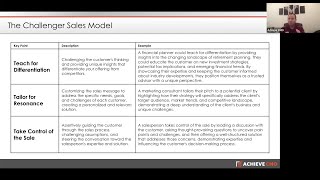
The Challenger Sales model rests on three behaviors: teach prospects with unique market insights, tailor your pitch to their specific situation, and steer conversations with purposeful questions. Redesign your pitch deck to start with a polarizing insight, make the customer the hero, show a similar company's success story, then present your value proposition.
Chapters
The Challenger Sales model and the way that the differences in which a Challenger does sales versus somebody else, right? There's 3 characteristics here. They teach for differentiation, they tailor for resonance, and they take control of the sales, right? So what does that mean? It means that challenging, when you teach for differentiation, you're challenging, oh, sorry, they're challenging the customer's thinking and you're providing unique insights that differentiate you, your offering from competitors. So in this case of, you know, teaching for differentiation, you often start with like a unique insight around the industry. You're setting the stage that says, hey, I really understand this and I'm gonna give you some unique insights. The way I like to think about this is when you go into a sales conversation, The conversation should be so good that the person leaves that conversation and says basically, wow, I would've paid them to have that conversation. That was so good. I came out a different person than I came in. Right? And so you're thinking about like, like that kind of a standard of conversation where it's like you're giving them so much value and so much insights that they've actually changed the way their thinking. You've educated them to a point that now they see the world differently, right? You know, here's an example of financial planner, right? Financial planner could teach for differentiation by providing insights into the changing landscape of retirement planning. They could educate the customer on new investment strategies, potential tax implications, emerging financial trends. And what happens is by showcasing their expertise and keeping the customer informed about the industry developments, they position themselves as a trusted advisor. With unique perspective, right? What they've done is just said, hey, guess what, the retirement planning landscape has changed, um, and this is, you know, here's how you should be thinking about it, right? One other way I like to think about is like, the best-in-class companies are doing this thing. And you might even add, you're probably doing this, but in case you're not, you know, here's, here's what we're seeing, like the best-in-class people that we're The ones that have the best experience with us are seeing these things, right? The next point is to tailor for resonance. So customizing the sales message to address the specific needs, goals, and challenges of each individual customer, creating a personalized and relevant solution, right? So now we're not just selling to everybody, we're selling to them, right? We're, we're tailoring it so that person can resonate with the things we're saying. In some ways we're talking about, um, you know, those 5 brain types a little bit here too, right? We have to be able to sell and resonate with the type of person they are. Here's an example. Marketing consultant Taylor Baker Baker Baker Baker Taylor's pitch to potential client by highlighting how their strategy will specifically address the client's target audience trends, competitive landscape, and demonstrating a deep understanding of that client's business and unique challenges, right? I know for me personally, when I come in prepared to a sales conversation, It's a much better conversation cuz I can tailor it, right? I've done some research that says, hey, I think I understand your audience. And because I understand your audience, I believe that I can tailor a solution for you, right? The next point is to take control of the sale. So they assertively guide the customer through the sales process, challenge assumptions, and steer the conversation towards the salesperson's expertise and solutions. So we can steer the conversation to the things that we know and, and avoid maybe even some of the obstacles or challenges that might come up because we're, we're steering and controlling the conversation. Example: a salesperson takes control of the sale by leading discussion with the customer, asking thought-provoking questions to uncover pain points, then offering a well-structured solution that addresses those concerns, right? So they demonstrate expertise and influence. They can influence it because they are in control of it And they're in control of it because they're asking the questions and they're leading them down a path, right? So some of the key skills of the Challenger Sales Model, we talked about these kind of 3 circles, right? Teach for differentiation, tailor for resonance, take control. And what we find is that the Challenger rep delivers insights that reframes the way customers think about their business and their needs, right? So we're, again, we're framing the conversation, we're reframing it in the way that we want them to think about things. They also communicate sales messages in the context of the customer. Talked about that. They seek to leverage constructive tension to their advantage across the dimensions of sale. Now, we didn't really talk about the constructive tension, but it's actually okay to have a little bit of tension with the client. Not to the point where you're like fighting or anything like that, but like you're challenging them, right? And guess what? Challenge— when you get challenged, you feel a little bit uncomfortable. And so there is a little bit of tension, but it, when it's constructive tension, it, it's a good thing cuz you're pushing them to do things differently. And then Challenger reps will openly pursue goals in a direct but non-aggressive way to overcome the increased customer risk aversion, right? So that's kind of the Challenger sales model. What we often see in a pitch deck and the way we present, it's often about us. Now you don't have to raise your hand, but is your pitch deck about you or is it about the customer? Right? So the traditional pitch deck is something like this. Hey, our company has these features and you're gonna get an ROI on our solution. And guess what? This is why we're better than the competitive competition. And here's all the proof that shows you why that we are so cool. Right? Has anybody ever seen a pitch deck like that or heard one? Hopefully yours aren't that way. If they are, I'm going to challenge you a little bit. Go take control of it, right? Because guess what we learned in our last conversation? Who's the hero? The customer is the hero, right? Our company is not the hero. So if our pitch deck says, hey, I'm the hero, guess what? We're doing it wrong. So if you're building a pitch deck, The challenger sales pitch deck is more like this. Hey, I'm gonna have this polarizing insight. I'm gonna tell you something really unique about the industry and what's happening today. I'm gonna talk about the problems that it creates, and I'm gonna tell you a story about how a company was able to solve those problems. And that company, guess what? If I can make that company look like them, even better. And then I'm gonna propose a value proposition and show our best evidence on why we are successful with that. So here's an insight slide. For example, we now live in a subscription economy, right? So this, this gives a polarizing insight that changes the way your customer thinks and feels about a key problem or opportunity, and it can eventually be tied back to your solution. Now, you don't want to just go and throw an insight out there that's not relevant, right? But if you can throw an insight that kind of makes you think about things You know, in this case you're saying, hey, we're in a subscription economy. What that means is that people are willing to subscribe and guess what they're gonna do later down the road? They're gonna try to get you subscribed, right? And they're talking about why the subscription economy is important and how it's changing the way we think, right? Here's some other examples, you know, you know, here's some consumer insights. 65% of management's not buying into things. You know, there, there's no robust processes to do this, right? I'm presenting data. Hey, YouTube Analytics, guess what? 64% of YouTube subscribers are male. Guess what that means for you? You have an audience that is male, right? I can tailor that audience if I'm selling YouTube, right? But the insights slide should represent an undeniable change in your buyer's world that's independent of your product. So we're not talking about your product yet. We're not— we don't even want to mention your product yet. What we're talking about is a key observation in the market, but it's related to the problem. But we're talking about the market problem. We're talking about high level, you know, that what is that like? So what I want you guys to do is I want to think about a polarizing insight that you could provide to your customers. Not your solution, your product. It's a, it's, it's an insight that you have on the market and the things that are happening today. Some questions you might consider: what unique and valuable perspectives can you offer to your market? What advice would you give to someone in, in your buyer situation? If, if a buyer came to you and you weren't trying to sell them, but you were like, hey, here's what I know about the market, what would you say? How can you help your buyer avoid potential landmines? How can you educate your buyer on new issues and possible outcomes? An example statement might be something like this: we— the way we do blank has changed. Think about whatever example. And now the way we do it has moved from this thing to that thing. So go ahead, take 5 minutes and think about what kind of polarizing insights could you provide to your customers.









