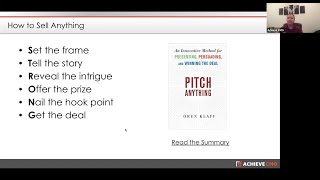
Oren Klaff's STRONG framework starts with setting the frame, which means understanding which of five decision-making brains your prospect uses: crocodile, analytical, impatient, social, or pricing. Whoever controls the frame controls the conversation. The speaker walks through how to spot each frame from verbal and non-verbal cues, then asks you to identify the frame in a recent argument you had.
Chapters
So let's get going. There's a book called Pitch Anything. Um, this, this guy's in— Oren Klaff, he wrote it actually for entrepreneurs and helping them try to win more deals. Um, it applies in a broader perspective for sales generally, and so I like some of the concepts that he talked about. One of the things he talks about is this idea of STRONG, right? Or this acronym STRONG: set the frame, tell the story, reveal the intrigue, offer the prize, nail the hook point, and get the deal. Now, we're not gonna go into depth on all of these, but one of the things I really wanna talk about and bring out from this story or from this book is this idea of setting the frame in your sales pitches and also in an investor pitch if you were doing that. We're gonna go into a little bit more of the Challenger Sales methodology around telling the story and the intrigue and some of the other things. But if you wanna read more, I highly recommend the book. It's a, it's really interesting book about how he basically, he claims he can pitch and win any deal. Probably not true, but you know, he has some good points. In, in the book, he talks about these kind of 5 brains, if you will, or frames of reference. And he, and he makes this thing, says when you're reacting to the other person, that person owns the frame. But when the other person is reacting to, to what you do and say, you own the frame. So think of the frame as like the context of the conversation and who's owning the direction of that conversation, whether you're winning or losing that deal, right? So in, in this, he talks about 5 kind of frames or brains, if you will. One is the crocodile brain. So this represents your primal instinctual part of the brain. It's focused on survival, self-interest. It's trying to avoid threats, maximize rewards, right? When you're talking to somebody with a crocodile brain and you can see that, you know, often you're, you need to, you know, they're gonna make, they're gonna quickly filter information and make quick judgments, right? So what you've gotta do is break the frame in the sense that you don't want them to make quick judgments and decisions and filter information quickly, right? And so the way in which you frame the conversation needs to take that into account. The next one is the analytical brain, where they represent logical analytical part of the brain. They value data, facts, rationality. They want a lot of detailed information and evidence. They require logical and coherent arguments to make a decision. So they're gonna, they're gonna want more time as well. You know, they're like, oh, I want to analyze this, let me look at the data, let me look at this, let me look at that, right? They're, they're kind of Hemming and Hahn, right? But if you can break that by, by kind of basically saying, hey, here's the fact, and then moving on from the story, there's ways you can break that. The impatient brain represents the time-sensitive impatient part of the brain. If you're talking to somebody and they're like on the clock, you know, and they're like, hey, just get to the point, you know what I mean? And you, you, you need to break that frame of mind for them and, and basically say, hey, here's a solution and the, the, the way we're gonna do it. And you get it in concise and pitch, but you also want to ask for more time and say, hey, I recognize that you're, you've got a time crunch, you know, And that kind of knocks them out of like, okay, I'm being impatient. How do I do this? There's a lot of tactics. So we're gonna talk a little bit more, but the social brain represents social relationship-oriented side. They value trust, rapport, emotional connection. They want validation and social proof. Um, it often requires a personal and engaging pitch, right? They want to, they wanna like you. They're gonna be sold on you, on your emotions and that like your personality. The pricing brain represents the brain's focus on status, hierarchy, competition. They value exclusivity, scarcity, being part of the elite. Um, they want to win and achieve high results. So the pitch needs to highlight a unique value, some sort of competitive advantage, an opportunity to be part of something special, right? An exclusive deal, things like that, right? So the question is, how do you identify the frame of the other person? This is, this is kind of a hard thing. So in a sale, you have at least two people, right? So on the one side you have your audience or your buyer. On the other side you have a salesperson. I'm gonna talk about the salesperson in a minute. On this one, the question is, if you're the salesperson, you're trying to sell something, whether it's your business or your product or service, the question is, how do you identify the frame of the other person? So here's just a few ideas. Um, often you'll see as you start to communicate them, the way in which they communicate. So an analytical person's gonna communicate kind of in a detailed, logical, data-driven, evidence-based way, right? If you were to see them in person, you might see some nonverbal cues of more of a composed, focused demeanor. The social side, you're looking for more— they're trying to build rapport and the personal and relationships and community, and they want to tell you about their grandma's mom and their flowers and the, you know, I mean, you can see kind of that social side of them come out. Um, you can also see the way they talk. It might be more expressive or empathetic. Impatient people, you can, you know, they're urgent, time-focused, you know, they're looking for fast results, streamline, you know, they're, they're talking the way they're talking is like, hey, let's get to the point, I need to know this thing, right? You can see kind of restless behavior. They're trying to be fast-paced, right? Um, a crocodile might be more cautious, risk-focused. They might use words like risk or security or safety. They're probably a little more skeptical, right? If you kind of get a skeptical persona, they might be more guarded. Um, prizing, you know, they're, they're kind of status-oriented. They might talk about all the things they've done and how good they are, and you can, you can kind of see that confident assertiveness out of them. So the thing is, if you can identify the frame of the other person, you can then learn how to control that frame. If you don't learn how to control it, guess who's going to control it? They will, right? And so there, there's ways and things you can do. If I, I highly recommend, if you want to kind of go more in depth on this, read the book or listen to it on Audible because it gives some really good examples of kind of how to break the frame of those other people, right? Okay, I want to do just a 2-minute exercise for a minute. I wanted you to think about some frameworks that you've encountered in your own life. Let's just think about the last time that you tried to sell someone, or maybe the last time you went— tried to win an argument with a spouse, a co-worker, a friend. They have to be an argument, but like you're trying to get your point across and maybe they don't hear you or whatever. So just think about something, write it down. What's the framework that they had?