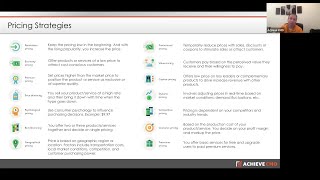
A walkthrough of 13 pricing strategies from penetration pricing to dynamic pricing, with examples like early-bird tickets and $9.99 price points. The speaker explains when to evaluate pricing: new launches, repositioning, competitive benchmarking, or to better meet customer expectations.
Chapters
Last thing I want to talk about here is this idea of pricing strategies. There's actually a lot of different ways to price things out, right? And, and you may never realize this before, but there's, there's a bunch of different approaches to pricing. And it's a question that, especially as you're starting up or if you're launching new products, that you, you want to keep in consideration. So I'm just going to quickly go through these different pricing strategies. One is a pricing strategy called penetration pricing. Basically, the idea is you keep the price low in the beginning, and as it rises in popularity, you increase the price, right? So you kind of got a discount at the beginning. Um, and think about events often use penetration pricing. Hey, get an early bird price, and it's going to go up as more people— because more popular. Um, economy pricing, really we're looking at like low-cost leaders. Say I'm going to offer a low price to attract cost-conscious customers. Premium pricing is the opposite. Hey, I'm gonna, I'm gonna price my product as a, as the highest. You're creating an exclusive pricing market and you're going to be at the top of that market. Price skimming is when you sell your product at a high rate and then bring it down with time when the hype goes down. So kind of reverse the penetration pricing. We're going to start high and then we're going to come down over time. Psychological pricing. So we're going to use consumer psychology to influence pricing decisions. Think about the $9.95 or the $9.97, $9.99, right? There's a little bit of psychology to say it's less than $10. It's weird, but it makes a difference, right? Bundle pricing. So you can offer 2 or 3 products or services together and then offer single prices. Some of these, by the way, you can intermingle. Um, geographical pricing, you know, prices based on geographic region or location. Think about gas prices, you know, a lot of, you know, transportation, market conditions, the purchasing power in the market. And promotional pricing is where you might offer reduced prices for sales, discounts, or coupons. Value pricing— customers pay based on the perceived value they receive and their willingness to pay. Actify used the value pricing model where it was actually a pay-per-close model, right? So, hey, you're going to pay us an X percentage of the deal when you close it. Captive pricing, um, this is a— there's two ways to think of captive pricing. I actually thought of captive pricing more as like, hey, I'm in like, um, like I'm at a resort or something and I'm like forced to pay this higher price. But the other idea of captive pricing is, is actually having a loss leader. So you get people to come into your market with— and maybe you come into the store with a loss leader, but your complementary products and services actually increase the value of all the other products. Captive meaning you've got them in your store now, now you can sell them other things. Dynamic pricing involves adjusting price in real time based on market conditions, so I might go up and down. Um, stock market's very much like that. Competitive pricing, you might just be like, hey, you know what, I don't really know, but it looks like my competition's doing this, so I guess I can do that too. Um, cost-plus pricing, so basically say, hey, I've got— it's costing me X to produce, I want a 40% margin, therefore I'm going to mark up the price. The other idea is a freemium pricing model, so you offer basic services for free and then you upgrade users to a paid or premium service. You could also do like a trial, you know, hey, we're going to do, you know, give you full services for 30 days and then you're going to lose those over time, right? It's important that occasionally you do pricing analysis. So pricing analysis is when you evaluate your current pricing strategy against the market demand, and you can perform this pricing analysis to identify opportunities and threats with respect to the change in the pricing model. So So when would you want to do a pricing analysis? When you're considering a new product idea, like, so you're going to launch a new product. You might be developing a new positioning strategy, or you're maybe trying to run some tests. You might be looking at how you compare against your competition, or maybe you're trying to determine and better meet the, the consumer's expectations, and you might need to adjust your prices accordingly. Let's just take maybe 1 minute to think about this since we're kind of low on time. But what pricing strategy does your company use today? When was the last time you adjusted your prices, and why did you do it? And is there a better pricing strategy for your business? Think of maybe some alternative ways your product or service could be sold. So let's just take maybe 2 minutes and just think through this pricing strategy.