sprint framework.mp4
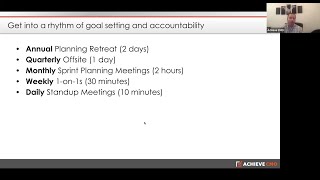
A framework that moves from annual vision down to weekly sprints: quarterly planning generates a prioritized backlog, teams pick 3-4 high-impact projects per person for 3-week cycles, and each sprint ends with a demo where people show what they finished. Daily stand-ups and weekly one-on-ones keep work visible and moving.
Chapters
As you do these things, you want to get into a rhythm of goal setting and accountability, right? So some of the recommendations I've seen is if you think about it this way, like an annual planning retreat, you know, do I— can, can I get my team, my leadership team together for 2 days and just really map out the year? Can I do a quarterly offsite? Maybe it's a 1-day event, you know, where we really lay out the quarter, we figure out what our goals are, our SMART goals for that quarter. Can we do monthly sprint planning meetings? We take them to, let's, let's plan this month, right? And so now we're, we're taking this big, hairy, audacious goal. We're bringing it back down to this year. Now let's bring it back down to this quarter, to this month, to this week, to today, right? So if you can get into that rhythm of goal setting and accountability, you're much more likely to achieve the goals that you set out for, right? This is one method of doing it, right? So I like kind of the monthly sprint plans, planning sessions, a weekly one-on-one, daily standup meetings. And this might vary company to company depending on where you're doing and how many resources you have, right? But in an annual meeting, right, for example, it might be a 2-day event. Leadership attends, you're aligning a vision, you're drafting your annual priorities and your goals. You might do a SWOT analysis where you're looking at your strengths and your weaknesses and your opportunities, your threats. You might review your purpose and your submission statements, do some team building. On a quarterly, maybe it's a one-day event, maybe the leadership of teams attends. You align around your vision, you look at your quarter priorities, and again, looking at those things, how can we build those teams? As you break it down further, you know, one of the things we do and, and help our clients do, right, is to create a backlog of projects that you need to do to reach your quarterly goals. So we look at our annual plan, and then you look at next quarter's goals and their success metrics. What are the actual projects and ideas that can help you reach those goals, right? No ideas are bad in this. You're doing a brainstorm, like, what are the projects that will get us there? Create a list of all the ideas. We then categorize that list by department or the team responsible, and then we can prioritize it based on impact. Right? The idea is simple. Prioritize the obstacles and eliminate them one by one. Right? I have a goal for the quarter. Hey, I have a clear SMART goal. I know what I've gotta do this quarter. Okay, what are the actual projects that I need to do and what are those obstacles that are preventing me from doing them? Right? One of the tools that I've had a lot of success with And I think can help, and we kind of follow this methodology a little bit internally as well at Achieve, is to do a monthly strategy meeting, right? So you get the team together, whoever's involved, you, for 1 or 2 hours, you look at your mission goals, you look at your KPIs, and then you add new projects to your backlog, right? And you prioritize those projects. So, okay, great. We could do so many things to help us. Here's the goal. I need 1,000 volunteers this quarter, right? Okay, this month, what can I do to help accomplish those? Okay, so I've got, I've gotta do this event, gotta create a new website, gotta send out these emails, right? And get really specific on those. Put 'em in a backlog, prioritize that backlog on impact, right? What I've seen success, especially in the marketing realm, is if you can pick 3 or 4 projects per person. That can be completed over the next 3 weeks? Think of it in a 3-week sprint, 1 week off, right? In the next 3 weeks, what can 1 person accomplish? What are those big projects? Now, typically what you'll find is that there's kind of this like lights-on work. I've gotta be doing work all the time and it's just gonna be there no matter what I do. And then you've got like these strategic work. The strategic work, things that are coming out of this sprint. And there's a balance. It's usually about a 50-50 balance of like, okay, there's all these things I gotta just do to live and survive and to do my job. And then there's these other things I gotta do to really make an impact. Right? So in this case, if you were to say, okay, I've got this list of projects and I'm gonna pick 3 or 4 projects. Think of it even like one a week, one project a week. If you did nothing else and you accomplished this one project, guess what? It's gonna move the company forward. And then you outline those tasks for that project and you clearly define done. What, what you can do is you can do this called sprint. It's called agile project management. And I morphed it a little bit if anybody's ever familiar with agile, but, but the idea is you have this sprint, right? And you say, okay, for the next 3 weeks we're gonna accomplish these goals. So you've, and, and then every day you would have a 10-minute standup meeting to talk about those goals. And the idea here is if you're thinking of it from a sticky note perspective is like, okay, in my sprint planning meeting, I went through and identified all of these projects that we could do. Let's say Jack has 3 of these projects. Let's take one. Okay, we're gonna improve conversion rate on the website. Jack's gonna own this project. We know that success, what done looks like, for this project is that he went through and implemented 3 tests on the website and that here's test number 1, test number 2, test number 3, right? And he might have, you can put it in, you think sticky notes, you can think of if I'm using like Asana or Trello or any kind of project management tool, if you wanna use a piece of paper, whatever it is the way you wanna track it. But since you're gonna outline those tasks and every day in your standup meeting, you're gonna say, okay, I'm I'm gonna move my task number 1 to working on. Today I'm working on that task. When I get it done, I move it over to completed. By the end of the sprint, all of the tasks or sticky notes on the to be done side get moved over to the completed side. Right? If you're in an office, this works great in a sticky note format. A lot of us are remote, so it's harder to do. So use, you know, use a tool like UpClick or Asana or Trello, whatever it is. But the idea is like, hey, I've got these tasks that are— I've got these projects, I've broken out the tasks, and I'm gonna work on them, and I'm gonna hold myself and my team accountable for doing that. The reason they're called daily standup meetings is that you shouldn't ever last more than like 10 minutes in it. If you're taking too long, then you need to say, hey, let's talk about this afterwards. The reason they stand up is if you were doing this in person, is you get a little anxious and antsy after standing for 10 minutes and you wanna go sit down. That's the whole point. It's meant to just be a status accountability meeting to quickly say, hey, I'm working on this and I have a roadblock here, or I have a need here. I have a challenge that I'm working with on, right? You then, as you execute against the sprint, typically again in a 3-week sprint, you have 1 week off. In that week off, you might have to play some catch up. Hey, maybe I didn't get through all of those things that I did. You know, my 50% of my time that I was supposed to be lights on, guess what? It was actually more like 75%, right? And you, and you can talk about it and it gives you some time to maybe re— to catch up on those. The important part of this then is that when you're done with the, the sprint is you actually want to do a demo. Right? So what you do is each person creates one slide that represents one project. Again, this creates a definition of done. Can I put it on a slide? What does done look like? Am I clear in that expectation? Okay, my project was to improve conversion rate on my website. To do that, I'm gonna do these 3 tasks. Here was my starting point. My ending point is that those tasks were done. So I could take a screenshot of the new website, point out, hey, this is what I did in the sprint to go and make that improvement, right? The team leader then combines the slides, schedules a sprint demo meeting. You might want to invite other departments or impacted team members to the meeting. This creates accountability, it creates visibility. So each person has a minute to present their slide. They complete the project, you celebrate the wins. Does that make sense?









