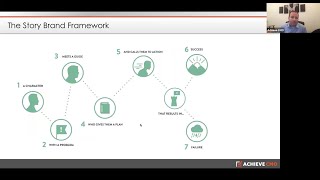
The StoryBrand framework casts your customer as the hero and your brand as the guide. Create buyer personas like Volunteer Vicki or Corporate Christy to align your sales and marketing teams around what each customer actually needs, budgets, and timelines. In B2B, map the whole buying center, not just the decision-maker.
Chapters
So the StoryBrand framework basically goes like this. You have a character who has a problem, who meets a guide, who gives them a plan, calls them to action that results in success or failure. This is a story. This, this story framework is used in a lot of Hollywood films. We could, we could look at Luke Skywalker, for example. You have a character, Luke Skywalker, who has a problem. The evil Empire's after him. He meets a guy. In this case, he meets two guides. He's got Yoda and Obi-Wan Kenobi who give him a plan that says, hey, trust the Force, go fight, calls him to action that results in the Death Star being destroyed. Or, you know, if he fails, the rebellion is crushed and the world ends, right? Uh, another example of this is The Hunger Games. You've got Katniss, who's a character, games. She meets Haymitch, who's the Xers, and gives her a plan and then says, hey, go and fight. It results in Katniss living and District 12 rejoicing, or if she fails, Katniss dies and District 12 is crushed and everyone is sad, right? This, this story framework is used in a lot of places, right? In the case of a story brand, the really important thing to think about is that your brand is not the hero of the story. Your customer is, right? So when we talk about things and solutions and ideas, remember that it's not the brand, it's— that's the hero. You're not the hero, you're the guide. Your customers are the hero. And what we want to do is lead them to success, right? So if we break it down, you have a character, a potential customer who has a problem, there's some sort of pain or opportunity, they meet a guide, your brand, who gives them a plan, which is a product or a solution, right? So this is kind of the framework that we're talking about. In marketing, we call these characters, often we call them buyer personas or user personas, personas is kind of the word that we use. This example, so I used to be the general manager of a company called Spingo, and we were an event calendar company. We would help event makers or event organizers promote their events. And so they would buy sponsorships on the calendars. These calendars were across a bunch of publications. And what we found out is that we actually found out that there were 6 main kind of buyer personas. Or characters that we were working with. In one case, you had a volunteer, Volunteer Vicki, who was just a volunteer trying to help on an event. You'd have a nonprofit organization, we called her Nonprofit Nancy. You'd have a venue that's maybe putting on an event, Venue Vince, and then you have professional event makers like Professional Paul, or maybe a corporate event organizer, Corporate Christy. Or you might have an agency that's representing a brand and wants to do an event, right? So what we did is we, by identifying these buyer personas, we could actually create custom journeys for them and we better understood them. So when we think about the character, what we're looking at is who is my ideal client profile, my ICP, what are the needs and the problems of that character, and then how do we go serve them? And what we're talking about right now, we're not talking about the problems or pains, we're just talking about how do I identify who the character is, right? So in this case, Professional Paul was our ideal client profile. He organized large nationwide events, concerts, expos. They were often owner, director of development, VP of communications. Those were the titles that they had. And what we learned is that they had money. They had budget, right? But they also had often short timeframes to get things done. And so what we were able to do is create a buyer persona card. This is what this is called. This says, hey sales, this is how you use information about Professional Paul. Hey marketing, this is how you go find Professional Paul. And hey product, these are the things that you need to make sure you do for Professional Paul. Right? And so this, became a great resource internally to help new sales reps learn about who they're targeting, to help marketers know how to target, and help product create services, experiences that were relevant to professional Paul. That make sense so far? So what we're trying to do is really understand who is the character or characters so that we can then go and help them. Sometimes in a business-to-business scenario, you often have what are called buying centers. And now this is true even in, in non-B2B, but it's definitely true, more true when you have more complicated sales, right? So your character in this decision might be this decision maker who's the manager, but guess what? There are a bunch of people influencing them that are also personas or characters in your journey. Right? And we have to take them into account. So Steve, I'm thinking of your company, ILP, for example, right? We know the main character is a— is often a college student, but there are influencers around them that are influencing their buying decision. Their friends, their parents, people that have been done it before, whatever it is, right? We need to make sure we take into account those influencers as well when we think about the character and their journey in— to success, right?