A workshop on launching products covers industry maturity, pricing, and competition. The speaker uses VR and cookies as examples, then walks through distribution models, competitive positioning grids, and SWOT analysis. You'll map your competitors and your own market position.
Chapters
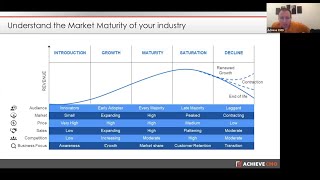
So when you take your product to market, right, so whether it's a new product or your existing product, one of the things you got to think about is the maturity of the industry in which you're in, right? So I know we have some clients where, you know, that they are the leader in this industry that's being created, right? And so what happens is when you're in an industry that's being created or created, it's usually a smaller market. Usually you can get away with higher prices, but you tend to have lower sales, lower competition, and lower awareness around it, right? So, um, let's suppose, you know, that— I mean, I think there's an industry— let's take the Jump. Have you ever— anybody heard of Jump, where you put on the VR glasses and you go and you know, you, you make this leap as if you're like diving off a cliff, right? And you're gonna fly in the squirrel suit, right? Well, that industry is, is a fairly new industry, so you probably don't get people typing in, hey, how can I have this virtual experience jumping off a cliff, right? So they're kind of creating these virtual experiences And so they're maybe a little earlier in that, right? And so what happens is you, you have these kind of smaller market. Well, guess what? As people learn and companies learn, hey, there's actually a market here, the market starts to expand and grow, and the competition also increase at a point where there's saturation and you see decline, right? So often industries go through the cycle of maturity from innovators to early adopters to the majority, like, late major, laggard. So now it's just a commonplace. Let's take that. Now it's like, oh yeah, there are 5 shops now that do this. I feel like in some ways, if you look at the cookie industry in Utah, you know, this is a great example, right, where Crumble— and you remember all the cookie wars going on, right? So there were some first mover advantages, and, and there's debate about who was, who was the person that created this industry, what company it was, right? Was it Chip or Crumble or Dirty Dough or whatever it is, right? But what you're seeing that is that there's more and more— the market's maturing, right? So a lot of people know, hey, I can go and get these cookies there, they taste really good, they're kind of big. Um, you know, as competition goes up though, what you're going to see is the prices will actually start coming down because they got to be more competitive. Where if they're the only cookie shop around, guess what, you're stuck with them, right? But as you have more options So that, that's what happens with the maturity market, right? When you look at the elements of like a go-to-market strategy, these are the elements that you typically think about. One is, hey, do I have product-market fit, right? Who's my audience? Who are my competitors? How am I going to distribute this product or service? What's the value proposition I'm going to propose? What are my timelines? What are the channels? What's the process with the retention strategy? We're not gonna talk about all these things really. I'm, I'm kind of more focused on the competitive landscaping and some of the pricing. But the other thing you gotta think about is like, how do I go to market, right? Is this a self-service model? Do I have an inside sales business model? So like e-commerce, for example, is a very self-service type model, right? An inside sales model might have like, I have a call center team. You know, I'm— I— it's all, you know, it's tap, it's controlled within my environment. I could have a field sales model where they're all out in the field, you know, maybe I'm knocking on doors or doing things like that. I might have a channel model, you know, hey, I'm gonna— I'm gonna distribute my product through these stores, right? And these different strategies that, you know, the complexity also changes, right? So for, you know, on a self-serve model, it's a pretty low complexity. They're going to go and they're going to buy something by themselves. The cost's also usually lower. You can get a high volume of it. Profitability might be interested. It might be harder to build initially, um, but you know, as you go in, you know, there's different kinds of strategies you think about, like how am I going to take this to market, right? The other thing you need to consider is just the competitive landscape. right? So where do you sit on that, that grid, if you will? It says, okay, I'm here and I might be low price or high priced, or it's more of a natural fit or a less natural fit to my competitors. Like, where are they? How are they solving the problems? And understanding where you fit on those is also really valuable when you're doing market research and product innovation. When you look at doing like— this is a competitive analysis template if you wanted to to take this and you start thinking about your own competitors and how you sit in those spaces, this is a grid that might help you do that. So we might look at company highlights. Okay, here's a quick profile. Here's their key competitive advantage. You know, we're targeting this market. They might be targeting a slightly different market. You know, they have, you know, we have 20% share. You know, sometimes we're guessing a little bit. But you can see, like, here's their strategy. And good product marketers really understand this of like, hey, here's where you sit and here's how the competition sits. Um, but you might say, here's the product services, their pricing, their distribution strategies. We might look at the strengths and weaknesses, opportunities and threats. Um, as you're doing this, the SWOT analysis also becomes really helpful. Has anybody ever done a SWOT analysis? And anyone know what that is? So basically, it's this grid right here where we're looking at internal strengths and weaknesses and external opportunities and threats, right? When you're, when you're comparing yourself against your competition, you're looking at the market opportunity. The SWOT analysis is a great way to kind of quickly analyze the situation. So you're like, okay, what are our internal strengths? What are our internal weaknesses? And then you look externally, like, okay, what are the opportunities that exist in the market? And then what are the threats in the market, right? So this is really helpful if you, um, in analyzing how you compare against your competition. So let's do an exercise for a minute. If you don't know who your competitors are, let's take a few minutes and try to identify and just make a list on your piece of paper, wherever you wanna do, like, who are your competitors? What are their products and services? How do they compare? I don't expect you to know all of this stuff, but if you wanna think about these things and maybe just get it started, let's start a competition grid for a minute. So that's what we're gonna do for the next 5 minutes.