Learn to build a problem slide that names the prospect's pain better than they can, using vivid analogies like "email limbo." Then craft a story slide showing the customer's win, not your heroics, backed by real numbers: Gong saw 33% deal-size increases, Plum Voice cut churn 70%.
Chapters
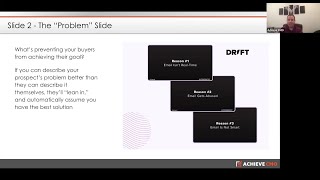
The next slide is the problem slide. So what's preventing your buyers from achieving their goal? If you can describe your prospect's problem better than they can describe it themselves, they're going to lean in and automatically assume you have the best solution. So we talked about this last week in depth, right? We talked about the problems that are happening with your customers, right? In a sales presentation, these kind of clever names become relevant, right? And kind of the way you describe or talk about the problem, right? You might say in this case, you know, too many emails or email limbo, right, is a problem. Or horse blinders. Hey, you're not, you know, what we notice is that marketing teams have horse blinders on them, right? They're only seeing things from their silo. Right? And so, you know, what, what's happening because of that, they're not getting insight into what's going on around them and how their work is impacting other people, right? You might describe that problem and what you should see is a nodding of the head, essentially like, yeah, you got it. You got, you nailed that. That's exactly what's happening today, right? This is the problem that we're having. And so you can take those problems and bring 'em into this story You can have a slide that kind of shows that, that, you know, that challenge, right? So in this case of Drift, this is the example that we're using here is, you know, email isn't real-time, email gets abused, email is not smart. And they're talking and trying to reframe the problem statement in a way that then leads them to some solutions about email in this case, right? Or not even email really, they're talking about thoughts or like live chat. Okay, so there's the problem slide. Think about that one. We're not gonna do an exercise on that. I feel like we covered that pretty well in depth last week. The story slide, right? So this is, I, I've given an insight, I've talked about the problem. Now what I'm gonna do is I'm gonna actually frame our solution or service in the context of a story, right? So the prospect's mind is now ready to accept the new idea. This is where you show them how they win. But again, we're not showing them how we win as a company, we're going to show them how they win as a customer, right? So 80% of sales decks typically highlight the vendor as the hero here, but remember, we're talking about the customer, right? So with your product, your product's simply a tool that helps them do this. This is a good slide from Gong, you know, so this is saying You know, here's it. Let me tell you a story about Ambassador. Ambassador was able to use GONE to actually increase their deal size by 33%. Act-On did it by 28%. And this is how they did it. Right? So it's not like an ROI statement. It's really a before and after statement. And you can use this slide as a backdrop for your conversation, but the conversation is focused on the story. With some emotional highs and lows, right? So we talked about customer story, and that success framework that we talked about last week, right? This is the story that says, and the more relevant you can make it to the customer, the better. You know, I try to do this when I sell. For example, if I'm talking to somebody who really needs leads, I will often tell them a story about Lendio and my time as the VP of customer acquisition for Lendio. And demonstrate that, hey, I was able to go from 500 leads a month to 10,000 leads a month, right? That story builds credibility and trust. Now, if I'm talking to a different story, maybe I'm talking to a startup, right? My story might be a little bit different, but what I'm trying to do is demonstrate that, hey, I have ex— experience in our company, our product, whatever, can do these things, right? And it's focused on the result of the customer and framed in the context of the customer. So last week we built a messaging framework. This is exactly where our marketing— if we talk about the brand experience, right, and the salesperson's part of that brand experience— this pitch and the pitch deck should be completely in line with all of the other messaging architecture and everything else that we're doing, right? So in this case, this is a great place to leverage your messaging framework to tell your story. Hey, you have a problem. Guess what? You have high wait— patient wait times. The solution is to implement efficient patient flow and appointment management. But instead of saying it that way, might— we might be like, we implemented this solution with this company and it improved their, their wait times. Now people are not waiting as long, right? So this is an opportunity for you to bring your messaging framework, influence the sales conversation and the pitch deck, and make sure that the story is being told in the right way and in the right context. Use real case studies to tell your story. So we have a client that, I guess they, they have brought in kind of their own marketing personnel, so they're not a client right now, but I worked with these guys for about 4 years, client success. And one of the things we did was really trying to highlight and bring case studies to the front because these case studies become those find those foundational points which we can train new reps on. We can bring in and we just know, oh, guess what? We help Plum Voice improve communication with customers and decrease customer churn by 70%. This is how we did it, right? Beyond Insurance leveraged, caused client success, decreased time to adoption from 1.5 years to 6 months. This is how we did it, right? And so bringing these case studies into that can really help you tell those stories. It's harder to make up stories on the fly, especially if you have a new salesperson that maybe doesn't have the experience and hasn't been there, done that. So having case studies is really helpful for this. And then remember from last week's discussion, try to make those stories compelling, simple, unexpected, concrete, credible, emotional, right? If you can create that kind of a story with the highs and the lows, because what they're gonna go on this journey with you and they're gonna accept the response at the end. So what I want you to do is I want you to think about a customer story and we're gonna take a few minutes and we're gonna write down a story, right? A story that talks about your solution and how you, by using your solution, you were able to help the customer accomplish something. So here's an example. The customer is doing X, but by changing and doing this, The customer is now able to accomplish the goal, which led to the outcome. Here's Gong's, since we're talking about Gong. Imagine being able to pinpoint high leverage improvement areas for each of your reps. It's hard because you can't be on every call, right? Well, guess what? Drift used Gong to automatically identify coaching opportunities and boost win rates. So the story was, was Drift, you know, here was this problem they were having. It's hard to pinpoint proven areas. But guess what? Drift was able to do that with Gong. And they were actually able to identify coaching opportunities and boost win rates. That's the story being told. Okay, go.