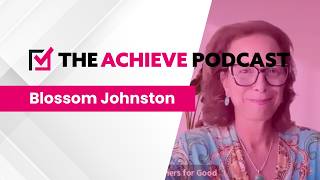
In this episode of the Achieve Podcast, host Taylor Baker interviews Blossom Johnston, founder and CEO of Idaho Partners for Good (IPG). Blossom recounts her early career working for Idaho’s governor, which sparked her commitment to strengthening families and children. She explains IPG’s mission‑driven, volunteer‑heavy model—over 100 part‑time consultants and no paid staff—allowing rapid pivots and cost‑effective scaling. Growth is driven by a purpose‑centered ethos, strong client relationships, and referrals, with a design‑with‑clients approach that contrasts with typical “design‑for” services. The organization continuously conducts environmental scans to adapt post‑COVID, and leverages AI for automation and efficiency, while identifying a need for an AI‑generated internal landscape‑assessment tool. Blossom shares personal leadership lessons rooted in Hawaiian cultural values—faith, family, culture, pilina (relationship weaving), and ha'a ha'a (confident humility)—and reflects on her StrengthsFinder profile, noting how her Achiever drive can unintentionally leave others behind. She emphasizes the importance of staying proximate to those served and building trust. Looking forward, she is most excited about empowering young leaders, even middle‑ and high‑school students, to bring fresh, unbiased perspectives. The conversation concludes with a reminder to keep people first, not technology or profit, and invites listeners to connect via LinkedIn and the IPG website.
Chapters
Welcome to another episode of the Achieve Podcast, the show where we highlight leaders, creators, and entrepreneurs, those who are building meaningful businesses, shaping their industries, and having an impact. I'm Taylor Baker Baker, your host, and excited today to be joined by Blossom Johnston, the CEO and founder of Idaho Partners for Good. And you can find them at Idaho Partners Number 4 Good at, uh, number4good.org. So Blossom, thank you for joining us today.
Absolutely, it's my pleasure and my honor to be with you today.
I know we've been trying to get this together for a little while now, so I appreciate your time. And for those getting to know you, give us the backstory a little bit on how this project got started and how you got involved with Sure.
So I'm going to start back in early 2000s because it's— it was so fundamental to me to be invited to work for Dirk and Patricia Kempthorne, who were the governor of Idaho at the time. And I got to work in this really innovative space for, for government. And so we worked across all of the counties in Idaho doing work that was meant to strengthen families and children. And so it was from that point that I started to see people differently and what they essentially need. In Idaho, and I'm sure in Utah as well, a lot of stuff is done with duct tape and baling twine. That's kind of the, the quote, you know, we do things with duct tape and baling twine because we are super resourceful, super creative, and there may not be a lot of resources to tap for the fundamental things that are important to us when we're talking about families and children. So it was that where I really got my, my insight into what, what I needed to do. I didn't know it at the time, but certainly I can look at that particular milestone when I worked there as a very fundamental piece of this legacy that we're building right now, which is built also on a lot of those places across my career, which I think most leaders, if they looked back over there, you know, those of us that are in, you know, in that, in that legacy stage, uh, we look back and we see the connections, uh, and it was, or it may or may not have been something we actually look for. In fact, my trajectory was I didn't look for hardly any of this stuff. It emerged at the time when it was supposed to emerge.
Gotcha.
Wow.
And so with Idaho Partners for Good, and your involvement with it, what would you say is driving growth for the organization?
Oh well, it's really about this notion that we need to show up in the world for each other. It is. There's a lot of people struggling right now. And I just came from a coffee with this young leader. And he says, wow, it feels like so many people are walking around without any purpose, without any they don't know why they're around and they're depressed. And I said, it does come back to this place of purpose. Who are you and why are you on this earth? And so that's really what's growing our movement is really around people who get that they're supposed to show up in the world, not just for themselves, but for others.
And how big is the team and organization right now?
So we don't have, we don't have like paid staff. We use consulting. We use, we use people who consult part-time. That way we can get what we need when we need it. So it's really the model that is much more— we can pivot fast and we can pay for what we need when we need it. So, but we have over 100 volunteers that lean in with specific expertise around things like governance, leadership, marketing, communications, evaluation, finance, all of those things that nonprofits and others need to do more of what they do best.
Gotcha. Now, looking back, what turning points for you have had the greatest impact in or changed the way you think about running the organization?
Um, uh, when I keep hitting my head up against the wall and it— and I just get bloody instead of get through, uh, that's a pretty sure indication that I need to step back. And really take a look at the landscape. I'm a big proponent of doing environmental scans, uh, where you can actually see what's happening in your landscape or your ecosystem at the moment so that it can help inform your decision-making. So we keep pivoting because we started right in COVID, and everything from that moment until now, we have been doing the environmental scan and we go, okay, now we need to go here. Now we need to go here. We're still mission-driven. We still know what our values are. We still know where we're going, but the approach changes based on our environment.
Gotcha. Okay. Now, looking at your systems, as far as attracting new guests, new clients, what's been working well to bring on new clients and keep them?
It's really the recommendations. I mean, if you don't show up well for, for your clients, forget about it. You know, if you just— if you're just— if you're treating them like a project or money, you know, just money in your pocket, you just need to stop and you need to go do something else. Because it's all about relationships, it's all about making sure that it's mutually beneficial. And so, you know, that's just how— that's our mojo. We design with our clients, we don't design them, uh, which is very atypical out there. You know, some— somebody comes in with, here's how we do things, and more often than not, that's going to either cause harm to the client or they're not going to get what they actually need from you.
I like that. We design with, not for.
Yeah.
So when it comes to your marketing and sales material and opportunities, where do you still see great opportunities?
Uh, it is on with those that we have already impacted. Um, we're— while we're getting new clients, it is almost always by referral from clients that have already used us. And it is a factor of, um, them seeing us out on social media, which is a big deal. It brings them— bring us— brings us back to mind because there's so much noise out there that we don't stay active out on social media that they'll forget us. Until a pain happens, and then they'll go, oh yeah, I remember. But then their first referral is when, when a friend of theirs or another business owner or somebody else comes to them, go, hey, this is really hurting right now, who do you know?
Gotcha. And is there an ideal client or business industry or type that works best for what you guys do?
Uh, you know, we are— we love smaller And here's why. When they're bigger, they can go get whoever they want. They got the resources, they got, you know, they're highly professionalized. We're scrappy. We want those that are out there scrapping it day in and day out because they're normally the closer in proximity to our end users, which is the community. So when we can help the mom and pops, the, the frontline nonprofits, the state agencies that are the municipalities that are delivering, that's where we get our most bang for the buck and that's where they get the most bang for the buck. Can we do large federal agencies? Yeah, we probably can, but we're probably not the best fit.
Gotcha.
Okay.
Yeah. Now with all the change around AI and automation, where have you guys found ways to utilize it internally?
Well, you know, if you're not using it, then you're, you're not going to survive in the, in this environment. I mean, it's going to be really hard to survive as a business unless you're really niche and you just maybe do one or two things. Then, then if you're a craftsman, AI may not be your best bet for automations and for pipeline and for things like that. That's how we typically use it. But for the rest of us, it can help streamline, it can help automate, it can help do all the basics that a leader needs to just keep doing what they do best. So AI leaves us space to do what we do best as leaders.
Gotcha. That makes sense. Now, if you had to pick one constraint to focus on and solve, over the next 90 days that could change the trajectory of the business? What would it be?
Oh, what a— what? That's kind of a gnarly question. What is— wow. Okay.
Hmm.
The thing that really would accelerate us to the next level would be for someone to come in with expertise and a toolset, probably AI-generated, that can help us do the internal landscape of our vendors, of our technology, of our processes, and give us a game plan on where and how to let go of things and how to add more fuel and where to add the fuel. So I think that that would really help us tremendously. And I think maybe one of your— maybe somebody listening to you today is going to go, hey, I can help with that.
Maybe for sure. And so we'll have to see what comes of that. So, Blossom, when you think about your own journey, the wins, the mistakes, what lessons stand out to you? And which ones do you feel like maybe took longer to learn than they probably should have?
I'm a hard-headed Hawaiian. And so I am one of those people that tend to learn by doing. I mean, actually, most leaders do tend to learn by doing in their leadership journey. But it wasn't until I actually reconnected with the things that meant the most culturally that I started to put down the right kind of roots.
Gotcha.
So I, I learned a lot of lessons over my life, um, in a very shotgun way, but it wasn't until I really started to ground myself in those things that were most important to me that I began to really be a lot more effective. So my personal values are faith, family, culture. Those are the things that are super, super important to me, and if I have to choose, those are the things I'm gonna choose, okay? Then I have a set of values as a leader that I go to all the time, and it's rooted in being a great humanitarian, not a great capitalist, not a great just leader, but it's really about being a great humanitarian. And so I find that leaders tend to go up the ladder and then they forget the face of those that they're serving. So that's the first lesson. We have to stay proximate to those that we are serving. If we don't, we start making up stuff for them and it doesn't work. We've got to stay in the trenches with a face on what we're doing. So the next one is called pilina. Pilina is this weaving of relationships. If you don't have good relationships, you will not be successful. Just pure and simple. Not as a great humanitarian. So, Polina is the weaving of relationships. You can't step into someone else's environment well unless they trust you. So, Polina builds trust. This much I know, I am, because I'm so headstrong and because my top 5 for StrengthsFinders are all the stuff like Achiever, Connector, Believer, Learner, Relator, those are things that all have corresponding weaknesses. So if I don't understand those weaknesses in my strengths, I'm gonna damage people, which I have in the past. Because my number 1 is Achiever, I leave people in the dust and I'm trying to get them to keep up. But most people who have Achieving as their number 1 tend to leave people in the dust. And so you have to realize that it's not because people don't want to go with you, it's because they can't keep up as an Achiever. So I've had to really tone it down. Ha'a ha'a is a super important piece of what I do, and that is this confident humility. As a Native Hawaiian female, I'm in a lot of rooms that have not typically been a place for Native Hawaiian females. And the way I navigate, the way I try to navigate, is with a confident humility. I don't have to have people like me. I don't have to have people agree with me. But what I have to do is walk confidently in the space that God has created for me to walk in.
Yes. Wow, some good nuggets right there. A lot of good takeaways. So last question for you then. When you think about the next stages of the business, what are you most excited about?
Young leaders. That is what I'm most excited about. I want to take as many young leaders with me as possible. We have got to give seats to young leaders that have historically been held by older leaders. If we do not multi-gen, uh, generationalize our business sector, we will lose some of the most innovative solutions that we could possibly want. It's not because they aren't there, it's because we haven't invited the right people into the room. So especially young leaders, and I would go so far as to say, I love to have middle school and high schoolers in our mix because they don't have the blinders that we do. They don't have the biases, they don't have the bureaucracy that they're fighting, they just bring it. And so that's what I'm most excited about.
I like that, I like that. So often that focus creates those blinders that you're talking about.
Yes. Yeah. And, and we're super passionate about it. I mean, I, my, my candle is getting smaller and smaller. I need to light as many wicks as as possible.
Say that one again, that one's good.
Uh, my, my candle is getting shorter and shorter. Yeah, I need to light as many wicks as possible.
That is beautiful, that is beautiful. Well, Wilson, thank you for coming on and sharing your wisdom, your experience, and your journey. Any final thoughts for our listeners or others on a similar journey?
I would say people first. We, we have to remember it's about people. It's not about technology. It's not about profit. Keep the people first and you'll get to the end of your life and you go, okay, I did it right because I put the people first.
Wow. And so for those who want to learn more, they can go to LinkedIn. They can also go to IdahoPartnersForGood.org. Anywhere else you want to send them?
You know, subscribe. We do some awesome social media and it's about lifting all boats. It is not about us. It is about the ecosystem in which we reside and lifting all boats.
Awesome. So reach out and subscribe. And thank you again. And thank you to our sponsors of today's episode, Achieve Fractional, which provides fractional executive leadership for growing businesses. And if you enjoyed the episode, share it with a friend, with a colleague. If you're in a stump, you're not sure which way to go, or you need some connections, reach out to Blossom and the team. They will help you help navigate and help grow your business. So reach out and we'll see you in the next episode of the Achieve Podcast.