The Achieve Podcast - Matthew Christou (Big League Clean)
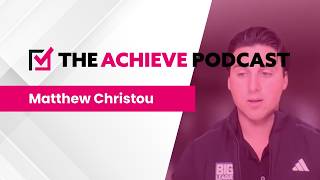
In this episode of the Achieve Podcast, host Jesse Warner interviews Matthew (Matt) Christou, co‑founder of Big League Clean, a commercial cleaning company launched in Denver in 2023. Matt shares his personal backstory—from a small‑town New Jersey upbringing, through college setbacks and early failed ventures, to meeting his partner Nash and launching Big League Clean while facing personal financial hardship. He describes the company’s evolution from a two‑person operation to a multi‑department team with a focus on rapid client response, delegated sales and marketing, and a presence‑focused outreach strategy. Matt explains how AI tools (Whisper for voice‑to‑text, Claude for copy, Firefly for meeting notes, Make for automation) are embedded throughout the business to boost efficiency. He identifies trust and brand perception as the primary scaling constraint in a commoditized cleaning market and outlines the firm’s ambition to become the premier buyer of commercial cleaning businesses, aiming for $70 million in recurring revenue by 2031 while helping owners exit with legacy preservation. The conversation concludes with Matt’s key lessons—securing mentors early, managing ego, and leveraging feedback loops—and his advice to other entrepreneurs.
Chapters
Welcome to the Achieve Podcast, the show where we highlight the leaders, creators, and entrepreneurs who are building meaningful businesses and shaping their industries. My name is Jesse Warner and I'll be your host today. We're excited to have Matt Christou, who is a co-founder of Big League Clean, with us today. Matt, it's a pleasure to have you on the show.
Thanks for having me, Jesse.
Matt, so our audience can get to know you a little bit better, give us the quick backstory of your business. What do you do? How did it all get started?
Absolutely. So first I would want to get a background on kind of who I am and how I got here and Bigly Clean got here. So kind of rewinds all the way back to small town New Jersey named Morris Plains. And from there, I didn't really know anyone that owned a business. Everyone that I knew worked for someone else and That was just kind of the reality for me. So from there, I went to a high school, it was one of the top all-boys high schools in, in the country named Del Barton. And I really saw what greatness was there. And I played on one of the best soccer teams in the country at Del Barton. And really, I developed a sense for a hunger for greatness. I just didn't know how it was going to show up in my life. As I went to college after, I kind of fell into a little bit of a slump where You know, was drinking, was partying, was just kind of doing the thing in college. And I felt myself kind of lose touch with that hunger for greatness. And I realized in college that that greatness for me would show up in entrepreneurship. And that's kind of where I made a big jump in my life of, hey, I want to build a business somehow. I don't know how, but I want to figure that out. And from there, that's where I tried a couple businesses. One was a breakfast sandwich company. That failed. One was a turf wall art company that also failed. And in that time I was still working in corporate America. Now this all changed when I met this gentleman named Nash who was living in Denver, Colorado, and that's where I was living at the time as well. And Nash was starting a commercial cleaning business, which funny enough, I was too at the same time. It was my fourth business. And when Nash and I chatted, we both had the same mindset, both kind of wanted to do the same thing, had the same, had the same goals of growing a big business and providing a lot of value to society. And additionally, Nash was looking to get out of his, um, corporate kind of job where he had climbed, climbed the ladder for around 10-ish years or so, and he was just ready to do his own thing. He was really fed up with it. And for me, I was just really hungry for building my first real business. And for both of us, through that time and talking and meeting each other, we were able to develop a partnership and say, hey, We want to do this. We want to bet on each other and go for this. And the name of the company is Big League Clean. So that's officially where we started back in Denver in 2023. And then from there it was a lot of struggle. I was on unemployment, $30,000 of personal credit card debt, was on food stamps, eating sardines for dinner. I was trying to be a little bit healthy but had to kind of budget it and was just a really tough time. I was waking up at 3:45 every single morning And this was also the same time I got fired from my job. So I had no income. Bigly Clean wasn't producing enough capital for us to pay ourselves and we just had to fight. And in that period we grew a ton and it was around 2025 where we then expanded to San Diego. And then we realized like, hey, we've had the success, you know, we're paying ourselves now, we have a 7-figure business. Let's really look within the opportunity. And we saw that there was just a massive, massive opportunity for these hardworking cleaning business owners to sell their business in the industry. They didn't have anyone to do it to, though. And we wanted to be the premier commercial cleaning buyer in the industry. And that's our goal right now. We want to get to $70 million in recurring revenue by 2031. We developed our own commercial cleaning company in the industry. We built it by hand, and now we're looking to help owners exit as well. So that's the full story. That's how Bigly Clean was, was created. I hope that gives you a good background. Jesse.
Tell, tell me a little bit how the business changed as it's grown. So you and Matt, or you and Nash, start the business, the two of you. How big is your team now?
So now we have a pretty widespread team, and it, it's a bunch of different, um, pieces of talent as well. For example, we have salespeople, we have marketing people. In the beginning, it was just Nash and I. Um, we were pretty much doing everything. I think a lot of business owners can relate to this, where when you first start up your business you have— you're wearing all the hats, right? You're doing a lot of stuff. And that was Nash and I in the beginning. Now we have a lot of talent and delegation which is outsourced. So for example, sales, marketing, client communications, we really try to pride ourselves on having a 14-minute average client response time, which we developed from Goldman Sachs. They have, you know, spoke to someone who worked at Goldman Sachs and they let us know, hey, they have like a 5-minute internal response time.
Rule.
Any time of day, you're responding within 5 minutes. So for us, we were like, hey, that's awesome, let's try to implement, implement that. And that translated to customer service. So we have someone that handles customer service, which we try to respond as quickly as possible. And then we have a lot of things delegated, which vastly changed from where we were at in the beginning, where Nash and I were trying to do everything ourselves and struggling.
When you look at sales, marketing, and outreach— talked a little bit about that— where are you seeing the most traction? What's working for you as you try to bring on new businesses?
So for us, the most traction that we've seen has come from consistent follow-up, and our follow-up really we've positioned as more of a presence follow-up rather than a sales follow-up. So we try to make sure that what we're doing in our communication is letting them know we're here, this is what we stand for, this is what we care about, and all that we're asking for, Jesse, is a spot at the table. That's all we're looking for here, for when you guys need to make a decision, for when you're looking to bring on new commercial cleaning company to, to clean the building. We just want to be there at the table. We're not asking for it right now. So really for us, it was the realization that, hey, we need to do less selling and we just need to be present for, for the prospects and let them know we're here to help them when they need it, not try to force them to make a change when they don't need it.
There's a lot of buzz around AI and automation right now. Like, people are, are implementing. How are you using it in your business today?
We use it everywhere. And AI is a— I'm a massive proponent of AI, and specifically in service businesses. I think service businesses are kind of like catching up to it a little bit, but it's, it's, it's like a must-have in tech companies, right? You must have it to survive and really compete. But in service businesses, you don't necessarily need it. And there's a lot of small business owners that don't have it and they're getting by fine. But I think in a couple of years from now, there's going to be a really big difference between those that began learning and those that really, really did not care about it and stuck on pen and paper. So for us, how we're specifically using it, I use it on a personal level in multiple ways where I try to increase my speed and efficiency as a, as an owner. And the first example is going to be for voice, voice-to-text. So there with voice-to-text, there's a 3x typically for people. You're typing at around, let's say, like 50-ish words per minute. For speaking specifically for someone, a guy from New Jersey like myself, my word per minute is a lot higher than the average person, but typically it's going to be around 150. So you get a 3x. To me, that's efficiency right off the bat, having Word2Text. There's a software called Whisper where you can use, you can use your computer. And that's been very, very fantastic to use for myself. But from a business lens, we use a lot of different artificial intelligence. We use Claude, for anything that— anything creative. If we're looking to build copy for marketing or sales, Claude's a fantastic resource. And we use Firefly's note tracker as well. We're having meetings, we're able to take that information. And then on top of Firefly's, we use Make, which for automations will take that meeting information and then we'll create an automation where that meeting information is then funneled down into digestible pieces that we can use. To really get better, whether it's our team getting better and understanding how we performed in the meeting, um, understanding how we performed with prospects and speaking to them or clients. We, we use it really everywhere. So there's just a couple use cases of how we use it.
As you're trying to scale, you have some ambitious plans here over the next few years. What are some of the constraints that you're seeing? What, what do you keep bumping into? Time, people, systems, capital, leadership? What, what are those constraints that you're feeling?
I think the main constraint is trust. I think that for us, we want to reduce that as much as possible. We want to have our prospects, clients know who we are, what we stand for. And I think this is a big reason why I'm making a large push on putting content out there, putting myself out there. We want to reduce the constraint of, of trust in that factor, because I think in the commercial cleaning space specifically there is, there are a lot of options. It's, it's sometimes viewed as a commoditized space. And I think that with that comes the territory of if you can uncommoditize yourself and be a known, be a known brand and people understand what you, what you stand for and that you do quality work and care for your clients and people you work with, I think that you have a much better chance of success. I think that applies not only in the commercial cleaning space as a business owner there, but also as an acquirer and looking to buy other commercial cleaning companies. If people can know me and see me and hear what I'm about, um, they can make a decision whether I'm the right fit before we even have a call and, and not waste anyone's time. So I think trust is the number one barrier that we're looking to, to, to break down.
As you look at this next stage of growth, what are you most excited about?
There's a couple things. I would say one of the top ones is going to be helping commercial cleaning business owners exit. I think it's, it's a space where it's, it's challenging and we've only been doing it for a couple years now, but I've spoken with enough commercial cleaning business owners to understand there's blood, sweat, and tears that really goes into building successful company in this industry. And you need to work hard for, for a, a long time to really build something great. And I'm excited to, to work with cleaning commercial cleaning company owners and help them exit and, and do it in a way that retains their legacy. And their people that they provided a home for and, you know, really keeps the thing that they built special going and gives them a good payday. So I'm really excited for that. And then the other thing I'm excited for is just continuing to provide value and affect people in a positive way. I think that one of the biggest honors of owning a business is being able to provide employment for other people. Provide value for others, whether it's through if they're your client or a partner in some way. And that's— it's just something that I really appreciate being a business owner is being able to provide value to society.
Matt, look, looking back at your journey, you've started and failed on some companies. You've had some success here with this company. Talk to me a little bit about the wins and the mistakes, the lessons that stand out to you.
Absolutely. And there's been a lot of them. Um, there's been a lot of mistakes that, you know, looking back, I'm really appreciative for it. I, I think that my personality is one that I'm— I don't learn well off people just telling me stuff. I need to go and, and trip walking up the stairs because I'm walking too fast before I can go, oh, I see why I shouldn't have done that, I should have listened. So for, for example, in, in my career so far, um, some, some mistakes that I've made that have that have held me back were number one, not getting mentors early enough. That was the number one thing that I did that advanced my, advanced my learning, my growth, my growth curve, everything about being able to be successful in business. Having mentors was the, was the key thing. Once I got a mentor, that was awesome. And the mistake I made really there was my ego. I was too egotistical and thinking that I could do everything myself and I knew everything myself. And once I got past that and really dropped my ego and said, you know what, I don't know everything, I actually barely know anything. I got to learn from people that have been there and done that. It really was a 10x for myself.
Last question for you. What advice would you give to other leaders or entrepreneurs who are on a similar journey to you?
Number one would be find a mentor. That's in a position that you want to be in, that you would like to listen to and take advice from and really use as a guiding light on your journey. I think that it's absolutely pivotal to have someone as a feedback loop because as an entrepreneur, when you're starting out, especially if you're alone, if you don't have a business partner, there are no feedback loops and you could be doing the wrong thing over and over again, but you don't have any awareness on to what, what to adjust. Having a business partner really helps with that, especially a good business partner, which I have had with Nash, which has been awesome. But having a mentor and having multiple mentors, you just get all these feedback loops and they're not just giving you feedback from a general source. It's feedback from a highly specialized source, from someone who's in a position that you would like to be in in the future. And I don't know what could be more valuable than that as a new entrepreneur.
Well, Matt, thank you for sharing your story and insights with us today. Really appreciated hearing from you and learning from you. For those listening, if you want to learn more about what Matt and Nash are building, you can go learn more about Big League Clean. Bigleagueclean.com is their, their website. Sounds like they're doing great things in the commercial cleaning space and, and growing their business. So if you want to do that, and that'll wrap up today's episode of the Achieve Podcast. So Matt, thanks for joining us.
And just going to cut in real quick.
Yeah, go ahead.
All right, we have— we do have a link for anyone that owns a commercial cleaning company business and would like to have a conversation. You just go to www.bigleakcleanteam.com. So www.bigleakcleanteam.com, and you can easily, in under a minute, request a private conversation with us around buying your business or selling your business.
Great, fantastic. We'll make sure we include that link as well as we publish this, Matt, so you have that there.
Thanks, Jesse.
Um, big thank you to our sponsor Achieve Fractional, who provides fractional executives for growing businesses. And if you enjoyed today's conversation, follow the show, share with another entrepreneur to also find value in it. And again, thank you all for listening today. We'll see you on the next episode of the Achieve Podcast. Thanks again, Matt, for joining us.
Thanks, Jesse.









