The Achieve Podcast - Melvin Yuan (Stellar)
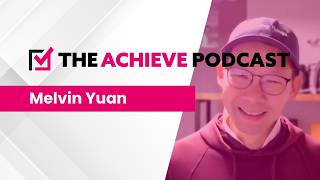
Melvin Yuan left the Singapore Army to start Stellar, a back-office service for founders handling accounting, legal, and admin work. He's building toward an AI voice interface called Hi Stella that automates tasks like expense reporting, and plans to launch a working version in 6 to 12 months.
Chapters
Welcome to another episode of the Achieve Podcast, the show where we highlight leaders, creators, and entrepreneurs, those who are building meaningful businesses, shaping their industries, and having an impact. I'm Taylor Baker Baker, your host, and excited today to be joined by Melvin Yuan, the founder and CEO of Stellar, and you can find them at hystellar.com. So Melvin, first, thank you for joining us today.
It's a pleasure.
And so for those getting to know you, give us a little bit of backstory, how you got into this space because you have a lot of talents. How did you get here and who are you serving?
Oh man, it's a long windy road. My career path has been, you know, it's not been a linear path for sure. I actually started off my career as an infantry officer for 6 years in the Singapore Army. Then I went into public relations and branding, rode the Web 2.0 wave, and I started deploying Web 2.0 technologies for the work of communications and PR, ended up evolving into digital marketing and then very quickly transitioned to building my first tech startup with a co-founder. We used Wi-Fi signals to predict the location of people indoors. And so it was an indoor GPS type solution. We eventually got acquired by Ruckus, you know, wireless company based here in the Bay Area. After the acquisition, I worked with them for a bit, went, you know, started building another company. In art. That one didn't work out. And it was, it was commissioned art. It was like, on hindsight, it was supposed to be NFTs. That didn't work out. Went on a long sabbatical. And then when I came back from my sabbatical, I started looking around for things to work on and I stumbled into this space. So it's kind of a windy road, but eventually ended up in this space of helping other founders with their administrative back office. And I looked at this from multiple angles and I felt like— so, so sorry, maybe a bit more context. So after my sabbatical, I ended up talking with one of the investors who invested in my first company and asked him, what are you doing? And he said, oh, I'm busy rolling up accounting firms. And he talked about how he looked at all these old-school accounting businesses that have very routine workflows. And he said, you could make, you know, you could make money and build a really big company by just buying them at 1x of their revenue. And sort of grouping them together and then improving efficiencies, centralizing operations, centralizing marketing, you could build a big company. I looked at it, I thought, that's really interesting from a commercial perspective. But I also looked at the experience of working with an accountant. I'm like, I remember when I first started my businesses, I would go to the guy who formed my company and I said to him, now I need a trademark, can you do this for me? And he said, nope, we don't do trademarks. And I'm like, why not? You have all my information. So I went on to find a trademark lawyer. And, you know, then the trademark lawyer said, I'll do this for you. And he said, I need information about your company. And then I went back to my corporate secretary, the guy who formed my company in Singapore. And I said, well, now I need information about my company that you have. Can you provide it to him? Didn't learn my lesson. A few months later, I moved into office space and I needed corporate insurance, insurance for the office. And again, I said to him, could you help me get insurance? And he said, no, I don't do that. So I went out, I found a guy to do insurance, and the guy said, "Well, now I need information about your company." Came back to him, like, "Okay, now I need information again." So that made me realize that the company secretary, the guy who incorporates your company for you, your accountant, the guy you meet on a month-to-month basis, has so much context about the company. And this was before we went into, like, you know, like we talked about AI and generative AI and the importance of context and now context engineering. It dawned on me at that point in time that if I have all the contacts of a company from day one, I could be of service. I could provide so much more value-add than many of the current providers are providing. I could do their trademarks, I could help them with insurance, I can help them with, uh, their CFO-type work, with their financial planning and all that. Um, and that's when I jumped into the business.
Wow, I love that you saw the need and experienced the need. And then jumped in. So how big is the team in the organization now?
So we're, you know, with 10+ people, 12+, oh, actually about 12 people right now serving a few hundred clients, you know, in Singapore and here in the US.
That's awesome. And what would you say is driving growth for you guys right now?
Right now? Right now, most of our growth is really through referrals. If you go into the market right now, what you see is you see a lot of point solutions. And when we started the company, we knew that there, was, you know, there were tons of other point solutions addressing every single part of running a back office. When we launched, you know, there was Stripe Atlas, there are platforms that basically say for a few hundred bucks you can incorporate your company, for a few hundred bucks a month we can do your accounting and bookkeeping. So all these solutions were already out there. There are QuickBooks, you know, founders who want to do their own accounting would go to it. And I kind of lost track on what the actual question was.
What is driving growth for you guys?
What's driving growth? So what's driving growth is the realization of our clients that it is much better to have one partner who would handle your entire back office than to go to the different multiple point solutions like log into QuickBooks, log into the payroll system, and do everything by yourself. So I kind of like to think that we could be the closest to a co-founder for somebody. Because if someone's taking care of your entire back office, um, and is dealing with all the stuff, you know, dealing with, um, things like, oh, you know, look, well, basically, if someone's managing your entire back office, you don't have to worry about training your accountant, doing QC, auditing, you know, the work that they do. If you run your own back office and an accountant leaves or bookkeeper leaves, all that context, all the history goes with them, and you have, as a founder, You've got to go hire the right accountant, the right bookkeeper to come in and teach them everything all over again, or give them all the context. We handle that. So we're the closest to a co-founder without giving up equity.
I love that. Wow. That's a very unique approach to the market. Now, looking back for you, what turning points have had the greatest impact on how you think about and run the organization?
Wow. You know, I think Most people agree, would agree with me that in the last 18 months there have been multiple turning points thanks to how, you know, AI has been evolving. When we started the company, you know, as you pointed out, our domain name is HiStella.com, not Stella.com because Stella.com is taken by the crypto company. But when we were looking for an alternative, I chose HiStella because very early on I imagine a founder walking into his office and simply saying, "Hi, Stella, can you generate a report of all of last month's expenditure in business and entertainment?" Or, "Hi, Stella, can you form a wholly owned subsidiary company for me in Singapore with my holding company in the US?" And it would get done. I envision a world where a single sentence would basically accomplish the entire work that needs to be done.
I love that. That would be amazing. So when it comes to you guys' messaging and your outreach and marketing systems, what's been working well to attract and keep clients?
Well, so frankly, in the last, I mean, we've actually never really focused on marketing very much. You know, I sometimes go to LinkedIn and share with my friends on LinkedIn what I'm working on. But I haven't really made a huge push in marketing. So all our growth has been through existing customer referrals, customers who realize that, well, it makes a lot of sense to go with one partner to handle your whole back office than to handle multiple point solutions by yourself. And so it's customer referral. It's, it's people within our network who trust us. And the reason why I haven't been doing this is because I think that in this industry, the work that we're doing, again, we talk a lot of those point solutions. I personally feel that the better way to serve our clients is really the way that what we call old-school services firms have served their clients for decades, which is build a relationship, understand your customer, speak to them in natural language. Don't make them fill up a 20 or 30-question form in order to get something simple done. AI is quickly allowing us to scale that bit. But the fundamental paradigm of a good relationship is I know you, I talk to you in the language that you like to be spoken to, I understand your context, and I execute everything, and I take accountability for everything. So that's the whole reason why we— but it's not easy to do. It's much easier to have that form, get customers to fill it in, swipe a credit card, have them deliver something in a, with a template approach. Here's a templated, you know, incorporation document and leave it. And then 2 years later, and this is a true story for many people, 2 years later when the founder starts to raise their like Series A or Series B, they go back to the original documents and they realize those templated documents do not fit their needs. And right now they've got problems with fundraising because something's gone wrong 2 years ago and there's a lot of unwinding to do. We've had many clients who've taken this template approach to forming companies, who've taken a, you know, who've outsourced their accounting and bookkeeping to a bunch of people who, you know, don't really know what they're doing, only to end up with a lot of problems when it comes to fundraising. Wow. Yeah.
I love that ethos.
So the reason why we've not done much marketing is because it's a hard business. It's not an easy business. It's a hard, complex business. That's traditionally and still driven by human professionals sitting down and doing things the old way. The re-engineering of that is now possible with AI, but it takes a lot of work. And for that reason, we've been focused a lot on just getting our, our own house in order and getting the intricacies sorted out operationally before we go and do more like sales and marketing.
Wow. So where are you seeing a lot of opportunity on the table with what you're doing? Like, where do you want to be in 12 to 24 months?
Um, I should have an answer to the question, but I frankly don't. Um, I kind of do. Where do we— where do we want to be? I think we've done a lot of hard work in terms of getting our operations in order. I do believe that we can scale a lot of the work that typically needed to be done by a human professional. Uh, where I want to be is I want to make the agentic workflows the, the knowledge that we've built and distilled into, you know, a set of AI agents. I want to make that more widely applicable to people. So yes, going out and talking to more people and helping them solve their day-to-day problems with a combination of human professionals as well as the AI system that we've built is what I want to do.
And Do you have a grasp on like your ideal client, your ICP?
Um, I kind of do. I've got two extremes. The people that, you know, probably love us the most would be international founders who are aiming to set up their companies in the US. The US is obviously a huge market. You know, I think that for a while In the past decade or so, people were saying, oh, you know, there's lots of opportunities in Southeast Asia and Europe. But somehow people are still realizing the US is still the primary market for the most ambitious founders and business owners. And these people are coming from outside the US, from Europe, from Southeast Asia, where I'm from. And we, we understand the complexities that they face probably more than a typical service provider who may have grown up here and may not be able to understand what an international founder knows or doesn't know, has or doesn't have. Yeah, yeah, yeah.
A lot of new—
So that's our ICP, somebody who's coming from overseas and just having to deal with the complexities of running a company. That's one. The other ICP is, you know, with AI, people have been talking about these one-man unicorn companies. right? Uh, super lean teams where 1 or 2 people can build a billion-dollar type business or multi-million dollar business. Yeah, these are the guys do not want to be that 1 or 2 man team with a 1 or 2 man accounting compliance back office, right? So we're, we're an ideal solution for these guys because you're like, hey, you know, if I can reduce dependency on the people that I directly hire and I essentially find a partner that is wholly accountable for running my back office, I can, I can live the dream basically, right? Run my whole company myself, a whole bunch of AI agents. And where AI agents don't work out, there's a team of professionals that would step in and do that for me. And right now running a back office is still, is still something today that you cannot have fully autonomous AI agents running for you.
Yes.
You don't want a fully autonomous AI agent running your bank account, running payroll, talking to the IRS, right? You still need people, you still need human professionals for that.
Yes, yes, so true. It helps you get close, but it doesn't get you all the way across that line.
Yeah, yeah.
So with AI and all the automations, where have you guys found ways internally to utilize?
Well, there's so much to talk about, um, internally Well, just simple things like, I think one big push is really codifying our knowledge. And actually, in the last couple of weeks, I've been putting together a book project on essentially codifying knowledge. And, you know, I think in many organizations, both big and small, much of the conversation around AI has been focused on the tools and the use of the tools, which is fun, really fun to talk about. Right? It's the most exciting thing. Yeah, because you throw in a whole bunch, you know, throwing a prompt into a tool, into an AI platform like Claude or ChatGPT, and you get a pretty good response. And it's the thing that grabs your attention most. But I think that one of the hardest and most important work is really encoding the collective knowledge of a company. And it's not as easy as most people think. Most of you think, oh, you know, just give me your SOPs, we'll feed it to ChatGPT, and ChatGPT will act on your SOPs for you. Or no, it's not that easy. When you talk to the human professionals who are doing the work, like we have people who are experts in payroll, the experts in keeping your company compliant and bookkeeping, and, you know, answering questions on HR compliance. It's easy to ask them. It's easy to get them to say, to list what they know and what they do, but an AI cannot take that information and do exactly what they do. And that's because encoding the information that's in the brains and encoding the habits is a massive task. So one of the things we've been really— I've been really busy in is really just observing the way that I work, observing the way my co-founder and my other team members work, and just think, If a completely new person, a 20-year-old intern comes into the company today with no prior knowledge, no prior experience, and just given a set of documents, would they be able to do the same work that I'm doing, that my co-founder is doing? And the answer is no. So we've been— I've been trying to basically build a knowledge base that someone like that and an AI would be able to use and execute the work as well as possible.
I like that. Wow, so much potential in that. So Melvin, if you had to pick one constraint that could affect the trajectory of the business, one constraint you focus on the next 90 days, what would it be?
One constraint, um, so when you say one constraint, do you mean, um, one problem I'm trying to solve, or, um, challenge keeping me from Either or, like, what is one thing you could, if you focused on the next 90 days, could change the business? Um, it's a good question. Um, because when you ask a question, I'm looking at a list of all the 26 projects I'm working on in the next 90 days. I think the answer is actually focus. Um, right now, um, you know, we all know, right, focus is the most important thing. Yeah, it is difficult to focus for two reasons. One is purely, you know, just so much going on in a business that there is— it's easy to get distracted. But at the same time, there's— I believe that there's also a good reason to be distracted. And that is when we're— I think that what we're building today is not just— it's not just about building one or two workflows and then shipping it. Um, I think we can build a really powerful organization if we're able to see the interconnected relationships between all the different things that happen in the company. For example, the unique knowledge that sits in the payroll and HR compliance expert in my company could also— it's used not just for servicing clients, but it's also used for marketing and branding. Yeah. Um, and so where I'm focused on right now is really building the system. So maybe that's the answer, right? If it's one constraint, it's about clearly seeing the entire system that needs to be built and having the patience to actually wait for the whole— to having the patience to actually build that system. And I think that one of the problems, one of the things that founders like me, can sometimes get very tempted by, with all good advice, and that is, oh, go for the quick wins. Like if you see the problem, fix it, fix it fast and ship it. Right. And I think sometimes this advice can be counterproductive because sometimes those quick wins don't actually enable you to compound the value of your system. So for me, it's focus and patience in building and focus on building the entire system as opposed to just trying to fix, you know, the day-to-day problems that surface.
Wow, that is impactful. Sometimes those quick wins dilute and pull away from the overall.
Yeah, sometimes they're useful, right? I mean, I'm not, I'm not going to, you know, ding the quick wins. Sometimes you need them and sometimes you don't want to over-engineer things. But I think today more than ever, building sophisticated systems are a way to really enable you to compound all your work. And sometimes it's very tempting not to have the patience to actually build that system.
Yes, very tempting. Well worded. So when you look at your own journey, the wins, the mistakes, what lessons stand out to you?
What lessons stand out? Oh gosh, there's so many. Where do I even begin? Um, well, I think that I think it's really all about, you know, making decisions and acting on them fast, especially today, right? Things are changing so fast. Industries are getting disrupted. The disruptors are getting disrupted, right? I mean, look at, you know, Claude. Claude just launched Claude Design a couple of weeks ago. It's doing a lot for us right now. But once they launched Claude Design, a whole bunch of very successful startups last year are going to face a massive challenge, right? You know, I used last year, I was like, I was using Lovable to design websites. I was using Gamma to do presentations. I canceled my account on both. I never thought I would, you know, sometimes when you get a new tool, you're like, this is it. This is the tool I'm going to use for life. And that was my experience when I, when I started using Lovable and when I was using Gamma and You know, in less than 12 months, I'm like, oh, I don't need them anymore, but cancel the subscription because I'm going to do things a different way on Cloud Design. So I think that whether it's building your own solution as a founder, or whether it's adopting a solution as a user, I think the importance is really like, I think the lesson is continue being nimble and agile and do not be afraid to make a decision and move with it, even if a bunch of people are giving really good advice like, "No, you should stick to it. Like, don't give up. Stick to this, you know, persist a little bit more." You know, just trust your gut and be nimble and adapt.
I love that. Trust your gut, be nimble and adapt. So last question for you, Melvin. When you think about the next stages of the business, what are you most excited about?
What I'm most excited about is just having everything come together. I've been working on this, you know, I built a business in Singapore and then came over here to the US a couple of years ago to essentially build what I, you know, built for the US market. So I've spent a number of years here and I think I'm somebody who can envision what the future of at least my work should look like. Um, all of that to say, I've got ideas, uh, and I like those ideas, and I want to see them bear fruit. But it's been hard to get those ideas realized because the tools that we had, you know, pre-LLM, has been generally clunky on hindsight. Clunky, uh, overly deterministic, But the tools that we have at our disposal today would enable me to unlock a lot of the vision I had when I first started the company. And so I guess what I'm really excited about is seeing everything come together, at least, you know, V1 of that in the next 6 to 12 months, and then seeing more of that come together in the future.
That's beautiful. So for those who want to learn more, who want to reach out, They can go to LinkedIn, they can go to highstellar.com, anywhere else you want to send them.
Um, yeah, I think LinkedIn, highstellar.com is great. Yeah.
Okay. Again, thank you for coming on and sharing your story. Like so many talents brought together.
It's impressive.
And that's why that back office, you guys can serve so many people so well. So love that. Thank you.
Thank you.
Yeah. Thank you to our sponsors as well of the episode. Achieve Fractional, which provides fractional executive leadership for growing businesses. And if you enjoyed the episode, share it with a friend, with a colleague. If your business is stuck or you're not sure where to go, you want one solution, reach out to Melvin and the team. They can get you taken care of and get everything organized for you. So reach out and we'll see you in the next episode of the Achieve Podcast.









