The Achieve Podcast - Nate Olsen (BestFit PEO Solutions)
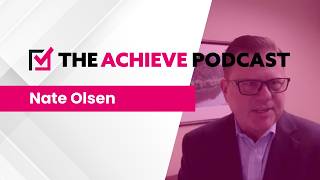
In this episode of the Achieve Podcast, host Taylor Baker interviews Nate Olson, President of Best Fit PEO Solutions. Olson recounts his 30‑year journey through the PEO industry—from early roles at World Tech Group, Administaff/Insperity, TriNet, and ADP TotalSource—to launching a broker program at Insperity that grew to 30% of its new sales. Three years ago he co‑founded a brokerage that has since pivoted to become the first pure‑play PEO general agency, focusing exclusively on supporting broker partners rather than selling directly to businesses. The conversation covers the industry’s “PEO inflection point,” where business owners increasingly seek broker‑led optionality among the 526 U.S. PEOs, and how Best Fit’s back‑office, AI tools, and nearshoring enable rapid proposal comparison and scaling. Olson emphasizes trust, deep industry relationships, and a combined 200‑plus years of experience as core differentiators. He discusses the current growth driver—onboarding roughly one broker per day—while highlighting the primary constraint: maintaining white‑glove service as broker volume scales. The interview wraps with reflections on lessons learned from corporate America, the value of entrepreneurship, and advice for founders to persevere. Olson expresses excitement about the evolving broker‑led PEO market and invites listeners to connect via bestfitpeo.com or LinkedIn.
Chapters
Welcome to another episode of the Achieve Podcast, the show where we highlight leaders, creators, and entrepreneurs, those who are building meaningful businesses, shaping their industries, and having an impact. I'm Taylor Baker Baker, your host, and excited today to be joined by Nate Olson, the president at Best Fit PEO Solutions, and you can find them at bestfitpeo.com. So Nate, first, thanks for joining us today.
Oh, you got it. Thanks for having me.
Absolutely. And for those getting to know you, give us a little bit of backstory of how you got into the space and who you're currently serving, because you're in a bit of a niche here.
We are in a niche. So I've been in the PEO, or Professional Employer Organization, industry for almost 30 years, uh, basically right out of college. Father-in-law happened to know the, the CEO of a PEO out in Cerritos, California, and made the introduction and got the job. But I worked there for about 4 years. It was called World Tech Group International. From there I went to Administaff, which is now known as Insperity, a big publicly traded PEO. I was there for about 4 years or so, got recruited away at the time by another company called TriNet, one of the major publicly traded PEOs in Southern California. And then ADP decided to enter the California marketplace and needed people that understood how to sell PEO in California. So I received a call from an old friend of mine who was over there and said, would you like to open the Long Beach office? I agreed, went to ADP TotalSource for about 4 years until Insperity called me back and asked if I'd like to come back. And at the time, I agreed. I took over their Century City office as their district manager, then their Irvine office. And then, long story longer, ended up getting a call from Jay Minx, who's the— who was the EVP of sales and marketing at Insperity, and asked me to start their insurance broker program. So 2013, moved from California to Houston with my family, and we launched the first broker program for Insperity. During that time, we grew it from 0% of their annual sales up to 30% of their annual new sales through that broker program. Was in, in about a 6-year time span. And so having that experience on that side of the business about 3 years ago, um, after Jay Minx, who was the EVP of Sales and Marketing, retired. Uh, he and I got together and decided that we might start our own brokerage, and so that's what we did about 3 years ago. We started a brokerage, and now we're a general agency.
Wow, that's quite a rich history. Now, how big is the team in the organization now?
We have about 10 people on the team. We leverage a lot of AI and we leverage a lot of nearshoring as well to help with scaling the business.
Okay. And what would you say is right now driving the most growth for you guys?
You know, it's really the PEO industry as a whole. So the PEO industry is going through an evolution. I call it the PEO inflection point. If you're a student of history like I am, look at what happened in the '50s and '60s in the insurance industry. Back then you had all these insurance captive agents that worked for different carriers that primarily sold insurance to small businesses. Well, if you look at the insurance industry today, almost nearly 100% of all policies are sold through brokers. The same transition, the same evolution is going on in the PEO industry. You see that the, the buyers out there, the, the business owners want optionality. And so they're starting to work with PEO brokers, people that can help them evaluate different PEO options, for them of which there's 526 PEOs in the United States today according to NAPO, the National Association of PEOs. So if you're a business owner, you can imagine that's It's pretty complex. That's, that's a lot of options out there. And how do you determine what's the best fit? And, and so that's when they're turning to brokers and we're, we're starting to see more and more business owners turn to brokers to help them evaluate those options. And therefore, you're seeing more and more brokers pop up every single day in this industry. And as a general agency, that's what we do is we support those brokers. We become their back office. We provide all of the connections, the relationships to the different PEOs, help them shop the market and operate as the, you know, as their strategic deal team, if you will, to help them close more business and scale their business.
That makes a lot of sense. Now, what would you say for you, what turning points have had the biggest impact on how you think and run the organization?
Well, as I mentioned, we started as a PEO brokerage firm about 3 years ago where we were going direct to the business owners. We were going direct to the clients, and it was great. We were succeeding. We were having a good time working with business owners and consulting with them. And, you know, there was a point when I received a phone call from another PEO broker, a competitor. And the competitor called us and said, you know, Nate— and I've known this particular individual for years and years— but he said, Nate, you know, does your back office— we had built a back office to help, you know, put, you know, these proposals together and comparisons together— and he said, Nate, does your back office have capacity? And I looked at him and I said, what, what do you mean capacity? He said, well, 'Can I run some deals through your back office?' And I said, 'Well, you're a competitor. What do you mean you want to run deals through us?' He says, 'Well, yeah, you know, but we can work out a deal.' And at first I was like, 'Well, let me think about it.' But then within the about a 2-month time period, I was approached by 3 other brokers, 3 other competitors, who also said that they would like to partner with us and they'd like to work with us. And so after a lot of you know, discussion with our leadership team, we said, all right, we think we're— we might be on to something here. There is an opportunity for us to support this broker community as a whole. Let's shift from a broker to a general agency and, and just focus on being the first pure-play PEO general agency in the industry, in the market. So that's what we did. And that happened about 6, 7 months ago. Where we transitioned into this pure-play PEO general agency. And since then, we've been, you know, we onboard just about a broker a day at this point in terms of, you know, growing the business. And as a general agency, that also means we don't compete with our broker partners. So we stopped going direct completely. We don't want that to ever be a conflict of interest or reduce the kind of trust that we have, you know, in the, in the ecosystem. And so we, we had to put that completely on the side. We, we shifted 100% to this new model and, you know, so far so good.
That's amazing. So this next— I mean, going down that same vein for you, what would you say is— I mean, you're looking at what, what's been working the best at attracting and maintaining your clients?
Well, you know, it's when you're working with brokers, it's all about trust and relationships. Our team here has— I think we counted it up the other day. It was over 200 years of combined experience in the PEO industry. We have individuals on our team who were on the inside of the pricing and review teams and the client renewal teams of some of the major PEOs. I mentioned some of them earlier. We have my partner, Jay Minx, former EVP of Sales and Marketing at Insperity. He's my partner. So we have relationships, very trusted relationships and a great reputation, frankly, in the industry. And I think that's really helped in terms of recruiting new broker partners to the— we call it the Best Fit Broker Network. So all these brokers are joining our network. They know us. We have the relationships, we have the experience, and we have the knowledge that they need to succeed.
That makes a lot of sense. So where do you still see with sales and marketing opportunity or money on the table?
Say that one more time. Repeat that question.
When looking at your sales and marketing, where do you still see more opportunity or money on the table?
Well, we definitely want to onboard more brokers. That's what this is all about right now, attracting and retaining brokers to the Best Fit Broker Network. And in order to do that, we have to provide value to the industry. And so what we're working on are things like educational content for brokers so that when they join the network, they can really bone up on which, you know, what makes the different PEOs different and special and unique and how can they best position those PEOs out in the marketplace. We're focused on AI tools that help with speed of execution. That help with, you know, comparing, uh, different proposals that we receive back from the PEOs and assisting in the needs analysis in terms of determining which PEOs are the best fit based on the client's actual needs. And so by offering these tools, these resources, that is what is really going to help us, you know, attract and retain brokers who at this— as a GA That's who our client is. Our client is the broker at this point, and our job is to make them better, help them scale and sell more clients.
Yeah. Now, touching on the AI option, you're— I think you brought up— there's a lot of talk around where have you guys found ways internally to utilize?
Oh, yes. It's a— AI is basically the expectation now. It's not, you know, if you tell somebody You know, you're not bragging if you say you use AI because everybody should be using AI, especially in our business. But, you know, we have built a platform where the AI tool helps us in terms of auditing information that we collect from the broker partners, making sure that we have everything that's necessary in order to submit to the PEOs, that it helps us reconcile proposals that we get from different PEOs and help us with the comparison. It helps to score, you know, which PEOs are, are the closest fit to what that client needs. And from an efficiency standpoint, it just, it sped it up 10 times. I mean, there's a good chance I'm not going to have to hire very many more auditors and analysts because, you know, the AI tool is going to be able to handle that. Now, I do want to handle more strategists, people that can work with the clients, people that can work with the brokers directly, that can help them in terms of, you know, what their plan is going to be for, for growing their individual company and how they can best position these different PEOs with their clients. But in terms of that grunt work, I mean, it just eliminates you know, almost 90% of it. It's fantastic.
Yeah, it's amazing. And, and I love, I love how you, how you mentioned that where with the AI, saying you use AI, it's like saying I have a website. It's like, yeah, are you using it efficiently?
Yes. I mean, it's like, hey, we use email. Okay, great. You know, everybody else does too. You know, I mean, you know, it is, but to your point, it's about how do you use it? Are you using it you know, the best way possible. You know, just like with ChatGPT, it's all about the prompts. It's all about the prompts that you give it. It's, you know, and, and that's an art and a skill set that needs to be developed too. But yeah, AI is here. AR is part of the future. It's a tool that we're going to continue to use moving forward. And, um, but the real value is the relationships. It's the experience. And it's the ability to strategize with the clients.
Yes. So if you had to pick one constraint to focus on and solve over the next 90 days that could change the trajectory of the business, what would it be?
One area. Well, for us, it's, it's simply about the number of brokers that we're able to work with at any given time. It's, it's a scale issue. Sometimes you can sell yourself out of business. You've heard people say that. And so we need to ensure that we can properly support all of these brokers that we're onboarding. I mentioned it's about a broker a day at this point. So as long as we can continue to scale with those brokers and we can continue to make sure that we provide that white glove, hands-on service to those brokers as we scale, that That's, that's what's top of mind for me. I don't see it as a problem right now, especially because of AI, because we have the ability to even use nearshoring options to help us with analysts and auditors. But, but yeah, that, that's really where my focus is in terms of, you know, a constraint that we need to just make sure that we're cognizant of and we make sure that we mitigate.
I love that, keeping that white glove experience. And so 100%, building on that reputation you guys have developed over so many years. So when you look back at your own journey, the wins, the mistakes, what lessons stand out to you, and which ones do you feel like took longer to learn than they probably should have?
Well, you know, I'll tell you, I spent a lot of time in corporate America. No offense to anybody that's in corporate America today, but I'm pretty sure that, you know, I'm not going to go back at this point. You know, I never say never, of course, but I wish I would have jumped into this market 20 years ago. I really do. I mean, owning your own company, being able to grow your company, to take all the, you know, the advantages that you get with, you know, the freedom that you get, the level of creativity that you have to build the company any way that you deem fit. You know, there's, there is something just about that freedom and being your own boss. I mean, that, that is something that, you know, until you've been there, you don't understand the freedom. Now, it also has pitfalls and there's a lot of, you know, you get lonely at the top and you have to make a lot of decisions. And that's why you have peers and you have mentors and those types of networks to help and assist you in growing the company. But Um, you know, and I learned a lot from corporate America. I brought a lot of it over here. But yeah, if I were to do it again, I'd probably be jumping into this field about 20 years earlier. 20 years younger me, that's the advice I would have given myself. I love that.
So last question: when you think about the next stages of the business, what are you most excited about?
I'm excited about the growth, the evolution of this industry. I mean, we are on the front edge of this evolution, this transformation where the PEO market is going to evolve into a broker-led industry. And to be here at this time, it's the right place at the right time, is amazing. It's, it's amazing to be part of this. And to, you know, I think there is going to be a point in the future where, you know, the, the PEOs are going to significantly, drastically reduce their direct sales force because The best, you know, channel and distribution arm is going to be those brokers. And we get to be a part of that. We get to help shape it.
That's awesome. That's wonderful. Any final thoughts or words of advice for others on a similar journey?
Well, just to hang in there. It's not an easy road, but there's a reason why, you know, what, who was it? Tom Hanks in A League of Their Own. There was one of the ballplayers that was crying to him saying, "But it's just so hard. It's so hard." And Tom Hanks responded with, "But that's what makes it so great." And, you know, that's what you have to keep in mind. You got to keep going. You got to keep plugging forward. You're going to get the highs. You're going to get the lows. You're going to struggle. But ultimately, if you don't quit, it will be successful.
I love that. That's what makes it so great. So for those who want to learn more, want to reach out, bestfitpeo.com, LinkedIn, anywhere else you want to send them?
No, that sounds it. That, that would work. LinkedIn, Nate Olson, you know, Olson with an E. I'm Norwegian, so, you know, mom makes sure I get that in there. But, uh, yeah, no, would definitely love to chat with anybody, any of your audience. I'd happy to pick up the phone.
Oh, thank you so much. And again, thank you to our sponsors of today's episode, Achieve Fractional, which provides fractional executive leadership for growing businesses. And if you enjoyed the episode, share it with a friend, with a colleague. If you're getting into brokerage, you're not sure who to partner up with, reach out to Nate and the team. They will give you some good guidance. So reach out and we'll see you in the next episode of the Achieve Podcast.









