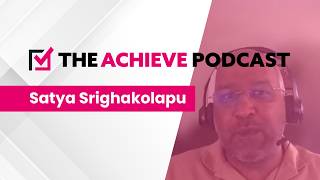
In this episode of the Achieve Podcast, host Stephen Bunker interviews Satya Srighakolapu, founder of Cogniforge Global, a data advisory services firm that partners with Databricks and Snowflake. Satya outlines the company’s evolution from its 2018 founding to operational launch in 2025 after leaving a full‑time IT role. He explains that Cogniforge’s growth is driven by enterprises seeking to modernize their data platforms, offering end‑to‑end assessments, architecture design, and implementation. The choice of Databricks and Snowflake is justified by their open‑source foundations, deep ecosystems, and large customer bases. Satya reflects on personal turning points, moving from an order‑taker to a strategic leader focused on people and culture, and highlights the challenges of recruiting talent, especially the reliance on subcontractors and the need for equity incentives. Investment constraints emerge as the primary bottleneck limiting the ability to hire directly and scale operations. The conversation touches on AI, noting that Cogniforge embeds AI use cases for client projects but has not yet built internal AI products. Satya sees opportunities in expanding to additional industries, particularly SMBs that prefer smaller consulting firms. He emphasizes the importance of rapid decision‑making, delegation, and staying true to long‑term goals, advising entrepreneurs to persist through the first two critical years despite hardships. The episode concludes with a call to learn more about Cogniforge Global.
Chapters
Welcome to the Achieve Podcast, the show where we highlight the leaders, creators, and entrepreneurs who are building meaningful businesses and shaping their industries. I'm your host, Stephen Bunker, and today we're excited to learn from Satya, founder with Cogniforge Global. Now Satya, for those getting to know you, can you give us a quick backstory of just your business?
Sure. First of all, thank you so much for the opportunity, Stephen. I really appreciate that. And coming to my background and the company's background, I've been in the IT space for almost 26 years and Cogniforge Global was started back in 2018, but I did not do any operations since then. The operations kickstarted last year in 2025. I was in a full-time job till then and then when I quit my job, I fully focused on Cogniforge. So what we really do is we are a services partner to Databricks and Snowflake. Their product companies, and we do provide services and consulting expertise. So we do have teams in India and we do have a few people in here in the US. So we acquire clients through Databricks and Snowflake and provide services to them. So we are like a data advisory company providing technical services as well as implementation.
Okay. And at this stage, what would you say is driving growth for you right now as a team?
I think the main driver would be companies looking to modernize the data platform. I think they approach us through our partners and then we help them with the current state assessment and what the destination or target architecture should look like. We advise them on what are the best ways to get there, what are the teams we need to build, understanding the data, all those things. At a holistic level, uh, end-to-end implementation and advisory services.
Okay. And with Databricks and Snowflake, what inspired you initially to work with those particular platforms?
Mainly because of their data, data and AI platform. Uh, you know, like they're very open source, uh, ended, and they're like open source, and there's a lot of depth in the architecture, and also there's a lot of, uh, products any company can build within their ecosystem without even going to multiple different vendors. So I had prior experience in Databricks and Snowflake when I was actually doing a job, and I also got certified in both the tools. And I thought these are the tools to go forward, to move forward with for the future, because a lot of companies are embracing both Databricks and Snowflake. If you do some research, Currently they have more than maybe 20,000 customers globally. So there's a lot of potential, there's a lot of depth, and also opportunity is huge. So that's why I chose Databricks and Snowflake.
Okay, that's awesome. And when you look back for you personally, obviously it's been a journey getting to where you're at. What have been like the turning points, both positive and negative, that have changed how you think about running your organization?
Positive is, uh, definitely you have a lot more freedom to make decisions. You're not, uh, you're not an order taker anymore. I'm not an order taker anymore. I'm more like driving strategy and decision making and building teams, more of a leadership, uh, you know, being a leader in an organization is different. Being a boss of a company and running the company is totally different. Uh, you know, you, you, you actually do performance evaluations in a leadership role in a, in a large company or, you know, even midsize company or any company for that matter. But when it comes to a small startup growing company, more than performance evaluation, uh, the key is understanding people and their strengths. When I work with several people, that's the biggest positive I get to know people better, uh, other side of not just the technical side, but also the human side of it. So that, that gives a lot of, uh, leadership, uh, insight into different personalities. And also it, it provides an opportunity for me also to change some of my attributes, right? As, as a leader, as a professional. The negative side is that, uh, when you start, you have to do a lot of things on your own unless you have a big investment and you, you know, you've hired 10 people or 5 people to do so many things for you. Initially, a lot of things were performed by myself, and now we have a few team members in India and here. But, you know, eventually the goal is to grow the company and scale it to the next level. There will be so many positives and negatives along the way, but I'm only looking at the positives at the moment.
Okay. And then as you're trying to grow and expand, like, what has been the biggest bottleneck or obstacle that keeps getting in the way?
Investment is one, definitely one big thing. So the more you invest, the more you— the better you scale, right? And you have to have people who take ownership And, you know, they— for a startup company like mine, uh, you— they expect certain equity in the company because, you know, why do they want to come, come and work for Cogniforge, right? So they want to, uh, you know, have equity in the company. They have— they want to share in the company. So the challenge is really convincing people to join us and provide services through our company. Good talented people that can stick, uh, with us for a couple of years, or at least 2 to 5 years kind of timeframe. And right now I'm relying on other partner companies to provide the resources for us so that we don't have to have the liability of maintaining employees. But I want to get to the point, the challenge that I want to overcome is have people work for us directly as employees rather than depending on other companies, more like subcontracting. Right. So right now we are relying on subcontracting. Uh, we won't have more employees on our own.
Okay. So it's really been a recruiting and talent challenge primarily.
Okay. Yeah.
And when it comes to like your recruiting and like, uh, like your recruiting systems, what has been working well?
So we, what we do is, uh, we just rely on companies to do the heavy lifting for us on the recruitment side. Uh, let's say you know, we— they find a resource for us and we work with them and we onboard them for our client. So we don't— we just do the technical interviewing part of it, but the additional recruitment or the basic recruitment, everything that has— that they have to go through will be done with the partner company. We don't get involved in that. So the goal is to focus on areas where we can grow, which is the strategy and implementation rather than recruitment for us. So we empower the companies to recruit for us while we focus on strategy and implementation.
Okay. How about with like all the buzz with AI and automation, have you found ways to use that productively in your organization? Yes.
For, you know, we in this project that we are doing right now, we are actually embedding a lot of the AI use cases for what we do. We have a customer based out of Dallas where we are working with their AI department to define, you know, to actually define the use cases and how we can make it more agentic. So, you know, our consulting company, since we are a services provider, within our company we don't have any AI yet, maybe in the future, but we provide AI services to our clients. So right now we are doing it for one customer in Dallas.
Okay. And then where do you think there's opportunities that are still left on the table as far as like low-hanging fruit that you can help?
More industries. So we are confined to a few industries right now. There are many more industries out there. So we want to expand our services to multiple industries. I think that's a huge opportunity. And there are some industries where They cannot work with large companies, consulting companies. They want to work with smaller, you know, companies that can actually focus more, uh, and have less bureaucracy, right? So there is a huge opportunity to expand into other industries in the small to medium business segment for us.
Okay, so that kind of brings up the next question. That was just fairly related, but When you think about the next stage for your business, what are you most excited about?
I think the scale and the growth and the growth trajectory is what I'm excited about because there's a lot of potential in our area. So 3 years down the line, or even not even 3 years, 3 years is a long time in this current age, 1 year down the line, right? So we are expecting a lot more growth. So I'm very excited about that.
Okay, and, uh, what do you feel like needs to be done in order to allow that to happen? I mean, like, what are some of the biggest bottlenecks that are preventing that from happening right now?
Uh, I think the investment, uh, part, uh, that I was referring to, and, uh, we, we are actually trying to get more investment poured in into the company, and, uh, that is a bottleneck that we are trying to overcome. Once we get to the point of good investment and good cash flow, we will be able to scale it to the next level pretty quickly because we have a strong pipeline. All we need to do is invest and bring more people and deliver what we do best.
Okay, so it's really an operational bottleneck more than it is a go-to-market strategy. It's more of, hey, we got demand, we just don't have enough seats on the bus. That makes a lot of sense. Yeah. And when you look at your own journey, just the wins and the mistakes, like what lessons have stood out to you?
Uh, the most important one is take decisions quickly. I think the lesson that I learned is don't wait too long to arrive at a decision, right? So I've done it, uh, in the initial stages I waited too long, maybe a couple of months, 3 months to take action. I think I should be quicker. That's a big lesson. And the second lesson was really around the— when you do a lot of things on your own, uh, how do you shift focus and mindset from one area to another? So the lesson that I learned was have somebody and delegate that work to somebody so that you can focus on growth side of things rather than operational side of things. I think we are trying to, we are trying to actually work on it and do that. As we, as we speak, you know, we, we are actually working in the background to have two more people join us and help us with the operational things.
Do you have any final thoughts or advice that you'd give other leaders and entrepreneurs who are on a similar journey?
So stay, stay true to your goal. If you have a goal in mind, stay true to it and see how you can get there even with all the hardships that you encounter. Right. So set a timeframe, set a goal. And if you can achieve that goal, even with hardships in those 2 years, I think that will be a valuable time, you know, like an experience to scale beyond those 2 years. Right. Those 2 years, if you give up in those 2 years, then it will be hard to come back, make a comeback, unless you are very young. But once you are at a certain age, don't give up in the first 2 years. Even if you have hardships, you just keep, keep pushing and make sure you reach the goal. At least even if you don't reach the goal, at least the journey to— in those 2 years will be a big lesson for you to use that experience for the next few years.
I think it's really interesting too that you mentioned that you're working with your previous employer for the first couple years while you're getting this business started. So that's a tremendous commitment as well. So I mean, yes, a lot of sweat equity that you had to put in.
Correct, you're right, absolutely right.
Yeah, and so really with those first few years, you were kind of validating that there's market, doing the work yourself, building those relationships until you kind of hit a point where it's like, yeah, there's we've established ourselves enough that now they trust us as a trusted vendor. And that's where you're running into scalability issues. But there's that commitment.
Yes.
Congratulations, by the way.
Thank you. Thank you so much.
Yeah, I, I'm inspired by what you've said today. This has been a wonderful conversation. I, I appreciate your advice too about sticking in it. To those, those second— like, in your 20s, I definitely agree with you. It's like, it's easy to come back from a down or a hit, but like, in your 40s or 50s or 30s, like, it's just harder. And so, like, you're sticking to it. That's commendable.
Yeah, you— it's important to stick to your goal, and no matter what. And, uh, if you, if you give up, make sure you give up after, after a good Try, you know, good effort, you know, putting in a lot of effort. And then, you know, like I said, stay true to it. And then you can give up. You know that you did not lose, you just lost it because of various other factors. But you gave it your best shot, right? So, and then you can come back and find another job, or you can come back to your career if you don't like being an entrepreneur or you cannot take that pressure, but those 2 years will make you better for the rest of your life.
Yeah, that's awesome. Well, Sasi, I want to say thank you for sharing your story and insights with us today, especially how you're just navigating and adapting with this ever-changing world and your advice on just the grit and the tenacity to stay in there as an entrepreneur. So this has been fantastic and thank you again. Also, to learn more about Cogniforge Global, visit cogniforgeglobal.com. And that wraps up today's episode of the Achieve Podcast. A big thank you to our sponsors Achieve Fractional, which provides fractional leadership services for growing businesses, as well as Achieve Bootcamps, where entrepreneurs learn hands-on how to build their marketing systems. If you enjoyed today's conversation, follow the show and share it with another entrepreneur who'd find value in it. Thank you for listening. I'll see you on the next episode of the Achieve Podcast.