
AI Resumes, Ghost Jobs, & The State of the Market w/Sr. Recruiter Steven Evans
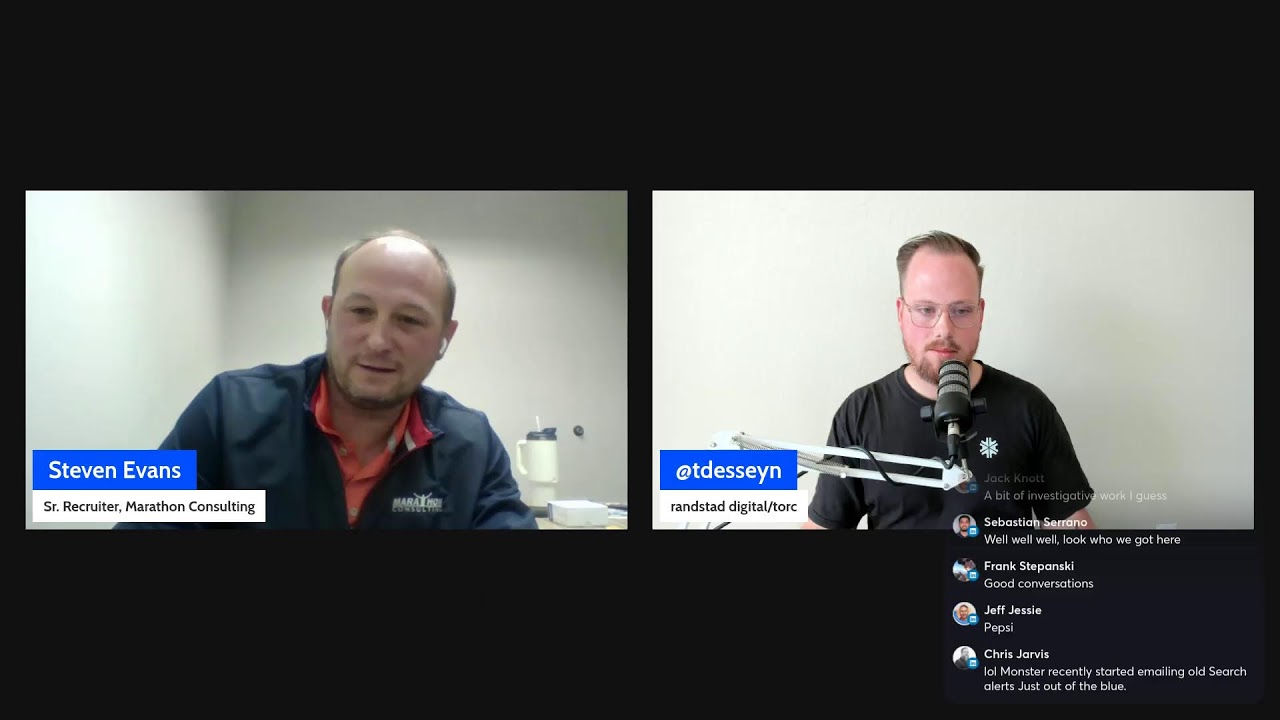
In this live interview, host Taylor Desseyn talks with senior recruiter Steven Evans about the evolving recruiting landscape. They discuss the pitfalls of AI‑driven recruiting bots that call candidates, the phenomenon of "ghost jobs" that stay open indefinitely, and practical follow‑up tactics for job seekers. Steven shares the heavy administrative load of agency recruiting, including call quotas, interview coordination, and burnout. The conversation moves to resume best practices—favoring concise, content‑rich PDFs, avoiding excessive bolding, and using the STAR method to highlight tangible impact. They explore how AI tools like Copilot are being used by developers and how interviewers are beginning to ask about AI experience. Advice is given for junior talent, emphasizing internships, pet projects, and community involvement. The hosts also touch on networking through meetups, Discord, and community bots, and they assess current market trends, noting increased risk aversion, remote‑work policies, and salary dynamics. Finally, they play a rapid‑fire segment rating various job‑search elements as overrated or underrated.
Chapters
A fun bot on— oh, somebody posted about a bot on Reddit yesterday and it's my buddy's company's bot.
Are you serious? What, what it like, like, uh, like what is the bot like? What does the bot do?
So when someone applies, it immediately starts trying to call them and then have a quick— it's an agency, so like a quick little conversation like, oh my God, like what, what skills do you have? And like let's get some rate and some work status information. And then if you don't answer, it calls back like twice. And then if you never answer, it sends you this like automated email like, hey, like please answer this email and then text you. And somebody was like, can't like some just idiot recruiter just call me that doesn't know what they're talking about rather than just a robot?
Yeah. You know, and I think that's—
my boy was like, so we, we said it in our group chat and my boy was just like, oh yeah, that's ours. We built that.
That is absolutely hilarious. And I mean, we're live now, and so I think it's— I think this is just good, like, jibber jabber for people, you know, people tuning in. I, I think— I think that's the hardest part about the recruiting process is I think there's a lot of administrative tasks that can be automated using AI, but I think at the end of the day, like, I don't think people— I don't think people are going to want to talk to a bot.
No, that was the person's response. They're like, yeah, just call me. Like, Can it be a— can this not be Riley the recruiter calling me? That's AI.
Well, and, and, and, and I think it's just, and I think it's just, it's just a bad vibe. It's like, it, because I, I think there's ways to do AI in the staffing space for sure. I mean, I think one of the things we're doing at Torque is like our internal thing is like, hey, join Torque and then our AI is gonna match you to jobs in our ecosystem. I think that's a great way to do it. But I think if you're trying to automate even the initial outbound call, I just don't think that works. And I think from a, it's like a negative connotation where, you know what I'm saying? I just think it's a bad vibe.
Yeah, it's, I made a joke. I was like, why don't you guys just do a power hour and call 600 people in an hour? And then you can have the same stupid little simple lockup call of like, tell me about X years of experience with Y. Yeah. Technology. And that, and that's literally what the email was. It's like, right. They're not even gauging interest. It's just, yeah, overly simplified. Just like, I mean, I get it trying to cut the cut to it faster, but like, but people don't wanna cut to it faster.
And good morning everybody. I'm good. Good morning. We're, we're, we, we just went live and I told people it'll take a few minutes to chime in and everybody's already here. So people obviously wanna hear this. So But good morning. Welcome. Welcome to Guidance Counselor 2.0. I am back from Raleigh, Durham. Durham, not Raleigh. Durham. I keep getting corrected. I'm back from Durham. All things AI. It was a great, great 3 days. For those of you who live under a rock, Roxy, who's in the chat, is our new hire that's replacing Jason, who's also in the chat. Jason, miss you. Love you. And so Roxy just came out on just like on a dime. She was like, I'll be there. So it was great to have Roxy there. It was a really, really great 3 days in Durham. Had the opportunity to speak in front of about 300, 350 people around how to leverage AI. It was kind of a twofold thing. It was like I gave a bunch of facts to start the talk about how the market is still really good. And then we kind of got into some practical uses of how to use AI in your career. So that was a great conversation. Had a Torque meetup. Um, where, uh, we, um, we were at capacity. Um, so basically now, you know, I, I talk about it and Stephen, we'll, we'll get into your, your swim backgrounds. Uh, but, uh, you know, my background is being in a band and I tell people all the time that like basically at this point, like building community is being in a band. So basically every time we go to Raleigh now, we draw, we draw about 50 to 60 people, which is pretty cool. So that was a great event. I had a developer come up to me. They're like, man, no company is doing these type of meetups. And just like bringing people together, catching a vibe and not shoving— because my whole thing is like, you can go to YouTube, you can go to ChatGPT, you can go to Claude, whatever, and find technical stuff. I think people just wanna meet people. And I think like meetups have been so focused on cramming technical knowledge. I think people just wanna hang out. Eat a cheese plate that we provided, have some bevs, and talk to people. Like, I think a lot of people overcomplicate things. Steve, what are your thoughts on that?
Yeah, you've heard me say it's like networking is just making friends. Like, you're not gonna go to one networking event and find a job or get some business within the first like 35 seconds. It's like just hang out with people, like eat some mozzarella sticks and Yeah, just talk about whatever.
Yeah, eat some mozzarella sticks and catch a vibe. That's it. You know, it's pretty simple. It's pretty simple. So, uh, it was a great time. Got back yesterday morning, then jumped into a slew of calls. So I'm very— I am crazy busy today, but had to make time for Steven. Um, Steven, Steven, how is this just like a, a, a LinkedIn relationship? Is that, is that, is that it?
Is that how exactly—
is that our relationship?
Yeah, yeah.
So again, right, like, you know, Steven's commenting on my stuff, I'm commenting on Steven's stuff. We kind of of started to, you know, like each other and, and are kind of our vibe. And I was like, yo, let's just, let's just catch up. I've been trying to get Steven on the show now for 3, 4 months.
A long time.
Yeah. Yeah. Steven's like, oh, I just totally forgot to book something. So I'm excited.
3, 4, man, you know, Christmas, you get it.
Yeah. Yeah. Yeah. So excited for this talk. It's gonna be good. Again, kind of my focus over the, for, for, for the show is, is really bringing on, I was telling Steven backstage, that what people really want right now is career stuff and AI stuff. I think the latest JavaScript framework conversation is exhausted, and I think people just wanna hear about AI and job search. So kind of my core focus moving forward is to bring on recruiters like Stephen who I trust and who do things the right way. And then also AI practitioners like Nader and like Aaron Francis. And I'm looking to pull more on over the next few months. So Before we dive in, a few housekeeping things. First and foremost, uh, go check out torque.dev community. We got a lot of things going on. We got our calendar of events on there. That's great. If you want to sign up to be ambassador, uh, most of the ambassadors have gotten their Torque swag. It's pretty sick, I have to say. Um, so go check that out. Uh, if you want to be updated when I go live, I, I, I text this. I don't spam, I just text it when I go live. So if you want to be kept up to date when I go live with future guests Shoot me a text. We'd love to have you, uh, jump into our Discord. We got a laid-off lounge today with my buddy Dan Thompson. Dan and I recruited at Vayco, uh, together for years. Um, he's kind of in a sales recruiting space. He's gonna be a great, great session today in our laid-off lounge. Uh, so jump into the Discord. I think that's at what, 1:30 today or 12:30? It was 1:30 Eastern today. So do that. Also want to give a shout out to the unofficial official coffee sponsor of the show, Seek Coffee. Um, you get 50% off. I'm trying to work with them. Uh, the founder's in Nashville. Um, I'm trying to work on kind of like a community sponsorship. Um, but, uh, most coffee, Stephen, I didn't realize this, has mold in it. So, uh, he's created—
Really?
Yeah, that's what he said. He— so supposedly it's like a family-owned business. His mom was suffering from autoimmune issues. She was drinking a ton of Starbucks and he— and she was pretty sick. He like pioneered this. His mom's symptoms healed up. So, um, yeah, all that being said, try Seek Coffee, it's great. Uh, also, final thing too is before we dive in, uh, newsletter, sign up for it. So many people are like, I can't keep up, I don't know what you guys are doing, there's too much going on. There is a lot going on. Join the newsletter, you, you get everything. We, we, we promoted this episode on, on the newsletter last week. Um, so please jump into that. All right, enough with me yapping. And yes, what Jordan said, the cheese was fancy. We had great cheese. Uh, I ate a lot of cheese.
What kind?
Uh, I don't know. It was a lot. It was good. I don't know. I didn't put in the order. Uh, Brianna—
I love an adult Lunchable.
Oh dude, adult Lunchables are great. They're great. Really, really good. All right, Steve, enough of me yapping. Uh, let's get the people what they want, man. Who are you? What do you do? We'll go from there.
Well, yeah, Steven Evans. Um, I've been in recruiting for probably over a decade now. Stopped counting. Started an agency. Um, kind of slowly migrated out of that and Yeah. Not internal with Marathon Consulting and hiring people for us, but yeah. And then I've, if it's happened, I've seen it. I've been on the block.
Yeah. And then you've worked both, and I wanna set the tone. You've worked both corporate and agency, right?
Yeah. I grew up in agency setting and then like slowly moved out of that. Yeah.
Yep. Yep. So, so we'll, we'll touch on that today. So a lot of topics to get into today, Stephen. First off, I wanna get into, and I think it's kind of the topic, the hot topic right now is ghost jobs, right? You and I were chatting a little bit backstage. I said, hey, I wanna break down what ghost jobs are, why companies put up jobs that may not be real, why people don't get callbacks, how you should approach them. Just give your general thoughts on ghost jobs. Again, we were kind of talking about this backstage.
How far back do you want me to go?
Go back, dude.
We got So I know way back in the day, um, when I was an agency, they were building out a database for ERP talent, and they did literally put up ghost jobs just like source people into their database. Um, that was a long time ago, but like now I think my personal opinion is like, I don't think there are ghost jobs where the job doesn't exist. I think there's jobs out there where companies are seeing Stupid amounts of applicants. And if, I mean, it goes down the list. So like if they find their top person on resume 2 and your resume like 1,042. Yes. And that goes— They may not get there. Like, and like they'll just close it. And if they don't have like the automation or the processes there to like close said loop, it seems like a ghost job. Yeah. Like what you was like, we hire the same, 3 or 4 jobs, but because we know we're doing that, we just keep the jobs up nonstop. The jobs technically never close.
Yes.
They're just always up and there's no like, cool, this job closes in 90 days. Cool, we always need .NET developers, but when we might be able to bring them on or not bring them on is really—
Depending on timing.
Yeah. Right.
What would you tell job seekers, folks on the stream right now on how to navigate ghost jobs, how to apply, why they shouldn't be as frustrated as they are?
I mean, for me, and I see like if someone pings me and says like, hey, like I applied, what's the deal? I'll just be like, yeah, we're going forward to people who are further down the pipeline with you. Then like once that wraps up, then we'll come back to you. Yeah. Like I just, That's my, that's all my, my whole thing is. But like, again, I don't see thousands of resumes for one application. I know there's companies out there where it's like 1,000, 2,000 resumes and they just have to like slough through all of it.
Yeah. Yeah.
Kind of fills into the whole like AI applicant thing. But yeah.
So, so, so, so your advice, your advice to job seekers is, and this is gonna be a little crass, but get over it. apply and just start to— because I feel like people, I feel like job seekers equivocate job open, submit, gonna get a callback. But I think there's this kind of this whole process and timing loop that I don't think people are necessarily aware of. Like, can you give an example of like how somebody would apply? Like, can you give an example of like maybe Maybe at Marathon where like somebody applied to a ghost posting, which again, it's not necessarily ghost posting because you need it, but can you talk about maybe— I think because you said it backstage, like somebody applied.
Oh, there's been a couple. Um, yeah, like there's been a few times where like somebody applies and it's like, cool, this person's a fit, I'm not gonna tell them no.
Sure.
But then they just kind of sit there and like, I know like a month later they're like Hey, we need like what was it? We needed. Oh, we just need to develop. Look, I don't need a C# developer. I need somebody who's done Unity that has worked with C#. And I was like, oh, someone applied like four weeks ago that had that. And now he's working with us. And like we had an architect, same thing. He applied and I like hit him up. I was like, hey man, we got a job. He was like, I applied to you guys like three weeks ago. I was like, yeah, my bad. Things were slow, but like. I need somebody like you now. Like, let's, let's, let's push the, let's push the envelope. Yeah.
Let me ask you this, right? So one of the biggest things that I preach in the job search for job seekers is the follow-up.
Yeah.
How, how do you recommend people check in with you, follow up? What do you think best practices should be, especially if they see a job and they post and they haven't heard anything?
Send email. I mean, it's super simple. It's like, so like friends, like we all have that one friend where like you text them to make plans and they respond internally and then never actually send them a text message.
Yes.
It's like, follow up. Like, yo dude, like, are we meeting up for drinks or not?
Yeah.
Oh, my bad. I forgot. Like, just, yeah, it's super simple. Like in my mind.
Can, can you talk about, and again, just trying to open up the playbook for people who don't understand how much recruiters are having to balance at a time. Can you kind of shed some light on that from an agency perspective?
Okay. Yeah, I'll go down 2 paths. Yeah, agency, you're doing stuff where you're having your manager send out some call report to you to tell you, make sure you're making about X number of calls per day. Well, some aren't, are not doing that.
So—
Some are, some aren't. They're monitoring how many submittals are going to each open rec on your plate. How many open recs on your plate is really dependent on the company. You're having to follow up with candidates, you're having to chase down BGI and drug screen stuff, you're having to follow up with interviews, make sure people get on interviews, you have to make sure somebody shows up their first day. Like, but that's just all encompassing on the agency world. Like agency world, like I remember leaving the job every day and it's like my brain, you know, like there's like—
Your brain's fried.
Yeah, just completely gassed. Like living off like 6 energy drinks a day. Yeah. Yeah, but yeah, there's a lot of admin stuff like monitoring, like, you know, scheduling interviews, making sure people show up. Like now it's like a lot of, it's like after this call I'm going to like an AI summit conference thing where I have to, well, I say have to go socialize, but yeah.
Yeah, exactly. It's a lot at one time. Let me, we got 2 questions here. Where do you see the main broken piece of the process?
Between candidate and job opening. I think there's— I mean, I don't know if I'd say it's broken, but I think I posted about the other day, like, it's people. Like, people are people. Like, it's— yeah, it's hard to know, like, what people are thinking. And I mean, I don't know, there's a lot to go in there.
Do it.
I don't know if it's really like, it's just everybody wants to have their cake and eat it too. Like, yeah, job seekers wanna have control, companies wanna have control, and it's trying to figure out like where that middle ground is. Like, like, like 2020 through 2022, like pure job seeker market, war on talent. Everyone could like say, if you're looking for a job, like you could name your price, name your— and then it slowly started coming back the other way. And now some companies are trying to essentially get back their control of like, yeah, no, we're gonna push these salaries back down, make it fair market. I mean, it's all a business and I guess maybe some people just don't understand the business side of it and you kind of have to put that hat on to swallow the pill.
Yeah.
If that makes any sense at all. Yeah.
Yeah. Talk about, especially with With, you know, one of the things that I keep seeing is that companies are risk-averse right now. What can a candidate do in terms of what you just said to make themselves the least risk-averse in your mind?
So, I mean, I think a lot of companies have kind of shrunk the circle of like where they are looking. Yeah. I know we've seen it from us is like, We have a very flexible hybrid work setup. Like, there's no expectation, but the people who are in like our geographic areas tend to stay longer than somebody who's out there. So like, when I have friends that are looking and they're like, I can't find anything, shrink your geographic search area.
Okay.
And say like, I'm cool coming in, 'cause then companies get like that warm and fuzzy of like, yes, I can see you in the kitchen eating Cheez-Its. Yeah. And I can talk to you about like, and make those in real life connections with people, which theoretically makes it harder for them to leave, which is what companies want. They want people to stay for a long time.
Yeah. Yeah.
Even if— yeah.
What about, what about approaching you as a recruiter? What can people do?
Because Oh, I have an answer to this, but I wanna ask you.
I have an answer to this, and so I'll chime in after you say something. What can, what, what can a candidate do for you and you're like, ah, this person is dialed in, they understand? What are just some key things that people can do?
Just honestly, it's like simple, like have some concept of like the company. Be like, hey, like crazy, like, hey, I saw you guys won this Best Place to Work Award. Like, that's cool. I'm like, cool. Like, you have some idea of who we are. Like, that's great. Versus like, what do you know about this? Oh, nothing. Then it becomes a very transactional relationship. Yeah. Yeah. Yeah.
I think, you know, I put this in my talk at the conference, like with AI now, there's no excuse for you not to be prepared. Run a quick, hey, I'm about to interview for Marathon Consulting and Steven Evans. Can, can, can you do a quick web search on some things I should bring up? Right? Literally, I have some AI thingy. I, I messaged Steven this. It did the research for me.
It was pretty creepy. Yeah.
Like, like, like it pulled that Steven was like a swim coach. I didn't know that about Steven. And, and, and it literally prepped, it prepped our meeting for me. So like, so like, if you're not using AI in a simple, hey, give me the rundown of some things I should talk to you about, because like, because, because, Stephen, let's, let's role play here, right? As most staffing companies did back in the day, right? If I'm a candidate interviewing, dude, for the record, I don't know if you had to do an agency, they would get you up in front of everybody and you would role play in front of people.
We would do it on the headset with your mentor in the desk right next to you.
Yeah. I mean, literally, like, people don't understand, like, the amount of people like, Taylor, you're so good at public speaking, how do you do it? I was like, dude, I can't even begin to tell you the amount of stuff that I've been put on the spot for back in the day recruiting. So for me, if, if, if I would have done the research— and Stephen, correct me if I'm wrong— if I'm like, hey Stephen, did some research on you, saw your swim coach, I actually grew up swimming, I did this, this, this, and this. I'm sure that will drastically change the conversation with you.
Yeah, you go off on tangents of stuff that's completely unrelated to what you're having the conversation for.
And I feel like that's where the magic happens.
It kind of goes back to what I was saying where it's like you're building some in real life relationship stuff where you learn about somebody and it's not hyper-transactional. Like, oh cool, you're a senior application developer. How many years of experience do you have with Java? Okay, cool. How many years of experience do you have with React? Cool. How many years of experience do you have with SQL? Cool. Check, check, check. Versus like having like a real conversation like, oh, you played hockey? Oh, my best friend plays hockey. Like what? And then it just kind of like breaks down those walls and you kind of have a more open conversation of like Cool. You did Java. What did you build in Java?
Yeah.
What applications have you built?
Well, and I think too, I think the way recruiters work as well is if you talked with me and you're like, hey, I like you, you have the skills. And, and, and let's keep that swim thing that, that I said. Yeah. If you get a job for me 3 weeks later, you'd be like, oh, the swim guy. Yeah, that's how this stuff works in the recruiting world, right? Yeah, yeah, yeah.
The dude I talked to about XYZ, like, yeah, talking— actually, I talked to a web developer last week. We went on a tangent. He told me he likes to make jerky in his free time.
There you go.
Now he's the jerky guy, right?
And now he's a turkey. That's how recruiters associate people. So like, if you can bring in, you know, like, like, for like, like, like, I know Seth Seth's on the chat. Like, Seth, that's the pest control guy in my mind, right? Like, like, he worked in pest control, he's trying to break into tech. Like, he's, he's the pest control guy, right? Like, Naz, who's one of our ambassadors for Torque, like, she's like, she's trying to get into Python and like AI and computer vision, all this stuff. Like, she's like the computer vision girl, right? Like, that's just, that's how recruiters like to put you in buckets. So if you can show up and do the research and make that commonality, it's going to help tremendously.
It's— yeah, it's like you meet so many people, you have to have some—
you have—
it's like a name game. You have like people like— so when I was coaching, people like, Stephen, how did you learn 100 kids' names? It's like nicknames, word association. Like, yeah.
Yep, absolutely. Um, uh, Emma comes in. What if I apply and the recruiter and/or dev senior hiring For that position, what if I apply and email the recruiter after applying, says, hey, I saw you're looking for so-and-so, I bring so-and-so, would love to chat? I think this is— I think this is great. Stephen, Stephen, would you like this? Yeah, yeah.
I'm like, if I hadn't queued up the resume, I'd go back and look at the resume again.
Yep, yep.
All right, cool. Like, why, why haven't I talked to this person? If they're reaching out, I'll be like, all right, cool. Like Oh, we need someone that's worked with X and they haven't worked with X. Yeah. Hey.
Yeah.
And and hey.
Well, and and I think too, I think again going back to Stephen's comment about hundreds or thousands of resumes in a pile. Let's say let's say M were let's say she was number and and and I've talked about this. It all depends.
Four hundred and fifty-two.
Yeah. Let's say she—
She, she, she— I'd immediately go to her resume and be like, oh cool, like what's going on here?
Yep. Yep. Now I— and so what I would always try to do, I would always, I would always apply because then the recruiter's just gonna be like, well, have you applied? Because, because you gotta get in their process.
Yeah. Yeah.
But, but I would also try to follow up. Now on LinkedIn, a lot of times you can see who posted the job.
Yeah.
So message that person. Hey Stephen, saw you posted a .NET SharePoint consulting role with these skills. I actually have these skills. This is what I've done. Let me know if you wanna talk more. Stephen is gonna go, thank God you did that.
Do it every time.
Every time.
Yeah. My wife's friend was looking at career switching and I was like, if you can see who posted it, reach out to that person immediately. She was like, I don't know how to do it. I'll just— I would go through and I would find the entire TA team for her and send her every single name.
Yeah, exactly, exactly.
I would use my— I would use my, uh, my skills for evil.
Yes. Um, I'm going through the comments here, a lot of comments. All right, so let's, let's, uh, let's talk. Let's touch on resume writing a little bit, right? We do a resume writing session in the Torque Discord. Um, had somebody come up to me at the conference about he got an internship because of it, because of the way we edited his resume. Yeah.
Yeah.
That was really, really cool. Talk, talk to me about how you like a resume to, to, to see, to read. Does, does, does the length, does like 2, 3 pages matter to you? Just give some general state and then I have some other follow-up questions on resumes.
So generally speaking, I do not care about length. I mean, in the electronic age, like, yeah, granted, you don't wanna be like 50 pages, but like most people aren't gonna look past a page or 2.
Right.
So, but yeah, how it looks like, I'm weird. Like I could care less, like PDF, Word doc, whatever. As long as I can open it and read it, it's fine. As long as the content's there, really, it's all that really matters to me.
One of the things I'm big on, I'm interested in your thoughts. You and I haven't, you know, uh, workshop this. So one of the things I always say is it's very difficult and, and it's not really feasible to edit your resume with every single job that you apply to.
Yep.
But I say have a professional summary at the top and outline your main skills, years of experience, because recruiters ask that. So it's like if you apply to one of your jobs in the .NET space SharePoint and you're like, hey, we need somebody with 15 years of .NET experience, 10 years of SharePoint experience, 3 years of Unity, 2 years of React, and you have those skills, I would take that job description, the nice-to-haves and must-haves, and put it in the professional summary portion of years of experience. Thoughts on that?
Yeah, like the time, like I mean, I'm sure you guys had it at Vacant. It's like you have your summary.
Yeah.
And then you have your tech skills box.
Yeah.
And then just put the years in the tech skills box.
That's it.
And then everything else underneath.
Yep. Yeah. I mean, recruiters, recruiters' job is to, is, is to flesh out the resume at least 50% of the way there, as I would say. And so if you can get the recruiters being able to flesh out your resume quickly, Because I mean, realistically, how long are you looking at a resume? I mean, I think that 7 seconds is real.
I'd be like 20 seconds maybe.
But yeah, yeah.
But so you said it, um, like the nice-to-haves or preferreds, we always start there.
Yes. And I would say in this market, because a lot of—
because, you know, a lot of clients and a lot of companies like And a lot of jobs is like, cool, here are requirements, our basic requirements. The nice-to-haves and the preferreds are sometimes requirements, but they just don't want to say it.
Right. And especially if you're working with a recruiter like Stephen, they hired— or I know you're more internal, so let—
or corporate.
So let's talk agency. They're engaging the agency world to find the people with the nice-to-haves, if we're being honest.
They want, they want the cupcake with the icing and the sprinkles and the cherry and the chocolate. They want everything.
They want everything. So if you're not addressing the nice-to-haves and must-haves in your, in your resume at the very top, you're already going to be behind. Yeah, yeah.
Ctrl+F this. Yep, this is very hard to find skill.
That's it. I always tell people, stop bolding. words on your resume because recruiters are just gonna control F anyways.
Control F anyways. Yeah. Well, now you have, now you have ranking tools with AI.
Yeah, exactly.
Exactly.
So there's no need to bold. A lot of bolds. We, we, we, we go through a lot of bolds.
If you bold the first thing, Control A, Control B, unbold everything. Yeah. Yeah.
Um, let's kind of move into, I guess, kind of some general stuff, the state of the market. Again, you're, you're one recruiter. I say this, this is— Steven is one recruiter in one specific space. It sounds primarily in the .NET space. What are you seeing? Are we, are we picking back up? Are we like— what, what's—
what do you think? Small picture, I think it's picking back up. Big picture, I think the general like hurt people feel is that like If you think, you know, in the last 5 years what the market's been like, it's just not as hot as it was the first 2 and a half years. And that's something that none of us can control.
No.
It's just not the same. It's just, yeah, just companies are being more risk-averse. It's just, I don't think it's good. I don't think it's bad. I think it's better than it was. Um, yeah, like last year for us, from a net growth perspective was probably slow, but from like an overall like business perspective, it was good.
Yeah.
It's just for us the way, yeah, the projects was like, cool, person's rolling off a project. All right, now we have a new project starting and there was no need to bring in somebody new. But overall I think it's better. I think a lot of companies, especially the bigger guys, are drawing lines in the sand on RTO versus work from home and trying to filter things out that way.
Yeah. What are you seeing? I mean, you're, I mean, you're in the .NET space. What are you seeing with companies? And, and again, I, I'm not looking for you to get technical here, but like, are companies wanting developers with Copilot? I think that's like the Microsoft AI thing.
Like, yeah, it is. They're exploring it. I think a lot of people are exploring ideas on like how they can do it and do it well. I think there's some companies that just don't understand what it is. Sure. And they're still in that whole space that they think it can do more than it really can.
Yeah. Do you think that could separate people right now if it's like, even if you don't have like real-world experience, but you've— you're doing something on the side to be able to put that on your resume and show like, hey, I know Go ahead.
I was gonna say, a lot of our developers I know are using AI to work faster. Yeah. Like one of our team leads on the data side, he was telling me, he's like, yeah, like I use AI to write SQL queries because I know how to write them.
Yeah.
But whatever bot or agent I'm using can literally spit it out faster than I can physically type it.
Yeah. Yeah.
It's like, why would I not save that 45 seconds?
Yeah, because that 45 seconds is gonna build on itself pretty quickly.
Yeah.
Yeah. Yeah. So, so I, I think being able to, to showcase that, um, you know, what I've said is, I said this in my talk, and, and again, I'm gonna have to keep editing my talk because this, this is changing so fast. I still think you're not late, but I think I could see in 6 months where you go into an interview and people are gonna ask, how have you used AI? And if you go, I don't use it, that could be a red flag.
Yeah, I think it's a concern if you're not even like exploring it. Yeah.
Yep. Do you have any of your clients like asking about AI things in an interview yet? 'Cause I'm trying to ferret that out on where the market is.
No, I think, I think they do. I know we do. Like when we bring someone on, like we always ask like, what are you doing with AI?
Yeah.
And almost everybody says like they're using it as a tool in their tool belt. Like, it's like, it's kind of like what I said, like, if you're not messing with it, like, why not? Like, why wouldn't you?
Yeah.
It doesn't make sense.
Absolutely. What— so let me— so you primarily recruit for more senior type of roles, right?
Yeah, I would say so.
What would be— I mean, again, like You know, again, I ran some stats for my talk at All Things Open. I'm gonna call it what it is: the junior market's getting squeezed right now.
Yeah, it's hard.
Do you have any advice for those folks? Uh, like, like, like, like, what do you tell them?
Something somewhere, huh? It's like, try to— like, depending on where they are in their careers, like, if they're coming out of school, like, try to get some kind kind of internship somewhere. Yeah, some kind of real-world experience. Like, you could say the same thing, like, someone transitioning career-wise. Um, yeah, get your foot in somewhere. Like, I think that's the easiest way. I know for us, we use our intern program as our junior hire program.
That's— Oh, so you guys do have an intern program?
I mean, it's— we hire like 3 to 4 interns a year.
That's awesome.
And out of the 4 we had last year, I think 2 are already back with us full-time, and I think we're hoping one more comes back.
Really? That's awesome. That's awesome. Um, yeah, I mean, one thing I've said is that I think, I think now I, and I think there's huge opportunity for people transitioning. Like, for example, I went to, I went to Nashville to do music, right? Let's say I was trying to transition into development right now. I would be trying to build something using AI to do something in the music industry, to fix a problem in the music industry.
That's, yeah, I think that's another thing people kind of forget about is like pet projects or fun projects. Like those count. Like, yeah, those are real. Like, yeah, like when we talk to like college kids, like, all right, cool, like you've taken CS 400 and all these classes, like what have you done? Like that is like applicable. Like, oh, I made a Dungeons and Dragons dice rolling application that can like predict like how many times X numbers show up. Like, sweet. Yeah, tell me more. Yeah, I don't play D&D, but Yeah, me either. Let's, let's go down the path.
Yeah, yeah, yeah. And we'll go down the path. We'll go down the path as a recruiter.
We'll go.
But I think, I think that's what you said. What have you done?
I think kind of going back to resumes, it's like, don't just tell me for resumes, like one of our juniors, like he had to do up his resume and I was like, he's like, dude, like don't just tell me like what you've used. What have you built with us and what did you use to build it?
Yes.
Yeah, this application using XYZ, not just I used a bunch of techie buzzwords.
Yeah, I think right now, I think companies are looking for people who understand how to solve business problems. Yep, because the code is commoditized.
Yeah, that's what we say. The code's the tool. The brain is, the brain is what you need. Like, how can you solve X?
Yeah, and I want to give a shout out to Jeff here. Jeff's one of our ambassadors, super active. Love you, Jeff. And Jeff, like, I, I put this idea out months ago. I was like, I can't get into the Discord as much as I want to because I'm in meetings all day and streaming and, and all this stuff, but I still would like to know what's going on. And so Jeff's like, bet, I got you. So Jeff went out and, and, and developed a bot, some like a, a Discord bot that summarizes the activity.
Sorry.
Yes.
I just found an X handle of this dude who posts once a day and all he does is summarize all things sports. It's amazing. Every morning I read it, I was like, I know what happened yesterday. Yeah.
And so again, for us, again, Jeff saw a problem and he's fixing it.
Yeah.
And I think that's what companies want right now.
Yeah. And now Jeff can be like, yeah, I built this bot for this.
Yep. Yep, absolutely. And there's like 3,000, 4,000 people in our Discord. So if he says built a bot summarization for 4,000 people in a community Discord, I'm calling you.
Updates daily or biweekly or what have you. Yeah.
So again, solving problems. Yeah. His nickname in the community is Botman. So I love it.
I love it.
Um, let's— so I, I, I want to go back a little. I kind of rewind a little bit, but I want to talk strategy for job seekers, right? So, you know, I tell people finding a job is like building a house. You can't just build a house with a screwdriver. You can't build a house with just a hammer, right? And I think a lot of people view, I'm gonna cold apply and that's gonna get me. I think the general sense now in the market is like, that's not gonna go anywhere. I think people are realizing that. But I think one of the things that people don't talk enough about is just networking with recruiters.
Yeah, yeah, it's— yeah, strategy, huh? I feel like if you need a job, you can't not apply. That makes sense.
Correct.
But the easier pathway is through referrals and networking and like Hey, you are friends with my uncle, like, can you just like get me in the door?
Yeah.
Getting that first conversation is the hard part.
Yeah.
And any good like recruiting team or talent acquisition team, like, if there's a referral, like, they're gonna get a fair shake.
Yep.
Or more of a fair shake than just like Sounds bad, but like, then like John Smith who just applied, it's like, John Smith, I don't know you heads from tails, but oh, Taylor gave me this person's, uh, Taylor told me this person's legit. Cool.
Yep, yep, absolutely. Um, Colin comes in here, goes, this is hyper-specific, but would you say solving problems is a stronger resume point than optimizing something existing? Perhaps framing it as fixing a bottleneck.
Aren't they the same thing? I don't know.
Are they?
If you're optimizing a bottleneck, aren't you solving a problem? Yeah, that's kind of where my head is, is like, as long as you like can like explain it the right way within the resume, it shows itself.
Yeah.
Like you don't have to use the keyword solving problem. Like that's That's one of those things that like you can't. It's not like a searchable phrase. Interesting.
That's just yeah.
That's just that's just that's just something you that's something you have to discover.
Talk about searchable phrases. Why did you say that?
Like Boolean, like think about Google. Like you like like it like you I know you know, but like Boolean logic for those that don't know, it's like and or statements. If we're if I'm running a Boolean logic search for a .NET developer, it's going to be period net in quotes or .NET with dot spelled out for whatever reason because people do that. And then and Angular or React and Cloud or Azure or AWS. Like I'm not putting solving problems into my Boolean search because not everybody has that on their resume. Like that's That's a waste in my opinion. I guess tangible, you search tangible words, I guess is a good way to put it. Yep.
Yep, absolutely. Tangible words.
And then through conversation you figure out, oh, this person solved X problem, or Colin solved, oh, worked at this company and they had this bottleneck and he wrote some API that fixed said bottleneck.
But I, and I think, but, and Colin Kongos makes sense, kind of answer my own question. No, no, I think the question's good because I think I think, Colin, your head's in the right space. This is how you write your resume, period. I think going back to what Stephen said, a lot of resumes that I'm sure Stephen looks at, that I've looked at in my career, is I used React, I used AWS, I used Node. Yeah, it's just— but it's like—
Wrote applications with React on AWS. That tells me literally nothing.
It tells me nothing. Right.
Nothing of what you did.
No. So it's like, I solved the Discord, you know, going back to Jeff's thing. I, uh, I'm a part of a community. There's 10,000 messages going a month. People wanted a summary of it to keep up with current events. I used XYZ technologies to fix that.
Yeah.
Yep. That's how you should do it.
They call it the STAR method.
I don't even know what STAR stands for, but they call it the STAR method. But like, I don't even know what it stands for. It's a data thing.
I should know what it means. I know.
Um, so yeah, so that's that. Um, what else?
I know what you're talking about.
Yeah. What— so as we— as we— I, I, I have, I have a, I have a different way to end up the pod. I literally just used AI, used ChatGPT to come up with some questions. But, but, but, but before we slowly wrap up here, if anybody has any questions, please ask them for Stephen. Is there anything else that maybe have popped into your brain that we haven't talked about?
Uh, I don't know. I mean, I'm sure there's lots.
I know. Is there anything you're seeing people mess up on a lot in interviews?
I don't think people are messing up. It's just— and I know you talk about it— it's like just being able to tell a story. How does somebody get better?
How does somebody get better at that?
Talking to people?
Yeah.
Like, I mean, I mean, I've talked to people on phone calls where like their story or their origin story is like well, well rehearsed. Me, I like to like freewheel a lot, freelance a lot of stuff. Like I just, I don't like very, I guess, structured conversations. I like, I let my brain take over. But yeah, like talking to people like, hey, like, like Colin, like cool, you did this bottleneck thing. Tell me more.
Tell me more. Tell me more.
And then being able to fill in that tell me more without someone having to fill in the tell me or ask to tell me more is like part of the storytelling. Yep.
Yep. Jeff, Jeff out here. Situation, task, action, result. Love it. Yep. That.
Jeff the Bot. Got it.
Jeff the Bot. Yeah. Jeff the Bot, man. Yep. Absolutely. Absolutely. Um, I'm trying to think if there's anything else. Uh, What would be your biggest words of encouragement for job seekers right now?
Keep on keeping on. I mean, it sucks. I mean, I know a lot of people are in tough places, but you kind of just can't, like I said, you can't not apply. Yeah. Especially if you need something.
Yeah.
I was gonna say, if you get something, it's okay to take it just to take it and then keep on Keep an eye on them.
I would get into communities. That's another thing I've talked about. I think, yeah, I think, I mean, people are posting. So I, one of the things that I encourage people, and I'm actually starting this up in my, I'm creating more work for myself, but I'm, I'm gonna start putting jobs on my Substack that I see in my network from on X and on LinkedIn.
Well, I also think there's jobs out there that like are never posted.
Exactly. Talk about that real quick. That's kind of where I'm at.
Okay. So I know for us specifically, like a year and a half ago, we had a lot of people leave to go chase government jobs because of stability, which we know how that went. Yeah. Then some of them ended up coming back to us, so they filled a hole, which is why last year was weird for us. We didn't have met new people, but we had people come back to us who had worked for us before. Cool. You wanna come back? You did it the right way. Like, we're cool. Like, let's find you a home. Yeah. But that job was technically never like, I never sourced for that job. I never recruited for that position. Yeah. And I know it happens. Like, jobs are out there. It's just, again, it's always timing and it's always hard to do. It's like you just have to stay out there.
You have to.
It's like dating. Yeah. Like, you can't, you can't find, you can't find someone if you don't date.
That's literally— I said that in my talk. I said you literally can't find a significant other by sitting on your couch.
Unless it's a bot.
Unless it's a bot. Unless it's Claude AI. But yeah, so again, I mean, you know, I think there's— because of the massive amounts of bottleneck that's happening with these auto-appliers and whatnot that's out there, a lot of people are just posting to their LinkedIns. Like a lot of people are just posting on X. Like, my entire X feed is of people hiring. And that's kind of what, you know, I wanna give a shout out to 2 resources that I have in my talk notes. And if you're interested in seeing those talk notes, email me taylor@torque.dev and I'll send them to you. But one of 'em's called the Anti-Job Board. Literally, like that's their Twitter handle. And like, I've connected with this girl. And she like posts jobs that she finds on X from like, uh, high-growth startups. And then there's another one, I think it's called Open to Work. I have the Substack, um, and I subscribed to her Substack to see how she does. And that, that spurred me on to wanting to do my Substack like this. But she just takes jobs that she sees on X and, and just posts it. So like, you need to follow and like network with these people to find— like, you, you like, you gotta be everywhere.
I know. And also get out of like the traditional job boards. Like, yeah, it's not all LinkedIn, it's not all Indeed. Like, there are some really— there's a lot. Yeah, like do a Google search on like if you want to work for like startups, Google search job boards for startups and then get on there.
Yeah.
And again, if it's edtech or health tech, like whatever.
Yep.
You don't have to be on LinkedIn or Indeed or I don't even know if Monster's a thing anymore.
No, Monster's not a thing anymore. Yeah, yeah, like, it's kind of like the old traditional that I used to recruit on was CareerBuilder, Monster, Indeed, and Dice. Those were like the OG 4 that I used to recruit on. But now there's like, there, there's so many jobs. That's why, I mean, obviously plug Torque. Like, go create a profile on Torque. You may not get a job with us, but it doesn't hurt. You got to be everywhere.
Why not throw a line in it? Why not throw a line in the water?
Yeah, take 30 minutes, go create your profile on Torque. And maybe you get matched 6 months from now, right? But like, but like, you have to have that activity going all the time, which can get exhausting. And I don't— and I understand for sure, for sure. All right, if anybody has any questions. Yeah, a bit of investigative work. Yes, I would say your entire job search is investigative work for sure. Um, I always do background checks on companies before I would ever apply. Yo, yeah, yeah, yeah.
When I was looking, I was like, oh, this job looks good. I was like, what's the catch? And then if anything squirrely popped up, I just wouldn't apply.
Yeah, yeah. Sea Bass, it's good to see him. All right, as we wrap up here, let me know if there's any questions. So I want to do underrated, overrated. So this is a little bit of change up from what I've done. So I'm, I'm— so I'm gonna do I'm gonna say something and you just say overrated, underrated, and you are more than willing to give some thoughts on it. Okay, college degrees?
Overrated.
Boot camps?
Oh, I'm neutral.
Okay, that's not a choice, but okay.
Well, I've seen— I know, I know people have come out of boot camps that are really, really good. And I've seen people come out of bootcamps that think they're really, really good.
Yeah, that's true. That's true. That's true. LinkedIn personal branding, overrated, underrated?
Probably underrated.
Talk about it.
Again, it's like one of those, like, why not? If LinkedIn is the professional website, why not get things out there whether you post silly stuff or not?
Yeah.
Like last year, my goal was like, Last year I did a bad job because of twins, but yeah, anyways. But now the goal is like just be more present so more people can find me versus me finding people. Yep.
Love that. Networking events, overrated, underrated?
Depends on the event, but mostly underrated. Yep.
Cold outreach?
Overrated. Or from who's seat?
Say what?
Yeah.
Uh, uh, remote work.
Oh, for me it's overrated.
Yeah, yeah, yep. Office culture.
I think it's underrated.
Okay. Job hopping.
Um, I think people, people put too much stock into job hoppers. Granted, if it's too often, it can show something.
Yeah, but so overrated.
Yeah.
Staying 5 years at one company?
Overrated.
Side hustles?
Underrated.
Mentorship?
Underrated.
Career coaches?
Uh, underrated, probably, for most people. Certifications. Overrated.
All right, last little bit. Resumes.
Probably underrated.
Cover letters.
Hands down overrated. Yeah, yeah. Throw this in the trash.
Throw them in the trash. Yeah, yep. Technical interviews.
Interviews or assessments?
Let's, let's do both. Interviews.
I think they're underrated. I think you can learn a lot on those assessments. Depending on the assessment, there's so many, like, there's assessments that are just like stupid hard and there's those, those are overrated. Like they're designed to make you fail. Yeah.
Yeah.
Like a technical assessment should be just putting code down so people can see you code. Yeah, referrals, underrated.
Uh, recruiters.
Oh, probably underrated because they're essentially the gatekeepers.
I love it, I love it. Sweet, awesome. All right, Stephen, thank you, my friend.
Uh, Coke for, for CBass.
Coke, there you go, there you go. I love it, I love it. All right, y'all, go, go, there you go. Uh, go connect with Stephen. Um, uh, he is on LinkedIn. Um, he is a great follow. Please go connect with him. Tell him you found him on Guidance Counselor 2.0. Um, Steven, thank you, my friend. That was great.
No problem. Thanks.
I appreciate you. Have fun at your AI event. Stay on so I can say bye to you backstage. Y'all have a good one. Um, and we'll see y'all Laid Off Lounge, 1:30 Eastern, with my guy Dan Thompson. We're doing 2 streams today, so your boy's gonna be fried this afternoon. But y'all have a good one, and we'll see you on the Torque Discord.
Peace.
More from taylor



tech doesn’t have to be the only thing that brings us together #techcommunity #techcareer

I want to give back to y’all that make the tech community so great #jobsearchtips #techjobs




spend a little time investing in yourself #linkedin #linkedintips #careeradvice


