
Career and Community talks w/Domitrius Clark
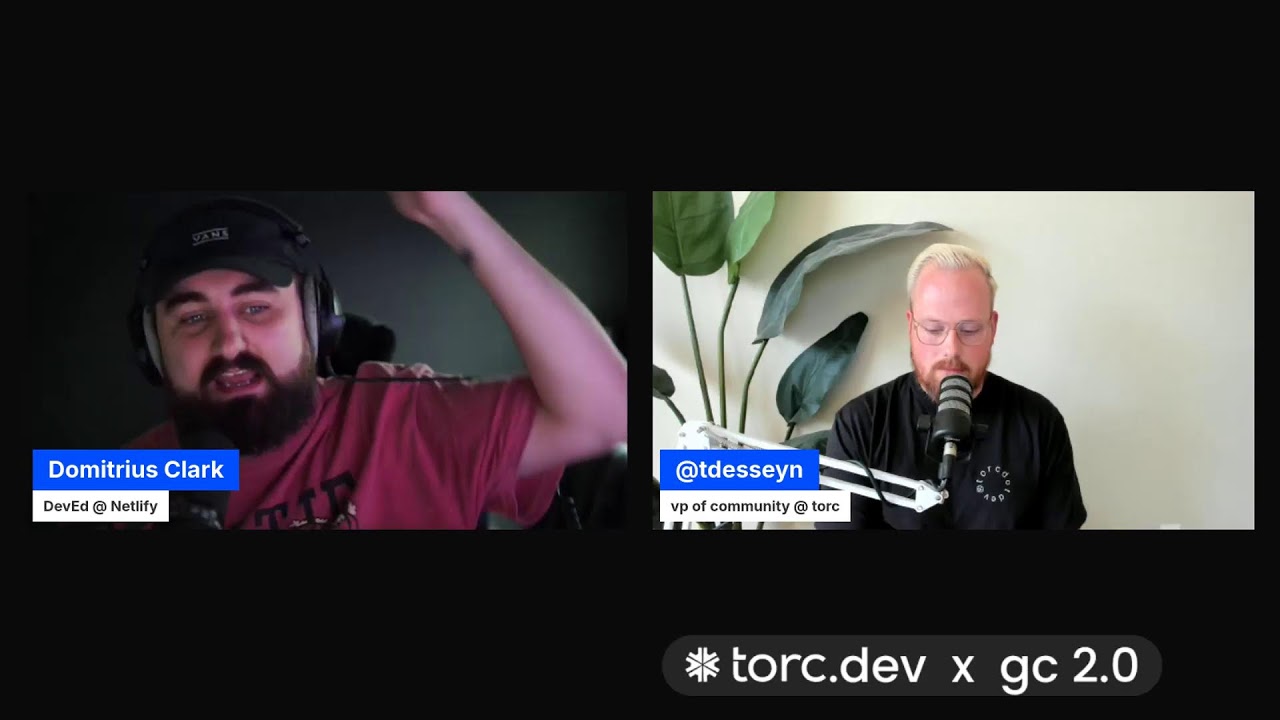
This content was created by taylor desseyn. This content was uploaded by taylor desseyn. This is a YouTube live-stream titled "Career and Community talks w/Domitrius Clark" (created 2025-08-06T03:20:34Z). The excerpt is a conversational interview / live discussion between Domitrius Clark and the host (labeled here as "Speaker B"). They discuss career and community topics: DevRel roles and hiring, job-search experience (Domitrius describes an 8–9 month search), networking and referrals, the effects of AI on developer work, interview and hiring practices (including contract-to-hire), mental load and time management, and the importance of giving back to community. The conversation references companies and people (Netlify, Clerk, Zeta, Jason Lengstorf, Angie Jones, Danny Thompson, etc.) and is informal, interactive, and audience-aware (live chat mentions).
Chapters
these people who catch the hype, the end of the hype, right? Like, they're going to have to— Oh, we're live.
Keep going.
That's fine. They're gonna have to meet them as the developers that they are, right? And have an understanding of like— because you're no longer— you don't— it's not that you don't have to have expertise as a developer anymore to get a job, but you still do. You still have to understand, you know, the core machinations of building software. Sure.
Yeah.
But at the end of the day, now people are building stuff with their, with English, like with, yeah, with their native language. They're going in, they're prompting.
It's crazy. You said that. I had a developer from Microsoft, uh, I won't say who, um, but he texted me and he goes, I was like, do you think the layoffs are happening at Microsoft because of AI? He goes, no, not that I can tell, but I will tell you the next great coding language is English.
He said that.
I have it screenshotted.
Yeah, well, which is funny because like a lot of like code is written natively in English as it is.
Sure, right.
Yeah, yeah, yeah. So it's like now it, now it just translates. The translation layer has like widened.
100%.
Like a large amount.
Good morning, y'all. So Dom and I were having a, uh, a very lively chat backstage. Uh, I wish, wish we could have shared it from the get-go, but some of it was just—
Oh, we're here now.
Us, us boys yapping. Um, but yeah, good morning, y'all. Excited for this. I've not gone live in a minute, um, because I've been so busy. Um, and I'm actually heading out to DevUp to speak tomorrow in St. Louis, so I'll be on a flight first thing, uh, in the morning. Um, but we squeezed in Dom. Um, so really, really pumped about this one. Um, uh, Dom was scheduled actually like 2 or 3 weeks ago or a month ago.
Um, and then— 2 or 3 months ago.
Was it 2 or 3 months ago already?
Isn't that crazy? That is crazy. I hate time. I hate time a lot.
Time in corporate America is wild.
Yeah, it's weird.
Yeah. Like literally, like my wife wonders why I ask her about things all the time because I have no recollection of time whatsoever.
And like, and like at, at this point, you know, you, you grow up trying to avoid the calendar being your life, but like, it is.
Oh dude, if it's not, like I was, I was messing with somebody at Torque to do a quick call. He was like, yeah, gimme a quick call. And I was like, no, I'm sending you an invite. I was like, if it's not on the calendar, like I schedule date nights, I, I, I send the calendar to the wife. I was like, listen, like if it's not on and I can't plan for it, I won't remember. It's never gonna happen.
Yeah. And we've, and we've talked about our, our memory capacity not being great.
My— I, I am— yeah, like when I track, like my memory and my sense of direction is terrible. Like I think if I were on Survivor or— no, no, not Survivor. What was the one? Great, Great, Great Amazing Race or whatever. Where you like—
the Amazing Race, the— right.
I would die.
I literally would. I don't know if I could get out.
Dude, I literally set my GPS always. My wife gets— she goes, you don't, you don't know how to get to our house?
Don't, don't bring up, don't bring up directions because that just hurts me deeply.
Yeah, yeah, yeah, yeah. Just send me the address. Don't tell me how to get there. Just send me the address.
I'm a big like— and I think this is a, this is probably a New Jersey thing, but this is definitely a me thing— I'm a big like, yo, once you're on that road, you're gonna see this really big Wawa, take a right at that, and then hit the big yellow tree, and then you're at my house. Like, that's it. Yeah. Oh my gosh, the chat is going insane.
Yeah, chat's going off. Good morning, y'all. Welcome. Uh, say hey, we'd love to hear from you. Again, it's like I tell folks, I, you know, the, the one of the things we're trying to do— and Dom and I were talking about community backstage, and I'm sure we'll get into it, um, here in a second— but, you know, what I've realized over the course of, of the 5 years I've been doing this live stream is And Dom's been with me from the get-go. Um, but, you know, yeah, this is like your second or third time on the show. But for me, like, like, this is a virtual meetup, right? Say hey. You know, the, the point of this is, is to grab some coffee and, and comment and, and engage with folks, right? Give people a platform. You know, one of the things I talk about— we did a New Member Monday. We're doing this kind of like initiation type thing. That sounds creepy. We're doing this like thing in the Discord where it's like, hey, um, you know, I'll tell you about Torque, whatever. And basically, um, uh, I, I tell folks like, we want to open up our network to you all, right? And I tell people this, like, if, if you have DM'd and just at least said hey to every guest I've had on for 5 years, your network would be insane. Pretty, pretty expansive. So again, say hey. Oh, there he is. Wow. There we go. I, I see Don.
You see what I'm saying?
Everything. The great Danny Thompson.
Danny Thompson has a, has a mad kissable forehead. I just wanna put it out there.
Yeah, 100%. Also, you know what's crazy is I did the Grok, who's like the most famous, who's the most followed person that follows me, and it's Danny Thompson. Grok goes, Danny Thompson is the most followed person that follows me.
Yeah. I mean, he is goated.
He is— He's unbelievable. Unbelievable. I aspire to be like Danny.
I'm just kidding. Like, remember, remember how we were talking about how you, you, you were talking about like the NBA and how they take all, or they don't take your likeness? I feel like Danny Thompson is like a LeBron of the coding world, right? Like he's up there.
What are you? Who am I?
Like Jersey.
Who am I? Am I Austin Reeves?
I think you give Austin Reeves. Yeah, yeah. Probably an Austin Reeves kind of guy. Yeah, yeah.
What are you? Are you—
Am I a Jokic kind of guy? Like, I feel like I might be.
Maybe. Maybe. I'm not a big basketball guy.
Because I definitely would have a beer in the locker room. 100%. He's leaned up.
He's leaned up though.
Sure, right. We don't have to talk about being lean. That— yeah, I mean, now you're just—
yeah, yeah, yeah, yeah, yeah. I'm in my thick boy era.
It's fine.
Um, uh, but again, it's great to see y'all. It's good to see you, Emmett. It's good to see you, Amelia. It's great to see you as well, Joshua. So I ran into Joshua.
That's my cousin.
Yeah, is it really? It's not your—
no, it's not going—
no, I didn't think so. I ran into Joshua at Laracon. Um, it was so good to— you know, again, and we talked about the power of community, right? I mean Josh, uh, Joshua was super kind, said some nice words to me. But like, I helped Joshua write his resume. I'll call him Josh. Joshua, I feel like, is a little intense. So I helped write Josh's resume like 4 years ago.
Hell yeah.
He came up to me and he goes, yo, I just want you to know, like, I got a job because of it, and I gave your tips to a friend and he got a job because of it. So like, you know, again, power community. You never know the smallest interactions you have years ago and how it comes back.
I'll tell you what, dude, I was on an 8-month job search and, you know, I wanna talk about it. You've seen my accolades, you've seen how long I've been in the industry. You know, I, I, I definitely had my, my time being more public, um, when I used to do live streams and a lot more content.
Steve Nash. You're Steve Nash.
You're 100%. I'll take Steve Nash. I'll take, I'll take Steve Nash. Yeah, I think that's a good one.
Yeah, I think it's a good one.
Yeah, I think that's a good one. Um, yeah, 8 months on the job search. Um, I definitely turned down jobs. Like, it's not like I wasn't finding Sure, my in. But I can tell you right now, uh, the, the way people showed up for me, um, like when you've got— and I'm just gonna shout her out because she's absolutely goated, uh, Angie Jones.
Like, dude, I mean, just—
I mean, we all know, like, I don't have to, I don't have to, you know, her flowers, dude, her flowers are, are, are largely given. But I, like, don't be wrong, I know her. We, you know, hang around a lot of the same circles and we've known each other for online for a long time. We'd met a few times at that point, but it's not like we have this deep relationship with each other where I would reach out to her and be like, Angie, find me a job. But she reached out to me and checked in on me weekly.
That's crazy.
Sending me—
because that girl's busy as all get out.
That's what I'm telling you. And so I'm telling you, that really opened my— I know me and you have had this conversation a million times of, like, how important it is to be yourself and to spread as much. If you get success, spread the success, right? Like, that's just—
Yeah.
That's just period, point blank. And like, the coolest thing, I think we talked about this like really early in, in our meeting, but like the idea of in tech, there's a lot of bullshit. Like, we're now, we're now right in the middle of like social media being the owner of a lot of the things that we deal with.
You said it, not me.
At least where we are. At least where we are. Like, I, I think there's a ton of developers out there who don't ever have to deal with the social media, but I think they're even getting there to where they're starting to see that, like, shit, the competition is all over there in public and everyone sees what they're doing. Um, but like, now that social media is, is that, is that big of a deal, like pushing yourself to help people is cool. Like, yeah, that's something that almost no other vertical has. Like, no other business. It's not cool to help people in other businesses. It's cool to gatekeep people in other businesses. It's cool to like it. Like, all the people that you look up to gatekeep you and make you feel like, oh, I have to work harder so that I can get to that level. So like that, it's like this weird challenge.
Yeah.
Here in tech, don't get me wrong, there's a ton of BS, but it's like relatively empowering, like in your social status to help people.
Yeah.
Yeah. And so like, I help people because like, I just love community. I love people. I, I love seeing like why I loved being a manager is cuz I just love seeing, like, I love telling somebody what they can do and them not believing it. And then them doing it and being like, how the hell did I do that? Um, that's, that's something that's always kind of driven me in my career. And now it's like in the same position. Like, I, I just feel like I told— before we got— we went live, I told you like 10 years ago when boot camps happened, that's where I came from. When boot camp happened, like, it was so hard to find your way in this like insane world. It's only gotten like more big and more crazy like now. And you see this in, uh, you know, I think in the tour community pretty, pretty heavily, but and just surrounded by the people that you've surrounded yourself with. Everyone wants to do that. Everyone wants to uplift the next person and it's like a community of fostering and like, that's so hard to build. So hats off to you for building something like that because I think that it's a lot. Thanks for that. And we talked a little bit about this, you know, no drama, but we talked a little bit about this where businesses try to— I'm going to say they try to bastardize community. They try to, they try to wring it dry of what they can get from it. And the best communities start where they give out as much as they can. And I don't mean giving something like physically, I mean doing these events and bringing people together and connecting them and working with them. And I don't know, I think that that's like a very special thing to see transpiring in a really hard time to do it. So yeah, absolutely.
So, well, man, you know, obviously talk about community briefly. I do wanna talk about your job search, right? I mean, I think, you know, I think somebody like you— I think people can get a little weary, right? Somebody like you, you know, if they don't know you, you know, I definitely want to give Dom his flowers. I mean, you know, I think that I, I try to bring people onto the show that get me fired up, and I, and I, I don't know if there's anybody who fires me up as much as Dom. I mean, literally a brother from another mother for sure. I wish I had his dark complexion. That would have— that would probably help my day.
No, I feel like, I feel like our, uh, duality is what—
Yeah, yeah, you're like dark and I'm like Yeah, well, I don't know if I'm dark.
I'm like also pretty dark features. Yeah, I'm also pretty like— I'm— I burn, I burn pretty easily. Yeah, yeah, yeah.
So, but no, I mean, Dom— I mean, Dom's got an expansive network, right? And you know, I, and I do mean this, I aspire to be like Dom and help it. There's such a community-first approach that Dom takes. And but I do think people can get— they're like, wow, somebody like Dom took 8 or 9 months to find a job.
Oh yeah, like that could be exhausting to think about.
So I mean, talk about, talk about those 9 months, man. I mean, like, like what worked?
I'm gonna get honest with y'all.
Yeah, I love it. No, no, honest, totally, totally uncensored. Again, this is, this is the whole point of the show.
So, so I will, I will say going into my job search, I spent about probably like 2, 3 months recovering. 2 months, about 2 months recovering of just like dealing with— like, we had just bought a house. Like, we're coming up in October 2 years on, on the house that we bought. Um, and so like, at the same time as like settling into my house, I, I'd lost my job. And everybody can, can empathize with how stressful that can feel of like, okay, I have to get back. There's no—
Yeah.
So what I did was I took those 2 months and I didn't stop working. I started figuring out who I wanted to be in the next phase. Like, do I want to go back to managing? Do I want to go back to IC? You know, what is the— what are the companies that I'm really interested in? Who do I want to work with? Because like, I'll be honest with you, like, I started my career with like, where do I want to work? Now I kind of moved my career to like, who do I want to work with?
Mm-hmm.
Because I'm gonna tell you right now, like, I've been in the gambit. People, you can go look at my LinkedIn. I've been— I'm like the right before being the worst job hopper kind of job hopper. I stay about a year at most places, but I realized really early in my career, nobody cares about me like I care about me. Nobody gives a shit about my future like I will. And every company gives a shit about them way more than they care about me.
Yeah.
Um, and so I wanted to find a way to work towards not putting all of myself into my work. Like, I, I spent a lot of my early, like, the first 5 years, like you said, like, I was tirelessly working, right? Like, I was out there in the community all the time, in every community. I wasn't even just in, like, a community I built. I tried to spread myself across as many communities as possible, open as many doors as I could. Like, that was a big part of my career. But I wanted to spend the next kind of half of my career like, what do I want to define myself as later? How do I want to see myself in my career? And like, honestly, like, what do I want to do outside of my career? Like, what are the things that I care about outside of this, this stuff, right? Like starting a family. And I play a lot of Magic: The Gathering. Like, that's been a hobby.
That's really nerdy stuff. It's way over my head.
Dude, and I'm gonna tell you, but I'm gonna tell you right now, like, I did that in high school and I hadn't really had a hobby. I play video games, but I hadn't really had like a hobby hobby, like something that I Like, I travel for this now. I go to tournaments and I meet people, and it's like I get to do the things that I really like to do outside of work. And not everything has to find its way back to be like— everything in the beginning of my career had to find its way back to being useful for my career.
100%.
And like, that was so tiring. And so first few months, I was like deciding on who the hell I want to be. Um, I see I do not have a bachelor's degree. Straight out of a boot camp.
Straight out of boot camp. Not Compton, but boot camp.
It took me a year out of my boot camp. I I learned Ruby on Rails. I'll be quick. I learned Ruby on Rails. I was in Philly. I had to teach myself JavaScript. It took me a year to like get really good enough to like interview. And again, this is when people like didn't give a single shit about bootcamp graduates. Like they didn't care how long you spent, what you could build. It was like you had to prove yourself or not. But anyway, 2 months about just kind of finding myself and figuring out what I wanted to do next. And I started like grinding interviews.
Yeah.
Like, I probably— and like, I was like on LinkedIn, I was in my network being like, who's— like, every company that I cared to interview for is where I started. Like, I reached out to a bunch of companies, um, to even just to see where they are. I didn't even know if they had like openings, like, but I've been a part of a lot of processes where I've gotten like the Listen, we don't have a position open, but I'll open one if I can. So, I went through a few of those interviews. A lot of AI companies were reaching out to me.
This was your latest job search?
This is my latest. This is right before Netlify. A lot of AI companies were reaching out. And every time I got into an interview, it would be for like a developer relations, developer advocacy, whatever type of position. A lot of them were like head of DevRel, you know, style roles.
Sure.
Like I got into the interviews and like, I'm just not a novice. Like I'm not gonna just, I don't need, I, I need the job, but I'm not just gonna take the job. Right. And so like I started every interview with like, yo, like why are you hiring me? Like what, what responsibilities do you see this role fulfilling? Most, like 90% of them were like, we don't know. Like, we were hoping that like you would help define that. And like, for me, I'm like out right there. I'm good on that. I, cuz like every time you walk into a position like that, you're gonna spend more of your time proving why you exist more than doing the job.
Interesting.
And like, I, I personally think that if you're running a DevRel team, if you're running a, I think you should keep your DevRel close to being engineers. Like stop pushing them towards being social media marketers.
Yeah.
That, that, that hurts more than helps. And it's why you, you're laying off, you know how many companies are laying off their marketing team to hire a DevRel team to do the same things and then wonder why those DevRel are burning out? Like it, cool. Anyway, um, spend a lot of time kind of sifting through and I'm talking like, 3, 4 interviews at company, and I probably— I still have a Notion sheet. I did— let me go check.
Yeah, so, so you kept up with everything, which is again smart.
Yeah, yeah, yeah, yeah, brother. Me and you, you know, you know that I'm, I'm, uh, because it's especially because I was so nervous. Like, I was so nervous, which I want to highlight, right?
So I want to highlight 2 things. One, You took time right now. Two months. A lot of people like I don't know if I can take two months. That's fine. I interviewed Lawrence last month. I don't know times times time. I don't know what time is, but I think it was a month ago. You know, Lawrence took the weekend, right? Like I think giving yourself that breather, man, is huge. And then also too, like I want to like you were nervous. Like I was nervous when I when I left Vaco and was interviewing, and then when I left Gun and I was in an interview, like. People, I don't care how much you yak online.
And people, people think that you might just be saying this performatively. I have the DMs to prove, like, it is, it is a stressful time. No matter, you, you, everyone sees what we do and how public we are and, you know, how, how we, how we, how enthusiastic we can be. And they're like, dude, that guy's, that, that guy probably never worries about anything. We probably worry more than you do because, because we are so public and because we are so readily available to people. Like, that's even more stressful because you have to keep up this— like, I'll tell you, by that, like, I was stressed going into it, but I had confidence. Like, I knew, I knew who I was.
And you can be stressed and have—
But I'm gonna tell you right now, dude, I lost— we'll get to this— I lost all of that. Like, I, like, by the end of my Like 5th month, like looking like I was like, like you could talk to my partner Dominique. Like she had never seen me so defeated.
Wait, your partner's name is Dominique and your name is Demetrius?
We're both, we have the exact same initials. That is wild. We're both, we're Dak. We're, we're literally Dak squared. Oh my God. That's hilarious. We're, we're like 3 days apart birthday-wise.
That's crazy. That's crazy weird. Uh, so you were nervous and you were stressing? Yeah, I mean, 5 months. I mean, listen, I mean, I've been tweeting about it. Uh, I think the timeline's gone from less than 3 months in 2021, 2022 to now. I mean, we're looking at 6, 9, maybe 12 months.
You know what the real big issue is, is that I don't think a lot of these companies know how to interview. Oh, buddy.
Don't get me started with that.
Like, I, I don't, I don't think that I— it's weird. Like, tech itself is pushing so fast, but I feel like a lot of companies are regressing in how they see growth and what they believe will get them there. Like, because, because they're, they're grasping, trying to figure it out just as much as they've ever been, right? Like, with this shift to AI, like, it's It's every— and you know, I think it's funny because you, if you remember the beginnings of AI, everyone was like, if you add an AI, like a lot of devs were like, if you add AI to your product, like I'm done with it. Oh yeah. And now it's like, good luck using a product without AI and good luck finding a job that doesn't have some semblance of crossover with it.
Would you say companies don't know what they want?
I think that it depends on the role.
Sure.
I think that DevRel has always been a really bad place to be. And I don't mean that as in, like, I don't— I'm not appreciative of the years that I've been one and continue to be one. But I mean, I've been across 6 companies at this point. And I like— there's some that I love, there's some that I'm indifferent about. But like, I can tell you right now, I can't remember one that I felt confident understood why I worked there.
Yep.
And I don't mean I, I mean the collective, like any, any dev rel at the company. Like it just, I think that engineers, I haven't worked as one, like as purely like a product engineer in, in years, but at least you have a realistic goal. Yeah. It may be an insane goal. It may be like the features are a lot of work and it may be like, too many features at once, but like what you do is defined.
Yeah.
And you have PMs to manage it and you have skip levels to figure out how to sell it above you. Like every DevRel that I have ever experienced, worked with, worked as, has had to do all of those jobs by themselves and then still be questioned about the output and how it converts. And so I think, you know, when we ask, do we think companies know what they want? Um, I think that that's changed wildly in the last 5 years. Um, but I think it, it really depends on the role. Like, I, I can't tell you that I feel confident that any company that I interviewed with had a, like a really active reasoning as to why they were hiring DevRel other than like a lot of them were DevRel masked as content engineers. Like, yeah. And not like really just like content engines. Yeah. Um, and/or like social media specialists that built projects.
So how did you ferret that out? Right. I mean, I, I don't know if there's a silver bullet, but did you have any, like, did you have any tips or tricks where you tried to ferret that out sooner rather than later?
Um, I played the, I played the game for the first 2 interviews, right? Like, You know, excited to be here. I want to learn about the product. I want to hear what you guys do, because I, I like to, like, I, I, I like to run my teams and I like to be ran as an engineer first. Like, I care about— I think DevRel that were closest to product are some of the more successful ones because they can, they can much more easily look at like output as a success metric.
100%.
And so I start a lot of my, I start a lot of my interviews like, What does your product team look like? How does your marketing team run? Like, I have a lot of questions because I've been around in such different capacities now. I've kind of seen it all. And I think one of the coolest things about being a DevRel is that like, you're really a, you're a great context holder across teams. And so like, you get to work with like sales a bit and you get to work with solutions a bit. And like, you know, my time at Clerk, I was dual managing both support and community or end, uh, end DevRel for a little bit. And so like, I, I never had dived into support deeply until that, until that role. And so like, you, you get a really good broad blanket understanding of like the operations that exist inside your company more than just the wording. Um, and so I spent a lot of time like figuring that out. And then like, first question I ask is always like, why am I here? Like, what, what do you, what do you think I'm here to establish? What is your team's Like, not only what do I— and I ask individually because, you know, they always set you up with like 4 different people to interview with. I ask individually, like, what do you believe DevRel looks like? And most of the time they all have different answers or they don't have an answer at all.
Right.
Uh, and so like once that would settle in, I'd be like, okay, like, I, I'm happy to finish up because I'll never— to your point, I don't, I don't shut down an interview even if I don't feel like I'm, I'm the right you know, choice for it.
Yeah. Yeah.
But I will say, but I will say, hey, like, I, I think that you, what you guys are doing is great. I, I don't think that I'm the right choice. If you wanna keep interviewing and, and that changes, like, I'm happy to do that. Um, and then sometimes, like, on the other side of it, like, I would describe my expectations for success and it didn't align. Right. And we would, and we would just, you know, split ways amicably. But I think it's like, For new people, a lot harder to understand and speak to.
Well, I think you gotta take control of the interview process. I think I will tell you this, I have not— I have— I'm confident to say at Gun and even at Torque, I have taken the jobs without fully knowing because I truly— my hot take is I truly don't think you can get— that's why I think contract to hire, in my opinion, is like the best way for both the employer and the person. I started as a contractor at Torque just because it takes forever to get an offer letter at Ron said. But like, I think contract hire is the best way to do it because I don't think any interview process can ferret out any developer appropriately. And you need an idea of how you work within the organization. That's— I mean, we did a lot of contract hire at, at Vaco. You know, I'm, I'm obviously on the other side of it now, being on the community side, but I still pitch to clients. Like, I think to get the best angle for a developer or anybody, I think contract hire is the way to go because I, I just get the person started if you like them, and then after 6 months, let's see if it works or not.
Yeah, I think, I think it, again, it really depends on the work. Like, like, sure, what is the hire?
I think what we do— and my wife even messaged me after I left Gun, messaged me, she talked to me. We don't—
we live in the same house.
That's insane.
Yeah, yeah, yeah. She goes, schedule time to talk to you.
Yeah, yeah, yeah. Getting calendar advice. Um, uh, schedule a one-on-one sync with her this afternoon. Um, but like, she was like, you gotta be careful because your, your community and people resonate if you keep bouncing around. So it's like, I, I, I do feel like it depends on the role for sure. Yeah. Because I've had people ask me like, hey, why don't you start as a contractor? And I, and I, and I've told 'em like, hey, No, like, I'm embedded in your organization. Like, I am a full-time employee for sure. I don't think you can hire me as a contractor.
If you're not— if you're not— well, that— but that's like, I'm not— I wouldn't say that I disagree with you, but I think that the hard part is that— well, no, no, because I don't— I don't disagree with you. I think the problem is, is that it just shows a lack of investment from the company to me.
Agreed. Yeah, yeah.
And so, like, you know, Emmett in the chat here said, I wish contract-to-hire covered health insurance. And it's like Well, yeah. Like, do I really wanna take 6 months and, and hope and, and just stay in my house and hope that I'm like, okay for 6 months? Yeah, I get it. To like, why did I just spend— and that's another problem is that like, even if it is contract to hire, why did I just spend 3 months high, like interviewing for like to get that?
Well, that's another thing. If you're gonna do contract to hire, you gotta get that person started quick.
It better be like that. Yeah. Yeah.
It's the whole thing. Um, so what else in your job search, man? Like what, what, what else worked? What else didn't? Yeah. Obviously I'm sure you've had referrals.
Yes, that's what I was gonna get into next is like— Yeah, go ahead. So I, I did, I did a lot of work submitting to my own, like to ones I really wanted. Then I moved on to like the, I like the product, let me go see if the team has, you know, spots. Then it became like, I'll literally mass apply to as many jobs as I possibly can, uh, and just start playing the numbers game. And when I started playing the numbers game is when I started to really dip back into my network and be like, hey, I'm just gonna be like completely honest with you. I'm having a hard time finding work. Sure. I'm having a hard time finding a place to, to, to put my feet down. And that, and that's the thing too, is that like I spent, I, I spent about 5, 4 or 5 months at Zeta, head of DevRel, moved to Clerk for about 8 months.
Yeah.
8 or 9 months. Uh, all head of DevRel, right? And before that was all IC. And so everywhere that I interviewed went into this cycle with me where they would say, I don't think that you're experienced enough as a manager to hire you into this role.
Interesting.
And I, and I think you spent too much time as a manager to hire you into as an, as an IC. I don't think you've done enough IC work in the last year and a half. Uh, and so I like was in this really weird, like hard place of like, I don't really give a shit. I can manage a team or not. I can work, you know, independently or not.
Sure, sure.
But a lot of the jobs that reached out to me were coming to me for management positions, for head positions.
Yeah.
And so like that, and I can't tell you, it must have been 5 companies that like reached out to me and then would be like, yeah, I don't think you have the experience we're looking for. And I'm like, I know you saw the resume. Like, I know you've seen how long. And it always, it don't, for some reason it always came down to time. And so, I spent a lot of time reaching out into my network. Like, shout out to Jason Lengstorf. You know, me and you talked about him. That's like my big brother. He's always looking out for me. He's the reason I'm back at Netlify again.
Yeah.
Angie, again, shout out to Angie. Huge supporter, huge help. But yeah, I just started reaching into my network, started, you know, just straight asking people. Like, if you— like, you know, I would hit up all of the people that I used to work with and, hey, Do you know somebody that would even give me an interview?
And I think it's an undervalued thing. I think a lot of people are like, oh, like net new, net new, net new. I need, I need new connections, new connections. Like, and while that's important, like, even messaging people you used to work with is like a huge underrated thing that I don't think a lot of people do.
Well, and I think also that like a lot of it, it also comes down to the fact that like at a lot of the jobs, like, I try to make myself memorable while I'm there and like not just be your coworker. Like, I'm gonna reach out to you and be like, hey, like, you know, you know, if you— and I would do this to, like, people that I had no business doing this with, but I'd be like, hey, like, to our marketing frontend team, if you ever get overwhelmed, like, message me. I'll hop in and do some PRs with you. Like, there's that.
Yeah.
Like, because to me, it's like people have to trust you within an organization for you to do your best work. And so put yourself into a position where you really connect with the people that you work with. I don't hang out with all of the people that I work with. They're not all my friends, for instance, but like work friends are a real thing, right? Like, and I love to make work friends. And so yeah, I started spending a lot of my time doing that. And then towards the end, I had about 3 really interesting job opportunities.
Okay.
And Jason was like, look, dude, I'm gonna fly you out. You're gonna come be on Learn with Jason. Um, you're gonna be in an episode. It's in person. He's like, I think, I think the problem is, is that you work best in person. Like, people need to meet you. Yeah. See how much they need you.
Yeah.
Yeah. And I was like, okay. I was like, cool. Like, appreciate it. Get there. I mean, what an episode. It was such a good episode. It was me, Kent, Kent Dodds, Charlie Gerard.
Yeah.
Aaron. Um, It was like such a banger episode, uh, and Sanity sponsored it. We did it at a warehouse near the Next.js, uh, I think it was the Next.js conf was happening. Um, so we were like one of the events. So, you know, he had me out there and that was like where I really started. I was like, all right, if I'm here, like I'm putting in the work. I'm like finding the CEO of Sanity.
In person, dude, we're just at Laracon. It's different.
It's so different, dude. Yeah.
I worked this into my slides actually for, um, uh, the— my, my talk at DevUp, which is the power of content and community. Um, and literally it's, it's the profile pictures of the COO of Laravel and, um, Adam, the creator of Tailwind.
Yeah.
Because I was literally at the Mostly Technical pod meetup that Aaron Francis did at Laracon and I just like somehow bumped in. I was hanging out with Tom, the CEO. I was like, hey, hey Tom, like I see you have Laravel on your badge, like what do you use? He goes, I'm the COO. I was like, oh shit.
I literally said, oh shit.
And then, and then I was at the next meetup the next day, uh, the happy hour or whatever they were doing. And, uh, this guy named Adam with Tailwind on his, on his badge came. I was like, I was like, hey dude, like what do you do on Tailwind? He goes, oh, I created it.
I was like, oh shit.
So I mean, I'm telling you, like in-person events are just huge, man. Huge.
I mean, they definitely— well, because you can't— you like, people can watch me on this stream and, you know, for folks that may not have known me before coming in, like, you know, they're gonna get an impression. They're gonna— they're gonna be, oh, I like this guy. Maybe I'll follow him. He seems like a guy, a lot of energy. But then you meet me in person. I'm like this 6'4 monster, like loud. I'm, I'm hugging you and you're like, I don't even know this guy. I love him. I love him.
Right.
And I, and I bring this level of energy that like you're gonna remember. And so like for me, I go to this thing. I'm like searching out the CEO of Sanity and being like, you need me. Like, you need me. I love it. I'm gonna— this is how I'm gonna— this is what I'll do for your community when I join. You know, I see that you and I— what people need to understand is that you need to actually know the company's product. Like, like a lot of people will like get an interview and they'll skim the product page and they'll talk a little bit about it and they'll like go and use it and then talk about the things that you dislike. Like, talk about the things that you like, talk about things you dislike, what you would do to— like, people love And so, like, realistically, if you're able to, like, talk about the actions that you would— that you would take if you got the job, even if they're at— even if they're absolutely off-kilter from what they are currently doing, that shows an initiative that they're gonna be really excited about. So I was doing that. I'm, like, hungry. Then I see Matt Billman, CEO of Netlify. Me and him had a great relationship from when I was there before.
Mm-hmm.
Um, I had left when Jason had left. So like Jason was my manager again. He's like, you know, my big brother. He's like, hey, I'm leaving. And I like, when he did that, I was like, okay, well, I, I really wanted to work at Netlify, but I really wanted to work for you. Like, I really wanted to work under you.
People want to work and buy from people.
From people.
Imagine that.
And so, um, you know, I ended up, I was, and I, and I also wanted to move up. I wanted to manage teams. I wanted to try my hat at doing the thing that I thought I could do so well. Right.
Yeah.
So, I had left, whatever, but I left in a great— you know, there was no hard feelings when I had left.
Sure.
So, I walk up to Matt, I'm chatting Matt up. And he's like, what are you doing right now? What are you like for work? And I was like, oh, I just left head of DevRel at Clerk. Currently on the job search, honestly. And he's like, dude, things have changed a lot at Netlify. You know, we're looking to do this, that, and the third. I want you back. I would love to have you back to push into this new kind of era that we're, we're running into. And I was like, all right, dope. Like, and I hit him with a couple of hard, like, you know, you say that this has changed. Like, what about this, this, this, and this? Like, these are things that I, I, I, I held dearly to myself while I was there and things that I wanted to change and whatever.
Sure.
But because again, like, I'm a, I'm a terribly honest person. Like, I do not hire me if you want a sycophant. If you want somebody to just tell you everything is great all the time, Yeah. I am not your hire.
Me neither.
And I'll tell you that in the interview process. And I'll tell you right now, it probably turns me away from jobs, but like realistically, it's gonna make the job a lot worse when I get there and they don't know that.
100%.
So I'd rather you know that upfront about me than anything. And so I tell Matt that, and I only ever tell you these truths because I give a shit. And for me to do something at your company that's prolific, I have to care. And for me to care, I have to tell you the truth. And so it's this cycle of like, these are the ways that I work. Um, and so push comes to shove and, and he's like, you gotta meet the new, you know, uh, leader of the DevRel team, the DevEd team. Um, you're gonna love him. His name's Sean C. Davis. Meet him. Great conversation. Like, you know, totally aligned things that I wanted, things that I— and I told him, I'm like, look dude, like I'm back on the IC track. I wanna, I wanna make it to staff within the year. Like staff would be really cool for me.
Sure.
Um, I, and I always have to have a goal and I always talk about my goals very early so that there's no confusion about like what what I'm here for.
Yeah.
Um, and people can tell you all they want that like job titles don't matter. And it's— there's a duality of it. The job title doesn't matter. The respect that you get when you initiate conversations through that job title does matter. Uh, so don't let people tell you that job titles don't matter. It 100% gets you seats at tables that you wouldn't get seats at. And it also would— it also gets you the ear of people that people typically wouldn't give a shit about. Um, it doesn't always matter, but it can matter. Um, So, yeah, got the job. I'm about 8 months into my time back at Netlify now. You know, we're heavily pushing on AX, like agent experience. We are, you know, the— like almost solely the platform a lot of these AI kind of like no-code, low-code platforms deploy to.
Yeah.
Which is really cool. And I get to like, I think one of the coolest things about being back is I get to learn a lot. Like I get to like, I get to like, I think AI is a lot. I think learning AI is a lot. I think all of the models and like to be deeply entrenched in it, like you really have to like finger on the pulse, know what you're talking about at all times.
Yeah.
But it's a lot more fun. I feel a lot more empowered knowing how to use it and all of the things that encompass it. than staying sheltered from it because I don't think it's going to impact me. Yep.
Yep.
I love it. I love it.
All right. We got 5 minutes left.
All right. Let's do it.
I got rapid fire. Do you have any last final thoughts? We can end there. Which one?
Rapid fire. I love rapid fire.
All right, cool. Let me pull it up. Where is it? Here we go.
All right.
What's— you can't say Netlify. What's one tech tool or app you can't live without right now?
Probably Raycast. Okay.
Love it.
Love it.
What's the very first job you ever got paid to do?
Oh, I was a mall junkie. Like, I was like— Mall junkie, bro. If there was a mall—
were you selling? I could see you selling cologne in the mall kiosk.
No. God, no. If there was a cool company at the mall, I worked at it. Like, I love it. People don't understand. I spent 10 years in retail. I thought that was my career.
Yeah, I say this all the time. They— I saw this joke on social media that us millennials don't have like world wars to associate ourselves to, so our world wars are retail, uh, uh, uh, restaurant, and tourism. Yeah, 2 of them. Restaurant.
I wouldn't be where I am if I hadn't worked 10 years in retail.
Yeah. Oh, same.
I learned— I learned people.
Same.
Yeah, back of my hand.
A restaurant No job has ever been as stressful as trying to get 3 Bloomin' Onions to a table at the same time on a Friday night.
Yeah, I was like a Zumiez guy. I was like the— Yeah, I skated for like 15 years. Yeah, I was like Zumiez, Tilly's, GameStop, Journeys, Radio Shack, Best Buy. If it exists, I work there. Know that. I love it.
Let me ask you this. Obviously you're fully remote.
Yeah.
If you could have your best setup, Yeah. Would you go into the office 1, 2, 3, 4, 5 days a week? What's kind of a good—
like, so this is actually— This was a big piece of the interviews. This is a huge— a lot of companies were asking if I'd move to San Francisco, and I was like, are you paying me $500K base salary? Sure. No, eat, eat, you know, kick rocks. Um, I almost said something way worse, but yeah, um, you know, for me, I've been— I've only been remote.
Sure.
Like, I've never— I worked in office as a frontend engineer right at the beginning of my career for like 2 years. Yeah. And I've been remote ever since. Um, it is for me, like, I— so my ADHD and I just like, I, I waste more time in an office than I'll ever waste it. Yeah.
Yeah.
100%. Um, and so for me, I would like— there was a company that I was interviewing with in New York.
Yeah.
Uh, and I told them, I said, if you I would come out once a month for a week. Yeah. I'll be in office all week. I'll stay at a hotel near the, near the company. Um, and, and, or I would be willing to commute in 2 days a week. Yeah. If, if, if, if absolutely necessary. Correct. I will do that.
Yeah.
Yeah. But otherwise, like, if it's not remote, I'm, I'm, I'm for the most part good on it. Yep.
Um, what, what did you wanna do originally when you grow— grew up? Like when you, when somebody asked you when you were like in 3rd grade, what did you wanna be when you grow up?
Dude, I thought I was gonna be like a game programmer. I thought like, I've always, I've always thought that I was gonna work in video games.
Right.
It's what, it's what actually pushed me to do what I'm doing now. Like I was working in retail and I was like 23 or 22 and I had, I thought I was gonna be like a DM by 30. Like my whole goal was like, how do I get before 30? How do I make 6 figures? And then it's like becoming a DM. And I was like so fucking full of myself that I thought that like I could do it. And then, uh, and I probably could have, but, um, the— I like met a bunch of store managers and they were like, yeah, dude, like I've been doing this for 15 years and they were like 40. And I was like, oh, like I have to leave. Like I have to get outta here. Uh, and so then I went and like did the bootcamp, whatever, whatever. But, um, for me it was like, I— my first company that I'd ever worked for was a video game, like tooling company. Like we built second screen apps for video games.
Yeah.
Um, and so I was like real close and then, and then I realized video gamers don't get paid well. Like video game programmers don't get paid well, which is really— it's such a shame because they do some of the hardest programming.
I know.
And it's crazy in the space. Crazy. And then the work-life balance of like people in the games industry is horrible. And so I pivoted to web and I'm so happy because like it makes me feel much more connected to where we're going as a society. And I feel a lot more empowered to be able to, you know, like we talked a little bit about Magic. I joined a team recently of an artist who like sells his wares online. Um, I'm like gonna set up his whole like Shopify shop, a website, like something like that. Like I'm able to like combine my passions a little bit more now and, um, I'm much more happy. Yeah, I think I love that. I did.
Last question as we wrap up because I gotta call in 1 minute. Run it. Um, the show's called Guidance Counselor 2.0 because you had guidance counselors in middle school, high school, and college, but now as adults we don't necessarily have a guidance counselor to turn to and ask for general career advice. You can go back and tell young Dom something, what would it be?
Um, to be honest, it's stay, stay, uh, cocky. Like, stay alone because, because like I, I say it, I said it before, I'll say it again, and I'll leave with this. No one gives a shit about you like you do. Yeah. Um, so true. No one can believe in you like you can. And I know it's hard. I know that like the world that we've lived in for the past 5 to 10 years, makes it really hard to believe in yourself and to believe in others and to believe in the good of the things to come. I'm not a religious person. I know you are. I know that there's a lot of faith that runs around. I decided to have faith in me.
I love it.
And I carry my team. I carry my family, you know, the best that I can. And I know that there's a level of selfishness that you have to have to become successful. And it's not a selfishness that has to keep you from people. It's a selfishness that allows you to succeed in a way that as you succeed, more doors can get opened up for the folks that come behind you. And my whole big goal has always been push as far as I can, leave as many of the doors that I've pushed through open so that others can easily, more easily walk through them and utilize me as a resource by the end of that tunnel. I love it. So believe in yourself like no one else does. And And give a shit. Like, give a shit about the work that you're doing. Give a shit about, like, how they treat you, how, how people view you. Like, it, it does all matter. And, and especially, uh, as you get into the job search, like, how you treated people is gonna, is gonna matter a lot. So, um, I love it. Good luck to you all. And thanks for having me.
I forgot this question. I always ask this question. Coffee or tea?
Um, coffee guy all day.
Hot or iced?
Uh, both. I'd prefer probably iced.
There you go, my man.
Yeah. All right, sweet.
Awesome. Well, Dom, stay on Sexy Body Backstage. Love y'all. I'm gonna hop into a meeting with Brianna. Y'all have a good one. Peace.
More from taylor



tech doesn’t have to be the only thing that brings us together #techcommunity #techcareer

I want to give back to y’all that make the tech community so great #jobsearchtips #techjobs




spend a little time investing in yourself #linkedin #linkedintips #careeradvice


