
Guidance Counselor 2.0 + AI and Your Career w/Aaron Francis
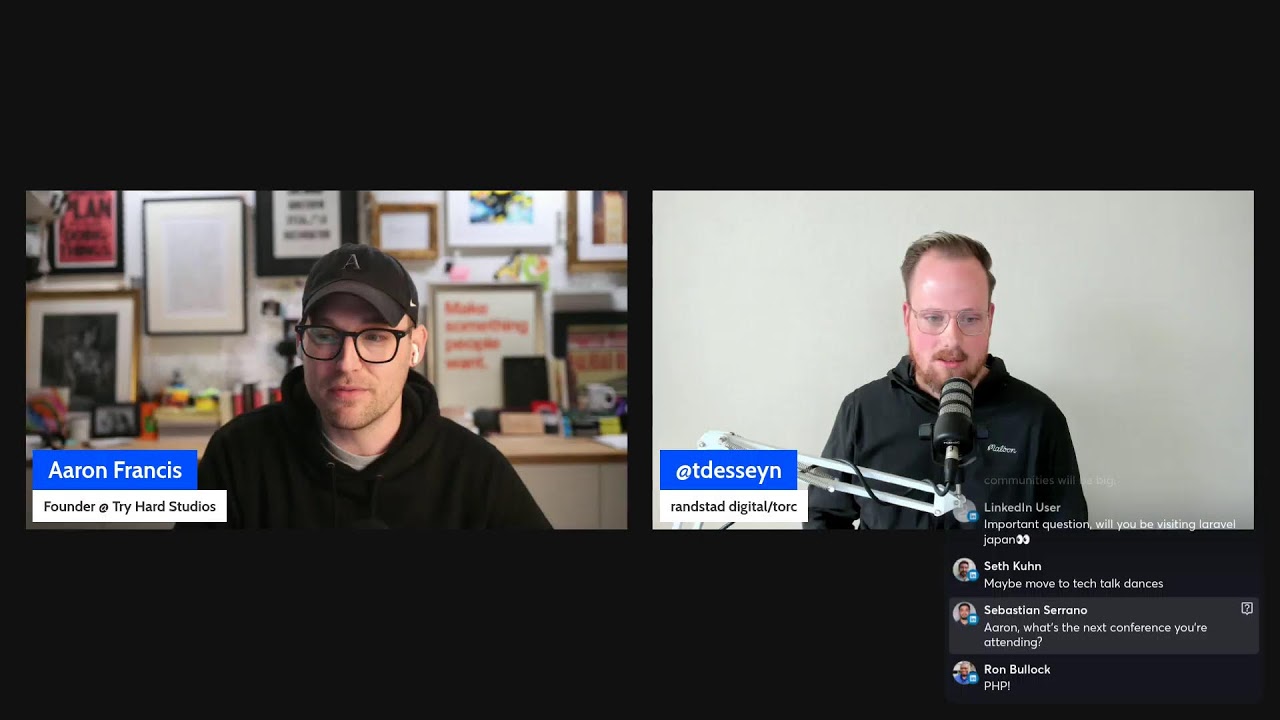
Aaron Francis, a software developer and founder, explains how AI is reshaping developer work and why treating LLMs as assistants with guardrails matters more than hype. He shares concrete advice for engineers: build in public, create side projects, and focus on problem-solving. His Faster.dev platform shows production-grade AI workflows in action.
Chapters
All righty, this alerting the troops. All righty, sweet. All right, good morning everybody, uh, happy hump day. Um, excited to, uh, hang out with the legend himself, um, Aaron Francis. Um, for those of you who do not follow Aaron, um, he's great. I'm gonna get him to obviously talk about himself. Um, but excited for this conversation today. I think, you know, one of the things I'm, I'm really kind of focused on— I've been doing this show now for 6 years. Um, it's 6 years this year, um, or 6 years this month rather. Because I started this thing when COVID hit, um, and I wanted to just get information out to the general public on career stuff and yada yada yada. And it was just me talking to my mom on Facebook, basically, on streams. Um, and then people started to chime in and other people started to DM me. They're like, I would love to come on the show. And this thing's kind of morphed into what it is today. And so Really been doing some thinking, obviously had paternity leave. We welcomed our 3rd kid. Quickly catching up with Aaron. But basically, we— I've been doing some thinking and I have focused a lot on the job search when it comes to careers with developers. I think what I wanna do and kind of where the market's heading is really trying to shed a lot of light on the uncertainty. I think, you know, I think you can live on X and think you're falling behind. I don't think that's the case, and we're gonna talk about that today. But I really wanted to focus and bring in on folks who have a good grasp of AI, who are building, and talk about AI in your career and what you can do. But then also I wanna bring on recruiters as well. So Aaron is not a recruiter.
I think Aaron is.
Aaron falls into the first bucket. So that's what we're gonna talk about today. Uh, just really kind of break down what Aaron's seeing, um, really what you can do to improve yourself, some skills you need to learn and be aware of. So excited for today's episode. Um, as always, please comment. We'd love to hear from you. The comment section is already, uh, blowing up. Um, I know I've had a bunch of DMs about this episode and people are excited to hear Aaron yap. Um, so again, we're gonna let him yap here in a second. I want to give obviously shout out to a few things. Um, if you Uh, want to be, uh, notified whenever I go live, 615-235-5650. Uh, shoot me a text. This is my number, my second number, I guess you could say. Um, would love to have you. Also, listen, we got a ton going on in the Torque Discord. Would love to have you in that. Um, and, uh, also too, go check out our community page, torque.dev/community. Uh, would love to have you a part of that group. Oh yeah, finally. Yeah, yeah, we launched a newsletter. We have a newsletter, but we actually have a landing page now. So if you want to be kept up to date Whenever all of our events, all of our streams, all of our workshops, all of our in-person events, we'd love to have you. If you are in the Raleigh-Durham area, we're gonna be rolling in for all things AI here in 2 weeks, throwing a little meetup, giving away some swag. It's gonna be a great little time. All right, Aaron, enough of me yapping. Let's give the people what they want, man. Who are you? What do you do? And we'll go from there.
That is a great question. Um, I'm Aaron. We'll start with that. That much is known. Um, I am a software developer, uh, historically, and founder of, um, a company called TryHard Studios, which you'll see here on screen. And, um, I do a lot of things, and it seems like it's changing you know, day to day, if not hour to hour.
Yeah.
Historically, I have— I've done a lot of database education. So I've taught a lot of application developers how to use databases at a more serious level. And I am now doing that same sort of thing, but with AI, teaching developers how to use AI thoughtfully and conscientiously and uh, without giving up, um, I think not necessarily control, but without giving over our brains to the neon gods and still like, you know, validating and being actual engineers instead of just, you know, saying yes, yes, yes. Uh, so yeah, that's probably as succinct as, uh, is necessary.
What— let me ask you this, man, and we can go ahead and dive in. I, I want to start the conversation With how you've pivoted, right? I think we are in the market right now where I think there's a ton of pivot. I've been recruiting in the tech space since 2011. I remember when .NET MVC came out and everybody was going from Web Forms to MVC. I remember when React came out. I remember when Angular came out. I remember when cloud started to get hot. This is, this feels like an entire shift.
Yeah.
And as somebody who was doing database and giving out content, again, if you do not listen to Mostly Technical, highly recommend listening to Aaron's pod. I've referenced it a lot on the show. I do listen to it. I listen to Ian and Aaron in terms of trends and where things are going. Aaron, what has gone through your mind over the last few months that has made you go from database, database, database to, hey, I, I'm making this full shift into AI.
Yeah, that's, I think, one of the benefits of having a weekly, you know, How's Your Father podcast where you just kind of, you just kind of jam, is the whole thing is like documented contemporaneously. And so, you know, if you listen— and I wouldn't wish this on anyone— if you go back and you listen to Mostly Technical from the beginning, um, You'll hear pre-Thanksgiving of 2025, pre-Thanksgiving, I was kind of a downer. Yes, you were. Because you see, like, you see on, on x.com, the Everything app, which I'm sure we'll talk about, you see the hype. And then I was having a lived reality where I was like, guys, this stuff sucks. Like, even, even pre-Thanksgiving, I was like, I understand that this is useful. I do not understand what you are all talking about because you'd go on X and everybody would be like, oh, if you're still writing code, you're an idiot. And then you'd have it write code and you'd be like, this is terrible. Not even just like stylistically different than what I would prefer. It is actively terrible. And so, you know, it's all well documented that I was like, this is not every— this is not a panacea that you guys are talking about. There was a point when I think GPT-5 came out and I told Ian like, hey, I feel great because this thing, I tried it and this thing is not very good. And so I think education is gonna live on. Like, I feel really good about this. I was nervous my whole business was gonna go away.
Yeah.
Being an educator. And then GPT-5 came out and it was like not much better. And I was like, oh, thank God, this sucks. And then, um, You know, I was building out the new video platform for databaseschool.com, which is where I do the database education. And I was doing that just pre-Thanksgiving and Gemini 3.0 was out and I think Opus 4.5 was out at that time. And I tried those 2 models and I realized, oh shoot, this is so much better now. Like, this is actively very good now. And so I think it was frankly just like the game on the field changed and I experienced it firsthand and I became like a believer that this is actually useful now.
Yeah.
And so hopefully, hopefully the record will show that like I missed NFTs altogether. I didn't do NFTs.
I thought they were stupid. I think I'd like for the record to show that most people except Jake Paul—
I think Web3 was stupid. I think the whole thing was stupid. I'm not like the— I'm not much of a hype trainer. I still have never used Docker. Like, I still like— I avoid as much technology as possible. And pre-Thanksgiving, I was like, y'all are crazy for loving AI. And then the models changed and I'm now I'm like, okay, this is the future, whether or not we like it, which is an interesting question, whether or not we like it. We need to know how to use this the same way we know how to use a hammer. Like, it's just a tool. And I think a lot of people are having existential dread about the tool, and I'm sensitive to that. But I think at this point, the, the cat is out of the bag, and it's like, we got to know how to use it. And so my hope is that we can all learn how to use it and get rich and happy and work really fast instead of get displaced. That is my hope.
Yeah, I love that.
What—
let me, let me ask you this, and I know we've got some questions, and I'm gonna try to, try to work these in, uh, when we can. If you have questions for Aaron, please drop them in the chat, and I will moderate the best I feasibly can. Let me, let me ask you this. There's, there, there's a lot of, uh, layers to this onion, if you will, right? There is, hey, I'm gonna use ChatGPT to ask some questions. Um, there's, and, and this is just the way I, I, I infer, which most likely is wrong, but there's like using it just to ask questions and prompts. Then I've gotten into like Claude Cowork to automate some of my stuff, which is pretty tremendous. Obviously I don't touch the coding side, but obviously you have the coding side. Then you obviously have like kind of the deep technology, ML, NLP, computer vision, all that type of stuff. How can people get started as a developer? Like what are some simple things that people need to really start to do to really start to get this thing under their belt? Under their belt, hands?
Specifically as a developer?
Yeah, as a developer.
Um, yeah, I think specifically as a developer, um, I think you should— I think you should download Cloud Code, um, the, the CLI tool. You should spend $20 of hopefully your company's money, um, and get on like the low-tier paid plan for 1 month. Like, you're not committing, you're not committing to never writing code again. Just open Cloud Code on a paid plan. And you can even keep it side by side with your editor. Or if your IDE has an integrated terminal, you can use it in there. You don't have to close out the terminal and never look at the code again. I'm sorry, close out the editor. My encouragement would be to start everything in Claude Code. Codex 5.44 is extremely good, but it's a little bit more neckbeardy. I find Claude Code to be super friendly. So I would start just like come in on Thursday, tomorrow, come in tomorrow and open Claude Code and start working there. And what you'll quickly realize is that it's stupid and it's frustrating. And that, like, that is either— typically, typically what happens is it depends on your point of view. Like, if you're a developer that's like, no, nothing can ever replace me, you're going to use Claude Code, it's going to do something stupid, and you're going to use that as confirmation of like, haha, I told you, you're all idiots and I'm the genius. Or it's going to do something stupid and you're going to be like, Well, I guess this is just the new world is we're stupid now. And I think both of those are— both of those are wrong. I think it's the same thing as like when React does something stupid, which is every time React does anything, you don't— you don't just like say, well, I'm going to go back to handwriting JavaScript without a framework. Some people have done that and I think they've been left behind, frankly.
Yeah.
So what you do is you use Claude Code and you say this did something stupid. Okay, well, how do I make it not do something stupid in the future? Is that writing a different Claude MD? Maybe. Is that adding guardrails in my application that are deterministic and will prevent Claude or its friends from doing something stupid in the future? Probably. Like, you're still the engineer. And so if Claude writes some terrible code and, you know, as the smart, very smart engineer that will never be replaced, you know that there's some sort of static analysis tool or some sort of test you can write to make sure that Claude never does that thing again, do that. Like, like lean into the tool, have the— so all of these LLMs are probabilistic, you know, word slop cannons, right? But lean into that and have it write deterministic tools that enforce like guidelines and structure and tests. And you don't have to take everything Claude says.
Yeah.
Like, you should push back on it. You should use planning mode. You should prepare. Like, I think a lot of people get stuck as they go in and they're like, build me an app like Salesforce. And then it doesn't. And they're like, well, I told you, I guess I'll go back to, you know, carving with my chisel into the stone. And you're like, whoa, like, just like, let's take a couple of steps at a time.
Right, right.
And as you, as you get used to where these things have limitations, because they certainly have limitations, You start to get this like spidey sense of, okay, well, I know that it can't do this very well, so I'm going to take this in 8 steps instead of 1. Or I know it can do this, no problem. I'm just going to have it one-shot this test or this harness or whatever and move on. I think the, the main takeaway is like you are not too late, but the time is coming when you may be too late. So it's not— it's not too late. Yeah, it's not too late to start. Like, you haven't been left behind. But you need to start. Even if it's just dipping your toes in the water for an hour each morning and then saying, well, I'm gonna go back to my pen and paper. That's fine. But you have to start, like, probably now.
Yeah. Let me— let's— and I'm kind of gonna lay this up into Faster.dev. Talk about that. Because I feel like you're taking a very pragmatic approach to this new endeavor.
Yeah. So my approach to Faster.dev, which is my education for engineer AI-assisted engineering, is you'll see a lot of stuff on the internet about like, well, if you don't have your agents running in a slop loop overnight, you're going to get left behind. And I just don't believe that. First of all, anything you read on onx.com unless it comes from me is a lie. So like you can just, you know, you can just kind of be like, ah, this is just somebody that's like trying to get points on the internet, right? I think— I think the approach that I'm trying to take with Faster is like, guys, this is real. This is actually helpful. It's not just like a, you're going to get left behind. It's like, no, actually you can get ahead. And what an exciting time to get ahead.
Yeah.
But you are still an engineer or should be an engineer. Like, even if you're not, now's a great time to learn how to be an engineer. I think the level at which entry, like junior people start is much higher now. Like you don't have to learn all the lower level stuff about like syntax, but you do have to learn all the stuff about computer science, right?
Yeah.
So it's like it's still a great time to become a developer. In fact, maybe the best time ever because you have these superpowers. But my point of view on Faster.dev is, like, you still need to keep your hands on the wheel. We're gonna use these tools, but we're gonna use them in a thoughtful and conscientious way. And from, like, an engineering-first perspective instead of, like, a vibe coding perspective. And vibe coding is great if you want to build a workout tracking app that goes on your phone that only you ever use. Like, don't look at the code. Who gives a rip?
Yeah.
But if you're working at a company or you're building a product that's gonna go out to people that trust you with their UI/UX, US dollars, then you need to like, you need to be serious about it.
Yeah.
And I think AI-assisted engineering is fundamentally different than vibe coding. And with AI-assisted engineering, you have to know about stuff like state machines and you have to know about stuff like idempotency and like static analysis. And that's fine. We've been learning stuff since the beginning. Like, this is no different. It just feels a lot different because maybe this is our first takeoff to live through. But like the mobile revolution, the internet revolution, like everything changed back then as well, um, and it's just changing again.
So is faster.dev like— are you working within a specific AI tool, or talk, talk to me about that?
All of them. Yeah, so right now there's, uh, there's a series on Cloud Code and Skills and something else. But I'll do— I use Codex, I use Gemini, I use AMP. And I am now like historically I've been a pretty pure Laravel developer.
Yeah.
Now it doesn't really matter, right? So now like I'm writing stuff in Rust and React and all these other languages. And a big part of Faster.dev is like the tracking, the real-time tracking of projects that I'm actually working on. And I think that's super important as you're like, as you're evaluating the people that you're going to like learn from and listen to, not, not just me, but include me in that bucket. Like, you have to look at what are they, what are they doing? Because if it's just— And there's nothing wrong with— there's nothing wrong with being a pure content creator. I don't malign that profession at all, but If you're looking towards a pure content creator to be like, this is how you write production software, well, what are like, what are they, what are they building day to day? What, what consequences of their choices are they living with? So like now I have, you know, these applications that are shipped to end users and I'm like, why I was late was I was debugging with a user in Slack, like why this thing is working.
I figured you were heads down.
specific machine.
Yeah.
And it's like I have to live with the consequences of what I teach. And so I'm hoping that these projects that you're following on faster.dev, um, will keep me honest to be like, listen, you could run a Ralph loop for 8 hours, but I'm not gonna do that because I have to ship this to users and they're gonna Slack me when it's broken and I'm gonna have to fix it. And so I'm hoping that that keeps me like on the straight and narrow of being a practitioner who also really has a heart for teaching rather than just making stuff up because it gets a lot of clicks. Like, I have not installed OpenClaw because I've got a business to run. Like this, I— it would be great content, but it doesn't do anything for me. And so my hope is that for practicing engineers, faster.dev becomes the place that you trust.
I love that. I love that, man. That was great. We'll clip that and send it to you. That was great. You can include it on your website. I think, Pat, I think you and Ian talked about this, about boring businesses, right? 95% of stuff on Twitter, LinkedIn is bleeding edge. Everything will normalize over time. Make sure you are using something. But Aaron's right about this. Can you talk about kind of your thoughts around how long do you think it's gonna get into enterprise? You know, kind of— I know you and Ian have talked about this a little bit.
I think it's going to take forever. I mean, yeah, we still have— and you would know this better than me— but we still have companies that are doing lift and shift to cloud.
Yeah.
And cloud has been around since the dawn of time. Like, uh, so I think right now, um, I think right now execs are probably super hot on AI. I think they're probably forcing people to implement it and they have no metrics for tracking it. They've got no support for these mandates they're handing down. Everything's gonna go sideways and then they're gonna roll it back and then potentially implement it in a more thoughtful manner moving forward.
Yeah.
And so I think right now we're at the super frothy stage of, hey, my golf buddies said, uh, that AI is everything. Let me write a memo to all my underlings and tell them to use AI. And then everybody's like, what the hell? I have no idea. You have not prepared me in any way, shape, or form for this. Now you're telling me I gotta use it or I'm gonna get fired. And so I think we're at a, we're at a like a, it's a very whiplashy part of the cycle right now.
Very whiplashy.
I don't think that means that this is all gonna go away. I think there will be ebbs and flows where uh, execs and maybe managers realize like, all right, this is not, this is not like a silver bullet, but it is helpful. So what do we do now? But as far as like, how long will it take Ford to implement generative AI? Probably a long time. I mean, you know, the Fortune whatever, it's gonna— the main problem in all companies is people and bureaucracy, not code. And so, yeah. I don't think this solves it.
David brings up a good question. Is learning AI for young folks? Am I too old to learn AI? Thoughts, Aaron?
You're never too old for anything except maybe like the Olympics or something. But like, no, like if you— if you— I think AI is— AI is a multiplier for things that you already know. I think I am way, way better at using AI than people that didn't spend 20 years being a developer. Because I can look at what Claude is doing and be like, dude, stop.
Yeah.
Just implement this data structure and all of our if statements go away. Like, what, what are you thinking? And then you tell Claude that and it's like, oh, that's very smart, my friend. And I'm like, I know you're supposed to know that. So no, I don't think it's, it's just for young folks. I think it is just for curious folks. So I don't think curiosity has a correlation with old or young. Maybe it has a correlation but not a causation. Like, you can be— I think you can be old and curious, or you can be young and stubborn. And I think if you're curious, you can pretty much learn anything. Um, and if you're stubborn, it's hard to learn anything at all.
Yeah, yeah. Um, and going back to fast.dev, this was a question earlier. I'm getting to these. Jason, how did you decide on specific content for Faster?
Yeah, so I picked Claude, um, in the beginning because that's the one, that's the one that I use the most. I think these days I'm maybe 50/50 Claude and Codex. Um, but I specifically stayed away from some of the, like, you know, Ralph Wiggum loops, which if you're not familiar, don't look it up because it doesn't matter. Um, I stayed away from some of that stuff because it's like, I think that is performative slop cannons. And so I'm trying, like, I'm really, really, really trying to focus on, like, I am a working developer. If I were a working developer inside of a company where there are 50 other working developers, what would I do? Well, I would be responsible for the PRs that I submit. I can't just YOLO everything. And so everything I'm doing on Fasters is in part a reflection of things I actually do in my real life, and in part a reflection of what do I think the average working developer needs, not what does the person on Twitter need.
Yeah, absolutely. Ron comes in. Are there any open models you like for coding?
I have not used any open models. Um, I only use— I only use, um, Claude, Codex, Gemini, and Amp. Those are the only ones that I've used.
Where, where do you see— so let me— so going back to like what people can, can do, you know, open up Claude Code, we'll start working in that. You know, I think one of the things that, um, you're doing with Building Faster, and then, and then what's your other— the desktop app Solo?
Solo, yeah.
Talk about that real quick.
Yeah, so Solo is one of the apps that we're tracking on faster.dev. Solo, which you can find at soloterm.com. Solo is basically like a terminal multiplexer. And so like if you're working on, let's say you got a frontend project, a backend project, an admin, an analytics or whatever, or you're working on like me, you're working on faster.dev, soloterm.com, Solo the desktop app, you end up with all these processes that you need to run to boot up the application, right? You need npm run dev, you need queues, you need logs, you need yada, yada, yada, whatever. And you end up with 8 different processes running. You don't know if npm has crashed, whatever. So Solo allows you to set up these projects and say anytime I want to start working on faster.dev, the website, I'm just gonna hit play in Solo. I'm just gonna hit the play button and it's gonna spin up those 4 processes. And now faster.dev as a local dev stack is running.
Cool.
And I don't have to remember like what was the npm command for this? Or like, why are my logs and my queue logs and my npm logs all interleaved? Because I'm using npx concurrently. All that stuff. So it just breaks it out and then you can share that configuration with your team so everyone's on the same page.
Yeah. What, um, uh, let me see here. You got a few more questions pop up. Uh, Nick, the Codex app is pretty solid too. Do you find you use the IDE less and less? I find I'm almost never in IDE nowadays.
I have not opened the IDE since Thanksgiving.
Wow.
Um, wow. Which doesn't mean I don't read the code, and I think that's something that people conflate. I did— I haven't written code since Thanksgiving.
Wow.
But I am— I'm also not like working in multiple Git worktrees and having 8 agents work in one codebase at a time because I'm watching what the agent does. That's how I'm catching. If I miss something, like if I'm working on 2 or 3 projects at once and I miss something, I just scroll back.
Yeah.
I'm like, okay, I see all the diffs that you're writing. Again, we're entering this situation where you're littering state all over the app instead of centralizing it. No, we're starting over. Um, so no, I don't use the IDE at all. I watch what the agent does and I use GitHub Desktop when I need to actually like look at a pretty diff instead of interleaved with the agent's thoughts. Um, but yeah, I haven't opened— sometimes I'll open the IDE to edit a Markdown file, but other than that, no, I haven't used it in a long time.
Crazy. Uh, thoughts on spec-driven development?
Um, as like a formal, uh, process, I find it's a little formal. I find it's a little bit like when people got super into, um, not Agile— what was the other one?
Scrum.
Scrum. Good Lord. Like, I'm a Scrum Master level 4, and I'm like, dude, what happened to those people? Like, golly. So spec-driven development as a formality feels like a little bit too much of a formality. Now, planning before you work on something feels amazing to me. And so I will often throw Claude Code into plan mode in the beginning, or I have a skill called Interview Me where I just say, hey Claude, interview me about adding this feature.
Oh, I like that.
And all it does is it asks me like as many questions as it thinks it needs to. Like, it's not strict, it's just like, oh, well, you said this. Well, what about that? Well, that raises this question. What about that? And then finally, when it's done, it outputs, hey, here's what we decided on. Here are things we decided not to do specifically. And then here are things that we haven't covered. And then I'll throw that into Claude Code plan mode and be like, I want you to create a plan for this. So in some regards, that is spec-driven development. But it's a little bit more loosey-goosey. And I find that now the models like, like maybe spec-driven development was really important early on when the models were a little bit less capable. But now it's just like I start with a conversation, I make it do a plan, I validate the plan. Very important, actually read the plan and then I let her rip and then we iterate from there.
Yeah.
I love it.
Uh, Eduardo comes in here. What are your— these are great questions, y'all, keep them coming. What are your thoughts on founders who think they don't need developers anymore, especially because they have bad experience with them?
I would say, uh, go ye with God. Good luck. I don't think it's gonna work out for you.
No, I don't think it's gonna work either.
I, I think, I think Eduardo's question betrays the answer. I don't think it's gonna work. I think, you know, he, he believes that as well. Um, I think if you've had bad experience with developers, that is potentially normal. We can be a prickly bunch. I think it's also potentially like just part of running a business is you have employees. As far as like you don't need developers anymore, I think that's— I think a lot of founders are gonna find out that that is woefully misguided.
Yeah.
I think, I think founders and product managers and designers are frustrated with engineers because they have been kind of the gatekeepers for a long time. And I think engineers are frustrated with founders and product managers and designers because engineers feel like they're doing the important work and everybody else is just LARPing. And I think everybody's got to come to Jesus and be like, all right, well, the walls are kind of breaking down a little bit.
I agree.
Everybody, everybody needs everybody else. And this again, as smart as these gods are, they're not perfect. And we still need developers. We still need designers. I think we probably still need product managers. And do those lines blur? I think a little bit. I don't know that on average. a traditionally backend engineer is gonna have a huge desire to be a product manager. No, I do. I think it's fun. I love figuring out the UX, talking to customer. Like, I think that's great. But the person who's like deep in the code and pulling tickets, I don't think they wanna be a product manager. And I don't think a product manager is gonna be great at building out a complex backend system.
Right.
And so right now everybody's like, Finally, I don't need these morons. And everybody else is like, finally, I don't need these morons. And I think it's just gonna normalize to be like, all right, maybe we should just work together a little bit better. Yeah.
You know, I, I, I, I tweeted yesterday or the day before that I missed the JavaScript framework wars.
Oh man. Simple times. Yeah.
Simple times. Are we— and, and this is, this is just a question to learn from Aaron here as a non-technical guy trying to mask as a technical person in this space. Are— to me, it just seems we're heading to the language doesn't really matter, but more the problem solving and delivering value to users. Is that off base there?
In fact, I think that has always been on base. I think that has always been the real value. I think it's a combination of developers not wanting to do that historically, like developers just wanting to tinker with code. I think not so much in the past, maybe 2 years, but maybe like the 5 years before that, money was free.
Yeah.
And so it was like, hey, let's hire 1,000 developers and have them all work on nothing.
Yeah.
Except JavaScript frameworks for some reason, and the money will just keep flowing. And then somebody turned off the spigot and AI came about, and it's like, oh man, what if we like have to focus on shipping product and delighting our users? It's like, oh, imagine that. That's crazy.
Yeah.
And so I think a couple of things have conspired to the point where— and that's maybe part of the frustration of the business leaders— is like, what have we been paying you all ungodly amounts of money for if you're just gonna argue on Twitter about whether Remix or TanStack is better? Because we know Next isn't good. And so it's like, now, now it's like, one, that matters way less, and two, everyone's moving faster.
Yeah.
And the, the free money spigot got turned off. And so it's like All right, well, I guess, I guess we're shipping product now. Yeah, yeah, of course we are.
So do you— okay, so this is a little bit of a put you on the spot question. Do you think the layoffs that are happening are actually because of AI, or do you think it's because of what we just talked about?
I think—
No wrong answers here.
It is a combination of both.
Okay.
Um, I think specifically the Block layoffs were a bloated company and, uh, an idealistic founder. Like, I think they tried to build 4 or 5 different service lines and only 1 or 2, maybe Cash App, uh, 2 worked out.
Yeah.
And so they hired when money was free. They hired 5,000 extra people, literally. And then last week or the week before, they laid off 4,000 people. So now they're down to 6 total or 5 total, whatever. And so I think it's a combination of we super overhired because we could and because everyone else was. We super overhired. We thought we were going to build 8 businesses. We ended up building 2. Also, I mean, the reports coming out of Stripe who haven't to my knowledge, laid people off is they've got a team of internal minions, which is what they call their, their agents plus harnesses that are like merging thousands of PRs a day. And so it's not illusory that like AI is speeding things up.
Sure.
What I think is convenient is that you can lay off your, your over— you can, you can cover some of your mistakes with the AI out.
Sure.
And people will call you brave and smart when in reality some portion— and I'm not ascribing a percentage— but some portion is simply overhiring during the zero interest rates, right? And so, yeah, you know, and we've seen companies lay off customer service and then bring them back. And so I don't know, like, as bad as X is, I don't know that mainstream media in terms of like PR is better. Like, what is Jack Dorsey gonna say? I messed up and hired too many people. He could have, but he didn't. And so he said AI is— and now it's like, oh, AI is changing the world. And I don't think that's— nobody's malicious in that case. Maybe Jack believes it, maybe, you know, TechCrunch believes it, but is it at the heart of it actually true? Right, maybe less than 100% true.
Yeah, yeah, exactly. Let's, let's, let's go back to Kind of, you know, people getting started, people using AI, talked about using Claude. I hinted at problem solving. To me, it feels like the differentiator right now is people who understand how to use AI, but then also understand how to deliver business value. And I feel like You can't get that. And I'm speaking from a lens of more of a junior skillset here.
Mm-hmm.
I feel like right now it's more important ever to try to build stuff for some sect of users. You know, maybe, maybe your neighborhood has a bunch of missing cats and you wanna develop something to keep track of all the cats. I don't know what it is, but I feel like I've always talked about building in public. I think that's— I mean, you're big on it, I'm big on it. You and I give very similar talks about the importance of putting yourself out there. Yours is of course way better than mine. Um, and so like, I just feel like that's the answer, especially for the junior crowd. Thoughts on that?
Yeah, um, I think it— I think it depends on context. So like If you are— let's see, um, the way that I broke in 1,000 years ago was I was building stuff in public, right? I was working at, uh, Ernst Young as an accountant, uh, doing people's taxes. On the side, I was, I was writing, uh, I was building applications, trying to like do the solopreneur indie bootstrapper thing. And was writing blog posts about it. And a company was like, hey, I saw your blog posts, we're having that same issue, can we hire you? And that's how I got out of accounting and into software development. And so I don't think that spiritually that path has changed. Sure, I agree. I think that functionally, functionally it's changed quite a bit. But if you look at like the if you look at the spiritual path of that, build something that you're interested in, talk about it, and get noticed. I still think that that is 100% viable these days, and perhaps even more viable because the, uh, the bar is so much lower on the knowledge you need to build something.
Yes.
And so I think the reason it depends on context is, um, I wasn't looking for a job in tech when I was doing that.
Okay.
If I were looking for a job in tech when I was doing that, I probably would have taken a much more focused approach. And so I can only— well, I can answer both, but they're different answers. Like, if you are, if you are on the hunt, like trying to get a job, I can speak less to that. I still think having something that you've built that you can show Regardless of if it's keeping track of neighborhood cats, which is a terrible idea, or something that people are actually paying for. Having something that you can show that proves like, hey, I may not be the best in the world at this, but I am a self-starter who can learn these tools, who knows how to like stand up, even if it's just Vercel, stand up GitHub and Vercel and have a URL that points to a live project that I've actually done. I feel like that's going to put you leaps and bounds ahead of the, like, the pick-me crew, which is like, look at my resume, which I know you love resumes, but like, if you have something that is reachable by the World Wide Web, I feel like that's going to put you further ahead.
Yeah.
On the other hand, if you're like, I have a job, it's fine, I don't really want to go into tech, I just want to build something, I think that is the sweet spot right now. So like, if you're a builder that's like looking to escape whatever, whatever suffering you're in right now at your 9 to 5, I think now is the time. Now is like the golden age for that. So we've heard a lot of, uh, doom and gloom about like the death of SaaS, and I think that's only partially correct. I think the death of, uh, I think the death of big box SaaS is correct. Like, I don't know. I don't know who would use— I don't know who would use Salesforce when a tailored version exists. Right. And so I think the death of HubSpot, Salesforce, maybe Monday.com, those things, I would, I would maybe, I would maybe short those. But—
Yeah.
I think the rise of bespoke SaaS is not talked about enough, and maybe this is my optimistic hope for the future, but like, if your, if your aunt works at a title company in a small town, Salesforce is never gonna— Salesforce is never gonna stoop so low.
Yeah.
But if you're 17 or 18 and you know that this title company does $10 million a year and your aunt is the only thing keeping the whole company together, Like, if she's gone for a day, the papers don't flow. That's a great opportunity to build a local niche SaaS that serves like 10 title companies, and you're 18 and you're making $500 grand a year.
Yes.
And it's like, and now the title company can make $12 million. And it's so— I, I feel like that is the future that a lot of people aren't talking about.
Yes.
We do see, we do see some people talk about personal software, like Nick just said. I think that's also a lot of fun. Like, building the workout tracking app that you wish had always existed or whatever. I never work out, so I can't speak to that. But like between personal software and salesforce.com is the local title company for your Aunt Linda, right? And I think that is the software that, um, that's the big missing middle.
I agree.
Like it used, it used to be that that was really expensive and then we just skipped over that altogether and went to No, you just use ServiceNow or ServiceTitan or whatever they're called. But now we're back to where like, hey, as a, as an 18-year-old kid over the summer who never sleeps, you could rip out a fully functional CRUD SaaS that automates your Aunt Linda's job so she can move up and be the manager of the software and the company can make more money and you can get rich as a kid. And so I think that, that is a totally viable path. Yeah.
Yep. Also, my wife just texted me. She said, I love your guest background. So just—
Oh, thanks.
FYI, um, uh, it's not green screen. It's so good. It's so good. Uh, as we slowly start to wrap up here, if anybody has any questions, please ask them. I do want to get to obviously my favorite topic. You alluded to it in your last newsletter. Highly recommend, uh, signing up for Aaron's newsletter. This has been just basically an hour of Aaron's self-promotion, but I'm a big fan of what Aaron does.
I love it.
Uh, talk in-person events. You just went to Laravel EU, right?
Yep.
Um, you made a comment in your newsletter about the power still of in-person events. Obviously we're really big on it at Torque. Talk, talk about just some general thoughts there as we slowly start to wrap up.
Yeah, so what I went to was a tech conference. Um, and kind of the, the dichotomy of the tech conference is I think in some regard the highly technical talks from stage are becoming less valuable. Um, that is not universally true, but I think at like a, like a gen pop conference, which is like what Laracon is, it's like the average developer. I think we're still early on this, but I think The highly technical talks are becoming less useful now at something like a KubeCon where it's like, I'm not a gen pop developer, I'm like deep in the weeds. I'm like building databases.
Yes, yes.
Highly technical talks are probably going to thrive there for a long time. But for like Commit Your Code or Laracon or React Miami, I don't know. And this, this is like, this is pure think boy stuff. This is not a proclamation. I don't know how long the Tech Talks will be valuable, which is not to say that the conferences aren't valuable. And that's where it gets weird, right? Because I think the conferences are more valuable than ever.
Yes.
I think there will be some sort of invisible hand that pushes the talks to be different. I don't know what different that becomes, whether that is how to use AI or how to build products or whatever. Um, I think the invisible hand will push it that way because the audience will be like, brother, I don't need to know how to scope this certain thing in React. Like, prod does that for me.
Right.
Um, I think the conference organizers will maybe be the visible hand that pushes that one way or another, but I think the market will decide on that. But what I think is important about conferences is all of the interstitial programming, which is like what happens at every moment someone is not on stage. I think that is in some ways that has always been the valuable stuff. But I think that is becoming even more valuable. Like what happens between talks? What happens on night zero before the conference starts? What happens after all the talks are over on day one? What happens at lunch? And I think, I think conference organizers need to pay a lot more attention to, all right, if, if technical knowledge is worthless, which I don't believe it is, but as a thought experiment, if technical knowledge is worthless, what does my conference become?
Yep.
And I think there are a lot of, a lot of good answers to that. And which one you choose is more of a stylistic preference. But I think it's an interesting thought exercise for a conference organizer to say, Tech talks mean nothing. What do I do now? And then you can walk back from that, but I think that is directionally correct, if not, uh, exactly accurate.
Yeah, I agree. I've also been noticing that as well. Talk about still the power of meeting people in the conversations in person.
Yeah, I mean, that is like— that is the thing that the interstitial programming allows. So all the in-between times Um, the reason I think it's so valuable, not just because it's like fun to hang, but like that's where you get to meet all of the people that you know from the internet.
Yeah.
And that's where you get to have these conversations. And like, I'll, I'll have interacted with somebody 100 times on the internet and I'm like, no, this person seems cool. And then I meet them in person and I'm like, oh, okay, I gotta follow them. I gotta start DMing with them. Like, they're awesome. I finally met them. And so, you know, you'll interact with somebody whose avatar is a rocket ship. And this is a real story. I interacted with this Twitter person whose avatar was a rocket ship for a long time. And I'm like, I don't know if this is a real person. They seem fine. And I go to the conference and I meet them and I'm like, oh, this dude is totally normal. Yeah. You know, 14 followers on Twitter. I'm going to be number 15 because I like him. He's normal. We get along like he's a real person.
Yeah.
And like the number of— the number— like, I— the reason Mostly Technical started is because I went to a conference and Ian was there. And after, he emailed me and was like, hey, I think we'd make a good podcast together. And I was like, yeah, turns out we do. Um, the number of like open source packages or businesses or podcasts or just general— generally I categorize them as scheming, like all of the interstitial programming You should be scheming. You should be talking to people. Hey, what do you do? Hey, how can I help you? What can you do? Like, let's, let's do a thing together. Let's have some fun. Let's, you know, whatever. And I think that is especially as the bots overtake the internet.
Yeah.
I think that is just like more and more valuable to get together in person, talk to people who have experienced your pains and can help you skip over some of the painful spots, or you can do that for somebody else. Um, and you can scheme. Like, that's the whole thing. Like, hey, are you guys hiring? Because I hate my job. Like, that goes really well in person, and that's hard to pull off online because it's like, who are you? And like, am I gonna take a screenshot of this and post it? But like, when you're in person and somebody's like, oh my gosh, you hate your job? Well, we haven't opened it yet, but we're about— we're about to open it. It's like, all right, you're in.
Yep, yep, absolutely. Um, will you be visiting Laravel Japan?
I wish. Um, no, my, uh, my 4 children will prevent me from that.
What's, what's your next conference you're gonna be at?
Laracon US in Boston this summer. I will be emceeing, uh, that one. So I'll be a—
You're a great emcee. Great.
I appreciate that. I enjoy it quite a bit.
Also, if you haven't listened to Aaron's keynote from Laracon last year, highly recommend it. A lot of similar things we've talked about today. Um, so highly recommend that. Um, all right, so Aaron, time flies when you're having fun with friends. Rapid, rapid fire. You've done this before, but it's been over a year, so I don't know what you said, so we're gonna do it again.
I don't either.
Yep, me neither. Uh, what's the, what's the one tech tool app that you can't live without right now?
Right now it is, uh, Speech to Text by Monologue. So monologue.to is my speech-to-text.
Okay, awesome. No Whisper Flow? Okay, there you go. Uh, what, what's the very first job you ever got paid to do?
Uh, software development. I was 13. No way. Uh-huh. Really? Yep, yep. I was, I was 13. I was doing a bunch of coding for fun, and the company that my dad worked at Needed a contractor to do some front-end web development, and that's crazy. That's what I did. Yep.
Uh, also, as an aside, you putting out accounting content, if you were still in accounting, would go super hard, I bet. Uh, yeah, I thought about that as we were talking.
Yeah, I do. Uh, what—
so when you were growing up, when you were— when, when young Aaron was young, what did you want to be when you grew up?
Rich. Originally just rich. That's it.
I mean, that was it.
That was it.
There was no profession. Not a lawyer, not a veterinarian.
No, it was always software.
Um, always software.
And then, yeah, then I went for this. I think so. And I went to college and discovered that accounting is programming, um, just in a, in a different wrapper. Um, and I loved it dearly. And so I got my master's in accounting, got my CPA license, and then started practicing accounting, and it was numbers on forms. Um, so I got out and went back to programming.
There you go. Uh, what is, um, what is a career moment or mistake you could say that you're oddly grateful for? Like, is there, is there a part of your career where you're like, ah, that sucked at the time, but in hindsight, like, it, it, it, it kind of worked out?
I mean, obviously getting laid off sucked. Which I did.
Because you were at PlanetScale for—
I was, yeah, for like a year and a half maybe. And I got laid off when I was at home with my second set of twins having just been born. So I had 2 2-year-olds and 2 newborns and I got the call while on paternity leave. So that sucked a lot. I am proud of the things I've done since then. I hold no ill will towards PlanetScale for making a business decision.
Sure.
I'm not super pumped that I got laid off, but that's the game that we play in America. Like, if you're in Europe, you get laid off and you're like, oh, I'm free for 6 years to live off my old salary. And it's like, oh, that sounds awesome. That's not how it works here, my friend.
Yeah.
Yeah, so they made a business decision that turned out to be very smart, um, in terms of, you know, turning their business around. They're doing fantastic now, but it sucked for me personally. Um, but since then, I, you know, I'm very proud of, uh, the comeback story from that for sure.
I love that. I love that. If, if I told Aaron tomorrow morning when you woke up But you couldn't do anything in tech, what hobby would you pursue for a living?
Just hobby? It doesn't have to make money?
Yeah, like money's not a— money's not a thing.
Oh man, for sure I'd buy like 100 blighted acres somewhere and then just terraform it back to health.
There you go, just living on the land. I love it. Um, all right, last question as we wrap up here. And again, thank you all for the comments. Uh, it has been, uh, it's been cool to see. everybody chiming in. Um, so the show's called Guidance Counselor 2.0 because we had guidance counselors in middle school, high school, and college, but now as adults we don't necessarily have somebody to turn to and ask for general career advice, which is the whole ethos of this show. What would be your biggest piece of career advice to young Aaron if you can go back and tell him something?
Oh, I feel like I remember this one from last time.
I don't know what you said though.
I don't either, but I have so few shticks that this will probably be the same answer as last time. Uh, if I could go back to young Aaron, um, I would probably tell him like to be less afraid of what people think and take more chances on crazy ideas.
Yeah.
Or like to like act as if you couldn't fail and see what happens. Um, I think I spent a long time worried about what would happen if I failed, and then it turns out like nothing really. Um, and so I wish I had started that arc, uh, at, you know, 17 instead of 34 or 33 or whatever it was.
I love it. I love it. Well, thank you, my friend, for coming on. I appreciate it. Yeah, so I can say bye to you backstage. Y'all have a good one. Um, we are back next week. I am pulling Nader Dabit out of the depths of the internet and going to be interviewing him on some AI stuff as well. So it's gonna be a great conversation. But y'all have a great rest of your week. Go connect with Aaron, check out faster.dev, check out his newsletter, just subscribe to everything he does. He's a great voice in the market right now. So y'all have a good one. Aaron, thank you, my friend, and we'll see y'all next week.
Thanks for having me.
More from taylor



tech doesn’t have to be the only thing that brings us together #techcommunity #techcareer

I want to give back to y’all that make the tech community so great #jobsearchtips #techjobs




spend a little time investing in yourself #linkedin #linkedintips #careeradvice


