
Guidance Counselor 2.0 (Solo Show) + How To Create Your Linkedin Profile
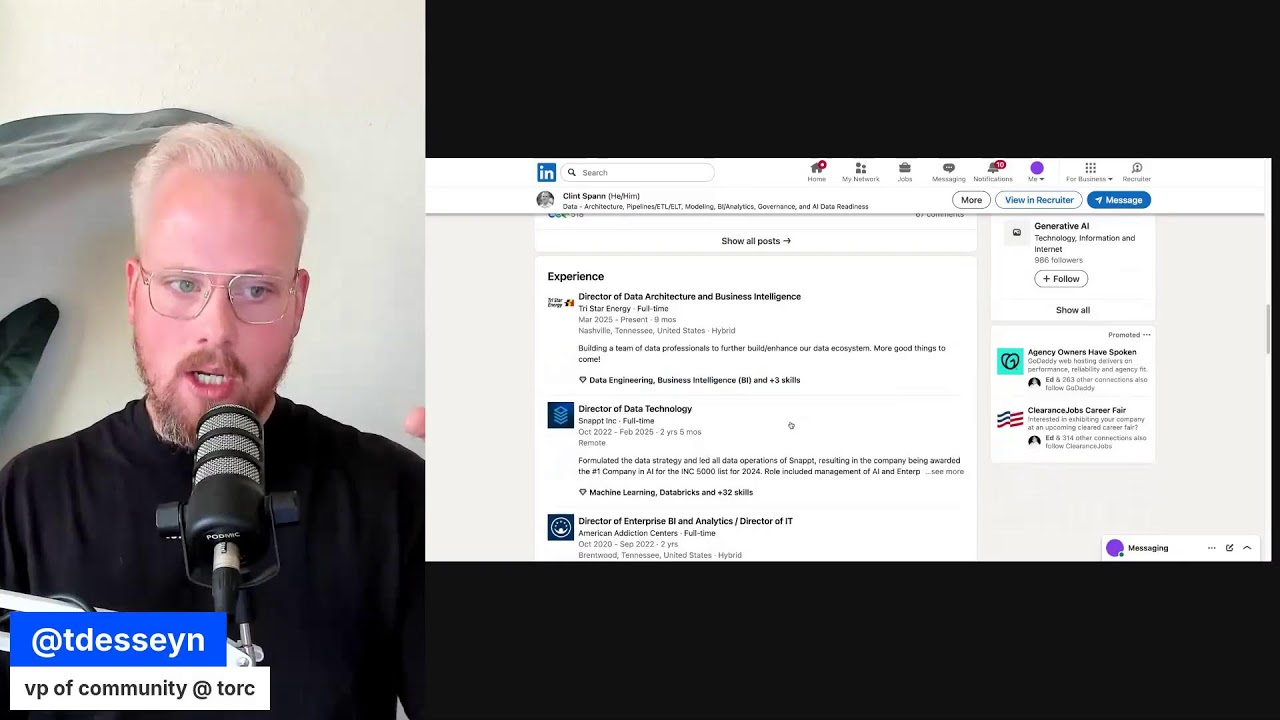
In this solo livestream, Taylor Desseyn walks viewers through a comprehensive, step‑by‑step guide to building an effective LinkedIn profile. He begins with a brief personal intro, explains the purpose of his Guidance Counselor 2.0 series and the upcoming Torque content catalog, then dives into each LinkedIn section: the banner (using personal‑professional branding), profile photo (professional credibility), the headline/title (keyword‑driven SEO for recruiter searches), the About section (front‑loading keywords and narrative pillars), the Experience section (high‑level bullet points, technologies used, senior vs junior detail), Activity (using posts and reposts to spark conversations), Licenses/Certifications/Volunteering (relative importance), and Recommendations (social proof, how to request, relevance of recency). Throughout, he offers concrete examples from a client named Clint, shares best‑practice tips, and answers live chat questions. The session ends with a recap, a reminder to watch his resume‑review video, and a preview of future Torque content on LinkedIn outreach.
Chapters
All righty. Good morning. Good morning. Hello. Hello. Hello. Welcome. Happy. Happy Tuesday, y'all. Got the candle going. I trimmed my wick, by the way. I trimmed my wick. Anybody's watching? Since I got yelled at about my wick usage yesterday, but happy Tuesday. Excited for this one. Gonna break down LinkedIn today. So if you are tuning in, please say hey. Would love to hear from you. Would love to see you again. You know, I I I tell people this. This is just a way for you to network with others, right? I mean, really, you know, doing these live shows. Um, it, it really allows you to get connected with others. So please say hey. There's no way, uh, that people know if you're watching unless you comment. So also let me know when you are, uh, let me know where you're streaming, where you're tuning in from. I always love— we had some people in like Africa tune in last week. Um, so definitely let me know. Uh, thank you, Jason. I appreciate it. Just, just Jason's here. I love it. Just Jason. You know what, Jason, I'll just talk to you. Um, and we can do that. So— oh, look, look, we got Ricardo! We got Ricardo! What's going on? Uh, you did, you did the right candle etiquette. Yeah, yeah, I almost bought another candle yesterday. I was at a shop. Not that y'all care, but we're just yapping as people tuning in. But I almost bought another. I, I, I, I have, I have a major candle problem. I'm a big fall scent guy. I'm not a big let's burn candles in the summer, um, but man, once, once that once there's a tinge, a tinge of, uh, uh, of, of coolness in the air, fall candles come out immediately. Uh, but again, good morning, y'all. Doing these solo shows, if you are tuning in or you're coming across LinkedIn, you're like, what is this thing? Um, basically, I've been doing Guidance Counselor 2.0 for 5 years now, almost 6 years. In 2020 is when I started this, and I started this show back in COVID when I was, when I was heads down recruiting engineering talent day in, day out. Um, and, and I realized that the market was shifting, right? So a little bit about me real quick is, is I was recruiting in Nashville specifically. Um, I was recruiting all types of engineers in Nashville. Um, and then when COVID hit, I saw the writing on the wall that, that, that essentially the engineering industry was going to change forever, and that is going to be a more global workforce. And so I was like, hey, a lot of the conversations I'm having with local Nashville talent is pretty applicable to the globe. So I was like, I need to just start yapping. And so I started to do the show. I got on LinkedIn Live super early. You actually had to apply to get LinkedIn Live when it first came out. So I got on it early and I really been doing it ever since. And so, you know, it started with just me, myself, and I, and then it kind of morphed into me interviewing people on the show. Um, and then, you know, you know, some people asked me yesterday, you know, over the last 24 hours, like, why are you going back to just doing you? Um, admittedly, admittedly, I've just been so busy I haven't done a great job of like reaching out to people to come on. Um, but it also just kind of coincides too. Um, you know, one of the things that we want to do at Torque is, is really provide a catalog of content, you could say, um, to really allow you to navigate the job search easier and more effectively. And so I'm really just going to take this time over the next 2 months before my baby gets here. Baby number 3 is going to get here at the end of December, so super pumped about that. So, you know, my goal is, is really from now until baby gets here is to do a lot more solo shows and really just walk through the job search, right? You know, I did a quick call with the director of engineering yesterday and And we kind of went over some stuff and he was like, man, like this type of stuff, like, you, you, nobody, nobody talks about. And so that was again really a reinforcement to me personally to keep doing these lives just myself for right now and really walk through the job search. So hopefully by the time Christmas gets here, my third, third kid gets here, um, you, we, we will have developed a catalog and we're gonna host this stuff on the platform, the Torque platform, once it's live. Which should be very soon. But my goal is, is for you to be able to watch these videos and be able to navigate the job search, um, uh, on your own with these videos. And so that's kind of the reason why I'm doing these solo shows. But again, keep continuing to let me know if you're tuning in. Um, would love to see y'all. We do got some people here. Mark, it's good to see you. I love it. Ryan, it's good to see you. Sally, Taran, it's great to see you, brother. Danny, it's good to see you. And just always wonderful to see you, man. Um, so, all right, well, let's go ahead and get started. Um, and, and I'm talking about LinkedIn today, right? So, um, let me, let me pull up— I need to find, I need to find— so I actually helped this guy specifically write his LinkedIn. Um, and, uh, I want to go ahead and share it with y'all this morning. Let's go ahead and dive in on how you write a good LinkedIn. Also, Lawrence, it's good to see you, brother. Um, so, uh, again, if you have any questions, please ask them in the chat. I will get to them. Um, again, please keep saying hey. Would love to hear from you. Let me pull up Clint. All right, so let's see here. So y'all can see this, I'm gonna work on— oh no, hold on. There we go. I like this. This is better. I like this. All right, now can you see that? That's really small. Here we go. Hold on. All right, so can y'all, can y'all see that? Uh, let's go in a little bit more. Oh, okay. All right. All right, so Clint is up here, right? All right, so, uh, LinkedIn lags so far behind the Twitter stream. Yeah, yeah, yeah, it's, it's, it's really bad. I feel like LinkedIn's kind of gotten worse. Anybody from LinkedIn product streaming with that watches us now in the future, please fix your streaming. Fix your streaming, please. Um, because I honestly love streaming on LinkedIn, but dadgum, I keep hearing complaints about it. All right, so Uh, let's, let's go over Clint. So, uh, I worked with Clint specifically. Um, Clint does not know I'm sharing this, um, but Clint's a great guy. So if you're in the data space, highly recommend reaching out to Clint. He's great. He's probably gonna get a flood of DMs and be like, uh, uh, why are people reaching out to me? Um, so if you want to reach out to Clint, um, tell him I sent you. He is a great, great dude. Uh, can we do Tago on the solo show? Sure, Emre. What— do it, do whatever your heart desires, man. And because of baby 3, you're gonna get a Torque onesie. Uh, sure. Yeah, we, we, we need a Torque onesie. That'll be great. That'll be great. I'll, I'll get Brianna on that. Um, all right, so let's talk about, let's talk about this banner section thing, right? I think it's fascinating that LinkedIn allows you to customize a banner up here at the very top of your LinkedIn. I think it's a, I think it's a very interesting tactic, right? And so for me, you know, one of the things that I would say is, is I would really use this as a way to draw people in to who you are, right? I would, I would actually use this as a way to tie in your personal and professional together. And I told Clint this, and I, and Clint, Clint got a job after we did our, the LinkedIn review. I don't know if he specifically got the job because of the banner. I do know that I've had somebody in my past, um, I did his LinkedIn years ago and he reached out to me and he was like, you know, we, we were doing our session together and, and, and I was like, well, man, tell me about yourself. He's like, well, I, he goes, I'm an audio engineer. He goes, I recently did He goes, I recently did a concert for Backstreet Boys. Like, I did like the audio engineering for Backstreet Boys. And I was like, man, like, that's really cool. I said, you should put that at the banner at the top of your LinkedIn profile. And he goes, really? I said, yeah, because you have to understand something. Like, in the sea of the AI world we're in, and I talked about resumes yesterday on my livestream, so go check out on the Torque YouTube. I went over how to write a resume. But what I talked about is adding a hobby section on your resume now. I used to be against it, but now in the sea of AI resumes and just the slop that's out there, allowing people to connect with you on a more personal level and making you look more human, I think, is incredibly important and will continue to be so moving forward. And so I really think that using the banner portion of your LinkedIn, the top portion of your LinkedIn, and allow to pull in some of your professional life into your Your no, your personal life and your professional life is huge, right? So Clint, Clint loves the outdoors. Clint has invited me to hike a few times. I am not a, I'm not a, I'm not an outdoorsman. Like I told Clint, Clint, I love you as a person. You will never find me outside hiking. So but Clint loves the outdoors. He loves the outdoors, right? So what Clint did is he goes, you know, he's a data outdoor enthusiast, right? One thing I would edit probably on Clint's profile. I don't know why. Clint, I love you. If you ever watch this, I don't know why Clint put the LinkedIn link of his LinkedIn because if you're on LinkedIn, like you don't need the link to LinkedIn. But like what I would put here is, is you know data outdoor enthusiast passionate about building blah blah blah blah blah right? I I would get rid of this LinkedIn link. But again, like you know if so if I hit so if if I'm an outdoor enthusiast like Clint is and I'm a recruiter or a hiring manager. Um, uh, you know, I, I'm immediately going to wanna talk to Clint, uh, about his outdoor, you know, adventures, right? Uh, I think it's a great way to draw people in, right? So whether you're like a former, uh, like, like a former chef, um, whether you're a, you're passionate about cooking, or like for me, it's like, you know, honestly, if, if I was on the job search again, I'd probably make it something around, um, Uh, I'd probably make it something around, uh, like, you know, college football or South Carolina football or ice hockey or being a dad and, and being a husband, right? Or, or owning, owning a miniature donkey, right? Again, drawing somebody into your profile, uh, is incredibly important. Um, so that's what I would do on the banner. So I know there is a lag, so let me know if you have any questions. I, I, uh, and I'm gonna move on. So the next thing I wanna go over is your profile picture, right? I, I think You have to understand something. Everything you put out online, everything that you post, every profile you have online is a potential data point for an employer, right? So if your profile picture is like a MySpace picture, it's probably not going to come across well, right? We don't need any bathroom selfies, right? We don't need, we don't need an artistic moody picture with a, with a bunch of gradient or editing. Right? Like, don't overcomplicate it. I, I think, I think, and this kind of went back to my resume conversation yesterday, too many people get too fancy when it comes to resume writing and LinkedIn writing. Again, it needs to be very simple, very straightforward, right? Like, like, the job search is not the time, unless you're in design or creative, is not a time for you to get fancy, right? So I like Clint's profile picture. He looks happy. He's smiling, he has a professional shirt on, great profile picture. I know who he is. I think also making sure you're not catfishing employees, right? There's like, there's no need to put a profile pic from, from something 15 years ago, right? Because what's going to happen is the last thing you want is like put up a profile picture from 15 years ago and then somebody gets on a Zoom call with you and you're like, this isn't the right person, right? It just comes across as a little weird. So make sure your profile picture is, is updated, accurate. Um, I think, you know, if you want to stand out, um, you know, maybe have a colorful shirt on with a plain background, or maybe an interesting background with a plain shirt. My wife's in photography. Natural lighting is huge, right? Make sure— again, I don't want to harp on this too much longer, but just make sure your profile picture is you. You look happy, you look presentable, because again if I've never spoken with Clint, my initial impression with Clint is, oh, he looks like a nice guy, right? So again, very, very important. Um, uh, next thing, moving on, right? I, I, I, I really want to take time to focus on this right here, right? Uh, so, um, the words under you— I'm trying to think for the people who listen to this from a podcast form perspective— the words under your name on the LinkedIn, right? I call it the title portion of your LinkedIn. I don't think there's any specific actual, um, uh, key— like a technical term for this. I call it the title portion. This is again the, the words that go under your name. This is incredibly important. The reason for that is when recruiters search for skills, the thing that pops up on the search is— are these words, right? So like for example, let's say I'm trying to find a .NET developer in Nashville, right? So I'm going to go to LinkedIn, I'm going to type in .NET developer, I'm going to go to people, um, and then I'm going to go to locations and I'm going to go to Nashville. And again, one of the lives I'm going to do here soon is really how you navigate— why, why isn't this working? Okay, that's not okay. All right, so let's just go, let's just, let's just do this, right? So if I search a .NET developer The title portion of your resume are these words right here. Spencer, CTO, AI Architect, .NET Developer, Microsoft MVP. I love that. Carlos, it just has a .NET Developer. For Carlos, I'd love to see Senior .NET Developer with Angular and AWS. Or same thing with Bill Wei right here, .NET Developer with something. You need to put the main skills you have and/or are targeting at the top. I like Tulasi's post here, .NET full-stack developer, C#, ASP.NET Core, MVC, Web API, .NET 8, Angular 16. I'd probably even shorten this up. There's no need to— I'd probably just put .NET developer and then put these because this shows me you're a full-stack developer. I think saying .NET full-stack developer and these skills are a little redundant. Again, like Naga right here, he just has full-stack developer. Right? I would love for you to be able to expound on this a little bit more. Recruiters aren't going to search through 40 pages of search content. They're just not. And so for me, if you can put the keywords that you're skilled with or want to be called for, um, you are, uh, they're, they're going for all the keyword searches. Yeah, yeah, no, 100%. All I'm saying is just get rid of the full stack, just keep all the technical terms, right? And so For me, I think it's incredibly like senior .NET developer at London Stock Exchange. I don't really necessarily care for like with Keerti. I can find out she's at London Stock Exchange when I click on her profile. I would want to know Keerti's main skills as a .NET developer up here, if that makes sense. Again, incredibly important part that nobody really talks about because again, Like, like you need to be able to get caught up, uh, because again, if I search .NET developer here, right, let's say I'm doing a global search, there's 100 pages of LinkedIn content or 100 pages of LinkedIn profiles. Recruiters and hiring managers do not have time to sift through all these pages. So what we're going to do is we're just going to look at your name and we're going to look at the title portion And we're going to look at your location, right? So again, incredibly important there. All right, let's, let's go back. Any questions, please ask. So like right here, right? So Clint Data, right? So, so if I'm searching him, he's got data architecture, ETL modeling, BI analytics governance, AI data readiness. I think all of those are very, very impactful, um, parts of data that he wants to get called For, for jobs, right? Which is incredibly important. Tomas, it's good to see you, brother. Good to see you this morning. All right, so moving on. Again, if you have any questions, please ask. We're trying to move through this as quick and efficiently as we can. So let's talk about the About section, right? I think the About section— I think there's 2 ways to, to, to view the About section, right? I will say this, you are not going to lose out on a job because of your About section. But I do think, going back to what Lawrence is saying, You want your LinkedIn to have a lot of keywords in your profile because that is what gets caught in the LinkedIn search algorithm, which bubbles you to the top of the search when I do a search like .NET developer, right? So now another thing to think about is a lot of people never click see more, right? So what I would do is I would play with the sentences, uh, that are visible Until you click the see more, right? So for Clint, he goes, I'm experienced executive and data leader with a proven track record of transforming data into business value, right? One of the things I would say is I still would like to see, without pressing see more, the technical skills that he has, uh, under his belt, right? So what I would say for Clint is, I'm an experienced executive and data leader with a proven track record of transforming data into business value using technologies like X, Y, and Z, right? Incredibly, incredibly important. Um, uh, and then, and then right here, so then we click see more. I do like what he has here, right? So he, he highlights his data experience, he highlights his systems integrations experience, and he highlights his global scalable infrastructure experience. I think that is an incredibly— and that is a great way to bring— and, and his leadership experience, right? So I think he hit his 4 pillars here, right? He, he is a leader, he's deep in data, he's deep in systems, and he's deep with global scalable infrastructure. And he highlighted those 4 key pillars in the about section, right? So with me, my 4 key pillars would be recruiting, community building, content creation, and marketing and brand awareness, right? And so that's what I would put. So if you're a Java developer who specializes in backend systems, cloud systems, and maybe some embedded, that's, that's where you put that on there, right? So you outline your embedded, you outline your cloud experience, you outline your Java experience. Or if you're a front-end developer, right, you outline your front-end experience, right, breaking down maybe your React experience or your Angular experience or your design experience, right? I love the way Clint broke down his 4 key pillars in the About section. Now, will I click on the See More? Probably not, right? But what he put in the About section is all of the technical jargon that is going to get caught up in the keyword search when recruiters are running searches in LinkedIn, which is incredibly important. We got some more people tuning in. Kelly, it's good to see you. Alex, good to see you. So let me know if you have any questions there. Again, the About section, not going to make or break you. I think, again, going back, I think the title portion of your resume is the most important part that no one talks about, but the About section is good as well, especially to get caught up in, uh, the keyword searches. All right, let's go into activity. Listen, I think posting— again, we're going to talk about— I'm going to do a session on posting Um, and curious what's visible above See More. Yeah, yeah. So to answer Lawrence's question, so if we refresh this page here, so this is the only thing that I see with See More, right? So what I would like to see from Clint is a little bit more technical, uh, jargon, or even just breaking down his 4 pillars in the About section. I think that's incredibly important. Um, uh, so let me know if that answers your question. Uh, um, Lawrence. All right, so moving into the activity section, I'm gonna have an entire session dedicated, um, to, uh, I have an entire session dedicated to posting. I'm not gonna get into posting on LinkedIn, but I will say this, being able to see people's posts is incredibly important, or what they engaged with, especially if you're trying to DM them. and, uh, engage with them, right? So if you're trying to get to Clint's DMs, right— and again, this is going to go on another show I'm going to do— but you see that Clint reposted about this post right here, you could, you could message Clint and be like, hey Clint, I saw you reposted this post about this. I find it super interesting. Would love to chat about this if you have a few minutes, right? Use this as a way to network with people. I think it's incredibly important. Um, and does what is shown. It may change based on device, but I think going back to Lawrence, the line, the About Me, that top part before the See More has to be perfect and value impacting. I totally agree with that. Incredibly, incredibly important. Um, all right, let's go to your experience portion. All right, so here's— there are some, there are some differencing of opinions on how you write a LinkedIn, right? Um, some, some, some of my, uh, opinions on writing a LinkedIn is I think a LinkedIn should be a summary of your resume It should, it should include, it should include like the really like key moments, right? Almost like an, almost like an expounded cover letter. I do see the argument of like, well, why don't I just put everything, right? I see both. I think for me, I think very rarely am I clicking through somebody's LinkedIn to really Uh, to, to really— like, I'm looking at their resume, if that makes sense. Like, I'm not— the, the, the purpose of a LinkedIn, you're not going to get hired off of a LinkedIn, right? So the purpose of the LinkedIn is, is to give enough to where the person goes, this person's got enough of what I need, I'm going to message Clint for his resume, right? So again, I do like the way Clint has written that his LinkedIn, he has, uh, he has Overall, his goal of what his role was at Snapt as a Director of Technology. He includes 3 main bullet points of what he did, and then the tech— again, he listed technologies used, right? Again, I talked about this in the resume review yesterday. Incredibly important to include as many technical skills as you can in your resume and your LinkedIn. Having a technologies used bullet point is incredibly important. I don't know if these bullet points— so, or, or if these— so, um, for the people who listen to this in the future, there's a part of your LinkedIn where you can like select skills to add to your profile. I don't know if those are searchable. I do know that the actual words you put in your profile are searchable. So that is something to keep in mind. If Clint, just like for example, Clint put you know, these, you know, data engineering, business intelligence under these like pre-automated skills that you could pick. I don't know if those are searchable. Only the things that he posts are searchable, right? So, uh, again, going down here with American Addiction Centers, right, you know, a few bullet points outlining what he did. Again, technologies used, incredibly important to get caught up. Again, the purpose of the LinkedIn, in my opinion, is to put enough content on here to where I go, oh, I like Clint's background, I'm going to message him to get his resume. Right now, if you are more junior in your career, as always with your resume and your LinkedIn, I would have as much as you feasibly can on your LinkedIn and your resume, right? If you are 0 years to about 3 years of experience, you need to put as much content on your resume and on your LinkedIn as you feasibly can. If you are director level, VP level like Clint, there's no need to expound on every, everything that you did at every job. 3 to 5 bullet points with each LinkedIn, I think makes a lot of sense. Make sure you include the technical skills to get caught up in the search engine. And that is how I would write the body of your LinkedIn. All right. Good morning, LinkedIn user. All right. So let me know if you have any questions there. We're gonna continue on here. Education important. Licenses and certifications important as well. Um, and then, I mean, all this stuff is fine, but it's not important to me, right? Like, I would say, like, if you have licenses or certifications, that should probably be in the About section or in the Title section, right? Like, this is— this, this area, and again, this is just me, this is just me, but basically anything under your work experience aside from recommendations is kind of— falls on deaf ears for me, right? Right? So like, I don't really look at licenses and certifications. I don't necessarily look at volunteering. Again, I would maybe put a hobbies or volunteering section on your resume because again, that's where the conversation happens. Skills, that's fine. I do have to say, I think recommendations are important. Now, for me, for me, recommendations are not a make it or break it. However, Again, I'm thinking of it from a recruiter perspective, right? If I don't— if I didn't know Clint, right? If I didn't know Clint and I was looking through his LinkedIn, I was like, man, Clint's pretty good. And then I go to— I go to his recommendations and see like Clint's got recommendations from a senior director of IT, a cybersecurity, and he's got 10 recommendations. I'd be like, all right, I think Clint's pretty good, right? And again, you're probably like, well, Taylor, that's dumb. On record, I— you can— I can ask anybody for recommendations, I know. But the thing is, is again, like I talk about this all the time, with your resume and your LinkedIn, narratives are created in seconds for the reader reading your, your profiles, right? So for me, yes, Clint could be a terrible person. He's not, he's not. He's a great dude. He could be a terrible person, but the fact of the matter is, is if I'm seeing his LinkedIn profile and he has Over 10 recommendations he's received. In my mind, that immediately signals to, ah, Clint must be a pretty, pretty good guy and pretty technical to allow people to write 10 recommendations for him. It— I always talk about recommendations are like going to a restaurant, right? When you go to a new restaurant, where do you go when you're looking to see if they're good? I go to Google Reviews. I just booked a hotel in Atlanta next week for our Torque All Hands. What did I do on this hotel? I literally went to the— I went to the reviews just to see what people are saying about it, and I booked the hotel because the reviews were good, right? So again, it's not, not a make it or break it, but again, it's helping craft that narrative in the person's brain who's reading your profile. Also, uh, it's very easy to ask for a recommendation, right? So we're gonna go to my profile. If you go down here, if you go to recommendations and you go to, uh, you go to ask for— you click the plus button and you do ask for a recommendation. Um, you know, I know Lawrence is on the call right now, so I'm gonna go to Lawrence, right? I'm gonna go to Lawrence Lockhart, right? And then I'm gonna continue. You select your relationship. I can just— I'm just selecting whatever, selecting whatever. And then you can tell the person what to write about. So for me, right, if Lawrence and I were working together, I'd probably message him like, hey Lawrence, can you talk about my leadership skills? Um, and just, you know, how I run the team, right? Or something like that. And again, what you do is when you send this, it pops up into the person's DMs in LinkedIn. They click on it, they open it up, and they can fill it out. Okay, any questions as we wrap up here? Any questions? All right, so Again, again, to recap, okay, I think the banner portion is incredibly important. It invites people in, gets to add some personality to a LinkedIn profile, which, let's face it, doesn't have a lot of personality. The title portion, the words under your name, you need to— you need to— this is like your SEO, I would say. You need to be able— you need to finagle this, see what works, see what doesn't. Mess with that a little bit. Make sure you have the skills you either want to obtain or have for the— for your next job. The About section, incredibly important. Make sure your first few sentences before you select See More are highly impactful, highly impactful, that make the person want to click into your— the rest of your About section. Make sure keywords are there to get caught up in the keyword search. Um, When it comes to writing your experience, if you're more senior in your career, you can give a little bit more of a high level, 3 to 5 bullet points of your main accomplishments. Make sure that you list technologies used again to get caught up in the search results. Again, for me, license certifications, volunteering skills, not a huge thing. I'm just gonna blow past this if I'm a recruiter. I'm gonna go directly to recommendations and see how much you have. That's going to allow me to create a narrative in my mind of who you are. So all that being said, let's see here. Okay. All right. Uh, I'm wrapping up here, so ask questions. How do you feel about adding recommendations ourselves from company internal feedback? Um, I don't know how you do that. Is that— can, can you even do that? I don't think you can even do that. Let me see. You cannot do that, Jeff. There's no way for you to manually add something yourself. So again, I would encourage you to get that person— just send them a recommendation and be like, hey, I know you said this internally, can you just throw it up in a LinkedIn recommendation real quick? It does not look like you can manually add recommendations yourself. Do LinkedIn recommendations from 15 years ago still hold water? David, I will tell you, if it's the recommendation you have? Probably not. If you have multiple recommendations and it dates back to 15 years, that's probably better. But let me ask you this, if you were to go to a restaurant and the only review that was there from a review 15 years ago is— are you gonna want to eat there? Probably not, right? And so again, do recommendations make or break your LinkedIn profile? No. No, it does not, but it just helps. It just helps. Uh, oh good, I didn't miss anything. Love you too, Jason. All right, cool, awesome. Any last questions before I wrap up? Again, uh, yesterday's live stream was, uh, how to write a resume. It's on the Torque YouTube, go check it out. Today we're doing LinkedIn. This is the last stream, uh, that I have this week. Um, and then next week we're going to continue on with the curriculum. Uh, next week we're probably going to start looking at outreach on how to use LinkedIn effectively to network, um, and DM people. Does it make sense to say intermediate software developer in a section under our name, or does it make sense to put the skill levels? You put senior in that section. I'm fine with intermediate software developer, but I would even, I would even focus, Demetrius, on, uh, intermediate .NET engineer, or I would— but also intermediate's very vague, right? Right? So what I would put is your years of experience, like 3+ year, and I would use the word .NET developer or Java developer or whatever your skill is. Intermediate software developer, I don't know what that is. Is it you Java, Python, front end, back? Like what do you do? Right? So for me, I think it's incredibly important to specifically, specifically say I'm a 3-year .NET developer with Angular, C#. Microsoft SQL Server. That is what I would do. Um, all right, let's see here. Gotta work on some recommendations. Yep. Um, let's see here. Intermediate adds nothing. Just say— I would say not even software engineer. Just give me like 3+ years of .NET with MVC, VS Code, whatever, right? Uh, I missed the first half. No, I did not review I'm— I, I did not review any resumes. I went over my friend Clint's LinkedIn, who I helped write, that I think is really, really good. Um, and Luca, yes, I gotta bounce on the call. I have a call right now, uh, with, uh, 2 people on my team, Team Lou. Um, so, all right, any last questions as, as I wrap up here? Any last questions on LinkedIn? I know there's a lag. Uh, again, this is the last live for this week. If you want to go check out my resume review, it's on the Torque YouTube. Go check that out. Um, then, uh, we will have this on the Torque YouTube as well for you to go back and reference. Um, cool. All right, no questions are coming in. Thank you guys for hanging out with me today. Appreciate it. Hopefully this helps. If you want to share this with somebody in your network, obviously would love the reshare. But again, y'all have a great week and we'll see y'all back next week. Y'all have a good one. Peace.
More from taylor



tech doesn’t have to be the only thing that brings us together #techcommunity #techcareer

I want to give back to y’all that make the tech community so great #jobsearchtips #techjobs




spend a little time investing in yourself #linkedin #linkedintips #careeradvice


