
Guidance Counselor 2.0 (Solo Show) + Interview Prep
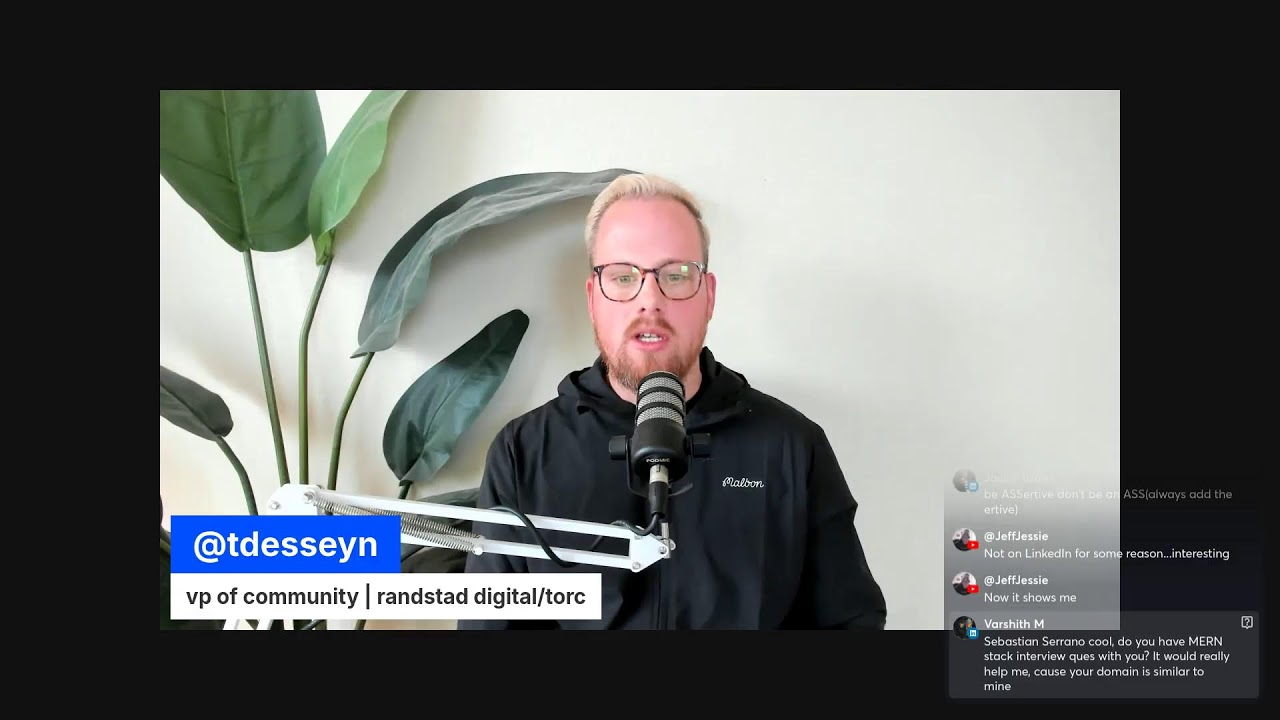
Taylor Dessein walks through interview prep as a consistency practice: research the company and interviewers, prepare a personal narrative tied to their mission, ask about why the role is open and the hiring timeline, use a notebook during the call, pause before answering, and follow up within 48 hours with a personalized LinkedIn note.
Chapters
All righty, good morning USA. I'm just kidding, anybody really. I mean, we get a lot of people all over the place. Um, good morning. I'm alerting the troops. I've had back-to-back meetings today, so I'm a little Not prepared for this. Give me a second. Alerting the troops. Good morning. Good morning. If you're tuning in, say hey. Would love to. Would love to hear from you. Good morning. Good morning. Good morning. Good morning. Let me drop in the disc in the Torque Discord. Good morning. Please say hey. Would love to hear from you. Good morning. All right, cool. All right, we're all right again. Been crazy morning of meetings. I've been on calls for the last two hours, so kind of coming in here a little a little unorganized here. All right, so back to just me. If you did not check out the episode yesterday with Emma, please do so. It was. Fantastic. We got into like a lot of life stuff, just about how hard life can be. And essentially, you know, that community is so important to have people. I don't know, it was just a great conversation. You know, again, I never do, you know, I never do questions for my guests because I always love where conversations kind of head. And for about 30 minutes of the conversation yesterday with Emma, it was really meaningful. We kind of got into just life. just doing life. And so, uh, if you, if you have not checked out, uh, check that out. Go check that out on the, um, Torque YouTubes. Um, but anyways, good morning, Taran. Good to see you, Lucas. Good to see you. Um, uh, so yeah, back with just me today. Gonna talk about interview prep 101, just some basic blocking and tackling stuff, right? I don't think anything I'm gonna say today is gonna be like just out of like, out of like you're gonna get something crazy. Um, out of it. But I do think it's really good to kind of go over blocking and tackling. You know, I was talking to somebody yesterday, um, uh, on a call and I said, I said, the problem is, so, so the job search and interviewing is a lot like, um, training. So, so the person I talked to was like a marathon runner. I was, I was catching up with him and, and, uh, he's a Java DevOps engineer. He's a marathon runner. And, and, uh, we, we, we were just chatting and, you know, and, and we kind of got into the fact that like a lot of the job search is just like, Doing the same thing over and over and over again. Not on LinkedIn for some reason. Interesting. Hold on, let me go to it. Taran's here. Taran's here. Let me see what we got going on here. What we got? It says I'm live. It says I'm live on LinkedIn. So anyways, yeah, Amelia, good to see you. Jeff, I think it's I think it's a user problem. Now it's good to see you. All right, so I was talking. I was talking to this guy. And we talked about the fact that finding a job and, and, and just going through the job search is, is, is a lot of the same things over and over again. And I think, I think as we have, we as people, I think struggle with doing the mundane over and over again. I know I do, right? Like, I have had problems like really getting up in the morning, right? And like getting up earlier before the kids and like I just, I haven't been doing that, right? And so like, listen, like I'm saying this for me, it's very difficult to do the same things over and over and over again. Prime example, I do this, this little behind the scenes update, um, that I send out to people in my texting community that want to join, um, and I do like a daily journal, right? I'm gonna be honest with you, I've slacked off. I've— life's gotten busy. been as consistent with it, right? So like, I think a lot of the job search is just being consistent. And so that is what, you know, again, I just want to start out by saying this morning is consistency is what we're going to talk about. Obviously kind of a few things. First off, I want to give a shout out to Appwrite, part of the Appwrite Heroes program. Go check them out, tell them the Torque Boys sent you. Also some community updates. Again, please go check out torque.community, um, our, our brand new webpage. Um, so a few things. One, Uh, December 5th, that is when Ambassador, uh, that's when Ambassador signups are gonna conclude. We're gonna close it up. Uh, we most likely will be not doing another Ambassador signup for the year, um, for 2026. So Torque Ambassadors, December 5th, that's it. All right. Um, at the time we've had about 76 people sign up. Um, uh, and I'm sure it's probably over 80 at this point. Um, uh, which is humbling. Again, we're not accepting everybody. Um, 2026 is about depth. 2025 was about width. We wanted to get the name out. We wanted to accept everybody. We wanted to get as many people into our circle as we feasibly can. 2026 is going to be about depth. And so, uh, again, we will not accept everybody. Um, uh, but again, please go sign up. Would love to have you. Um, also Mentor-Mentee program is going to close up December 5th, right? So we are finishing out, uh, the first cohort from 2025. Um, and, uh, we learned a lot. We're going to iterate on it again about depth. 2026 is going to be about depth. And so, uh, please go sign up if you are looking to be mentored by somebody. Go sign up on the Torque page. Or if you're a mentor, And you're a senior in your career and you want to mentor somebody, um, uh, my thing is, is like, hey, like, go sign up. We will give you the resources. We will match you with people. We will drive the conversation. You just need to show up. So please go sign up. Um, uh, let's see here. Uh, yeah, uh, Nick, my favorite analogy for the mundane task owner is what's the most exciting part of the plane flight? Taking off and landing. But Uh, but when do you make the most progress? When you're in the air. That's great, that's great. I love that, Nick. I appreciate that. Um, also listen, another thing too, uh, when I go live, text me, right? I text everybody, um, when I go live about certain topics or guests. So if you want to get a text, probably like once or twice a week, uh, text me. This is my number, um, and we'd love to have you. All right, so let's talk about some basic, basic building blocks of interviewing. First off, I want to say this. Just for the love of the Lord, research the company, right? Research the company. Now, I will tell you this, not only do you need to research the company, but I would also try to be prepared to tell somebody why you're excited about interviewing at that company, right? If, if somebody goes, hey, do you know what Torc does? Like, yeah, I know what Torc does. And you tell them, that's 60% of the way. But what I would love to see is, hey, here's what Torque does, but like, I'm so pumped about the potential working at Torque because I love your mission statement around community. Um, community has played such a huge role in my life around this, this, and that. If you can blend that together, that's a game changer, right? Because again, right now people want to hire people who are passionate about what they are doing, right? Another kind of unlock too Is I would go after industries you're passionate about. I think for me, I think if you're big on hiking, right, go apply to software companies in the nature space, right? I know AllTrails is one of them, right? With the map trails and stuff, right? If you apply to AllTrails and get an interview, they're like, hey, what do you know about AllTrails? Like, well, you guys do this and I'm super passionate about what you guys do because like I love nature. I hate nature. Right? Not a big outdoors guy. Not a big— the only time I'm outdoors is with my kids or playing golf. Um, and so, um, so again, uh, yeah, so try to tie that in when somebody goes, hey, what do you know about Torque? Tell them what you know, but then also tie in why you're passionate about potentially working for the opportunity. The next thing, research the people that you're interviewing with, right? Research the interview, research the people who you are interviewing with, right? Incredibly important. I would also— key thing we've talked about this year— tie in some of your background to the people you're interviewing with. Again, if you're interviewing with me and you see I went to South Carolina and you went to an SEC school, uh, bring that up. I will talk about football with you, right? I will talk about SEC, right? I was in the marching band, right? So again, research the person. Now you're probably wondering, Taylor, um, uh, you know, what if I don't know the person? Well, that is a problem. You need to know the person you're interviewing with. You should always know the person who you are interviewing with. Um, so those are the first 2 things: research the company, know the person you're working with walking into. I'll never forget, um, uh, when I was at Vaco and scaling up a team from just me to like 8 or 9 people. Um, I had a, uh, my, my first hire was a guy named Matt Driggers. Matt took his time to research about me, and the questions he asked are tremendous. Yes, Chris, I do live on a farm, and like I said, I am outdoors when I am on the farm, but I hate, I hate nature, right? So I feed the horses and then go back, back inside. Yeah. See, FSU, right? Again, right, common commonality, right? Also, Michael, I don't know how you feel about keeping Mike Norvell, but it is what it is. So bring some of that together, right? Research the company, but then also tell them why you are interested in the company. The next thing, research the people and come with questions. Going back to my comment about Matt Driggers, Matt walked into the interview with me and asked me some very poignant questions. questions. Hey Taylor, I've seen you've been at Vayco for 10 years now. What's made you stay there? What do you like about the culture? Hey Taylor, I see you went to the University of South Carolina and went to Nashville after that. How did you get up there? I still remember his questions 5 years— 5 years now. It's been like 5 years since I interviewed him. I still remember he's been the only person that I've interviewed that have really come with questions, right? It's been huge. Uh, how do you find out who is going to interview you? Never done this. So there's 2 ways, right? Typically, if you're interviewing with somebody, you either got there through a recruiter or you got there through your own accord. If you're— if a recruiter matched you to it, to an opportunity, you need to ask the recruiter Who the hiring manager is. They should always know that. If they do not know that, I would not take the interview. If a recruiter cannot tell you who the hiring manager is, I would absolutely not work with that recruiter. If you reached out to a company and they are interviewing you, you most likely are interviewing with the person you reached out to, so you should know the name. Or if in return— if an internal recruiter reached out to you, they will have that information. Always, always ask who you're interviewing for so you can prepare. The next thing when you walk in— so first rounds are typically tell me about yourself, which mind you was the live I did on Friday. Hey, tell me about yourself, right? What you need to focus on is you need some notes walking into that first round. I would absolutely ask whoever you're working with these few questions. One, why are you looking to hire this position? Did someone leave? Did is did did did uh is it a new headcount? Did you get budget? Is it growth? Did someone leave? Right, or or why else is this position open? Ask them that question. Hey, Mr. and Mrs. Manager, super pumped to talk with you tomorrow. Hey, real quick, why is this position open? Okay, next question I would ask them in that same DM is, hey, what are some things we're going to talk about tomorrow? Right? You need to know what you're walking into. You— again, if a company is interviewing you, they want to talk to you, so you need to use that to your advantage. You have a captive audience that if you ask questions, they will get them for you. So one of the things I would ask is, hey, Mr. Mrs. Manager, what are we going to talk about tomorrow? What's the goal? What's the goal? Right? That way you can frame your about me question, right? Hey, tell me about yourself. Well, that tell me about yourself question is gonna be a lot better to answer when you know what you're walking into, right? Another thing what I would do is is I would ask the person. Hey, realistically, how fast are you looking to move on this role? Right? Because you need to— you, you need to be able to have that mindset. If you message somebody and they're interviewing you and you ask them, why did a person leave? Or why is this position open? Is it growth? Did somebody leave? Number 2, what are we gonna be talking about? Number 3, I wanna know kind of the expectation or speed around hiring this role. If somebody goes, hey, we need, we need this role yesterday, that gives you the opportunity to be a little bit more aggressive on the call, be more straightforward, be more direct. Now, if they go, you know what, like with budgets and stuff, we probably aren't looking for this in the next month, that's okay. Still come to the interview prepared. But for me, I would, I would ask them that so you can get a mindset, a framework on how they're gonna operate. Because for me, a lot of us get in interviews and we don't ask that question of how fast they're looking to move, and then we wonder why they're kind of waffling. If you can get that information on the front end of how fast you're wanting to move, game changer. All right, so then the next thing, day of the interview, right? Day of the interview, you're walking in or you're, you're about to hop on a Zoom call. Uh, print out the worst Glassdoor and Blind reviews, ask them about this. All right. Listen, I'm gonna address this. This is a scary tactic, right? I would not ask the manager this stuff, Michael. I would not ask the manager. This could be off-putting. Now you're probably like, well, Taylor, it's public knowledge. I understand, but let me ask you this: if you went on a date with somebody and the moment you meet with them they start peppering you with some off-putting questions, how is that going to come across? Again, there's a lot of similarities between dating and the job search right now. I think these are questions to ask the recruiter, right? So if you're working through a recruiter— I've had people back when I was recruiting, I, I had multiple people asking me this. Hey Taylor, I know I'm interviewing for this role. I just did some research. What's up with these Glassdoors? Reviews. I will tell you this, a few things to look at with Glassdoor reviews. One, look at the dates. There's a lot of Glassdoor reviews that are old. Number 2, look who posted them, right? I'll never forget, I was hiring engineers for a, uh, hospital, um, a healthcare system. The Glassdoor ratings were awful, and the developer sent them to me. And I go and I look them up. I go, did you see these were from nurses, not developers? The 2 Glassdoor reviews from developers are good. That person did not see that. I'm fine with using these and keeping these in the back of your brain. What I would do if you really want— if you, if you want to ask the managers, I would work these into your questions that you prepare. Right? So instead of saying, "Hey, Mr. Manager, I saw on Glassdoor that you guys work a ton of hours," the better question would be, "Hey, what do you what do your working hours look like?" Right? Do you guys work weekends? Do you guys work after hours? Like what's kind of the culture? Use Glassdoor to craft your questions to the managers. Right? Uh, when you are walking in, AKA hopping on a Zoom call, I would have a cheat sheet. I would have a cheat sheet written down of some things you don't want to miss out on. I think a lot of times we get into interviews and we black out. I've done it before. And then you get done with the phone call or the interview and you're like, oh man, Man, I forgot to ask them this. Write it down. Write it down. Jot some notes down. When you get on the call, also let the person know that you have a notebook and you're going to be writing things down. Do not have— do not type on the screen. With the use of AI cheating tools and all this stuff right now, that is a red flag. If you get on a— if you— I would absolutely have something written down. Or something where you can write something down on next to you. And when you get on the interview with a hiring manager, like, hey, Mr. or Ms. Hiring Manager, I just want to let you know I have a, a notepad that I'm just going to be jotting down notes if I think of something, right? Incredibly important. Next thing I want to talk about, interview prep, or just interviews in general. You do not need to always answer the question immediately. Let me say that again. You do not always need to answer the question immediately. If you need to work something out, it's okay. I think a lot of us don't like silence, right? Silence is sometimes your best tactic because it gives you the chance to collect your thoughts. A lot of times when you go into interviews, you just start rambling, you just start talking because you're nervous. You want to fill the space. You're not going to get a second round interview by filling space. You're going to get a second round interview by being thoughtful in your responses. I'll never forget when I was interviewing with Torque, Mike Morris, the CEO, asked me, he was like, how would you build community in Australia? And I thought first, I was like, you know what, give me a second. And I was kind of like, all right. Thought, just thinking. That's uncomfortable. That's uncomfortable. And if you can get good at, hey, just give me a second, give me a second, give me a second, that is a powerful tool, right? So that's, that's one piece of advice. Don't always feel like you have to answer everything rapid fire, right? Um, yeah, say nothing. Yeah, again, that space. If somebody asks you a question and you don't know off the, off the bat, like, give space. Also too, talking over people is, is just not good. I have a tendency to talk over people. My wife reminds me that, uh, weekly, that I have a tendency to talk over people. One of the reasons why I would have a notebook is if you have a thought that pops into your head during an interview while the interviewer is talking, write it down. Write it down. Uh, I want to get some comments, questions here. Um, asking for clarity from Demetrius: are you saying to email them asking what will be— what we will talk about tomorrow if we're directly in touch with them on the invite? More often I've had recruiter coordinate. Yes. Okay, so again, there's kind of 2 different There's, there's, there's 2 different— there's 2 different angles we're taking here, right? If you're working with the recruiter, always go through the recruiter. You say it again: if you are working with the recruiter, always go through the recruiter. It is a no-no to go around the recruiter and go to the manager. It just is. It just is what it is. Um, so for here, if you are working with a recruiter on an opportunity, message the recruiter, hey, Mr., Mr. Recruiter, I would like to know an agenda of what we're talking about tomorrow. If they do not get that for you, that is a red flag. That is a red flag. So be able to have the comfortability to ask the recruiter that. If you are working directly with a manager, it is fine to ask them that. As well. Let's see here. Going through here. Going through the comments here. Silent feels so awkward. Yeah. Listen, as somebody who blabs as much as me, I'm trying to work on thinking before I speak. Trust me. Yeah. Again, I love this, right? Taking taking time and answering it actually shows you are a good thinker, right? People, one of the most consistent themes I've had on this show. When interviewing hiring managers is they want to know how people think, right? And if you take the time and pause and work out your thought, it really is a good, good opportunity to show that you can process things. Um, uh, let's see here. Yeah, give me a second. Yep. Um, let's see here. I'm interested to know what is written. It's just a bunch of random notes. Um, all right, so to recap, and again, I know Nas is out here saying it can be difficult. It can. I don't want to get too in the weeds here, right? That's why I want to go basic building blocks. Basic building blocks are know the people you're interviewing with, know the company you're interviewing for. Very simple. Ask for 3 questions. Why is this position open? What are we talking about tomorrow? And how quickly are you looking to move on this role? Okay, next thing, when you're walking into the interview, aka on a Zoom call, have notes in front of you prepared, especially to help answer the about me question as it relates to the interview that you're walking into, right? So if you got specifics that you guys are going to talk about tied into your about me statement Have the notebook. Tell the manager, hey, I have a notebook in front of me. I'm gonna be writing things down. Just wanna let you know I'm not distracted. Don't always feel like you have to talk. If you wanna pause, that works. I will also tell you this too. Most of the time, interviews are not long enough, right? And so I will tell you, a lot of your questions probably won't get answered, but keep them for the next round. Right. I would really get— so the first round interview is a lot of tell me about yourself, tell me about your background. But when it comes to next steps, drive next steps at the end of the conversation, right? Hey, Mr. and Mrs. Manager, it was great chatting with you. I really enjoyed this. Um, what do next steps look like? Now, for the most part, they said they will reach out to you. But what I would tell them is, okay, sounds great. Are you okay if I follow up in like 48 hours? Most of the time they're gonna say yes. Sometimes they're gonna say no, and that's okay. But most of the time they're gonna say yes. Um, and then, uh, the final thing that I would say and do is at the end of every interview, I would connect with the person you spoke to on LinkedIn and send them a personalized thank you note on LinkedIn. Right? I know back in the day we used to send thank you notes, right, by mail. That's not a thing anymore. I would, but I would send them a DM thanking them. And the reason for that is because you wanna stay top of mind, right? Hey, Mr. Mishman, it was great chatting with you. I love talking about this. Super pumped about, about our next steps. Um, if you wanna move forward, I will tell you this, being gracious, being kind, Being humble goes a long way in the job search. The first round interview is a way to set the tone in who you are as a person. So if you show up and you're grumpy— that's why I always tell people to take a time or two, take like a day or two before you start the job search and collect yourself, because people can feel it. I can't tell you the amount of recruiter screens I've done in my career where somebody just got laid off and they hate the world. I can feel it. So being kind will help guide you through the job search more than you know. I will tell you, I've been considered for a lot of roles just because I'm kind and I'm just, hey, if this works, great. If it doesn't, no worries, right? Um, uh, don't— so be assertive, don't be clingy, right? Hey, Mr. and Mrs. Manager, it was great chatting with you. Would love, would love to chat soon. Can I follow up with you in 48 hours? After you follow up with them, right, you don't want to come across as clingy. You don't want to be like, oh man, I really hope I get this role. I really like using these overarching terms. Be very clear, very concise, and just let them know like, hey, like again, even if it doesn't work out, we still love to stay in touch, right? Kind of this like, if, if you can play in the middle of, of wanting the role and not wanting the role, and that's a very fine line. to toe, that will also help as well, right? Because then people won't feel pressured, right? But I think your consistent follow-up will help move the needle and get you over the finish line. So that's all I got today. Again, I want to keep it simple. I know it's a lot of information to digest. If you go to the Torque YouTube, I've kind of broken down all of these things. And I know this can be a lot, but really, again, research the company, research the person, come prepared with notes. Have something written down. Ask them, ask them questions on why is this position open? How fast are you looking to move? And what are we gonna talk about tomorrow? As you wrap up the interview, ask them about follow-up. See if you can follow up with them. Send a thank you note on LinkedIn. It's that simple, folks. All right, cool. That's all I got. Appreciate y'all hanging out with me today. Uh, last one of the week. Thanksgiving's this week for folks in the US. Hope you have a wonderful Thanksgiving. Eat a lot. Um, spend time with friends and family. Hope it's great. Um, we are heading up to Bowling Green, um, uh, Kentucky for my parent— for my wife's side of the family. Um, so y'all have a good one. If you have any questions, please DM me. Um, yeah, just like Nick said, always be kind. You never know down the road. Absolutely. Um, DM me if you have any questions. Feel free to share this if this resonated with you for others in your network. And y'all have a good one. We'll see y'all soon. Peace.
More from taylor



tech doesn’t have to be the only thing that brings us together #techcommunity #techcareer

I want to give back to y’all that make the tech community so great #jobsearchtips #techjobs




spend a little time investing in yourself #linkedin #linkedintips #careeradvice


