
how content & community can impact your career - jsconfmx 2024
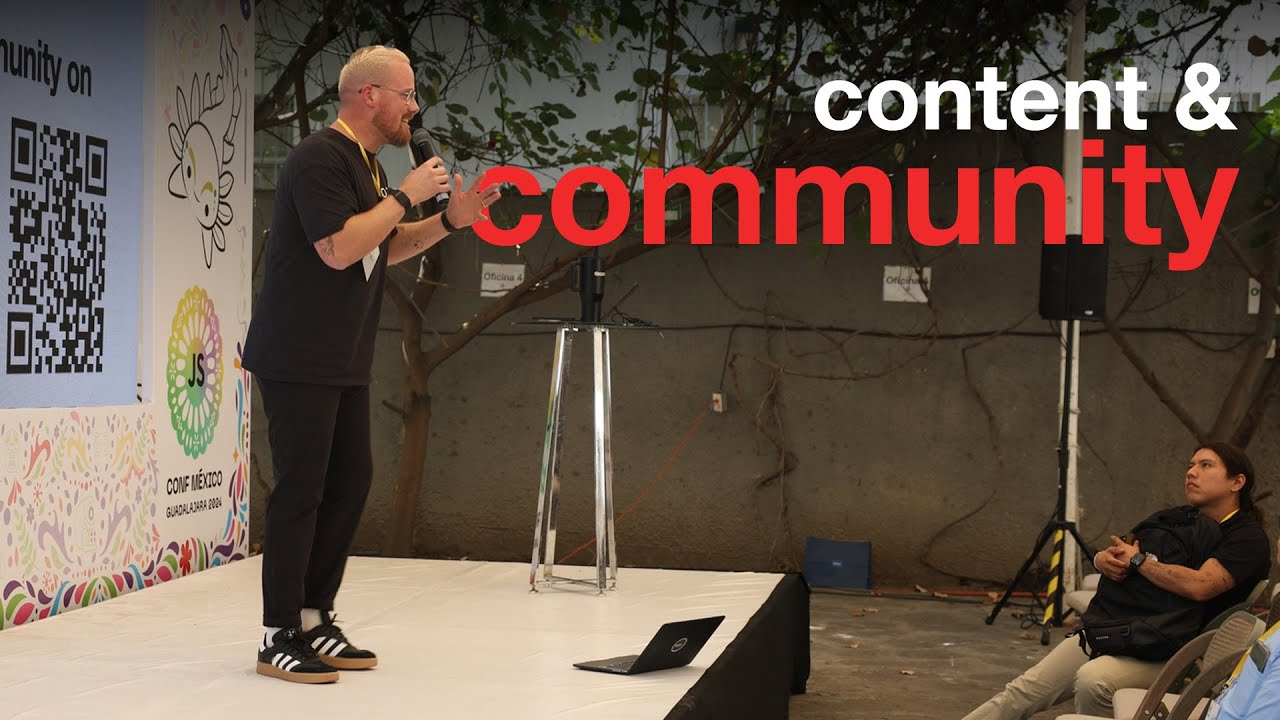
Taylor Desseyn, VP of Global Community at Torque, shares how building community and creating consistent LinkedIn content accelerated his career from recruiting to community leadership. He hired Jason Torres after following his LinkedIn journey and helped his non-tech dad get a restaurant job through networking. The key: attend meetups, post regularly, engage daily, and block calendar time for follow-ups.
Chapters
Awesome. Good afternoon. It's good to see you all. So this is my first time in Mexico, and this is obviously my first time in Guadalajara, and the people are amazing. You all are amazing. The food is amazing. The vibes are immaculate. And so I'm very blessed to be here. A little bit more about Torque. Obviously, a lot of you all came by our table. Thank you so much. We are out of— we have 2 XL shirts left. That's it. All the shirts are gone, so thank you again for everybody who came by. But I want to go over what Torque is again just for everybody who may not have come by our table yet. So Torque is a talent marketplace. So we help people get jobs. As plain and simple as that. Specifically, companies, US companies come to Torque to hire developers in Latin America and Mexico. So again, and we don't just do developers. We do project managers, business analysts, product designers, you name it. If you are in tech, in any way, shape, or form, I would love to have you on the platform. If you're like, well, Taylor, how do I get on the platform? Go ahead and scan this code. This code is the direct— I'll get out of the way. This code is the direct access to our platform. We will follow up with all of you after this conference today. We do a lot of virtual networking, so all the companies that come to us are fully remote. And so I'm really big on developing community at scale across the world. And so I've been talking to a lot of community leaders. I think there's a lot of stuff happening in December. So you may see us back down here in December, which I'm pretty pumped about. So we'd love to have you on the platform. Second off, again, a little bit about me is I have been recruiting engineers now for over 13 years. I was your typical recruiter and I moved into the growth community side of things. And then I was just recently hired on at Torc to be their VP of Global Community. So all the initiatives that our team is gonna do is to make sure you do not feel alone in the job search. That's incredibly important to me. The job search can be terrifying, the job search can be very lonely, and so my goal is to make sure that you feel comfortable throughout the job search and you have a lot of resources and that you have a home base. Like, what I want is I want Torque to be home for you, where you can learn from others. So we're about to roll out some ambassador programs and a lot of other initiatives to help you throughout the job search. So the talk I'm giving today is the power of community on your career. If you are here at this conference, you understand the importance of community because you are here. But I wanted to— my goal for you by the end of this talk is that you want to grow more community, to do more things in your area, because I would not be where I'm at today if it wasn't for my community. And so I first want to go ahead and give a background is that I moved to Nashville, Tennessee. Has anyone heard of Nashville, Tennessee? Country music? Yeah, yeah, yeah. So I moved to Nashville to do music. I'm a drummer, and I did— I drummed for a few months, and what I realized is that I needed to find a job, right? That there wasn't a long-term career in playing music. And so what did I do? I started to ask people that I knew in my network, who do you know, right? How can I find a job? Who do you know? Who is hiring? Right? And so there was this one girl that grew up in my hometown. We moved to Nashville together. There's a group of us that moved to Nashville, and she was like, well, I babysit for somebody. And I said, great. And they're looking for a recruiter. I said, great. That sounds— I don't know what a recruiter is, but sign me up. So I interviewed, and a few days later I got a job offer. Right? So that's one specific area of community, how that's helped me in my career. Another part is I started to recruit software developers. I started to recruit engineers. And over the course of a few years, I started to become friends. I started to listen. I started to go to conferences. I started to go to meetups. Who in here actively attends a meetup monthly? Right? A few of y'all. Right? I started to go to meetups. I didn't talk. Right? Most recruiters, if you know recruiters, we are annoying. Right? We like to annoy you. We have jobs, you know, please join us, and we try to sell you, and then we're just annoying, right? So I didn't do that. I kept my mouth shut. I listened. I observed. I tried to be in community with others. A lot of people thought I was a developer because I just kept my mouth shut. And so I carried that through my career, and then I started to throw meetups, right? Then I started to throw meetups in Nashville. I started to throw meetups across the country. Typically, as a recruiter, you cannot get out of the recruiting space, right? If you are a recruiter, it's very hard to transition It's a very— it's a siloed career, but my career took a drastic turn because of the community I built. We are not meant to go through the job search alone. We are not meant to go through life alone. We are not individuals— as individuals, we are not meant to go through life alone. And so I beg you to get involved in community. Now, Most of you are waiting for somebody else to start community. Right? I talk to so many engineers on a day-in, day-out basis and they're like, oh, well, I want to— I've always wanted to play basketball with developers. Or I've always wanted to play football, proper football, with developers. Right? But nobody starts. Everybody is scared. And I will tell you this. Coming to conferences like this, it can be obviously overwhelming. Like, listen, Taylor, I can't start anything like this. There's like 300 people. Are you kidding me? I'm not asking you to start this, right? I've had a lot of people come up to me in my career, they're like, Taylor, I can't do what you're doing. I can't do, you know, a virtual meetup. I can't grow a Discord channel. I can't grow a Slack channel. And I'm like, listen, do you have 5 friends in tech? Actually, better yet, do you have 2 friends in tech. Everybody's got at least 2 friends, right? I hope. And so my thing is, is invite those people to do something you love. I think the hardest part about community is people think you have to build community around technical aspects of your career. While that is important, and I think coming to conferences like this and learning about community and learning about technical topics from others is incredibly important, but I want to encourage you If you have a favorite soccer team, if you have a favorite basketball team, if you have a favorite restaurant and you just want an excuse to go eat with your friends, start inviting people to that, right? I started a dad group. I have a Dads in Tech group where I have a virtual meetup once a month of dads and we just come together and talk about being dads. That doesn't have to do with tech. We never talk about tech. But the fact of the matter is, is now we have over 50 dads from all across the world and I would love any dads in here, I would love to have you. We have over 50 dads every month that show up to this meetup, and I had dads message me after the first virtual meetup and said they were in tears afterwards. They were crying because they did not realize how much they needed this community in their lives. So my goal for you is to get off the sideline, right? You sitting on the sideline and waiting for somebody else to start a meetup. to start a group like this is not gonna happen. You have to be the catalyst. Another thing I wanna talk about today is the power of content, right? So how, in terms of posts on LinkedIn, in terms of using LinkedIn, it's an incredibly important tool. It is the, let me kind of, this is incredibly important here, don't miss this. If LinkedIn is the only tool right now, is the only platform where you can message any hiring manager at any company that you've ever wanted to work for and potentially start a conversation today. Let me say that again. You could message any company that you've ever wanted to work for— Google, Zillow, you know, Amazon, whatever— you can message a hiring manager today and strike up a conversation, and I still feel like none of us are truly utilizing LinkedIn the way it needs to be utilized. Right now, I've talked with a lot of people, especially engineers, like, Taylor, I don't want to be a content creator, right? You see a lot of these DevRel individuals out here that are creating a ton of content. It's very hard, trust me. But all I'm asking you to is to document what you learn, right? So for example, yesterday or even today, what I would do is I would make a post on LinkedIn talking about what you are learning at this conference. That's it, right? A lot of people ask me like, Taylor, I don't know what to post. I never know what to post. Do I post You know, do I post a technical thing? Do I post like, what do I post? All you have to do is document your journey. That's all you have to do because here's the deal, people are naturally nosy. People naturally are interested in what you are doing. There are so many people that I have rooted for online. Prime example, I hired this one guy, his name is Jason Torres. Jason's on Twitter. He's constantly on Twitter, right? And I've been watching him from afar. He transitioned from being in the movie industry. He was— he worked on, you know, did some video work, and he was transitioning to the tech industry. He was trying to find his first job in tech. And so basically, I watched his journey. I became fascinated with his journey because he just talked about the people he was meeting, the technologies he was learning, the events he was going to. I eventually got into a role, the role I'm at now, and I saw the work that he had done over the course of 6 months to a year because he posted about it. He posted on Twitter, he posted on LinkedIn, right? Hey, I learned React today. It was very difficult. Hey, I learned Java today. I had a really tough time, but here's what I learned from it, right? He talked about organizing meetups. And I watched him from afar, and now he is on my team. I hired him because of the things he was putting out online. So it's incredibly important to put yourself out there because what happens is, and this is one of my notes here, consistent content creates consistent community, which then leads to careers. Right, prime example, I have never found a job Through submitting my resume online. Never. Why? Because I've built relationships. In today's job world, it is very difficult to find a job, if you have not noticed. It is very difficult. The market is not great. And so unfortunately, as we as human beings, we basically confuse activity with productivity. Right? We're out here submitting hundreds of resumes online. We're submitting, yeah, not even hundreds, thousands, right? I literally saw somebody on LinkedIn the other day say, I posted, I submitted 5,000 resumes on LinkedIn, or on, I submitted 5,000 resumes across job boards and it hasn't worked. And in my mind I'm like, you could have stopped after 1,000, right? And so the, so what I, what I beg of you is to build relationships in person. Build relationships. Here at this conference is where you could potentially meet your next hiring manager, right? I would go to every single booth, every single booth, and make sure you shake hands with everybody. If you have not shaken hands with me, please shake hands with me, right? Because what happens is, is one conversation today could lead to a LinkedIn comment in 6 months, which could lead to a LinkedIn DM in 9 months, Which then could lead to you being hired by that person in a year. That is how this works. But the fact of the matter is, if you are not putting yourself online for others to find you, you're never gonna be found. Now, you're probably like, well, Taylor, this isn't fair. I don't— this isn't fair. 'Cause I've had a lot of people come to me like, this is gamesmanship, right? I have to play the game. And it's like, well, I'm sorry, this is just the way it is. But also too, yes, yes, you have to be discoverable in today's market to be able to land a job. And so again, post just once a day, once every other day on LinkedIn about what you are learning. Another thing I talk about too with creating content is creating content is essentially interviewing your first-round interview at scale. Okay, let me say that again. Creating content is essentially you interviewing for the first time with a hiring manager across the internet, right? Because what that— what it does is I already knew, going back to my Jason story, I already knew Jason, right? Why? Because I followed Jason. I followed what he did. I followed his learnings. I already knew what I was getting when I interviewed him. So then we jumped immediately into, okay, here's what I'm doing, do you think you can help? Boom, hired. He actually, in true honesty, he didn't even interview with me. I literally called him up and I go, hey, I wanna hire you. He goes, okay, tell me about the job. And I told him about the job. He says, okay, accept. Because I've been following him, right? Another thing about creating content and the power of community is you will find your tribe. You will find your friends. If you just post about AWS, other people who like AWS will find you. If you just post about Java, other people who do Java will find you, right? For me, I started posting about job search content. Guess who found me? Everybody. 'Cause everybody needs job search content, right? And so what I encourage you today is for you to level up your career. You, I truly believe that Everybody in here is 90 posts, 9-0, 90 posts away on LinkedIn consecutively from something amazing happening in their career. I firmly believe it. I would not be where I'm at today if it wasn't for the community of the engineers that I've become friends with, right? Most of my team, a prime example, if you go meet Brianna, anybody's met Brianna at the table? Brianna, she runs a massive conference called Render ATL, right? I interviewed Justin, who runs Render ATL, on my podcast, right? I became friends with Justin. Justin then invited me to become an ambassador for Render ATL in their second year, right? By the way, check out Render ATL. They're not paying me to say this. I think it's a great conference. So after the second year, I became really good friends— after the first year I was there, I became really good friends with Brianna. Brianna and I stayed in touch. I then became a host of Render ATL the 3rd year, okay? Then she invited me back to become host for the 4th year. Guess who I just hired? Brianna. Brianna. For this role. Do you see how this all works? Do you see how one conversation could lead to an amazing part of your career. But the problem is, is most of us again just sit here, go through the motions, right? And listen, I get it. It is hard to network. It is hard to put yourself out there. I'm an introvert, right? This is exhausting to me, right? Shaking everyone's hands, it's exhausting. I'm tired, right? I wanna go to bed, right? And so, but the fact of the matter is, is I consistently show up and put myself out there and amazing things have come and happened to me. And the problem is, is that most of us are just very comfortable sitting here, not talking to anybody, taking some notes of what we're learning, and then leaving. And then we wonder why opportunities don't happen, right? You have to have activity right now in this market. Again, this market is very difficult, and I'm trying to give you the tools to basically level up your career. I think it's incredibly important right now. Another thing too, when it comes to creating community, is that you really need to make sure that you stay in touch with people. How many— like, I would basically stop your— I would block out the next week on your calendar if you can, and I'd try to follow up with everybody you met here. Because 90 to 95% of you will leave this conference and never speak to anybody who you met with here again. When in actuality, the follow-up of conferences are even more important than the actual conference. I can go around meeting all 300 people that are here this afternoon. I could shake every one of your hands, but if I don't follow up with you afterwards, what good is that going to do? Nothing. What good is that going to do? Absolutely nothing. And so again, I encourage you to make sure that you are connecting with people and inviting people out. If you are local to Guadalajara and you meet other individuals here local, go ask them to coffee, go ask them to lunch. I can't tell you the amount of community builders I've met like over the last 24 hours. Amazing community builders, amazing. And guess what? I'm gonna try to talk to every single person I met. I'm gonna try. We'll figure it out. I don't know how I'm gonna do it, but I'm gonna try. Because that is where community happens, right? Another thing too, we talk about building community like, well Taylor, this all sounds great, this sounds exhausting, right? I don't know if I can have conversations. Another important thing on LinkedIn is you can literally just engage with people's posts on LinkedIn. I can't tell you the amount of friends that I have made Because I've just consistently engaged with them on LinkedIn, right? I've liked a post, I've said LOL, I've said great job, right? And it's the consistency of that that builds on itself. I think a lot of us as individuals, I think again, we mistake activity for productivity. When we go to conferences, we shake a lot of hands. We shake a lot of hands. Shaking hands at a conference and introducing yourself is the same thing as liking and commenting on LinkedIn. It's the exact same thing, right? When you meet somebody here, you're like, hey, what's your name? Here's my name. What do you do? Here's what I do. Let's stay in touch. Sounds good. You move on, right? That's pretty much how it goes. That's the exact same transaction that can happen on LinkedIn, and you could be in the comforts of your own home. Again, like I said, I'm an introvert. I like to sit at my house with my family by myself, right? Giggles. I feel like I'm resonating. We got some giggles up here. I feel like I'm resonating with some people here, right? And I will tell you this, I'm very proud of myself and the community I've built from the comforts of my own home. But it's the consistency of it. I had an engineering manager or CTO rather, of a React Native startup consultancy post. He goes, I want to get better at LinkedIn, but I don't know how to. I want to start posting more, but I do not know how to. You know what I told him? I said, go on your phone and delete every other social media app off your phone but LinkedIn. Because what happens is you start changing your behavior Right? You're like going to the bathroom, right? You pull up LinkedIn, right? You don't pull up TikTok, you pull up LinkedIn, or you don't pull up Instagram, you pull up LinkedIn. You don't pull up Facebook, you pull up LinkedIn, right? And it's the constant engaging of individuals that will happen. I promise you it works. I don't know how, right? But human psyche is, is if you like my post enough and then you need my help for something, I am going to help you because you have engaged with my content. You have been interested in my content, right? So as we wrap up here for the next, for the next, you know, 5 minutes or so, I want to kind of get into some tactical things around some content community real quick. So if you're taking notes about like how to practically get started, here's a few notes. First off, for content, pick a topic or a few topics you are passionate about. So if you love Bitcoin, post about Bitcoin. If you love Java, post about Java, right? Stay consistent with it. Number 2, make time on your calendar. I don't know about you, but if, but if it's not on the calendar, for me it's not getting done, right? If it's not on my calendar, it's not The biggest issue when I talk to people, they're like, I don't have time to post. You do. You do. You just haven't set the appropriate action behind how to do it, right? So block 10 minutes, 15 minutes, 30 minutes on your calendar every day, post on LinkedIn. Next thing, let's see here, if you can talk specifically about any client work you're doing, obviously not naming names, huge opportunity. And also too, you get— try to get comfortable with filming yourself. Video, right? Face, open up your phone, talk about what you're doing, post about it. Video content goes a long way, but that's kind of a 201 class, not a 101 class. But stay consistent with writing. But if you are interested in creating video content, I would highly recommend it, especially in today's market. Again, from a community perspective, stop sitting on the sidelines for someone else to start something. Stop sitting. If you are passionate about the smallest things, just start inviting people, right? There's— there are obviously— there's a lot of online communities out there. Go get involved. Open source communities. Just get involved, right? If you're sitting here and you're not involved, my challenge to you, if you remember anything from my talk, is I want you to force yourself to get involved in some sort of monthly community in the next 30 days. Challenge yourself, whether it's technical or not, just challenge yourself. Be in community with others. Again, it can start with 2 people. That's all you need, right? I started— I know a lot of conferences. I had the opportunity to speak at another conference recently in in Florida called Thrive Tech Conference, right? Thrive Tech Conference, you know how the conference started? By 10 people hopping on a Zoom call 3 years ago, 4 years ago, and now there's like 500 people at the conference. And all it took was one Zoom call with a handful of people jumping on and then staying consistent with it. Another thing with community, consistency is everything. Consistency is everything. If you are not consistently doing something monthly with what either you're doing or getting involved somewhere, you're gonna miss out. That action is one of the hardest things for creating community, right? Doing conferences like this, they need to do it consistently, right? If you do it for 3 months and fall off, and you message me and you're like, well, I did it for 3 months and it didn't work. Well, I'll tell you, you probably did it for about 2 to 3 years less than you should have. Right? So again, stay consistent. So as we wrap up here, I want to leave you with a story that I tell all the time because it just shows the power of community and the power of reaching out on LinkedIn and the power of networking with people. So my dad went through the job search change recently. He's not in tech at all. He owns a restaurant. And after 25 years, he left that restaurant. And essentially, he called me and he goes, Taylor, I want to find a job, but I don't know how to find a job. And I said, okay. He goes, Taylor, the last time I was on the job search, the internet did not exist. Right? And I was like, well, Dad, you're really old. And so basically he was like, well, what do I do? And I said, give me a day and let me kind of think about it. So I talked to my wife and I was like, how do I communicate to my dad basically how to find a job and try to meet people? She was like, Just challenge him, you know, like with activities that you did as a recruiter, but like make it simpler. So I called my dad up and I said, Dad, I said, my challenge to you, this is a challenge to everybody in here too, is try to meet with one person a day in your network. And my dad's like, well, what's my network? And I said, your network is people on your phone, your network is people on your LinkedIn. My dad has a LinkedIn, I made him get a LinkedIn. I said, that's your network. Literally just open up your LinkedIn, open up your phone, and start reaching out to people. So my dad said, okay, I'll do it. So my dad started to do lunches and coffees, and he would call me after them, and he'd be like, hey Taylor, I may have an opportunity. I said, that's great. Then I would ask him where it went. He goes, it didn't go anywhere. I said, that's okay. Again, most opportunities, most job opportunities that you find may not go anywhere. 99% of them don't, but that 1% is the career opportunity that changes your career. And so my dad again kept messaging me, kept messaging me. He was like, he was like, hey, I think I'm on to something. I said, yeah, I think you are too. And then he calls me up one day, he goes, Taylor, I found a job. And I was like, no way. I said, how did you do it? He goes, I messaged somebody on LinkedIn that I worked with 10 years ago. 10 years ago, and I said, hey, I said, I'm looking for a job, didn't know if you were hiring, it's been a long time, would love to talk with you. That guy eventually became his boss, and my dad is still at that restaurant 7 years later. So if my dad, who is not in tech, can find a job on LinkedIn, none of us have an excuse. That's right. None of us. But the fact of the matter is, is my dad did the work. My dad had the coffees, had the lunches. He checked in with people. How are you doing? Let's talk. Again, creating community is not easy, but it's absolutely worth it. So again, thank you all for listening to me over the last few minutes. I appreciate it. Hopefully this empowers you to not sit on the sideline. And thank you so much. I appreciate it. Thank you.
More from taylor



tech doesn’t have to be the only thing that brings us together #techcommunity #techcareer

I want to give back to y’all that make the tech community so great #jobsearchtips #techjobs




spend a little time investing in yourself #linkedin #linkedintips #careeradvice


