
How to Build Healthy Developer Culture w/Matt Stauffer, CEO of Tighten
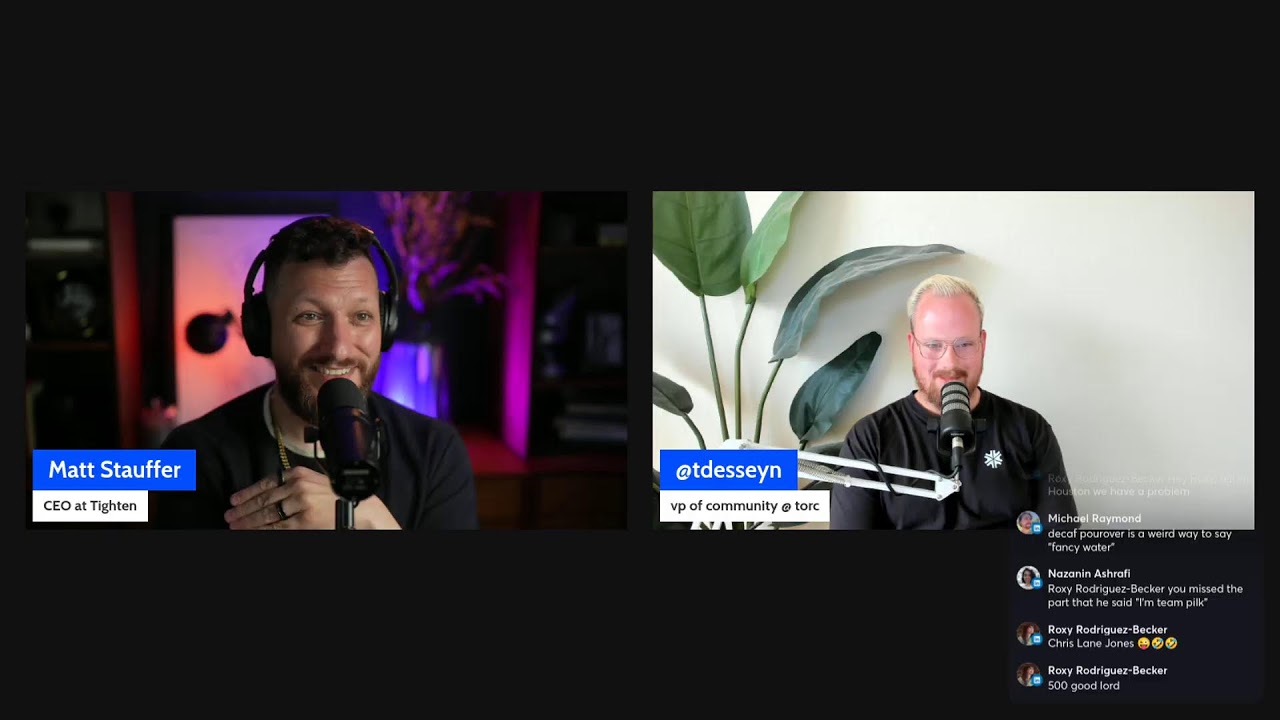
Matt Stauffer, CEO of Tighten, talks about building developer culture through empathy, hiring practices, and work-life balance. He covers manager tactics like tracking hours, sharing company finances transparently, and when to scale teams. Stauffer draws on his experience running Tighten to show what actually works.
Chapters
All righty, good morning everybody.
Good morning.
I say everybody, I mean nobody. Um, let's see here. You know, Matt, I always ask folks— I usually save this question at the end, but I gotta ask now— are you— do we do coffee? Are you a coffee guy?
My coffee unfortunately is empty. Uh, I'm a coffee nerd. I have ADHD, and I was informed by my my diagnosed as an adult, and I was informed that I'd been using coffee to self-medicate prior to getting stimulants. But but in order to be able to take ADHD meds, I had to switch to decaf because otherwise it was too much.
Okay, so you're all decaf.
I've mastered the art of an actual tasty decaf that doesn't.
It's not bad. It's really. It's so I went through you know a few few like I've dealt with a lot of anxiety. I mean, we're just jumping right into it this morning.
Yeah, let's go. I mean, I've I've dealt with a lot of anxiety.
anxiety and, and stuff. And so I did a— I, I hired a nutritionist like a few years back, and we were kind of like, you know, we're almost basically doing elimination diet where she was like, let's get rid of caffeine, let's get rid of gluten. And so I was on the decaf kick for a very long time. Um, yeah. And I found some great beans. Um, shout out Methodical Coffee in Greenville.
Okay.
Yeah, Methodical Coffee in Greenville has great decaf beans, great beans in general, but great decaf beans. And also Crema. up here in Nashville has fantastic, fantastic decaffeines. My wife can't do— my wife got off of caffeine. She can do matcha, but she can't really do like caffeine. She has like a sip of my— so I'm back on caffeine though now. So what we realized, what we narrowed it down to, is we narrowed it down to it's gluten. So gluten for me, like, like if I, if I have gluten consistently over time, um, Uh, I get really angry. Like, it's, it's the weirdest thing. Like, I get super anxious. I'm really short-tempered. Um, and so, uh, so yeah, it's an irritant, right?
You're just like, I'm irritated all the time. Yeah, it's crazy.
And then my wife being pregnant, you know, she's cheated a little bit on gluten. It gets her like massive migraines. Isn't that crazy? So, uh, but yeah, decaf is not bad. Do you— so I just make iced coffee. Like, I brew coffee at night and put in the refrigerator. Are you like, do you do espresso? Like, what's kind of—
I'm doing— my main one is a V60 pour-over. So if for anyone who's not familiar, it's the simplest possible thing. You've got a little cone, you know, a little cone that just sits on top of here, a little filter, and then you just drizzle hot water over it. And I've tried everything. I've got AeroPress, I've got an espresso machine, I've got American press, all these things that nobody has ever tried. I was all into it, and I've landed on a V60 is still my favorite coffee. So if I go to a coffee shop, I'm usually going to get like Hey, do you have a V60 pour-over? And I'm like, yeah, I'm that guy.
It's great. Yeah, yeah, yeah. One of the best coffee experiences, super blessed to speak at Spring I/O last year or this year in Barcelona. And Barcelona has a, they have like the mecca of coffee. I paid $23 for a cup of coffee.
And was it worth it?
It was unbelievable. It was unbelievable. It's a certain type of glass. It's frosted. Like, they take the ice cubes are perfect. They pour something, they get— I mean, it's just, it's just an experience. And there's actually a place in Nashville. If you ever come to Nashville, let me know. I'll have to take you. It's called, um, it's called, um, oh, what's it named?
What?
I, I just went, um, with a developer and I'm blanking on it, but basically, uh, it's not No Free Coffee. That, that was a spot that closed up. That was my favorite. But, um, It's a really elevated coffee, so you can get it like many different ways and drip and blah blah blah.
It's it's fantastic. So anyways, um um uh I wanted to share about it because I got great coffee. But first, good morning everybody. Nas, did you just say pilk? Like because I googled pilk after that. Pepsi and milk? Please tell me it's kind of like inside joke within the okay. Um great. That's fine.
That's fine. Yeah, I'm I'm not even uh I'm not even a part of that joke.
But yeah, it's it's definitely a thing within the oh that makes me yeah that's a little gross.
It feels like it would Yeah, yeah, it does not, it does not sound good. Uh, but good morning everybody, welcome to Guidance Counselor 2.0. I'm excited to have Matt on the show this morning. Uh, I was unfortunately not able to come to the laid-off lounge that Matt did within the TORQ community, uh, but I saw all the messages. Um, and so like it seemed like it went great, so I was like, yeah, I'm super pumped to hang out with Matt today and obviously get some gems out of him. Um, but, but for those of you tuning in, please say hey, we'd love to hear from you. It's like I was telling Matt backstage, I've been doing this for 5 years now. And so what I tell people is this is, it's really kind of molded into, in my perspective, like a kind of a mini conference, right? Or mini meetup rather. Conference is a little extreme, like a mini meetup because we go an hour, all the people in the comments, and again, you have access to industry leaders, right? Like the whole kind of vision with Torque and what me and Jason and Brianne and the team are trying to do is like, We're just trying to give you access to our people, right? And I tell folks, if you message every speaker that I've had, every speaker that Jason has, keep in touch with them, tell them, hey, and you've been doing that for 5 years, I mean, your network would be expansive. And so that's kind of our vision with Tech Commute and Guidance Counselor 2.0 is just to kind of share our network with you all. So if you have questions, please ask them. But again, Please say hey, tell us where you're tuned in from. Uh, we'd love to hear you and connect with other people in the chat, right? I mean, this is the whole thing. Like, you know, people, you know, you know, Matt and I were talking about kind of conferences and my travel schedule lately, which has been aggressive. And, and, and I, and I tell people, I'm like, listen, like, you people struggle for come— with coming up to people at conferences. It's really hard to do. It's really, really hard to do. You can do it from the comfort of your own home and just message people, be like, hey Ricardo, saw you on Guidance Counselor 2.0, or hey Jeff, sorry. So again, That's the whole thesis of this thing. But I wanna get to kind of a few shout out or a few kind of housekeeping things. First off, Appwrite, I'm a part of their Heroes program. I always joke I'm probably the only non-technical guy that's never used a product that's a part of the Heroes program. So I like the DevRel team at Appwrite. I think their product's cool based off what everybody's telling me.
It's cool.
You should go try it out. That's my pitch. We also, for the tork.community team, we did a website refresh. Um, so if you go check it out, we have open ambassador signups. Um, so our ambassador program has been the single most impactful thing I would say that we rolled out this year. Um, we were actually at Laracon in Denver. Um, we had a few people come up to us and be like, hey, you and Jason can only cover so much. I see everybody else posting. So, um, if you want to be an ambassador, if you like what we're doing, please go sign up on the Torque.community page. If you were an ambassador this year, you still need to sign up. We're gonna dwindle the list. We're gonna really make it impactful and really make it kind of one of our cornerstones for 2026. And then also we've opened our mentor program, right? So for signups, again, to be honest with you, you know, we could, we did good. We had 10 cohorts for our first stab at it, but we've learned a lot and we're gonna make it better. So we're gonna have 2 tracks. We're gonna have a technical track and we're gonna have like a career job search track. I met a CEO in Raleigh in the AI space.
He's like, I love what you—
again, I don't know this guy, right? This is the power of what we're doing. He emailed me, he goes, I want to be a part. How can I be a part? I was like, we'd love to have you as a mentor. Love to have you give a session in our Discord. So Jason's working on him to give an AI session in our Discord, and then he's going to be a mentor. So again, we're going to have some pretty high-caliber people. And again, if you are a mentor, all we ask, it's really just 2 30-minute sessions a month. That's it. Nothing super intense, and we give you the resources. We just want a way to give back to people, um, as much as we feasibly can. Also, if you want to know when I go live, text me. This is my number. It's actually me. I'm actually using the text messaging, uh, uh, a lot more. If I get a lot of people like, Taylor, you were in my city and I didn't know, and I'm like, listen, I live on the internet. If you did not know, that is your fault. So I'm trying to get better, trying to give people not an excuse Join my text message community. I send out a text for tickets. I send out a text whenever we're in your town to do a meetup. I send updates whenever I go live. So if you want to know everything that we're going on at Torque, please text me 615-235-5650. All right, enough of me running my mouth, Matt. Let's give the people what they want, man. Who are you? What do you do?
And we'll go from there. Got it. My name is Matt Stauffer. I am the CEO at Titan, which is a consultancy working primarily in a backend framework called Laravel, which is sort of like Rails for PHP. We do all sorts of fun JavaScript on the front end. We help people build custom web applications primarily when they have some reason for it to either be in PHP. So they're like, hey, we need modern PHP. Well, Laravel is the answer. Or if they need something to be— I don't know the right word for it. They need it to be minimum MVP, maximum scalability, right? Like if people are like, we are bootstrapped and we've got, you know, just, just a small amount of money, we got to get something that actually functions and can scale. That's kind of the sweet spot for the type of work that we're doing. So we work with nonprofits and small to medium businesses and giant enterprises, all who have some various needs to do that.
Love it.
I personally am a CEO. I started the company as a CTO with a co-founder. And then, you know, he's on his way out of the company now. So I'm now CEO. So I historically have been a technologist and an educator. So I run podcasts like the Laravel Podcast, Business of Laravel Podcast. I wrote the O'Reilly book about about Laravel. I love teaching. I love helping people. In a previous life, I did nonprofit work. And I'm kind of just trying to do the same thing here in the world of capitalism that I did when I was working for nonprofits, just kind of taking care of people and trying to make great communities. So that's why when I heard about Torque, I was like, yeah, let's, let's get to know each other.
Yeah, definitely, definitely. And again, thank you so much for obviously everything you've done already for us. It means so much. I did see a text, Lucas, I send, uh, I use a tool called Community. It's actually a tool called Community. It's a text— it's, it's like if text messages meets, um, email. Um, so I can like segment people and I can like zoom in on regions and stuff like that. So yeah, so it's, it's, it's called Community. All right, so lots to talk about today. Again, I don't have set questions. I always get people to kind of fill out, you know, kind of just an idea. And, and, and so this is This is what Matt filled out, um, so you guys can hold me to it. So he talked about, um, he want— we're talking about helping our clients hire and teach them about how to build a healthy dev culture. I think it's incredibly important. And also have a lot of strong opinions about how hiring, uh, and it can do better, um, especially helping, uh, non-white dudes, which, uh, I'm a big fan of as well, right? More diversity in tech is, is definitely a passion of mine and kind of what we're doing at Torque. So Lots to unpack today. So I think the first thing I wanna talk about, Matt, is, man, how do you build healthy dev culture? Like, what does that look like?
Yeah. A lot of it is the golden rule. Like we, my business partner and I had both worked at agencies before. And if anyone's seen Office Space before, it was like that, mm, I'm gonna need you to come in on the weekend to work on your TPS reports, right? Yeah. Yeah. So it's salespeople who are making calls about what's gonna be maximal profitability without considering the actual lived experience of the programmers. And it's, it's, you know, setting people against each other so that they are trying to prove who's the smartest because they know there's cuts coming. It's all these things. Like, we've all experienced these things. There's all these different toxic things depending on the environment that you're in. There's nonprofit toxic, there's fast-paced startup toxic, there's big enterprise toxic.
Oh, yeah.
We've experienced them all. And so we were like, well, what if we just tried to make a company where it works for the people who work for us the way we would have wanted to be treated in the first place? And we didn't set out to be one of those like sticky, like we're just gonna live by the Golden Rule TM and, you know, like slap that across everything.
Sure.
But we did say, what if we just build a consultancy we wanna work for? Could it be profitable? Could it be successful? And we wrote this blog post like called The Great Titan Experiment. Like, are we capable of running a company this way and actually making money?
Yeah.
And so far the answer is yes. You know, we're 12, 13 years in. There, there are lots of other nuances we can talk about, about how to build that. But at the absolute core, It is just empathy. Like, in each circumstance, asking the question of, if I were this person and I were in this circumstance, what would be the best for me? And sometimes people can take that to an extreme where you're not considering about the fact that the company still has to make money, right? That's always a balance, right?
Sure.
I'm not helping you empathetically by making a decision that's going to make you out of a job in a year because the company went out of business, right?
Right.
So there's, there's a balance there. But in the end, it's just like treating people like people takes you pretty far, pretty far down that road.
How do you think people should vet, right? Because again, I, I'm gonna pull everything you say, I'm gonna try to pull back to job seekers, but then also we're gonna touch on managers too. Let's talk about interviewing for a company, right? What are some things people should maybe ask or observe or be aware of, of what they're about to step into? Because I will tell you this, I've been, I've been in unhealthy, uh, cultures as well. Um, I've, I've always said I'm never gonna work for somebody who doesn't have kids ever again. Hmm. I think that is, I think when you have kids and you understand family life, I think that's a key indicator. But what, what, what, what are some other things that people should be aware of?
Yeah, I mean, there was a, there was a tweet that went semi-viral this morning, I think it was, where someone said, I'm not interested in, if somebody asks about work-life balance, then they're not even gonna make it further in our interview process. And I was like, cool, you just saved us from the possibility of working from someone like you. Right? I do think conversations around work-life balance, whether it's that phrase explicitly or something around like, hey, you know, how often are people at your company, you know, working extra hours? Do people do work on the weekends? Do people work in the evenings? You know, how, how, how likely is it for people to be able to step away and go pick up their kid from the bus and then come on back?
Right.
I, I certainly hear you on the not working for people who don't have kids. But I found that there's, There's jerks with kids and there's empathetic people with kids.
That is true.
That is true. Now, I do hear you, though. There is definitely the element that, like, when you have kids, you got one of those, like, well, as a father of a daughter, suddenly I see the world differently. It does have an impact. But in the end, it's just like, you know, does this person have an understanding and empathy of the constraints that you're living under in the world that you live in? And the, the, to me, the most helpful in an application process is, can I talk to somebody who's not the boss, right? The hiring manager, the boss, they're often going to say the nice things that make it Sure. Um, one of the things I talk about in my Laircast course that's about this is like, as people who own businesses, many of us want to be seen a certain way. We want to be the nice boss. We want to be the person who's giving and caring. And so it's really easy to say all those kind things and then not necessarily back them up when it's hard to promise them, right? It's really super easy to promise that you're going to do all this stuff when it doesn't cost you anything, or that cost is something you can really manage. But what happens when that cost is something that is no— now feels painful? It really, you're feeling the cost. More likely than not, they're going to back off of it. Right. So all the promises in the world, all the great programs in the world only do so much if you talk to the real people and they're like, yeah, you know, they say they talk a good game, but when it, you know, stuff hits the fan, we're working on the weekends, you know.
What do you, what do you think of Glassdoor ratings?
I'm too small to know, unfortunately. So those—
Yeah, but like, just the general scope of it, though, because I know a lot of I know Glassdoor and Blind and all those things were really big when like tech was blowing up back when everybody was overhiring, everybody wanted the inside scoop. But like, what do you think of those reviews on those sites?
Yeah, I, I truly have minimal usefulness in answering this question. I, I would say, um, all internet reviews are most populated by the people who are really, really, really angry. And sometimes people are really, really angry for a very legitimate and valid reason.
Sure.
Sometimes people are really, really angry because they're, um, kind of like they got laid off or whatever, and it was legitimately their problem. So you got to take everything, you know, business reviews with a grain of salt. And then with stuff like Glassdoor, I'm guessing there's also probably people who are motivated to try and make their own company look good, and so they try to push them to do that.
Yeah.
So I, I wouldn't— I would say if you've got something that's got 1,000 reviews and 900 of them are negative, that probably says something. But unfortunately, I'm not knowledgeable enough about Glassdoor and that kind of whole world to be able to speak eloquently about it.
Yeah, yeah, yeah, me neither. But you answered that question, which, which is, which is what you said, right? I think you, I think you need to filter through it. I remember recruiting for a company back in the day at Vayco, and I had a developer reach out to me and they were like, man, like there's so many bad Glassdoor reviews. And I was like, all right, let me take a look. And I was like, you do realize all these are from nurses?
Which is not what you're doing in the first place.
It's not what you're doing. Also, there, it's like 2 to 3 years ago, right? So again, like, like, like we need to, we need to be aware of, of what we're reading, right? Um, let me, let me ask you this. So you talk about lead with empathy, right? Like, I want to get a little tactical, practical here. We'll, we'll flip back to the manager side of things. If managers listen to this, I know managers listen to this because I get DMs about it. Um, what are some tactical, tangible things that you feel like you've done well at Titan to obviously live by the Golden Rule, be empathy-first? Like, what does that look like? Can you give me 1 or 2 specifics?
Yeah, sure. I mean, one of the first things is that we tell people that we don't want you to be working, you know, over 40 hours a week. And, you know, people hear that, and it sounds like every other company that has said that, and then they hit— try to work 40 hours a week their first week, and somebody takes them aside. It was originally me, but now I've tried to have my managers do it and says, Hey, we saw that you clocked 50 hours this week. That's not what we do at Titan. You need to work 40 hours a week or less. And they're like, oh, you know, really?
So you're keeping track of that?
Yes. Yeah, we're keeping track. And my, my project— again, it used to be me, but now the project managers are attentive to a lot of the emotional, socio-emotional aspects of what's going on in our teams. Because first of all, we care about people. And second of all, like, I always try to tie this back to like, the caring about people actually makes a better business for you. So like, we do it because we care about people. But if you need a business justification, which I know you don't, but a lot of people do, teams are more effective, employees are more able to do their work, they're less likely to burn out. If you are in a place where you're watching what's going on, and you're ensuring that like, hey, we know when this person is showing signs of burnout, we know when they're pushing themselves too hard. We often know what's going on in their personal lives only when they share, right? We're like, oh, hey, this person's dealing with a, you know, an injury in the family or a sickness in the family, they're probably going to be a little bit lower. What can we do to kind of take some of the load this week? So that's one of the things. Another thing for us is, I give this example a lot, but when we make decisions about the decisions we're gonna do in terms of the company, for example, what healthcare plan we're gonna work with. When we were sitting down to decide the healthcare plan, there was 2 primary plans we were looking at, and one of the plans had better retirement stuff. I forget what it's called, but those, like, health, the plans where you can set aside certain amount of money as tax-advantaged HSAs.
That's the way I— yeah.
Yeah. So we had some people at the company who were like, you know, just financial maxers, right? Trying to always optimize every penny for their savings, which is great. FIRE movement is great and everything like that. And then the other plan had better coverage for single moms. And so we were just looking at— they're like, well, in this circumstance, who is more in need of a boost? It is the person who's doing fine and they're trying to optimize their retirement savings to the last penny, Or is it a single mom who gets pregnant while working at her job and now is worried if they're going to continue to have a job afterwards? And so it's like questions like that. It's like, you know, I could have gone what's good for me because I'm not going to be a single mom, right? And I'd like to optimize for my retirement savings.
Sure.
So again, it's just, it's just like in each circumstance, like think about the other person and then, yeah, you know.
Let me ask you this, and I'm gonna— I'm asking you this because I'm, I'm, I'm kind of— I'm gonna cheat off your paper a little bit here. As a leader of an organization, are you, do you think oversharing, or are you more of an oversharer or undersharer of where the company's going and what's happening? Because, because, and let me, let me tell you why I'm asking you this, right? I have been a part of many organizations where my leaders, not at Torc, where it, where like there's not a lot of visibility on what's going on. Right? So it's like, how, how am I affecting the bottom line? How, how is what I'm driving— like, there's just, there's just not a lot of oversight on what's going on. One of the things I've always been, and it's maybe a weakness of mine, I don't know, that's why I'm trying to ask you this, is I overshare.
Mm-hmm.
That, that may be a fault of mine, I don't know, but I want people knowing the whole picture. And sometimes the whole picture looks a little not good sometimes. But I'd rather have my team in the know. And what I've seen is that has really endeared all of my teams that I've managed over the course of my year or course of my career to, to be more bought in, to, uh, be more empathetic on what's going on. What are your thoughts on that?
Um, I think that, uh, the more we're in a position of leadership, the more the pressure is to undershare. So while everybody has their own penchant, you might be more or less likely to do one or the other. If I had to give a blanket rule, the blanket rule should be lean closer to oversharing than undersharing.
Yeah.
That's just baseline, just knowing people.
Yeah.
I also think personally, I believe that there's a lot of value in, you know, erring towards oversharing for a couple reasons. And I'm actually gonna start with the one that's not about me as a business owner, but because of the way that I run the business, my employees often feel comfortable being a little bit more transparent with me about things than they would with other people. So I've actually had multiple employees come to me when they're like, hey, I'm looking for another job. Uh, I have realized this isn't the career for me, or I'm looking for another job. Wow. Uh, this was my first remote job and I realized that I need to be back in person, or I'm looking for another job. Uh, we have a cap on our salaries because with it, so there's this thing called the agency spiral of doom where basically agencies can only raise our rates so quickly.
Uh, yeah.
And the inflation for our salary is, is faster than that, right? So if you as an agency raise your rates at your normal pace and then you raise your pay at a reasonable pace, you are going to quickly run outta money. So agencies have to come up with an option and there's usually one of two options. One option is have a crappy enough corporate cultural that everybody eventually cycles out. Uh, and then, and they basically, agency owners start to talk about like, yeah, well, our seniors are gonna cycle out because they're miserable here. And then we're gonna bring on more juniors and we're gonna do that, you know, get our money out of them or do what I do, which is put a cap. And so each of our roles has a pay cap. And after that pay cap, your, your increases in pay go up much smaller every year after that. that. And so one of the people came to me and was just like, hey, I've got a job offer for a startup that's going to pay me $60,000 a year more than you can. And so each, each of those circumstances, I'm like, great, I love you. I'm glad you worked here. Your tour of duty here was a wonderful experience. And now let's talk about what your transition looks like. I love that. And multiple of them had 6 to 18-month-long transitions because they knew they could say that long before they're actually ready to go. And we can start kind of working through. So it made my job a lot easier because I know this person's going to be on their way out at some point. I can give them a better experience to maybe keep them a little longer, but also can prepare for their leaving a little bit better. And it gave them the ability to not have to be like hiding this thing and making sure you put it in your calendar or whatever. Just sort of like, yeah, this is just what we have going on. So that's transparent from the employee perspective.
Right.
From a business owner perspective, I tell my entire team, here's where we are financially. Here is how we're doing relative to last month. Here's what our savings targets look like. And I do this because I think it's a valuable thing for people to know how we're doing. And if we're doing poorly, so we, we in 2022, I'm trying to keep this short.
In 2022, we have until, we have until 10:30. This is why I went an hour. This is why I went an hour.
So in 2022, uh, I did not run the finances of the company. I was the CTO and my business partner was starting to step away a little bit and things were, this was when things got really tight for a lot of consultancies. And so I started looking into the finances of the company and I was just like, I don't know what's going on here. I, I, I'm a little skeptical of how everything's going. So I go to our fractional CTO company who's also our accountants. And they're like, everything's totally fine. Everything's totally fine. So I check in a month later, everything's totally fine. And I reach out to them in November and I'm like, hey, Facebook's doing layoffs. Google's doing layoffs. Why are you keep telling me everything's fine? You know, what's it looking like? And they're like, oh, you need to lay 6 people off. And laying those people off was the hardest thing I've done in my entire career because first of all, laying people off sucks. Second of all, they trusted me. And third, I had been asking for months what's going on with our finances and they kept assuring me everything was fine. So I fired them. I learned how— I went to all sorts of training to learn how to do the finances. I run the finances of the company now. I'm the CFO and the CEO. But one of the reasons why I wanted to be able to learn all that and take care of it is I never want to be in a position again where I go to somebody who's been doing a great job for the last 5 years and say, you no longer have a job as of a month from now. I give everybody like a month, you know, what's it called? Severance. You no longer have a job today and you only got a month worth of pay left because of my mismanagement. Right? So regardless of whose fault it is, I want people to know ahead of time what's coming so that they have the opportunity to say, hey, you know what, things are looking tight at work. I might go look for another job that feels more stable. You should have the ability to make that decision. Additionally, we do a profit share, and the only way to do an honest profit share is for the people to know what your profit is or when it is that they're actually going to have profit. So they need to know what's going on with the finances of the situation. So for me, I'd say sharing. There is such a thing as oversharing.
Yeah.
As a business owner, you don't need to know every single aspect of my life or every single business decision I'm making. And it is a fine line. And once you become a little bit of an oversharer, it's very tempting to just share everything.
Yeah, same.
Yeah, you gotta find some people who don't work with you or who are at your same level who it's more comfortable to share with so you're not always sharing everything. But yes, err on the side of oversharing to me. So yeah.
Let me ask you this. It's interesting you talked about people leaving and, and, you know, one, one thing I've You know, one thing after taking this role at Torque, what I've realized is that when you manage a community team, when you, or a DevRel team, right? And is that your people are gonna be very out there, right?
Yeah.
And so I've, I've, I've, I've, I like, I know that all my people are getting probably DM'd all the time, all the time. And what I've realized early on through taking over the Torque community team is that if I'm doing my job right as a leader, I should position you for the next step of your career. Now, do I want that to be with Torque all the way? Sure, absolutely. But sometimes that's not feasible. But for you, what are your thoughts?
And I'm—
it's kind of a dumb question, but I'm trying to tee you up here. Like, as a leader, of course. as somebody who runs a small consulting firm. I mean, if you're doing your job right, your people are gonna get picked off, which is crazy to think about.
Yeah. And I mean, interestingly, like, we have very low turnover, and I— it is definitely something I'm proud of. I'm really glad that people wanna work here for a long time. But every single time somebody leaves, I've had to learn that that means 2 things about it. First of all, they were able to find a place that's an even better fit than Titan. And every single one of them who's left has told me, like, Titan was one of the best jobs I've ever had. Oh my gosh, you guys have such great things. But you have another thing after that that is even able to give you even more of what you need in that moment of your life than we are. That's, that's, that's great. That's wonderful. You're paying off student loans. You're, you know, whatever it is that you're looking for. So that's, that's a wonderful thing. Um, and second of all, that means there's another spot for a person that I can bring in to give those same opportunities.
Yeah.
Because one of the things that's really important for me to tighten is making space for people who are new to the industry. I know people who may traditionally have a harder time getting a job. And so like, if I've only— if I've chosen to keep my company small, like it'd be a lot easier if I had a 100-person company, but I don't wanna run a 100-person company. I want a 15-person company. So that means there's only 15 slots for that. And so every time somebody leaves, we got a new slot for somebody I can bring in and hopefully be a part of their journey of going through our training process basically, and learning how to be amazing at Titan and then moving on to the next best thing for their life. Yep.
So.
It does mean you can't just ever rest back on your laurels.
But sure. Why, why, why don't you want to get big?
So there's a couple reasons. First one is we did get bigger, and it was everything I was worried it was going to be. So in the nonprofit I worked at before I started Titan, I— we studied a lot of organizational psychology, and they talk about the fact that there are different kind of tiers of the size of the company. So Tiers are, or even not necessarily company, but any kind of organization. You've got, you know, 3 people and then 12 people, and everyone doesn't have the same tiers, but it's often 20, 50, 100. And at each point, the culture of the organization changes. And there's 2 important notes there. One is you have to know when that culture is changing so you can adapt to it. And you can't try to run the, you know, 50-person company like you did the 3-person company.
Right.
But second of all, you might like those cultures more or less based on what is required. So for example, when you move above 20, you start needing middle management. You know, you, you, you can't have a 40, 50 person company without some level of management, middle management. You can run a 15 person company without middle management, right? I don't like middle management. I know I like knowing everybody on my team. Um, I like having a relatively flat structure, not a perfectly flat structure.
Sure.
And when we were at 30, I spent an inordinate amount of time dealing with the, the newly found, um, miscommunications, mistrusts, groupthink among smaller groups among the company than I ever had before. And when we dropped back down to 50, led by those layoffs, right? I didn't want to do it in the first place, but when we started getting smaller, every single time somebody's left, I'm just kind of like, I'm not gonna replace them so I can get back to the size that I remember loving, which is 15 to 20. And we got back down that size. I was like, yep, it's just as good as it used to be. It's a totally different set of people. It's not like, oh, it's just those people, but there's just something about our relationships and our interactions with each other. That is the company I want to have. And I'm not in this company to sell it and make billions. I'm not in this company to make someone impressed with me because of the size of company I built. I'm in it to make a great job for my family, or you make a great life for my family and the families of X number of other people. And I'm like, yeah, if everybody's happy at 15, then let's keep it at 15. I love that.
I love that. All right, let's go on to the next kind of area around hiring, right? There's a lot to unpack here. Let's set the stage first. How does Tighten hire? What, like, like, like, like, what's the process for you guys?
Yeah, so there's 2, there's 2 processes. We alternate between them, usually one and then the other. The first process is we put out a job posting, we put it on the main job board for our world, which is LaraJobs. We get 500 applicants, roughly, it's usually around that. And then somebody else other than me filters through them and gets it down to usually between 50 to 70. That are real applicants, real people to consider, people who are at the right level for what we're interested in. And then I and several other people at Titan will read through all their job applications. We'll try to filter it down to somewhere between, I don't know, like 5 and 25 people who will get a 5-minute phone screen. 5-minute phone screen is just to see you and face to face and say, hey, are you a decent verbal communicator? Can you, you know, laugh at a joke? You know, just kind of what, what's the vibe?
Yeah.
Can, can you be a person? Yeah. Um, and then the people who make it through that one will, will get up.
Matt's jokes.
It's truly, truly, even if you think my jokes—
We'll talk about that.
We'll talk about that.
Like, why? Like, I, I went live with Alex Burke last week, talk about just soft skills. Talk about why, like, being able to laugh is, is a superpower right now.
I mean, there's a couple pieces to it. One of them is that we're remote, and so how we interact over Zoom is how we're going to interact the vast majority of the time. We're either on Zoom or Slack. Right? So if we can't have a good time and get to know each other over that, then I'm like, what? What's the point of this at all? Right? Because I'm like, I don't need people. If I wanted people to just sit at a chair and just do tasks that are assigned to them, I could pay an 18th of what I'm paying you to get somebody offshore to do it. Right?
Right.
Like, that's— I want full human beings bringing their full presence, their full set of experiences, because it's a better workplace. Sure. But I think that we do better work when we bring all the life experiences that we've had and all the background and things we had. So I need a person to be a person. They don't have to be me. They don't have to be someone who I necessarily would hang out with, but we gotta at least be able to have like a, a good interaction. But also all of our devs are working with clients. All of our devs are working with project managers, right? We're not some 1,000-person company where a dev only ever sees 3 other devs in a basement at some point. Our devs are in teams of usually between 1 and 4 programmers and a project manager, which means you're actively interacting with the client every single week.
Yeah.
And so you gotta be able to represent my company. So if you are incapable of having interpersonal interactions, not only you're reflecting poorly on us, but you're not reading their signs. Like if the, if the, the client is uncomfortable, I need you to be able to sense that they're uncomfortable and say, hold up, what we're doing is obviously not working. We need to pivot a little bit. And if you don't have social skills, you're not gonna be able to figure that out. So I literally lead each of those 5-minute phone screens by some intentionally corny joke. One of the things I love to say is— 5-minute phone screens? 5 minutes. That's it. Yeah, an intentional corny joke. And I'll say something like, well, you know, this is a phone screen. We just wanted to get to You know, make sure you can actually say hi to us and make sure there's not an axe in the wall because you're actually secretly an axe murderer. Just some stupid thing to see how quick are they at picking up stupid stuff. How do you handle a corny dad joke? Like, you don't have to laugh, but you gotta give me something. If you were completely stone-faced through that, like, I'm like, okay, we might, might not, you know, be able to work along.
Yeah, yeah.
So yeah, 5-minute phone screen and then usually a short take-home that's an hour or 2 at most, and then a 1-hour technical interview. Usually after we go through those phases, we've gotten it down to 2 to 3 to 5 people. And then normally without any more interviews, we can figure out who the person is we wanna offer the job to. If not, we might ask for one more clarifying call. And then that's the first round. So that person gets the job. And then the next round, we have a queue of people who are the top 3 or 4 or 5 who didn't get the job the last time. plus people in the community we've been building relationships with. And I got that pile. And so the next 2 times, 3 times, sometimes we have a job, I might be able to reach into one of those pools and just say, oh, let's just grab one of those people. I do want to do one of those big round overview hires as frequently as possible, like every one, every, every other or every third, because they bring people in who aren't in our natural cycles. And we don't want to just hire our friends, right? So, but that's kind of some kind of balance between those.
So, so let's talk about being inclusive when it comes to hiring, right? I went on a huge kick around this when I was at Vaco. around how job descriptions are written, giving people the ability to, you know, at the time, people were coming into the office for whiteboarding stuff, you know, code, whatever. What, what are your thoughts just on the general state of how to be inclusive when it comes to hiring?
Yeah, I mean, inclusive can mean a lot of things. Normally, in my history of hiring, in our world, inclusive has primarily meant not just straight white dudes from the United States and Europe, right? So, you know, we're talking about ethnicity, we're talking about, uh, country of origin, language, gender orientation, uh, religion at times. There are other aspects of inclusivity, like you mentioned coming into an office doing a whiteboard, you know, we can talk about disability and stuff like that.
Sure.
Um, but in general, the, the biggest thing for me is there's really kind of 2 pieces you're looking at. One of the pieces is hiring people, making space for people who aren't traditionally represented or given space in the tech world. And the other one is hiring and making space for people who aren't like you. And they're often the same group because it's often a white man hiring manager, but it's not always the same, you know?
Right.
And so the, the, the second one is easier to address. It doesn't matter whether the person is not like you because of the way they look or because of their gender or because it is a person who's your exact same, you know, gender, blah, blah, blah. But they have been to prison before, or they're the exact same as you, but they come from a different socioeconomic status from you. You can be different in a million different ways, and you can be bad at making space for them or good at making space for them. So it's very, very important as a hiring manager to recognize that our biases are naturally going to make us want to hire people who are like us. And that's not— that's not racism. That's not sexism. That is inherently how humans work. If you are like me, then I'm going to feel more comfortable on a call with you. And that could be anything. It could be because you grew up in Michigan like I did, or you live in Atlanta like I do. It doesn't matter. You're going to make me more comfortable. So I have to do intentional work to try to build practices in myself and in our hiring processes that are giving space for those biases to be identified and corrected. And so some of that is me just basically being aware of it and trying to like get comfortable with different people and try to ask the question of like, hey, do I like that guy a little more because he's from where I'm from or whatever?
I know.
Part of it is bringing other people at the company to be a part of the invitation or the process. So I'm like, hey, you know what? Like, this person has done interview with 3 bearded white men. Let's make sure we get a woman on the call or a, you know, person of color on the call or whatever. So that's one of the pieces of it. But another piece of it is trying to learn from people who have talked about what are the steps you can take to do this. So there are some people who teach about how do you make your job application more friendly and welcoming to people who are from different backgrounds, right? So I read all those articles and I try to build those into in our job application, whatever. So first thing is that the first thing is just trying to build a process that if you do get people from different backgrounds to your door, you're going to do a better job of giving them an equal opportunity. The problem is it's the whole, if you build it, they will come idea. I've talked to so many well-intentioned, kind founders who are like, hey, I open it up to everybody and yet I only get applicants of a particular socioeconomic Ethnic, whatever background.
Right.
I tried, right? And I was like, no, there's another step that we need to do, which is doing intentional work to understand the dynamics that lead to you getting less applicants and figuring out how do you address those. And there's lots of different dynamics there. One of the dynamics is if there's only people of a particular group at your company, someone different is going to feel uncomfortable coming in, and you're going to need to do extra work to bring your first different person in. And they're gonna have to take a leap of faith, which means you've got to build those, those relationships ahead of time. You might have to actively recruit people, and you need to make sure that that person has a voice to speak to ways where your company might not be comfortable with them. Because the next person who applies, first they're going to do is they're going to look at that one person who looks different than everybody else and say, should I work here? Is this actually a good place and a safe place to work? And they're going to go behind your back. You're not going to know that happened. And that is the right thing for them to do.
Yeah.
So if that person's not happy, you're in rough shape. And if that person doesn't exist, you're in rough shape. So there's, there's active steps there. There's also recognition that like we are— we're not starting from scratch. We're not starting from zero, right? We're starting at a place where we already have an industry that looks a certain way. And so if we want to change it, we have to intentionally move momentum in a different direction. So one of the things that we've done at Tighten that's really important for me is like PHP, with all the things I like about Laravel, PHP is an old language and the older languages tend to be more white and more male because it's just established that way. So I'm like, hey, there's not— Yeah, you have to be frank. Yeah, right. So it's like there's not a massive surplus of, you know, Black women PHP programmers ready for me to hire at a senior level. So I have to introduce an apprenticeship program so I can allow people who look different to get into the world. I have to be a part of that pipeline because the people are sitting here talking about, hey, there's no pipeline for people who don't look like us to get into the company.
Well, create it.
Somebody's got to make that pipeline. So create it. Yeah, yeah.
I mean, I, I, you know, I'm really big, and I have a whole other conference talk that I don't really give because I really need to start submitting for 2026. But I basically have like how you should hire, which is totally around, uh, you know, inclusivity and the way, like, you know, I'll, I'll never forget, I tell a story all the time, uh, uh, Becca, who runs Virtual coffee. Um, she and I were chatting years ago about a job description that was written and it said, uh, possible travel. It was like an extensive amount of travel, but it said possible. She said I was a fit for the job, but she goes, I didn't submit because I'm a mother of 3.
Yeah.
And I can't be on the road that much. To me, yeah, if I'm being hard on that job description and the person who wrote it, did you actually need that person to hire that, like, travel that much? Because you just rejected a mother By reading the job description, because you said possibly, yeah, 6 to 8 times a year. It's like, is that actually 6 to 8 times a year or did you just put that in there? So it comes with like even the nuances. Uh, like I truly think that a lot of tech hiring and diversity can be fixed with remote work and job descriptions.
I mean, like, great start.
Like, I like list the bare minimum.
Right? Yeah.
Be inclusive, and then ultimately you'll cast wide net. But I love what you said about apprenticeships and internships. I don't know why— I listen, I know it's hard, don't get me wrong, but it's like, if, if you're trying to build diversity, you're trying to be inclusive, it's just like I talk about— I talk about, uh, NFL and college football, right? NFL has a great pipeline of college football, right? What are you doing in your organization to have that pipeline coming in?
Yeah.
And almost nobody has internship apprenticeships, anything like that. And that to me is the best way to be able to serve underprivileged communities for your organization.
But you know who, who had those the most was all the big guys, FAANG. They, they had tons of apprenticeship and onboarding programs, and they were responsible for making job opportunities for an incredible number of people coming out of, you know, bootcamps and everything like that. And then ZIRP ends, they— and they do all the layoffs in '22 and '23, and they didn't open those apprenticeships back up. And the thing is, it is significantly easier for a large company to, um, to do all that stuff than it is for a small company. If you got a large company, you've got all this excess people, excess money, throwing 100 internships is totally fine. If you got 15 people, you have to come up with an apprenticeship program. You basically have to be able to lose money off of an employee for an entire year, you know? Like, I want to give credit to small companies that it is a harder decision.
Yeah, I'm not saying it's not hard.
No, totally. Yeah. And you said it was hard. But I do think that a lot of the responsibility lays on the larger companies. And they did it. And then money got tight. And the first thing they did was completely chop all those programs and all those employees.
Yeah, absolutely. Talk about, let's see here, anything else? Okay, so let's pivot a little bit towards general interviewing right now. What are people missing the mark on? You talked about the personal skills. Is, is AI affecting your interviewing at all right now? Just kind of give a general lay of the land of what you're seeing to help people during the job search right now.
So I will tell you one thing that is, that is a little embarrassing. I have not— because I've said I'm shrinking the team a little bit, I haven't hired in the last year. So I have not dealt with the AI lockdown. Yeah, well, not, not only have we been locked down, but I have so many people I would hire if I got a chance. I'm not going to go through the 500 people application right now. Like, I've, I've got a long queue of people. I'm like, oh, I would give you a job right now if I could. But because we've been constraining the size a little bit, we just haven't. So I have not had to deal with the whole AI hiring thing. I don't know exactly how I would handle it. I'm not the right one to answer that. But I can still give interviewing kind of notes.
Yes.
There is a large number of people who, because of the circumstance that, that they are unfortunately in, have to spray and pray, just blast out as many applications as you possibly can. And there's only so much I can tell you to do to make sure that your application reflects the specific place you're applying. But I will still keep saying it. I do think as much as possible, especially if this is a job you're actually excited about, spend that extra 10 minutes, extra 20 minutes, extra 50 minutes, throw Grammarly at it, whatever you got to do to write a specific version of your cover letter or even your resume or something or the email that shows that you know who they are and you're not just sending them to 1 out of 500. If I am 1 out of 500, I'm deleting your resume. Period. That's it. I know that's not true for everybody, but at my size, 100%, I'm just one of 500 places you're sending the same resume to. I don't even care about your resume. But once you get in the interview process, if you've actually gotten a face-to-face call, you better have freaking done the work. And that's not always true. Like, but right now we are in a moment where unfortunately the hiring managers have the, the, the, the lead, right? Like, it is what it is. It is what it is. And so go into that call knowing everything you can about the hiring manager. Knowing everything you can about the company, have they put out anything publicly recently? Have you— have they— do they have a podcast? Did you listen to the last 3 versions of the podcast? Do they write blog posts? Have you written all those? Do they specialize in a particular technology? Have you gone back and reread the docs of that technology and made sure you're up to date? The idea that there's this really important job that could change the next 10 years of your life, and the prep you've done is just read the job posting at best— many people don't even read that before you get on a call— like, that doesn't make any sense.
No. So good. Let me ask you this. I know this doesn't really necessarily apply to you, but as a manager, so I have been, um, had a great stream recently with Mark Thompson at Google, DevRel at Google, and we talked about how to use AI to empower the, your interviewing, right? One of the things we talked about is using AI to develop like a quick proof of concept for potentially a product company or, or something you're trying to get into, right? So he, we, the example that we used was like, hey, if you're trying to, if you love dogs, And you're trying to go work at Chewy, right?
Mm-hmm.
Develop something with some, again, I'm not technical, some sort of API, blah, blah, blah. Develop some sort of, be like, hey, like, I like your product. I, I like, I think you guys could improve this. Use AI to develop quicker so you don't have to hardcode the whole thing like you used to do and be able to present that potentially in the DMs initially to a manager and/or during the interview. Do you think that stands out?
Um, I think it stands out if it's really good. I think if you gave me AI slop, sure, might help a little that you're showing initiative, right? It's that you have good ideas and you're good thinking. You got to prioritize. But if, if your job is to code for me and you send me something and there's bugs all over it and I can, I can trigger 16 edge cases where the whole thing falls apart, or you share the code with me and the code is garbage because it was generated by AI, that does not help.
Yeah.
So I think this is a fat— Fantastic idea, but be careful that you're not delivering something to them that suggests that the quality of work you're doing is the quality of work that is immediately spun up by Claude, because something immediately spun up by an AI tool is not the level that I wanna hire somebody at.
Yeah.
But if you'd say, I think that you should create a fun little proof of concept that shows you have a really clever way of thinking, and you should use AI so that you can spin out that proof of concept in a way where you're doing less coding than you would be otherwise, that makes it worth it because you don't wanna spend 50 hours coding for a job you might not get, but 5 hours fixing AI output for code you might not get makes more sense. I'm 100% here with that, but it's gotta be at a quality that you would deliver code to my company at, or I don't wanna see it at all. I love that.
I love that. Let me ask you this. We, I had a, I had a live last Friday with Kelly Vaughn, talked about promotions, right? And, and Again, I know you're a small team, relatively flat organization. What do you like to see from your devs to deserve a promotion or raise or something like, like what, what are some key characteristics? Because I think no one's talking about this.
No, we don't go ahead. It's my job to have defined the metrics in the first place. You, you as an employer should have told somebody, here's the job you're at, here's the next job in your job trajectory. Trajectory. And here are the steps to get from where you are to there. And if it's not defined at your company, you should ask it to be defined at your company. So while I can name some of those things because of the things that I have defined, if a company has not told you what merits a promotion, it's on them. And you have every right in the world to gently say, hey, I'm interested in moving up to the next role. What's my next role? Or if it's clear, but it's not clear how to get there, I'm interested in moving to this specific role. Can you tell me What things do I not have and how I can get them there? Can we work on them on our one-on-ones? Can we set goals or whatever? You can lead up and say, I should know how to get there and I'd like your help in getting there. So once I defined that, we now have a very well-defined list of here are the roles for a programmer. You can be an associate, you can be apprentice, you can be a staff programmer, you can be a lead programmer, and you can be a principal programmer. Those are your options. And there's a document that shows you what each of those are and how each one stacks on top of the previous ones.
Right.
So for me specifically, that promotion is not necessarily based on the best programmer in the company, although you need to be improving in order to move up. Our leads have a higher level of responsibility for ensuring that the work that's done by the team is good and doing data or coding architecture. Yeah. So that's code stuff, reviewing other people's code. So those all have a level of expectation of coding ability, but also looking at the more junior employees on your team and helping them grow. So there's interpersonal skills there. There's working together with your project manager to make sure that you are on the same page about what's the most important stuff for us to be working on this week. So you need to know how to split out tasks well and delegate and not get stuck doing direct delivery of our work to our clients. So you know how to not only talk to clients and present, present well, but also understand the priorities of clients, which is not usually the priorities of programmers, right? You have to be able to be empathetic to the fact that, yeah, you want to build this thing perfect and it's going to take you 4 weeks. But the client wants it done to 80% in 4 days. And if you don't understand that upfront, then the way you present is going to make us look bad or like we don't understand them. So I define those roles and those responsibilities and what delineates one role from the other based on the things you're going to practically do. And then I say, if I put you in that situation, could you do it or not? And I try to give everybody like little tastes of the situation so we can actually watch them. So how to move up is Do the things that the next roll up in your stack requires of you and find opportunities outside of work and in work, you know, to learn those things and shadow other people who are good at them and, you know, get coached on them and whatever else. Yep.
I love that. I love that. I have some rapid fire questions, but I want to see if you have any more. Do you want to plug? We haven't plugged what you just dropped. Do you want to? Do you want to? Yeah, sure. What you dropped.
So Laracasts is the premier video education platform for the Laravel world. And it is a paid subscription. But they asked me to give a course for free. So you don't have to be a LaraCast member. All right. I don't think you have to be a member, but you certainly don't have to be a paying member to watch this. They only have the first 3 episodes out, but this is a course about how to build a dev team. I have spent the first half of my career teaching about how to be a developer and it was a lot of fun. I mainly taught towards entry-level people and that's on purpose cuz that's the change I wanted to make in the world. But at some point I realized that there was nobody in our section of the world talking about how to be better managers, how to be better owners of technical companies, better CTOs or whatever.
Mm-hmm.
And so I started getting conference talks about it and stuff like that. And at some point, Jeffrey, the guy behind Layercast, said, hey, I want you to, you know, make a video course, 2-hour-long video course saying, you know, we, we kind of brainstormed, but where I landed was if you are running a dev team or are you are being tasked to build a dev team. So we're talking about technical leads, CTOs, you know, that kind of stuff.
Yeah.
What are the things that I have learned and I want other people to be doing so that my impact won't just be on making a great job for the 15 people who work for me, but hopefully be making jobs for hundreds of people out there. I'm like, it's worth it sharing the secret sauce of how we do things great at Titan in hopes that there will be more and more and more great workspaces out there. But I would say that even if you're not a managing director, you should still check it out because, yeah, it's good to know. It's good to know what you should be looking for. It helps you lead up if you're, you're not in a leadership position. I think it's good for anybody. So.
I love that.
I love that. Yeah.
So go check that out. If you like what Matt said today, and based off the comments y'all have. All right. So rapid fire here. Again, if y'all have questions, I do think the stream has been lagged a little bit because I see comments coming in from like 10 minutes ago. If you have questions, please ask them now as we kind of get into rapid fire. So the first question I always ask, what tech tool, mobile app, piece of software that you can't live without right now?
Ooh. What tech tool, mobile app, piece of software? This is so not sexy, but I'm writing multiple conference talks and a video course. I'm recording a video course. I just finished another video course. And I organize everything in Bear, which is this, like, old school. It's not the sexiest new— it's not Obsidian. Yeah, because it's old. It was one of the first Bear, B-E-A-R. It's basically like Apple Notes if it was based in Markdown. That's it. And Obsidian is like Bear but way better, right? So like, I'm sure that I should just say Obsidian, but I, I've got a functioning process in Bear.
I love it.
It syncs between my Mac, it's on my, my, you know, iPhone. I've, I've got it, um, you know, I write in Markdown, but you can copy it as rich text, you can copy this Markdown. It's got tags, it's got just, it's just the basic level thing. And so all my talks are in there, all my video series are in there. I use use it for everything.
So I love it. That's awesome. Uh, if anybody from Behr's watching, sponsor this boy. Uh, 'cause it's old.
Uh, nobody's ever heard of this.
Yeah, right. No, I've never heard of it. Uh, what's the, what's the very first job you ever got paid to do?
Yeah, I was cleaning out, uh, horse stalls at a horse farm. I was below the legal working age. No way.
You wanna come muck my stalls? That for our horse?
I've done enough. I am good. I'm, uh, but yeah, I was below the legal age to get a job, but I was hustling and I was like, I wanna get a job. I wanna do this. Didn't have a car, lived out in the country, and found a friend who, um, who did the same thing because she rode horses. So she would clean the stalls for horse time. And I was like, I don't want horse time, pay me $10 an hour or whatever. So I would ride my bike down a little dirt road over here once a week and, you know, over the summer. And that was my job.
I love it. I love it. Uh, Terron, we actually covered this in the beginning. He's a big coffee guy, but decaf and pour over. So, uh, everybody asks that because it's, it's a question I always ask. So yeah, so he's a coffee guy, Terron. Um, let me ask you this. So obviously You're leader of an organization, you guys are remote. Do you go on site ever? Do you do like— because I guess just what I've— this question I don't love, but I'm trying to get into the mind. Like, if you had it your way, do you want all people on site? Would you like to have a location, have like 2 days on site? Like, if you could just like snap your finger and business wouldn't change and everything's good, what would you— What would you do as a leader?
Yeah. So across the history of the company, we have done 2 on-sites a year. Uh, right now I have joined them because the world is tight and finances are tight. So if I had my way, I would split it out to 2. Um, so basically we do an on-site once a year where we bring the entire company all into the same place in some very large Airbnb or something like that. And we hang out and we do a little bit of work, but a lot of team building. We give little 20-minute lightning talks. Uh, you know, this year we went to a game show competition place where they like You get in a dark room and they run a whole fake game show. You split into 2 teams. Oh, for real? That's kind of cool. Yeah, it was so freaking fun. We just have a good time, get to know each other. You know, people are FaceTiming their kids and people are saying hi. You learned that this one guy, Mateus, drinks like 17 coffees a day, and you're shocked about how. And there's— every year there's one thing that we just get obsessed with. Like one year it was some stupid, uh, reality TV show when we were all slumped in couches at 3 AM being like, turn on another. This year it was some, um, kind of inappropriate meme-based board game, and we were up playing it until 2 AM. So that is just a really wonderful experience. And then the other one is we all go to our industry conference, Laracon, every year, and we all show up a little bit ahead of time. Yeah, great conference. So we'll table at the conference, we'll get to know people. There's usually at least a few of us speaking every year. So what I've done for the last couple years to save money is that we do them back to back. We go 4 to 5 days early to Laracon, to the same city, get an Airbnb, we do it on site, and then we go for from there over to LairCon. It's great. I wouldn't mind doing it twice a year, but it's a pretty decent setup.
So yeah, I love that.
I love that.
Um, what did you want to be when you grew up, when you were younger? Like, like, like OG Matt, like first grade Matt?
Yep. So my dad was the president of an American distributor of a German company. The German company was called Jobo, J-O-B-O, and they made, uh, not whatever between professional amateur, so prosumer level Um, photo development products. So basically the type of people who now have a $4,000, you know, prosumer-level digital camera and they're in Lightroom all the time, but they're not like super professional. Those people used to have a home darkroom and Jobo made supplies for small and home darkrooms.
And I need to ask my wife if she went to school for photography at SCAD. Oh cool.
Yeah, she might have heard of Jobo depending on the timeline. So he was the, the, the president of Jobo USA. He was the deliver— uh, the distributor, all that stuff. And also as digital started becoming a thing, he was the one who brought digital into Jobo and is like, hey, I know that we have this stuff, but like we are the photo people. We need to build these little photo-based hard drives and camera bags, stuff like that. So when I was in first, I was just, I don't even know what he does, but it's so cool that my dad kind of is the president of a company. I wanna work for my dad. Um, so yeah, that was, that was my first desire.
That's cool. I love Michael's comment here. Decaf pour over is a weird way to say fancy water.
Uh, if you're ever in Atlanta, I will show you what good decaf pour-overs—
Do you have a favorite spot in Atlanta? That was my original question I was trying to get at at the start, but I just totally lost my train of thought. Do you have a favorite shop?
Yeah, there's 2 that I really like. I mean, there's probably a ton of really good ones. I've only been here for 6 years, so I haven't tried them all, but there's Portrait Coffee and then Black Coffee are both really, really, really fantastic coffee.
I'll, I'll try those next What's, what's a, what's a career mistake you're oddly grateful for?
Huh. Yeah, my career mistake I'm oddly grateful for is working for that nonprofit because it was a terrible fit for me. I should not have worked there. It was one of these high-pressure nonprofits where you're in college and they're working, you know, with you. And then they're, they try to recruit you to join staff in the nonprofit. And they're like, you gotta do this. It's, you know, they don't say those words, but they're basically highly pressuring you to join the nonprofit as a staff worker. And I was miserable. I was terrible at it. It was not a good fit for me as a person. And I'm so glad I don't work there anymore. So you'd think like, well, that's just a terrible mistake, right? But the amount of things I learned about what I wanted, how to run a business well, how to care for people, some of the relationships that I built in that thing. Like, I'm still like, one of my primary mentors is one of my first bosses when I worked at there. And I pay him money to, and I'm literally, I'm like, I'm gonna get you to quit this nonprofit one day. But right now I just pay him money to come be my mentor. I'm just like, hey, we're gonna do executive coaching, right? And it's just us hanging out and talking and him being my mentor. So yeah, like that, screw that place. But thank God I had all those experiences and met all those people.
That's awesome. I love that. Um, and, uh, if, if I were to tell you tomorrow that you couldn't do anything in tech anymore and I'd pay the same amount of money, what hobby would you pursue for a living? Or just what would you do for a living?
Um, I've often named things that are fun for me. Uh, but right now my wife is a filmmaker and— Oh, wow.
Oh, that makes sense.
Being able to support her in what she does and do a lot of stuff that's really fun for me because I like cameras and lights and I've been a, you know, I'm a bass player, so I like thinking about the sound connection, stuff like that. So every day being like working with my wife, supporting her career aspirations and getting to play with, you know, not technology technically, but, you know, like cameras and lights and all that kind of stuff. I'm like, yeah, that, that would be a great time. I love it.
I love it. All right, last question. And again, for those who tuned in, thank you so much. Been a great conversation. It's crazy how, how fast an hour flies by. Um, so show's called Guidance Counselor 2.0 because they had guidance counselors in middle school, high school, and college, but now as adults, we don't really have a guidance counselor to turn to and ask for career advice. What would be your biggest piece of career advice if you go back in time and tell young Matt something?
Uh, um, it is very easy in life, career or not, to be driven based on what other people tell you you should do, or you should expect, or you should want, or to follow other people. And it is just absolutely vital to be able to create spaces for you to ask yourself on a regular basis, what do I actually want? What do I value? What are my priorities? What do I care about? Um, and that's going to help you in your career. It's going to help you in your relationship with, you know, politics and religion and interpersonal relationships and everything else.
Yeah.
Really work on understanding who you are and what you're about, uh, and it'll take you a long way.
I love that.
I love that.
All right, y'all, well, thank you again for hanging out this day. Only, uh, live of this week. We'll be back next week, um, but y'all have a good one. Please go connect with Matt. He's on all the platforms. Please go connect with Matt. Tell him you said— tell him you saw him on Guidance Counselor 2.0. And, uh, y'all have a good one. Matt, stay on so I can say bye to you backstage. Uh, but y'all see— we'll see y'all next week and in the Torque Discord. Peace.
More from taylor



tech doesn’t have to be the only thing that brings us together #techcommunity #techcareer

I want to give back to y’all that make the tech community so great #jobsearchtips #techjobs




spend a little time investing in yourself #linkedin #linkedintips #careeradvice


