
How to Navigate Internal Recruiters w/Principal Recruiter Aaron Harmon
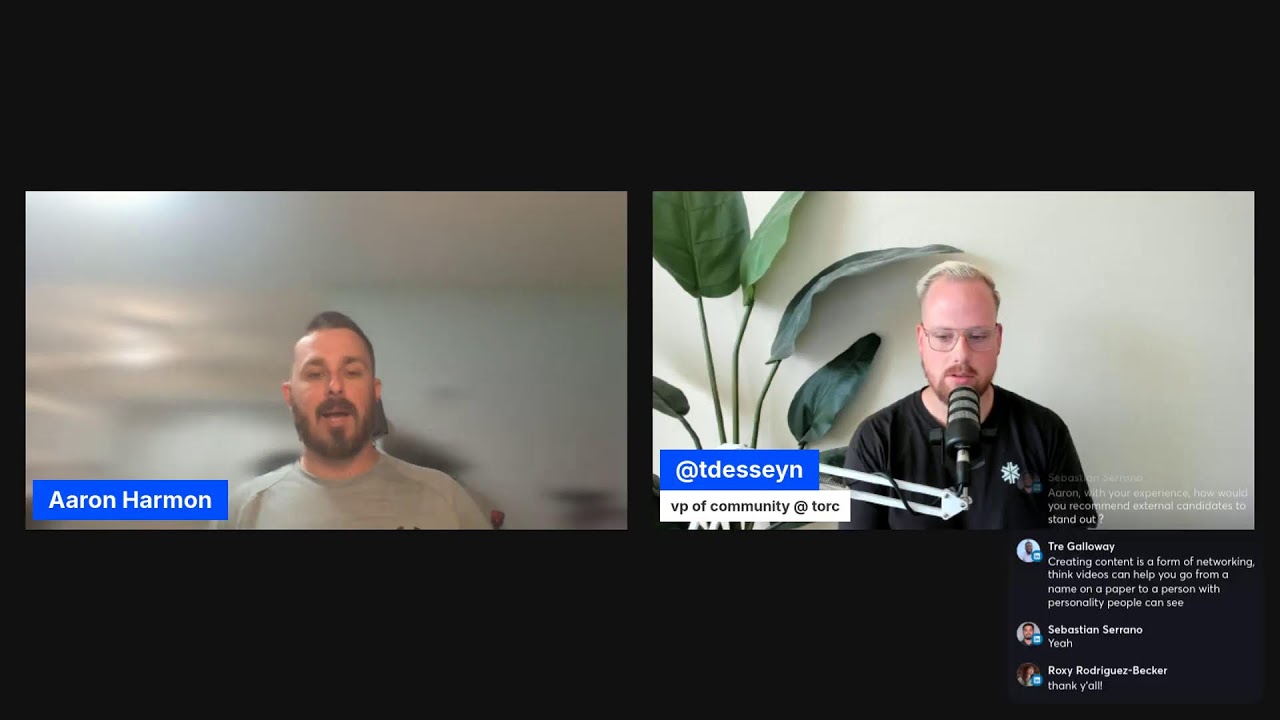
In this live interview, host Taylor Desseyn chats with Aaron Harmon, a principal internal recruiter at Performance Drone Works (PDW) and former Tesla recruiter. They cover Aaron’s career path—from agency recruiting at Air Attack to internal recruiting at PDW—highlighting the differences between agency and in‑house recruiting, volume of hires, and the unique challenges of being a one‑person recruiting team. The conversation then shifts to practical job‑search advice: why many candidates miss the mark by not reading job descriptions, the limited value of tailoring a resume for every posting, the importance of keyword searching (Ctrl+F) and a concise professional summary, formatting preferences (bullets over paragraphs, minimal fluff, ATS‑friendly PDFs/Word), how to label contract or layoff periods, and when cover letters add value (especially for career changers). Aaron shares outreach best practices for candidates (short LinkedIn/email messages, clear intent, follow‑up cadence, BCC “trick” for agency recruiters, and leveraging company page followers), recruiter workload realities, the need for speed, handling spam, and the role of hyperlinked employer names. The episode wraps with Aaron’s career advice—take risks, network in person, and get out of your comfort zone. The discussion is conversational, enthusiastic, and aimed at empowering job seekers and recruiters alike.
Chapters
All righty, we're live. So, uh, it takes like a minute to 2 for people to tune in, uh, but for those of you who are tuning in, Aaron's already on his second cup of cold brew. So Aaron, I have to ask, do you have a— do, do you, do you have a spot in Chattanooga you go to? Like, do you have a good coffee shop anywhere?
I do, I do. Uh, unfortunately I don't live near any of the ones downtown, but there is one called Drip. Uh, it's the Drip Kitchen and Coffee. It's family-owned. They got a couple—
there you go.
It's about 10 minutes from the house.
There you go.
Can't make it there, it's, um—
That's so funny because literally this is from a coffee shop called Drips and that, and, and yeah, near my house.
Yeah, yeah, I go with the old, uh Cold Brew Stoke or Stock, I'm not sure.
Yeah, yeah, Stoke. Yeah, yeah, Stoke. The, uh, they sponsor Wrexham.
Really?
Yeah, that's, uh, uh, I, I've, uh, obviously a big fan of documentaries based off every— all the content we put out, heavy documentary based. And, uh, yeah, they, they, they are the, um, stadium sponsor for Welcome to Wrexham, or like Wrexham's football, so soccer.
Yeah, I've got Stoke in bulk at Costco.
I love it, dude. Costco. I'll tell you this, shout out Costco Hendersonville. They had some banging samples this weekend. Um, it was great. It's basically the closest thing we have to like a playground, pretty much like an adult playground. Yeah, so I don't know, I don't like stoned. Yeah, good morning. We do have some people. Yeah, it's early. Shout out— so shout out to Aaron. Shout out to Aaron for making this happen. Aaron is a busy man. Um, I am, uh, honestly, I am grateful that he took time to do this even though it's early. I think it's gonna be great content. Um, but, uh, Aaron is a busy man, so, uh, we, we had to do this, uh, an hour early because of Aaron's meeting schedule. Um, so Aaron, thank you, my friend.
I appreciate you. I appreciate the invite.
Um, for those of you tuning in, welcome, um, uh, to Guidance Counselor 2.0, uh, midweek edition. Um, I'm gonna be honest with you, I'm tired. Um, and, and Aaron's a little undercaffeinated as well still, even though he's on his second cup. So we're gonna get through this together. Um, but I think it's gonna be a great conversation today. So, um, I've, I met Aaron through LinkedIn. Um, I really like the, really like the content he was putting out on LinkedIn. Aaron's got, Aaron's one of those guys, he'll never say it. Aaron's an influencer on LinkedIn. Um, and he'll never say it, but I've never seen a recruiter get as many comments and, uh, uh, engagement on a, on a post. Um, and so, uh, uh, he is, uh, yeah, definitely message him and say, hey, I am, I'm a LinkedIn, uh, Great to see you, LinkedIn influencer, because that is, that is who you are. You're a LinkedIn influencer. Um, and so we're— this is gonna be a good conversation today about really how to navigate internal recruiters, right? I, I think there's a lot of questions. We coming at it from an agency side. Um, but even like we were backstage and we'll get to it here in a minute, like Aaron even had some contrasting thoughts and contradicting thoughts to what we talk about, right? About resume templates and whatnot. So it's gonna be a great conversation today. So again, if you are tuning in, welcome. I know it's a little bit early time. I want to get through some housekeeping things as always. First off, Appwrite. Listen, I'm an Appwrite hero. Love the DevRel team at Appwrite. I want to say I love the product, but I don't know how to code. But I think it's good. So you should check it out. That is my sales pitch. I think it's good. So you should check it out. But Jason Torres, my business partner, is an Appwrite hero as well. So go check them out. Tell them the Torque Boys sent you. Um, also too, listen, we got a lot going on in the Torque community. Um, one of the things that Aaron and I were talking about backstage is just the importance of events, getting out from behind your computer. Um, so we got a lot of things happening. Um, so go check out torque.community. We got a brand new, uh, refresh, repay— the, the page is refreshed. It's pretty. Let's just say that it's pretty. So go check it out. Um, it's got testimonials, it's got links to everything. So, uh, if you have not checked it out, go check out torque.community. Also listen, When I do go live with guests like Aaron and you want to be kept in the loop, shoot me a text. Just say live. It'll automatically lump you in. And I shoot this text out every day to folks. So if you don't want to miss it or you just want to be kept up to date, definitely join this texting community. What else? I think that's it.
All right.
So Aaron, let's give the people what they want, man. Who are you? What do you do? And we'll go from there.
Yeah, so, um, my name is Aaron Harmon. I've been recruiting almost 10 years now, which is crazy to think.
That's crazy. And then we're getting old.
Yeah, we are. Uh, in the same breath though, I feel like, you know, there's— I feel like I still don't know how to do a lot of things, right? So there's a lot to learn left in the recruiting industry. It's one of the— it's a weird industry to be in because You can do it for a long time and still learn every single day. Yeah, new rec or, you know, a new, new individual that has a different mindset or a different tactic on things. You're always learning. So that's something that I like about it the most. But, uh, yeah, been starting the agency side.
Um, who did you start with on the agency side?
I didn't even know that.
Air Attack. Nice. Yeah, nice.
I was there 5 years.
Nice. Okay, there you go.
Yeah. So stuck with recruiting the whole time. You know, I think the agency, general agency push is like, hey, recruit and then get into sales. And I was like, no, no, I, I like recruiting. I want to get good at this. Right.
So, yeah.
And yeah, stuck with that. Learned a bunch. I learned a little bit about a lot of industries and what I did and did not like as far as recruiting goes and what I, what I enjoyed and what I did not enjoy and what I was good at, right? So that propelled me to get into the internal side, which, um, is a whole different beast in itself. Yeah, small company, big company, you know, whatever industry it is, it's just the, the core function is the same, but it's, it's a different animal.
Yeah. And you were at Tesla for a bit?
Yeah.
Uh, what, what, what did you— what type of roles did you hire at Tesla?
Um, a little bit of everything. So I was hired to do battery cell manufacturing. And never touched it.
Um, battery cell manufacturing?
Yeah, never, never touched it once. Um, yeah, I got hired, I think someone went on leave and I filled in for something, and then I ended up owning that. And then somebody would call our boss, um, shout out Kevin, great guy, um, miss working with him all the time. But, um, he— they would call him and say, hey, we need extra help. And then me and a couple other people on our team Were this kind of like, I kind of call it like a cleanup crew. Like we would come in and, you know, fill surge recs or fill the kind of hard to fill recs that were bogging their teams down. And then we would own those departments for those types of roles. So we had this like mixed bag of positions from, I mean, I was hiring parts runners, then I was hiring crash test technicians, right? Doing like full-blown crash tests.
Yeah.
Right. So it was everything under the sun, which might have been to my demise there, right? Because I, I wasn't a specialized recruiter, I was a generalist, right? So yeah, but I think that generalist mindset got me to where I am now. So I'm very appreciative of that, that experience.
I love it. And then, and then where, and then where are you at now and kind of what do you focus on?
Yeah, so I'm with PDW, Performance Drone Works, out of Huntsville, Alabama. Uh, we build, uh, small unmanned systems for the military, heavily, uh, designed and engineered for the military. So I am a team of one currently as far as recruiting goes. Everything under the sun.
Crazy.
Corporate manufacturing, engineering, product.
How many people do you think you've extended offers out to at this point?
This year, over 100.
That's crazy.
Yeah. Yeah.
Nuts.
The— I had a conversation. I think we have, we have some pretty, pretty stiff hiring goals for the next 5 years, which it'll be a pretty good trajectory. Not, not a huge spike, but a very gradual and sure hiring curve. So I'm looking forward to it.
I—
it's cool to see a lot of the new faces. Like, you know, I'm remote, but I go down there quite often. Yeah. And I can go down, there's a new person, right? Like, hey, who is that? You know? And it's like, it's someone that, you know, I might have talked to 2 or 3 months ago and I forgot what they looked like, or—
Yeah, yeah.
Things like that, right? So it's so cool seeing the new faces. And we're in the new building now too. So we've been in a new building since July 1st. And we're really proud of that too.
That's awesome. Yeah, I saw the video. I saw a nice little video. I think you reposted it, Aaron. So to let you know, Aaron and I, uh, you know, we also— your dad, your dad, uh, how many kids you got again?
2.
2. Yeah, it sounds like our daughters are about the same. Um, yeah, so Aaron and I always message each other on Instagram, kind of dad-daughter type content. Um, and, uh, uh, so yeah, shout out, shout out to, shout out to you for About sending out 100 offer letters and also balancing kids as well, man. I mean, it's, it's, uh, it's a challenge.
Yeah, I don't get in the whole personal stuff on LinkedIn. Um, like, I'm a pretty private person, but yeah, people don't even realize I have kids sometimes. Like, yeah, I'm married. I've been with my wife for almost 15 years.
That's awesome.
Uh, got, got 2 little ones, got a dog. Um, there you go.
Yeah, and then you do golf sometimes, right? You and I have messaged about golf a little bit whenever you have any time.
Yeah, yeah, I do enjoy golf. My dad's a lifelong golfer, got me into it. I worked at the golf course.
Did you really?
Yeah, yeah.
That's awesome.
I used to wash the golf carts, man, hit the range.
That's awesome. I'm actually in my first official— when I say official, like I had to pay for it— I'm in my first official golf scramble on Monday.
Oh yeah.
So like, it's me and 3 guys, um, they're actually from my church, and, uh, we're gonna, we're gonna all, uh, go out there and, uh, you know, try to hit the ball around the the, the course. So I bought 100 balls. I plan on losing all of them, so it's gonna be great. Yeah, it's gonna be great.
Don't, don't buy the expensive ones, I'll tell you.
No, I'm— I, I did— I, I'm doing the refurbished ones, um, uh, because your boy don't have the funds for that. All right, so, um, let's just, let's just start out, dude. Like, let me give you kind of a softball question and then we can kind of chip away at it. Like, where, where are job seekers really, um, missing the mark right now, um, in your eyes when it comes to, uh, the job search?
I don't think people fully read job descriptions. And I say that with a grain of salt, because some job descriptions are just not that great, or they're very vague.
Sure.
So sure, it's not the fault of the, of the applicant or the job seeker. Because sometimes job descriptions are just trash. And that's, that's the reality of it. But when the job description has requirements, explicitly stated and you don't meet those requirements, or you're not in the industry of what this role is, the, the, uh, I guess desire to apply shouldn't be there, right?
Right.
But here we, here we are, 2025, we still get people that work in non-adjacent industries that aren't— don't meet any of the qualifications that are applying, which is great. Like, I, I love everyone shooting their shot, but it's unrealistic sometimes.
And, and, and so let me ask you this. Yeah, and Jeff, uh, so I said it. So Aaron's, Aaron's a busy guy. We had to work around his meeting schedule, so that's why we're early. So, so Aaron and I, this is the, this is the morning morning show that we're both trying to wake up on. Um, so, uh, so let me ask you this. How, how do we, how we, aka the job seeker, how do they portray— so one of the things that we teach a lot within the Torque community, we're doing resume reviews today, by the way, for anybody who's watching now in the future. We're doing resume reviews, uh, this afternoon in the Torque Discord. You know, one thing we always say, and one thing I'm really big on, is having kind of this top part of your resume, what I call the professional summary, right? Where it's like you're kind of hitting, um, the must-haves or the nice-to-haves of, of, of the job description. So it's kind of laid out really easy to you. Is there— is, is that a good way? Is there other ways that you want to see, like, hey, here, here's a— here's how I can't— has exactly what's in the job description? Like, how do you like A resume to, to, to look?
Yeah, so I, I definitely don't recommend tailoring your resume to every single rec, right? Um, interesting, right? Yeah, you can specialize and you can edit some certain things. Like, for example, like if you're a software engineer and it's like, hey, you have to have experience with C and C++, right? That's like must-have, that's what they use, and it's stated in the job description. And you have C++ listed one time on your resume at the very bottom, probably, probably put at the top, right?
Yeah.
So yeah, you can, you can, again, with a good job description that has clear requirements, you can create a little bit of an edit there and appeal to what the job description says. Now, as you and I both know, every recruiter has their own preferences, right?
Yes. Right.
Whether they want to say it or not, recruiters have preferences. I don't typically care on format, right?
Like, you know, which is crazy to think about, like, knowing you, because you and I have exchanged some texts. Like, you're kind of like me, we're both kind of grumpy, um, and, you know, we both have very strong opinions. The fact that you don't really dig into format is kind of wild to me.
Yeah, yeah, yeah. I'm like, you can literally hit Ctrl+F and find the keyword you're looking Right.
Okay, so I want to highlight that.
Easy.
I want to highlight that because I talk about it and people, I'm sure, are tired of me talking about it, but like most recruiters just Ctrl+F. I mean, I mean, that's how I started. I didn't know anything about anything and I was just out here Ctrl+Fing skill sets. So it's like, and listen, whether you like it or not, if a recruiter doesn't know the in and outs of Java and you have Java and you have Spring Boot on your resume but not the word Java a lot of times—
Also true. Yeah.
You, you could get rejected. So talk about the importance of the Ctrl+F and just actually just, just when I say littering, that's like a bad term, but like making sure your resume has the skills.
Yeah, so that's the thing, you know, I, to go back to what you were saying, the recruiter should know enough about the rec to be able to find other keywords, right? So like, for example, like if we're looking for someone that has QML background and I type in QML and it's not on there, hey, I'm not gonna just throw the resume in the trash. I'm gonna, I'm gonna go through it, right? 'Cause this person's been a, you know, software developer for the last 10 years. They probably have touched it somewhere.
Yeah.
Let's see the industries they've worked with. Let's see the platforms they've worked on, right? And do another screen through it that just gets The, the Ctrl+F and, you know, and the keyword search gets me started with the right section of the resume, and then I can look through everything else, right? I don't want to look through the whole resume to find what I'm looking for. I want to find that first and then see the full picture after the fact, right? Um, 7 seconds, 30 seconds, 90 seconds— LinkedIn will tell you 40 different, you know, time frames someone spends on a resume. But if the resume is good, I'm gonna look at it. Right? If it, if it matches what we need and it's the correct industry, the correct skill sets, I'm gonna spend as much time as I need to on it to make sure that I'm not missing something. Because I'm not an expert, right? Like, I'm not the expert in manufacturing engineering or, um, or, you know, product development, right? But I know enough about it to know what we're looking for and what fits well with the company. So if it takes, it takes any extra time to find that, I'm going to invest in that to make sure we're not missing anyone and I'm not doing anybody a disservice by just looking for a keyword.
Yeah, absolutely. Do you think that's the difference between agency and internal recruiting? Because agency, man, like, if you don't got it, like, we just move on.
Yes and no. Um, it depends that this— the, the format of the agency, right? So for example, like, if you're working for a very specialized headhunter where it's like, hey, I just work in A, B, and C industries, as you were saying, like, you know, like you used to focus on 3 buckets, right? Whereas the bigger, bigger, you know, legacy staffing companies, you can submit candidates to other account managers, right? So like, if you find someone that's really good, you're like, hey, this doesn't fit my rec, but it might be good for somebody else's rec. Like, they should be talking to that person because, you know, when it comes to commissions, as long as the recruiter's filling the rec, the account manager is happy, you know what I mean?
Yeah.
So they should take that extra time to cross-recruit.
Yeah, absolutely.
that isn't always the case and not always able to do that if there's no recs, right? There's no recs for it, then as you said, hey, we have to move on, right? Because we can't, we can't help everybody, and that's just the reality of hiring.
Yeah, absolutely. What Jason, my coworker, uh, asked a good question here because again, we do, we do resume reviews all the time. How do you know it's good? Like, how do you know? Because like you're saying the format doesn't matter, but then you're also saying you look at things? Like, like, where do your eyes go? I think that's a great question. Like, like, when you open up a resume, where are you looking first?
I'm looking at a quick summary, right? You know, it— the quick summary is what I look at. But if it's, if it's the buzzwords, the multifaceted thought leadership, you're getting great, great things to be, right? But if it's full of filler words and it doesn't really tell me who you are, I'm gonna go right to your experience. I'm looking at titles, I'm looking at companies. If, if I know the company, great. If I don't, I'm looking it up, looking at tenure real quick, right? You know, things. And I'll start with that. Tenure is not a deal breaker. Contract roles are so popular now.
Yeah, it was crazy when I started in 2011, like nobody wanted contract.
Nobody.
No.
And if you're a contract person, it's because like, it's because, oh, you know, no one wants to hire you. Well, now people want that contract because they want the diverse work, like diverse portfolio of work.
Yeah.
So what I recommend though is if you're doing contract work, write contract, right?
Yep.
The, the best thing, the best advice I tell people when creating a resume, answer questions before they have to be asked. So if you're like, wow, like I don't know if I should put if I was laid off or like if it was like a reduction in force or if it was contract. put it on there.
Yeah.
Like, if it's a short-term thing and you did a couple jobs here and there, write contract, write laid off due to budget cuts, right? Answer those questions because people could be like, oh, this person's a job hopper based on tenure alone.
Yeah.
And not even look at— not, not look at the content of the resume because of the tenure. And that's unfortunate that it happens, but if you can answer those questions and address those quote-unquote red flags yourself and own it, say, hey, like, this is, this is my story, this is what I was doing.
I love it.
Then that typically can help. Now, but again, I'm looking at tenure, I'm looking at is it easy to read. But please, please use bullets. That's all I say.
Like, thank you.
Please.
I say all the time, like, people, like, they write massive paragraphs. It's like, dude, nobody reads in paragraphs anymore.
Yeah, yeah. So, um, I think Jason has another comment down at the bottom.
I can't read it.
There you go. Immediate no. I don't know if I have an immediate no unless they just don't meet the requirements. Like, so if someone worked, let's just say, in hospitality, right? They worked at a hotel chain, they were GM, or they worked, you know, uh, supervisor of restaurant or housekeeping, and they're applying to a warehouse management role. They're 2 different industries.
Um, yeah.
Operations side, the management side, team leadership time, all that translates, but there's no direct Um, relation to the industry and the new role right now.
Yeah.
That's where, in my opinion, I don't ever— I'm never going to say you have to create a cover letter, but if you're changing industries, if you're going from, let's just say, the hospitality piece to a logistics type of industry, and you have— and you know you have that kind of cross-relatable skill set that can match, write that cover letter, explain yourself, right? Because If I look at it, I'm like, well, this person doesn't meet any of the requirements, but they have a cover letter. I'm gonna read it real quick. Okay. Now, if there's no cover letter, hey, I, I don't know what you're—
There's no context.
Exactly. Yeah. So that's why I'm never gonna say it's a requirement. But if you are changing industries, if you're wanting to kind of get your feet wet into a new industry or do something just different than we've done in the past, that's where I see the benefit of a cover letter. That being said, The day and age we are in now, the, the opportunity to change industries or change jobs—
Hard.
Scope, it's very difficult because you have this pool of candidates that meet all of the requirements already, and then there's someone that meets 10%, right? Yeah, but they have the aptitude and the ability, but you're going up against candidates that maybe already have 5 years of experience because there's so many layoffs and everyone's looking for work. So Again, it happens. I see it all the time, people, you know, going from X to Y, and it's possible, but the opportunities are far and fewer now.
Absolutely. Jeff, Jeff, expound on this. Is this a new normal? In what part? Um, uh, expound on that real quick, um, for us. Um, let me— so interesting thought about COVID letters, right? Because, you know, we get, we get that question a lot. From an agency side, I've always said I've never dealt with COVID letters because your agency recruiter is kind of your cover letter.
Yeah.
Right? They take the time to meet with you. They take the time to craft your submission to the client. They kind of do a lot of the selling for you. But I think when you're going internal, I think you bring up an interesting thing that I think cover letters are good for career switchers. Do you think cover letters are good also for like Somebody who's been in the industry a lot or not really?
It can be, you know. So it's like, for example, if someone's been in, let's just say, an engineering manager role, right? And they're applying to an individual contributor position, then that's when they can say, hey, in, in my last 5 years of being a manager, I was also a player coach, right? Yeah. So I was in the weeds. I was spending 50% of my day coding, programming, whatever it may be. and explain that in the, in the COVID letter because someone can see that and say, oh, their, their manager, we're not, you know, it isn't a good fit, right? Where this person managed maybe a team of 2, team of 3, right? When their main, their main function was doing rather than leading. That's when you can explain that.
Um, yeah.
And I'm not sure what, what Jeff was referring to as far as—
No, no, Jeff's just referring to, to the time. No, Jeff, this is just a, this is just a one-off. This is just the one-off. This is just the one-off. Yeah.
Yeah. But, and again, you know, I'm like, like we discussed backstage, I am a team of one at one company of thousands of companies in the US, right? So there, there are so many ways to be seen and to be heard. This is just my, my experience, right? So, you know, yeah, yeah, I follow a guy on Instagram. He's a, he's a barbecue guy. He always says, I'm gonna do this how I like doing it. Yeah, you do it how you like doing it, right? Yeah. So yeah, that's, that, that's kind of where I, where I stand with it, right? There's a million ways to recruit. There's a lot of wrong ways, but there's a lot of right ways to recruit.
Yes, yes.
This is what works for me. I always say the same thing.
This is just— this is my career and what's worked for me. It doesn't necessarily, um, doesn't mean it's like the golden standard. Let me ask, one of the things that Jason and I talk a lot about in our resume reviews we do in our Torque Discord is, um, we do, uh, we, we, we really try to harp on company description if it's not a big company. And I think it kind of lines up to what you're saying. Like, if I'm working for another drone company that you haven't worked for, Um, I, I would put that in your resume because then you can see, oh, I didn't know what this company was off the rip, but the fact that you talked, you said, hey, it's like a $2 million in revenue, blah, blah, blah company, that allows more context to your resume. Thoughts on that?
Yeah, so my resume has The employer name is hyperlinked to the website of the employer.
Oh, okay, cool.
So I know that's a, that's an information security thing, like shouldn't click links that you don't know, you know, their source from. So that can— I, after I did it, I was like, ah, probably, you know, wasn't a good thing because it could be flagged by TIAA information security. Now that I know, now that I know more about that. So the perks of being a generalist, but I do think, um, you know, a quick You know, here's the website, or, you know, the industry or style of company, right? Like agency. Like, so for example, like we have a marketing role open and someone worked for a company, I look it up and I can't find it. Well, it's because it's a marketing agency, right? They, they work on behalf of hundreds of companies, right?
Correct.
But I didn't know that, right? So going back to the time piece, like not every recruiter is going to take that time to go find out what this company is. So if you—
You gotta try to give it to everybody, like In your resume, you can—
you have to assume that someone reading your resume doesn't know what you do, right?
Yeah.
So now, for example, if it's, you know, an adjacent— an industry adjacent role, the recruiter should be educated enough and should have done their own research to know their competitors, know the market, right? But the hyperlink or a quick, you know, This is an automotive company, a tier 1 automotive supplier, or, you know, ISO certified clean room environment, right? All those things can be added. Yeah, it's not a requirement, but again, for the smaller companies, it does help the recruiters out because again, it answers the questions before they have to be asked.
Yep, absolutely. I, I, I want to— and, and Jason comments right here, incorporate your cover letter will rarely ever get read. Again, like Yes, probably. Right. And, and again, I, I think it's a mixed bag. I, I think, um, I would say just have one ready to go. Right. I, I, and again, I think again, it goes back to, it's like what, it's like what, um, Aaron just said. It, the, the buzzwords fill, like, not the buzzwords, the filler words have got to go. Right. I think the biggest issue I see with COVID letters is it's just riddled with, I'm a great communicator. I'm a great leader. I, and passionate about the industry. It's like, that's cool and all, but like, I want to know like what you've done and how it relates to this opportunity.
Yeah, yeah. You know, and ChatGPT and Grok and all that stuff like that, you know, there's— they all look the same, they all sound the same, right? So like there's a portion of our application where you can basically copy and paste a cover letter, but I have people that just type out a few sentences.
Yeah, just like, yeah. I don't gotta be long.
Exactly.
I don't gotta be long.
Give me your elevator pitch that I can read in 30 seconds if you want to do that. Again, I'm never gonna require that, but if you wanna write 2 or 3 sentences and I can check it real quick as a— it's literally right below the resume in the ATS. So yeah, it's, it's not like it's a separate function that has to be done outside of the, the resume review. That can be very impactful if you wanna do it. And, and to Jason's point, sometimes people just don't. don't have the time to look through resumes— I'm sorry, look through cover letters because of the workload or the applicant flow that they have. But in my opinion, if you have 100 applicants and they all— they're all, you know, on par with what you're looking for, see who wanted to share a little bit about themselves, right?
Yeah.
See if you can— if you can differentiate one from the other, and that cover letter could be the differentiator in some situations.
Absolutely. I wanna, I wanna get into, I wanna start talking a little bit about, um, uh, like communication strategy, outreach for job seekers, right? I'm sure you get a lot of DMs on LinkedIn. You sent me some. Yeah. Uh, you sent me emails, right? You screenshotted emails to me. What, how, how do you, how can somebody stand out? How do you like to be approached? What do you think some best practices are? Like, if I really wanna work PDW, and I've submitted my resume a few times and I haven't heard from you. How, how do you want to be approached? Because I think this is where— I think, you know, one of the things we consistently preach in the Torque community is like, hey, you got to do outreach, you got to do outreach, etc., etc. But like, what, what's a tactful way to do outreach?
So I'm It depends on the day, right? If I'm— if I'm—
It depends. It depends if I'm in a good mood or not.
I'm being honest. Like, there's, there's days where I have set aside for sourcing, those days where I've set aside for meetings and interviews, right? So if I'm gonna— if I'm in a day where I'm back-to-back meetings and interviews, I'm not checking my LinkedIn. I'm not. I'm checking the next day, right? And to your point, it can get back— it can get backlogged pretty well, pretty easily. So if you're going to do outreach on LinkedIn, my best advice is keep it short. Hey, this is my name. I applied to these positions in the past. Here's my resume with my contact information. Would love to chat with you about this position. If you're not the recruiter, could you send me who is? Right? It's short, sweet. It's direct. It's, this is my resume. This is what I applied for. Can you help me? If not, can you help? Can you find, help me find who can help me?
Yeah.
The 5-paragraph email about your educational background, that's just not—
Where you were born. What time you were born, what city you were born.
Like, that's not required on a first message. So that's why I like short and sweet and direct. Now, also a little bit of humility, right? Like, hey, like, you know, you can say like, I've applied 3 times, I haven't heard back from anybody. Like, that's gonna catch my attention. Like, nobody should apply to 3 to 4 jobs and never hear back from someone, right? So if I see that, like, be honest, right? Don't, don't be rude and be disrespectful. But say, hey, like, I've applied a couple times, haven't heard from anyone. Can you look into this for me? Absolutely. Hey, send me, send me your email address and I can look you up in our system, right? Yeah. The LinkedIn to me seems to be the best way to find recruiters still because it's so searchable, so visible, right?
Yeah.
You can look at— I can go to someone's page, look at all of their post history and see what they post about, what kind of roles they post. um, the industries that they support, if they're agency recruiters. You can do all that yourself, right? So on the job seeker side, I, I do— I would like to empower job seekers to do a little bit of research on the recruiters to find out who they should talk to, at least get a head start of, of, and narrow the funnel down. Now, yeah, that same advice can be given to recruiters when they're doing outreach too. Hey, narrow the funnel down. Don't just, don't just spray and pray.
Yeah.
You know, outreach messages looking for candidates too. So that, like, it goes both ways.
Well, a lot of times too, you can see who— so I did a quick call yesterday. It was a referral. It was a developer wanting to get into recruiting, right? So we talked about being a sourcer, right? And like, what did that look like? And I quickly showed him on LinkedIn, if you go to jobs and type in sourcer, you can see all the jobs posted and you can usually see who's posted the job.
Yeah.
Right. And so like one of the strategies I said is, hey, like I would message this person and just be like, hey, I saw you had a sourcer role posted. I'm trying to get into recruiting. Do you, do you have any thoughts for me? I've been a developer. Do you think I should post? Like, like, like I, I think even kind of going to maybe, maybe even the job poster, right? Like, you know, like if, if I were to see you posted, uh, I'm gonna make like a, I don't know, drone developer. That's not a thing, but like embedded engineer, right? You, I like, do you think could be a good tactic? Like, hey Aaron, I saw where you posted an embedded engineer role. I have these skills. Um, uh, you know, uh, which I guess this doesn't make much sense. Like, should I apply? You're probably gonna say obviously yes, but like, I guess, I guess it goes back to saying like, hey, maybe I've applied 3 times to an embedded engineer role and, and I have these skills. listed in a job description, where do you think I'm missing the mark? I'm sure you're probably gonna be like, oh shoot, like this person has applied 3 times and looks like they have the skills. You're probably gonna help them out because of it.
Yeah. And I'll be the first to say like recruiters make mistakes, like flat out, you know?
Oh dude. Yeah. We're humans.
The, so many of the recruiting teams since 2022 until now are lean teams, right? So they'll, they'll have 15, 20, 30 recs. Um, they'll have hundreds of applicants depending on the role, right? I can post one rec and get 2 applicants, post another one and I get 30, right? So yeah, no rhyme or reason to it, but we do make mistakes. So like, for example, you know, if this person has, has the requirements, right? And that message could, could be like, hey, I have, you know, ABC experience that isn't on my resume, but it actually applies. I'm like, okay, in my mind, I'm like, that, that could have been a cover letter, right? Again, if, or better yet, put it on the resume. Yeah, put it on the resume, right? If, if you meet the requirements for the role, but your, the experience that meets those requirements is not listed on the resume, it's hard for recruiters to identify that because we don't have the, going back to the lean teams topic, we don't have the ability to call everyone. It's just not, we don't have time in the day to talk to every single applicant. And that's sad because I think everyone should get a shot to be seen and be recognized.
Agreed.
But The reality is we don't have the bandwidth to do so when we have X amount of recs open. And, you know, like, let's just break it down. Say you had 20 recs open, you got 3 candidates, 2 or 3 candidates in play for each rec. That's 40 to 60 candidates that you are managing at one given time. And then you're dealing with more inbound applicants, more inbound outreach.
Yeah, it's, it's, it's a lot. I don't think people understand the volume of people that recruiters have to keep in touch with. and manage, um, which is why I'm so big on follow-up, right? So it's like, you know, I, I— one of the things that I've talked to a lot of people about is like, following up with me 3 or 4 times is not annoying. The way you're framing the follow-up and your wording can be annoying.
Yeah.
Right? So it's like, I think self-deprecation goes a long way, right? So like, I always tell people, there's, there's 3 immediate follow-up messages that I would send. The first, like, like, so let's say I was job seeking and I was trying to get to you. Be like, hey Aaron, listen, submitted my resume, I haven't heard anything, here's where I'm a fit, you know, let me know if I'm off base, whatever. Second follow-up, hey Aaron, listen, I know you're crazy busy, right? Just want to follow up again. Last one, hey Aaron, listen, I know I'm borderline being annoying at this point, but I just wanted to close the loop on this. That's 3 messages, and I'm pretty confident that you wouldn't find those annoying because of the tone of them. It's usually the tone of the messages that really turns us off.
Yeah, you know, and, and I think that's a good tactic, right? Because it's like, hey, I'm persistent, I'm confident, but I'm, I'm also aware, realistic, and yeah, aware, aware of the situation at hand. So I like the follow-up, and, and I've even used this tactic, right? Like if I'm talking to somebody I know I'm back to back, like I have, I think, 8 interviews today scheduled. Right, which is awesome. I love it. Like, no, no complaint with that whatsoever.
I touch a lot though, man. 8 conversations.
I'm like, give me 48 hours to hear back from the team. Yeah, give me 48 to 72 hours to hear back, get, get feedback, so on and so forth. If you don't hear from me by Friday, call me. Yeah, like, yeah, it gives them, I guess, power, right?
Authority. Yeah, yeah, 100%.
Yeah, if you don't hear from me, I need you to call me. Because, yeah, I could get busy, I could be out sick, you know, I could get pulled to a different, different strategy or different, different hiring, uh, initiative, right? This could get put on the back burner. So call me. You have my phone number. You can text me, like, because all my first interactions are phone calls. You have my, you have my, my cell phone number. You can text me. You can email me. All my initial outreach is email, right? So you have 3 ways to contact me.
Yeah.
I don't mind that, right? Um, I will say If you have direct contact to your recruiter and you're texting them or calling them, leave a voicemail with your name. Yeah, I get all the time, hey, checking in on, on, on this position. I have to look up in the ATS who this is, right? You know?
Yeah.
And you can search my phone number. It's easy to do. But if you're like, hey, this is John Smith, we talked last week about the software role, checking in. Great. I immediately know who that is, right?
Yeah.
Or the voicemail of, you know, from the random phone number that, that we talk to all the time, right? We're always making outbound calls.
Yeah.
We don't, oh, we don't always save phone numbers. So if you do outreach, you do reach out to a recruiter with their direct line of contact on phone, via phone, leave voicemail or message with your name and ideally the role that you spoke about, right? Just so the recruiter can get a quick shot of who, who's reaching out to them. Yeah.
Uh, so I, I have, I have this trick. I, I wanna bounce it off for you to make sure. That it's, that it's a good trick. Um, when it comes to a— so agency side, right? Like, like I, I would say this doesn't quite work for an internal side because you guys are just so reactive. But like, I call it the BCC trick, right? There's no clever name to this. So like what I would do if I was a job seeker and, and let's say I spoke to 10 recruiters, agency recruiters, right? Not Aaron, more on Ronstadt and Torque and yada yada. And let's say I— there's like 10 or 5, let's just say 5 recruiters I like. I would email them once a month and BCC all of them and just refresh their memory on who you are, what you're looking for, to cover more ground. Because there was multiple times when I was recruiting agency, and I'm sure you probably dealt with this, where like we had— like agency recruiters have their favorite candidates. Like we just have our favorite candidates. Like, like we work with you a lot, we know you're good. There was one candidate in Nashville, his name was Ben, and he— and I was working on this role and I forgot about him. He was a perfect fit. He got called by another recruiter and he messaged me, he goes, hey, I got called by this role, are you working on it? I'd like to work with you. And I forgot him. So like I— so I called the BCC just to stay on top of everybody's mind. Thoughts on that?
I like it, uh, on the agency side especially, right? Because agency— the agency side, you can, depending on the agency model, they can have a very wide array of, of workload and, and clients, right? So we can't— now I will say that that's when it gets into the system side, right? So like, you should have a portion of the ATS or an Excel of your pipeline candidates that are your first— hey, like, here are my first 10 people I'm gonna call for this skill set. For this skill set, for this skill set, right? I will put that on the recruiter to have, um, the, the organization side. But I also understand the real— the reality of it is that it's chaos. You know, agency is very speed to market, um, and you might have someone on top of your mind you're gonna call first that isn't on that list, right? That you talked to yesterday.
Yeah.
Forget about the person you talked to a few months ago that was really a good fit, like Ben. But the The check-ins, like, again, the tone, the demeanor of it is, can go a long way. Yeah. So I like it. I like being followed up with. I have no issue with someone checking in like, hey, I applied. Hey, we spoke. I'm no lie. Yesterday we had, I had someone email me who interviewed with us a few months back, wasn't selected, and was like, hey, I've been thinking about it ever since. Like, I would love a second shot. Like, yeah, um, I keep thinking about you guys. I'm looking for work. Can we have another conversation? We'll talk to him today, right? So even if you're rejected, right, like, even if you're told no, it's not a no forever, right? Unless you do something egregious, right? And you, you know, really bomb the interview, which, again, the reality of it does happen. But the follow-up, you know, with the recruiter, especially if you have the email address or phone number, like It's okay to do that. It's the recruiter's job to be accessible to the candidates that they're working with, right? Um, now there's a lot of back and forth of like what, what the recruiter's role is like. Do we work for the client? Do we work for our company? Work for the candidate? It's all the above, right?
Yeah, it's tough. I mean, I'm telling you, like, being a recruiter sucks. Like, it's hard. It doesn't suck. It doesn't suck. Let me rephrase that. It's just hard. It's just hard.
You have to play both sides of the fence. You have to advocate for the company or the client that you're supporting. You have to advocate for the, for the candidate as well. And doing that is a very fine line.
Do you, um, do you like— I, I think one of the issues, um, that I consistently saw is the lack of, um, not motivation, the lack of like intensity with follow-up. Like, if I reach out to you for an interview and it's an interview for a job, I expect for you to get back to me within the next hour. And I feel like people— I don't know if you're seeing that right now with this market. Maybe people jump on a little bit more. But, but also too, like, when you finish an interview with a recruiter, like, I'm sure you probably like if a candidate, if a candidate interviews, They email you immediately after and be like, hey Aaron, I thought the interview went well. Maybe I missed here. So that way you can go like, I just, there's 2 things here. Let's talk about, let's talk about just speed to follow, speed to follow up. Are you dealing with that? Do you deal with candidates who you reach out to and then you don't hear from for hours?
I don't hear from people for weeks sometimes.
Are you serious?
But I will say that the folks that are serious about the job search and that are truly looking for a new role, they have their notifications set up on LinkedIn. They have notifications set up on their email. They're being dings when they're getting text messages, right?
Speed's everything, right?
Things are, things are not muted, right, when you're looking for a job. They shouldn't be, in my opinion, right now, right? There has to be a healthy boundary. Don't, don't look for a job sunup to sundown every day. Like, give yourself a mental break.
Sure.
You need it. I was in that situation not long ago. Yeah, wear yourself out job searching. That is, it's difficult. And I do empathize with the job seekers looking for new roles right now. But the, the speed does help. Now, I will say, you know, the first applicant, even the first applicant, if you're not qualified as the 10th applicant, it doesn't help you, right?
Sure.
But when, to your point, if I reach out to you, and I like, let's say I go through, I'm looking for a mechanical engineer, just random, random title here. I send in 5 outreach 5 outreach messages to connect, and I send an automated booking link, and the first 4 people book the next day, and another person books 2 weeks out, right?
Yeah, you can't do that.
My, my next email to that person 2 weeks out saying, hey, thank you for booking, appreciate the quick response. If you become available anytime sooner, please let me know. Sometimes they don't, they don't know that, that we need somebody right now. It could be You know, on the government contracting side, a lot of it's like pre-award stuff, you know, and they're, they're very familiar with like, hey, this, this role could, could close Jan— Jan 1st. When I'm like, no, I need somebody October 1st. Right?
Right.
They don't know that. Right. So that following up with the recruiter, it's also our responsibility to create the urgency if we don't see it right now. If they don't reply and 2 weeks later we talk, you know, hopefully we have some people already in the process by then. But, and then again, that's where the transparency piece comes in. Like, hey, we opened this 2 weeks ago. We have a couple candidates already in later stages of the interview. What we're gonna do here is I'm gonna get your information to the team, but we're not gonna bring anybody new until we finish out this process, right? Because the last thing a job seeker wants is to finish a panel interview and you're hanging out and then we're bringing somebody new in the process that has to do 1, 2, 3 interviews and it takes 2 or 3 weeks and this person that finished that panel interview It's like, well, you know, what the heck? Why, you know, like, why am I waiting, right? So we have to create that urgency if we don't see it. Now, if we don't, if it doesn't reciprocate, you know, um, timing is a lot in recruiting, right? So you can miss out if you're not checking emails, if you're not checking your spam folder. You know, that, that first email from a recruiter can very easily go to spam because it's not a recognized sender.
Sure.
In your Yahoo, Gmail, whatever it is, or it can go to a junk folder very easily. So I would say check the spam and junk folders daily if you're, if you're job seeking at least. Now, yeah, again, if it is a spam, spam recruiter email, those are running rampant right now.
Sure, dude, the amount of spam texts I'm getting right now is unreal. Unreal.
I get no less than 10 spam calls a day.
It's crazy. The new iOS supposedly, uh, fixes a lot of spam stuff, which I'm actually very excited about. So, so as you wrap up in the last 15 minutes, ma'am, I have some rapid fire, but you're just a wealth of knowledge. Um, any, any other things that maybe we haven't covered that you want to get off your chest?
Um, when it comes to this conversation, I, I know, I think someone mentioned it in the, in the comments there. I can't quite read it, but about formatting, and you and I discussed this backstage, like format is not going to make or break. It shouldn't. You know, a, a qualified and respected recruiters should not disqualify somebody over—
Sure.
Format, right? If the meat and potatoes are there— I call it meat and potatoes— if that's there on the plate and it's just kind of funky looking, like, but it tastes good, I'm happy, right? So for example, like, if I know a manager is like, hey, you know, this person has crazy format, or hey, it's, it's good, it has different colored fonts, I can select all, change the font color to black, change it all to the same size 'Cause I know what the hiring teams are gonna like. Now, again, even in the agency days, we would reformat resumes so they all looked the exact same. So nobody had that advantage or disadvantage from formatting, right? In this era, we don't have time to do that all the time, but the formatting, in my opinion, isn't something that I am picky about.
Yeah.
I, again, as we discussed earlier, recruiters have preferences.
Yep.
They shouldn't, right? They should be looking for the best qualified candidate for the role regardless of what, you know, font color or font size. Now if it's 10 pages and it's, it's size 36, I'm gonna have some questions, some, some judgment there, right? You know, as far as decision-making skills. Yeah, joking of course. But, um, that's something that I wouldn't put an emphasis on. Like Microsoft Word has great templates Yeah, like, don't pay— do not pay someone to create an ATS compliant— Yeah, yeah, yeah, yeah.
I mean, I've, I've always said, if you want the best res— if you need help, I, I do understand now being on the job search 2 times, I do understand you sometimes need somebody to help you write your resume. I would go to an agency recruiter or a recruiter to help you write your resume. I would never pay— I mean, prime example, I still am mad at my dad like 6 years later Not really, but like he paid somebody. I was like, what are you doing? I was like, I literally had to rewrite his entire resume because it was all fluff. Yeah. So I, if you wanna pay somebody to write your resume or help you write your resume, go find an, go find a recruiter who you like and they will help you way more. Yeah. Yeah.
The whole ATS compliant thing, that, that's just kind of breaking down some like the whole LinkedIn fluff out there too. It's like, If, if I come across a resume, if I'm going through applicants and it says like resume file not supported, if it doesn't gel with my ATS and I can't view it in like the embedded view, right next to that it says download and I click download and it downloads the PDF, the PDF downloads the Word doc. Don't ever send me a text file, please.
Um, yeah, I've got those. Those are wild.
Um, I will say Word or PDF. Like, do you have a preference?
We always sent PDFs in agency just because, like, so the client couldn't, you know, change it. Yeah, change it.
I think, I think that's like an agency thing too, because we had— in the agency world, we did PDFs a lot too because, like, we didn't want them to, like— I don't know if there was like a paranoia thing or what, but, um, I don't, I don't mind either way because, again, like, if you upload— if it's a, you know, a non, non-current Microsoft Word, um, like version, right? It could mess with the formatting when I download it. But again, I can select all, change the alignment, and make it all look good, right? Like, yeah. And I don't mind doing that for candidates, right? Like, it— the formatting shouldn't make or break a candidate if they're qualified for the position.
But again, and Jason and I talk about this all the time when we do resume reviews in the Discord, like, people though, like, people develop narratives in their head Yes. Whether you like it or not, based off what they're seeing.
Yeah.
You gotta try to dial it in as much as you can.
Right, right.
Because people do have narratives.
Yeah.
Like, like, you know, so, um, let me, let me ask you this with the last 10 minutes we have. I, I wanna talk about your last job search, right? I always find it interesting when a recruiter goes through a job search, right? Because like, we kind of have to eat our own dog food. Anything that worked well for you Uh, anything that you would like in hindsight not have done? Or do you think— I mean, I feel like you weren't on the market super long, or am I wrong with that?
Um, it was about, about 2 months, I believe.
That's pretty good. It's pretty good. Yeah.
And I, I probably took an unhealthy approach to it, right? I was like up super early, up super late, you know, just applying and networking, applying, networking, right? But I think that, that worked for me, right? That might not work for everybody, you know, even even the job search 18 months ago is not what it is now, right? So yeah, what, what worked for me was having a bit of a presence on LinkedIn, you know, but that was not what got conversations, right? Like people that I were like messaging were InMails that I wasn't even connected with, right?
Okay.
Um, so I had—
I was—
I don't recall who it was, but somebody sent me a random person I was connected with, never never spoke to them before. They sent me an email, not email, a LinkedIn message that, hey, I got 6 months of LinkedIn Premium free for you. Here you go. Here's it. Here's a code for it.
Okay.
And I was like, game on. I was in-mailing everyone, right? So, because that, in my opinion at the time, like in-mails is what's gonna get their attention. That's not realistic, but that was, that was the mindset that I had right then and there. So I would say what I would do differently is my, my original post was like, I'm back on the market looking for work. I was mad, I was pissed off, I was laid off. I was like, you know, I'm just gonna post that I'm looking for work, right? But it didn't tell anyone who I was. It told everybody that I was pissed off and I was mad I got laid off, right? And like 3 days later, I was like, no, I need to reinvent this. I need to reintroduce myself to the network that might not know me, right?
That's good.
And who I am, what I've done, what I can do, what I'm looking for, right? All those things. And but I didn't spam it, right? Like, and again, it's very easy to be desperate, to feel desperate, and to have that like, I need to find a job, I got to post every hour that I'm looking for work. But I wanted people to know who I was outside of just what the resume says.
Sure.
And some of the people that I interviewed with, I didn't have the experience, right? But it's the outreach, right? It's how I approach them. It's the presence that you hold in your communications that to me really helped me out, right? So—
So when you said networking, like, were you out here trying to message like head of TA, head of talent, being like, hey, here's who I am, would love to chat? I mean, were you taking Was a lot of your networking calls, Zoom calls, were they like net new connections or they existing preexisting condition, uh, preexisting, uh, connections?
Preexisting conditions.
Yeah. We have a lot of preexisting conditions.
Yeah. So it was both.
Okay.
Right.
So like, was it a 50/50 split, you think?
Probably. Probably. Like I, I lean on my, on my, on my first, first degree connections first. Right. Like that's, that, that makes the most sense. That's the path of least resistance. Right. And but it wasn't always the head of TA, right? You know, the head of TA isn't necessarily always one's going to be making the decision to hire.
That's true.
Right? So like recruiting managers, recruiting leads, um, recruiters that have been with companies for a long time. Like, ah, I'm trying to remember the company it was. Um, civil construction company, like nationwide company. We actually work with them at Aerotek. I'm drawing a blank on the name. I knew them. I'm like, hey, I would love to work for that type of construction background because I come from a blue-collar background.
Sure.
And that was just like, hey, like, I'm gonna go after this. And in that outreach to them, it was like, hey, I, I am a recruiter, but I come from this background prior to recruiting, which you'll never find anywhere on me anywhere. And this is, and this is why I'm interested, right? And those types of conversations Um, outside of like, hey, I just applied, here's my resume, right?
It's giving context. It's just like, you got to tell a story. Like I say it all the time, it's storytelling. Yeah, yeah.
I got Sebastian says someone here, I can't read it. Yeah, yeah.
Aaron, uh, with your experience, how would you recommend external candidates to stand out? I mean, I, I guess, I mean, Sebastian, I don't know if you can expound on this like quickly, but like I know we've talked about like applying and stuff. I, I guess Maybe outside of applying, like, how, how can people stand out? Sebastian, if, if you want to comment.
Let's—
Aaron, let's, let's, let's go on this route. Outside, how can somebody stand out just in their job search?
If you're interested in a company, my recommendation is to follow the company page on LinkedIn, follow them on socials. Right now, the recruiters typically aren't involved in socials. Right? Like, I don't, I don't see who likes our Instagram posts or our X posts, right? I'm just not involved in that.
Yeah.
But on the LinkedIn side, right, I'm, I'm seeing who's interacting with our LinkedIn page, right? You know, because if someone's— if, if our, if our socials, um, shout out Ashley, she's great, um, she's— if she posts, hey, we're hiring, I'm looking at those comment sections. I'm looking at who's liking, um, who's engaging with our company page. And then even on LinkedIn, uh, recruiter, you can, you can filter to company followers, right? So I can filter who follows our company, right? And again, in the grand scheme of things, a follower is a—
it's a, it's a, it's one data point. It's right.
It's a, it's a vanity term at its best, right?
Sure.
But it shows the folks that have looked us up before, right? Versus just applying. Um, yeah, engage with the company socials, uh, in my opinion, especially on LinkedIn. Follow the, follow the company. Um, I'll take a, I'll take a playbook out of Darren McKee, you know, engage with the people's content, right? Yeah, you know, you—
We talked about yesterday with Barrett on the show.
Yeah, yeah, as, as you pointed earlier, you know, you can see who posts, who's posting the position, and the recruiter can select or deselect that. So if they select that they want to be posted, they should expect to be contacted, right? But if I'm, if I'm seeing You know, John Smith commenting about, hey, like, would love to work there, you know, hey, apply here, blah, blah, blah. Like, that's gonna catch my attention. Now, again, the end-all be-all is apply, right? Apply to the role. But to be noticed and to stand out, like, engage with the person that you're trying to connect with, right? You know, the comments, the likes. Like, I don't— I'm not— my head's not 10 feet wide. I don't look through all my likes and comments, you know.
Well, you get a lot. You get a lot.
But I'm looking for seeing the people that I can talk to, right?
Yeah, yeah, yeah.
I look at people who view my profile on LinkedIn. I, you know, I can see that, right? So if I see people that are constantly looking at our profile, it's a skill set that I, you know, would probably hire at some point in time, even if they're not— even if they haven't applied, I'm gonna connect with them. Hey, you know, again, taking a page out of Darren's playbook, I love that you check out my content. You, you know, love to connect with you. How can we— how can we help each other in the future, right? That type of, of thing does make a difference to the recruiters who are active on socials. If they're not, hey, it's, it's hard, hard to figure that out.
Yeah, absolutely, absolutely. All right, so we're at time, Aaron. Appreciate you, man. Yeah, let me, let me, let me ask you this. It's just the only question. So what, what's your biggest piece of career advice, right? Show's called Guidance Counselor 2.0 because we had guidance counselors in middle school, high school, and college, but now adults, we don't. As adults, we don't. Well, if you could go back to young Aaron, what would be your biggest piece of career advice for him?
Take risks. Yeah, take risks. If, if you see the opportunity, if, if it's across the country, across the world, um, if you have the opportunity to go to a networking event, don't think about it. Just, just do it, you know? Yeah, you never know who you're going to talk to. You never know who you're going to meet. Like, I've met so many cool people in Chattanooga by just Hey, now I met one person and I probably know 15 from this one person, right?
That's crazy.
Because we went and got coffee one morning. Yeah, like as you and I did, right? Yeah. So yeah, take, take the risk, get out of your comfort zone a little bit. Um, again, I understand people are very introverted. That's, that's a very common theme as we've all worked from home. We've all been detached from the office spaces for a long time, but take the risk, get out of your comfort zone, do something that makes you a little bit on edge sometimes, right? And you'll notice the doors that start opening up from that.
Yeah, agreed, agreed. All right, y'all, Aaron, stay on so I can say bye to you backstage. Y'all have a good one. Uh, uh, we'll see y'all next week. Um, and, uh, uh, the resume reviews in the Torque Discord, 1:30 Central, 2:30 Eastern today. Y'all have a good one, and, uh, we'll talk soon. Peace.
See you guys.
More from taylor



tech doesn’t have to be the only thing that brings us together #techcommunity #techcareer

I want to give back to y’all that make the tech community so great #jobsearchtips #techjobs




spend a little time investing in yourself #linkedin #linkedintips #careeradvice


