
How to Write a Resume That Doesn't Suck (Solo Show)
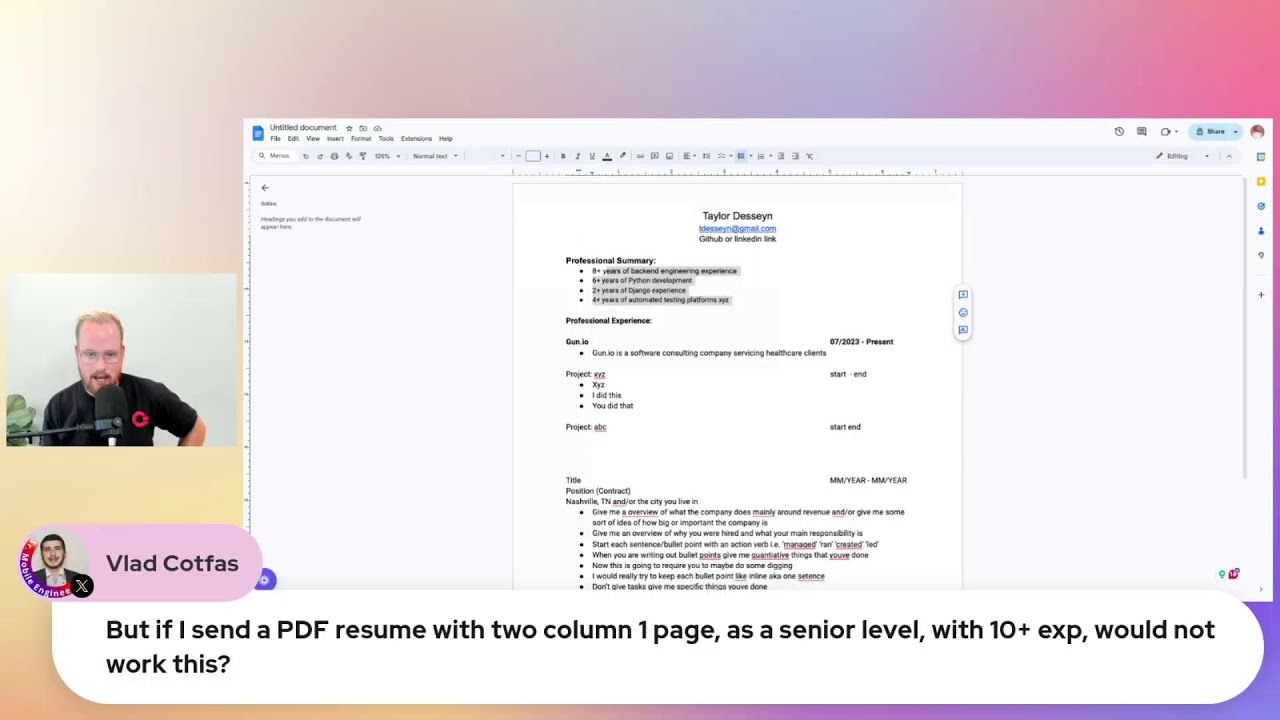
In this solo livestream, Taylor Dessein walks viewers through practical, tech‑industry‑focused resume advice. He begins by emphasizing networking through live streams, DMs, and community engagement, then critiques generic resume‑writing services and urges seekers to find writers with domain expertise. He details optimal header layout (name, email, optional phone, GitHub/LinkedIn links, appropriate font size) and advises against oversized fonts or unnecessary footers. Taylor stresses tailoring the professional summary to each job’s required skills and keywords, noting that recruiters often scan for years of experience and specific technologies. He outlines the experience section format: include month‑year dates, remote indicator, concise company overviews, clear role responsibilities, action‑verb‑led bullet points, and quantitative impact metrics. He warns against wall‑of‑text paragraphs, recommends one‑sentence bullet points for mobile readability, and suggests using a clean, single‑column layout. For contractors or consultants, he shows how to list multiple projects under one employer without confusing the reader. He provides page‑length guidance (1‑1.5 pages for junior, up to 3 pages for senior/lead roles) and font size recommendations (no smaller than 10.5 pt, Roboto works well). Throughout, he touches on ATS considerations—using relevant keywords and avoiding excessive links—while interspersing live‑chat interactions and sponsor shout‑outs. The session concludes with a quick recap of the key resume rules.
Chapters
Good morning, good morning, good morning everybody. Happy Tuesday. Good to see y'all. Comment, say hey, we'd love to hear from you. Got the music going. I don't know if y'all can hear it. If I can even do like this, y'all hear it? Yeah. Good to talk about resumes today. Excited to hang out with y'all. So you're like, Taylor, I thought Brianna was going to be on the show today. Well, she was. She had internal meeting come up. So, uh, all that being said, um, It's just me today. Brianna's coming on Thursday. Brianna is coming on Thursday on the show, so excited to hang out with Brianna. But today we're going to talk about— basically going to talk about how to, uh, how to build a resume. So please say hey, we'd love to hear from you. Glad to be with y'all this morning. The reason why I tell people to engage and say hey is this is really the way to network, you know, unless you go to conferences and meetups every single week, which probably not. Uh, showing up to people's live streams, especially in an industry like tech kind of that you play in, this is really how to do it. So please say hey, we'd love to hear from you. Uh, network, network with people, right? I tell people all the time, like, slide into the DMs, um, of those people that are hanging out. I tell this, like, literally, like, if you have stuck with me for 4 years and DM'd with people that have commented on every single show and have DM'd with every single speaker I've brought on the show and DM'd with every single founder I brought on the show, my other podcast You would have a pretty expansive network at this point. So please do that. Please say hey, we'd love to hear from you. Let me know where you're tuned in from too, by the way. I always love knowing where people are tuning in from, especially some mornings I feel like the show is more global than others. What else? I wanna get to— so it's great to see y'all this morning. Awesome. Got the crew today. Getting a lot of X comments this morning. That's a good sign. Let's see here. Making sure I'm live on LinkedIn. I am, of course. Shout out, also shout out Appwrite. Great t-shirt, got this at Render. So, um, uh, let's see here, what else? Want to give a shout out to obviously Gun.io for sponsoring the pod as always. Uh, you know, listen, we've done some pretty cool stuff lately on our product platform offering, making it easier to hire developers from our platform. So go check us out, Gun.io. If you're a developer, listen, I mean, listen, our kind of our sweet spot is 5 years of experience plus. Um, but, uh, if you're a 5+ year developer, And are looking for a job, would love to have Gun.io as a resource for you. So head on over, fill out your profile. We'd love to have you on the platform. Again, like, we're just, we're just one of the many tools, right? I never— I tell people right now, like, with this job search right now, you should never just rely on, like, on one thing. You should rely on— you should use a lot of different tools. So I would say we are one of the many tools in your tool belt for the job search. Also, shout out to Endorsed AI. Listen. If you're a recruiter or hiring manager that watches now in the future, typically when candidates submit their resumes to job postings, the people on the other side, especially recruiters— I've been on that side— we search just on timestamps. So we either search on most recently submitted or oldest submitted, and we just go chronologically. What Endorsed.ai does is it plugs in your ATS and it sorts the resumes based on relevance to the job. So you're actually getting the best person. Because if I'm having to sift through 300 resumes, And the best resume is like number 150, smack in the middle. I may not even get to it. But now with Endorse AI, you'll be able to get those searches to the top, which is incredibly important, especially in today's market. So go check out Endorse AI. Tell them I sent them your way. Uh, what else? Um, I think that's it for now. A few more people tuned in. Eric, it's good to see you. Do I hear some background? Yeah, yeah, there's some background. There's some vibes going on. Try to have some vibes dance. Good to see you. Hopefully Montreal is great. All right, so let's talk about how to write a resume. Let's go ahead and dive in this morning. Again, if you have any questions, please ask them. I'm gonna go ahead and share my screen. And again, so here's what's great about resume help, LinkedIn help. Everybody has a different opinion, right? So like literally you could shop my opinion around and like, you know, Dan may disagree with some of the stuff I say, right? And that's okay. But so what I would do is like when it comes to resume writing, I would definitely like, work with people in your industry that have been in your industry. I think kind of a blanket— Richie, it's good to see you, buddy, always. You know, I see a lot of resume writers out there and that say they're a resume writer. And what they do is they have this stock template. And typically every single resume writing service that I've seen is not good. They typically put way too many words in the mix. It is just a wall of text. So my recommendation to you is if you want to go out and find somebody, a resume writer to help you with this, I would recommend finding somebody in your industry. You know, I don't publicize this a ton, but I do do resume reviews, LinkedIn reviews, and kind of some career coaching. So if you're interested in that, DM me. But I'm really good in the software space right now. I have helped my dad in the restaurant industry write a really good resume. Did he get the job because of the resume? I mean, I don't know. He got the job because he networked the way I told him to network, but the resume did help. So I would highly recommend to find folks in your industry. So if you're a software developer and need your resume written, you don't want to use me, I would find a resume writer who specifically has deep experience writing software engineering resume because it's— it's— they, they need to know what the hiring managers look for. So that's kind of my rant around resume writing services. Be careful with them. Um, it's usually kind of a, a quick way for folks to make money, and you technically don't really need to be qualified for So, all right, I'm gonna go and share my screen, um, first and foremost this morning, and, uh, we're gonna go into it. So we talked about this briefly yesterday, um, but I do want to dive into it again, so I'm gonna pull it up right now. Uh, it's good to see you this morning, my friend. It's great to see you this morning. All right, so let's, let's go to resume. So first off, make sure, uh, you leverage the header for your name and contact information. Listen, folks, some of y'all Just Not Robin, I don't know who that is, but just be on the lookout, Dan, be on the lookout for that. And then you both, good to see you. So make sure you leverage the header portion, right? There's so many resumes that I see day in, day out that like kind of don't use this part up here and like start the resume, like start the resume stuff down here and it takes up room, right? You really want to keep your information up at the top, keep it clean, keep it short. Don't have big bullet points because I want to get as much information on the first page as humanly possible. A lot of y'all do like y'all's names like, like a gazillion point font, right? Like, I mean, I'm telling you, some of y'all are out here like this, and then literally you do like— I mean, I'm, I'm not kidding. I mean, it's like 30 font like that. Listen, like, I don't, I don't need that. Like, I don't, like, I, I don't need— your name does not need to take up that much information. Again, I think 14, 16 point font. I know there's different theories around this, um, but like, keep it short. Also too, a lot of people ask me, it's like, I wouldn't even include your, um, phone number. Or somebody posts on TikTok— I'm doing this on LinkedIn Live, so head over my LinkedIn Live. My, uh, link is on my page. So head on over my LinkedIn and watch us on LinkedIn Live or YouTube or Twitter, pretty much anything but TikTok. TikTok doesn't do really good integrating. I, I would personally just do email unless you want to get blown up with calls. For me, I do much better if I can like track everything like in a single like way. So like if I'm getting calls for a job and like, and I get flustered, sometimes I don't do the best at like recovering. So what I would do is I would just put your email and have everything kind of come through your email Another thing that I would do too is, let's see here. So honestly, I would just do this. If you do have a link, maybe a GitHub link or LinkedIn link right here, right? I would say keep it simple like that. Very, very simple. And then we can, again, just keep it super, super simple. Um, let's see here. Uh, I'm guilty. Yeah. Uh, good morning, it's good to see you. I'm guilty of using 36. Yeah, you don't listen, uh, but like, you don't need to scream at me, right? You don't, you don't need to scream at me at all. Um, a Google Voice number is also a great way to have, uh, your phone number. I love that, love that as well. Um, uh, my name and number in the footer, but I hate it. I wouldn't put in the footer, Chris. I would put it on, on just the top right here, right? I think put it, put it in the header. Next thing that, moving on, that I talked about yesterday, professional summary and then professional experience. Like in my mind, and also some of y'all just get crazy with bolds. Like you don't need a ton of bold text around here. I would just use bold to break up kind of the, I would break up the portions using bold text. So the professional summary experience, I would use this experience to basically outline your career. as it relates to the job you're submitting to. So a lot of people are like, you should change your resume for every single job. Listen, the feasibility of that is like almost nonexistent, right? It's almost impossible to change your resume for every job you post. But for the professional summary experience, if your professional summary lines up to what I'm needing in my job, I'm not even gonna read the rest of your resume. I'm gonna call you immediately, right? So I took this example yesterday from a job description. They're basically looking for backend Python engineering. role. So I just made this up, obviously. Let's say I have 8 years of backend experience. This position needed Python development, at least 4 years. Well, I have 6 years of Python. Then they were looking for solid Django experience. Let's just say I had 2 years of Django and they were looking for automated testing platforms. So I said, hey, I have 4 years of automated testing platforms. So again, what I would do right here is for every job that you submit to, change the professional summary as it relates to your career and the must-haves or required in the job you're submitting to. The, uh, the where I pulled this from, and Dan can attest to this, when we were— when we recruit and we submit to hiring managers, we literally— all hiring managers want to know is how many years of experience do you have with the required skills, right? So if you can just jump that and just put that in your resume, that's going to make you have the callback way more than not. Um, uh, Uber comes in here. Do you think including Linktree? I mean, you can, but here's the deal, man. If, if I'm looking at your resume, I'm not really going to necessarily look— I'm not really necessarily going to look for like you to click on— like, if I'm looking at your resume, I'm not looking at all your socials, right? If anything, I would include your GitHub and/or your LinkedIn. I think Linktree is overkill, but I don't think it's going to dock you by any means. I would just I would be careful to not put a ton of links in your resume. I don't know if this is true, but I know a lot of times it doesn't do well in the ATS kind of reading if there's a bunch of links. Of course you are, Kelly. We are the same human being. Please stop copying me. That would be great. All right, so, and then let's dive into professional summary of professional experience. So again, right, this is not the end-all be-all, but the way I would write your job is company, Tab over month, year, month, year, right, for start and end date, right? Always include month, year, not just the year. I would put your title here. And then, um, if— I mean, back in the day we used to put city, state, but now that everything's remote, I would just notate if it's remote here. Or if you are local to that and have to go in town, I would put obviously Nashville, Tennessee, and/or the city you live in. All right, so let's, let's move on to the next bullet point of what I'd like to see, right? So the first bullet point is, um, give, give me an overview of what the company does, mainly around revenue, and/or, um, give me some sort of idea of how big or important the company is, right? So again, if, if you're not working for a FAANG or Google, or if you're not working for a FAANG company, I, I— most people probably don't know what it is, right? So for example, my last company, Vaco, right, we were a billion-dollar staffing organization, right? Like, that— those are big numbers, right? That is not— that is not a startup staffing company with mom-and-pop numbers, right? That is a huge enterprise environment And that looks, that looks good on paper because I've worked in a, you know, high-performing, you know, enterprise, a billion-dollar organization. That brings a little clout. Okay, this person has been there, yada yada yada, right? So give an overview what the company does. Like, as recruiters, a lot of times we are given, uh, requirements like, hey, we really need this person to have healthcare experience, right? Well, if you just put your company the company name and you don't describe what the company does, I'm not gonna Google your company if I'm looking at your resume. So if it's a healthcare startup, say, I'm working for a healthcare startup that's trying to solve XYZ. So that way, if I'm a recruiter and I'm looking at developer with healthcare experience, I can find it, right? Again, incredibly important. The next thing I would do is give me an overview of why you were hired. and what your main responsibility is, right? So like for me, like what I, yeah, exactly, Steven comes here, don't assume people know about the company you're working at. Yeah, 100%, and again, right, like if I'm looking for a software developer with healthcare experience and you don't include that the company you're working for is a healthcare company, I could maybe look over your resume, right? Again, like you need to have all this stuff you know, in front of you. Um, so, uh, so obviously, and then give me an overview, right? Like, hey, uh, you know, here's the overview of the company. I was specifically hired to come in, you know, let's just say Gun.io, use me for example. I was specifically brought in to help grow content, community, and drive revenue back to the business, right? So again, I'll give you an overview what Gun.io is. We're a talent marketplace where we have our own platform that we have built to help connect hiring managers and developers faster. My second bullet point would be, I was brought on to do XYZ. And then the rest of the bullet points needs to be, so start each sentence, sentence slash bullet point with an action verb, right? So i.e., managed, ran. Created, you know, led, led, led, right? So like, again, I need like, I did this, right? Led, you know, led, you know, led initiatives to start virtual meetups for Gun.io, right? Like, need to have action verbs. I need to know exactly what you've done, right? Um, uh, next thing what I would do as well is, um, uh, also when you are writing out bullet points, give me quantitative things that you've done. Now this is going to require you to, uh, to maybe do some digging, right? So like, I've talked with a few developers. What up, Trey? It's good to see you, buddy. Um, I've talked with a few developers like, Taylor, I don't know how to find like how many users use the application I'm working on, or I don't know how much revenue that my application I'm working on is driving. Well, ask somebody, right? And, and, and, and, and just casual stuff, right? Like, like legitimately Just ask. Ask your product owner, ask your manager, like, hey, I'm just curious. I've been doing some thinking. Because I mean, listen, if you go to them and be like, hey, I'm rewriting my resume. How much revenue does our app make? That's obviously gonna trigger some red flags with the hiring manager, right? So I would just say, hey, I've just been curious, how many users or how much revenue does this app that I'm working on drive or something like that? Again, do some digging. Also too, like one of the biggest issues I see is like it's just a wall of text. I would try to, again, this is just my 2 cents, people may disagree. I would really try to keep each bullet point like, inline, uh, aka just like one sentence, right? I, I, I think it's a lot cleaner if like you can just read it. And if you have like multiple bullet points where it's like 2 to 3 sentences under the bullet point, it gets a little wordy. Challenge yourself to, to keep it one sentence on like a single line and be as quantitative as possible. I think that's a really good rule. If you can write specifically what you've done in one bullet point and it's quantitative, to the point, that is gonna be way more effective than 3 bullet points of just word vomit, right? Another thing I would add too, especially from a development perspective, so don't give me tasks, give me, you know, again, give me specific things that you've done. So instead of saying, hey, I've built a You know, I was a part of a team that built a platform using React, right? That tells me nothing about what you've done. What I would say is, I work on a 10-person team creating a highly scalable SaaS application, driving $1 million in revenue, And my responsibility was specifically using React to implement blah, blah, blah, right? Like get quantitative. A lot of folks write resumes and it's just like, it's so broad, right? Like you don't talk about yourself, you talk about the team you're on and that's just going to hurt you. Can you teach me how to use ChatGPT? Don't use ChatGPT to build your resume. I'm just gonna say that right now, or do, I don't know, I don't care. Dan brings up a really interesting idea I have never thought about. Assuming most emails and resumes are being first consumed on a cell phone, it's estimated that 50 to 60% of email opens come from mobile devices. And okay, I didn't even think about this. So Dan, thank you for bringing this up. Again, I mean, keep it short, keep it concise. If you have a wall of text in your resume and I'm trying to open it on mobile, I'm gonna delete it immediately, right? If you're looking at this resume right now, this resume is a lot more consumable on mobile. than I would imagine than most of y'all's resumes with like long, long paragraph text, right? Jordan comes in here, if you're a contractor and the contract renews with a different company, but you're still working the same position at a new company, how would you put that? Let's see if, yeah, so Dan comes in here and says, so no block of text, 100%. And I'm sure Dan's seen this constantly. A lot of y'all just write paragraphs, like bullet points, bullet points is key. Let's see here. I wanna go back here. So if you're a contractor, the contractor news with a different company, we're still on the same, right? So what I would do, Jordan, in this instance, so I would put company. There's many different ways to do this, right? So let's do, so let's say this was one position right here, right? So let's do, all right, so let's say you work at, so let's just say, let's say Gun.io is a software consulting company. Right? And then let's just say, you know, I started July 2023, and then I'm still here, right? So what I would do is I would do like, um, if you're a consulting company, I would do like, uh, Project XYZ. And then what I would do is then I would tab over and I would do start end date right here. And then I would do, you know, XYZ. I did this, you did that. And then I would do Project ABC, start, end, right? So, so, so what it does, and what I would do is I would bold Gun right here and then not bold these so, so the user's eyes don't think you've had multiple positions. And then, and that way I can say, all right, gonna gun.io Taylor's worked there for the last year, and then Project ABC lasted 6 months, Project XYZ lasted 3 months, and then that way, you know, you can easily, easily read it. Let's see here. Christina, yes, absolutely. You need a personal brand that stands out from your team. Yeah, again, don't talk about your team or what your team did. Talk about what you did. No weird columns. Yeah, I mean, Kelly and I've done a talk, kind of a general talk on this. Check out my YouTube Um, because, uh, we talked about it on my YouTube. Uh, Kelly and I presented about this at Connect Tech last year. Um, but yeah, no weird columns. I don't know who's out here teaching kind of the column thing, but it's just, it's just a wall of text. Again, going back to Dan, it's just another block of text. Uh, quick hit bullet points. Um, recruiters are lazy. Give us enough, uh, uh, give us just enough to want to keep reading. Yeah, 100%. Quick hit bullet points. Recruiters are lazy, 100%. I need to know exactly what you do immediately. Let's see here. Jordan Rice, if it's for one of the client, I would list a single position on a PA, 100%. Make it clear this is a consulting gig in the description though, easier as a hiring manager to see. Yeah, 100%. So like what I would do is like, you know, so again, Gun.io, you know, I would do right here, you know, Gun.io is a software consulting company servicing, Um, healthcare clients, right? Um, and then what I would do is I would do project this, or, or if this is a contract role, right? So let's do this down here. Um, so let's just say this is another role down here. What I would do here is if it's a contract position, I would do contract like that. That is, that is what I would do there. Um, is it true, uh, let's see here, is it— oh, my StreamYard's not working. That's kind of weird. I can't pull up your, uh, I can't pull up your comment. Um, Dan— Don, I can't pull up your comment. Is it true that a lot of large companies are using software now to scan resumes? Uh, I mean, here's the deal, Don. I mean, I— there you can A lot of companies' ATSs, and I've never worked internal, so like somebody can correct me if, if I'm wrong on this, the ATS is just people, right? It's literally just people, um, looking at your resume. I do believe that you can set some parameters in the ATS to reject resumes based off not enough keywords. Uh, I have no idea what happened. Are we back? Yeah, yeah, I've— yeah, literally StreamYard just went out on me. Are y'all there? Are y'all there? Lost connection. Yeah, yeah, I can believe— please comment, please comment. Yeah, StreamYard literally just died on me. I have no idea what happened. Are we back? We're back now. Okay, all right, that was crazy. I have no idea what happened there. That was, that was wild. It literally just stopped on me. All right, so I have a call here in 3 minutes, but to recap, let me— so I'm gonna go back and share my screen real quick. So again, to recap, y'all, let's not kill it with bullet points, keep it very simple font, a lot of quick hits, try to keep your bullet points like in a single line to hold you accountable to not ramble. Always put month and year for start. If you're in a position where there's multiple projects, set it up like this. Um, uh, let's see here. Dan comes in here, goes, you can reject resumes usually based on knockout questions. Most ATSs have zero functionality reject based on resume. Okay. All right, awesome. There you go. Awesome. Cool. Sweet. All right, y'all, I know that was kind of random. Uh, let me know if there's any questions. We got 2 minutes left. Let me know if there's any questions. But I would say that's it at a super high level when it comes to what's the smallest font size. I mean, here's the deal, right? I mean, this is 10.5. I mean, I don't know, I probably wouldn't go smaller than maybe 10.5. Again, this maybe, yeah, I mean, this is 10.5. I probably wouldn't go any smaller. I mean, maybe if you wanna do 10 to maybe fit a little bit more on your page, But again, keep like this Roboto font's pretty good in my opinion. So again, just be aware of how it comes across, right? I'm glad this is helpful, but if I send a PDF with 2 columns as a senior level, would not work this? I would not have a 2-column page, Vlad. It is a wall of text. The problem I see, and honestly, I could do another resume with senior developers or senior engineering leaders because It just is kind of a mess. But when it comes to a lot of leadership resumes, a lot of y'all have just like a, just a ton of words and there's no bullet points and it's just, it's just a lot. I will, I will tell you this. I would just keep it, I'd get rid of 2 columns. It's okay to go over more than a page, especially if you're a leader in tech. And yeah. That's what I would recommend. How many pages do you recommend with all these details? So I would say at most, if you're a senior developer or senior engineering leader, I would say 3 pages max is probably the most you should do. If you're like, if you're junior to mid, I would say like 1 to 1.5 pages. If you're senior, I would say 2 pages. And I would say if you're above senior, around 3 pages. There's no reason to go more than 3 pages. And even then, if you do 3 pages, I'd probably only like go into the 3rd page, if that makes sense. So, all right, y'all, I got a call. I appreciate y'all. Sorry about that. That was crazy that it died. Hopefully you got something out of this and I will see y'all in 2 days. Peace. Peace.
More from taylor



tech doesn’t have to be the only thing that brings us together #techcommunity #techcareer

I want to give back to y’all that make the tech community so great #jobsearchtips #techjobs




spend a little time investing in yourself #linkedin #linkedintips #careeradvice


