
In Demand Skills in Today's Market w/Founder Ken Schumacher
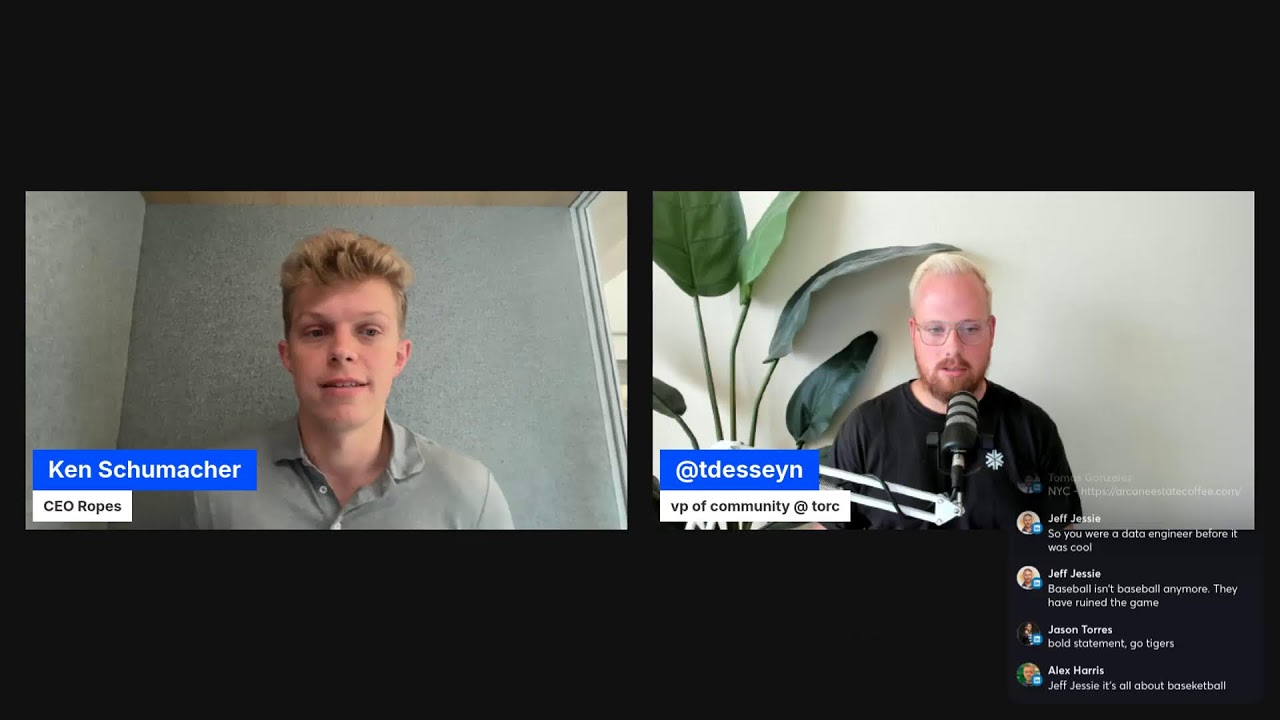
In this 2025‑08‑27 live interview, host Taylor Desseyn chats with Ken Schumacher, founder and CEO of Ropes, an AI‑powered assessment platform. The conversation weaves personal anecdotes (New York office near Margaritaville, coffee preferences) with a deep dive into the rapidly shifting tech hiring landscape. Ken explains how traditional interviews and Scantron‑style tests are being replaced by AI‑open assessments that let candidates demonstrate real‑time tool proficiency (e.g., Claude, GitHub Copilot). They discuss lagging vs. forward‑looking hiring indicators, the rise of AI‑first skill sets, the “framework wars” analogy, and how companies balance fundamentals with AI tool fluency. Practical advice is offered on resume building (listing AI tooling experience), community engagement via Torque, and the cultural fit of an all‑in‑office startup. Ken shares personal career reflections, the importance of iterative learning, and rapid‑fire insights on hot technologies (React, .NET, Rust, Go, data science) and personal habits (cold brew, sleep tech). The session ends with encouragement for job seekers to “hack their days” and continuously experiment with AI tools.
Chapters
All right, got that, got that, got that. Got alert, alert the troops. All righty, uh, sweet. Well, how you doing, Ken?
I'm doing great, man. It's good to, uh, to be here this morning.
How's New York? How's New York?
New York's good. Uh, honestly, New York's perfect right now. It was, uh, about as hot as it gets a couple weeks ago, so if you asked me then, it would have been a different story. But, uh, no, man, everyone's in good moods. Uh, morning runs, you know, the whole, the whole nine.
And so I gotta ask, are you part of a run club? Are you part of the Pinted Run Club?
I'm not a part. We've jammed out. I love their videos, but no, I'm not, uh, not subscribed. I do my own thing. But, uh, no, man, the city is, uh, is, is alive right now. And our office is, uh, like 40th and 7th, so we're, uh, Times Square of Times Square. If you know Margaritaville in New York, we're about 2 doors down. Are you serious? Yeah, you want to, you want to talk New York? Um, it doesn't get, uh, it doesn't get a lot more electric than where we are.
So for better or for worse, yeah, it doesn't get any more electric than Margaritaville at Times Square.
No, it doesn't. That's where all great work gets done.
So yeah, 100%. Nothing about posting up with a little bit of a margarita and, uh, some vibe coding, you'll be good to go.
It is, uh, it is genuinely hilarious when you hop out at, you know, 10 PM from the office and you you're just thrown into a new world. But no, man, it's a blast. We're having fun.
I love it. Well, good morning everybody. We got some people tuning in. We're trying this live chat on stage, so, so, uh, you can see the comments down here. Um, it's good to see everybody. Ricardo, Teron, Mark, Richie, Sebastian, good morning y'all. Um, also want to give a shout out to my, uh, business partner Jason. He is, uh, we're hosting a pretty heavy, uh, heavy-hitting, um, panel today. Today at noon, actually. I wonder if I can throw it in the chat. Is that possible? I don't think that's possible. But anyways, yeah. So follow. So we're going to be live. Jason's going to be live. We're streaming with Leon Noel, Danny Thompson, and Quincy Larson of— and it's just going to be a great chat. It's basically the state of the web, which is really interesting because we're kind of going to talk about it here, right? Like the state of the market. Um, and kind of what's going on. So excited about this chat. You know, I, I've, I've started doing these lives, so, so an hour. Um, and, uh, so I, I, I've done these chats heavily every day for about 4 years. Um, which has been nuts. I've met so many amazing people. Ken is another guy I'm going to add to kind of my, uh, to kind of my, my, uh, my net— my, my network. Um, my tool belt is what I was trying to say. And, um, and so You know, and so lately, lately I've had to pull back. Ken and I were talking backstage. I had 16 meetings yesterday. That's not a brag. I'm not bragging about 16.
Sounds like a brag.
Yeah, it, it just— it, it got crazy yesterday. And so because there are days with 16 meetings, which is a new all-time record for me— 14 was, was the previous all-time high, um, to be honest with you, it was probably 18 because I've had 2 auxiliary phone calls after that— all I had yesterday was a protein shake. And so, you know, I was talking to Ken, like, I do run a business. I help run a division. And so it's not always yapping online. But I think one of the, one of the cool things about this and going to an hour has been getting to more meaningful conversations, right? The feedback on the hour sessions, I've gotten a ton of DMs, has been tremendous. So excited to kind of dive into Ken's hour and kind of what he's doing. But again, great to see y'all this morning. Again, we see in the comments, so keep commenting. Let us know where you're tuning in from. I love it. Anybody from New York, let us know. Again, Ken's by Margaritaville in Times Square. Um, a few housekeeping things as always. Uh, first and foremost, want to give a shout out to Appwrite. I am part of the Appwrite Heroes program. I always tell people I'm probably the only non-technical guy part of a technical heroes program. I love the crew. I love the DevRel crew. Um, I, I love what Appwrite stands for. Check them out. I know they've pushed a lot of new updates. Um, again, don't know what they really do because I'm not a coder, but I love their, uh, I, I love their people. So if you do Uh, reach out to them, tell them the Torque Boy sent you. Jason Torres, my, my business partner, is, uh, is an app right here as well. Also, listen, we do a ton of stuff on the Torque community, um, and I would love to have you a part of the community, right? So torque.community is kind of our community page. You can check us out, we'd love to have you. Um, obviously most of our chatter is in the Discord. I kind of tell people that, listen, like, our, our Discord has kind of morphed into like a massive friend chat at this point, which is really, really cool to see. close to 5,000 members in the, uh, Torque Discord, which is, uh, which starting 10 months ago we had zero. So it's been a huge growth on our end, um, and thankful for everybody who's involved. Also, if you want to be, uh, texted when I go live, shoot me a text. Um, this is actually my number. It's not some AI bot. I didn't vibe code anything. This is actually my number. Um, so, uh, shoot me a text and, uh, we'll update you on when we go live. And again, it's great to see y'all this morning. I see y'all, JC, Emre, Amelia, Jason, it's good to see you, um, again. And Devon, it's great to see you, um, from Dallas. I love it. All right, Ken, enough of me yapping. Let's give the people what they want, man. Who are you? What do you do? And we'll go from there.
Yeah, uh, man, I'm fired up. I guess this is like— I got my cold brew here with however many—
Hey, hey, where are you drinking from though? Where— like, like, like, there's a lot of coffee spots in New York. Where are we Not—
we're not sponsored. La Colombe is the official, uh, cold brew and coffee of, uh, of Ropes AI. We drink a lot of it. Uh, clean, good jet fuel.
Straight jet fuel.
Yeah, genuinely. Uh, you don't need it on some mornings like this, but, um, no, man, we're feeling, uh, feeling great. Should be a fun hour. Uh, yeah, my quick spiel. Um, so I'm Ken. I'm the founder and CEO of, uh, of Ropes. And Ropes at its heart is kind of a new type of assessment company. So my background is I'm an engineer, at least I was an engineer. They don't really let me write any code anymore. But back in the day, I was an engineer by trade. I worked at a startup called Retool, which maybe some folks in the chat have heard of. Shout out to Retool, one of those kind of hot Silicon Valley companies. And my job was awesome. I basically just got to build AI tools All day. So this was, uh, it sounds like a long time ago, really wasn't, but like ChatGPT, you know, uh, you know, GPT-3.5, GPT-4 had just come out.
That's too funny. We're dating AI now with like the—
Certain releases. Yeah. Yeah. Isn't that hilarious? Um, and people hated those models. I loved it. I mean, for me it was like, I was like a, you know, whatever, uh, fresh outta college. So, um, I didn't want to go write a bunch of like boring code and they sped me up and I kind of just got to become the AI guy where my job, I didn't really have a boss. I just kind of came into work and hacked on AI tools for as long as I wanted. And every now and then Ken will ship something cool and life will go on. So my job was like perfect except for like 2 hours a day, I'd have to hop in this phone booth and I was giving this kind of algorithm interview question to some smart Stanford grad and you know, the Stanford, you know, student, just like I would have like a couple years ago, would go look up the problem on Glassdoor and come into the interview and knock it out. And I'd fill out my little— and I was like, this thing's just so absurd, right? Um, so that's kind of where Ropes came from, is, is really doing really cool, awesome stuff out there working on AI tools. I had to sit through a lot of boring interviews. Um, it gets you thinking about the combination of the two. So yeah, um, that's kind of what led us to today. Um, The idea of Ropes at its heart is that we have interviews, which work. They're not perfect. They're biased. They're slow. But you sit down with an engineer, you get a good sense of who they are, what can they do, are they going to be successful in a job, that sort of thing. So there's interviews and then there's tests. And everybody hates—
Which everybody hates taking tests.
Everybody hates tests. You know, it's— and when you hear tests, think like Scantron, right? You got an hour, Taylor.
I haven't heard that word in ages.
Scantron.
Holy smokes.
But the beautiful thing about a Scantron is like, you've got an hour, Taylor. Go do— go fill in the bubbles. I'm gonna come back when you're done.
High anxiety, just making my palms sweat.
Oh yeah. And it's completion-based, right? It's like, I, I don't know how the hell you got to those, you know, 40 Bs and 30 As or whatever it is, right? It's just like, I'd look at what you got. In an interview, You're looking at what did somebody do? How do they work? It's, it's more holistic, right? Right. So the goal of Ropes is simple. It's like, take all of that quality of an interview and bring it to a test. Yeah. And, um, you know, there's great reasons, you know, there's like business reasons on why that's valuable for companies, right? But one of the things we really believe in is there's a lot of really smart people out there who didn't go to Stanford or pivoted into tech more recently or don't have the great, you know, background that you post on LinkedIn or whatever, right?
Sure, sure.
But they know how to do the job. And, um, if we can give everybody kind of the quality of an interview, uh, jobs should go to people who can do the task right, not the people who have the perfect background. So, um, yeah, man, it's been a wild journey. It's been cool.
So you guys moved into an office?
Moved into an office.
Uh, you gotta pull up the picture. You gotta pull up the picture. Pull up the picture. So that— this phone booth was not in existence last night, correct?
No, it, it was not. Uh, this was a bunch of boxes, so I just kind of—
there it is.
There it is.
Last night, Ken specifically bought phone booths for this live. Uh, yeah, yeah, Taylor, we're gonna be live with Taylor. We need to look good. We need a phone booth in advance.
You got to get the lighting. Um, no, I mean, our, our sellers are just Rejoicing today. I've never seen them so happy. It's like they need their, you know, their, uh, their space. But yeah, no, man, that's what startups are all about. It's been a lot of fun. I love it.
So, well, let's— there's a lot of angles. And again, I kind of— again, everybody tune in, welcome. I see all in the comments now. Now that we have it up on the live here, I can kind of see it more. So I'm not gonna— it's not quite as much of a moderating as it used to be, so I kind of like it. But it's good to see y'all. Yeah, Jason says, uh, Jason goes, uh, to be clear, uh, is a work pod in Margaritaville? Because if it isn't, why not? Um, and then Sebastian, our ambassador, comes in. Can you imagine the Torque fam working in office next to Margaritaville? We would get— I will say this, remote work has allowed probably the Torque team, community team specifically, to be more effective. Because if you got the Torque community team together too often, I think it would just—
Trouble.
It would be trouble, 100%. So a lot of different angles we can go here. I want to start out by the most important thing, and that's, you know, I said this backstage. I think there's lagging indicators and like forward-thinking indicators. I don't know if that's the correct term. That's just what I call it. Lagging indicators here are the Dice reports, the Indeed reports, the job salary reports, in-demand skills. Typically, by the time those are posted, it's a year in the rears. With the way tech is changing, it's It's super fast. So those aren't going to be the best things. I think one of the big things that you need to be talking to agency recruiters— we are in it, we see what's happening, we see the hiring that's happening. But also, I'm really excited to get Ken on because he actually runs a company that people are asking for assessments being built in real time that are— that like— that you're— that's— it's like a true visit. It's like a true— I'm having problems with words this morning, but like, it's a true insight into what companies are hiring for. So, Ken, can you just talk about the landscape of tech, what you're seeing, what, what you're being asked for, for assessment perspective, and, and let's just go from there.
Yeah, let's do it. Um, yeah, it's kind of a cool position, right? Uh, and I think, um, you know, a lot of our users are recruiters, right? Yeah, right. Uh, we're right there in the trenches with them in terms of those the people who are knowing first what's coming. A, it's They're the ones in the ears of hiring managers who are asking for these things right off the cuff, right? And B, they're the ones kind of delivering that message to candidates. On the other hand, we get candidates who come to us and say, hey, like, where should we be going next, right?
Yeah.
So it's kind of a privileged position to be on the forefront, right? And part of that, again, is like, we try to be the best in class for our customers, right? So, you know, staffing firms, companies hiring, that sort of thing. And for the candidates on the platform, it's a little bit weird kind of having 2 sets of customers at the same time. So yeah, I guess TLDR is like, it's a cool position and one that we watch pretty closely. I think a few things come to mind. First, positions aside, is like the pace of all this stuff. So we are seeing trends like on an order of weeks, not on an order of months.
Really?
Uh, yeah, I mean, this thing is moving really, really fast. And one of the big believers I'm in is like the cost of building software is just dropping, right? And as that happens, kind of the whole cycle starts to speed up. And, uh, it's one of those things where like you never know, like when you're on an exponential, you never like have the feeling that you're on an exponential, but you can see it a little bit.
Yep.
Um, so yeah, the quick answer is like it's changing so fast that I'll give you an answer this week and it'll be outdated Um, for next Tuesday's podcast. I know, seriously, seriously. Yeah, the big push is AI, um, and everyone's tired of that word, but I think there's AI kind of on 2, um, kind of like 2 different paths. The first is, uh, how well can you drive AI tools? So it's weird because this skill is never, is never necessarily someone for like, I want someone who can use Cursor really well, or someone who has been using— it's always like, I want a great .NET developer. But then when they're evaluating .NET developers, they're looking for like, do you use Cursor or whatever? I'm sure that's probably stuff that's being talked about in the community is like how well you can drive these tools.
Yeah. What are companies wanting? Because I want to go down this rabbit trail hole a little bit, whatever you want to call it. Like, what are companies wanting from an AI perspective? Like, how, like, the people who are watching that, and we got some questions coming in. If you have any questions for Ken around the state of tech and what you're seeing, please ask them. We'll get to them here in a second. But like, like, how are assessments being created to judge a .NET developer with AI? Like, like, like, what's those conversations like?
Yeah, so one of the more recent, uh, kind of developments we have here is like AI Open Assessments and Roast is in an interesting place because some of our customers still are not as AI forward as we'd want them to be. And that's totally okay, right? Like, if I'm in a highly regulated industry, there are reasons why I can't just let contract workers drive, you know, Claude code across all my, like, prod DBs, right?
Yeah.
So for those customers, we have to be very careful on, like, there's skills that should be evaluated without AI, right? And we need to, not necessarily lock down the browser, but be conscious of where and when people are using outside sources and how they're aiding a solution with that. And we can— that's a whole separate topic, right?
Sure.
There are some companies though that want these skills. They either are okay with people using AI tools. It's like, I'm going to hire the best .NET developer. And if that's a developer who uses Claude really well, amazing, right? Or we have customers come to us and say, no, I specifically am looking for developers who can drive these tools really quickly. Right. Interesting.
Okay.
Assessments today aren't really set up to look for that, right? Correct.
I know. Yeah, yeah.
You know, you take a LeetCode problem or one of these classic tests and plug into ChatGPT, it's going to give you the answer, right? So, uh, I'm not really testing how well you can drive Claude if you can do it in one prompt or whatever, right?
Correct.
So, um, one thing that we've been developing is what we call AI Open Assessments. So these are assessments that instead of locking it down and, you know, promise to me you won't leave your browser, all that stuff, it's like, go crazy. Uh, I want you to, to run with AI. Uh, like, remember to use these tools, right? Um, and instead, let's look at how fast you can drive these things.
Yeah.
Um, I think that's kind of where a lot of development is going. So we'll give like a frontend project, for example, and it'll be like, here's the dashboard, I want you to build a feature with it. Go ahead, plug the whole thing into Claude, like, you know, drive these things however you want. And those tests are really cool, right? Because there's some folks who have used these tools quite a lot and they can pick up a project like that and get moving really quickly. And anecdotally, what we see from hiring managers is, man, do they love that, you know, as someone who's just got that gusto and can get after it quickly. So yeah.
So, okay, so I wanna pause and the comments are outta control here this morning. We've obviously struck a nerve.
Love it.
First off, before we, before we get to some questions, so you're kind of seeing 2 types of tests coming in right now. You're seeing, hey, we don't want AI, we just want to test on the fundamentals of C#, .NET, or React or whatever.
Yep.
Then there's other companies coming to you and be like, hey, we actually are a very forward-thinking AI-first company. We want to develop a problem and then essentially have a person develop it. Are you guys in your product like, helping judge how they do it? Like, how does that work?
Yeah, first I'll say it's not just like the new startups asking for that. Like, we have like Fortune 100 banks who are like, give me the AI skills. So it's like, really, really cool to start to see the permeation, right? Okay, now there's a lot of opposing forces. These companies are large, there's different opinions within an enterprise, so it's all scattered. But, uh, you— it's very cool. And this is what I meant, like, we're on the edge. You can feel the, the permeation day over day. So, um, yeah, the way Ropes works is we don't have like a library of like canned assessments on the platform. So—
Right. Everything's kind of custom built for you guys.
Everything's custom. Yeah. So, uh, we're never gonna give somebody like a hello world and say, uh, you know, write me hello world in Python. Because again, you could plug that into ChatGPT in one prompt and—
I mean, I could probably do that.
Dude, it's also just like not interesting. Like, uh, you're a candidate, you show up, you're just like, man, you know, like I gotta write another like reverse linked list or whatever. Yeah. Yeah. Um, I certainly didn't enjoy those days, so we don't want to bring that back at all. Sure. Right.
Sure.
So part of, to answer your question, part of the experience is like putting people in interesting situations.
Okay.
And then the second part is like helping judge. I don't really like that word, but helping kind of show hiring managers how people reach the final solution. So if you're driving Claude code, we want to show you, hey, they used AI at this part, this part, and this part, right?
Interesting.
Okay. Um, okay. And a lot of it is to credit the developer, right? Think about kind of how, where we started, Scantron versus interview. Well, the cool thing about an interview is like, I actually don't care if you get to the final answer.
Right.
That's not really what's important. What's important is like, did you know how to approach it? Did you reach for the right tools at the right times? Right? That's the goal of Ropes is like, let's watch the hour and show hiring managers why this person might be a good fit. It's not just that they built a perfect front end, right? But they had the right instincts and tendencies. Um, we wanna be on the candidate's side and say, hey, we love Taylor, not just cuz he can solve problems, right? But because he's got all of these instincts. Um, and, and that's kind of what Ropes is all about.
I love that. I wanna get to a few questions here.
Let's run it.
Uh, let's see here. Um, Emre comes in, uh, he's a really active member in the Torque community. Do you think we're in a framework wars era? Do you think we're in the framework wars era of hiring? Like every company thinks hiring sucks and it is hard and no other platform is good. Let's create one, which leads to a billion of these. Interested to hear your thoughts on that.
Yeah, I'm Switzerland for what it's worth. I love that. Yeah. So I think for what it's worth, I think like ambition is a good thing, right? So if a lot of people are like, hiring sucks, let's improve it. I'm all ears for that.
Sure.
Part of at least our strategy is like, I'm not good at everything, right? I'm actually not a recruiter. I'm an engineer. We have a team of engineers, right? Um, I think recruiting— ironically, we're a software company in the space, right? But I think like recruiting at the end of the day is human to human, right? So, amen. Um, you see a lot of startups trying to throw out, um, you know, agencies or staffing firms or recruiting firms or whatever, and I think that's a fine approach. For us, it's like, let's leave the human part to humans, um, but use technology to help them where they might not be quite as strong, right?
Sure, sure.
Um, so, uh, Yeah, I think competition in like every industry is going up as the cost of software decreases. Um, but, uh, no, I don't think everyone's kind of has the goal of building a platform. We don't, right? We just try to empower the folks who, who know recruiting really well.
I would say, I mean, Emre, my, my hot take on this is I feel like we're actually on the other side of framework wars. Like, my hot take is like the framework wars happened like 5 years ago, right? We had Vue come out, we had React come out, we had Angular kind of 2.0+, right, with TypeScript. Like, we had, we had all this. I feel like now that the internet is kind of morphing into kind of this one thing where— and I think a lot of that's being led with AI. That's just what I see. I'm not saying I'm right, but I feel like the framework wars were like 5 years ago. That's just my take. Kenny, any thoughts on that?
I think it's a good one. Um, again, the world's changing really fast, right? But, uh, I will say the energy feels really collaborative. One of the cool things about the opportunity right now is like, uh, I don't know how to say this bluntly, it's like there's, uh, kind of— there's like problems that you can solve to like financially make a lot of money, right? And then there's like problems that are like morally good for the world. And one of the cool ones is that if we can help people fit into the jobs that they care about you're kind of doing both, right? Like, companies are, are super excited because they're finding great talent faster for cheaper, and people are getting jobs, right? So, um, I think that's a big reason why we're all, uh, you know, building phone booths late at night in the office or, uh, all grinding here is it's like, it's a rare moment where those 2 axes are kind of aligned. Um, and obviously we're trying to build a great business, but, um, you're also kind of doing a lot of good too. And it's very cool to obviously hear all the stories of people getting jobs through the platform or, uh, you know, successes of, of our partners like Torque. So, uh, no, man, it's cool, cool, uh, space to build in.
And I think too, Emre, like, um, uh, he goes, yeah, like, not literally saying we're in framework wars, saying we're in a similar era with hiring. Oh yeah, yeah, yeah. Oh yeah, going back to Emre's thing here. Yeah, where I'm not saying framework wars, saying that we're similar. Yeah, I mean, listen, I think I mean, hiring platforms have, have been out there for a while. I would say what people are realizing is that to scale hiring across the globe, you kind of need more of a platform. But then that's where I think when we say platform, then we go into community building, which is obviously, you know, Emre, which is what we do at Torque, right? I think I think there are a lot of platforms out there. I think now, just with the way the market's moving, I think, yes, I, I do have to say, I think, I think there are more hiring platform wars happening. But again, that's why, you know, you, you can go to Upwork and get a job, but do you feel part of their community? Probably not, right? So, um, want to get to some more questions here. And again, I love the questions. Um, also another thing too, going back to the framework wars, even though Emre wasn't referencing this, If you watch Aaron Francis's keynote talk from Laracon in Denver this year, he talked about how the age of the web is moving towards pragmatism, which is just shipping things well and fast, right? And I think that's why Laravel is pushing a lot of things to help their developers ship fast and high-quality code. So I think that's just kind of— if you have not watched that, go to Aaron Francis's profile and find it. It's a great keynote. Another Jeff Jesse, one of our ambassadors, companies don't know what they want from AI developers because they don't know what they want from AI. Thoughts on this, Ken?
Yeah, I think this is mostly correct. What comes to mind is, again, like a lot of people don't know they want AI necessarily, right? But they want the best .NET developer. And it just so happens that the best .NET developer is the one who knows how to use an LLM. A lot of it's tied. I'm not saying I want AI, it's like I want .NET, and then so happens that person who can drive .NET really well wins. But I agree with the take. Part of it is just like the ground is shifting so fast, at least like the larger enterprises where ROS gets played in a lot. It's hard for a large bank, for example, to plan a 2-year AI initiative.
Right.
Yeah. runs too quickly.
So yeah, I agree.
Should change. But yeah, I mostly agree with the take.
Let me ask you this, and this kind of gets into— hold on, let me, hold on, let me get— I'm getting ahead of myself here. What's, uh, Jamie comes in here. What's interesting to me about the mention AI tooling is that I'm seeing a lot of engineers who specifically don't want to use AI tooling.
Yeah.
Yeah.
Yeah.
So what are your thoughts on this? I feel like you're gonna have to. So, so I presented this in Raleigh at All Things Open, the meetup I, I spoke at. It was a 17-minute talk. For the record, it's very difficult to give a 15-minute talk and be coherent.
Oh my goodness.
Yeah, I actually had to rehearse. I never rehearse my talks. I actually rehearsed in my hotel room. Um, I think where we're at right now is when React came out. This is verbatim one of my slides. When React came out a few years back, you had people who were like, React's a fad, I'm going to keep using jQuery, I'm going to keep using the tools that I have right now, React's a fad. Those individuals who did not adopt to React eventually have had problems. I know people who still are resistant to new tools that are, that, that have issues finding jobs. I don't think that's a coincidence. I think you have to be open to it right now. Thoughts on this, Ken?
Yeah, again, I like mostly agree with you.
That's fine. Yeah, no, hey, listen, we can banter back and forth.
Oh, I love bantering. I'll get into arguing. I love arguing. Uh, Yeah. I agree with you. You have to adopt AI. Part of it's like it does mess with your head a little bit.
Okay.
The example that comes to mind for me is like if I was teaching like an intro to CS course right now, I feel like I'd be in a really tough spot because if you just over-rely on these tools, it almost feels like you're not really learning. I can code things very quickly that I don't totally understand, which is probably why they don't let me touch the codebase anymore. And also, but it works, right? But there's kind of like a— it used to be the kind of like the more you ship, the more you learn, right? And now there might be a little bit of like this going on. What you're learning is maybe not the fundamentals of like whatever you're implementing, but like how to drive AI to accomplish that goal, right?
Right.
The problem is that if you just say, okay, I'm not going to do it and I'm going to keep kind of doing things the old way, Today you might be missing like a, uh, I put it like a 1.6x speedup. So one developer at Ropes might equal today using AI tools might be like 1.6 engineers, uh, who, if they were—
Okay. That's pretty close. I've, I've, I've been saying 1.25. So there you go.
Depends on the org, right? So as you go smaller in size, I think the power of Ropes becomes—
That makes sense. Yeah.
So when I was solo, I kind of built v0.0 of Ropes totally on my own. And that's crazy. It was so much fun, man. Yeah, you were just flying.
Now all the engineers are still unbundling your code to this day.
Yeah. So now that we are paying down the debt.
Yeah.
There's a running joke in here. Uh, they code, they're trying every day. They're like excavating more of my code, putting more actual stuff in. But, um, but that's what you had to do, right? Because I had to go sign first customers and prove out the ideas so that we could get to the point we are today. And today we're fighting for tomorrow and so on. Coming back to the question from Jamie, the problem is if you just say, I'm not going to use it today, it's 1.6, but tomorrow it might be 2.2.
Interesting.
3. The models, I often say, are never going to get worse than they are today. This is the absolute worst they'll ever—
This is the worst.
If you're the type of person who says no today, then you'll be the type of person that says no tomorrow. That's part of the problem and maybe part of the reason you see people not getting jobs who pick up new tools. It's not like you're that far behind today, but you won't be the person to adopt it tomorrow when the delta is higher. And, uh, that's a problem. So, yeah, absolutely.
What are your thoughts? Because Jeff comes in kind of along this, and again, I love this chat. I knew this conversation was going to be good. Uh, so the problem becomes developers that rely on AI. This is what we just talked about to the point they don't understand what the code So the issue rises, they cannot debug or fix the issue without the assistance of AI. How does a newbie or somebody early in their career balance this? Because I feel like if you're senior and you've been through the trenches and you know the fundamentals, you kind of can do that. But if you're junior or mid, I feel like this is absolutely a problem.
Yeah.
Do you have any, like—
Really hard question, to be honest.
I know.
I think Terran's partially right where it's like, as an engineer, I think the definition is just like you're learning, right? Um, so, uh, if I was an early engineer, uh, I would be leaning as far as I could into AI. I, I wouldn't be— I wouldn't hold back. Now part of it's like, um, when AI implements things, you are kind of just learning by following in some ways. I'll give an example. I was not an infrastructure engineer. It's kind of like me showing a vulnerability on the podcast. I was so scared of AWS. I was like, I don't know, you know, what's gonna happen. And I remember it was like v0.0.0 of Ropes, and I had to figure out how to get the thing online and lock it down and all that stuff. And I blocked out a week. I was like, all right, this is gonna be AWS week. We're just gonna figure it out together, right?
Yeah.
Um, you know, I turned to ChatGPT and I think we were done by about noon on Monday, right? Uh, and, uh, that was one of the moments where I was just like, holy crap, man, this thing. But when it— when you walk through that, now it's like, okay, I understand like, uh, what an instance is and how to turn it on, turn it off, right? So you learn by doing. And, um, I don't think you can be scared of this stuff. I think it's just like every day you show up, you try to learn as much as possible. For me, AI has been accelerant for that, not a deterrent. So yeah.
And I talked about this in my talk too, and I'm really glad this conversation is validating my talk. So thank you. I mean, I feel kind of crazy as like a non-technical person speaking on a technical matter, but again, I'm speaking on a large swath of like, you know, kind of a viewpoint. But like Jeff, like if I were to say a junior to mid-level developer right now, I would still say while you need to go all in on AI, you still gotta be focused on the fundamentals. Like, I would say if you've gone through bootcamp, if you are coding, I think it's marrying the two together. I think you can both go 100% on both areas, right? I think you need to. And then if you find yourself doing a bunch of things that you don't understand why, go figure that out. I think that's the biggest disconnect. You can use AI to do all this stuff, but if you want to take it upon yourself, you have to go do research as well. Like, hey, why did this work? Why did I not know this? That's the onus on you for sure.
Here's an optimistic message, Taylor. If you want to be the best React expert in the world, you're at a little bit of a disadvantage. There's other people who have had about a 12, 15-year head start. If you want to be the best Claude Code expert in the world, well, Claude Code came out 4 months ago. By definition, the greatest folks in the world have only had their hands on the tools in there 4 months than you have. So, um, that's one of the reasons I try to encourage people to lean into this stuff as much as possible is like everyone's just starting out, uh, in a sense, right? You're not that far behind. So, uh, I think it's an opportunity, not, not a risk.
100%. Yeah. And that's one thing I said in my talk. I said, you're not behind. Nobody's behind yet. No one's behind. No one's behind. Yep. I like what Jamie said here. That being said, it'd be interesting how both Ken and Taylor recommend that AI tooling experience be listed on your resume.
Um, yeah, what are your thoughts, Taylor?
So I think there's kind of some fundamental things. We, we, me and Jason Torres do resume reviews bi-monthly, biweekly, bi-monthly, twice a month in the Torque Discord. There are a few fundamental things. I think if you're using, again, I'm just making this up, if you are using Claude or GitHub Copilot, I think you need to put that in as a bullet point, right? Leverage Claude to Do X, Y, and Z, you know, blah, blah, blah, or use GitHub Copilot to do this because of this, because of this, whatever. I think you need to put that in there as a bullet point. I think where you need to start sprinkling this stuff in is I always, me and Jason always talk about the last bullet point of a, of each position on your resume should have a technologies used bullet point. And that's where you just list every tool, every technology, every framework that you have touched in the job. And that's where I would start inserting this stuff right here. If you you did a large project and you heavily use Claude or GitHub Copilot, put that as a main bullet point. But if it's, if it's more an auxiliary thing, I would absolutely put that in the technologies used bullet point. So I don't know if, I don't know if you had any thoughts or if I just answered it properly.
Uh, you did. Uh, I love Emre's comment. Uh, you should put, uh, leverage Claude to generate the resume you're currently reading because that, that's beautiful. Um, uh, yeah, you're asking the wrong guy because I'm, I'm like the most anti-resume guy there. Yeah, yeah, I think the resume is dying because Honestly, because of Emre's point, it's just like so easy for anybody to write anything in there these days, right? I think that's kind of one thing that Torque has done well is it's learn by doing, right? Show me your projects. Show me you can pass some of these harder challenges, right? Do something. Build a side project. Do whatever. As a hiring manager, I guess that means a lot more to me than anything I see on a resume.
Yeah, we send Torque profiles over to managers, right? So it's like, you know, you know, I know you're hiring. right now. So if anybody wants to go work at Ken, yeah, you gotta be in New York, but if you—
Gotta be in New York. Work with Ken. Yes.
Um, you know, so for me it's like, hey, you know, if we were to send Ken, we, we don't send Ken resumes, we would send him profiles and we would show that they've taken an assessment or that we've showed them, we would highlight any AI projects and basically cultivate the profile of the person as it relates to what Ken is looking for.
Yeah.
So Ken can have a better holistic view, which is why I truly believe what we're doing is single-handedly changing the way hiring's done at Torc. It's going to take time for us to get there, but I do think what we're doing is definitely, um, heading in the right direction.
I totally agree.
Uh, uh, Thomas comes in here, um, going back to Rope specifically, how are you guys judging the cleanliness of the code with, with, with your assessments?
Uh, loaded question. Uh, uh, I could pull a share screen and show you, uh, behind the scenes. It's actually very cool. Part of like the founding thesis is like when somebody sits in an interview, we don't have to train ICs on like how to interview well, for example, right? Like there are, it's all kind of very innate and part of the difficulty and like the cool problem we get to work on is like, how do we load that into a computer? So I guess to answer the question, sort of. Um, like cleanliness can be one of the many things that hiring managers look for. One of the cool things about ropes is everyone's looking for something different, right? So a .NET developer at Bank A looks a little bit different than a .NET developer at Airline B, right?
Right.
Both great companies, both hiring for a JD that might look exactly the same, right? But they care about different things. Someone might care about moving really fast and maybe the cleanliness is less important, uh, and somebody might care about like I'd rather them write 2 lines of code as whether they test it really well and it looks perfect and it's clean and all that stuff. So, um, the answer is kind of, um, uh, maybe to tie it to a more interesting message, I think like the world is moving towards more custom stuff. Uh, everybody's looking for something different. And going back to like the hiring wars or whatever, like platforms are starting to figure out the more you can tailor the experience for hiring manager and the candidate, the more success you're going to have. So yeah, people want—
So it really is just at— it's really just what the company wants, really.
Exactly, exactly. Like, tell me what you're looking for and we'll go look for that in the best candidates and bring that to your doorstep. That's kind of the MO of the platform.
Let me ask you this random question. If people want to— is any of your assessments like public-facing? Can somebody like go try out a ropes assessment if they just want to give their shot at something. Is that something you guys offer at all publicly?
Yeah, we're getting there with Torque. I don't think it's live today, just open source. I would bet you that a few folks in the chat have, have seen the ropes challenge. Yeah, yeah, that would be awesome to hear about. Um, but yeah, it's all over Torque, and pretty soon I think we'll be at a point where you can just, uh, go step into one.
So yeah, that's— Yeah, and that's kind of my goal. That's kind of my goal.
Um, it's awesome, right? And I think this is part of the really the value that we're trying to deliver is like you've got great people in the community who have these skills, right? And We can go train them on go write Claude and the technology, and they should, right? Uh, go put this on your resume, go do all that stuff, right? But there's just so much noise in the hiring market that it's really hard to stand out. So the whole idea of Ropes is like, give them the room to run, if you will, right?
Yeah.
Don't put a seal on— it's like, you know how to drive a model, or forget AI. It's like you're just a really great .NET developer and you're sitting looking for a great new role. Well, Go write something that nobody else can do and post that right on your profile so you really stand out. Um, so yeah, I think there should be more, more and more opportunities to do that, uh, right within Torque. Uh, pretty soon.
So yeah, talk about— so we kind of got through the questions. That was great. If you guys have any more questions, please ask them. I, I, I want to kind of pick your brain, Cam. You kind of said something that kind of jogged my memory about building, showcasing it How are you evaluating talent when you interview at your organization?
Right.
I think I've kind of been more vocal. I've said it for a while, but I think more so now in today's age, you kind of have to show you can do the job before you get the job. And I think that's— I, there, there are 2 arguments that's slightly unfair. People can say it's incredibly unfair. I need to just get a job so I can get the experience. Then there's the other side of it's like, well, Companies are at a point right now I call like the great hesitation where it's like, we really wanna make sure it's a fit. We wanna make sure you can do it. How do you guys structure your interviews at Rope? And just as a founder CEO, how do you guys evaluate talent?
Yeah, so there's this really cool tool called Ropes that helps us evaluate our shares.
No, I'm just kidding.
We do use Ropes at Rope.
Eat your own dog food.
I love it. I love it. Yeah. Uh, oh, it is awesome dogfooding the product, by the way. Like, every founder that's listening, like, 1,000 times over, you should be using your own thing because you learn. We can listen to customers all day, um, but when you're actually the one using it, like, God, that bug is like so annoying. I know, I know.
It's like, God, like, we're actually not as good as I thought we were.
You kind of have this thing where like you're using it and it's almost unconscious. You're like, God, that thing is really annoying. And then you have like a conscious like Wait, I was the one who built that. You know what I mean?
Yeah.
So that's been very healthy for us. But we do do interviews afterwards as every company that uses Ropes does as well. And we look for kind of, yeah, trying to think of like good traits. For what it's worth, hiring at a startup is very different than hiring at like a Fortune 10 company.
Sure. Yeah. Only speaking to your experience for sure. Yeah.
Yeah. A lot of startups, I think, uh, technical chops are the baseline and a lot of it is culture and fit and all that stuff. And that's one of the tenets of the product is Ropes is a technology company, right? Like we, we vet out hard skills or, uh, kind of these like hard slash soft skills, I call them. Um, but things like culture, are you a fit? Are you gonna be excited to work here every day? Uh, are you a good fit for the problems we're working on? That's not stuff that an AI is gonna be really great at. That's stuff that like is human to human. So we try to spend a lot of time with these folks to understand who are they, what are their motivations, what do they wanna do in 5, 10, 15, 20 years, right? Because that helps me as the founder kind of assess, are you gonna have fun when you're in October 1st and we've got all these like—
Oh, did we lose Ken?
Ken?
Ken, did we lose you? I think we lost Ken. Hold on, let me text him. Ken, come back!
Ken, I think I lost you.
Yep, there you are. You're back, you're back, you're back.
All right, you're back. Sorry about that, mid-rant. Um, TL;DR, culture, you know, fit, all that stuff is really important. And you might be a horrible fit at Ropes, and you might be a great fit for a startup next door, or vice versa, right?
Sure. Do you, do you look at— because I'm always trying to think of how people can jockey themselves kind of to the front of the line. If somebody is like, hey, love the idea of assessments, you know, I've, I've hated assessments, I've Vibe-coded assessment platform and kind of want to give you my thoughts on it. Or, hey, I, I've taken bits of ropes, you know, I walk through your product, I've taken— I've, I've created this feature that I think could be beneficial. Is that something that you guys look at? Like, yeah, like, like, would that help somebody's chances to get into the top of the line?
Yeah, I don't know if you need to go that far necessarily, but like, uh, mission alignment is really important to So one cool thing is like every engineer that works here has taken, uh, you know, these crappy tests, uh, before, right? So they all have like a little bit of a vendetta. It's like, yeah, dude.
Oh yeah, trust me. I, I've always said if there's— and I think we're— there's plans to do it, but if you can like get other devs involved in fixing the hiring process, devs have lots of thoughts.
And one of the coolest things is, again, our customers are the firms, right? But right, our customers are the candidates. And what we love is candidates will write in and be like, hey, that was actually badass. Like, uh, I felt like it was fair. Like, I love that stuff. You know what I mean?
Yeah.
Um, and, uh, to be honest, Taylor, that's like one of my main focuses over the next 6 to 12 months is like, listen, Ropes, you have to do something, right? You've gotta log on, you gotta go through this stuff. Uh, it's a test in the sense that it's, uh, asynchronous. There's nobody on the phone and all that stuff. Right? But we built this thing not to just be another, you know, checklist item that everyone's got to go through to go get a job, right? We built it for the reasons we were harping on 20 minutes ago. It's like, you've got great folks, give them the room to prove themselves and jump to the top, you know, the top of the list. So, right, for me, it's really validating when we have people write in and be like, that was cool, or I enjoyed that, or like, you haven't heard those words before in a testing environment. So—
Sure.
feel like we're on the right track and we just try to make these things interesting and cool and hopefully you, you learn something, right? But also fair and, um, evaluative and all that stuff.
So it sounds like what you're saying is, is that like for people to really stand out for you is like to give their thoughts, to like actually try the assessment, to come to the interview and be like, yo, I just took, I just took the JavaScript or the React test, loved it. Maybe here are some suggestions that I see really just taking ownership during the interview of the product and doing some research.
Spot on. Yeah, it's, it's just, uh, like doing stuff, right?
Like, uh, isn't that wild? Isn't that wild? Just applying yourself a little bit more goes a long way.
The cool thing is like the bar is fairly low. Uh, incredibly low. That's the cool thing on like Torque. It's like you go dress up your profile, you go spend a few hours, uh, in some of these biweekly sessions or whatever, and you're all of a sudden in the top 2% of profiles, right? Like there are people looking. Um, Um, but it does take some action, right? Uh, and in the short term, it doesn't feel like there's payoff. So there's a little bit of faith, but yeah, that definitely matters for us. Like, how much do you care? Um, for lack of a better word.
So as we kind of last, last 10, 10 minutes or so here, um, I want to kind of just go back to kind of the main— I know we, I know we started to go all in on AI real fast.
Obviously, there's an appetite for that.
Yeah. What, what, what are some other skills that you guys are getting pinged a lot on just from assessment building right now? Like what's hot?
Uh, everything. I think I tweeted out like a graph of like the actual skills.
You're on Twitter? I don't think I follow you.
I gotta go. All right. I actually, it was just LinkedIn, not Twitter. Uh, go on my Twitter for unhinged thoughts. But, uh, I used to be a bigger Twitter guy back in the day. Too much of a time waster.
Um, oh, that's great. You should bring it back.
Yeah, React, I think it's like hot right now. Frontend type projects. I harp on .NET. We always see a lot of—
We're not backend. I feel like there's like, we're at market saturation for frontend and I feel like we've swung really deep to Python and Java and data. Like, are you guys seeing that too? I know I just led the witness here from a question perspective, but I just, I need to validate my opinion here.
No, you're wrong. No, I'm just kidding. No, you're spot on. Data science. Uh, seems to be a hot topic.
Um, data science in what, like, are we talking about ML, NLP? Like, like when you say data science, just heavy data analytics and stuff like that?
Yeah, kind of all of the above. So on the right, uh, kind of like niche side, ML engineers, uh, NLP stuff is still hot, although it's trumped by all these like AI generalists, that sort of thing. On the left side, it's like, uh, QA analysts, like your data science roles. Like, there you go. stuff that's good for folks to go swing into for a few months and learn the ropes, if you will, and, uh, and kind of move towards, uh, some other stuff on the right. So yeah, seeing a lot of data stuff. Um, uh, yeah, hopeful that the market is starting to tilt kind of back up, back upwards. But we, uh, we like what we see. React's still hot.
So, uh, okay, that's good. No, that's good. No, by any means. Love it. Um, all right, I'm trying to think. Anything else that, uh, I know I told you like all these things we were talking about, we didn't get to any of them. Um, is, is, is Is there anything else? Any words of encouragement for job seekers right now before we go into our rapid fire?
Uh, I'm excited for rapid fire. Uh, yeah, I think, I think there's a lot of opportunity out there. Um, I really think we— it doesn't come up a lot, but I think it's like important. It's like the— I don't want to say like the floor is low because it's, it's, it's a tough market right now. Uh, there's a lot of people looking. Um, you know, jobs are sparse depending on where you look, right? But I do think Uh, there is an opportunity to stand out and everyone's kind of doing the same thing. Everyone's polishing their resume, doing whatever, right? Um, the more side projects, the more time you can spend with an LLM, the more, uh, you can dress up a profile on Torque. Hopefully the sooner you can run through a couple ropes challenges, improve your abilities, like that stuff just jumps you to the shortlist.
Yeah.
So I wouldn't be discouraged. I look at it as the opposite of like, there's a great moment right now to stand out. And it kind of is the snowball. That certainly happened in my career where it's like you have one win, the one win leads into the second, the second leads into a bigger third, um, and the thing just keeps rolling. So, um, yeah, man.
Uh, which, which, which backend languages are trending? What'd you say?
Rust is like top of our list right now. Go, Python. Um, uh, yeah, Go and Python are always hot. Uh, yeah, yeah, yeah. No JS, the, the, all the likes. But I love it. I love it. Yeah.
All right, let's, let's, uh, let's hit rapid fire and then, uh, and then we'll be on our way. First off, I always ask, you kind of answered it, are we hot coffee or cold coffee? Iced coffee? What are we?
Cold. Yeah, baby.
Always. Yeah, dude, I went, we were, we were all hands in Boston in January. It was like 12 degrees outside and I was drinking iced coffee.
I love, I love that feeling, you know.
Gloves, like, like the coffee freezes on my lips.
Well, people look at you like you're crazy and you're like, yeah, I'm that guy. Especially in Boston, that sounds, uh, sounds right. Oh, it's brutal.
The wind's brutal up there. Yeah. Do you have a favorite? I have to ask because I've been in New York quite a few times. Do you have a favorite iced coffee spot that you like to go to?
Like, thank you, we already were sponsored by Lockdown.
Oh, come on, talk, talk. Did you have an actual location? Like, like Devotion is always like my Go-to.
That's if you're a VC in New York, you know, you know Devotion well. Yeah. I don't have a lot of, you know, I'm trying to think about like Duncan. Duncan gets a shout out. No, no.
You're such a founder. You're like, I don't need frills. I just need straight to the dome.
Yeah. Just give me raw caffeine. Nowhere. I love it. We're 100%, uh, you know, cold brew or 2 a day, but I try to keep it clean. None of that Celsius.
Yeah. Oh, I can't. I had— my wife bought me the other day, like, I don't know, she got influenced on TikTok by all these, like, fitness influencers. Yeah. And she bought some drink, I forgot what it was called. It made me feel weird afterwards. Like, I'd like— nah, I just want to stick with coffee. I just— you don't like that? It made my tummy hurt. Um, all right, uh, next question. What tool— you can't say ropes. What, what's one tool, tech tool, or app you can't live without right now?
Yeah, this Ropes AI thing is just, uh—
Stop, stop, that doesn't count.
Ah, what tech tool can I not live without?
Yeah, or, or app. I don't know if you got an app on your phone you love. I, I don't know if we're on the, uh, Oura crew right now.
Uh, I've got an Oura, I've got an Eight Sleep. Uh, Eight Sleep is, is pretty cool. Uh, Yeah, uh, I think I spent way too much money. I think it's $3,000 or whatever, but it's worth it, dude.
I, I spoke with one guy years ago, I'll never forget. I was like, uh, I was like, how much you pay for your pillows? And he did— he told me ungodly number. And he's like, listen, you spend like half your life sleeping.
And it was like, literally, I don't get to spend half my life sleeping, but, but a little under a third, I guess.
Yeah, or whatever, whatever the number is, it's a fair amount of time.
If you can feel like 3% better every day Um, that's worth a lot of money to me. It's funny, I, I bought, uh, I bought it full price and like literally 3 days after, uh, one of my good friends started working at Eight Sleep. So I was like, man, I wish I had hit her up a couple days before because she could have got me— yeah, I would like negotiate the package, like, yeah, whatever. But, uh, no, I'll, I'll shout out Eight Sleep for that.
I love it. What's the very first job you, you ever got paid to do?
Um, uh, ever. Uh, yeah, I'm a big baseball guy, so I feel like when I was 12, I got paid to, uh, to like run scoreboards for—
Nice.
Baseball games. That was— I would have done that for free, honestly. There's nothing like when you're 12 and there's a scoreboard in right field and you got a lot of buttons and you press the button. It's the coolest thing in the world. Uh, instant gratification. Yeah, instant gratification. So yeah, that's the first thing that comes to mind.
Are you, are you a Yankees guy? Are we Mets? What are we?
Tigers guy. Uh, Tigers, right? Yeah, I'll be back there, uh, this weekend. So, uh, Tigers at heart, although I went to a Yankees game on Saturday and they lost and everyone's mad and want to fire the man. It's so fun to be around, but, uh, uh, no, Detroit's gonna win it all this year. I'm pretty excited about it.
I love it, I love it. Um, all right, we've already talked about the question here. Um, I, I always ask people like, what's your ideal in-office scenario? You guys are 100% in office, so this question is kind of null and void. I've asked people this, you know, my, my preference would be on-site for a week once a quarter. Um, but obviously you guys— what, what— let me ask you this then. Let me change the question a little bit. What, what was the mindset to go all on-site for Ropes?
It's just so much fun, man. Like, I can harp on, uh, I don't work well remote. I get too distracted. I go on too many coffee walks, whatever. But, uh, it's just so much fun, you know?
Yeah.
This thing, it's kind of weird, like, the better it does, and we're lucky that we're doing well, the harder it gets.
Sure.
So it's hard, you know, there's all these problems and big decisions and big moments. And, uh, when you're with, you know, the crew, uh, every day, and so much funny stuff happens, uh, every day to love, we just, we just can't do anything without it. So, uh, yeah. Yeah, man, it's like one of the coolest parts of this thing is we work really hard, but it also doesn't feel like work. And, um, it's a really, really enjoyable way to, uh, to spend my days. So, uh, yeah, all in person. I love it.
I have to say, I do miss being in the office. I can't believe I, I said that, but after 5 years of working remote, I mean, my entire career was in office, uh, as a recruiter. So, uh, I, I do miss it. I do miss it. Um, yeah. Back in the day when you were young doing scoreboards, um, uh, what did you originally wanna be when you grew up?
Professional baseball player, I think. Uh, maybe there's still time.
Uh, maybe there's still time. I will pull a Michael Jordan and just run a company and then also—
That'd be cool. I think my days are probably running out on that. But, uh, I will say, like, when I go out and, like, throw a glove on and throw in Central Park or whatever, it, like, literally comes right back to me. So, um, yeah, probably professional baseball player. I did, uh, my dad's an entrepreneur. Um, so I kind of grew up around, uh, startup life. So I didn't necessarily know I was going to be, uh, in the world of, uh, staffing and recruiting, uh, building there necessarily. But, um, no, man, it's been cool to see it all kind of come into fruition and long way to go. But, uh, yeah, I'd say probably professional baseball player, astronaut, the, you know, the regular deal.
What's, what's a, what's, what's a career mistake you're oddly grateful for?
Hmm, I've made a lot of mistakes. Uh, it's funny, like, you know, I'll sit down with like a, you know, candidate or whatever and they'll be like, like, uh, I don't even know, be like, you know, tell me about a time you failed. I'll be like, I could literally tell you like 1,000. Um, uh, but I am grateful. It's kind of like, uh, I don't even know, like bias in hindsight or whatever, like A lot of the failures have kind of gotten me here. So, you know, I founded the company solo. I, one of the big mistakes, I like spent a bunch of months like just building, building, building when I should have been just like talking, talking, talking, talking, right?
Interesting.
And that was a mistake. I think like when founders start a company, they shouldn't even touch product. They should just go have like 1,000 conversations, right?
Yeah.
But also like Building, uh, allowed me to learn a lot about like the space. It gave me like the punch in the face and what you built is like wrong and people want something else. So, um, yeah, building instead of kind of talking to customers on the outside was probably a mistake, but it's also one that kind of led to the product being where it is today. So I'm grateful for it.
I love it. I love it. Um, and then if you weren't— well, we kind of talked about if you weren't in tech, Let's just say realistically baseball's off table. If you weren't in tech, but money was the same, if not better, which hobby would you pursue?
So many. I wish I had like 10 lives. I know, dude. Same. One would be a professional poker player. I think that would get really boring really quickly, but I could do it for like a week. I love the game of poker. I'm not very good at it, but I think it's really, really cool. So that comes to mind. Uh, world traveler, golfer. Um, yeah, I don't even know. We'll see. Uh, but, uh, yeah, poker's first thing comes to mind.
I love it. Last question as we wrap up here. And again, thank you all so much for the comments. The, the chat's been off the chain. So thank you. And Ken, thank you, my friend, for coming on. Yeah, the show's called Guidance Counselor 2.0 because we had guidance counselors in middle school, high school, and college, but now as adults, we don't really have a guidance counselor to turn to. And ask if you can get general career advice, hence, hence the name of the pod. Yeah. So if you could go back in time and tell young, I mean, you're still young, but younger Ken something, what would be the one piece of advice you would tell him?
Just go lean into the stuff, like do something every day. Um, and I think we've kind of already harped on it in this session, but it's just like all the tools are out there, right? Like I think one of the cool things about the current state of the world is like everything's accessible. You can go sign up for one of these AI tools for $10 a month, or if I think a lot of 'em are free. Right? You can go hop on to like Torque and like see what happens. You can go hop on to, you know, well, I guess, roast through Torque and take a test. You can go try out for the Tigers or whatever. It's like, just go out there because the more action you produce in a day, the more feedback you get, the more you kind of iterate into wherever you're supposed to be, right? So— Yeah. I love that. Hack your days. It's also just like a cool way to live. So that's my big takeaway.
I love it. All right, y'all. Well, again, thank you so much. Appreciate y'all. This is the last live of the week. We are back next week with some great guests. But y'all have a great, good one. I'll tag Ken, but go connect with Ken on LinkedIn. And Ken, thank you, my friend. Stay on so I can say bye to you backstage, but y'all have a good one. We'll see y'all next week. Oh, and remember, today, Jason Torres live with a great panel on the state of the web. We'll see y'all. Bye.
Bye.
More from taylor



tech doesn’t have to be the only thing that brings us together #techcommunity #techcareer

I want to give back to y’all that make the tech community so great #jobsearchtips #techjobs




spend a little time investing in yourself #linkedin #linkedintips #careeradvice


