
Literally Writing The Book on Technical Interviews w/David McCarter
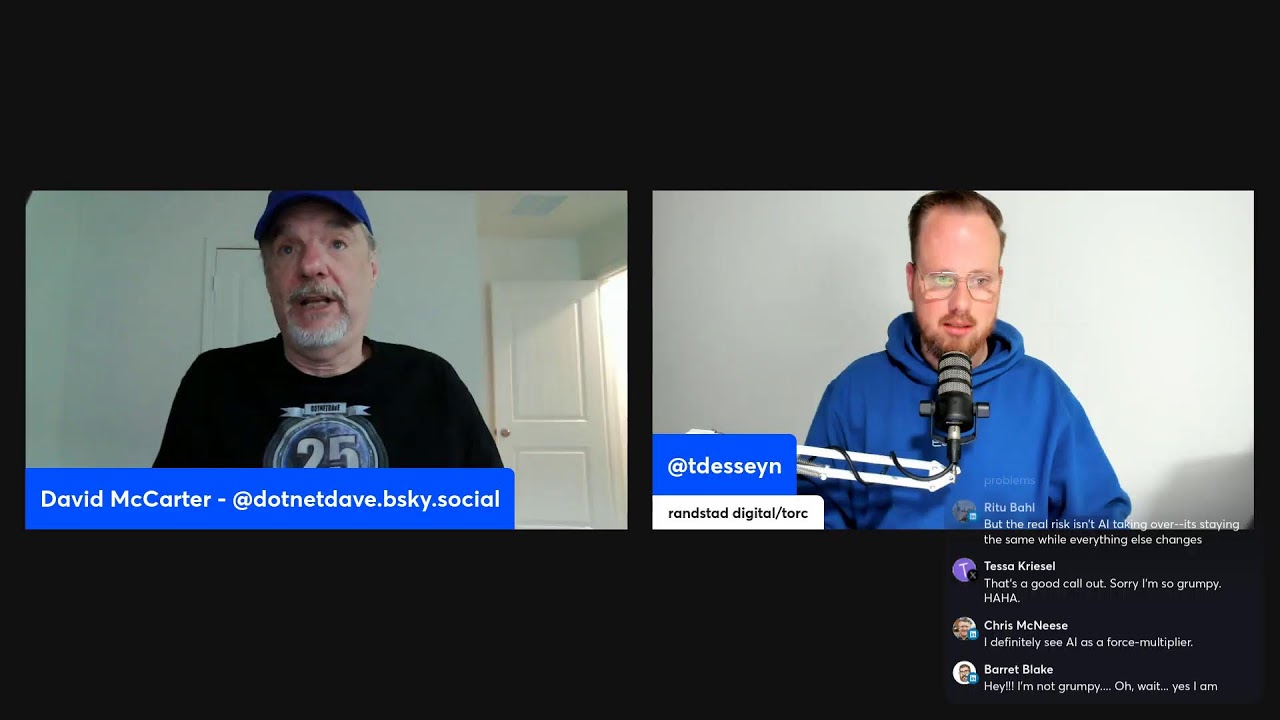
David McCarter, a Microsoft MVP and software engineer, shares how to ace technical interviews and build your career. He emphasizes thorough research before interviews, using AI strategically for resume help, and building reputation through community involvement like user groups and open-source projects. He also warns against ageism in tech and stresses learning fundamentals over chasing frameworks.
Chapters
Alrighty, good morning internet, good morning. Um, we're back. It has been a heck of a 2 weeks. Uh, the, uh, Ronstadt Torque community team has, uh, you know, David, I, I'm sure we'll talk about this. Um, we've been on tour, David. We've been on tour. I love going on tour.
Yeah.
We've been in LATAM. We've, we, we, we, we did our LATAM leg.
Mm-hmm.
Um, you know, I, listen, listen, I'm pumped to hang with you because like literally I talk about all the time, I said building community is just like being in a band. Yeah.
Yeah.
It's literally just showing up. Your dinners are your shows. You know, you go to conferences, you hand out the swag, you hope people come back the second time. You know, so we've been on our LATAM leg, we're back.
Uh, we went to the wrong airport yesterday, right?
Dude, dude, that was crazy. That's never happened to me. Literally, like, I landed— I landed— well, first off, first— all right, listen, listen, listen. This is why I want to get started, because I just— I have a lot to get off my chest, and David, you're just— you're my guidance counselor today.
So I'll send you a bill.
Yeah, yeah, yeah, perfect, perfect, perfect. So first off, LATAM Airlines, right? And like, I, I don't fill out surveys. I don't fill out surveys. Uh, I— if I filled out a survey, first off, security in Chile took everybody's waters before boarding the flight. So that was crazy. Then they only did one service. for 10 hours.
What airline was this?
It's LATAM Airlines. So it's a subsidiary of Delta, which is crazy. And like, and there was no internet for 10 hours.
Well, it sucks international anyway, so—
Oh, it was, it was, it was brutal. It was brutal. So, um, so anyways, uh, that was wild. And then I landed and I went to like go check my like big like swag luggage that always gets stopped at customs now. And, uh, I was like, hey, I want to check this. They're like, oh, you got to go to LaGuardia. And I was like, what? What are you talking about? I got to go to LaGuardia?
What do you mean?
And they're like, your ticket goes— I was like, I did not know that. So that was crazy. And then got delayed 2 more hours once I got to LaGuardia because of weather. It just, it just was an absolute just mess. So, but we're back.
Especially JFK is a mess. I, I tweeted back at you, I, I hate going through JFK. That, that's one of the worst airports maybe besides the one in Paris that I don't like. I hate going through. Yeah.
Charles de Gaulle in Paris.
Oh, it's awful. Yeah.
Yeah.
Yeah.
And so, and like I had this whole vision, I had this whole vision cuz like, so I do, I have a Chase Sapphire Reserve for like work credit card. And I was like, man, I, I, I booked— I was like, oh, I get to go to LaGuardia. I was like, that's fine, I'll go to LaGuardia, I'll get access to the Chase Sapphire Lounge, I'll take a shower, it'll be good. Nope, the Delta terminal is not in the same terminal as like the, the LaGuardia or as the Chase. So it was, it was a day, it was a day, but I'm back. We're back. Yeah, we're back, we're good.
Um, glad you made it for the podcast today.
I know, I know. Yeah, super important podcast, which I'm pumped about. Um, so again, good morning, y'all.
Wait, please hold on.
No, you're good.
Turn off my— I forgot that my—
I love it. Hold on, I'm actually—
cleaner starts up right now and, and cleans my house.
I love it, I love it. Hold on, I'm gonna drop something. I'm gonna drop something in the Torque Chat real quick. Uh, where is it?
Where Where is it?
Am I crazy?
Where is it? Here it is. No, I told you to stop.
We're just unhinged this morning. We got vacuums going on and me ranting about travel stories. But so, uh, excited for this episode. Um, so David, again, just, just the power of networking on social, right? I mean, you know, David Uh, David and I were connected on Bluesky and somebody tagged us or something.
Yeah.
And of course, of course now we're here. So super pumped to hang with David this morning. Um, but I want to get into a few housekeeping things. Um, first and foremost, if you are watching, uh, please say hey. We'd love to hear from you. I know we started a few minutes early, but I needed to get my ranting out. Um, so, uh, first off, listen, if you want to know when I go live like this, shoot me a text. This is actually my number. Very job search questions. Shoot me a text. This is my number. Would love to help you. We listen. We got a lot going on in the Discord. You know, again, kind of the home. The thesis of what we're trying to build at Torque is a home base for people, right? You can go out and find technical content anywhere. You can go out and find job search content anywhere. And we're really big on job search career content, super important, and technical content. But at the end of the day, it's people that makes things matter. And of course, Dave and I are going to get in that today with kind of his connections at Microsoft and The power of community. Um, also too, this is— I, I got some things in the works for a coffee sponsorship. I got some things in the works. It's coming. I've talked to the founder of Seek Coffee. Um, uh, right now it's a 15% off code, but we talked about, uh, making that more. Um, so I did not realize this, but most coffee has mold in it, so that's cool. Um, so, uh, so Caleb Developed a product, uh, coffee that's completely mold-free. It's tested, it's— it tastes great. I'm drinking it right now. Um, so highly recommend it. Check it out, Seek to Live. Um, use that code. But again, more stuff coming for the Torque community. Um, yeah. All right, so that's enough of me yapping. Jeff, it's good to see you. Kenneth, we're finally getting some people tuning in. News, what happened? That's why we gotta start a little bit early. Uh, David, let's give the people what they want, man. Who are you? I say, what do you do always? But like, you have like 16 lives. You're like a cat. But if you just want to give kind of a holistic background about yourself.
Yeah. So it's hard for me to talk about myself at this point because I've done so freaking much, you know, but yeah, I'm David McCarter. I, I now, I recently moved to the Austin, Texas area. So hey, everybody from Texas or California where I used to live, which I wish I was still there. And, and so I've been a software engineer for a really long time. We were just talking, you know, off, off, off the screen that, you know, I've been interviewing, you know, software engineers since my very first job. And I've been running— I started a user group in my first year, I was a software engineer too. So I've done that, you know, I've, I've So I've been a software engineer for a long time. I go all over the world speaking at conferences. I've written more books than I can even remember these days. And I just released 3 in the last 6 months. I released 3 books. So I'm working on another one. So—
Are you serious?
Yeah.
I can't even— I don't even like reading and you're out here writing multiple books. That is crazy.
I do so much writing these days because I'm trying to a number of years ago, I really wanted to start trying to get my experience on paper, you know, for longevity, right? And, uh, yeah, or, or, or in videos and, and things like that. So I've really been writing more than ever in my life right now.
So yeah, that's awesome. That's awesome.
I started a user group. I'm also an award-winning photographer. Uh, I work for many bands, big bands when they come into town. Just recently did a the, uh, the former lead singer of Queensryche, uh, a month or a month and a half ago or something. Uh, so I, I do a lot.
That's awesome. That's awesome. Um, it's good to see everybody in chat this morning. Again, please continue to say hey. Um, you know, I always say this, this is, this is a meetup. This is a meetup. Um, it's just, it's, it's, uh, you know, I, I always love this format. You know, David and I were chatting backstage. I'm finally using AI to help prep stuff. I just, after 6 years, just now started to send some topics that we talk about because of AI. But again, the whole thing of this is just to network, meet people. So slide into people's DMs, tell them, hey, it was good to see you. Message David. Obviously tell him it was good to see him too. He'll follow back up with you afterwards. But David, a lot to unpack here. I think the first thing that I just wanna get to right off the bat is interviewing. Right? I mean, you've literally wrote a book on technical interviewing. Um, I, I, I, I just want to, just want to kick it off super high level, just some thoughts, some wisdom that you can impart, uh, on the viewers this morning, and then we'll just kind of start to narrow in on some things.
So for interviewing, you know, like I said, I started, uh, my very first job, and, and, uh, I don't tell that story too much, so I'll tell it really quick. And, and You know, the people who ran the company realized after they— either when they hired me or after— that I have a really good perception about people, you know, and I do. And so, you know, when they came and asked me, hey, come sit in on this interview, and I go, this is my first job. Why do you want me to sit in on an interview? And they go, well, we want you to sit there. Don't say anything. just tell us what you think of that person afterwards. That was my first one. But now, I worked at a company and I basically interviewed almost every single .NET software engineer who came into the company while I worked there for its 4.5 years, and managers too. I've done it all. I've been the hiring manager, I have been interviewed, million times. I've interviewed hundreds of software engineers. And the one thing, you know, you asked for the number one thing that people miss, and/or don't pay attention to, which is exactly what my technical interview book is all about. And that's preparation, right? Too many software engineers, you know, they read the job description, or they maybe talk to a few people. And that's how they prepare. And that if you really want that job, you have to prepare a lot, you know, for the technical interview. And, and at that company where I interviewed everybody, basically, you know, my department head, the VP of the department said that everybody interviews with Dave first, right? And if they don't make it past Dave, that's it.
You know?
Yeah. And I think that's a really good strategy. Because, you know, Software engineers, we're technical, we're analytical. And if you can't get that through to people in the very first interview, you're gonna have a really hard time, you know, securing that job or any job at that point, right?
How do you, how do you think, I mean, what are your thoughts? I mean, I feel like there's absolutely zero excuse now to not be prepped because of AI. I mean, literally AI prepped our conversation. This morning.
Yeah.
So, and I'm already going off script, but that's not the point. The point is, is like, I feel like there's like no excuse anymore. Thoughts on that?
Yeah, there's no excuse. And, and even in my book, the, the, the book I'm working on right now is the 7th edition of my tech interview book. I hope to get that out by the beginning of June. But in it, you know, I actually did this. So one of the, the, the young women I mentor, She was going for a job at Alaska Airlines and I helped her prep for that. But I was thinking, well, I wonder if I can give AI the job description and ask it, what questions do you think I'll be asked when I interview for this company? It's in the new book and I was really impressed with the questions it came out with because—
Yeah.
I know the questions I ask. I have a document on that. But AI came up with some really good questions that you need to prepare for. So, yes, I mean, I believe, you know, especially if you're using recruiter, that's really the recruiter's job, right? But in addition to that, and whether you have a recruiter or not, you should also use AI and give it the job description and to ask it, what kind of questions do you think I'll be asked?
You know, again, we're going off script here because again, so David's an expert podcaster. So, it's 2 podcasters interviewing each other or having a conversation. I always love that.
Yeah.
But like, what do you— I think I live in Claude more now than like almost any other app. And I think there's 2 differencing thoughts on this that I wanna pick your brain on. There's some where it's like you need to have an original thought. You need to— you can't rely all on it. Then there's other one, it's like you need to be all in on it. Where do you sit? Because I'm, I mean, I'm starting to just throw everything at it right now. And it's, it's pretty, it's pretty incredible.
Well, at this point in my life, you know, I use AI every single day. You know, it's whether, whether it's coding or writing or generating images, like all the images in my book now, all, every single one of them I've generated with AI, right? The book cover is generated with AI. Everything, right?
Yeah.
So, um, but my caution is, you know, in the new version of the book is that, you know, you should, at least when it comes to interviewing or even writing, because I'm, I'm writing my first fiction, uh, short story right now.
Oh, nice, nice.
I wanted it to be short, but it's 95 pages at this point. So I'm, I'm still trying to—
That is long for me. Yeah.
And so, you My thing is, this is the way I always do it, especially in my resume, is, is I write it and then I just have AI help me make it sound better, right?
Yeah.
I don't think anybody should say, hey, AI, generate a resume for me, or hey, AI, write a book for me, which somebody just got in trouble for that last week or week before, where they just, you know, they published this book and they discovered a lot of it was written with AI, and now they're pulling it off the shelves. To me, even in coding right now, AI is just a tool you use. You don't let it do everything because all the AI I've used for coding doesn't code things correctly. I have a really long article coming out the first week of May about this where because I'm a Microsoft MVP, I get to go to this conference no one else gets to go to every year. And everything AI is coming out of Microsoft right now. So I decided to give AI a chance to write a program from scratch, and I wasn't going to write any code, right? Yeah. And you'll have to read the article, but it didn't go well. Yeah. Yeah. You know, so it's, it's better at maybe fixing things that's already written and things like that, but doing it from scratch, it's still not there yet for me.
Well, that's where it comes in. I mean, we, you know, we talk about taste. I know there's a lot of like taste in marketing with AI. AI and stuff, you still, I mean, you still have to, uh, you still have to be involved, right? There's, there, you still have to put your own touch to it. Um, but yeah, totally agree with you. Let me ask you this. Let's go back to interviewing real quick. I don't wanna go down to the, the AI rabbit hole. I think, I think there's a little fatigue in general with AI right now, which I totally get.
Yeah.
Obviously prepared is good. What are, what are some other things? What, what are, and, and it's, I think it's fun. I, I know people watch this like Taylor, You bring on the guests that say the same thing. There's a reason for it. They're like, David's not— David's thought is not original, but nobody does it. So what else? What else do people miss? How else can people get prepared when they go for the interview?
So yeah, one of the things I talk about, um, I write about a lot is, you know, a lot of software engineers think that you know, interviews are a one-way street, right? You're just there to ask, answer questions, right? Or be tested or whatever, right?
Yes.
But I have a whole multiple chapters in my book that's wrapped around the questions you should ask them, right? Because you also need to interview them to see if you're gonna like it there and for a long period of time, right? did a survey, and most software engineers don't stay more than 5 years in a job, and they move on. Right?
I would say now it's like 2 years.
But yeah, yeah, I would say more like 2 and a half. You know, the 4 and a half year job I had was the longest job I ever had in tech.
Right?
Yeah. And so one of the things is you need to ask them specific questions. And not only do I say this, because a lot of people say this, But I've been burned too many times about accepting a job. And I get there sometimes on the first day, and I realize I made a mistake, you know, and that's because I wasn't asking the right questions, right? And unfortunately, most interviews, they don't give you a lot of time for that. So you have to really pick the 2 or 3, maybe, that you're going to ask during the interview. But that is a big thing that— and that's, you know, I have a whole chapter on getting prepared to ask them questions, right? Because you need to do the research, and AI helps out a lot now. But you need to do the research on the company and what they do and how they do it, because you want to know if you want to stay there, right? So you need to ask the interviewers Questions, right? Super important. Yeah.
So I haven't talked about this in a bit, so I'll, I'll resurface this and then probably tweet about it after the show. Um, you should almost try to talk yourself out of every job. Like, that's how much— that's how critical you need to be. And I feel like a lot of people are like, all right, cool. Got a job. Now listen, I get it. Job search, it's hard.
I get it. Like, so hard now.
I, I'm gonna— yes, the blanket statement, I understand. But I think that's the first thing you should be as— you should be so critical. And again, going back to AI, how to use AI, throw the entire offer, throw all the details in and be like, let me poke, poke holes in this for me.
Right, right.
I think another thing that I think you bring up, which I love, I don't think the interviewee drives the conversation enough.
Right.
I remember interviewing at the company I was at before Torque, and I vividly remember not even getting to the meat and potatoes of the actual role until like interview 3. Because it's just kind of like high level. What do you do? What can you do? Here's what we do. And then there's like, you know, kind of the meat and potatoes, and it takes forever. And I feel like a lot of people just kind of sit there and they're like, oh, I'm good, like, we'll just, we'll just, I'll just answer questions. So I'm in agreeance with you on that.
Yeah, and, and that's, you know, quite frankly, that's where, you know, um, you know, I'll complain about recruiters just as much as anybody else because, and you complain about us, But, you know, one of the—
I complain about recruiters too, don't get me wrong.
But one of the— I think is one of the most important jobs as a recruiter is to prepare the candidate, right? Especially if they've already sent somebody there for, for an interview, they know exactly what they're going to go through, right? Yeah. So the good recruiters are the ones that contact you the night before or the morning of.
I was always the one that do that. Yep. Yeah, yeah.
But you know how many recruiters have done that in my, in my past? Almost nobody. Maybe one or two.
Maybe, maybe on one hand.
Yeah. And don't get me started on the recruiters from foreign countries. They're worthless, you know. And, but, but that is one of the things that a recruiter really helps with. So if you don't have a recruiter, then yeah, AI can help you prepare You know, yeah, going through it, a good technical interview, right?
Yeah, somebody messaged me, somebody messaged me, and, and I would say I did a series before I went out on paternity break in December, um, and it was like how to navigate the job search. And I have a YouTube on Torque's YouTube about how to screen recruiters or how to work with recruiters, and I've had a few people DM me, and, and, and I'll say it here again I, I get, I get multiple DMs usually in a month where it's like, how do I weed out like recruiters or bad opportunities from recruiters? Here's what I would say. I'll say it again. First off, ask them, is this a fish— do you have a contract signed or is this a fishing expedition?
Right.
Now it is okay if it's a fishing expedition, but you just need to know that on the front end, right? Because there are some times where they want to, they want to talk to you, they want to send your candidate profile over because you're actually good and they want to get the contract signed. And they use you as bait. That's fine. I've done it. It is what it is, but you just gotta know what you're walking into. Second thing is, do you know the hiring manager's name?
I've got a story about that.
All right, that's a big one. Third one, have you worked with these people before or placed anybody on their team?
Right.
Um, those are kind of the quick 3 things. Go ahead, I'm interested to hear, hear your story.
So I have a whole chapter in my book about dealing with recruiters.
What's, what's the book called again? Let me, let me, let me throw it up.
Rock Your Career: Surviving the Technical Interview. Wait, say it one more time. Rock Your Career: Surviving the Technical Interview. And then I have a— where is it? I have a new one out. I have an ebook out called Rock Your Career: The Real World Guide for Software Engineers. How to Use Recruiters Without Getting Used.
And do you have a website I can link to this after the show?
Yeah. Yeah.
Okay. All right, cool.
And, and that book is actually the recruiter chapter. The ebook is the recruiter chapter because I want— if someone doesn't read— want to read my entire book, I think it's really important to read the one about recruiters, right?
And so I talk about why.
While I was working on the 7th edition, I said, you know, this chapter is is getting pretty big. And maybe I can release it as an ebook. So, but that book is really designed not only for job seekers, but it's designed for recruiters to let you guys know what we expect.
Yes.
And it's designed for hiring managers and what they should expect from recruiters, right? Because being a hiring manager, I've fired multiple recruiting companies, right?
Yes.
Because they won't do what I tell them. Yes.
Yes.
And I won't deal with it and waste my time. So, so, so yeah, we, we always— there's always this back and forth about, you know, recruiters and if they're good and how to use them. And so that's, that's why I have a whole dedicated chapter to it. And when I first released the book, the first edition, I actually had a couple of recruiters come to me and go, Dave, you know, you're getting a bad reputation because you're bashing recruiters. And I go, no, that's not true at all. I'm not bashing recruiters. I'm just letting people know what they're in for. You're holding the red flags to look for.
You're holding recruiters accountable.
Exactly right. You're not bashing, you're holding people right. And I try to separate the recruiters who are in it for the money and the recruiters that are really in it for a career. And, and, and one of the really good things that a recruiter I actually worked with for the first edition of my book told me That, uh, you know, when, when you're using a recruiter, you should always ask how long they've been there, right? And he's— and he said minimum 2 years, right? Because that kind of separates—
Hey, hey fam, hey listen, if you follow my content, what have I said? That's exactly what I've said.
Yeah, and I haven't read your content, so there you go. You know, there you go. It's been in my book forever. But that's really what you should be asking recruiters because that separates The ones who are really in it for a career and the ones who just think they can make money.
Quick. Yeah, I would say, I used to say, because before COVID you know, we were, most recruiters were kind of like more local market recruiting, which is what I was. I was in Nashville recruiting the Nashville market. And so I would tell people, I would be like, work with a recruiter for at least 2 years, but ideally 4 to 5 years. And they need to be in the local market for at least 2 years to understand the local market.
Yeah.
Um, now everything's, you know, for the most part, remote, I would say at least 2 years. I'd probably bump those numbers up to probably about 4 now at this point. Like, I would say that 4 or 5, if they've been embedded in the organization for 4 or 5 years as an agency recruiter— remember, there's 2 types of recruiters, there's corporate and there's agency. Um, I would still probably say that same goes for corporate too, because, um, you know, most people bounce, um, if they, if they're not good.
So, um, I want to give a shout out really quick to Bear Blake, who's one of my geek friends. He says David's content is great. Thanks, Barrett. There you go. There you go.
Uh, oh, you know, go ahead.
One other point I wanted to make about AI really quick. And, and, um, you know, there's a lot of people going around saying AI is going to replace software engineers, right? And, um, even my daughter-in-law told me that. He goes— she goes— last year she told me, a year from now you're not going to have a job, you know. And I'm here to tell you that's not true by any stretch of the imagination. But What is true, what I'm kind of realizing now is because of AI, we need more senior software engineers, right, to look at what the AI is doing. So I really think AI is going to affect the beginners, right? And because we're not going to need as many of them anymore. So the problem therein is, okay, well, if we don't need as many Beginners, uh, software engineers, what happens when the senior software engineers retire? Right? So how do we bring up that next generation?
You're, you're throwing a huge fork in the road on my questions, my AI prepped. I love it. Um, yeah, I mean, listen, you know, this was my talk at All Things AI, um, in Raleigh last, last month. Um, there are statistics, you can look it up. There is, there is more need for software engineers right now than, than there has been in a long time. Yeah. However, so I think that is true. We know that is true, but we also know that AI is arguably taking a lot of junior opportunities.
Yes. Yes.
Here's what, here is my thought, and I'm interested to hear your thought as a senior engineer. I think, cuz I had a lot of people come up to me at the booth over the last 2 weeks on our LATAM tour. On what do I do if I'm junior? And I said, you need to be building and you need to actually be developing essentially not a business per se, but like you need to really just be doing it on your own.
Yeah.
Because companies, you need to be able to separate yourself from the AI. So I don't know, I'm curious to hear your thoughts on that.
So The companies using AI?
No, no, no. So what I was saying is, as a junior engineer, you need to be actually developing a product and getting some, even if it's 5 or 10 or 15 users, because you as a junior developer have to be able to, to basically separate yourself from the AI already doing your work, essentially.
Yes, that's, that's definitely true. And that, that gets back to how I started as a junior, right? And I have a whole chapter on this too. There you go. There you go.
I'll tell you what, let's just stop. Let's just stop. Go read David's information and come back. Yeah, I love it.
I love it. But the chapter is all about actually the wrong way, the wrong way companies test software engineers, right? Giving them these memory tests, or, you know, create a, create a website in 4 hours kind of tests and things like that. And there's a better way of doing that. And the better way is what what fixed the issue at this company I was working at. So let me back up a little bit. And so before I was even a software engineer, I was writing programs and releasing them, right? That's, that's how I learned, right?
Yeah.
And the second program I ever released— I'm dating myself— on a BBS system, because this is before the internet was popular, you know, that program was actually picked up by PC Magazine and they reviewed it. Right? And I never submitted it. I have no idea how they got it, but they reviewed it and my orders shot from like 10 a day— 10 a month to 10 a day for a while, you know?
Yeah.
And it was great because I had 2 little kids at home and I needed to make more money and all that stuff. But what I was teaching myself in that process basically was what you just said, you know? I was teaching the entire software. I was teaching myself the entire software development lifecycle.
Yeah.
Right?
Right.
And I didn't know it at the time, but that's what I was doing. I did everything from dreaming the idea up, writing it, testing it, producing it, dealing with customers, you know, doing new versions. I did everything, right? And before I was a software engineer, right?
Yeah.
And so that, the article about that, piece of software came out the February after I started as a full-time software engineer. And it radically changed a lot of things. And so I have a whole chapter dedicated. And the other thing is, most companies don't give us any time to learn new stuff, right? It's, it's work, work, work, work, work, work, work, no learning, right?
Yeah.
So we have to learn on our own, either by going to conferences, going to extension classes at universities, You know, things like that. But the number one software thing that software engineers need to do, whether they're just starting or where they've been in it as long as I have, because I still do it, is write programs constantly on your own, right?
That's it.
And release them, right? Yeah. And release them not with making big money, because it's probably not going to happen. But release it as so you can gain experience, right? Because that, that's exactly how I got jobs in the beginning, right? I knew nothing really. And I walked in, I walked into companies, they said, well, we're thinking about you doing something like this. And I said, you know, I've written a program like that. Here it is. I whipped out my floppy disk at the time, we put it in and ran the program. I explained it to them. I got the job every single time, never failed. Right?
Yeah.
So I use that experience as this one company, we couldn't hire any beginners because they were just really bad at interviewing and we couldn't get out of them their analytical thinking. And so I came up with how— I came up with a new thing. I retermed, I gave it a new name in my new book, but I came up with this thing at that company and it totally turned around people finding software engineers we wanted, completely turned it around. We couldn't hire anybody. We in We did that, that system, and we got to hire everybody we needed to.
I don't think anything has changed pre-AI to now. I think what's changed—
Not with that, right?
I think you just have to build, and I think there's more of an emphasis on it now than before. I will, I will also say this. I just had a thought and it just escaped me. I hate when that happens.
Uh, While you're thinking, let me tell you, I was teaching a web class at UCSD, and that was the first class I started this new thing I did teaching at colleges. That is, from the first class to the last class, we built an application all along the way that became your final project that you had to turn in. The first class on the first week of this class, you know, people had to go back and, and, and create a website, you know, using Visual Studio and all that. And the next class, this woman came into me and she goes, you know, I've been doing this for a while now, being a software engineer doing web stuff, and this is the first time I built a web— for a website from scratch, you know, and I— and that's really hard. And I go, really, this is your first time? Come on, you know, you should be doing this always, right? Yeah. Yeah.
Well, I think what, what I remembered, and, and, uh, Jason, former Torque, uh, community manager, um, he and I, I, I, I think, I think there needs to be a, I think there needs to be more self-awareness when it comes to the job search. And here's the reason why I say that. Jason and I, we were at, um, DataTune together in Nashville, the data engineering conference. And one thing that we did is we, we review resumes at our booth, right? I've, I've always been big on giving back and helping the community. And, you know, we gave out some small swag, but our giveback was reviewing resumes for a few minutes, right?
Yeah.
Um, and we, you know, we, we were through like 15 resumes and I finally asked We finally asked a person, we were like, would you call you? Would you interview you based off this? You know what that person said?
No.
What are we doing? He said no. So listen, listen, if you are—
if you are—
if you are writing your resume and you look at your resume and you ask yourself would I call myself? And you answer your own self saying no, fix it. And I think another thing too, I think people get in interviews and they have a very arrogant, like, thing, like this mindset. Like, listen, like, if, if you show up and you don't present yourself and you're not asking questions and you're not engaged and you're not prepared and, and you're not kind and you're not smiling and you're not, you know, You're not going to get the job.
No. Yeah.
And it's not AI's fault.
No, that, that's not AI's fault. No.
Sorry, I had to get off that rant. I'm just, I, I, I just think there needs to be more self-awareness.
Yeah. Like software engineers, number one. And then why I wrote the book is basically they're really bad at interviewing, right? And, and I think about that and I go, well, I don't really want them an expert at that either, because that means they're interviewing too much, right? So yeah, that's fair.
Yeah.
But, but they tend to be really bad, you know, and, and the resumes too are pretty bad, right?
Oh yeah, we've, we've reviewed resumes in the Torque Discord for a year and a half now. We rate them on a scale from 1 to 5 live. Um, I've never given a 5, and I don't think I've and I've only ever given a handful of 4 or above. Everybody sits in the 3s to 2s. And kind of our rubric is like 3 is like borderline burn it down. Anything under a 3 is you got to burn it down. And most people sit between a 2.5 and a 3.5.
Yeah. I write about, and this is before AI, my resume looks pretty good because You know, one of the tricks I tell in my book is what you should do to make your resume look better is, you know, good recruiters will fix your resume for you, right? They'll use spellcheck, which developers seem to forget to do. And, and, but ask for it back. And so I did that so many times, you know, I would have them fix it, I'd have them give me the document back, I'd fix up mine, keep going back and forth until my resume looked pretty good, right? Now we can use AI too to help us, but but that's really how I did it. I used recruiters to make me look good.
Dude, I say this all the time, David. You and I are like kindred spirits here. Um, I always tell people don't pay a resume writer unless they're a recruiter.
Right?
Like recruiters are the ones that know how to write the resumes.
Yes, yes, yes. All the resume writers, that's one of their jobs. They should know how to do that.
Yes. All like literally I can't. I mean, I probably in my career now have probably looked at 50,000 resumes.
Oh yeah, yeah.
I mean, and like, I know what pops and I know what doesn't. And again, we say this stuff all the time. I bring on guests that speak the same thing for a reason. If you do the things that we talk about on this show, you're gonna be in the top 1%. Yeah, I mean, you're, you're gonna be way better than anyone else.
Yeah, I, I was thinking about this this morning, you know, back in the early, like, 2001 or something like that. I actually— and we can talk about this later because I have a whole opinion about AI and ATS systems— but I actually wrote an ATS system back in the early 2000s, you know, 2001 or something like that.
That's great.
And, and what we did was we basically wrote that kind of thing. And then we partnered with large corporations like hospitals and advertising companies. And, and one of my jobs was to make, make it look like when you're answering questions and submitting your resume, it looks like their site, not our site, right. And so when, whenever I had a few minutes to kill, I would go on to our backend server, and I would read some of the resumes, right. And, and this was, these aren't resumes from software engineers. They're from nurses and advertising people. I think maybe that works. And they were pretty bad too. Right? I was going, you guys aren't even listening. You know, you're not even answering what the job is asking for. And I would read them and go, man, this is awful. And it's no wonder my system even back then weeded out so many people, right? Because of stuff like this. Yep.
Yep. Absolutely.
And they didn't— and they didn't answer the questions correctly and things like that.
So yeah, talk about— so let's kind of pivot a little bit. Community. You're my— you've been a Microsoft MVP. Can you just talk about, you know, again, obviously Torque, we're community-first, you know, jobs platform. Um, community is at the core of what we do. Um, and I always love hearing community and kind of networking stories from my guests. So if you want to kind of dive into just the power of community in your career.
Oh, The power of community— I've written about this too, you can go on my website— is why I'm here, you know, at this, at this level that I'm at now. Without community, I wouldn't have been like this, right? I wouldn't travel the world, I wouldn't become a senior lead software engineer very early in my career. None of that would have happened if I didn't start a user group, right? And I started that user group because at the time, I mean, I helped start the user group at the time. There's like 5 of us, and it was a Visual Basic user group.
That's how— There you go.
There you go. And, um, and, uh, at the time, you know, I had a terrible fear of speaking in front of people. Terrible, right? I even in high school, I would do everything I can not to get in front of the class and read my report or whatever, right? And that carried on. I'd rather die basically than than get in front of people. And but my first year of being a software engineer, I can still picture this in my head. I was this morning that something told me that I need to learn how to talk because it's going to become important in the future, right? And I, and I was going through this local San Diego computer magazine. And the guy who I call the father of the user group, had an ad in there. And I go, okay, that's what I have to do. I have to start forcing myself to get in front of people, to get over this dang fear because something told me I need it in the future. Right. And, and that's why I basically did it. But what I didn't know at the time was just how powerful community is and how much that changed my career. You know, I would say most everything I got in this career, including jobs, was because I worked in the community and still do. I mean, that's part of being a Microsoft MVP.
What would you say, like work in the community? Can you like break that down to people who may still be on the fence? Like what?
Like, what does it mean?
What's that mean?
Especially in our world, it's getting involved in group tech groups, you know, whether it was user groups, or meetups now. You know, in the beginning it was all user groups, now they call them meetups. But just get involved, right? And, and not only go to the, the meetings and learn something, right, but start speaking, right?
Wow.
And you asked this on one of the questions that, um, uh, you need the, the best way to get into speaking, it's not to submit your paper to a big conference like we go to. That's not the right way to do it. The first thing you need to do is start speaking locally at user groups because that's where you can do your training wheels on speaking and start getting your chops in and start developing a way you speak like I do now. Because the way I speak now is crazy, but I developed that over Over the years, right? I developed all these techniques to how to get people to pay attention to me. And even if, let's say you don't have a local group you can go to, start doing it at work, right? Start holding brown bag lunches and things like that and teaching.
I don't think people know about brown— I know the term brown bag because I'm 37 and I'm an elder millennial. So I know that term. But what's a brown bag lunch, David?
Because I don't think people understand. Brown bag lunch is basically Instead of going and eating lunch somewhere or leaving lunch at your desk, you go to like a conference room and you eat lunch there and someone teaches you something for an hour, right?
So those were so good. Those were so good. We used to do those back at Vaco when I was there.
Yeah. And, and, you know, I worked at Verizon Wireless for, for 2 and a half years and, and I'd only go into the office Thursday afternoon. And, and what my boss wanted me to do is basically periodically I would do a full-on conference talk into my team.
I think that's great.
Yeah. Yeah.
I did a conference talk in the Torque Discord. It was, it was a keynote for All Things OpenAI, or no, All Things Open in October. Sorry. And I needed to get my thoughts down. And so I was like, you know, I'm just gonna go live in the Torque Discord and like, even if like one person shows up, which is usually Jeff, shout out Jeff. You know, like at least it's one person and we can kind of try. And literally I had like a handful of people and they were like, hey, this didn't make sense. This didn't make sense. And I edited it and then the talk crushed and I wouldn't have done it without the Torque community.
Yeah. Yeah. And, and that's where you, that's what people will tell you. Right. And you, you definitely don't want to go to conference where they're paying for stuff and not go through that first. Right.
Yeah. Right.
And, and, and so Barrett just said that he still speaks at local user groups 2 to 4 times a year. Unfortunately, I think I've complained about this on social media that the Austin area is supposed to be Silicon Valley 2.0, but there's no active user groups for the Microsoft stack in Austin.
Interesting.
No, I did speak at the .NET user group in Austin, but they rarely meet. There's no monthly meetings and things like that. Unfortunately, you know, the internet and training companies and stuff like that have kind of killed user groups, right? Especially after COVID, it really killed user groups. So the amount of user groups we have now then compared to like when in the early 2000s is dramatically low. I mean, not very many anymore.
Yeah, no, it's drastic.
Well, I think part of the problem is you know, the younger people who grew up in the YouTube era, right, in the internet era, don't see a value in actually going someplace in person.
And it's a whole other conversation, David. You are just branching. Yeah, I think behaviors have changed. I think I've said it's not, and I want to get to Ron's comment in a second, but like behaviors have changed. So it's like, hey honey, I'm going to stop by a user group on my way home from work, to hey honey, I have to leave you and the kids to go to a user Yeah. They don't like that. And I think that's killed it. I think that's killed it.
Yeah. It's, it's when you're married like that, it's tough because that's 2 or 3 hours that you're not spending with your family or your, your kids. But those 2 or 3 hours are so valuable, worth more than you can pay for it, really. Yeah. If you ask me.
I wanna get to Ron's statement here, and it's so fascinating he said these words cuz this is the way I was taught as a recruiter when I started.
Yeah.
So, you know, I tell a story all the time about my dad and the job search and, and kind of helping him. And, and, you know, he's in the restaurant industry, you know, vastly different industry. Um, you know, they're not on X, they're not on LinkedIn, they're not on Blue Sky, right? So one thing I told him years ago when he hit me up after he transitioned— he owned the Outback Steakhouse in my hometown for like 25 years. Shout out Outback Steakhouse. Still, I think, the best chain steakhouse. Um, he, he, he asked me, he's like, hey, how do I find a job? He was like, you know, because the last time I did this, the internet didn't exist. And I was like, wow. Um, so, so for me, you know, I, I thought about it and I was like, how, how do I— so I was like, you know what, I'm gonna tell him how to be a recruiter on a, on a just a dumbed-down version, because, you know, being a recruiter, it's just, it's, it's a lot of churn and burn. So I told him, I was like, hey, every day, coffee, lunch, virtual conversation with somebody. That's it. Every day.
Every day.
So he would go on coffees, he would go on lunches, he would text me, hey, this went well, this didn't go well. Hey, guess what? Lo and behold, guess how he found his job? He messaged one of his former bosses on LinkedIn. Now, now some people are like, well, that's— he didn't get it because of lunch. But the thing is, it's momentum. And somebody said it earlier, I think Ritu said it It's networking, you know, it's, it's, it's momentum. It's all of it.
All of it. So yeah, networking is the best way to find a job. I mean, hands down, to me, that's the best way, right?
My—
and I've got more jobs than I can handle just because I was speaking or doing whatever, you know, without even applying.
Well, even prime example, right? And this is kind of the ethos of the Torque community here. So when I was at All Things OpenAI, In last month, um, I had a— we had a guy come up to me, just random guy. He was like, hey.
I was like, hey.
He was like, I don't think you know me. I go, I don't. And he was like, I hopped into one of your resume reviews. You reviewed my resume in the Torque Discord. I was like, get out of town. He goes, nope.
He goes, for real.
I said, okay, great. I said, what's up? He goes, because of what you told me, I edited the resume and I got my first internship at Intuit. I moved out to California. Here's the deal. When it comes to that, in my opinion, get involved in the online community. Yes, go to an in-person meetup once a month. If there's no in-person area, start one. I, I, I did a lunch my— when I was at Vaco, I did a lunch once a month, invite only, 10 engineers. Crushed.
Yeah.
And but it's kind of getting that recruiter mindset. Talk to a few people a week, talk to 3 to 5 new people a week. Get involved in an online Discord or Slack. Go to an in-person meetup once a month. I think that's the formula.
Yeah. Yeah. Talking to people is where you learn the most, if you ask me. And, and I read about this too. When I go to conferences, besides the speaking part, I rarely go to sessions, right? Because especially now they're, they're online anyway, but I spend as much time possible networking. and talking to people and getting to know people and, and that, you know, because that is way more valuable than sessions, if you ask me.
Yeah.
And especially now in this, I mean, you know, I don't believe that the internet and cell phones have made us communicate more. I think they've made us communicate less, right?
Yeah.
So it's, and especially with remote, remote work is really tough, right? And, um, And these are the things we need to overcome, is how do we do this on a regular basis now that most things are remote, right?
Yep, absolutely, absolutely.
But, but the power of speaking in front of people to me is, is not doing it remotely, is in person, right? In person is way different than speaking to nobody or whatever on, on the internet.
Well, and it's like, I interviewed Aaron Francis a few weeks ago and he was like, yeah, he goes, if you get in this in-person ecosystem, you know, and you could be like, man, I don't— you know, kind of looking, kind of not. Like, you can't put that online.
Yeah.
So like, the dynamic shifts when, when you're in person. Now I'll tell you this, managing a community team that's always out and networking is an interesting thing in and of itself. That's a whole other conversation for another day. Um, all right, so as we wrap up here, last 15 minutes, I got some rapid-fire questions, but I wanted to see David, if there's anything triculating, percolating in your mind that we haven't gotten to yet that you want to share as we've been talking.
Well, since we have at least, you know, one person that's older, you know, in this career online right now, I don't know about everybody else, but, um, and I put this into my new book too, is, you know, I I've known that, you know, so the tech industry doesn't really reward older people, right? It kind of pushes them out. And I knew that early on. And but I never realized just how bad it is, right? That the ageism in software engineering is just really mind-blowing, if you ask me. I never knew it was going to be this bad. So, you know, one of the things that people who have been in this career more than 20 years. I— last year I released 2 articles, what, uh, to describe what I call veteran software engineers. And veteran software engineers to me are anybody with more than 20 years experience. And so I'm learning the hard way that, um, that experience or those number of years actually hurt you when you're over 20 years, right? And so there's, there's something that I talk about in my new book About resume Botox. You've probably heard about this, right? And and I've I've been actively doing that recently. Is I've been Botoxing my resume and taking out the years and taking out how many times I've been doing it. I mean, you know, when I started my website in ninety nineteen ninety four, yeah, I don't put that in there, you know. And and unfortunately, I have to start lying on the questions they ask you when you submit a job. I can't tell them I've known SQL Server for 25 years, right? Because that works against you, especially with AI and ATS systems. Yeah. And someone said he's 40 and he can feel the ageism. Yeah, it's this, buddy. It's whoever said that, it's only going to get worse.
Yeah.
Yeah. And a lot of people don't talk about that, right? It just weeds people out and they go to different careers. I've known people have gone to you know, writing books and things like that as their career. Uh, but it's something that you really need to look at, uh, if you've been in this thing for over 20 years.
Yep, yep. Um, what else? Anything else? We're getting to some, uh, uh, rapid-fire questions.
Uh, let me see, see any important things I, I marked down. Um, Well, yeah, we talked about that. Oh, you asked me about timeless skills. So one of the things I talk about all the time on the skills you need to learn is focus on how to build software, not the frameworks, right? Because frameworks and languages come and go, right?
We've seen that.
I can rattle off things that for a long time, the things that don't even exist anymore, right? But the things that really stay with you is like object-oriented programming, you know, architecture, leadership, mentorship, those kinds of things is, you know, really drives your career, not the languages, not the frameworks, right?
Yeah.
So those are the things you need to focus on. Those are the books you need to write— to buy, because they will be worth— they'll be worth it for Decades if you buy those kind of books, right?
Yeah. Again, I think I've said this, and David, I'm curious to hear your thoughts as, again, an expert in the field. I have said part of the reason why I have this podcast is just to make sure I'm saying the right things, to be totally honest with you. AI has put an emphasis on actually solving business problems and not just writing code. Well, code's commoditized now.
Yeah.
I could write code. Not that I know what's going on, but I could write code.
Yeah.
So, so how do you solve the business problems?
Yeah. The big fear about AI is going to take our jobs and yes, that's going to happen. But to me, AI is just a tool, right? And I actually relate AI to code, right? Coding is not our main job, right? And I have a meme that says, if you're coding all day, you're doing it wrong. Right. And that's completely true, you know, and unfortunately, too many companies don't realize this. If you're not banging on the keyboard, you're not doing anything right. But that's only a minimal part of our job. So, you know, for a long time now, I want to write less code, right? Because the less code I write, the more I can focus on architecture, you know, delivering applications that people really like. Right. And things like that. So that's what AI hopefully will allow us to do.
Yeah.
With the juice. Yeah. Because no matter where I'm out in the world, I always look at what other— how other people use applications. And I can tell you almost every doctor or nurse or whatever I've asked, do you like using that program you're using? And every time they say no.
There's so much bad software out there. I even know that as a non-developer.
Right. And I even see programs getting worse, not better in the last 10 or 15 years.
Right.
Yeah. So my hope, if AI is used correctly, it's going to allow, free up our time to do those kind of things better. Right. Yep.
Tessa, Tessa's a dear friend. She asks, what are his recommendations for career check then? All right. I listen, I want to address the ageism thing. I know we just, I know we just addressed it. I, I want to, I want to say some things because we've had some people in the Torque Discord ask about age and AI. Is it too old? No. Here's my thing. I have, in, in the years I was recruiting, the only people that I dealt with from an older demographic that had issues finding jobs because they didn't stay relevant.
Yes.
Yes. Now, I'm not going to be blind out here and say ageism doesn't exist. I understand that. But for the most part, old people, you're grumpy and you don't— and you don't have relevant skills. So what are companies supposed to do? Yeah, you're, you're not nice to talk with and your skills are old. Again, let's have some empathy and some awareness here. Right? So, Tessa, I know you, you're crushing it. You're at Mozilla. Stay relevant. Keep putting yourself out there. Don't get grumpy.
That's it.
Yeah, I don't know if it's that simple, but I think it's that simple.
Yeah. And the best way to stay relevant is to write programs at home.
Right?
That's the way you do it. If you want to learn about the cloud, then write a cloud app, you know, force yourself to teach it.
Yeah.
And one of the things I say is that, you know, even if you have a job, you know, like every quarter you should go to LinkedIn or Indeed or whatever and see what jobs are being— what jobs are out there, right? And what 2 new technologies are emerging, right? So you can start learning them, you know, based on that so you can stay relevant. You know, that's One of the reasons I never became a full-time manager for a long period of time is most managers I've worked with, they stop learning as soon as they become a manager, which I think is completely wrong, you know. And I never wanted to be like that. And, and so you have to constantly be learning no matter if you're older or younger.
Yeah.
Until you leave this, you know, I tell people, look, I'm going to be on my deathbed coding. Yeah, that's, that's the way it's going to be. I'm going to be in the hospital bed doing something, and then you're just gonna— I love it so much.
Yeah, Tessa, Tessa, for the record, I'm not calling you grumpy. I'm saying that I'm just creating a rule. I'm grumpy. Literally, you can ask my team. I was so grumpy, uh, in, in Chile. I was so tired.
Uh, you're not— What makes me grumpy is poor software quality and, and performance. That's what makes me grumpy. That's what I get upset about.
I love—
I've reviewed millions of lines of code and I can tell you most of it sucks. You know, I'm sorry to say that word, but it's true.
Right.
And that's what makes me angry. You know, software engineering is— modern software engineering has been around so long. I just don't understand why it's not better. Yeah. Yeah.
All right. Listen, I got a call in 5 minutes. This was great. Oh, wow. This was great, David.
Yeah, a full hour.
Yeah, I feel like we could go— we could do a marathon, I feel like, between me and you.
Oh sure, yeah, you can invite me back anytime you want depending on what people say on the, on the chat.
Yeah, chat's been great, y'all been great. Uh, David, final wrap-up, where can people connect with you?
Uh, dotnettips.com.
Dotnettips.com.
Dotnettips.com. There's my Blue Sky, uh, a link. I don't really use Twitter anymore. But yeah, donettips.com. I'm constantly writing. I minimally have an art— a new article out every single week of the year, if not more, right? And so you can always come and learn. And I write about all kinds of things, including career and recruiting and resumes and things like that, you know, because I did that for so long, you know, and And I think like we were talking about, people just are terrible at it. So I'm constantly writing about things like that. I'm also looking for new ideas. So anybody wants to contact me, hey Dave, we think you should write an article like this, please let me know. I'll totally do it. I'm not afraid to write anything or say anything. You know, I, even though Microsoft MVP, I complain about Microsoft constantly.
There you go.
So I never sugarcoat things. I tell you honestly exactly how it's going to go. I'm not— oh, 24-hour stream.
Jason, Jason, my boy did it. Uh, and if you read his article, his 24-hour stream is the reason why he got his other job. So, uh, put yourself out there, it works. All right, listen, I gotta go. David, you're wonderful. Stay on so I can say bye to you backstage so we can make sure this uploads properly. Y'all have a good one. Uh, thanks everybody, and we'll see y'all very, very soon.
Peace.
More from taylor



tech doesn’t have to be the only thing that brings us together #techcommunity #techcareer

I want to give back to y’all that make the tech community so great #jobsearchtips #techjobs




spend a little time investing in yourself #linkedin #linkedintips #careeradvice


