
Soft Skills over Technical Skills w/Alex Berk, Lead Engineer
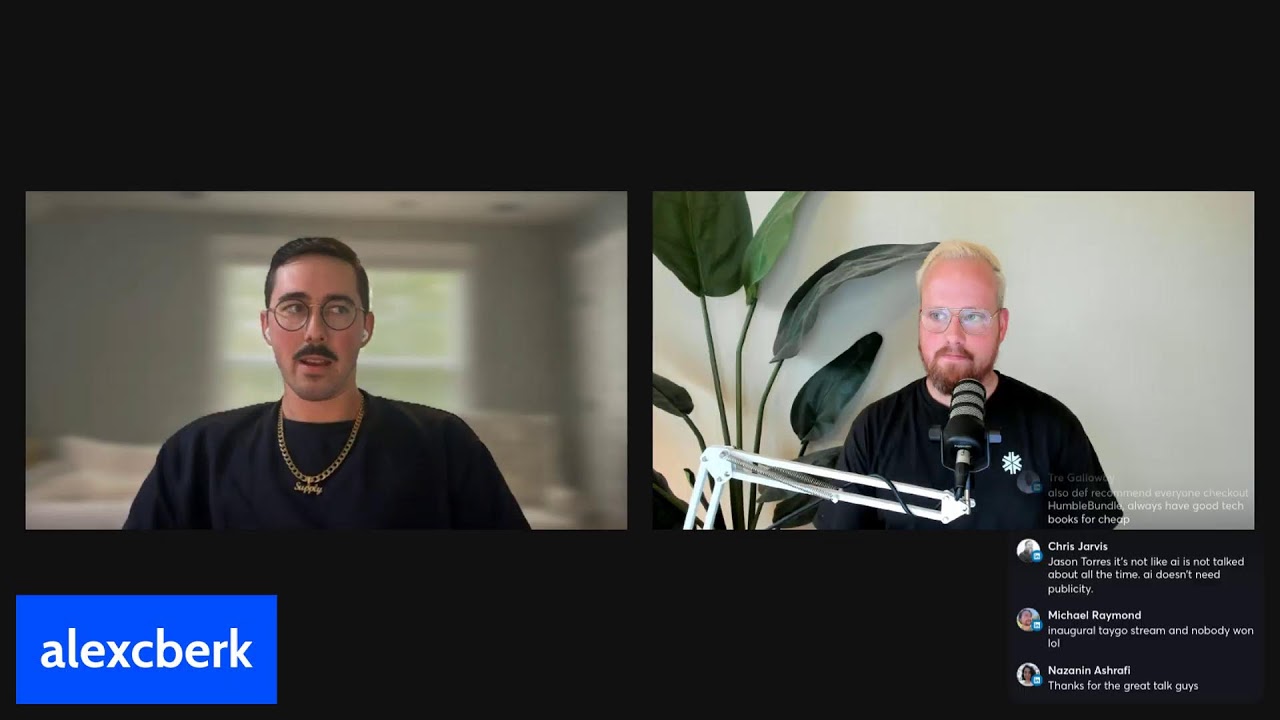
Taylor Desseyn talks with Alex Berk, a lead engineer at Shipium, about why soft skills matter more than pure technical ability in hiring and career growth. They cover networking strategies, interview stories from college hires to on-sites in Seattle, and practical tips for junior developers on how to position themselves.
Chapters
All righty, got that.
And then let's alert the troops in the Discord.
All right, sweet, awesome.
All right, good morning y'all, happy Tuesday. Uh, Alex is special. Uh, one, he lives in South Carolina, which is, is near and dear to my heart as a South Carolinian. Um, but also too, he's the only live I'm doing this week and next week. Um, okay. So, uh, you know, Alex is it. If, if you want to get your fill of Guidance Counselor 2.0, this is it. Um, uh, uh, next week, um, uh, I didn't have anybody scheduled for tomorrow, and then I head out for fall break with my 5-year-old. We're taking her on a little trip. Alex and I were talking backstage about having kids, so we're trying to like, you know, spend some good meaningful time with our 5-year-old. So we're taking her up to Louisville. Um, which we have, we have some good friends up there. And then next week we're at, uh, in Raleigh, All Things Open. It's gonna be great. Um, if you, uh, a little announcement time, um, if you are in the Raleigh area or can drive to Raleigh and you don't have a ticket, let me know. I think we have a few left, free tickets. Um, and we're doing a bunch of really cool torque stuff, so we're doing some Sunday night— I said Monday night, I can't get my day straight. Sunday night we're doing a speed networking, uh, type meetup with CodeRabbit and DigitalOcean and, uh, Palmerium. Um, and then, uh, and then Tuesday night we are doing our, um, our private invite-only— you got to be part of the Torque Discord to get the invite— um, event. So we're looking at— I think we have like There's 18 people registered now. We're shooting for 30. Um, so really, really excited. So if, if you can get in the raw— All Things Open is really cool. I mean, I, I think, um, uh, Todd, uh, he, he's a, he's a fellow Gamecock, by the way, Alex, just let you know. Alex went to Clemson.
Alex, deeply disappointing.
Yeah. So you know what the problem is right now, Alex? I've been thinking about this intro like it's the wrong season.
What am I supposed to say?
We both suck. We, we're both terrible. And honestly, y'all don't have an excuse because y'all hired Garrett Riley, which no, we thought was the second coming of Christ next to Dabo. And y'all, you guys can't, you guys can't figure out quarterbacks right now.
Yeah, it's painful. But luckily my kids aren't old enough to remember this season. So yeah, we can, we can turn it around. Yeah. And, and, and bring them up in. Yeah.
And I always had to get Alex on the time where South Carolina beat them the last year. So that's why I invited Alex. Alex couldn't hold that against me. But so anyways, no, super excited. So again, if you can get to Raleigh, DM me if you want a ticket. I think we have just like 3 or 4 left. But even if you, even if you can't go to the conference for the full time, we're doing a lot of stuff in the area. And FYI, the interview was listed or announced like 3 PM or 1 PM.
Is that okay? Well, we're here, so there you go.
Again, for those of you that are tuned in, welcome. Say hey, would love to hear from you. Again, I tell people this is What I've realized is this is, in my opinion, I feel like they, these sessions are, are probably better content that you can get at conferences. So I think these are just mini conferences, um, where, where I hang out with really cool people like Alex and we kind of unpack some, some topics. I'm excited to talk about the topic today, which has been, everybody talks about, but we're gonna hear it firsthand. I was, I was, I was catching up with Alex backstage and we were talking about some interviews he had and people just hired him because they liked him. Imagine that. So So we're gonna talk about that. But again, please continue to say hi. We don't know if you're watching unless you comment. And the Torque community is here. We— everybody's in the chat. Everybody would love to connect with you, so please do that. And then just kind of some housekeeping things. Again, shout out Appwrite. I'm a part of the Heroes Program. Again, probably the non-technical hero on a Heroes Program ever. I don't use their product, but I like their people. Does that count? I don't know. So go check them out. They're great. They're great folks, great product. Also, listen, we got a huge kind of refresh rebrand. Alex, I, I, I, I I promise you'll start talking here soon. Um, but, uh, I do want to say we have a lot going on. We are— we have officially— we haven't officially opened it up like, like on social media, but we officially opened up our ambassador program, uh, signups. If you want to basically be a champion of our brand and what we're doing and be invited to things and get cool swag, um, go sign up there. I do have to say, if you're an ambassador right now, you have to reapply. Um, so we're kind of gonna, uh, Um, kind of redo our ambassador program a little bit from a personnel perspective. So even if you are ambassador, please go apply, torque.community. Also, we are going to open up our mentor-mentee program again. Um, to be totally honest, we probably didn't do the best job. Um, it was our first cohort, we probably didn't do the best we should have. Uh, we, we learned a lot and we're gonna fix that. So if you do want a mentor, please go sign up, torque.community page has all the information. And finally, if you want to, if you want to know when I go live Shoot me a text. Also too, a lot of people are like, Taylor, I didn't know you're in my city. Listen, if you want to know when Torque is in your city and all that jazz, just shoot me a text. You can just shoot me a text. You don't have to say live. Live kind of lumps you into another group, um, that I text out. So if you want to— so, so if you want to know when I'm in your city, Torque's in your city, um, shoot me a text.
Would love to have you.
All right, so enough with me yapping. Again, it's good to see everybody this morning. Alex, let's give the people what they want, man. Who are you? What do you do? And we'll go from there.
Great question. Hi guys, I'm Alex. I currently am the lead engineer at— one of the lead engineers at Shipium. We're a supply chain shipping label as a service, all things carriers, back office, mostly API company. Uh, I am not here on behalf of the company, but that's what I'm doing. Nice. And, uh, I am in South Carolina, although I Spent 4 years in Seattle, uh, married, have 2 kids. Uh, that's more important than this stuff, but this is the stuff that pays for that stuff. Which—
and you and I are having kids like basically together.
It's true. Yeah, we're in the same life stage.
His third's due the— Chris, is it actually Christmas Day, 25th?
22nd.
But okay, mine's, mine's technically the 29th.
Nice. So, uh, so the difference Yeah, yeah, yeah.
Knowing how late my kids have come, we're probably looking like first week of January, if we're being honest. Um, so if you don't hear from Alex or I at all at the end of December, we are, uh, helping our wives, um, with the kids.
So there you go.
Congrats, brother.
Congrats. Yeah, you too. So, uh, yes, I am, uh, I've worked my way into this company. I ended up here as a product of people that I've known and worked with 4 or 5 or 6 years at other companies and started my career in Greenville, South Carolina, which is pretty close to where Taylor's from. Yep. And hopped around a bit. That's the short version.
I love it. I love it. So, so again, for those of you tuning in who may not be familiar with kind of how we do things, I don't really ask— we don't have set questions here. I ask the speakers to kind of fill out a form, kind of what's on their mind. And so what Alex What Alex filled out for, for this talk is kind of some, some 3 things. Um, one is networking matters. Imagine that. Soft skills beat technical skills. Imagine that. And just do things. So those are kind of the 3 areas we're gonna play out today for today's conversation. So Alex, I, I, I kind of wanna start around soft skills over hard skills, right? Um, you know, you shared your story with me backstage. Would love for you to share that again. And then after that, I'll kind of pepper you some questions.
Totally. So we're talking a little bit before the livestream about my first job. I was at Clemson University and a local CEO came and gave a talk in one of our classes. And I was one of maybe 3 people out of 100 or more who was normal enough to walk up and talk to the guy afterward. Imagine that. And so in, in—
so I want to set the stage real quick. So like, was it, was it, it was a meetup or—
No, this was an actual class.
Okay, so it was a class at Clemson?
Yes. Instead of the lecture, we had a guest speaker come in and talk about his company in, in place of the lecture. So everyone was expected to be there like a normal class. And we had a guest speaker instead.
And so like after, so after class also, by the way, do you play pickleball?
I do not. I did play fairly competitive tennis. Oh, did you really? Yeah. I'd love to.
Like, like, like what number were you?
I was, I, I played first doubles in high school. Oh yeah. And then I got, yeah.
Yeah. I dated a tennis, I dated a tennis player in, in high school, so I know. Okay.
Yeah, it's a great game and would recommend picking it up in adulthood as well. Pickleball seems good. Yeah, it doesn't sound as fun to me, but I do need to try it.
Clemson campus, Sean, is not beautiful. It's not. It's ugly.
No, I'm just kidding. Let's go, Sean. Sean knows what's up. It is really pretty.
Anyway, so back to the conversation. We obviously get very sidetracked in this medium. Easy to do. Yeah. Professor gave a talk, nobody else stayed, you went up?
Yeah, everyone went to their next classes or left the— I mean, you can imagine a typical—
everyone's like, peace.
Yeah, yeah, I got, I got, I want to go sleep, or, or my next class. I mean, nobody's going to their next class. Yeah, I went to get lunch. Yeah, people just dipped. Uh, I probably would have on another day, but It felt like the right opportunity to start meeting people. I was about to graduate, so I went and shook the guy's hand. We talked for 15 or 20 minutes. I told him— I talked about my coursework. He was interested in, uh, he was obviously there to scope people out, so yeah, why not introduce yourself? Anyway, we exchanged information. I told him about things I was working on, some of my projects. And, you know, I was due to graduate soon. And then he called me the next day, uh, asked me to come in. This was like a Tuesday. He asked me to come in that Friday for an interview, and I did. All the interview went—
Came up, shook hands.
Yeah, I shook the guy's hand and went in for the interview. He— the CEO already liked me. The other people who interviewed me liked me. I got an offer the next week.
Amazing.
And started a month or so later. And that was all before I graduated college. This was— I was, I was probably a senior by credit hours, but yeah, I had a lot of life going on. I was about to get married. I had transferred from Eastern Michigan University, and some interesting stuff had happened where I like needed to take a psychology class because something didn't transfer correctly. Yeah, if anyone who's in the chat who's transferred could probably relate. Things never line up correctly. It's, it's really annoying.
Yeah.
So the, the logistics ended up, I needed at least 6 to 8 more months of school, which I did online. But the guy was willing to hire me because I knew how to do the job.
So, so, so did you, so I'm, I'm curious because I, I, so you, so did you just stop going to Clemson like after you got the job? Like how'd that, how'd that work out?
No, I— well, I lived in Clemson. We, we weren't married. My wife and I weren't married yet, so I was still living in my apartment. I was going to classes. I think my in-person classes ended in December. I started the job January 1st or 2nd. I started driving to Greenville for 9-to-5 work and then took all my classes online.
That's crazy.
4 months, and I got the— I think I got the paper. I graduated officially in August.
That's awesome. That's awesome. Um, what— oh, and then talk to me, so then kind of move on kind of throughout your career. Where, where's been some other places where just being you and, and, and kind has, has kind of changed, changed things?
I would— yes, I would say every job has been impacted by my ability to hold a conversation, look people in the eyes, and speak somewhat intelligently about technology and software.
Yeah.
Not only I can do the job or I wouldn't be hired, but it doesn't stop there. And for me, I think the, uh, the connection with other people has put me above others in some cases. My second job, I took a cold call I was starting to look around in both in the Greenville area and out of state. We weren't sure if we wanted to stay around Clemson long term. Yeah. And I took a cold call from a recruiter. Uh, I would probably today, I would probably screen this call. It was one of those random phone numbers, you know, it says unknown caller.
I don't even answer.
Nobody answers those.
No, I don't answer anything anymore. Even my mom calls me Right? Sorry, Mom, but like, even— I mean, I just, I don't answer phone calls anymore, so it's crazy.
Yeah, reply with a text. I'll call you later, or I'll see you in person. Yeah, absolutely. Totally different times. But for whatever reason, I answered this cold call, and it was a recruiter. I was a little skeptical because you can get scammed. Yeah, I'd had, I had plenty of junk calls before, but sure, I, I heard the guy out. They were hiring for, I think, quote, a large manufacturer in the Upper Greenville area, which is either BMW or Michelin.
Yeah, if you work in the area, you know, that's either BMW or Michelin, right?
Yeah. Yes. So, uh, seemed legit. I, I talked to them and they ended up putting me in connection with the chief architect and the director of that organization at Michelin. And that interview wasn't technical. They were looking for somebody to build things from scratch for this new branch at Michelin. And they needed somebody who was willing to work hard and could communicate because old company like Michelin, you got to talk to a lot of different organizations.
Yeah.
There's files, Excel files and PDFs and flat text files moving between different, like, isolated orgs, and everything is very regimented, but they're trying to move fast in a small— smaller group.
Yeah.
So they really liked me just as a human, and we talked about what we could build, but I didn't do any technical interviews. I showed them what I'd been working on. I showed them the type of stuff we're doing at my current company, and they took a bet on me, and I worked there for 3 years.
So I, I wanna— so, so Naz comes in and she goes, I suck at, uh, holding conversations. Oscar, communication goes a long way. Um, what— let me—
I—
before we go too much further, I, I, I kind of wanna get to like some meat and potatoes here. What do you, what do you think you're like? What makes you good? I know you said like look people in the eye, but like, is it how you communicate? Like, can— is there any way you can unpack this for the people watching right now and what kind of separates you with this stuff?
Totally.
And brag on yourself. Now, now's the time to brag on yourself for sure.
Totally. The first thing I— some of this is unconscious. Practice makes perfect. It's the same as sports. It's the same in some ways as, as writing code and technology. You just pick things up. But one of the first things I consciously do in these types of situations is I try to make a personal connection. So with Michelin, one of the guys was from Michigan and I went to Eastern Michigan University. Instant connection. We can talk about some of the local places there. We can talk about the school. We can talk about things we liked and didn't like, things that our families experienced that are similar in some way. In, uh, in my interview, Michigan comes up a lot because they spread like a virus. But—
Dude, so many people. Yeah, I— so many people. Half my hockey team is from Michigan. That's another conversation. But yeah, there's so many people from Michigan. It's nuts.
Yeah, it's very, it's very funny how that works. But the, the, the job that moved me and my family to Seattle made a connection about Michigan with a guy who grew up in the same zip code. We still work together today. Wasn't the reason I was hired, but that disarms somebody immediately.
Uh, so you can, so you can— So like, so if you were to say like, I know we talk about all the time, but like Knowing who you're talking to is going to be huge. Yes.
And I do research. It's tough to— I mean, you sound like a stalker. I, I basically stalk all the people I'm going to talk to before I talk to them. Look them up. There's a reason they have a public profile. It's so you can look at it. Correct. So I go to their LinkedIns, I go to their Facebooks if they're public, I'll go look at their Instagrams, I'll look at their personal portfolios. their work history, and try to find those connections ahead of time, and you can just work them right into conversation.
Yeah. Super simple. Yeah.
I mean, with Taylor, it— I didn't do it on purpose, but it was pretty obvious he was from South Carolina. Super easy to poke fun at him on Twitter. You know, this is— it's kind of small talk slash interpersonal communication 101, but you figure those things out, and if you can make a connection You disarm the person. They're—
they're—
people love to talk about themselves. They do. That's why I have a podcast.
Exactly. So, and also too, like, and, and I think let's, let's list some things for people, right, that are good conference— all right, good conversation starters. One, if you got kids, that's the ultimate conversation. That is, that is shared suffering. I talk about all the time how to build community. It's shared suffering. If you got kids Shared suffering. Now, if you're like, Taylor, I'm single, I don't share joy. It— yes, sorry, shared joy. There is joy in suffering, for the record.
So we're, we're both in the thick of it, so I'm with you. Yeah, yeah, we have toddlers.
We're about to be in the thick of it again.
Exactly.
So joyment and shared suffering, um, for kids. Um, college, school, region.
Yes.
Um, what are— is that— those are the big ones that popped up. Anything else that off the top of your head that you could think of?
For me, it has been Jesus. Yeah. But you do have to be— yeah, yeah, yeah. Strategic where you bring that type of thing into conversation. Sure. Yeah, yeah, yeah.
Um, and then I'll also tell folks this too. Um, Is it college? Did I say college already?
Yep.
Okay. So again, I think people overcomplicate this networking thing. Now let me ask you this, and I'm mentoring some folks at USC right now, um, the real USC, University of South Carolina, um, and you know, I've done some mentorship with a college grad here or a senior at Vanderbilt. How can people sell themselves? I think the biggest problem that people have no skills. I think they have problems selling themselves when they don't have anything to offer. How did you overcome that as a college student?
Do you remember? So pets, I think pets is another one. Yeah, yeah, yeah, that's valid. Yes, we also—
coffee. Alex, do you, do you have the coffee? Do you have the coffee mug next to you? Do you have the coffee, Alex? So for the record, Alex, we got on our live and Alex picks up his like coffee thermos and moves it over on camera. I go You're a coffee fan.
And Alex goes, oh yeah.
So again, right? Like, and, and, and that's why, like, in the Torque community, like, that's why we have an F1 channel, an NBA channel, a shoe channel. Like, honestly, a lot of times if you can just get outta the professional stuff, you actually bond quicker.
Yeah. Talk about Taylor's plant. Where'd you get the plant? What type of plant is that?
I think my wife got it from Target.
It's fake. There we go. It's got a lot of dust on it. Well, you can talk about that now. We know you have a wife.
Yeah, exactly.
There. See, there you go.
So yeah, go, go, go back to college students. How does somebody position themselves as a junior dev or college student?
I had a pretty unique advantage. I think I grew up very involved in my church. And so I did a lot of speaking, a lot of preaching.
Oh, really nice. Awesome. Yeah.
A lot of leading small groups, Bible discussions, personal Bible studies. Uh, just social events. I was around people talking about things that we could connect on from a really early age, and our parents were very involved, so I was watching them give Bible lessons, singing in public, things that if you don't do them consistently— singing for sure.
Yeah.
They're very uncomfortable at first. Yeah, very uncomfortable. Yeah. Even if you're good at singing, rarely do people like their own voice.
Yep.
Applies to speaking. I might listen to this livestream later and I will regret it, but we'll see. TBD.
For now, you sound great.
Thank you. So just from the communication standpoint, it's a lot of practice. I had a lot of practice by default because of the lifestyle.
Yeah, that makes sense.
But speaking to people or recording yourself speaking or Going to meetups nowadays, it's really finding in-person events, I think. Yeah. But practicing your communication with other people, not for the sake of trying to land the job, but for the sake of getting your name out and meeting people in general. It'll help you in more places than just your job. Yeah.
Yeah. Yeah. And I wanna go, uh, see here, Christina comes in here. If you don't have experience, you can say, I don't have experience, but I have a wide network and know who to help, uh, ask to help, and I'm not afraid to ask for help. Love that. I would also say, um, so Kanika Tolliver, if you don't follow her on X, she posted an article today about AI, how to kind of position yourself as an AI engineer. A lot of it is just starting to talk about it, right? I say all the time, like, Naz is on my, on my Twitter, right? She is constantly talking about Python now. She's doing YouTube videos, right? Like, sometimes, like, what's, what's fun about being known for something is even if you don't have experience, you can just talk about it, right? So, like, if— so with these, you know, so these 2 kids I was mentoring at South Carolina, they went to a job fair recently and they're like, I kind of blacked out with my about me statement.
I go, everybody does.
I was like, talk about your passions and what you want to do and be assertive in that, right? If Alex probably went up to that college professor, was like, well, like, I do this, I do this, and I kind of interested— Alex probably went up there, I was like, yo, like Would love a job, or this is what I'm good at. Thoughts?
Exactly. Yes. Uh, walked up to him, said, shook his hand firmly, you know, all the stereotypes. But the first, at least one of the first things I said was, I'm, I'm due to graduate here in January. I'm looking for a job, would love to stay in the area. You guys are right in Greenville. Love Greenville. My wife is going to nursing school. She's going to be busy and we're going to be right here. I'm ready to start now. I can start before— I could even start before I'm done with school because it's all going to be online.
Sure.
And then I talked about, I just finished, you know, these 300-level classes, this 400-level class. I have a minor in digital production and animation. I have a lot of— I have a breadth of skills, but I'm also pretty focused on just building applications, which sounds like exactly what you guys are doing.
Yeah.
And I let him talk a while about what type of things they were looking for and what ended up— so I guess I didn't talk about this. They were really looking for a technical project manager. They wanted somebody who could write code and also could onboard and upsell customers. So my job, I spent a few months onboarding But my job was a lot of phone calls with customers right after the sales cycle, getting them set up in the platform, and then also writing code for them to get set up in that platform, and then upselling them as we went through that process and discovered you guys have this super custom whatever ABC and we have a pretty turnkey solution. But it's a module or it's an add-on, or we can charge you a 5-hour service charge and do it for you, which would probably result in me just writing the code myself. Yeah. But that's what they were looking for, somebody who could speak to customers while also building things. Yep. Yep.
So talk about that interview in Seattle, right? So you moved out Seattle pre-COVID, right? Or during COVID or pre-COVID?
Just barely.
Yeah. Just Just got it.
We didn't know, we didn't plan it. Yeah.
Yeah. Uh, what, um, uh, talk about that interview and, and because you told me about the staff engineer that was kind of traditional staff engineer, talk about how your personality came through there and helped you land that job.
Absolutely. So I did the, what I would consider the pretty standard LeetCode grind where I blasted out. My wife and I were looking to move west, and in tech, for me, that meant probably San Francisco or Seattle. Those were the cities we were interested in, and we didn't really want to live in California, so we looked at Seattle. I blasted out over 200 applications. This was in 2019 when everyone had money and headcount. Yeah, that definitely helped. Just— Let's presuppose everything I said. There was money bleeding. out of every company. Yeah. So that was the right place at the right time. That is the reason that I could get— I think I went through 20 or 25 technical rounds. So I made it pretty far with a ton of companies, everything from Amazon and Google down to like Redfin and—
Nice.
Adobe, and some smaller— Auth0. I interviewed with a ton of companies.
Okay.
I just named the ones I didn't Take jobs with.
Yeah.
So I ended up with a handful of on-sites the same week, flew out there. But the job that I ended up taking, the interview loop mostly went really well. But the last guy that I interviewed with was the most senior member of that interview loop. He was a principal engineer, very cut and dry. not big on small talk, uh, which is fine and fairly typical of somebody in his position, uh, but he wanted to— he wanted to talk about an algorithm. He had a practiced, rehearsed question that he wanted me to solve, and he wanted me to do it in such and such a way under some amount of time.
Yeah.
I think I had 45 minutes. His question was about building Bubble Bobble, the game that, uh, I think it's a—
Does anybody know that game? For the record, I— what is— is it a game? What, what type of game is it? Game Boy or what?
What is it? It's— so I, I did not know what the game was during the interview. I've since looked it up. Google it. I've since looked it up. You fire little spheres and try to pop—
Dude, this was a 1988 game. What a jerk move to ask if you knew Bubble Bobble Were you even born yet?
No.
Neither was I. I was '89.
Are you '89? '90.
You're '90?
Close.
Yeah, dude, that is crazy. Asking somebody to interview on a whiteboard to recreate a 1988 game. That is crazy.
Yes. So I understand probably why he did that. He wanted to see if somebody could figure out how it worked and implement it. I, I don't— I'm not necessarily bashing the guy. I, I get the reasoning.
Sure.
But I didn't know the game, and we didn't really click on a personal level, uh, which didn't help. And I was trying to tickle out like, how, how does this game work? What are the mechanics? Uh, before I could even really implement anything, that was the point of the interview. But I did not do well. I couldn't figure out how the game worked. I was trying to write these interfaces and classes and figure out where to put state. And it was a train wreck. I felt quite good about the company until that last round, and then I ended up leaving feeling super dejected, and there was no chance I was gonna get a callback or an offer from this company. I did get an offer 2 hours after I left. I got a phone call.
Oh, for real? It was that fast? Like, you bombed an interview but then got an offer a few hours later?
Yes, I was with my wife— uh, sorry, I was on the phone with my wife. I was by myself out in Seattle. I was in Pike Place waiting in line at Piroshki Piroshki, I think, and I was on the phone with my wife and the phone rang on the other line and I said, one of the companies is calling me, which is honestly surprising. Let me call you back.
Yeah.
And I switched to the, the other line and it was the recruiter. And I expected to hear like, you know, everyone loved you, but it wasn't a great fit. Yeah, thanks for your time. Yeah. Instead, the recruiter was like, everyone loved you and we're really excited to give you an offer. And I almost fainted on the spot because I really didn't—
Alex falling out.
Yeah, I, yeah, I could have crashed out. I'm glad I just stayed silent. But anyway, I got an offer. It was great.
The—
but what I found out after I started and became close with my teammates and all the people who interviewed me that, that weren't that one individual, he definitely was a no in the debrief. But I did so well both technically and personally with all of the other Loop members that were actually on the team that I was interviewing for.
Yep.
That they just discounted and overrode his opinion, and he was on a different team, so it didn't really affect his team. And they were really excited about getting me onto their squad because they were really confident both in my ability to learn but also just the connections that we made. So, yeah, you know, one, one thing I connected with one of those guys was about Michigan. He went to University of Michigan, and I grew up in Michigan, went to Eastern Michigan University. We talked about that state, we talked about schooling and the life there. Another girl, uh, she asked her— before we did the technical piece of her interview, she asked me, how has luck played a role in your journey?
I like that interview.
Which I've had before. It's a good question. And I, I have a somewhat rehearsed answer, but I, I spin it into for me, religion. Yeah. And I, I basically say some people will call it luck. I consider it faith. Yeah. But I've had a lot of faith in God that if I follow him, yeah, I will, I will have doors open. Yep. That give me opportunity to follow his will. Yep. I—
yep.
We can get into, you know, theology.
Yeah, yeah.
I don't believe that God is coming and stamping the offer. Yeah, but I do believe that God is omniscient and he does want to put me in places where I can serve him. And so, you know, combination of that and luck surface and just putting yourself out there, that's kind of how I spin the answer to that question. And so I remember giving her that answer and she was— I remember her saying something like, wow, I've never received—
Yeah.
Like that type of answer to this question before. That's really cool. And then we— then I built a calculator in a web app, which was super easy for me to do.
Yeah.
But so it's that type of things. Like, if I had just built the calculator but had no idea to communicate—
Yeah.
How to communicate with her.
Yeah.
Would that have been enough to override the principal engineer? Or if I had— with the guy from Michigan, his question was, uh, the, the LeetCode, the LeetCode problem where I think where you have to— is a pretty hard one where you have to, uh, find the area between the 2 largest buildings in a skyline represented as a histogram. And it's, it's, it's a math question, and I think I did it in a suboptimal algorithm, but I did finish the solution. Okay, there's a more—
Hearing tech interviews, ain't no way I'd be a developer. I'd be like, I don't know, 2 2 4.
It's, it's not fun, and you rarely use those algorithms. Yeah, in the real world. And if you need them, you can look them up online. So I have opinions on that piece, but yeah, yeah, whatever. But I— yeah, I don't know if that would— that have been enough, a, a sub— a slightly suboptimal solution without the personal piece, would that have been enough to override the principle? No. Right. Maybe not. Yeah.
Yeah, that makes sense. Wanna get this question by Justin. Great question. I have a question. With someone like myself who's attempting to land my first dev job, should soft skills be practiced more than technical skills?
I—
go ahead, you answer first cuz you're the guest.
I think, I think technical skills It's a good question, and it's hard to answer because I already had the soft skills when I started practicing the technical skills. I would default to yes, but it, it does depend on how— what your technical skills look like. You can't have no technical skills.
Yeah.
You'll get weeded out of a screening round.
Yeah.
You won't get to the people where the soft skills matter. Yep, yep.
I, I think the problem is— and I'm not, I'm not picking on Justin, but he just asked this— Justin, I feel like a lot of people in today's world are or, not and. I think it's both. But I will tell you this, there's been a theme emerging over my last few weeks of Guidance Counselor 2.0: the ability to talk While coding and talk to explain and talk just in general. Talk like there, there, there is a theme, right? Like one of my conversations with Brad Garappi a few months ago, he, he's, he got a job. He's, he's worked at Stripe, Atlassian, and Cloudflare, right? And he said the biggest thing that's made him like get these jobs is he's gotten really good at like just streaming to nobody but maybe his mom. and just talking about coding and while he's doing it. So I think it's—
that's right.
Yeah, I think it's both. And I think that I— and, and I'm really big on it. Like, I think everybody should have a YouTube channel. No one's going to watch your stuff, and this— it isn't for anybody else. It's for you to start getting the reps in.
I agree. As a concrete example, I looked before we started the stream. I have done 99 LeetCode to completion. Compare that to— I don't know, is that a lot? That's very few. There are thousands. Very few.
Gotcha.
Oh, okay. And you will typically see— I mean, for people who are prepping to ace a Google round or a Facebook round, you will see hundreds, if not the entire catalog. I mean, there are people who compete to try to finish every LeetCode, and they come out with new ones every a few weeks. But yeah, 99 for a lead engineer is very few. But obviously I've done some, right? I, I put in some time to make sure I knew how LeetCode works, understood the general strategies, different data structures that they're looking for, how to spin things up, and yep, yep, figure out a solution.
Yeah, so there's a question by Stefan I actually— I want to highlight. He goes, Something actionable. Take an improv class or present something technical or non-technical. I will tell you this, you know, the, you know, the single most— the 2 most single impactful things that made me a better speaker— and mind you, I grew up with major speech impediments, could not pronounce my L's, TH's, R's, S's, and had a stuttering— had a massive stuttering problem— is I— now you can't do this, I can't— I mean, most people can't do this, but I— my parents, and shout out to them, they, they pushed me into like competitive speech in middle school and high school. Um, that changed it. But if you want something like now, and the next thing is volunteering at a nursing home.
Oh yeah, I wouldn't have thought of that.
Yeah, my parents, they made me and my brother volunteer nursing home, uh, local nursing home. And you start to have convers— when you, when you get to the art of the conversation, being interested in asking questions and carrying conversations, because at the end of the day, if you're in a nursing home, not many people can carry conversations. You get really good at that. Now, am I telling everybody to go out tomorrow and like volunteer at a nursing home? Sure.
Maybe.
Honestly, I think you should for like 6 months. Gary Vee talks about it all the time. Um, but for me, I think it's like something like Alex said, like if, if you're involved in church, get involved with leading Bible studies. Or, you know, if, if you, if you don't go to church, then, you know, host a meetup, stream while you're coding, do something. But I do agree with, uh, Stefan here, improv class. present something technical, non-technical is huge.
Yes, that's a great point. Presenting anything. Yep, that's it.
All right, let me, let me, let's go kind of the, kind of the next, next topic, which is, um, that, that you put as we kind of start to round out our morning together, um, is just do things.
Yes.
We did not talk about that backstage. What did you mean by that?
So I, I did some contract work for Beehive.
Uh, that's right, you and I bought— yeah, yeah, you and I really early.
Yeah, really early. And my brother Daniel Burke, if you haven't seen him on social media yet, you— Oh wait, wait, wait, wait, whoa, whoa, whoa, whoa, whoa, whoa, that's your brother? Yes.
You're kidding me.
He works there.
Yes. Yeah.
Before he worked there, I did some work for them. And the way that that happened was I DM'd Tyler on Twitter before anyone knew who that company was. And they needed what I had to offer. And so I built some stuff for them. I wasn't in a place to work for them full-time. But I just did some work and Just DM people. And isn't that wild?
Isn't that wild? I mean, literally, like, when I was telling my students at South Carolina, I was like, get on X. And they're like, what? It was these 2 girls. They're freshmen, by the way. South Carolina, if you want, you're not watching this, but like, don't do mentees and mentors when they're freshmen. They have no idea what they're doing. But like, I was like, get on. So I said, get on LinkedIn and start DMing people. They're like, what are you talking about? And I was like, the art of the DM is in— it's undefeated. I think if everybody went out and sent out 100 DMs to people you want to talk to, I bet you'll get 10 responses.
Absolutely. Just to name a few examples, so that's the probably most concrete example of, uh, just DMing a guy and having some enough experience and things to back myself up. Where it worked out. Yeah, but I have, I have DM'd a person at Netflix and interviewed there because of the DM. I have, I have, I've had probably 5 or 6 other DMs because, or interviews because of DMs. I did a, I did 2 separate loops at Meta years ago.
Oh, really?
When it was Facebook. Because of just reaching out to people on LinkedIn.
Isn't that crazy?
Yeah.
I mean, I do, I tell people, I get goosebumps when we're onto something. I'm getting goosebumps right now. Like literally, literally you can DM anybody. Totally. Now, will you get a response? Maybe not, but you can literally DM anybody.
Anybody. Yeah, I sent a, I don't wanna name drop. I've sent DMs to CEOs.
You can name drop. I'll name drop. I got Jordan Rogers on. He was a former director of marketing from Nike and he has the Brand Fathers Podcast. He lives in Dallas. Great, great guy. Was in jail for heroin back in the day. Cleaned up. His story is incredible. And I just DM'd— I was on the golf course. He's a big— he's getting into golf creator now. I was on the golf course. I just emailed him. By the way, huge hack which I've talked about a lot, just email people back from their email newsletters. I emailed Tyler Denk from Beehive. I was like, he sent this one email one day. I was like, dude, you need a vlog. And he goes, he messages me back, he goes, I don't have time for a vlog. I just like to write. But I was like, but I was like, I have the founder of Beehive messaging me back from his email newsletter. And it's like, so I've had Jordan on and I've had Dee Murphy. Dee Murphy is on Group Chat. He's in LA. Group Chat is one of the top business podcasts. It's like next to All In. Like they're one of the top 5 business podcasts and I just DM'd him to come on my pod and he came on my pod.
Incredible. People are just people.
And I'm gonna message your brother after this and ask him to come on cuz I would love to talk about dads in tech and stuff.
Yes, do it. I can't guarantee that he'll agree.
That's fine.
But hopefully.
Yeah, no, that's fine. It's fine. I, I'm used to being rejected. That was my dating game in high school, middle school for me.
Yeah, I feel it. Yeah, yeah, uh, yeah, I'm just looking through on my phone.
Yeah, do it. Yeah, yeah, brag on yourself.
I mean, uh, the creator of React, Jordan Walke, I talked with him for a bit when he joined Replit. And if I was willing to move to California, which I'm totally not, I potentially pull that string and interview there. But I'm not looking right now. But you know, now I— he knows who I am just because I congratulated him and said, you know, Replit's been a really cool tool. I've talked with some of the libraries I use, like just asking real technical questions when I run into issues. We use Fastify, which is a JavaScript library built by a big Node.js contributor named Matteo Collina.
Okay.
And I've chatted with him briefly in DMs on Twitter.
Yeah.
Same with React Query is built by— it wasn't on Twitter. I think it was on Bluesky. But the creator of that, I had a technical question and he responded in like 30 seconds just because I asked him the technical question and it was super helpful. I had to do something at work and something wasn't working the way it was supposed to and he had a great answer. Obviously Tyler. Oh, I forgot this. The, uh, the ex-CTO of, oh, Lattice, Eric Koslow. Yeah, he, he left Lattice and I DM'd him a few years ago and ended up interviewing with him and talking about an opportunity that I, I ended, ended up being outside of my wheelhouse.
Sure.
So I didn't pursue it, but he— we had a call and he was telling me about what he was building and Uh, so I mean, being generally interested in— there's, there's a list. I mean, I'm scrolling through, there's a ton of people. That's awesome, dude. But yeah, it's just being interested in what people are building. Yeah, for the sake of being interested in it. Yeah. And if you are looking, that's good too. But most people, in my experience, are on there to connect with other people, and they have reasons too. Those guys are looking for great Engineers, yeah, product managers, company leaders, C-suite level people. And the first place they're gonna look at is the list of people they know, not the cold application off the internet.
Well, what's crazy too, and, and it's, it's special with what kind of we're building. Again, I appreciate your involvement within Torque because, I mean, you've bounced into some of our stuff and it means a lot. But like, that's, that's kind of my vision for this thing, right? Where it's like We get as many people in here and we're just sharing ideas and, and, you know, it just— it's kind of this tidal wave momentum type of situation. And it's like, everybody on the live stream, I've met some of y'all, I've met most of y'all, I haven't met some of you, but I'm gonna greet you. Like, Taran, I don't know if we met. If we've met, I'm sorry, I can't remember. You can ask my wife, my memory is awful. But like, Taran, you're always here, dude. If I meet you in person, I'm I'm gonna give you a big old hug. Actually, Terron, are you volunteering at our booth? I think you're volunteering at our booth for All Things Open. I'm gonna give you a big old hug.
Incredible.
So yeah, Terron's— yeah, yeah, Terron's gonna be at our booth. Terron, give me a hug for me, big dog. Yeah, I just checked the schedule. We emailed. That's awesome. Again, like that— I mean, that's what I'm saying. That's what I'm saying. So, um, uh, talk about— let me ask you this. Obviously we can't, uh, not bring up AI.
That's where I was going next.
So yeah, I think my conversation with Mark was really good the other day, uh, DevRel at Google. We talked about how to use it to empower you in the interview. You can spin up concepts, you can create things really quickly. Any thoughts to job seekers right now just around using AI to, to, to, to better themselves right now?
I don't know if I have an excellent question in that exact frame because I haven't been interviewing in the age of AI. I've been building.
Okay. Well then, then give me the general state, like some advice for folks then. Let's, then let's, let's, let's pull it off of the job search then.
Yes. I will say that the ability to communicate effectively became way more important. Yeah. Because now you have to speak to a computer.
Yes.
And your, your, your concision and your clarity is the most important part of your prompting.
Yes.
And I mean, as, as silly as it kind of sounds, honestly, we're all speaking to computers in plain English now in some form or fashion.
Yeah.
So that became way more important. We're all— if you were using anything in AI, we're all practicing a version of communication.
Yeah.
We're just chatting with a model.
Sure.
But what I'm, I'm doing a lot We're of course using the standard, like, developer tools, Cursor and Cloud Code, and trying to make things faster on an individual level.
Mm-hmm.
But I think getting past that and looking at more advanced strategies is what's going to make a difference for people. Like, I'm using a workflow orchestration tool right now to build custom agents and The tool I'm using is, is Mastra. It's a TypeScript tool. Okay, there's, there's a Python version, or there's a competitor Python option called CrewAI. Okay, there are a lot of tools all over the place, but choosing something that lets you plug and play different pieces of this new AI ecosystem, yeah, is a big learning opportunity. So I'm building agents which have their own custom prompts, and those agents are making tool calls. And I build the tools, which are more or less individual APIs, and they do some type of thing behind the scenes. And I'm getting into workflows, which are the new age Step Functions.
Yeah.
Where you can have AI do something and then pass it logically to a new something. and have as many somethings in a row as you want. And you have to do things like make tool calls and validate inputs and outputs. And it's a whole new ballgame because there is deterministic code, but you have to go through a non-deterministic prompt. Yep. And it's definitely a different way of thinking about—
Yeah, I mean, I'll tell you this, I mean, I am As much as a good communicator as I think I am, trying to write prompts is challenging. Like, I, I like, I like, one of the reasons I, I tell people to get better at speaking is tweet more.
Yes.
Because if you can distill down your thoughts into 140, or what's it like, 280 now or something like that?
Changes every, every time this video rolls over.
Seriously, just if you get good at like communicating in more of like a succinct way, That's gonna help. Honestly, prompting's helped me too because like I ask things, I'm like, nope, that is not like— yeah, I was doing a prompt yesterday for something. I was like, that is not, that is not what I wanted. So you just, you realize, I honestly think prompt engineering, I, I think is, is an art. I mean, it is a way to communicate. It is a way to communicate.
Yes, it's— and it is different than speaking and it's different than talking to a human.
Yep.
It does tease out your ability to describe well what you actually want.
Yep.
It's not just tough for you. I mean, every engineer is experiencing the same pain of, is this going to turn out the way that I wanted it to? What kind of assumptions is the model making versus what I made when I typed out this sentence?
Yep.
Just prototyping things is super valuable. I'm playing with Replit and v0 and some of the mobile app prototyping builders. I'm messing with those all the time outside of work hours, just building my own stuff. I built— I need to actually post it. I built a name— I built a Tinder for baby names so that my wife and I— I'll send it to you after this.
Okay, cool.
But you just swipe, you just swipe right and swipe left. Yeah. And I set it up so that my wife and I can join separately from our phones and it connects us in a single session and it shows us which ones we matched on so we can figure out how to name our baby. Yeah, sweet.
Yeah, that's cool.
So I love that we have it. We have like 10 or 12 names right now in the pipeline, but again Just going back to doing things. Yes.
Right. Like you created this app using AI, I'm imagining.
Oh, it's— I coded the crap out of it.
But now you can sit there in, in an interview and be like, hey, my wife and I are using this.
Yeah.
Right. Like, I think it, I, I, I was, I was gonna post this on LinkedIn. It was a little too of a hot take. I never wanna come across as a jerk, which probably why my content doesn't get near the reach it it should. Um, it's a whole nother conversation.
Yes.
In my, in my, in my 2 cents, I think it is inexcusable in this day and age to have no experience doing anything throughout your job search. Like, there are people that I know, I'm like, what have you been doing? They go, I've been job searching. So you haven't been coding?
No.
Like, that is inexcusable now.
Absolutely. I think it's always been Maybe not inexcusable. Sure, you're always— you— we have always been at an advantage if you're doing that while, while you're searching or while you're not searching. I'm always building something. I'm always tinkering.
Yeah.
It's tough because there are a lot of conversations with peers and on the internet about work-life balance, about mental health, And those things are important, but the people who are— maybe not but, and the people who are succeeding, at least in my experience, are tinkering and building things regardless.
Yes.
Doesn't mean that they don't have balance.
Yeah.
But I can tell you for sure I have excellent balance.
Yeah.
But there have been times that I have put in the grind.
Yeah.
In my, in my career. Even at my, at my current job, at every, at a point at every one of my jobs, I have put in a grind at some point. Yep. And it has been net positive without a doubt. Yep.
Yep, absolutely. All right, we're gonna wrap up rapid fire. Wanna get to these 2 quick questions real quick. Any tips for you to use AI for learning? Because as a beginner, I can't tell if the solutions are good or bad. Oh, There we go, man.
Sorry, you were quick with that.
You were real quick with that.
Yeah, most of the people around AI have already read that book. Okay, but it's a pretty good practical introduction into how models work and how you could use them to build practical applications. Yeah, beyond that In terms of just practicals, you should already be using either Claude Code or Cursor or both. I use both within each other just for convenience, so I have both available to me. Uh, there are others like Windsurf and other IDEs.
Sure.
JetBrains has plugins for AI. You should be using something, some kind of sidekick that is running an agent to write code. That alone will jumpstart you into thinking about what is the AI seeing, what is the AI good at generating and bad at generating. There are code bases— I, my company's been around for 5 or 6 years. We have some code bases that do not do well if we try to give AI too much to do because of the state of the code base. But then building a prototype from scratch, AI doesn't have to take in context and follow existing patterns and figure things out. It can just spit out its own patterns and the things that it was trained on. Yeah, that's really great for prototyping 0 to like 0 to like 0.7 is what I kind of think of because it never gets it all.
Sure.
But it can get you a pretty decent prototype that you're gonna have to refactor. Yep. So you just need to play with it. That's how I got into it. I just started using Cloud Code and Cursor. And I downloaded everything. I downloaded Replit, I downloaded v0. I was in all the beta programs for these different— like, poke around, you can find ways to get on a newsletter that'll give you early access to some tool that no one else has. Newsletters.
Yep.
Signing up for that, having something if you're a phone user, Everyone should be, but if, if you're not, good for you. Probably better than the rest of us. But we all have our phones in our hands all the time. Get something you can do on your phone.
Yeah.
There was, there was a month where I had an SSH client into my MacBook from downstairs so I didn't have to have my laptop, but I was just writing prompts. Like, kids are already in bed, we're watching a TV show, I write a prompt, I let it go run for 10 minutes. Yeah. And I checked to see what it did and I write another prompt and it's just my computer upstairs running. But I just SSH'd into it. Just find creative ways to do things with what you're already doing daily.
Yeah.
If it's your computer, fine. If it's your phone, download an app or SSH into your computer or find the best tool. Build something that you're not familiar with. I built a, I'm starting to geek out and ramble. I built a shot tracer app for golf. It's not something I can— yeah, I'm a golfer. We should talk about that.
We're like same human being.
Yeah, it's incredible. Uh, I do need to go golf again. It's been a while. But the, the YouTube golf space has been like exploding.
Massive. Did you see Bryson DeChambeau with Kevin Hart? He was his caddy.
That was hilarious. Oh my gosh, I didn't finish the video. Uh, no, it's like an hour and a half long. Yeah, it's crazy. Dude is hilarious.
Oh my gosh.
Um, I built, I built a mobile app to trace shot paths and AI computer vision. I used— I was experimenting with RoboFlow, which is a computer vision, uh, platform. There you go. Just find something that you need. I needed the baby names app because we got to figure out what to name our kid. I wanted to trace my shots when I'm out playing, and the only one that I saw I didn't like, so I built my own. Just go build stuff. I built a weather app. Like, everyone's built a weather app, but back in 2015, the Weather Channel was like riddled with ads. I was just tired of opening the app, so I spent like 30 minutes building a weather app that would just tell me the weather in under a second because that's all I wanted.
That's great.
And I used that in I forgot about this. I actually brought that up and showed it to the Interview Loop in Seattle that hired me. It's all these little things. I forgot I should have brought that up. Like, it's all these little things that round you out as a person.
Yeah. And that's why I think, like, I think, you know, if you want a general about me statement, hit a lot of things you're passionate about, right? So like, you know, my about me statement, if we're not, you know, talking about work, is father, husband, Very average golfer, ice hockey player, you know, former band nerd, was at the University of South Carolina drumline, moved to Nashville for music. Like, that about me statement will get a lot of conversations going, right?
Yeah.
So like, I would have some about me statements that are different that you can pull out kind of at different places. But yeah, man, I love it. That's awesome. I need that app. I wanna try that app. Uh, all right, rapid fire. Anyways, where, where can people find you on X, by the way? What's your—
Alex C. Burke is my handle everywhere. My Instagram's probably private, but my LinkedIn's public. Is that it? It's E-R-K. B-E-R-K. Excuse me.
B—
say B-E. There we go. So close. There you go.
Close spelling, not my strong suit. There you go.
Yeah, we're the only ones who spell our last name.
Yeah, Clemson. Yeah, you guys spell, we don't. We're just vibes of South Carolina. That's why people like us better. All right, that's funny. As we wrap up rapid fire here, what's one tech tool app you can't live without right now?
Cloud Code. Okay, there you go. Love it.
What's the very first job you ever had that you got paid to do?
Refereeing soccer at age 12. Oh wow. There you go. Yeah.
Refereeing a bunch of 5-year-olds running around. Um, uh, what did you want to be when you grew up, grew up when you were a kid?
If you go back far enough, it was a combination of astronaut and professional sports of some type. Any professional sport that you want. It switched from basketball to baseball to soccer. to tennis depending on my age.
Hey, I appreciate the range of that for sure.
Yeah, yeah.
What's one career mistake you're oddly grateful for?
I stayed— I probably stayed in Greenville, South Carolina longer than could have served me. Both financially and career-wise.
Okay.
Because it's not a tech hub.
Yeah.
But out of that time, which was 5 years, I have circled back on— I can think off the top of my head at least 5 strong connections in my network because of the time I spent in proximity working with those people. Sure. In person. And that would not— I would be making more money probably. Yeah. But my network wouldn't be as strong had I left Greenville. I love it.
If I were to tell you tomorrow that you couldn't do anything in tech and money is not an issue, what hobby would you pursue?
Golf. Golf. Yeah. Yeah. Yeah. I feel that. I feel that to my core. Yeah. Yeah.
Um, last question. No, second to last. Are we a hot coffee or cold coffee? Are we iced? Are we hot? What, what are we?
This is hot coffee. Now I will drink iced coffee. Okay.
Okay.
But the good coffee is black poured over.
Yes.
But with nothing added. Yeah. Yeah.
Nothing black.
Yeah.
I'm one of those like, I'll take it But cold brew, yeah, yeah.
Okay. Yeah, I do love a nitro cold brew.
I'm not a big fan of nitro. I don't like it. It just— it— yeah, man. I am drinking— I don't have a cold brew setup. I just do iced coffee every day. Um, but I am, uh, today I did, um, Common Voices. I'm on Trade Coffee, the subscription. Common Voices is very good. Talked about Methodical in Greenville. Shout out Methodical.
Amazing coffee.
And then, and, and, and I still think, I still think even though they've become very commercialized, I think Barista Parlor here in Nashville, I think still has the best iced coffee cold brew bean.
So. Very nice. Well, Charleston, Second State is the coffee that I approve. I haven't found much else, to be honest. Really? Yeah. In Seattle, it's Anchorhead Coffee or— Anchorhead's great. Olympia Coffee Roasters. Yep. And I, our subscription is bottomless coffee. Okay. It's a smart scale that automatically orders the beans when it runs out. And it, and you can choose, you can set up a queue.
Yeah. Yeah. My, yeah, I actually edited my queue this morning.
Incredible.
I put Methodical in my queue this morning.
I'm, I'm so proud.
It's so good.
It's so good. Great coffee.
Um, last question. Again, thanks for all tuning in.
Appreciate it.
And again, Alex, thank you, uh, so, so much for hanging out with me. Um, so show's called Guidance Counselor 2.0 cuz you had Guidance counselors in middle school, high school, and college, but now as adults we don't really have anybody to turn to and ask for general career advice. If you can go back and tell young Alex something, what would it be?
That is a hard question. That's why—
that, that's why it's the end. That's always the last question.
I don't think it's career. I think it's cherish, cherish every moment with your family because as you get older, those moments reduce and become less.
Yep.
And they're not, and they're not all going to be there. Yeah. I love it. I love it.
Uh, all right, y'all. Well, again, thank y'all for hanging out with us today. Again, go connect with Alex, Alex C. Burke, on all socials. Um, go send him a DM. If, if, if you did like this, share it. I've already seen some shares on X. Haven't gotten on LinkedIn yet. Um, but if this resonated with you and you feel like your network could benefit from this stream, uh, which, uh, in all honesty, I think they could, please share it. And, uh, we will, uh, this last one for the week. For those of you who are coming to All Things Open, see y'all next week. And otherwise, we'll see you in 2 weeks for Guidance Counselor 2.0. Y'all have a good one.
Thanks for having me, Taylor.
Stay on so I can say bye to you.
Don't go
More from taylor



tech doesn’t have to be the only thing that brings us together #techcommunity #techcareer

I want to give back to y’all that make the tech community so great #jobsearchtips #techjobs




spend a little time investing in yourself #linkedin #linkedintips #careeradvice


