
Staying Positive in Your Job Search w/Bree Hall, Developer Advocate
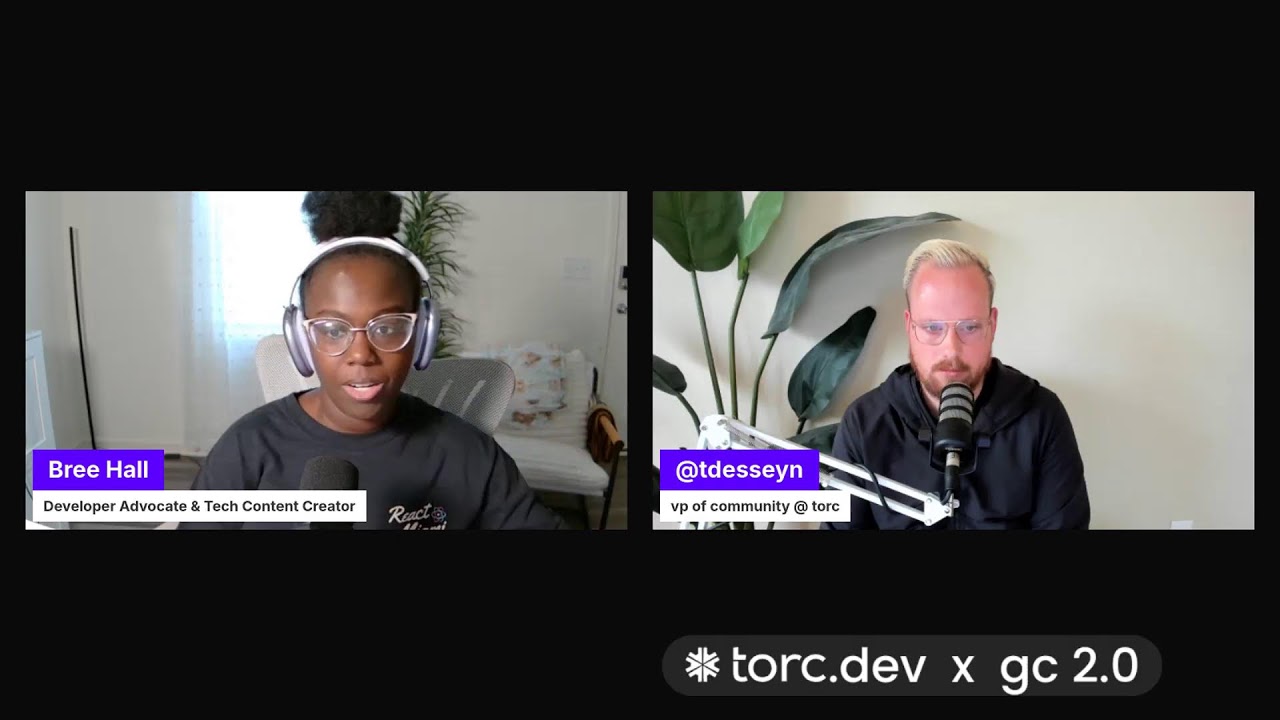
Developer advocate Bree Hall shares her path from client support to front-end roles at Revature, Elastic, and HubSpot. She keeps a rolling interview-question log, tailors resumes to skill Venn diagrams, and uses small daily actions to stay positive through rejections. Community and empathy matter more than you think.
Chapters
Alrighty, we are live. I'm gonna alert the masses, post it in the Discord, send out my text community. Got live on TikTok. Alrighty, cool. Good morning everybody, welcome.
Good morning.
No one's here yet. Uh, excited for this one. Bree and I, uh, MC together.
We did.
Yes. And I think, I, I think we crushed it.
We absolutely did.
We, you know, I tell you what, I don't think there's any— I don't think there's any way I'd like— I think like if you want to bond with somebody very fast, MC with them.
Oh yes.
Um, because like you are in it together. Um, and so I, I feel like I've known Bree now like all my life, uh, with, with, with how fast we connected. So Again, if you do watch this now or in the future and you run a conference, we are available for hire.
We are, absolutely.
I think we do a great job. And then if you want a reference, ask Kent C. Dodds, because I think, I think he'd be a reference for us. So, but no, excited this morning. We got people tuning in, which is great. You know, I think I'm excited for this one because we're talking about positivity and talking about Bri's kind of career journey. And I think, I think positivity is, is a very underrated thing when it comes to the job search. Um, and, you know, getting to know Bri, and I think she just radiates positivity. Um, I, I, I love hanging out with you. You make me happy every time I hang out with you. Um, and so, uh, so yeah, very, uh, excited for this one. Um, a few housekeeping things. Um, well, we got Jeff, we got Jeff in the chat. Noah, it's good to see y'all. Noah, by the way, I saw your vlog that you edited for Jason. It was great. So I can't wait for Jason to drop that, his travels down to DevOps Day in Atlanta. But first and foremost, before we dive in, a little housekeeping things as always. Appwrite. I wanna give a shout out to Appwrite. Again, I'm probably the only non-technical hero on a technical program. Love the crew at Appwrite. Grateful that they, you know, obviously invited me and let me be a part of the crew. Um, but go, go check them out. Great service. I don't code, but it seems great, so go check them out. Um, uh, also too, we got a lot going on. Listen, we got— we average around 5 to 10 streams a week within the Torque community. Um, we're always active between me, Jason, Ximena, um, and sometimes Brianna. Um, we have stuff within the— so we have stuff publicly, we have stuff in the Discord. It's a lot going on. So basically, I would highly recommend just check out torque.community. We kind of have like a calendar listed. of all the events week by week. We'd love to have you a part of our community in any way, shape, or form. You don't have to join the Discord. We do a lot publicly on LinkedIn and public places like this. If you're not a Discord junkie, you don't have to join, but obviously would love to have you. Next thing too, if you want to get text updates of when I go live, please text me. This is actually my number. This— all the texts come to me. Text LIVE. Would love to have you there. Um, also too, I do want to say, uh, my ice hockey team won the championship last night. Congratulations!
So I have—
I had to— trophy has to make an appearance. Um, we are kind of— if anybody watches, uh, Wrexham, welcome to Wrexham. Um, the soccer team that Ryan Reynolds, um, took over. Um, uh, they've been promoted 3 times and we've been promoted now 3 times, so we are basically the Wrexham of beer league. Um, so again, shout out to my team. Um, we won last night. I'm very tired this morning. Um, I am on my second cold brew. I'm trying to recover. But yes, uh, we, we won. It was a grueling— we won 6-5. We were up 6-3 with like 3 minutes left, and we kind of had to slip up and they came back. Um, but, uh, but anyways, yes, this is here. It's very dirty. People ask I should drink cold brew out of it, and to be totally fair, um, it's very dirty. I'm not drinking cold brew out of that. I may die. I'm gonna get something. Don't do that. Some, some sort of disease. Um, Trophy, Trophy had to make an exp— uh, make, make an appearance. Um, and we got some people in the chat this morning. Chris, it's good to see you. Uh, Christopher and Chris. Pat, it's good to see you. Jordan, it's good to see you. LinkedIn users, good to see everyone. Bree, I wore that shirt yesterday. There you go.
React to Miami vibes.
I love it. Devon, it's good to see you. Mark, where are the spacesuits? Uh, I returned mine. Um, uh, so, um, uh, I'm sure Bree still has hers. I'm honestly surprised you didn't show up with your spacesuit, to be totally frank with you. Um, uh, but yeah, exactly. Um, again, um, uh, Jeff or Chris, it's good to see you. Um, I, I would not kiss that. Yeah, yeah, 100%. Um, all right, so, uh, enough of me yapping, Bri. Let's give the people what they want. Who are you? What do you do? And then we'll dive in.
Absolutely. I'm Bri. I'm a developer advocate, software engineer, and content creator, and I like to code and yap on the internet, not necessarily at the same time, but— You're very good at it. Thank you. And I started content creation to show people that there's not one right way to become an engineer. That turned into a love for teaching and a love for connecting with other developers. So that's how I got where I am today.
I will tell you this, if you don't follow Bri on TikTok, what's your TikTok handle?
It's Bytes of Bri. B-Y-T-E-S-O-F-B-R-E-E.
I would highly recommend it. I, I, I, I will say this, And I wanna give, I wanna give Bri a shout out. We, we were literally emceeing and we were at our table and Bri is like editing her TikToks like at the table. Like people don't understand how hard it is to create really good TikTok. To be honest with you, I don't leverage TikTok the way I need to cuz it takes so much effort. Um, Bri's stuff is very engaging. I watch, I watch it every single time it pops up on my, uh, For You page. So highly recommend, uh, uh, to, to follow Bites of Bri. Her content is— Top notch. All right. So, uh, man, there's so many places to start here. Um, again, I told Bri, I was like, we'll just, we'll just start to go live. Let's, so let's talk about, let's talk about your career journey, right? So you, you know, I do have some, I do have like 2 questions people fill out just to kind of prep my, my mind for this. And, and one of the things that really stood out is, is it took you 3 years.
Yes.
To find, it was just your first job in tech after college?
It was my first coding job after college. I— so slight backstory.
Please.
I took a semi-traditional path into software engineering. So like, I took my first programming class, 10th grade, loved it. I was like, oh my goodness, I can do so many things. You could not tell me in the 10th grade anything. I was creating my own little choose-your-own-adventure stories in Java. Now, was that really complex? No, but it was enough to get me really interested and really curious about like what code could do. And then the rest is history, to be honest. Now, me and Java have since broken up. We don't really like each other too much these days, but that's okay. Um, I went to college for software engineering, actually, and I would say that's the most traditional part about my experience.
Sure.
Um, and then I realized college is definitely more theoretical and not very hands-on for a lot of people. That's what I've heard.
That's what I've heard. Yes.
And I started college in 2012. So there were not all of the tools that we have now, all of the AI tools and things like that to sort of like help me get through. And I also didn't see a lot of content creators. That wasn't really a thing as much then about people talking about their computer science journey. So I was just trusting what everybody was telling me in school, which was go to school, get good grades, get your degree, and you will have a job after college. And then when I didn't have a job after college, I was like— Oh my gosh. Wait, y'all said I was gonna get a job.
I know, I know, I know.
So I went on my first interview after school, and I had been using Java for the most part, and they were like, okay, so like, what kind of frameworks are you familiar with within Java? And I was like, what the heck is a framework?
Yeah. What do you— Yeah, yeah, I just—
yeah. What's that?
Yeah.
So that's what really started to open my eyes to all of the things that I didn't necessarily know or that our curriculum didn't go through. And because I was really leaning a lot into trusting what my professors and things like that were kind of exposing me to, there weren't really a lot of things that I went and did a lot of extra research on, like outside of school. So with most of my projects also being in the console, I didn't have a lot of, uh, really tangible things that I could show employers, which was the other half of that as well.
Yeah. So, so, so, so, yeah. So like, you— so you're interviewing, they're asking you frameworks, you don't know. I mean, you're like, well, what's a framework? I mean, how, how did you— how did you navigate like your career after college? Like, like, what did the interviews look like? How did— like, like, did you break into— like, how did you break into tech? Was it— was it a non-dev role? Talk to me about that.
Yeah, so the interviews were embarrassing. I'm not even gonna front. Like, it was embarrassing going into interview after interview, and every time I felt like I was researching like hours hours, days beforehand to be like, okay, so like, what could they ask me? What do I need to know? Going back into my notes. And then inevitably I would get hit with something that I didn't know. And I'm like, no, I thought I had everything. So basically I was going through writing down all of the questions, like as best as I could remember them after I got out of the interview. Like I would just sit in the car because this is for in-person interviews, which is, I think, worse. Sure. Sure. Like being in front of somebody and being like a deer caught in headlights. I would write down all of the questions. I was mostly like applying for Java roles, so it was kind of like contained. And then I would go home and I would try to like research all the things that I didn't know so that I would be prepared maybe for the next interview or know how to update my resume, um, like more efficiently to get more interviews. But what happened was I was like, you know what, I think maybe I need to actually take a step back because I'm putting myself in a position to get the interviews, but I'm not doing well and I'm not getting anywhere.
Sure.
And it was really demotivating. to do that. So basically student loans said, hey, we know you just graduated and we would like our money back. So eventually I had to like eventually go get a job. And the job that I did get was at a software company, which was really exciting because in the interview process they told me they knew I was like a software engineering grad, that I wanted to code. They said, okay, we'll start you off in our client support department and then eventually we'll move you up.
Yeah.
That didn't happen.
Oh, okay. All right.
Didn't happen.
That stinks. Didn't happen.
I stayed in client support for about 3 years. And then once I realized that no longer was on the table after like some company restructuring, it wasn't part of what they really wanted to do. It was kind of used to get me in the door. I was like, okay, it's all going to be hard. Being in this job that you don't want right now, it's hard.
Yes.
Getting the job that you want is going to be hard. So which one are you going to do and which one is going to get you to where you're going to be happiest? So eventually I was like, okay, well, let me give it one more try. If it doesn't work out, it doesn't work out. But at least I want to know if I can do it. And I think that persistence of like, can I do it, turned into, why can't I do it? Just do it. And then I landed my first job.
Okay. Yeah, there's so much to unpack here. So First off, I, in my mind, I'm like, yay, you got into a company! Because that's what I— oh boy— because that's, that's, that's what I preach, right? Like, get into the company. Maybe it's not— maybe it's a tech support role, customer support role. Learn the product, slowly move into that. You did not do that. It took 3 years for you for that to— I mean, you were there for 3 years. How, like, did you stay on top of coding? Like, what did that look like?
In 100% honesty, after you've been doing something for so long and failing at it for so long, the I can't do it kind of creeps in and life starts to happen and bills start to pile up. And I was not coding consistently that entire 3 years.
Sure.
I would say for the first 6 to 8, maybe 9 months after, I was like, okay, we're going to go full steam. We're going to get it. It wasn't happening. It wasn't working. And eventually after that 8 months, I was just like, okay, well, I'm tired. I'm burnt out from putting so much effort into it. Let me see what I can make of this job that I have now.
Sure.
And I sort of turned my gears to, well, maybe there's things that I can learn to leverage myself at this job. Maybe I can be promoted. Maybe I can move up the ranks here in client support. And then I got married. Life happens. Life starts lifing. And what ended up happening was my grandma passed away. And my grandma was always like one of my biggest supporters. And I was like, ooh. And all I could like hear her like saying in my head was that I could do anything, which is something that I'm so happy that I have a support system of like my family who's always telling me that I could do anything. And I was like, you know what, I think I want to try this again. I think I want to give it like one more good go.
Yeah. So, so how did— so, so talk. All right, so 3 years customer support. No upward trajectory, no, no, no promise of being a developer. What did that next job search look like? Like, how did you pull yourself up by your— I think bootstraps is the term— and then like get your first, get your first developer job?
Yeah, so it was a lot of teaching myself. Um, and at the time I found Team Treehouse and I was like, you know what, there's things that I already don't know, so let me look at it from a different angle. So previously I was definitely more backend geared, um, in terms of like the roles that I was looking for.
Yeah.
This time I took myself back to my MySpace days and was like, wait, let me try like front-end web development. And that was like falling in love with coding all over again. And it was almost addictive because I was like, I really like doing this. I, I'm learning. And I think the Team Treehouse structure, um, of doing specific courses and not having to go like back to college was something that was really nice for me. I really thrive on structure. So So learning during the day, at night, whatever moments I could like carve out for myself, um, was really how I was able to like learn and pick up those skills. And then the job search basically looked like me going through and figuring out what tools I needed to know and looking at like job descriptions to see what are people using right now, or like what are the technologies that are in demand.
Yeah.
And creating almost like a Venn diagram of what am I comfortable with? What do I want to know? And what's actually in demand? And what do I need to, to know? So then I tailored my resume that way and started applying for roles in that.
There's so much good stuff here. First off, there's people in the chat. You talk, talk about Render. You're speaking at Render, right?
I am.
Yeah. Let's go, let's go! What are you, uh, uh, what, what are you talking about at Render? Quick aside, what are you talking about at Render?
Absolutely. My talk is called Code But Make It Cute, because code should be at least a little cute. And it's going to be all about coding for the sake of creativity, art, and expression, and not necessarily for, you know, like a bottom line, a dollar and everything.
Yeah, I love that. I love that. Yeah, go check out Bree's talk. Um, hopefully I MC your stage, but I, but I, I don't know who I'm emceeing yet. So, um, all right, so back, back, back to regular scheduled programming. So a few things, a few things I like you did I want to point out. First off, when you were trying to get your first tech job out of college, you basically had a, uh, rolling basically study guide.
Yes.
How you like, you like wrote down the things that you missed, areas you were weak in. I talk about all the time, I think that's great. So I want to bring that out and, and bring and highlight that. I think if you are struggling getting in, if you are struggling moving past the like the second or third stage of interviews, really start to take notice of where, where you were missing the mark, right?
Yes.
So I want to highlight that. That's wonderful you did that. Next thing I want to— next thing I do want to ask you, if you could go back and do it again, college or boot camp?
Okay, I have like 4 different answers for this question. Yeah, my follow-up question to you, sure, am I doing it in 2012 when I started, or am I doing it now?
Man, um, I would say, I would say, I would say let's just frame it for now. Let's frame it for now. So, so, so let's say somebody wants to go to college now to be an engineer. Do they go to college or do the boot camp?
I personally am going to college now.
Really?
Okay. I am.
Okay.
I'm going to college because number one, first and foremost, before I even get into the rest of it, education is something that is very, very personal, and I want to acknowledge that The college structure is not for everybody. Sure, there are some people where you need to be able to learn on your own terms, in your own manner, and where lectures or how professors teach does not work for you.
Yep.
So if that is not a thing that is good for you, I definitely don't recommend, um, like going the college route. And also, if you don't have any funding, it can be very expensive. I'm sitting here with a bunch of student loans and I wish I didn't have those.
Correct.
Now, on the other half of that, I do not think that you have to go to college in order to become a software engineer. Between bootcamps, a lot of the information that we have both paid and free online today, um, you can really get a lot of that information and then pair that with communities like Torque where you can go get that actual community and like support. I feel like that's also a good combination. Now for me specifically, after looking at the job market and seeing what's like sort of going on and the talent that is on the job market today. Something that I'm noticing is that a lot of people are getting return offers or offers to their first roles from internships that they had. And unfortunately, when you go the bootcamp route, you don't always get the opportunities to do internships because they're usually for college students or apprenticeships or externships.
True.
So I think that college in some ways gives you a little bit of a leg up or different resources. But if I could not or did not want to pay for college all over again, what I would do is do something like Leon's 100 Devs course that he has on YouTube. Make sure that you're in a community, make sure that you're on LinkedIn and share what you're learning every step of the way. And that will also be sufficient in getting you there.
Let me ask you this question. If you could go back in 2012 and do things a little differently in college, what would they be?
First thing is I'm going to a community college for my associate's or for the first 2 years.
Agreed.
Because those classes are the same, or the, the, uh, what do you call them, the not major classes, whatever that you like. The Englishes.
Yeah, I know what you're saying. Yeah, yeah.
Those are the same at your university as they are at the community college. And a lot of times community college is free. Community college Um, in Maryland where I grew up was, I think, free the year after I graduated, which is really a little rude, to be honest with you. But rude, it is rude. So I would go to community college.
If you were to go back to college experience again, community college first 2 years just to get your— I think it's electives is the term. Yep. Okay, then go to like a state school or whatever, like either like a state school or a like a university where they are Specializing in it.
That's what the other thing was. I went to a school that specialized in hospitality and culinary arts, and their software engineering program was relatively new, so they were getting out a couple kinks in the program. I also am like a really Type A person, and I found a lot of enjoyment in scheduling my courses, which is a really weird thing for some people.
I get it. I'm the same way. Yeah, you and I are the same person. That's why I think we bonded so well, MC. And I think you and I were both on it, so yeah, I get it. Yes.
I like to have my document of everything that we're going to be learning. I like to know exactly what it is. And then I was not good at looking at the material before we went into class. So if I had to do it again, I'm looking at the material that we're going to learn before we step into class so that I'm not learning it for the first time when we're there. When we get out of class, I'm using any kind of tool, Granola, whatever it is, to get a summary of what we've talked about in the class to make sure that my notes line up. And then I'm going to try to take it one step further and see, is there something— for instance, frameworks. Java, had no clue those existed. Yeah, I'm gonna see what the equivalent of that is, or like, how can I take it one step further, or is there something that's more advanced?
Yep. Would you— internships, did you take an internship in college? Because I feel like that's something that like you really got to do.
I did. I took the easy way out though. I had a student assistant job and I was like Can I just use this as my internship? And it had nothing to do with coding, but it was— I waited until my very last semester to do it.
So go back and do the internship and try to get a developer. So you would probably do that differently.
Okay, absolutely.
And I would say, so I went to business school at South Carolina. South Carolina is known for their business school. In hindsight, I didn't learn anything. That's either— that's a whole nother conversation in and of itself about modern-day institution, but I wanna give a shout out to my brother's college. So my brother went to South Carolina too, but he went to the HRTM program, Hotel Restaurant Tourism Management.
Mm-hmm.
We called it diet business school. However, I think I still give my brother and, and that part of South Carolina more props. And I think it actually helped you more than the business school. They mandated 2 internships to graduate. And my brother got his first job in Nashville because of his internship that he had to do for, for school. Um, my brother actually— I, I— not many people know this— my brother was the OG for social media. My brother started at a content agency. Um, and so, but he got a job and he ended up landing it and, and he started his career into product management. And so Yeah, I think, I think internships, I think a meaningful internship's important. All right, next question that I want to highlight, which is the main topic of this conversation: how can people stay positive? You know, I think, you know, you are, you are just a breath of fresh air. You're always smiling. You know, I'm sure you've had your bad days. I'm, I'm sure you wake up grumpy sometimes. How do you, how do you, how did you stay positive 3 years working in a job that you didn't really want with, with the hopes that you would land in a dev job that wasn't working. I mean, I think, I think that would, that would, that would be tough for a lot of people.
I think it comes down to a couple of things. Mindset is definitely the biggest one, and I subscribe to the idea that it doesn't matter how old you are, what your past looks like, you can always change your situation and your scenario that you're in. Now, having that been said, is it always the easiest? No. But just like I said, sort of like at the top, it all comes down to it's all hard. So what is the version of hard? It's hard to be in a job that you don't like. It's hard to come home from a job that you don't like and say, I'm tired. All I want to do is sit on the couch and watch TV. But is there one thing, 1% that I can do better today to get me to wherever I'm looking to be? Now, that doesn't mean that I'm filling my whole after-work schedule with all of my lesson plans, all of my coding, all of my whatever. But is there a way that I can update the summary of my resume, some bullet points on my resume tonight? Like, if— can that be the only thing that I do before I, like, rest or that I go to bed or, you know, like, whatever it is? I think the other thing is, I feel my feelings. And anybody that you talk to in my family, my husband, my sister, I'm a crier. I really am. Same.
Same.
I cry. I get it out, but I can't stay sad. I can't stay crying. I can't stay moping. I can't stay whatever. Feel your feelings. And I think it's important to feel your feelings, especially when you're going through what feels like loss after loss or rejection after rejection. But if you flip that or try to flip that into something positive of, you know what? I felt the feelings. I got a rejection. I'm going to keep on moving to the next one. It's going to be okay. And just keep putting one foot in front of the other. It makes it a lot easier. So again, I think it is for me, mindset, making the space to feel the feelings and using that fire or that fuel to push myself one step further a little bit every day.
I love that. Talk about, so, so then, so let's talk about going from customer support into your first dev job. How did that interview process go the next time around? Right? So like, so like you were interviewing, interviewing, getting rejected. They were asking you frameworks. You had to, you know, you had to go in, you know, to get this customer support role. What did it look like the next time you were on the job search?
It was a lot better actually.
Really? Wait, is there a specific— I knew a lot more. Is there a specific thing that helped?
Um, I think working and being more of an expert at the technologies that I was interviewing in. So for instance, I went at it from a front-end angle the second time I was applying for roles versus when I was working in like client support and I was just trying to get any job at that point. Um, and I knew a lot more about front-end web development because I had used it a lot more recently. I was doing a lot more research about what interviews were like. in the initial interviews, the HR interviews, I was afraid to ask for questions. I was like, hey, can you tell me about what this job interview is going to be like so I can research and prepare? I don't know why I was so afraid to ask that in all of the other interviews because I would've been able to better prepare before. But I was like, you know what? I'm just going to ask. If they say they can't tell me, they can't tell me.
Yeah.
And I was starting to do a lot more online and look to see what people were saying. what variations of interviews that people had. So I feel like I in general was a lot more prepared, but also client support gave me a completely different set of tools that I did not expect that also lend themselves very well to like software engineering.
Like what?
So I think it was helpful as well. Um, number one is empathy. When people ask about like, tell me a time when you worked on a project and maybe like you had a conflict between different people, Client support and support in general teaches you a lot about ambition.
So you were able to bring in specific, like, real, basically real case examples?
Yes.
Gotcha.
Absolutely. Absolutely.
So, so was your first job at HubSpot out of college, or were you somewhere before HubSpot? Or, I mean, after customer success?
That first job was called Reviture. It was like a boot camp contracting sort of program. I was only there for, I think, like a couple of months before they transitioned my work to a company called process where I was a contractor for 3 years.
Okay.
2 and a half years or something like that.
So, so, uh, so obviously you could pull from real-world examples. How did it look like from a coding perspective? I mean, obviously you were working a customer success role for 3 years. You weren't necessarily on top of your Java as much. You were taking these classes through— what was it? What was the program? Treehouse?
Or Treehouse?
Yes, Treehouse. Like, what did the technical interviews look like? Yeah.
So, uh, it started out with the first round being like an HR interview. Tell me about yourself. I want to know about your background, about your skills. Now, sometimes I will say I did get a little bit nervous talking about why I graduated 3 years before I was actually, you know, like looking for a coding role.
Sure.
Explaining that gap was a little interesting sometimes, and I sort of had to talk my way around it. But after that, it was typically, um, an interview with like a hiring manager, maybe some verbal or like this like a couple of coding questions, nothing too in-depth because it was mostly over the phone. And then we would move into a coding, like a whiteboarding session where I was— because this is again in 2015, 2012. So we're like actually whiteboarding and like writing out how I would solve a problem, not exact syntax on code, but more so how I'm thinking about like approaching certain things.
Correct.
And we also did system design interviews where They tell me that they want, for instance, like a search bar integrated on a website. And the key there is to not answer the question immediately. You got to ask a lot of questions, a lot of clarifying questions to nail down what you actually want, uh, the project to be, and then sort of work with that person almost as like your pair programmer to understand how you would design that feature.
Okay, so all the skills that you just talked about Would you say it, it still sounds like there was a net positive value for still working in a non-dev role for your first job?
10,000%. Okay. 10,000%. If I had to go back and do that over again, client support easily has shaped the way that I think about code. I think about software and that I think about customers as well. So it taught me a lot about how customers think, what they want, and in turn that helps me develop with empathy, um, and like help sort of meet them where they are.
Yeah. Okay. I love that. I love that. Talk about— okay, so you're at Revature for a few years and then ended up at HubSpot. Um, talk about— I, I guess, I guess my biggest thing I want to highlight is when did you, when did you decide it was time to go to your next role? Like, like how did that whole process work?
Yeah. So, uh, before I got to HubSpot, I was at a company called Elastic, and I worked on their open source design system. So for me, it was like the Infosys, which was my real first coding job with Accenture, and then I went to Elastic, and now I'm at HubSpot. And the way that I realized that I was ready for something new, I won't even front with you, it was the money.
Yeah, that's fine.
Yeah. Um, I realized once I started like talking to people, this is during Peak COVID, by the way. So I wasn't really like talking to people physically.
Sure.
But a lot of people were starting to make more content online and talking about their software engineering experience. And then we got this fun new tool, not new anymore, called levels.fyi. And I was like, people are getting paid. What?
Yeah, yeah, yeah.
I was like, I want to get paid that too.
Yeah.
So that started a whole new, well, if you want to be paid more, you got to up your skills. How are we going to work To land the next job.
How, how did you— let me ask you this. So obviously kind of the growth of your career, I mean, it sounds— I mean, it's, it's been awesome and it sounds amazing. Have you, when you've gone through the interviews through the course of your career, are there any other tips or tricks that you've picked up that you can share with others? I mean, obviously kind of going from customer support into Infosys was kind of, you know, you, you learned how to to do that? And I'm just trying to get a— I'm just trying to get a general sense of like, are there any other general tips, tricks that you've, you've really kind of solidified in your tool belt to interview?
Yeah, so one is don't be afraid to ask for what you want, and don't be afraid to interview the interviewer. So for instance, one of the things that I was very hesitant about— I, I know I'd be getting on the internet and I do a lot of yapping, but I am actually like really shy and I have a lot of trouble asking for what it is that I want. And when people dictate something to me, sometimes it feels like it's finite and I'm almost afraid to challenge them or to advocate for myself and be like, no, I need this. So the first thing is—
Can you give a specific example outside of money?
Oh yeah, absolutely. So when we're thinking about work environments, so if somebody was to be like, hey, we have this role and it is going to be in office, 3 days and you can work remote 2 days. Immediately, I know previously my thought would've been like, okay, I'll take it. Now here today, I'd be like, hey, is there some way that we can work on that? Or is there some way that we can negotiate that maybe I can do 3 to 4 days remote and maybe 1 or 2 days in office? Is that variable? Is that negotiable? Also trying to negotiate things that aren't just monetary.
Yes.
Is there a way to negotiate on vacation time? Is there a way to negotiate? I said non-monetary, but maybe a sign-on bonus or maybe more remote tools or an allowance to get things for your off, whatever it is that you feel like you need and that it's going to make you a better person at your job. If I didn't have one of these DJI Osmo Pocket 3s, maybe I would say, hey, you want me to go do content creation somewhere? I need one of these. It'll help me be faster. It'll help me be more productive. This isn't monetary, but it will help me do my job better.
Correct. Yep. No, I love that.
I love that.
That's awesome. Um, uh, what else? Any other— we're already nearing our time. I knew that would happen. Uh, any, any other— I guess again, I want to highlight the positivity mindset. Any other thoughts, um, when it comes to just mindset in your career and your job search, especially if it's not going well?
Don't do it by yourself.
Yeah.
Um, yeah, that mindset isn't an easy thing to achieve by yourself, especially when you're the only person who's looking at your rejections after rejections. And when you see the work that you're putting in, but it feels like nobody else is seeing it, or maybe you're getting ghosted and you just kind of feel like, so what am I doing wrong? Especially when you go online and you see and compare yourself to other people who it seems like they're getting job after job, they're getting so much money, they're getting opportunity after opportunity. That comparison, and I know it's so cliché, is going to be the thief of your joy, but it's also going to be the thief of you feeling confident in yourself. So then when you start showing up places, you're going to be like, do I deserve to be here? Yes, you deserve to be here. You did the work to be there, so you deserve to be there. And imposter syndrome will creep up, but community, having other people's backs in the community will turn into them pouring into you. You can't pour from an empty bucket, but being around other people who have a positive mindset does something to you. That's why I really love in-person events. I have never left an in-person event or even like been in the community, and I'm like, I regret doing that. Yeah, it's just a contagious spark of being in the room with other people who are inspired.
Yes, I love that. That's awesome. That's awesome. All right, so as we wrap up here, kind of final questions, a little rapid fire here. Um, uh, I, you know, I've started to work this in here. Are you a coffee or tea person?
Tea. Can't do any caffeine.
Can't do any caffeine. Do you like ice or hot? If, if, if you're gonna go tea, okay. That's— I think any hot liquid is disgusting, but that's just me. Um, uh, next question. Um, uh, who, who do you want to give a shout out to in the community who's doing cool stuff? Just, just kind of just, just in your ecosystem. Um, just any— Yeah, everybody always like, why don't you prep me on this? Because I said— because I tell people like, the first name that pops in your head, like any developer, any company, any platform who's doing some good stuff you want to give a shout out to? Oh, okay.
So Roselle Scarlett, who is at Block, she's doing a lot with MCP, and that has been like one of my favorite things to like research now. But also, I think a lot of the people, the faces that I see on tech Twitter all the time— Roxy's always there. She's, she's one of my favorites, and I know she's in chat right now. So I think she's doing some really great things as well, trying to get her next role.
I love that. That's awesome. That's awesome. Um, is there any, like, um, is there any tech tools, frameworks, things that you're tinkering with on the side that you're pretty pumped about or even working in production right now?
Yeah. So I, as a developer at HubSpot, like, we've been doing a lot both with AI, but also we have these things called UI extensions, which basically allows you to customize your CRM and, like, do full React apps there. So I've been spending a lot of time trying to figure out like what are the boundaries that I can push with those and also create like some really fun generic things to make people's lives a little bit easier. So that's something fun that I've been doing. But also with the MCP and AI, figuring out not just how I can push AI into something, but like how it's actually going to be useful to people.
Sure.
I think people might be starting to get a little bit of AI fatigue. So if I'm gonna use it, I want it to be actually useful, actually make your life easier, and not just be a chatbot or like a summarize this for me.
Absolutely. I love that. Um, real quick, I always, you know, I, I talk about this all the time where it's like, I feel like DevRel folks don't get a chance to really talk about what they do, or that I feel, I feel like DevRel folks should talk about more what they do. What are you doing right now for HubSpot? Can you just give me a quick 90-second spiel about what you're responsible for at HubSpot?
Code samples.
What do you mean?
Really easy?
I don't know what that means. What does that mean?
So, okay. So when you go to the documentation of like any tool, you mentioned Appwrite, things like that, you will probably see like documentation that includes what each component of the tool is, how it works, and also code samples that are supposed to be there to help you understand what it is, to help you speed up your development, to have like copy and paste. Just, I want to make this work right now. So that's what my job is, is to create different code samples and instruct the community on how to use some of our tools through code. Now, this is really interesting today because we have all kinds of tools like Cursor, which are writing a lot of code for us.
Right.
So it's not just creating code samples for people, it's trying to think forward and create code samples that AI tools or any tools eventually will be using to help people who either may not know how to code or do know how to code, but they're just like not familiar with how we do things. So all things code samples, creating videos, blog posts, um, any content that basically helps speed up developers and make their jobs a lot easier. Because as a developer, I know we like to work autonomously and not really ask if we don't have to.
Sure. Yeah. And so you're trying to do all that stuff. So like if somebody wants to integrate HubSpot or use HubSpot in any way, shape, or form, they'll, they'll be able to find all that information. Yes.
Love that.
See, I love that. I love that. I think DevRel folks should talk more about what they do. Um, love that. All right, last question. And, uh, obviously you gave some really practical, tactical pieces of advice, but still want to ask it. So show's called Guidance Counselor 2.0 because we had guidance counselors in middle school, high school, and college, but now as adults, we don't really necessarily have them. If you could go back and tell young Bri something around career-related things, advice, what would it be? And again, a lot of the episode has already been very good stuff, but yeah, I want to drive it home.
Don't take what other folks tell you for granted. Uh, so for me, for instance, uh, people just telling me to go to college, get good grades, and then you'll get a job— I took that for face value for what it was, and I wasn't putting a lot extra in because that's what they told me that I needed. There's going to be more to the process than what you know. And just because you can't see the full roadmap right now, it doesn't mean that you're not going to be successful. There's going to be detours. There's going to be parts where you have to put in a little bit of extra work. There's going to be late nights. There's going to be all kinds of things that arise. And most importantly, there's going to be times where you want to change your mind or where you want to pivot. And as long as it aligns with you, and where you want to go, and you're not just pivoting because you're scared, then don't be afraid to do it. Because it's never too late to say, okay, I'm learning how to code. I don't want to do Java anymore. I want to do front-end web development because that's where I'm more comfortable. There's absolutely nothing wrong with that.
I love that. That's awesome. That's awesome. Wonderful. All right. Well, uh, everybody go connect with Bri. Uh, Bytes of Bri on Twitter and TikTok. So go follow her. B-Y-T-E-S, like, I think code bites. I think that's how that works. I also wanna give a shout out to my guy Angelo. He is going live at 11:30 AM Eastern to talk about what product marketing looks like in tech. So we're gonna break down how to get into tech as a product marketer. So please go tune in for that on his LinkedIn. And then tomorrow, 9:30 AM Central, my last live of the week, I'm going live with Will King. Will is somebody that I believe was at Epic Web. And we're gonna talk about one of the passions for me is like, you know, I'm hearing about AI taking junior developers' jobs or whatever, yada, yada, yada. So we're gonna talk tomorrow what junior developers can do to really stand out in the world of AI and to leverage AI to find a job. So that's tomorrow morning's chat. So it's gonna be a good one. But Bri, you're wonderful. Thank you so much. Stay on so I can say bye to you backstage. Everybody go connect with Bri. And, uh, we'll see y'all tomorrow, 9:30 AM Central. Peace.
Thank you.
More from taylor



tech doesn’t have to be the only thing that brings us together #techcommunity #techcareer

I want to give back to y’all that make the tech community so great #jobsearchtips #techjobs




spend a little time investing in yourself #linkedin #linkedintips #careeradvice


