
The State of AI and Your Career w/Mark Thompson, Sr. DevRel @ Google
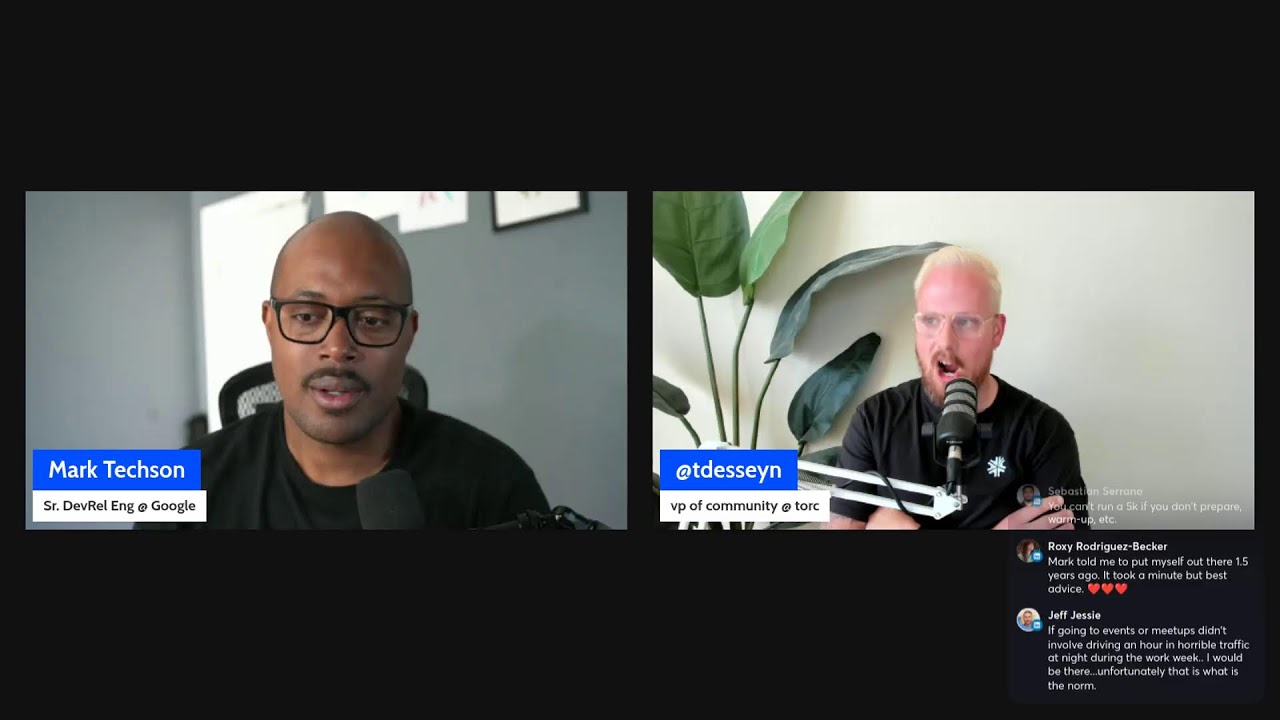
Mark Thompson, senior developer advocate at Google, explains how AI tools like Gemini and Claude are changing engineering careers. The shift isn't about typing less code, it's about using AI as a productivity multiplier while keeping fundamentals like system design and data structures sharp. Thompson advises positioning yourself as an AI-enabled engineer and building portfolio projects that show you can prompt, integrate, and review AI outputs for mistakes.
Chapters
All righty, all righty.
Good morning, everybody.
Happy Tuesday, happy Tuesday. Uh, Mark, are you recovered? Or commit your code?
I am not recovered. I'm actually, uh, down. I'm down bad, brother. I got, I got a commit your code. I got committed to a cold. So now I am under the weather, bro.
I struggled with it last week. Yeah, I had it last week. So who knows, maybe I gave it to you.
I don't know.
Um, uh, but you say what?
I said I shook a lot of hands.
That's, that's the problem, man. I mean, listen, when you go to these conferences, you're kind of just opening yourself up to, to, to the sickness, uh, if we're just being honest. So, um, well, you look good. You don't sound super congested, but you look great. Um, uh, for those of you tuning in, welcome. Um, no, I am on LinkedIn, Jason. I, I literally see it right now. Let me see. Hold on.
Make sure it's out there on the streets.
It says, it says on LinkedIn. Let me see. Oh, I got no error messages. Yeah, yeah, it's there. It's there, Jason. It's there. See, Jeff, good morning. Good morning, Terrance. Good to see you. All right, cool. Great to have met you both at Commit Your Code. Yeah, it was great. I'm sure we'll get into that here in a second. Um, but, uh, welcome everybody. Good morning. Um, for those of you who went to Commit Your Code, hopefully you're recovering. Um, we are so back. Um, and I know a lot of people have been messaging me like, oh my God, I'm so excited that you got Mark on the show. Um, so I'm excited that Mark's on the show. You know, I always tell people, I say, um, whoever— who I consider friends, I consider everybody friends. Right? But I think like the people who like I really, really respect and, and, and call close friends, I, I actually don't think of to invite them on the show. Um, and so Mark's been on the show, it's been a few years now, and like it was like raining. I was like, dude, we should— I should probably get you back on the show to talk about it. So, and to be honest with you, dude, I didn't even see you book it. I was gonna talk to you at Commit Your Code and like for some reason it didn't come in, or maybe I just deleted it. I was like, I was like, I was like, Mark, man, we need to get on. But then I saw that you were like my first guest after Commit Your Code. So like, well, that's great. That's great.
Good timing.
Um, so, uh, some housekeeping things as always. First and foremost, shout out to Appwrite and Appwrite team. I am an Appwrite hero. Jason Torres, Appwrite hero. Um, go check them out. Um, uh, love the DevRel crew out there. Tell them the Torque Boys sent you. Also, listen, we just got a brand new refresh on the Torque community page. It's nice and pretty. There's like colors and it looks nice. We got some testimonials. You can sign up to be an ambassador. You sign Sign up to be a mentor, mentee. It looks pretty. Go check it out, torque.community. Uh, it looks great. Um, and listen, if you want to know when I go live, you know, one of the things— so we, we, we do ambassador calls once a month for the Torque Community. Um, one of the things we continue to hear from the ambassadors is that, hey, like, you have a lot going on, it's hard to keep up. So we're trying to standardize some things. And one of the things, like, if you want to know when I go live, shoot me a text. This is actually my number, it's not some AI bot. Just text me live. I'll loop you in. I just sent out, you know, uh, some, some, some texts right before I went live with Mark to let y'all know we are here. Um, so please join that. Also too, we'd love to have you in Discord. We got a lot going on as always. All right, we got a lot of people tuning in this morning, uh, which I expected. Um, so, uh, Mark, let's, let's give the people what they want, man. Who are you? What do you do? And we'll go from there.
Who am I?
Who am I?
Yeah, so let's talk.
The best, the best voice in the game.
I am the best voice in the game. Yeah, so it's funny about the voice thing. I was, I was trying to get somebody's attention and I go, hey, you over there! And this woman turns around, she goes, is that your voice? I was like, yes it is. I was like, no it's not. And she's like, what? How do you do that? I'm like, well, you know, I have control.
Uh, you know, I got control.
I got control of everything. But yeah, so my name is Mark. I am an engineer. I'm a dad. I'm a musician.
Yeah, you are.
Creative. I love photography and videography. I love, love, love playing guitar, playing music. That's one of my, like, big passions. Let's see. And, you know, I've been writing code and working on tech for over 20 years at this point. And I'm just really happy to be here. I work at Google right now, which has been the best experience I've had in my career so far. I've learned a ton. I'll tell you, get into a job that stretches you because you will be surprised. surprised at how much you can learn if you allow yourself to grow, uh, in a job that stretches you. And I think Google has been that for me over the last 5, almost— well, 5 and a half, but like 5. That's crazy.
That's crazy. That's awesome. That's awesome. Um, so a lot, a lot to talk about today. You know, some, some, some folks, I'm like, you know, you know, I kind of do some digging and whatnot. Like, I, I know Mark, and, and, and I think one of the things I want to talk about today— and again, if you have questions, please ask them. But Mark, I kind of want to, I kind of want to go into your AI talk, um, that you gave at Commit Your Code. This, uh, you know, we were chatting backstage briefly, same kind of similar talk that you gave at Epic WebConf that I emceed. Um, so I, I just want, like, what, let's start with this, man. Like, like, what's, what's your talk titled? And give me kind of the thesis of the talk to set the stage, uh, about what we're gonna talk about.
Sure. So I've been I have 2 talks that I've been giving recently, one at keynote length and then one's a little shorter length. Both of them are about— I mean, the series or the idea is like AI for the people. And what I mean, I mean, the engineers out here, the engineering community, because I feel like right now there's so much like fear, uncertainty, and doubt around like careers in development, around how to use AI. Code generation has taken on like a mind of its own, and a lot of people are just like, is it even worth it to still be an engineer?
Yeah.
Is it even worth it? Did I just spend the last, you know, 8 months grinding after my full-time job, grinding at night on 100Devs or grinding at night, you know, doing a freeCodeCamp for nothing? Did I take this boot camp for nothing? Did I— am I studying for nothing? Right? And so this AI for the people, AI for everyone else, you know, this idea is that these talks are to dispel some of the fear, the best that I can with my educated guess about what's gonna happen next, and then giving people a practical roadmap as to what I would do. And this is the way I'm framing it. It's what I would do if I were starting today, or if I were—
Which I love these conversations because I think— so I was golfing the day before Commit Your Co with my buddy who's a CTO in Dallas. It's starting to become a tradition, me going out and golfing with some tech folks. And we actually filmed it. We filmed it. It's like a podcast style while we're golfing. It's gonna be great. Can't wait to release it. But I asked him, I was like, what do devs do now? And I think this is great, kind of dovetail into this conversation. So Mark, let's talk about, I mean, what would you do? What is junior dev? Is it even a thing anymore? Like what do people learn? Like is AI the biggest boogie scary man as we're making it out to be?
I think it's one of the biggest advancements in technology that I've seen in my lifetime and that most of us have seen in our lifetime. I think what it's capable of at the current state— we don't know the future state. We don't know when we're going to max out, you know, when compute will just not give us anything else. We don't know. We don't know that yet. But in terms of what it can do now, I like to frame it not about like, is it scary? So much about what can I do that I couldn't do before?
Yeah.
Right? Like, what tools do you have available to you now to build the things that you could never have built to serve the customers that you couldn't reach? So when you start to reframe it around that, it's like, oh, wait, there's more. Because I think, and I said this in this talk on Friday, we have to get over ourselves, meaning engineers have to get over ourselves. Because for the last, you know, 40, 50 years of engineering, our greatest value has been how much code we can type on the keyboard.
Correct.
that is no longer going to be your greatest value add.
Hmm.
Right? Your technical skills will still be valuable. So don't get that conflated. Your technical skills will still be valuable. But how fast you can type code will not be as valuable as it was before, because now we just have tools. It's so, you know, this is a flawed example. But it's a kind of fair analogy. For a long time we were using a screwdriver, you know, to like screw in, you know, like screw—
Yeah, I'm not a big tool guy. My wife does all the tool stuff in our household. I do laundry. But keep going. Yeah, I do know what a screwdriver is, so that's good.
Good, I'm glad you know that. Then we got power drills, you know what I mean? But like, here's the thing, to know when you use which is still valuable. Still, we get more and more like special tooling all the time, but But to know what to do, when to do it, is, is the value add, right? Like when it comes to like carpentry and all these kind of things, because I can cut with a handsaw, I can cut with a blade, you know, you know what I'm saying? With a, um, not a chainsaw, uh, I can't think of the name of this, you know, the circular saw. I can cut with a circular saw or a handsaw, but the idea that I know when to use what is like the magic. And I know what's right and what's wrong. You as a developer, friends who are watching, You knowing what's right and what's wrong is everything. It's everything because the solutions that maybe generated code may produce may not be accurate.
Yeah.
And we know as an industry that there is a bit of hallucination in code generation. In any LLM output, there's the probability that creates some hallucinations. But you knowing what's right and what's wrong is still valuable. You see what I'm saying?
Yeah.
So that's what I tell people. I love it.
So, so what, what do people do, right? Like, I don't know. Again, we, we, I, there, there's nothing wrong with some hot takes this morning. Like, are bootcamps gonna still be a thing? Like, like, as somebody who's, who's a non-developer.
Yeah.
I feel like I can go learn everything. I can just type in, hey, hey, I am a, a, a, a, a junior dev wanting to transition to the tech industry. I need a curriculum. to help scale up my backend skills, enter, and ChatGPT is going to write something up. Is like, where, where is that aspect of things right now?
Oh, good question. So should you just use like models to, you know, uh, curate all your education? You know, here's the funny thing, you've already been able to do that long before ChatGPT. Humans have written up game plans. Like, you can search. So back in the heydays of tech Twitter, before it got, you know, weird and then all fractured. Now, people posted every week, here's my game plan for learning how to be a junior engineer or breaking into tech. They posted every week these long threads. So you always had that ability. It has always been whether or not you want to follow through.
Sure.
It's always been that, and that has not changed. Even with the advent, we just have easier access to information. But our ability as humans to follow through That has not changed, right? Like, that is still the— like, we can click— just like when I look at vibe coding tools, like, you as a non-developer, Taylor, like, you can go and say, I want to create the torque.dev platform and here are things that I want. You can still do that, but that doesn't mean that that's going to replace torque.dev. Like, somebody can try to copy you, but there is more to the story than just the code itself. And it always has been that way.
Yeah.
Always has been that way. It's more to the story than the code. itself. There's the marketing, there's the product fit. And in all of these levels, like product fit, marketing, you know, customer retention, quality of service, and all those things, you still needed people to know what was the right thing. Because who would have known? Who would have predicted like that a black shirt and white pants looked really good together on stage, for example? Yeah, right. That's just like human nature, the creativity of humans to know what other humans will like. Yeah.
Yep.
You see what I'm saying? Like, yeah, yeah, pointing towards like, we're still the magic regardless of how many of our things get automated.
Yep, absolutely. So Taran comes in. So now it's about understanding system design and architecture.
I love this, Ron. Uh, shout out to Ron. Ron has been fantastic. Think about it like this, the fundamentals cannot go away. You still— so again, if you're gonna be an engineer, right? If you're gonna be an engineer, fundamentals can't go away because again, what has any— in the chat, just for fun, in the chat, have you been trying to generate code with any of the models and then it couldn't fix something or do something and you prompted yourself into a corner where it still wouldn't work? I know this happened to me where I'm like, I'll do it myself. You know what I mean? Put my gloves on like. I'll do it myself.
Yeah.
Because, because that is still a possibility. And me knowing what to do is still valuable. So it's yes and, Ron, like in this case, yes, and system architecture design and the fundamentals matter. But system design is everything. Because now think about this value add. You're a junior developer, you get a ticket, you thinking of an understanding about what the architecture should look like, Increases your effectiveness with the tools you have available to you.
Okay, so my question is, so I, I feel like it's— there's a push-pull here, right? Because it's like, all right, you say fundamentals aren't gone. I want, I want to touch on fundamentals here in a second.
Sure.
But, but the things you're talking about, from a non-technical guy like myself, seems to be more mid-senior level stuff. So how can juniors— yeah, and not even juniors, this question— I mean, junior— how can mids, how can seniors get the understanding of system design and architecture if that's the differentiator.
Okay, so you talked about hot takes, right? Yeah, yeah. Hey, we're full.
We're full. We need full of them this morning. I love it.
This is a hot take. I love it. You used to do as a junior, you gotta, you gotta— the bar has been raised.
Bar has been raised.
That's just it. Think about it across all industries where AI has had an impact. Would— excuse me, generative AI. Let's be super clear. Let's be super specific with our language. Where generative AI has an impact, the bar is just raised because the things that we used to do and take for granted, like, oh, I need to make this spreadsheet of all these numbers, all those things can be done now.
Yeah.
I could select a spreadsheet, I could select a CSV file full of numbers and say, convert this into a spreadsheet, make, you know, the last column this, that, and the other. So like, that's not the value add anymore. knowing which columns you needed to die at, you see? You see? So even with this, as a junior, your ability to just like type code on the screen, you know, like, you know, center divs, that's not interesting anymore. Knowing that a div needs to be centered is more interesting now. You see what I'm saying?
Yeah. So, so let's, so let's get practical here. Let's say, you know, one of, one of my questions at the end of the show is like, what would— if you went back in time and told young Mark something. So let's edit that a little bit. If you If young Mark was coming outta college or bootcamp or just trying to career transition, how would you structure your learnings, your search differently in today's world?
Oh, totally. One, I will position myself as an AI-enabled or empowered engineer. That's how— first is positioning.
Like positioning, like what you put on LinkedIn or what you post about or all that stuff?
When I talk to people about myself, like, say you're interviewing me, I would say, hey, you know, I'm Mark, I'm fresh out of college. Listen, I've learned all of my like fundamentals, data structures, algorithms, and I've been focusing on design architecture, and I've been learning how to— and how to use all the tools available to me, like these AI tools. I've been learning how to use those to get better and more effective output. So I spent time using things like Gemini CLI to check my work, for example. You see what I'm saying? So I will start telling a story about how I'm using AI with my work, not to replace my work, because I want to let people know what it can do for me, not what it can do instead of me or in my place.
Okay.
You know, and so that's a different positioning, because if you think about it, coming to say, well, like, oh, I know how to write for loops, I know how to write functions, yes, so do models. Models know how to do that already. But I know how to use, how to leverage those models and how to leverage those tools. Let's say that you are a person who uses like the Gemini Code Assist plugin in your VS Code, right? I say get comfortable with that. Get comfortable with the right workflow though. Don't get comfortable with like only prompting your entire solution. Get comfortable with like multi— like I think the future world is like a multi-level use of the tool. Sometimes I will use a tool to create an entire project. Sometimes I'll have it consult on my design. Sometimes I'll have to consult on code that I've written. Like, what did I miss? Like, when I use AI at work, for example.
Yeah.
Very often. So I write video scripts all the time. I am much faster and much better than most models, not because I'm like saying I'm like this genius. I just have done it so much and I know how to do it where it's like by the time the model gets one that doesn't sound generic, I've already written it. But what I will say is, okay, Gemini, what did I miss? What would someone who heard this video, what questions would they have? Ooh.
Okay.
You see, different way to use it. Okay.
So you're coming out of school, bootcamp, career transitioning. You frame yourself as more of an AI empowered engineer. What, I mean, are we just getting on Cursor and getting to know Cursor really well or Claude or like what about the fundamentals? Are you still, learning data structures and algorithms, uh, or like, like, how, how do you marry the fundamentals? Sure, the blocking and tackling with still trying to know how to use AI.
Yeah, yeah, I think you still have to write some code. I think you do. I think you also have to review the code that is written, which is why—
You or the AI?
I think you do.
That's what I was trying to get at right there.
Yeah, I think you have to still review the code that was written. For example, the demo that I gave Right? I was like, okay, you know, okay, transparency, transparency. Prepping for this talk, I started noticing that a lot of people, when I, when I got to the event, were touching on the same things. And I was like, damn, I gotta take this up a notch somehow. So I was like, oh, I'm gonna add a panel to the UI of the demo that I'm gonna show. But I didn't wanna sit there and design it all. So I started asking Gemini CLI to make it. I'm like, okay, update this screen on this page with this work. Very clear, direct instructions, communicating very clearly.
Yeah.
But then there was a bug and I was like, this is not working. I asked it to fix it and it's like, oh, I fixed it. No, it didn't. I had to review the code myself. I was like, oh, totally skipped this one part. Totally skipped this one part. Then I asked it to do the thing and it didn't quite do it right because maybe it just didn't have enough context or maybe I was prompting it poorly. But then I just did the thing that needs to be done myself, and it fixed my demo. You see what I'm saying? But like, I know what to do because again, like I said, the blocking, the tackling, those fundamentals. I think that maybe in 10 years, you don't need to know fundamentals, right? Maybe in 10 years, the kids coming out of college, you know, that's like assembly language to them. You know what I mean? Yeah. And they're only at like prompting and text-driven development in 10 years. I'm saying right now, people right now, people watching this looking to get a job, I'm saying your fundamentals still matter because guess what? One, not every company will allow you to use an LLM to work. That's number one. Yeah, right. And then 2, what happens when the LLM is unavailable? What happens when you, when you max out your tokens for the day? That happens.
Can't max out tokens. I'm just kidding. Uh, no, I mean, but I, I think it's— so, okay, all right, so let me ask you this then. What if somebody is, 'cause I know there's a lot of people in the Torque community and, and there's a lot of people just that I know that are in a position right now, they're not using AI. And, and, and, and, and let me hold on and let me just set this out too. I'm so excited that I have you on this talk, um, because I can kind of work through some things myself. This is partly a counseling session for me, if we're being honest. When we say AI engineer, Uh-huh. For the most part, we're talking about prompt engineering, right? Or generative AI.
Yeah.
Good. Because one thing we're not talking about, by the way, I was recruiting data scientists, ML, computer vision people back at Vayco 6 years ago. I remember I had a project to go find a computer vision person. That still technically is AI.
Yes. Yes.
But we're just talking about right now, you just getting good at Claude. Is that essentially all it is?
I think that is one of the parts of it, but I also think, okay, I— so the AI engineer term, that for me is super loaded and super complete. That's why I said AI.
To me, I like that. No, you're not an AI engineer. You just know how to like ask questions well.
Right. Which is super valuable. That was one of my roadmap points for the community. Learn how to communicate. Learn how to communicate to get what you want out of like your, your model of choice, right? Like learn how to communicate to get what you want out of the tool of choice. Now AI is so broad and so big, and one of the points that I made, Taylor, in the talk was it is confounding to me that like— I don't know if that's the right word, but it is just like it blows my mind that all we do with generative AI right now is generate code.
Yeah.
Like, that's wild to me in that we think the whole of AI as a broader community is the code that we generate. Like, nobody's, you know, like, why aren't— okay, if I was one of our friends watching who's looking for something, I will be learning how to use the Gemini API in my app, in the app to do something novel, to do something interesting. For example, I know some people are like, so computer vision, for example, that is a part of AI.
Sure.
Where is your computer vision app? That's interesting. Taylor, you cannot tell me that if somebody that you were in the Torque community came to you and showed you a computer vision app that they made, that you wouldn't be like, wow, this is impressive. Let's get this person in front of some people because they're thinking in a different way.
So I've been, I've been, I've been on that vein lately. So I kind of get on like different themes and trends in my talks.
If—
and so I interviewed Sunil Um, at Cloudflare. And, and I, and I was like, if Sunil was like, I want you to come into an interview like, hey, I don't like— he goes, that's how I got a job at Cloudflare. He was like, I, I, I don't— I went to them and said, I don't like how you're doing this, here's how I would do it. And he goes, I got the interview. In our conversation together on Guidance Counselor 2.0, I go, if somebody built some sort of AI tool leveraging Cloudflare and part of your business— again, I don't know the business, but I was like, if they did that, would you look at them and get them an interview? He goes, absolutely.
Yes. Yes. 100%.
So, so, so could you, so, so this just popped in my brain. Could you say that AI could help you, could help you become a more effective interviewer because it would allow you to spin up a lot of use cases that you could present to clients throughout your interview that you probably would not have been able to have time to hardcode every single one?
Yes, 100%, especially if you are using AI as a feature and not just to generate the code.
Correct.
It's a yes and, and that's the part that I, I can't— I'm, I'm really trying to like preach from the mountaintop about this yes and thing. So the demo that I showed was like, okay, so you got a chatbot. I hate chatbots, but I was just showing like the reason people hate chatbots because they don't have any power, right? Like that's why, because you talk to a chatbot just to get to a human. But I was— I made a chatbot that could like get items from the cart based on human description, like, I want to make a smoothie. Then it was arguing with me and I was like, fine, a fruit smoothie. Then it found all the fruit and then added only the fruit to the cart. I don't want to write the code to do that. Having a model be a part of my app that can do that is very interesting. You see what I'm saying?
Yeah.
Then again, make the— but then the example I'm waiting for somebody to show me is like, okay, Uh, you care about these types of things, right? Clothes and style and fashion. If I'm like, man, I got these shoes, but I can't, I can't match it to anything. Like, show me an e-commerce app where I upload my shoes and it gives me all the pieces that match my shoes.
Yeah.
You see what I'm saying? Like, that's the thing.
Yeah.
That's AI powered. So like, think about AI powered applications. That's really— I like that. Right now, AI powered applications. And, and you can use AI to generate the AI powered application, But be thinking bigger. That's what I'm trying to get people in mind. Think bigger because we have the tools to do things that we never could do. Why aren't we?
Yeah, yeah. I mean, like, you know, you know, again, I mean, we're, we're not hiring right now, but like, you know, if you're an engineer, I know there's, you know, pretty— I mean, we're an AI platform, right, on the back end. It's not really necessarily for job seekers, more for like the recruiter side of things, but like If you're a developer and you wanna come work for us, do something AI related.
Yes.
I'll get you in touch with our head of engineering, Lane. I'm sure that'll stand out because again, for me, it's like the thought of having to program stuff hardcoded before AI for interviews, trying to find a job, networking, like it would've been too much right now. Like I, I used, I use, I use something called, was it Base44 or whatever? Some AI prompt thing to create a website.
Right.
I, I, to me, I, I literally, I'm not, I, I'm the most in, I'm most non-developer there probably is in this type of opportunity, in this type of ecosystem I'm in. But I, I was able to make a portfolio site, like make a website for me. And for me it's like, oh my gosh, like that's when it really clicked. I was like, now developers could actually move faster. Because everything I think about is interview and job search. Now, now somebody can go in, work on a project implementing some sort of AI tool or AI feature. And I like that, that empowers a product way faster now than ever before to make you stand out.
Yes, 100%. Um, look, uh, people who have your portfolio projects, I'm gonna give some unsolicited advice, but I'm gonna tell you what I would do today. Like when you have— because I, I've reviewed some portfolios and when I see people's work, I usually feel like, why didn't you just copy the design of an app that does what your app does that looks better than yours? Like, and then add some AI features to it. Like, that is like, uh, I feel like that's a home run right now. I don't have any data to prove that I'm right about this, but like, for example, let's say that you're gonna make a, uh, an e-commerce store or whatever, or pets, a pet shop. That's a very common demo, right? Like, why don't you have your pet shop look like PetSmart with your own branding? Don't steal their branding, but like—
Or Chewy.
Yeah, right. Why not implement Chewy? And then in your interview, you talk about how you took design and functionality cues from Chewy, and then you reverse— look at that story. Look at that story. I reverse engineered the things that I saw on Chewy, and then I made it in mine. And then you have the polish of a Chewy .com, right? And now you have even more talking points in your interview.
Yep.
And then take it to the next level and saying, then I thought, I wish Chewy had this. Here's an AI feature that I added in, man.
I bet, I bet. Look, prime— another example, another prime example. Um, my boy Jeff Blankenberg, who runs— who help runs, um, Stir Track in Columbus, just had him on if you did not catch that episode. He's a big— I think he said baseball card guy, like, like big on baseball cards. When he was on his last job search, he created— he said, he said in the card trading card world, he goes, there's not a really good system for inventory, what you have, what's out there. So he created something.
Mm-hmm.
He then started to connect with people at Topps, the company, and they all were like, this is great, but we don't— he didn't get the job at Topps, but he got the attention from the C-suite at Topps because he had built something, which again, he said he would have not been able to do if it hadn't been for AI.
Right.
I'm going to— there's some questions. I haven't even been paying attention to the comments section because it's been—
I've been looking off camera to look at the comments just to—
Let's do this. I'll work backwards here. Yeah, uh, do people need portfolios now, Mark?
You do, because here's the other thing that I think— here's a hot take, and, uh, you gotta like know what's, what's what. The world— okay, there are a few very vocal people who make it sound like AI has already taken over the world. That's not true. There are still companies that don't even use AI, so you still got to show that you can do regular work. Like, like, think about it. Like, sure, there's some companies who are like, okay, so if you were at this place, Commit Your Code this week, the CTO of Yum Brands even talked about how long their trial was with AI tooling and where they ended up landing. Right. And that's a big, big multinational organizational—
Yeah.
You know what I mean? And his story wasn't like, oh, we reduced our engineering staff to zero. Because we do AI. He's like, no, we're still trying to figure out what are the right tools. So yeah, you do need a portfolio, or at least an example project that I can see how you work. Again, think about how you can stand out. There are a lot of you out there— not you, Jason— but there are a lot of you out there looking for a developer job. And I'm not trying to act, you know, all like callous and like I don't understand that it's hard. I'm just telling you, you gotta stand out.
You gotta stand out. And also too, we do portfolio reviews in the Torque Discord with our resume LinkedIn review. It's kind of just, it's just a general review session we do every other week. Some of y'all need better portfolios. I'm just gonna be honest. It's like, I— it's, it's, it's busy. I, I can't tell. Like, we— a lot of— Jason and I reviewed one last time and it was like, everything on here just could be on your LinkedIn. Give me your projects. I need to hit it and I know what projects I'm looking at immediately. So use, use AI for that. I don't know, just a thought.
I mean, look, here's what I would do. Here's what I would do. I would, I would feed my portfolio to an AI and say, what are the opportunities to improve this?
So that I love that. Yes, that.
Yes. From recruiters.
Hundred percent. Yeah. Another question. I mean, I'm getting all the questions here. So if you have questions, ask. Here we go, David. So AI is your copilot, not your rival or competitor.
All right.
I'm gonna say this, Mark. While you think, I'm gonna say this: AI has a marketing problem. Let me explain this. Everybody wants to put blame on something. We as humans want to blame something in general, right? It's just, it's who we are. We are broken, fallen people. We just, we, we, we, it's hard to take responsibility for our actions. I'm working on that in my marriage. And when it comes to AI, people are equivocating AI with taking jobs because it's hard to find a job. AI is not making it hard to find a job. The overhiring that occurred for 2 years from 2021 to 2022 is the reason why you still can't find a job, because hundreds of thousands of engineers were all hired within 1 to 2 years, and companies are paying the price still. To be honest with you, we probably won't see that fully fleshed out for another few years. So stop blaming AI.
Yeah, that's not wrong. That's not wrong. I do think that we— I mean, like, even during the pandemic, It was like, I was shocked because I thought the hiring slope was gonna go the opposite way. Right? And then when we were like booming and hiring all over the industry, I'm like, wait, what? This doesn't— it's almost like The Big Short. Remember when the guy was like, wait, why is this—
Exactly like The Big Short.
Exactly like The Big Short. Like, like nobody sees this. I'm like, wait, nobody sees that we're like hiring a lot and it's supposed to go the opposite way? But is AI your copilot? not your rival or competitor. Okay, David, let me tell you something that I honestly believe. There are some people who see it as a competitor or rival. I feel like as long as we as the engineering community that exists now do not shape the narrative ourselves, then the people who are pushing that false narrative will win. Like, the reason I'm talking about AI so much and I'm not just like, oh, look at all the flaws of AI, is because I can't have a voice in this fight if, if I'm not in it. So I need to use the tools. I need to understand the tools so that way I can make compelling arguments to help protect this industry. I mean, like, I know that sounds like a grandiose idea, but I'm just saying, like, I can have conversations like this because I have it. Let me show you something. Hold on. Let me just show you how I'm really— let me just talk about something real quick. So, like, this is how I'm thinking. You see what I'm saying? Like, I'm trying to understand— this is a book that I'm reading, Generative AI System Design Interview, right? Not because I'm looking for another job, but because I want to know what they— what the people are thinking about and how to be in front of the curve. Now, this isn't an advertisement for the book. This is just more validation of like, you are not alone in this. We're all trying to figure out—
Everybody's in this shit together.
Yes, everybody together. Everybody. I'm yelling, so if I'm too loud—
I love it, dude. I love it. I, I, I know I got you going because, because your voice went from like here to here during the interview, which is what I— that, that's That's my goal. I wanna say this, um, uh, I'm blessed to give the keynote, one of the keynotes at All Things Open here in 2 weeks.
Mm-hmm.
And my talk is kind of around this thesis. Yeah. Which is, to be totally honest with you, I'm kind of poking Mark to see if my talk is correct, which I've already done. I know it is.
Yeah.
Todd would not have invited me to speak if, if he didn't think so.
Right.
But one of the things for me is, is I had described where we're at right now when React came out. I think one of the most divisive things— so I've been recruiting the web since .NET, since 2011. Yeah, I think people forget that. While I have not been coding, I have been recruiting the web since .NET Web Forms and VB.NET.
Yeah, right.
When C# came out, all companies want C#. People were still on VB.NET. Golly, when .NET MVC came out, I mean, companies were like, we want MVC. We obviously— Nashville's heavy Microsoft area, Right? But so where we're at now in my mind is when React came out, there were people who jumped on it, started to become React like thought leaders, right? They then, then there was a lot of developers who stuck their head in the sand.
Mm-hmm.
I'm not learning React. React is a fad. I'm not doing this. And they have struggled to find a job year after year after year. Where we're at right now is we're early, but you can't stick the head in the sand.
That's right.
You can't stick the head in the sand.
That's right. Because you know what, I'm gonna tell you this, and this is another hot take, and blame me on the internet if you have to. Like, I get it, I get it. But understand the full context. Um, when people say, oh, this is just AI slop, everything's AI slop, that is a salve to— to that they cover themselves for the fear. They're just covering up their fear. Yeah, because they're afraid of what it can do. Now, am I saying that AI slop doesn't exist? No, not at all. But I'm saying that to choose to take a transformational technology and reduce it to its flaws, it's naive. Yeah, yeah.
Uh, let's see here. I'm just kind of going through here. Do you, do you think AI is overhyped on tech Twitter than how it actually is in real life?
Yes, it is overhyped. I think that, like I said, there are lots of people who are very loud right now. Now, when I say overhyped, I just mean the doom and gloom story. You see what I'm saying? The doom and gloom story of like developers being replaced by AI like agents, like that doom and gloom story I think is overhyped. But I think like Taylor just said, Nazanin, we are early, but this is the time to get your footing in place to position yourself for success. Like learn the tools, learn how this stuff works.
So the other two parts of my talk, and Mark, you're gonna validate my talk real time. You can correct me if I'm wrong, and I'll go back and change the notes. One of the things too is is like you said, starting to position yourself as an AI individual. Prime example: Kent C. Dodds, Angie Jones.
Mm-hmm.
Angie Jones, Java Queen.
Yep.
Guess what that girl's been talking about for the last year? Goose. Swear, if I had a nickel for every time I saw Goose on one of my timelines— and she's doing her job, right? Kenzie Dodds. You think of Kenzie Dodds like the React guy, right? Nope. What's he talking about now? MCPs like crazy, right?
Yeah. You know what's even more wild about Kent? Me and Kent were in Greece together. I had an event in Greece, and I was with him when he was telling me in real time, like, oh yeah, I'm about to do this MCP pivot. I'm gonna do this AI pivot. And he was talking about the domain name he was getting, and this was in April, and he's pivoted hard, hard on this, which is the right thing to do because he's like, I'm gonna get in on this because he sees the potential. Yeah, he sees the potential. So am I saying that everything has to be an AI app? No, that's not true, right? Not everything has to be an AI app, but you should know how to use the tool. Just like how front-end engineering went from just JavaScript to, like you said, React, Angular, Vue, Svelte, like all these tools emerged and changed the industry. And what I'm saying is that the industry is changing, it has changed, and it is changing. But is it overhyped about the, like, fear about, like, oh, it's all going away? Not overhyped. But here's another hot take that I feel like every time I say this, I'm getting closer to getting in trouble. Um, nobody who has anything to lose is saying that we're replacing engineers.
Say that one more time.
Nobody who has anything to lose is saying that we're replacing engineers with AI. So meaning by that, yeah, it's only the people always—
that kind of hurt my brain a little bit. That's a lot of like double negatives.
Oh yeah, that's right, that's right, that's right. Yeah, it's only people who have nothing to lose who are talking about, oh, we're getting rid of developers. They have nothing to lose. They're already rich. They're already in roles that don't require—
oh, I see what you're saying.
Yeah, yeah, okay. Yeah, they had nothing to lose. So of course they can, uh, bang that drum. But like I said on stage, I said this changed my life. You know, it literally changed my lineage. It changed my son's life. Yeah, well, I fought hard to be here. You know, I worked hard over the last 20 years to get to where I am. I'm not letting— I'm not going down without a fight. You know what I'm saying? So I'm gonna— I'm just gonna always be advocating for humans to do work. And what I'm trying to tell you how to get involved, because just talking about it ain't enough. Yeah, ain't enough. Get involved and show the value that you have, because in my mind, the best companies in the future This, this is my prediction. The best companies in the future will be the ones that have figured out the right balance of empowering their engineering talent with AI and training up those people the right way with AI. You see what I'm saying? Like, like training them to use the right tools and empowering them. I feel like that's what we're gonna see. Absolutely.
Absolutely. See here, trying to go through here. So many comments. Y'all are great. Someone bring up the Ross from Friends pivot meme. I love that. Uh, I love Mark's takes. Uh, Mark told me my 100-hour project needed to be way more enterprise, so I made it more enterprise. It looks way better. Look at that.
There you go. I did tell her that because she— bro, let's just talk about this project. I remember exactly what she's talking about. Yeah, yeah, go ahead. She made a project to serve a very specific community, and anybody in that community who has seen her project, it's like this is a godsend. And I'm like, Roxy, you can pivot this even further for yourself by improving the quality of the UI and the quality of the interactions. Because right now it looks a little bit like a hobby project, but make it look more enterprise, more, more polished, more professional. Because then when you show this to people, the story writes itself for that project. You see what I'm saying? Because when she interviews with that project, nobody has likely had to face this problem that her project solves.
Yeah.
So then that's just the conversation by itself, showing her resili— come on, bro. She gets to talk about her resilience and the fact that she's living through this Building, man, the story writes itself. So I'm gonna make it look really good so that way you can get— even when you get in the room. Yeah, you see what I'm saying? Like, you got it.
Well, and, and this dovetails to another part of my talk, which— thank you, Mark— find a mentor if you are serious about this. Yeah, just like Mark mentored in the moment Roxy to make it go more enterprise Mm-hmm. Right now more than ever. And this is, this is for us, you know, we are opening up our mentor-mentee program. We're about— cohort 1's gonna be done end of the year. We're gonna retool, have some ideas. But like, and, and, and I'm actually mentoring 2 college kids at the University of South Carolina right now. And, and there's, there's, there's a lot that comes involved with mentor-mentee. I think the mentees have to drive the relationship. South Carolina isn't doing that correctly. I'm driving it. I ain't got time to drive it. That's neither conversation for me here nor there, but Find a mentor during this time if you are serious.
Yeah, yeah.
And because I will tell you this, if you message a so-and-so or an Angie Jones, a Mark Thompson— Mark's probably super busy— but if you're like, hey Mark, I want 15 minutes, I will set the date, I will set the time, I will set the conversations. I want to start to begin to pick your brain on what I'm doing with AI. And if you come in 15 minutes, succinct, Here are the things that I'm trying to do. What are your thoughts here? I would imagine Mark will probably take the call more times than less if he's not super busy, and you will get more information out of the 15 minutes with Mark than you will get surfing the internet. But, but you, you got to find a mentor right now.
I'm not going—
you are serious.
I, I tell you that now, just the same way you saying, Taylor, like, I'm not going to look for you. So like, if you are like, you know For the people that mentor, like, I'm like, look, I'll give you my calendar link, you book the time, but I'm not gonna look for you. Yeah, I'm just too busy. I don't have time to look for you. I'll make time for you.
You put—
exactly. Look, I help people who help themselves all the time. Amen. You put yourself in a position to increase, man. Who said that? Um, was that Aaron Francis talking about like increasing your luck surface? Yeah, probably.
Anything that's good is from Aaron. Let's just be honest.
You increase your luck surface. Then people are more likely to do things for you. So like literally if I'm like, okay, here's my calendar link, book a time, come prepared, then yeah, we can talk. We can totally talk.
Absolutely.
Get a mentor. That's right. Uh, that point confirmed as well, sir.
Yep, yep. Uh, wait a minute, Teron had a good question.
Where'd it go?
Chat, I can't even keep up. What advice would you have for devs in the middle of a MERN stack training program? Finishing the program first or start implementing AI now? Probably both based off our conversation.
Yes, and.
Yeah, yes, and. Everybody thinks or, not and, right? The great Gary Vee said that. Everybody, everybody thinks or. I can only do this or this. Yeah, you can do both. Yeah, but you may need to stop watching your favorite Netflix TV show, or you may need to stop aimlessly scrolling on TikTok until your eyes bleed at night like me.
Can I tell a quick story?
I would love you to tell a quick story, Marcus, about a yes.
And I had— so when I got— so okay, first and foremost, studying to work at Google was one of the biggest, the most daunting challenges I ever had. Google is notorious. All the mega FAANG companies have notorious interview process. Most people don't get past the phone screen. I had to study for 2 hours a night. Intentional study, not study with my phone in one hand scrolling, And then, you know, playing, put the phone away. Phone away, you know, phone do not disturb. But here's the kicker. I had a small child. And I share responsibilities with my partner, my wife, on raising our kids. Like, so I'm putting my son to sleep. And I got the Coding and Algorithms book in the other hand, 2 hours a night. Now, this is not an exaggeration. This is a true story. But it cost me— you hear what I'm trying to tell you? It cost me to do the prep for the interview. Yeah, it cost me. Just like Taylor was telling you, like, you do have to give up something. I just spoke to a room of, uh, college kids, uh, at my alma mater a few weeks ago. I went in, I went in person.
Uh, where'd you graduate?
I actually graduated from Lake Forest College for undergrad.
Nice.
Yeah, Lake Forest in Illinois. And so I went over, I, you know, got over there, talked to all these people, and I told them— one guy asked me, he said, hey Mark, you know, should I work on my hobby project or should I work on my schoolwork? I'm graduating next year. I said, yes, and I said, but you also gonna have to skip a couple of parties. You gotta skip them all. You gotta skip some of them. Yeah, put your phone away. I'm gonna be honest with you, I'm not telling you to become a robot. I am telling you for a small amount of time— listen, none of you— this is a hot take, but I'm gonna be honest with you. Get them. I'm not telling you to grind your life away, but none of your favorite tech personalities got to where they got without some sacrifice. I'm just gonna be real with you. I'm not telling you you got to work 80 hours for the rest of your life, but there has to be a time that you are willing to sacrifice some, some temporary pleasure and satisfaction for the goal that you want. You just got to be willing to do it. And I know that it's not popular. I know work-life balance is what they, what they all scream from the top, but there is no work-life balance when you, when you're struggling. You got to get out the struggle first.
I will say this, you know, whatever you believe in, totally good. I do fasting for church, right? And one of the things I do is I take away my phone. And as somebody who is on my phone, I recently did a fast. It was for an entire week. I bricked up my phone. The phone is the reason why we don't do things.
Mm-hmm.
And I will say that too right here because Nas said it too.
Mm-hmm.
The reason why you are not getting things done is because you are on your phone. And listen, listen, this is coming from a guy who is glued to his phone, right? So like, this is, this is the pot calling the kettle black right here, right? Like, I get it, right? So for me, like, one of the things that I did is, is I bought the Brick. Uh, I know Aaron Francis talked about it and If you want a discount code, I have a discount code. Uh, but like, again, like, for me, yeah, it, it is, it is crazy how much you reach for your phone.
Yeah, yeah, that's why I showed my brick. Yeah, what I keep on my desk. Yeah, I keep a brick at my desk for that reason, because I am like everybody else. This, this little device is like, is, it's all-consuming. So again, And listen, friends, I'm not trying to say that I don't have any compassion for you because you might be working.
Yeah, no, I mean, I would say, you know, Mark and know me, we the utmost compassion.
Yeah, like, you might have a demanding job that you don't have a lot of time, and I get it. I do get that. Like, I totally get that you might have a family life that takes a lot out of you. But I'm also saying, I'm also saying that something has to give. Yeah, something has to give, and you get to decide what that is. Yeah, right. You get to decide the whole time. I always tell my son You are in control of what happens next, especially when I'm disciplining. I'm like, hey, listen, buddy, like, I'm not yelling at you, but I'm telling you what you do next will decide what happens, and you are in control of that. Yep. So decide what you're going to do. Now, again, I don't believe in grind culture because even I take breaks.
Okay. Yeah, yeah, I don't, I don't like that. Well, all that's tied to that, right?
But you— I think, Taylor, I think you would agree that like sometimes you just have to pay the price. For what you want.
Yep, yep, yeah, absolutely. And I, and I will say this, I will say this, and Mark, I know you're a fan of this. The more we get into, to the, the sea of AI, everything we are doing, the more it is to show up to conferences like Commit Your Code. Because I will tell you this, if you lit— if you don't get out or don't go to a meetup or don't go to a conference, it is Like the amount of people you meet at these things, not even trying.
Yep. Yep.
Is unbelievable. Yeah. And, and for me it's like, I truly believe that, and I say this all the time, your network is your net worth, which is one of the things I'm so passionate about Torque, which we're basically just trying to like, what, why do, why do you think I go live with guys and gals like Mark?
Hmm.
I don't do it for me. I mean, selfishly, I like hanging out with Mark, and our lives are so busy, if I can get him on an hour stream, that's great. But I do this for you to get tapped into our network. That's why Jason does Tech Commute, right? So you can say, hey, I saw she— uh, Jason just went live with April, uh, Microsoft, right? Like, like, you know, you can just message April and be like, yo, April, I saw you on Tech Commute with Jason. That's why we do this. Because we understand that you can't get through your career or life alone.
That's right. That's right. We're preaching today, bro. I mean, I can tell you another part of my Google story. You know, I don't think I was even on their radar, but let me tell you the power of networking and the power of like working intentionally, right, in public. True story. True story. I was building a fitness app as my like startup. I was investing my own money in it and I was working in public. I was tweeting about Google work. Using Flutter, using Firebase. And I'm like tweeting about the whole time, Flutter team's taking notice, all this kind of stuff. You know, I go to Google I/O, uh, one year I get invited to Google I/O because of my public like kind of work. Nobody's paying me, I'm not a Google GDE. I'm doing it because I know the power of connection. I'm being for real. I get invited to Google I/O, uh, this one year, and then I meet some of the engineers there. One of the guys said, Mark, I've seen you out here, I know what you're doing. If you apply I think you can get it. I really think you can get it. And I'm like, don't play in my face, bro. I know how hard it is, blah blah blah. Okay, so that gave me the confidence to believe that I could do it. Then here's what was really wild. A friend of mine had gotten a call from a recruiter from Google, and then they were like, hey, we want you to interview for the Flutter team. And he said, I'm not the guy, but I have a friend who is. You see that? That's how I got into the interview process. Now the rest of it was on me. To go and do all the work to get ready for it. But look at that network, because I had been a good community member, a good friend to other people, adding value. Somebody thought of me. I was top of mind for other people. Mark can do this. Mark is the right person.
If that doesn't sound familiar, folks, and haven't been following along, right? I mean, again, that's why I hired Jason. Yeah, Jay's top of mind was given a budget. And I will tell you this, I don't know— there's a lot of conversation going on with the future of Torque, uh, within Ronstadt. I know the budget and the amount of personnel that I submitted. Not saying that's going to come to fruition, but I will tell you this, guess where is the first place we're going to hire from? Our community.
Hmm.
Right, so take that for what it's worth. All right, Mark, anything else? I got some rapid fire here. Anything else you want to get off your chest that maybe we forgot, or, or, or do you think you brought the word today?
No, I just want to remind people, you know, while we're up here talking about this, you know, with so much passion and vigor, that there is mountains of empathy behind it all.
100%.
And it's just because we believe and care about you so much. We want you to win. Like, literally, we want you to win. And there is room for you all to win. All of us. it's gonna be easy. It's not gonna look necessarily the way you want it to look, but there is a win out there for you.
Yep, absolutely. All right, what's right now, Mark? What's one tech tool, app, phone, mobile, web, whatever, that you can't live without right now?
Gemini CLI.
There you go, little shameless plug. Uh, first job you ever got paid for?
Artist. I was, uh, an artist.
No way.
Yeah, and I was making art. Yeah, I can draw. Not as well as I used to, but I used to be able to draw.
That's really cool. So actually like drawing artist?
Yeah, yeah. I was like—
I didn't know that about you.
Yeah, and the funny thing is this, out of the group of us that were hired, I was the only person with a sold piece of art at the gallery. That's awesome.
I love that. What, what was your Watercolors, chalk, like what was kind of your—
Yeah, so I loved colored pencil and marker for like, because I used to do comics a lot, and then for my sculptures. Yeah, well, of course I do like clay and paint, and then I would use like quartz and stuff and different like, like stones to decorate, you know.
Yeah, nice, that's awesome. Um, when you were young, baby Mark— yeah, maybe not baby baby, but, but young Mark— what did you want to be when you grew up? Like a, like a skyscraper architect? Like building bridges?
I want to build houses so I could, so I could build my mother a house because we grew up in a small apartment. I love that. I want to build my mother a house. It's so, uh, I want to be an architect for that reason.
That's awesome.
I love that, man.
I love you so much. Um, What's, uh, what's a career mistake you're oddly grateful for?
Oh, sure, sure, sure, sure, sure. Let's see, uh, oddly grateful for, um, I think I'm oddly grateful for, uh, getting fired from my first job. My first—
Really?
Yeah.
Why?
Because, and at that position, I was kind of like, I won't say manipulated, but just kind of influenced and brainwashed into thinking that was the best that I could do. Yeah, I was really underpaid there.
Yeah.
And I was overworked and underpaid. And, um, that— I just drank the Kool-Aid believing that I was at the best company I could be at. I had no idea what was ahead of me because of that. Yeah.
Does that mean you're into anime, Marvel, or DC?
Oh, I was a big Marvel person, uh, when I was a kid for comics. I love it.
Uh, if I told you tomorrow that you had to wake up and not do tech anymore, what hobby would you pursue? I'm assuming I probably know the answer to this, but—
Yeah, I will be a full-time entertainer. So I host a game show. I will probably pursue that, to be honest, full-time.
You're, you're hilarious, dude.
You're hilarious.
Yeah, you're good. You're good. I always watch the clips. Um, all right, last question. And again, for those of you tuning in, thank you so much. If this episode resonated with you, please share it. We, we kind of This was probably one of the better episodes I've had in a very long time. Um, so, so if this resonated with you, please share it to your network. I think, I think a lot of people can get a lot of good stuff from this. Um, so, uh, the last question, Mark, as always— show's called Guidance Counselor 2.0 because we had guidance counselors in middle school, high school, and college, but now as adults we don't really have them. What would be your biggest piece of career advice if you could go back and tell young Mark something?
You can learn from anybody if you let yourself learn. I love that.
That's awesome. Love it. All right, y'all, thank you again. Appreciate it. Appreciate y'all so much. Mark, stay on so I can say bye to you backstage. Um, y'all have a great one tomorrow. Got another banger of an episode. My boy Josh Siri, uh, dev rel at Laravel coming on. Uh, we're gonna talk about, uh, fake it till you make it a little bit. Uh, why you kind of got to do the job before you get the job. So it's, it's gonna be a great conversation with Josh tomorrow. Um, so see y'all tomorrow morning, 9:30 AM Central. Y'all have a good one.
Peace.
More from taylor



tech doesn’t have to be the only thing that brings us together #techcommunity #techcareer

I want to give back to y’all that make the tech community so great #jobsearchtips #techjobs




spend a little time investing in yourself #linkedin #linkedintips #careeradvice


