
What To do If You Were Laid Off Today w/Will King, Design Engineer
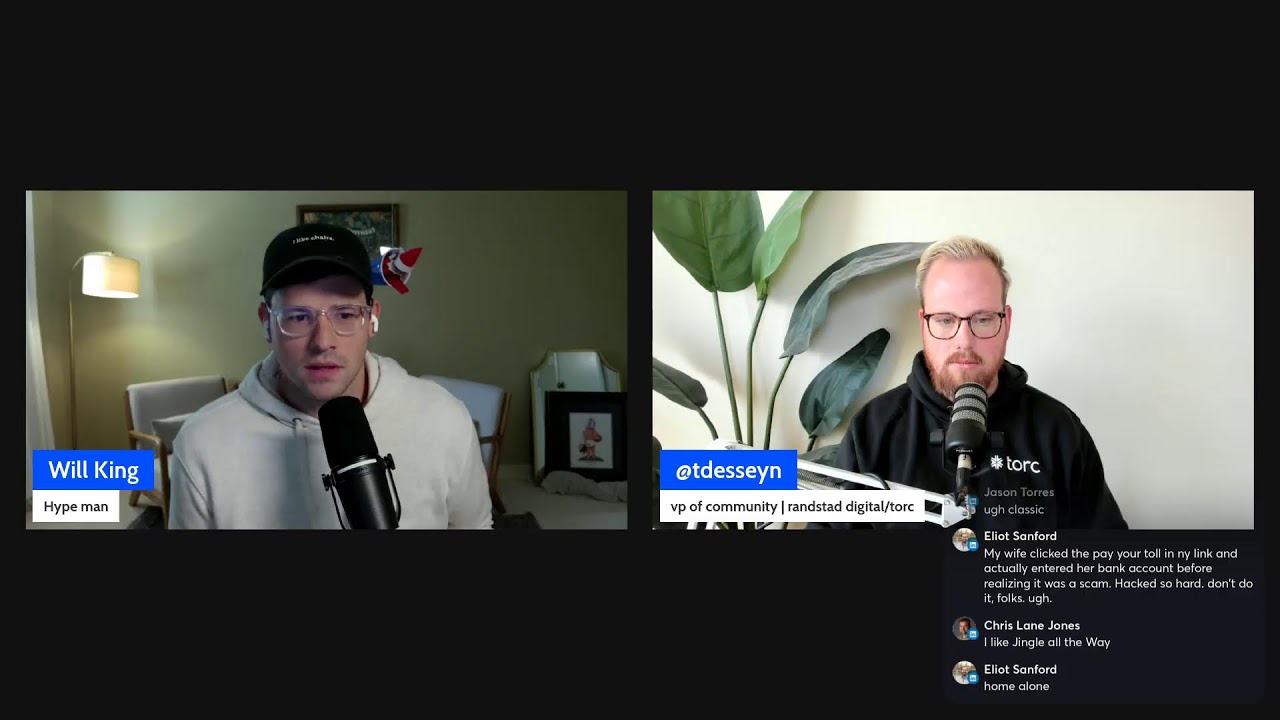
Will King, a design engineer, shares concrete strategies for landing a job after a layoff: build proof-of-work projects, contribute to open source, network at conferences, and use AI tools like Claude for research. He weaves in personal stories about burnout and family to ground the practical advice.
Chapters
All righty, alert the troops. All right, and then drop in the Discord. All righty, sweet. All right, good morning everybody, and I mean everybody, I mean nobody.
I'm gonna get here.
Um, Will and I were just chatting about kids backstage.
stage.
Uh, you know, you also gotta love when a sickness is going through the house.
So I, I was wondering, I could hear it, I could hear it.
Yeah, I'm very, I'm very congested. Daughter had it like 2 weeks ago, then it passed on to the wife, then the old round robin.
Yeah, I don't know if it's like a blessing or a curse, you know, like it always works out to where somehow it's one at a time, so it means it lasts Forever because everyone gets it individually. Yeah, but then like on the other hand, if everybody got it at the same time, it'd be over way faster. But then like you're all down for the count. No one—
yeah, so I will say I will die on this hill. I would rather get the stomach bug for 48 hours than a cold. I hate colds.
Bro, I am the exact opposite. Ali literally has labeled my alternate personality when I have like any type of nausea. She just calls me Nausea Will. She's like, I did not marry Nausea Will. I, I don't like him. Like, there is Will and then there's Nausea Will. We don't—
It's also like guys being sick in general. Like, we're like, you know, I, I just, I look at my wife, you know, because we have 3 kids now, we're about to have our 3rd literally any day. Um, uh, our third's due on the 28th. Um, I think we'll probably go into the first week of January. Um, uh, shout out Ronstadt. I have 30 days paternity leave, so I will be off the grid.
That's the best.
Um, yeah, in January, which I've never had before. So Jackie was super—
I don't know what the internet can handle that. Does the internet know what it's like to not have Taylor around for—
Yeah, I don't know. You know what's interesting? I think this is a whole nother conversation. Like, I haven't said this publicly, but like, man, I'm just burnt out. of social.
Heck yeah, dude. Burnt.
Like, you know, I think, I think one of my— I have a very like obsessive personality, right? So like, I do, like, I do think—
It has nothing to do with why we get along.
Yeah, yeah, just like I'm a 3, I'm a hard 3 on the Enneagram. And so it's like, you know, I think one of the things, like, I, I, I— that's just one thing. Like, if, if I get a task, I'm gonna wear it out. But man, I've been wearing out social now for so— for like 5 years. So I think like You know, I, I think, uh, I think I'll probably call it for 30 days.
Yeah, dude, you should. You will not— like, there will no— there will be no backlash. There will be nothing.
Yeah, yeah.
I do this periodically where it's like hard.
I know, I know Aaron Francis has talked about this a little bit.
Yeah, yeah, yeah.
It's so—
Shut it early. Really good.
Trying to get more focused in the morning.
Yeah.
It's hard because like everything in you is like, I don't think I'm gonna get left behind. Like, I don't think like But like, I think it's just so ingrained in me to do it that if like I'm not always there, like people gonna forget about me.
Right.
And there's the dumbest thing to say out loud.
That is not true. You know, like that people— you are not the first in people's mind. And so you have to put yourself in people's mind. So like there is, there's definitely truth to that. I think the— where the difference is, is like people think that means it needs to be constant.
Yeah.
And honestly, it does not need to be constant. You know, like with Aaron, he's like, I did not experience hardly any change in the effectiveness of my social media just by being on for a little, like cutting off the entire morning and just catching up for a minute in the afternoon. Yeah. He's like, wasn't that big of a change. Now, you know, like, I think that's different depending on like the type of career and the type of like thing that you're doing. Like if you're primarily media and social, like that is the thing, then like there's probably some difference to that. But I don't think any, any type of business has to be present all day. No, I think there might be the case for like a business needs to be present every day, but not all day every day.
Sure. Yeah, yeah. Um, I love it. Well, good morning everybody. Uh, happy Tuesday. Thanks for tuning in. Also, I, again, for those of you tuning in, I have been working through a series on really just helping people through the job search. If you go to the Torque YouTube, it's all there. How to write a resume, how to write a LinkedIn. We've talked about job boards. I've talked about how to use LinkedIn. And, and, you know, obviously a lot of my tweets and posts around the job search, which I'm super passionate about. And why I love tweeting stuff is that other people can respond. And Will responded and Will had some really thoughtful content. So of course I was like, hey Will, we should, we should hang out. So that's why we're here. We're still talking about the job search. We're still on the job search. Will is, Will, I think you're the last guest. I think you're the last guest of 2025. Yes, you— I can't confirm. So Will's the last guest of 2025. We'll save the best for last, always.
But again, we'll decide at the end if that was—
yeah, yeah. But for those who tune in, please say hey. We'd love to hear from you. Again, you know, I—
the—
just the power of this show. I just want to say I see y'all. I appreciate y'all. I brought up my buddy Aaron Harmon, an internal recruiter, the other day, last week on the show. And he texted me and he goes, what did you say? And I was like, what are you talking about? He goes, I've had an influx of DMs on my LinkedIn. He goes, and I know it came from you. What did you— So again, I just want to say thank y'all for the networking. Again, I really think this is, um, this is really a meetup, is a virtual meetup. Um, you know, to say hey in the comments is to engage. Um, reach out to Will, tell him you said hey. Uh, you know, tell him you saw him on the, on the stream today. But again, I just want to thank you for the community, and, um, uh, other people see it. And so thank you. You know, I, uh, I went live about a year and a half ago with a founder out of Austin. She has been on a ton of podcasts, and she messaged me a few days later. She goes, I've never had the amount of engagement from a podcast. I've been on a ton of podcasts, and I've not had the engagement except from your community. So again, thank you to all y'all who show up. I do want to get into some announcements real quick before we start yapping. First and foremost, I am an Appwrite hero. Me and Jason are. If you want to go check them out, please do so. Tell them that TorqueBoy sent you. Again, I always joke I'm the only probably non-technical person on a technical heroes program. I love the DevRel team. I love the folks over at Appwrite. So that should be enough. You should check them out because of that. Also want to give a few announcements here. If you go to torque.community, it's kind of our new community page. It's got some testimonials, yada yada. Um, I do want to say we have officially closed up ambassadors and the mentor-mentee program signups. So, um, we have 104 ambassadors signups that we have to get through. Um, that is all— that's a meeting that literally I'm gonna hop into, um, with Jason after this. Um, but really thankful for all the folks who signed up to ambassador program. Um, we have Will on the record, on the record at Laracon in Denver saying that he has seen the ambassador program. He's in the room.
I have.
And so, uh, again, shout out to y'all for— again, we're not— we're probably looking at accepting around 40 or 50, um, so we're going to cut the list tremendously. Um, so we'll, we'll announce that first of the year. Um, also mentor-mentees, um, we have, I believe, Jason, you can correct me in the chat, I believe we have 16 or 17 mentors who signed up to mentor folks and around 30 or 29 or something like that folks who want to be mentored. So really excited to kind of kick that Um, off, uh, January 1st as well. Um, as always, if you want to, uh, you know, if you want to know when I go live with guests like Will, I shoot out this text. Text LIVE 615-235-5650. It's actually me. Um, I'm actually trying to, uh, get more into the job search stuff too. So if you want to join the number, text me any questions around the job search. I will gladly answer those. I always answer those first, more than DMs, more than anything else. So please text me. Um, also I have 2 new show sponsors I want to highlight. First off, I'm still working on an affiliate link for Neurolyte. Basically, Neurolyte is just one of those mineral hydration things you put in your water. It's great. I have it right here. Highly recommend. It's got a bunch of stuff.
My kids call it blue water because mine makes my water turn blue.
Mine calls it pink water. Um, so, uh, but yeah, so, uh, check out Neurolyte. It's great. I've been drinking it. Um, I got sent a packet, um, and I like it. I really, really do. Um, also, the really the The big sponsor I want to give a shout out is Seek Coffee. I have it right here, Seek Coffee. Um, the founder is in Nashville. Um, his name is Caleb. Um, he's fantastic. And I did not know this, um, but most coffee actually has mold in it, which is not ideal with the amount of coffee I drink. So he started a company that has mold-free coffee. Um, I don't know why this keeps going away, but if you go to Seek to Live, use the code TDESSYN for 15% off. It's great. Um, highly recommend it. I know Jason got the hookup from Caleb for his, uh, 24-hour streaming that he's doing. Why is this going away? That's so annoying. Um, so again, check out Seat Coffee. I'm gonna drop in the Torque Discord as well. Um, but I like it, it's really good. The cans are great, the iced coffee is great. So check it out, it's great.
LOL, this comment is killing me. He's grown too powerful.
Yeah, yeah, yeah, grown too powerful. Yeah, absolutely, absolutely. All right, so, uh, enough of me yapping.
Uh, Will, 2 things. 2 things.
Yeah, go ahead.
One, Jason, this is the hat. It says, I like chairs. If the text is backwards, it says, I like chairs. So it's from a buddy of mine who's an industrial designer. So it's great because I live in the South, and in the South, one thing that all dads and like older men love is their recliner. So like they see it and they're like, oh yeah, I love my La-Z-Boy too. I like chairs, you know? So like hilarious because I'm in the South. But love a good chair. It means is like I went to school for industrial design and if there's like one thing every industrial designer dreams about is like designing a chair. So this is really like an industrial design hat because it's like I like chairs, I love it, I like chair design, that kind of thing.
So, you know, it's interesting. Okay, so that's the one thing. What's the second thing?
The second thing is what you need to get a sponsor for is that mic arm of yours. Man, anything with the spring is tragic. Let me hook you up with that Elgato. It's like a— it's called like the Streamline or the Thin or something. We're gonna hook you up with a good— you're on the mic too much not to have—
Yeah, this thing is like $30 on Amazon.
Yeah, um, I had that exact one in black, and every time I move it, it like creaks and it like bounces all around the place.
Yeah, yeah, it bounces. It's not ideal, but hey, it does the job. It does.
It does the job. Send me—
send me—
You're an influencer now, so we get you— we'll get you the hookup.
Yeah, yeah, yeah, yeah, yeah.
Okay.
Um, I love it. All right, Will, so, uh, we're gonna talk about job search today, but before we dive in, if you want to give a quick background about who you are, uh, what you do, and we'll go from there.
So I am a dad of 3 kids. That is like job number 1. Job number 1 is dad. Job number 2, design engineer. So I am a design engineer at Snowflake. We used to be at a company called Crunchy Data. Over the summer, we got acquired. So I went from working at a startup to working at a very large enterprise company, which has definitely been a change. But I also just like build things and share how to do things online. I enjoy speaking at conferences and plan to be doing some more of that next year. But that's basically it. I like to build things for the internet and the web. Awesome. And also like real life, I do like woodworking and stuff. So love it. I would say that summarizes me.
It was a great friend of Torque. I know Jason's had him on recently. Will's got a lot of hype from from from from the Torque team. We love Will. So yeah, Torque. And then you want to plug your pod with Josh as well? I know.
Oh yeah, absolutely. Every Friday, we me and Josh Siri have a live show. It's about People who love to make and build and create things. We just talk about whatever comes on our mind. It's called Riff and Refine. The whole point is that we just talk about things that we think are interesting or that we're building, riff on them together, and try to like make ideas better with everyone in the chat. Tons of fun. So I love it.
Yeah, it's great. I always hop in, try to say hey.
You do. You literally hop in every single time on X and just say, sup, nerds? Nothing. We can always count on that.
Yeah, yeah, yeah. Nothing philosophical for me. It's all vibes. What's up, nerds? All right, so, um, let's dive into it. Uh, there's a few things I want to highlight, but I kind of want you just to kick it off. And, and I don't know, I've talked to, I've talked to people who have been laid off and found a job, but I haven't talked to somebody who has a job and would essentially like talk about what they would do if they were to get laid off. So this is kind of a little bit of a different angle. Um, so I, I, so I, I, so I want to ask, like, like, like, what would you do, man? Let's say you got the notice today. I really pray you don't, but you know, let's, let's say you get the notice today.
Oh well, if I get the notice because I'm talking about getting the notice, yeah, man, that would suck. All right, so here, here's the important distinction I want to start out with is if you haven't been laid off yet, then like this still applies. Like you need to— oh yeah, you start now. Like, hopefully you're not starting to prepare for finding another job only once you've been fired from your current job. If so, this is, this is going to take some time. But yeah, here's what I would do. If I got laid off today, I would not. So the reason, the reason I commented is because you mentioned if I got laid off today, the first thing that I would do is be in a bunch of people's DMs.
Yeah.
And you would be sending out a bunch of resumes, etc. And I wanted to comment because like my first instinct if I got laid off would not be like doing a bunch of like a bunch of trying to do a bunch of lead generation, a bunch of activity, that kind of stuff right out of the gate. Because, and I think part of it depends on like the type of role that you're in. So like, I'm in a design engineering role. Which means like, I am like the work, how I am like, how people perceive like my value to their company is directly related to like the type of work that I can show them I'm capable of. Yeah. And usually when you've been working at a job for a long period of time, you do not have like the most exciting of things to show a company because you've been working on like probably maybe a few exciting features here and there, but mostly you've just been working on like day-to-day grind, which is not like an exciting thing to present to a company.
Right.
So the first thing that I would do is I would like find what companies I wanted to work for and like understand what they need. That would be like step one is like find who you want to work for, the type of projects you want to be doing, and understand what they need because the first, the biggest thing about the job search that you need to understand is that like, it's not about you. If you want to find success in the job search, it's not about you. It's about them. So if you're not worried about like understanding what they need, good luck finding a job because they're not here to hear about you. They're here to hear about like what you do for them. So the, the, the thing I always try to keep in mind is Is that like job hiring, the hiring process from a company inherently is like a trust exercise.
Yes.
Because it is like the most risky thing a company can do is take some of the revenue that they have as a company and invest it in something where they don't get that money back. And like, they have no clue whether like the work that you can do will live up to the expense that you will cost. Because like the reality is, is like the company— company's biggest expenses are the people that they hire. So they are also like their riskiest decision. So like your job in the hiring process is to make you the most like the least risky decision they can possibly make. So that is like all of the context that I like go into thinking about.
I love that.
And so what I would do is I would identify probably 3 max companies that I want to work with. And then depending on the company, I would build something for them after like evaluating the company that would show them, hey, I can do the job day one when I show up.
Hmm.
So like that, that's what you want to show them is like, yeah, we're not gonna— going into the interview, It's not going to be a question of like, can he do the job? It's going to be a question of like, do we like him? And that is a much easier thing.
Love that.
To like go through interviews on than to like go into an interview and instead of them worrying about like, well, do we like the guy? It's like, well, do we even know that he can do the job? So like that, that's like first, first thing that I would think about. Um, and then the next thing is like How do you know what to do for the, for the company?
Yeah, because I think people like, all right, well, that sounds great, but like, how do I know?
Yeah. So depends. Surprise, it depends. There are a lot of different type of companies, a lot of different type of roles. And there are some companies that this is like way harder to do this with. So this is a lot harder if you're like trying to like— and is not like a reality. If you're trying to go for a job in like a FAANG company, like Facebook, Meta, like Meta or Google, or even like the company I work for now, Snowflake. If I tried to get a job with them without having been acquired like this, this approach probably wouldn't work just because they are so big that they, they have so many layers of abstraction to their hiring process that they just won't—
Yeah.
go around for somebody. Like, you have to go through the process. And so, like, the best thing to do if you want to work at a company like that is, like, you just have to have somebody who will vouch for you.
Yeah.
Networking is, like, the way, the fastest way through on companies of that size. So, like, what I'm referring to is, is going to apply to, like, medium to small startup companies.
Yeah.
Which is, like, my sweet spot anyway. And, like, who I like to work with. And is honestly, like, if you want to get into one of those bigger companies, that's a really good place to start anyway. Because like, by getting your foot in the door with medium to small startups, you're going to be building things and meeting people that will, that will allow you to get that connection that you need to get the ref on like the bigger companies.
I love that. I love that. Real, real quick, I don't think people really are paying attention to what you're saying because people keep talking about the elf behind you. Can you—
yeah, yeah.
Jason goes, I'm sorry, have we not addressed the elf back there? Somebody goes, nope, not dressed yet. Looks like a cannon about to be shot off into the moon.
So my wife is like the world's biggest Christmas fan. Like, holly jolly, November 1st, our house is decorated for Christmas before Thanksgiving.
Which, by the way, if you do not follow Will's wife on Twitter, she is Don't do it.
She's a gem.
She's a gem.
She is.
Allie, if you ever watch this, I've never met you, but I feel like we'd be BFFs.
Oh, absolutely. Like, you and your— you and your wife are like— if we were in the same town, we would be best couple friends.
Oh yeah, Jackie. I'm so glad Jackie does not do social media because she would absolutely drag me through the mud on X.
Well, it's fun sometimes.
Yeah, yeah, yeah, yeah.
But, uh, yeah, no, Elf on the Shelf. Um, we— I've avoided— I've been like, Allie, I don't want to do this. I don't ever—
We haven't gotten into it, Jack. I mean, Ari, our oldest, our 5-year-old daughter, hasn't asked about it. So like, we haven't— I don't even know the premise about it.
Ours didn't ask either. Allie just loves Christmas and loves— like, wants to provide as much Christmas joy as possible. And so she was like, I think the kids would think it was so neat. And she was right. The kids love it. The kids think it's so neat and it's so fun. But I can tell you with absolute certainty, on like a Tuesday night when you finally get all 3 kids to bed and it's like 8 o'clock and you finally like lay down on your bed to be like a vegetable and an adult by yourself for like a few minutes, you're— the last thing that you really want to do is like come up with some ideas.
Don't you have to like move it around or something?
Yeah, you move it around. You got to wait till they're asleep because like apparently the elf is magic and he goes every night to the North Pole to tell Santa Santa how the kids have been, and then he comes back and he's in some different place in the house doing some different activity and has a note for the kids.
Gotcha, that makes sense. Is there any like cookies involved? Could we like leverage that? Or is that just Santa?
You can have like treats, you can have sweets. They could have like made a mess. Um, so in this one, he's like, my 5-year-old daughter— yeah, I'm not about— I'm not about that. Um, there's a ceiling fan, and so he's like tied to a Solo cup And this morning we turned the— he had a note. Yeah, he had a note that was like, I wanted to like watch Dad today, like your dad today at work, and keep an eye on him and thought this would be a fun way to do it. And then they turn on the fan and it like spins him around.
I want to take a second. We're definitely derailing, but this is why the show went an hour, so we can talk about this. Uh, I will tell you this, the mind games I've had to play with my daughter to keep her in check with Santa is absolutely ridiculous right now.
Yeah, it— especially with like, if you have an oldest who's a girl, let me tell you, it's all mind games.
Oh, it's all mind games. I've told her that she's gonna have to write Santa another letter because she's been misbehaving so much.
I—
that— I, I'm, I'm not, I'm not above that. I, I think— hey, Allie—
so Allie's a kindergarten teacher, so if you want to talk about leveraging Santa in the month of December to keep kids in order— oh yeah, kindergarten teacher, she like uses it on the daily to like keep them in line.
I haven't said this publicly before, so this is the first. My parents, they may be watching on Facebook, but my parents gave me coal one year.
Shut up. That is insane and awful.
We still have it. We still have it. I got coal and I remember crying my eyes out Christmas Day because like—
Ali has very strong feelings about that. and will disagree, but I for one applaud your parents on the commitment to— yeah, Taylor, who was like an absolute maniac one year.
It's fine. Um, you know, one of the many things we're unpacking in, in counseling. But, uh, yeah, no, I still to this day— they, they went light on the stockings. All right, here's another question. I haven't asked this with guests because I haven't had guests on. Always— okay, all right, this may, this may completely derail the conversation. We'll get back to the job search here in a second.
We will.
Are you a stocking before presents or after presents?
Uh, I have no strong opinions on that.
Well, Jackie is like, grew up after presents. I'm like, no, no, no. Like, for me, you always do stockings. Stockings are the appetizer.
Uh, yeah, I like that approach. That is in fact the case. I do. I think at home, I'm pretty sure every year we've done stockings first.
Um, yes, stockings.
We've not had— we've not had kids like old enough, like We like doing stockings first because me and Allie don't actually get Christmas gifts for each other. Yeah, we just every year we both have like a date night where we drop the kids off with her parents in town and we go do stockings for the kids together. And then once we've got all the kids stuff, we split up and we do like gag stocking gifts for each other where we get like some things that we know the other person wants, but also try to find like ridiculous and funny things for each other.
Yeah.
And like, we only do stockings.
There's, there's a— I— Jackie doesn't watch any of my content, um, which I—
All these people with stockings are always after.
No, stockings are not. No, before presents.
I feel like it's such a letdown. It's like, if you— okay, here's the deal. If you do stockings after with small children, you just don't get away with it because there's no chance that those kids are sitting still to like open a stocking when they have just opened the coolest present they've ever seen in their entire life and all they want to do is play with it. Like, we barely make it through. We barely make it through opening presents because as soon as they open like the one thing they want, they're like, I don't want— who cares about anything else?
Like, I'm out of here. This is why Jason and I work so well together, is because he is stockings prior as well. Yeah, some of y'all saying after. It's just a huge letdown. It's a huge letdown. Huge.
Yeah, yeah, I would agree.
I would agree.
All right, you mean I got socks?
Yeah, you mean— yeah, we're gonna, we're gonna wrap up with socks. Yeah, like, no, that's not good. Um, all right, back to the job search. So I had this idea while you were yapping.
Okay.
There's a lot of people out there, especially in the Torque community, who are building in public, trying to document what they're learning, yada yada. I feel like a lot of it's kind of arbitrary learning because it's not tied to anything. Like, one of the things that Wes Bos did recently, which I loved, is like he got under the hood on how, on how the F1 website was built.
He did the same thing with, um, the McMaster-Carr site. Yeah, because it's like super, super fast. And so he was breaking down like how that actually worked.
Yeah. So would it be— would it behoove people— that's my only like triple letter word score right there, behoove— would it behoove people to like, instead of just aimlessly trying to build something, like pick a product or a company that they actually use on a day-to-day and like Talk about what they would do better and try to build a feature? Do you think that would—
If you're in the job search, absolutely. Yeah, 100%. Now, I'm also— I'm a big proponent of like, finding what you care about and building.
Sure.
When there isn't something on the line. So like, while you are currently like in a job, yeah, you should still be building new things. Because you need to, like, keep learning. You need to, like, explore new things, new technologies, because, like, who knows when you uncover, like, oh, this is what I really want to do with my career. I did that. That's, like, how I got into React. Like, I was doing, like, WordPress websites and, like, web design at the very beginning of my career. And then I, like, started, like, getting into React during my free time.
Right.
And, like, that's what got me into, like, the tech path where I'm at now.
Yeah.
So, like, if I just waited for my job to provide that opportunity for me to learn that, like, zero chance that would have happened. So, like, I am a big fan of, like, find something that, like, is super interesting to you and try to learn new technologies building it when you're, like, safely employed. But, like, if you are job searching, like I mentioned earlier, you need to find companies, like, identify, like, who you want to work for. And solve problems that they care about in a way that shows them like you've got the chops to do the job.
Yeah.
So go ahead.
Well, I mean, prime example, I had a, I had a developer. I've actually had 2 or 3 developers do this. And granted, we are still trying to improve things desperately on the product side for Torque. And thank you for everybody who's bearing with us. But like, I've had developers do mockups and send me what they would do. And how to improve the Tor platform.
Yeah. And even if it's not like what you— even if it's not like, oh, yeah, like, he nailed it, he's absolutely right.
Sure.
If they've got— like, it gives you the indication that, like, oh, they care enough that they're thinking— they're not, like, waiting for— to be sent tasks. Like, they're a go-getter, you know? Like, that also sends a signal to them that, like, they are trying— like, they don't know enough maybe about the context to know whether that's a good idea or not.
Yeah.
But they're trying to figure out good ideas based on some thought process that they had. And like, the more context and the more information that they would have if you actually had them inside the company, you can see that they would be coming up with those kind of ideas as well on their own. And that like makes a huge difference from like somebody who's just like, yep, they're just gonna sit there and wait till you tell them what to do. And they may do a really good job doing the thing you told them to do.
Right.
But like, once again, we're talking about like risk and trust here. Like, would you rather hire somebody who's like only going to do the things that you tell them to do? So like more work for you to give them tasks? Or are you like looking for somebody who will do the tasks you give them, but will also like use that to identify other things that could help the company?
Yeah, I mean, we've had— and even it's not even code related. I've had some people that I've been interviewing for potential hires in 2026 on the Torque team. And I've had people like write out like a 90-day plan or suggestions on what they've seen, that what they've been following and like what we should do to improve. And it's like, that's not even code related. It's just like a one-pager on like, and for me it's like, man, like this is completely unprompted. Completely unprompted.
Yeah.
And so I don't think it takes much, but I do think like this is, this is a separator. I mean, I remember going live with Sunil at Cloudflare. And he was saying how he got the job at Cloudflare because he kept bitching. Now, yeah, this, this is— if you got to be tactful here, obviously a guy like Sunil who has the experience—
And when he said that, what he meant was he had been raising issues that he noticed because he was a heavy user, probably in a way that was like respectful. He just was funny, so he—
Yeah, he's just funny. Yeah, yeah, yeah. So again, I always want to caveat, you know, you need to, you need to have some, some, um, some couth about you. But like, to me, like, he got the job at Cloudflare Because he— the Cloudflare team finally goes, well, do you just want to come on and fix all this stuff?
Absolutely. All right, so that leads me to 2 things. One, after this, I want to talk about like where AI belongs in like—
Well, that was— that you already beat me to it. That was my next question.
Before I get there, before I get there, what you brought up is like the piece that I wanted to like resolve, which is like, how do you know what to do? So like in his case, he complained a lot. And that's like how he got the job. In other cases, like you see people who built like this really cool thing that is like technologically tangential to a company, and the company's like, that's super cool. We want somebody like that. And so like, how do you know what to do? And there are like different types of companies. So like, if somebody is like a consumer-focused company, who they're building a product for them, And especially if their, like, technology is, like, a lot more specific. Like, some people, like, some technology companies might be building, like, video-based tooling.
Yeah.
Some people might be building, like, audio. Or they might be doing, like, financial stuff for a lot of, like, charts and metrics. Or, like, a lot of, like, workflow stuff with, like, canvas editors. Like, whatever you know that their product deals with a lot. Build, build something that demonstrates, like, their primary medium for their technology. So, like, a lot of stuff today in the AI space is, like, a lot of canvas-based things. So, like, come up with, like, some interesting, like, project that requires you to use, like, canvas and, like, nodes and, like, edges and stuff to, like, connect a workflow of some kind together or something. And like build that out and use that to like submit to the company. And explain to them like why you built it, what you understand, like things you learned, that kind of thing. So like for consumer-based or like SaaS-type companies, like understand the product that they build and build something that is like proves that you know what the technology is and like the pros and cons of it. And like look for Look for things that you think could be, like, benefits to their company in that technological space or something.
Yeah.
Another type of company is, like, companies who do open source. So, like, this is, like, the same way with Cloudflare. Like, Cloudflare is, like, a platform for, like, developer productivity, developer tooling, that kind of stuff. If it's, like, a tooling company and they have, like, tools that developers specifically are supposed to use, or if they're like open source and they like have code, be somebody who like uses it and demonstrates that, you know, like you use it enough to know like rough, rough cases and either identify them if it's closed source. So like Cloudflare, they don't have open source stuff to where like you're allowed to just jump in there and start changing things. But like he said, he's a heavy user, so he was able to like submit Hey, I use it this way. This edge case is kind of weird. I bet he also suggested, like, here's what I would prefer or, like, the way I would want this action to happen. And then the other one is, like, if it's open source, like, don't just tell them that there's a problem. Just go in there and fix it and, like, submit open source PRs. A buddy of mine, Dax, they run OpenCode and a number of other open source products. as part of their company. And he said every single hire has been through people who contribute to their open source projects.
And we win.
Like, why would you hire anyone else?
Yeah.
When you have a proof— like, like what we're talking about, like it's about trust and knowing that you're like de-risking. If you're open source, somebody has contributed to your project over a period of time and their stuff is good consistently, like why would you not want that person to be the one you hire when you have an open role?
So, well, and that's, and that's so good. And I want to kind of get into this too. And, and, you know, I'm glad you and I are on the same wavelength— brain, brainwave, brainwave length. Um, uh, is that me and Jason did a Laid Off Lounge, uh, episode in the Torque Discord 2 weeks ago with James, um, uh, CEO, uh, James Perkins, CEO of Unkey, um, out in Raleigh. And he was talking about how he hires Mostly for people who submit open source PRs to their company. He goes, we hired a guy who was super junior, but he was just like aggressive as all get out. Like when I say aggressive, I mean really good with follow-up, asking for more. And he goes, we brought him on and he's been here and he's one of our best engineers. Yeah.
So there's a lot of companies these days that have like changed their hiring process to be like, to try and match this paradigm, which is based on like work trials. They're like, hey, which I think is way better.
That's a such a—
work with us for 2 weeks. That's what they're trying to do. Like, they're trying to de-risk and they're paying you to do it, but they've only committed to a very short time period to understand if this is going to be a good fit or not. And like, you want to short circuit that with other companies, like do the work trial yourself and show them that they can trust your work.
Yeah.
Like, that's what James was saying, like, he knew he could trust these people— this guy's work because of, like, how tenacious and, like, well he handled, like, follow-up, trying to do tasks, responding to feedback, etc.
This may be— this is a little naive question to me just because I'm not technical. Where does somebody— like, if somebody listens to this now or in the future and goes, man, that sounds great, I want to go do this, I want to go find some sort of open source thingy at a company— how does one do that? Like, is it public on the company's page? You have to jump into like a company's Discord?
It's very obvious, which like, that's the, that's the thing about the open source one is that it's like, it's very rare that you're going to be like, oh man, like, I don't know anything about this company. Let me try to get a job by just going to it and starting to contribute to their open source stuff. Usually the way it works is it's somebody in the tooling space And it's some kind of tool that you have used or are familiar with. And so you, you need to be like the kind of like the, the hurdle to this type of approach is like you've got to be a heavy user of whatever project it is. Because like otherwise, it's very apparent when somebody's coming in. And this is like one of those things that I want to talk about in a minute with the AI stuff. Like, sure. It's very apparent when somebody just comes in And it's like, well, I've got AI. I want to I want to try to get a job here. Let me just let AI tell me like AI what's something wrong with this code base and let me fix it kind of thing. Like that's so easy to spot from every single open source person maintainer that I know from every single like open source maintainer that I know like.
Who did we lose? Will?
Well, was it me?
Yeah, it was. I think, I think, I think it was you. You're, you're, you're frozen, but I can hear you now. Are you there? Well, folks, looks like Alabama Will's internet went out. So what happens when you live in Alabama? The internet is not ideal. Let me— for those of you watching, let me text Will. Let me text Will. Hold on real quick. For those of you listening in the future, um, we need some elevator music playing right now. Hold on, hold on. I'm texting Will. Oh, wait a minute.
I'm back. Can we get rid of fake me?
That was crazy. Fake Will. All right, go, go. So somebody goes, it's the elf. The elf got him.
I love it. We're back. All right, so, um, what were you saying about It was basically just like there are ways to use AI. We can start getting into that conversation. Yeah, but like the, the thing about open source to wrap that one up is just like it— you have to pick something and be a user of it to identify like real problems because it's very easy to identify somebody who's surface level trying to fix something.
Yeah.
By just like barely using it and using that as an excuse to be a contributor.
Yeah.
So like, just keep an eye out for that. Um, yeah. Which segues into like, where does AI belong in the job search?
Yeah, 'cause like I interviewed Mark Thompson about it and we kind of were along the same vein about like using AI to kind of speed this stuff up, right? So it's like, could you use AI assisting? You could use a Claude, could you use a Cursor, whatever, to help build something quicker for you to showcase it?
Yes, that's exactly what I would say. Like, where AI fits in the job search is to speed you up, not to like try and like generate something for them, so to speak. Like the issue that I like, you see a lot is they read some resume or some cover letter and it is very obvious that it was done by like AI.
Yes.
And like, you know, it's all that. it's like an immediate no. And like, that's the same way with like these type of project stuff. It's like, if you're going into unfamiliar territory, and all you've done is try to use AI as a quick win to get something built, like, just think about like what— like, like we said, this is a trust-building process. Like, the whole point is to prove them that they prove that they can trust you. And so like, whatever you are put— like, it's not about volume. It's about like quality. Now, volume does matter in the sense that like you don't want this to take months. That's just not like— so like leverage AI, but leverage AI like where it matters, like where you would actually use it in the job, not as like a way to like generate a bunch of things that are like slightly different and then shoot them out everywhere. Like use it to do research, like use it to understand and be able to make decisions on your own about things. Like, say you're like, this company's always been interesting to me, but I've never had a chance to like dig into like their problem space or whatever. Like, use AI and just like do some like heavy domain research. Like, that is like my favorite way to use AI is to say like, tell me everything about this product. What are like common issues with this product? What are common like issues with this market in general? Like, what do people often complain about? Give me sources.
Yeah.
like all this kind of stuff to like get a just like a wider and faster method of like gathering research and then like use that to then identify something that you, you resonate with because like at some point you're going to have to talk to them. And if you've not done the work to understand whatever you made a solution for.
Yep.
And you get into a room with them and they are like, well, this thing was really cool that you built. Like, tell us more about it. And then you just kind of like, oh crap. Like, if you, if you didn't make— if you are not part of the decision-making for building that, like, yes, like you can. I think especially these days, like, companies want to hear that you used AI, but they want to hear that you used it in a like responsible, professional way.
Correct.
Yeah, like I used it to do XYZ and it gave me this. Right here. And when I saw this, it immediately made me think, oh, I, I've got an idea for how to handle this. And like, so I did this, this, and this, you know, like, you want to be able to, to have like a knowledgeable conversation. So like, don't let AI do the work for you. Let it like—
Help frame up the work for you.
Right, right. Like, help it identify work. And then like, once you've identified work, Like, help— like, use it to help, like, get the work done, but don't let it decide what work needs to be done.
So let me ask, let me ask you this. I'm gonna kind of work this out in real time. So I've been saying there's kind of 4 buckets you should, uh, use, or tools, or whatever, whatever analogy you want to say, in your job search. There's open up your actual phone, because these are going to be your warmest contacts for the most part. Shoot off some text. Hey, I'm on the job search. Let me know if you got anything.
Yeah, totally. That's—
there's— there, there is— I, I've been always against— I think there's a difference between mass applying and cold applying, and we kind of unpacked this on the episode with Lawrence. Mass applying is just literally just cold apply— is mass applying everywhere. Cold applying, a little bit more to me, is more of a thoughtful editing your resume to it.
Yep.
That's 2. 3 would be Uh, you know, get, get into a community, right? Like get something.
That's like that open source kind of approach. Yep.
4 would be leverage recruiters. 5 would be try to network with strangers. Okay.
Yep.
Those are kind of the 5 pillars, whatever.
Makes sense.
I feel like there's kind of another sublayer of pillars that we've kind of been talking about that I kind of wanna hash out here. It's, okay, contribute to open source.
Okay. That goes back to community in my mind.
Okay, it's contribute, but then also build in public your learning.
What's funny is that that goes to like networking with strangers in my mind. So, okay, here is, here's what I would like— the whole point, and it goes to kind of like cold applying too, like how do you have a really good cold application? By coming in the door with something that shows them like, hey, we don't know you, But like, you've shown us you know what you're doing. So like, build something you can show them. Want to network with strangers? Like, how does a stranger decide like, hey, this is like a really cool dude, I want to spend time with them? Well, if you're a developer or like a builder, like, they want to hang out and talk about people who build stuff. So like, if you're building things, then you are someone who's really interesting to talk with and get to know because like you have things to talk about.
Correct. Yeah.
That's what, like, when you're in a job, that's why I'm doing what I'm doing right now. Not because I'm, like, worried that I'm gonna lose a job, but because, like, I've been building things and then the whole point of me building these things is so that I can talk about them. Whether it's, like, on social media, whether it's just, like, because one, I just love building. But, like, I have that show every Friday that I get to talk about it there. I talk about it on social media with other people who are building cool things. And I talk about it in like conference talks. That's like a big one is like, you go to a conference talk. What do you talk about? Well, if you've built something really cool, what you do is you talk about what you built, why you built it, how you built it, lessons you've learned from building it. And like, you get so many things in those pillars out of the box. Like you get community because like there's a lot of people there who are like, it's usually like a focused group of people. Like Laracons, like all these Laravel developers. React Miami is like a bunch of React developers. So, like, you're getting into communities of people who, like, care about a technology. And then you get, like, you get, like, a super— like a superpower in terms of, like, networking with strangers. Because, like, because you're a speaker, guess who everyone wants to talk to? the speaker who was like showing them something that they thought was interesting. So like, there's— it's just like less, um, icebreaking that you have to do. Like, you've got a built-in icebreaker that makes it easier for people to like want to talk to you. And especially if you've like crafted your talks to be about things that you care about, then it's just like easy mode, uh, and like very easy to like— I don't need a job now, but like I got fired and I could talk to a bunch of people who I met at conferences who saw me talk very deeply and technically about something, and they're gonna be like, yeah, if he could do that kind of quality of talk, then like, I don't have any doubts that he would be good at the job.
One of the things I was interviewing Brad Garopi about this months ago is one of the things he said that's really allowed him to get really good at interviewing is learning how to code and talk at the same time. Um, just in a sense.
So true.
Yeah. And so like, that's, I think, one of the things that like I— and, and we're— and we've talked about that through this pod today about, you know, building, talking about it. But I just want to reiterate, like, one of the consistent themes that I've continually heard as of late on this pod, because there's always themes that kind of emerge, the, the few themes are contribute to open source. And get really good at sharing how you think while you code.
Yeah, if I— if you want to know a really interesting secret, I have never taken like a coding interview where I had to like whiteboard and like code live.
Why do you think that is?
Because, well, I think it's partially because of the type of companies that I like apply for.
Sure, sure.
Where like usually The people, companies that I go after, I use this playbook where I'm coming in the door where they trust my—
So you've done this before?
Like everything you're saying, every job I have is because of this, like 1 million percent. I've not had any.
So then, for example, how'd you get the job at Crunchy Data?
So Crunchy Data is a really fun one. Um, I had this as part of my, like, uh, one of my conference talks. But when I got out, I did a project in college where I designed this thing and I put it in my portfolio and I met a woman, her name was Martha Underwood, and she saw this portfolio project that I had built and was like, this is really cool that you built this. Would you like to build some things for me? And this was like in college. So like over a period of like 5 years, I did some projects with her and she was like, hey, there's this like new project that I would like to do and I worked on that project with her and another backend developer. And that backend developer I worked with just for those few months. And then he— I heard from him, I think like 2 years later. And he was like, hey, there's this opening at this job. What you built was like so good. I think you'd be the perfect fit for this role. And so like, I got like a foot in the door that way because I had done some work ahead of time to show them, like, he, he could trust me because of the work that I was capable of doing, that kind of thing.
Yeah.
The, the very first job that I got, I took courses and I was a designer, um, by— and I was getting into development, so I took development courses and every single development exercise I like super designed. And so when I went to go like interview for a position at that company, they were like, oh, are you the Will who took our courses. I'm like, I don't know what that means. Like, I guess. And they're like, you design— like, your designs on every single project were like crazy good. And I was like, I never thought about it because it was just me being me.
Yeah.
And they were like, yeah, like it's a development course where like people are learning 101 of development. Everyone's barely like finishing the exercises, but I was like going above and beyond kind of thing.
Yeah.
So it's just like, it's stuff like that. Like anything you can you can do to demonstrate. It's like, you'll be so surprised. It will— it might not even be the door you expected to open.
Yeah.
But like, saying yes to like ambitious projects will open like so many doors. And being willing to then take ambitious projects and tell people about them is, is what will help you find the doors.
100%. Let me— I want to go to Roxy's statement here. I think I'd bomb anything that's not a take-home. What are your thoughts on this?
All right, so here's the— here, there's 2 realities to this. Reality number one is like, you do have to have technical knowledge. Like, if you have like an interview where like you, you do need to just know things about whatever technology they're expecting to hire you for, it's very easy to smell when somebody like doesn't know at least the fundamentals of what what they're being interviewed on. So like, you, you do need to know your chops at some level. And I think where people get confused about it is like, you don't have to be like some like coding god who like shows up and can nail like every hard problem. Unless you're going out for like, like I said, like a Meta or a Google or something like, yes, they're like very stringent requirements on like the type of interviews, and they will expect you to know all these like crazy coding challenge algorithm stuff.
Yeah.
Most companies, there's— it's a smell check for like, do you understand this technology? And how do you think? Like we were talking about. And that's like why— what I was talking about where it's like, there's not been that many where I've had to like legit code anything. Because it's more of like, the trap usually is, is if you actually start coding. Like, that's where you get like, if you're in a coding interview, and the first thing you do is jump into like solving it, Unless it's because like it's an easy one that you absolutely knew the answer to, right? Like the, the trap is like jumping right into a solution. And I actually like lost a job because I did this, um, one time. It was Unreal. It was like a design type of thing. And they're— they want to see how you think. So it's not about like how well do they solve the problem. It's like how well do they think. think through solving the problem. Because like, the— usually what you don't realize is that they're trying to pick something that is going to be tricky or stump you. Because like, they don't want somebody who's memorized things. They want somebody who can prove that like, when faced with an unknown problem, has a logical path for how they get to a solution. Yeah. Whether it is the right solution, whether it is like, like the best solution. It's such a short period of time. They just want to know that you have a process for like how you think logically about problems so that when you're in the company and y'all have hard problems, that you're so— you're a teammate who they can trust to like work through something.
Yep, yep, yeah. Um, I want to get— I want to get to Elliot's question here. Are job fairs, job boards still getting people jobs? So I'm gonna— I'm gonna take a stab at this. Well, I want you to take a stab at this. I think job boards for sure. Um, uh, my episode with Jerome Hardaway recently, it was, it was a, it was about a month or two back. He talked about how he got a lot of his leads from dice.com. Um, and I actually recently went over this, Elliot, on a previous live, I think like 2 weeks ago, on the power of job boards. I think, I think job boards are a place for you to set and forget your profile and let people come to you. I think it's a great inbound tool. Um, uh, I would say there's a lot of junk on job boards. Um, and so trying to chase down jobs on job boards is kind of counterintuitive, believe it or not. I think job boards are a great place for recruiters and companies to find you, but not necessarily go after. I think job fairs, depending on the scope and where they're at, and I think it's another great way to get in front of people.
Um, I would replace job fairs with like Conferences, like, yeah, yeah, any type of in-person, in-type, in-person, like meetup of some kind. The whole point of usually those is like somebody's going to be from some company in some form who is like hiring.
Yeah.
So like, replace that with, is getting out in in-person events getting people jobs? Like, yes.
Yeah, yeah, yeah, absolutely. Yeah. And then again, going back to Ellie said, I found jobs through volunteering. and getting out there in dev community and tech nonprofit community that led to referrals, then recruiters after— yeah, it's like what Will said, you never know. Like, I think, I think so many people are just tied to like every relationship should lead to an outcome, and that's not always the case because a lot of times I, I say this, so let's say you've been on a job search for 6 months, a lot of times your opportunities come from the people you met in month 1, not in month 6.
Because it takes time. Takes time. That's why, like, I was like, you should be doing a lot of this stuff while you're still in a role so that, like, you can harvest the fruits of your labor at the time you need them, not try to start growing them when you need them.
Absolutely. All right, 8 minutes left. I gotta hop into another meeting after this to talk about, uh, I believe it's the mentor program. Yes, mentor program. All right, so, uh, rapid-fire questions here, Will. Again, everybody go connect to Will. He is a wealth of knowledge. If you have any other follow-up questions, definitely DM him.
We'll have a good time. We're all about having fun.
Absolutely. Um, so right now, what's one tech tool, app, piece of software you can't live without? It could be a mobile app on your phone for personal use, it could be a wearable device, it could be anything. Like, if something was taken away from your life right now and it would be your favorite piece of software, you would be hurting, what would it be?
Um, I would have to say is probably Cursor. Right now, like, like Cursor is just like, if I had to pick the thing that I use the absolute most, it is that. And then like ChatGPT on my phone. I'm a, I'm a dad, like I said, and a lot of being a dad requires like sitting around in places away from computers.
Yeah.
But I'm a project guy. Like, I always got a project, always have something I'm interested in. And like getting to do a lot of research on the go with something that can like go and gather stuff and I can dig into with deeper questions. Like, that's like my favorite Workflow is like, when I'm away from my desk, yeah, I like—
Huge.
I just like dig in on something and get like, give me this example, show me how you do this, ask questions. And like, by the time I get to my desk to do work, I've like really honed in and fine-tuned. Like, okay, I know exactly what I'm going to do while I'm here and how I'm going to approach it. And then like I fire up Cursor and give it like way more specific like instructions and things to like get these projects that I want built, built in a much like faster process.
Yep. Uh, Devon, yes, recruiters do email you. They leverage job boards a ton. Uh, Will, what's the first job you ever got paid to do?
The first job I ever got paid to do, um, first job I ever got paid to do was to gather hay bales, uh, all summer for my grandparents.
It's exhausting work. It's exhausting. I just unloaded 75 bales the other day.
Oh yeah.
What is— what did you, when you were younger, what did you want to be when you grew up?
Grew up?
Grew up?
Grew up? I always wanted to be like somebody who built stuff. I didn't know what the title was.
You've always had that building mentality.
Yeah, I actually have a post that I'm going to be putting up about this.
Okay.
Where it's like, here are like my influences as a kid and like why I am who I am.
I love it.
That's great. It's like creative from the jump.
I love it. I love it. Um, uh, if, if I were to tell you, Will, that tomorrow morning you couldn't do anything in tech, but the— I will pay you the same amount of money to pursue one of your hobbies, what would it be? What would you do?
Uh, I would do like manufacturing of some kind. Like I would build a product. I would build— yeah, I'd build a phys— I went to school for industrial design.
Yeah.
So you just build bridges?
You just build bridges?
Yeah. Like here beside me on my desk is a 3D printer. And I don't know if you'd technically call that tech, Or not, but like any type of like product manufacturing, that kind of stuff. Like, man, I love product design.
Will, before you leave, can you turn on your ceiling fan?
Uh, I can't.
Because it'll hit you.
Because it broke. I turned it on for the kids this morning and it immediately got like caught.
Oh my gosh.
It's using like fishing line.
Oh dear. Oh dear.
spinning around and it got tangled and immediately snapped. And so like now it's just stuck around the fan and I'm dreading trying to unwind it later. So it's a stat— they're like, whoa, I bet that was so crazy. And I was like, little do they know that did not work at all. Like, yeah, so awesome, kids.
All right, last question. Well, actually 2 more questions. Do you have any, uh, Christmas traditions? I know Elf on the Shelf. I, I'm mainly around So we got in this conversation, like, the wife and I always do Mexican food on Christmas Eve.
It's—
my mom started it.
Yeah, we do it. We love rituals.
So yeah, do you have any other—
we have a Christmas tradition that we just started this year, and we call it, uh, Christmas movie night. Every week we have these like toddler-sized blow-up mattresses.
I think I saw you tweet about that.
And so we blow all of them up and put them in the floor of our den and move all the furniture out. and watch like a Christmas movie every Friday night.
There's a lot of like really short ones. What's your favorite Christmas movie?
My favorite Christmas movie is White Christmas. Same. Like old school White Christmas.
Same.
Allie hates it. I love it, but it's a good one.
Come on.
Allie hates musicals. Allie hates any— she's like, why are they singing? It's so stupid.
For some reason, I don't consider White Christmas a musical. Or I mean, wait, you say White Christmas or It's a Wonderful Life?
White Christmas.
White Christmas. That is a musical.
Yes, for some reason.
It's a Wonderful Life is my favorite. White Christmas—
That one's a good one. That's a real— that's a real like, that'll get you.
Yeah, yeah, it's a real— it's a real make you— make you cry.
Yeah, especially if you watch it once you become a parent. Like, don't do that.
For sure. Yeah, yeah. Um, all right, last question. The show is called Guidance Counselor 2.0 because we had guidance counselors in, uh, middle school, high school, college, but now as adults we don't really have them. What would be your biggest piece of career advice to young Will?
The biggest piece of career advice I'd give to young Will is like, do more ambitious projects. Like, tackle things that you don't think you can do and like figure them out sooner. Because like, that is where all of the best parts of my career have come from is just like saying like, hey, I don't think I can do this. Let me do it anyway. And just figuring it out. That's like all, all my friends came from that on the internet. All of like fun experiences that I've had came from that. They have not come from like day-to-day grind work at my job. They came from like doing something like above and beyond that I have been like interested or passionate about.
I love it. That's awesome. All right, y'all, today was a fun one.
Appreciate it.
We'll stay on so I can say bye to you backstage. Y'all have a great one. Um, I'm probably gonna go live tomorrow morning. Don't know what the topic is yet. It's probably not gonna get scheduled. I'm just gonna ad hoc it. So tomorrow morning, 9:30 AM Central, expect to see me on the interwebs. Otherwise, y'all have a great Tuesday, and, uh, we may see you tomorrow. Y'all have a good one.
Peace.
More from taylor



tech doesn’t have to be the only thing that brings us together #techcommunity #techcareer

I want to give back to y’all that make the tech community so great #jobsearchtips #techjobs




spend a little time investing in yourself #linkedin #linkedintips #careeradvice


