Budgeting Brilliance: Best Practices for Financial Foresight
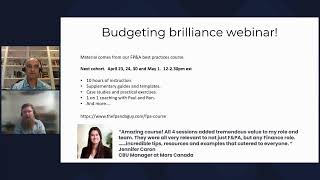
This is a YouTube video titled "Budgeting Brilliance: Best Practices for Financial Foresight" created in April 2024. It features a conversational webinar hosted by Paul Barnhurst and Ron Montero, both experienced FP&A professionals. They discuss budgeting best practices, challenges, scenario management, technology use, and strategies to improve the budgeting process. The session includes interactive elements such as audience engagement through chat, real-world examples, and practical advice for finance professionals to make budgeting more effective and less stressful.
All right, welcome, everybody. We'll get started here in a few minutes.
Good morning, good afternoon, good evening, wherever you are. We'd love to hear what country you're joining us from.
Far.
We got the US Represented, Philly, Texas, Steve and Jared, welcome.
Keep them coming. Let them let us know where you're coming from. And we'll be starting here in a minute. Our little Sadie.
Yeah.
Thank you, everyone.
Canada's made a nice comeback there. Toronto, Quebec, Manitoba. And it's nice to see people from Nigeria, from Lisbon, maybe other parts of Portugal. Welcome, everybody.
Yes, welcome. We got people from all over the place. We're excited to have you today. So it's going to be Ron Montero and myself that will be chatting with you today. And Ron's going to get us started. But we have a lot of exciting stuff we're going to talk about in this budgeting brilliant webinar here.
Okay, fantastic. So we thought we'd start with some quick introductions. Ron Montero actually spent almost 20 years in finance, 15 years of those being in FPA, worked for, you know, big consumer packaged goods companies like Kraft Foods, Campbell's and Krueger. And now I have the pleasure of working with amazing individuals like Paul and doing training, coaching, speaking. And I also host a podcast. And now I'll turn it over to Paul.
Yes. Okay. So my name is Paul Barnhurst, AKA the fp and a guy and really excited to be here. I spent most of my career in FP and a about 12 plus years full time with companies such as Digicert, Celera, American Express. Today I host a few podcasts, FP and a tomorrow financial modelers, corner influencer, share content regularly on LinkedIn and also I do a lot of training with Ron as well as a number of webinars and speaking events. So super excited to be here with you today and share some of those exciting tips and tricks we've learned from our career for budgeting. We all know that's everybody's favorite subject, right? Put it in the chat. Do you love budgeting as much as I do? We all need bumper stickers that say, I love budgeting. I like it.
Right, Ron, we'll get a coffee mug. And again, great to see people from all over the world. I see Ghana, I see India. Fantastic. So let's get into it. Okay, so we're going to start with a short little video that Paul myself absolutely love. And I think there's a slight delay with Paul, but we'll, we'll bear with it. It's not too Bad Paul. Hey, Deb, There's a budget meeting today. Budget meeting. Sweet.
Budget meeting. Budget meeting.
Budget meeting.
Up to the side, we have the.
Simulations versus the actual sales from our predictive algorithm. Now, as we break down quarterly over the past two, it's no wonder everything seems a little better with the delicious taste of Philly.
Made with real milk and cream. It must be the Philly.
Yeah. So. So what Paul, myself was, we. We find that video kind of funny to say, look, we want to be the opposite of that. We want to have budget meetings and finance meetings in general that, that draw people in and that are interested and not necessarily just coming in for the food. And the funny part is when that commercial came out, I was actually an FPA analyst on the Philly cheese business. So I was a little offended as a finance professional. But interestingly enough, it's really around. How do we completely flip that script and make budgeting as powerful and as valuable as possible?
Veronica let us know she had bagels and cream cheese for breakfast this morning.
Yeah, I know. As I saw that, I was like, that could be a pretty appetizing breakfast. Okay, good stuff. So what we'll do is we'll get into a few different things in this webinar and we really encourage you, ask questions as we go through it, through the chat, make some comments, and we will divert to whatever serves you in this webinar. So we're going to talk about what we call the truth about budgeting. We'll talk about common planning methods. We'll touch briefly on a process and calendar. We'll talk about budgeting components. And importantly, we'll talk about pain points. Right. To say, what are the pain points that we all feel and have felt and both Paul and myself have felt a lot of budgeting pain points. And then we'll share some statistics to say, how do we take control and make it better. Right. There's a lot of times in my finance career where I was victim to the budget pain and I just endured it and didn't necessarily take actions to make it better. And we both feel after reflecting on Probably a cumulative 35 years of FP and a experience here, there are ways to make it much better and importantly, much more valuable. What do you think, Paul?
Totally agree. I mean, there really is some ways to make it better. The process can take way too long in most cases. I mean, I've seen it last. It feels like a whole year. Right? You're just. Feels like you're constantly working on the budget sometimes. I know companies that have not even approved the budget till nearly Q4. And so there's a lot of things that can be improved about the process.
Yeah. And as you said that Paul, one of the trends I'm starting to see a little bit more with my, my network is more of a concept of a Sprint budget. Right. The world change faster and changes faster and faster. How do we still have the important elements of the budget but go a little bit faster such that we are not missing major changes? Whereas when I did a lot of budgets, it was a very linear, slow, methodical process that was frankly obsolete by the time you're done. So how do we take that and say, look, we can't do that that way anymore. How do we make it much better? Okay, so let's get into it. So Paul, tell us about the truth about budgeting.
All right, I'd love to know in the chat, has anyone actually hit their budget budget to within, I don't know, 10, $15, you know, less than half a percent or done that on multiple years? I mean, the reality is nobody's perfect on a budget. There's no point in trying. Sometimes we often try to overcomplicate things and build this really complex model to try to be more accurate. And actually, funny enough, a lot of studies have shown that often the high level model is as inaccurate as the detailed model. Doesn't mean there are other reasons that we need the detail. And sometimes we do need to be detailed. But I think we get caught up in that sometimes. As I always have said, if I could forecast perfectly, I would be sitting on a beach somewhere in the mountains because I would have made a fortune in the stock market. So it's all about the assumptions, the exercise, having something to hold the business accountable. And yes, you need to be directionally correct. Don't get me wrong, if you're 30, 40, 50 off, probably not going to have your job very long. But you know, there, there is room for error and that is normal because we're forecasting.
Yeah, absolutely. And I think it's really, to Paul's point, it's, it's about not trying to be perfect and, and Paul, I think, I think there's a slight delay in what you're saying, so I think we'll be okay. But one of the things I did in my career, a lot of times you try to get to every single detail, all the nitty gritty details, as opposed to just stepping back many times through the process to say, is this accurate? Is this going the way we believe? And as Paul mentioned it's really around documenting those assumptions and as you go through the actuals that compare against the budget, it's really saying, okay, here was our best budget at the time and how do we provide value to and commentary around it. Okay, let's go through our experience. So Paul, why don't you start?
Alrighty. So how many of you have ever bought a traveler's check? If you have put it in the comments, I'm guessing some of you on this call may never even heard of a traveler's check. But I supported that product. And you know, the budgeting experience there was unique for a couple reasons. One, typically the budget we think about the P and L there, all of our money was made off the balance sheet. And so it made for a really unique learning experience. As you're trying to forecast how much interest do I think I'll get, how many people won't use our products? And so what I'm saying here is the budget. The same principles apply no matter what the actual what you're budgeting. I don't think many people have probably done budgets. That's 80% around that balance sheet. Right. Eric hasn't even heard of Travelers Checks. And so that was the real learning for me of just bringing the principles regardless of how we're forecasting. Because yes, we had to put a P and L together, but that P and L was all dependent on basically nothing we were selling today. It was all stuff that had been sold years ago and how much we get in cash and how do we think it would work. And so it's just a really good learning of how those principles apply regardless of what the business model is. Because that was a really different business for me. See, Stacy's heard of them, so Eric has not. So at least a few of you have.
Amazing. And I love, I love the comments from Veronic, which is I once did an experiment of an extremely detailed versus a more summarized version and found that the summarized version turned out better for me. And again, same experience. We'll talk about a lot about what we call a high level straw case before getting into detail, which again has been one of the most game changing parts of building a budget. So really appreciate that comment. I totally agree with it. Okay, so my experience is a little bit different than travelers checks. I think you've probably all heard about toilet paper and I was working for a toilet paper company during the pandemic and so we spent probably six months building a very detailed budget. We had multiple plants, many, many people across the organization involved in it. And we, you know, as we get into the following year, it really felt like a marathon. Building that budget for the first week of the pandemic, which was probably in March in Toronto where I am, the budget was completely obsolete. So it's a big learning for me to say, look, all that time invested, make sure there's value added. And again, back to what I said earlier in the meeting. I really believe given the complexity and changing nature of our world, tightening up that period is a massive step forward to avoid a whole bunch of time invested in what I call non value added processes. So for me, a big learning. Obviously we had a great year from a financial standpoint in the, in that toilet paper company, but we really, really struggled in terms of all that time invested that could have been diverted somewhere else.
You know, Ron, I think that's probably the biggest thing when you mentioned sprints historically is the budget has just taken too long. And you know, because like you said, you finished it, it was obsolete. Probably made you really frustrated a month later to go, why did I spend three months? I had the same problem during COVID I'm guessing if we ask anyone here, you know, was your budget pretty much obsolete the day Covid happened, the day your country shut down? Yeah, it probably was. Or at least within a week, either it was way better or way worse, depending on your business. Ron got, you know, the better side. I was working in automotive, so I was on the not so good side, especially given a lot of our business had to do with insurance claims for accidents. And if nobody's driving, nobody is crashing.
Yeah, no. And so again, I think, you know, such contrasting experiences there, Paul. And again, what I've really learned is you actually learn a ton when things change the way they did. Right. So for me, obviously, massive changes. Our business doubled, we had more capacity issues, we had to completely change the way we look at our business. And Paul and the others side, you know, excess capacity probably. Right. And again you learn so much. And from a budgeting perspective, I think that was really, really valuable. It was painful, but it was valuable to really step back and think about what's the best way to budget for a business that's changing massively. Yeah, Jake, your comment is totally true. Very eventful working in toilet paper. But you know, the other side of that is we have a, we had a fantastic year the first year, but we lapped it the following year. Right. So always say in FPA and businesses and budgeting, it's a long term continuum that you learn and you take the good when you get it, but you actually learn the most in those tough years. Okay, so. So again as we think about budgeting, it's never been an exciting period for me in my career when I was in finance. But as I stepped back I actually talked to a lot of CEOs now and a lot of them say that is the best way to learn a business. Right. There's an ice cream company called Kawartha Dairy. The CEO is a former FPA professional who's now doing a marvelous job as the fp, as the CEO and he always talks about the budget can be a massive opportunity to learn, grow and integrate yourself into the business and team. And this is really where FPA or finance has an opportunity to shine. If they go all in and they have that glass half full approach to say yes, this is a great opportunity to learn the business, a great opportunity to impact the business. What do you think, Paul?
Yeah, no, I agree with you. I think it really is an opportunity to impact the business and when done right, you then when done right and integrated so that your financial, your operational is your strategic plan hang together. It really helps guide the business. And studies have shown the high performing FP and A teams, those companies have better margins, they perform better. There's a correlation and it's probably not just FP&A, because if you have a really good FP&A team, you're probably well structured as a company as a whole. So I don't want to say hey, FP and A just makes companies earn more in and of itself. But it definitely can, we've all seen it. And so I think like you said, you really got to treat the exercise with the carrot needs and think about the integration, the streamlining what you're doing, not hey, is this number right?
Yeah, absolutely. And whenever the, whenever I found the budget or finance process is disconnected from other processes, could be the operational budget, it becomes a really non value added exercise as opposed to when you can find that integration, even if it's not perfect, that really is where the value that.
Yeah, because we've all been. I'm going to guess everybody here and if you haven't, let me know. You haven't been in FP and A long enough has been in a meeting where somebody says that's not my number, I didn't submit that number. I don't know where did you get that number? That is not what you want as an FPA professional. If that's how your budgets end up, you're doing it wrong.
Yes, exactly. We've all had some good learnings from those type of experiences. So what we're going to share on this page is what Paul myself consider the top budgeting best practices. So we'll share a few how and we'll dive a little deeper into some of them but would appreciate any comments or thoughts. We love the questions and comments that are coming through so far, so keep them going. Okay. So Paul, maybe I'll start and you jump in as necessary. So the first thing, the first thing I always did towards the tail end of my finance career is do the high level straw case. Really try to understand and this ties to Veronica's comment earlier to say start with the straw case because that's going to be a tremendous guide for you as you work through the full budget or forecast process. And, and so what really happened there and especially my last role we would have a meeting with myself. I was the senior finance director on corporate finance with the CFO and CEO to really I what I would use that meeting is to get their thoughts on hey, what is the revenue target we want to go after, what's the overhead percentage inflation that we can allow on our plant? And we go through call it the high level assumptions. And then I could share that with the rest of the team, the manufacturing team, the sales team, the marketing team. And that provided me with a lot of guidance and some guardrails to say, for example, if one of the plants submitted a 7% inflation, we were only accepting 3%, I would say hey, come back with a more detailed explanation and I can take that forward. So that high level straw case, absolutely critical. And that way you can also say what are some scenario sensitivities that you want to incorporate? So again that planning up front leads to massive improvement and success and way less spin going further. So the next one's management alignment up front. Again, as I talked before, what are the targets, what are the assumptions, the timelines, essentially everything. And again, sometimes those upfront meetings are pretty painful. But again as I went through them towards the end of my FPA career, they became a complete must and a complete game changing event that helped reduce a lot of spin as the process went on.
Okay, so Paul, maybe yeah, I was going to add on number two and I know there's a little bit of lag. I apologize, I'm just having a bad Internet connection day. I'm not sure what's going on. But you know, on the management alignment up front I've seen we went through a budgeting process in one of the companies One of the last ones I went through and they said, no, just have everybody submit what they want and then we'll start giving you targets. And it wasn't until like two thirds of the way through. And then they decided they want us to adjust everything ourselves. And so nobody recognized their numbers. And when we got all done, it was just a disaster because there was no alignment up front. And so it made it really hard and really painful on. On FP&A. And so, you know, Rasheed, I do see the note says the writing is blurry. It looks clear on my screen. I don't know are other. Is it blurry for others as well? You know, let us know. I'm going to keep talking for the moment. Veronica's mentioning they have bad Internet. So it sounds like a few people are having some troubles. I know I'm having a little bit. Hopefully you can see it. All right, we will. This is being recorded, so we'll share it for those who may be having some trouble. Also, you know, we'll. We'll find a way to make the deck available. It sounds like it's working well for some people. So as always, you never know how the Internet's going to be where you're at. All right, back to our list here. So we talked about the first two. Talking about the next two. Calendar. I will say calendar, calendar, calendar. This one's just huge. If you don't have the timelines laid out appropriately, it's just you're going to be late and you need to build in the appropriate slack for each level of the review because there's going to be multiple levels of review and having that checklist. So really spend some time. And each year when you're done, go back and analyze the calendar and say, how did it work? How would I change it? And keep a few notes so when you go into next year, you can make those changes. You know, number four, book off, book off, book. A kickoff meeting, you know, really to align on those targets, the assumptions, the calendar, get everybody on the same page. And then number five, I'm a big fan of this one. I've been in companies where we do it daily. We'll have a daily check in and, you know, sometimes nobody will be on the call. Sometimes there'll be a lot of questions. But making sure you're available to answer those questions because we all know people will be going through things and they're going to have questions. Things are going to change. How often have we gone through a budget? We get two thirds of the way through the budget. And there's either some kind of big change in the company, they've lost a customer, there's some kind of economic change, or there's new leadership and you got to make a bunch of changes. And so having those check ins helps make sure you're communicating and keeping everybody on the same page. And Ron, I'm going to have you go through a couple of these next takes. Take some. But before we do that, I got a joke for you because, you know, I didn't have a joke at the beginning. So we're gonna do a dad joke just to break it up for a minute. So what did the sushi say to the bumblebee? Any ideas, Ron?
The sushi say to the bumblebee?
Yep.
No, I do not have any ideas.
Wasabi.
Very, very good. We'll have you stick to your day job there, Paul. Okay, let me tell one, let me tell one. So it's the Masters of Big Golf tournament just finished. I had an amazing chance to go, what? Why do you bring an extra pair of socks to the golf course?
In case you get an eagle?
In case you get a hole in one. Okay, so I want, I want to quickly talk touch on that frequent check ins. And an example for me is when I was going through the budget again back at the toilet paper company, Kruger Products. Fantastic company. What I used to have challenges with is receiving some of the information from the manufacturing sites on time. So what we did was we said, look, we're gonna put daily 30 minute calls optional for all the plants in order to help them resolve any issues and again, in order to get the information on time. And what was amazing is two things. One is people were able to ask the questions in real time. We're able to go solve them. And the second thing was it became a little bit of a team, right? You know, all the manufacturing controllers together with us and we started to break a lot of those silos. Somebody mentioned silos in one of the comments. And so those check ins can solve many things. It can be a great way to build a team, a forecasting team, so to speak. It can help solve issues and it really, for us it was about getting deadlines met and avoiding that slack that Paul mentioned earlier, which I still think is necessary. And the second thing is as we went through the forecast, we used to have, for example, revenue check in with all the sales leads and the leadership team, rather than have that right at the end when it's too late to change. So important milestones in the forecast really, really become Important. And that leads to a really important point. Highlight issues and gaps early. Right? Again, as a finance professional, I used to be almost scared to highlight a gap to say, look, we're way off our budget on revenue or on ebitda, whatever it is. And towards the end of my finance career, I really realized the quicker you do it, the better. But it's important to bring a solution mindset to say, look, we have a gap here, here's two or three things I recommend. And then that way you can solve a lot of the issues in real time rather than leaving it to the end, which just becomes a big plug. Scenario management really, really important to say, how do we set up our budget or forecast with a few different scenarios that we align on. And again, somebody mentioned the comments around during COVID It was just a, you know, we just had no idea. And so having that mentality to say let's be open to changes rather than be fixed is really, really powerful. So that scenario comes in really handy. Okay, technology. Paul, I think you're gonna have to jump in here. Number eight.
Yeah. So everybody knows I talk a lot about FP&A tools and you know, whether you're using Excel or a tool, you need to make sure you're using technology in an efficient way. If you're a small enough company, you can efficiently use Excel. If you're large enough, Excel by itself can be a real challenge. Or even Google Sheets, any spreadsheet. Right. There's some data integration, but technology can make a huge difference in getting everybody on the same page. Whether, you know, planning tool model, having a well built model and aligning on all that early. So everybody's in agreement of what you're going to use, how you're going to use it, how it's going to work. I mean, how many have ever had the budget where it says budget final. Really final version 87. Right. We've probably all experienced that. I know I have. Or you know, really final, final, final version two dated such and such without the discipline. And technology solves that. But even if you're using Excel, good discipline can help solve that. And then number nine, start your presentations early so you're not pulling the all nighter or you're not doing like many of us have probably done. Oh crap, the numbers don't tie. When I rolled it all up for the presentation, I'm $300,000 short and this is due in six hours. I'm just gonna plug it and hope we can figure it out later. Right. Raise your hand if you've ever plugged it. I'm guessing almost all of us have. And then that last one is stay calm. Things aren't going to go as you planned. If they do well, good for you. But the majority of us, that's not going to be the case. So, you know, make sure you keep calm, help your team realize that, look, we did our homework up front. That's one of the biggest things. You prepared yourself. You align, had that straw case, you had a good calendar, you thought about technology, you gave yourself plenty of slack. And so now just be prepared for things to surprise you. And you got to roll with it and adjust accordingly because if you get stressed, everybody else on your team is going to get stressed. Your business is going to get stressed. How many of you have worked with that manager that as soon as something goes wrong, they start stressing out? It's not a fun environment for anyone. Ron, what would you add to it?
Yeah, I know. And look again, as I reflect on so I do know travelers, check. So I'm old like you, Paul, but I reflect on my, my years as a fide person, whether it's an analyst, manager, director. And the amount of stress I had in these type of circumstances was probably way more than I needed to. And so it's about stepping back and knowing that in a way you're the messenger, but it's about really identifying those gaps or opportunities early. And then the more you can stay calm and have that, hey, here's some options to solve the gap, for example, the better it is. Right? So again, even those simple things like finding ways to calm yourself down and I'll tell you, even this morning, like I have a bunch of stuff on my calendar this week. I put on some music, took our our dog for a walk and I was back in my mental state of mind. Right. So what are those things to take care of yourselves as you're going through the budget? And one of the things I remember is we used I used to eat like the worst food, for example Tyrick budgets because those late nights and pizza and all that kind of stuff, I really believe like it's about taking care of ourselves and love that comment by April this the transfer of stress is real and so our demeanor as FPA leaders sets the tone for rest of the organization. If you have a team, it sets a tone for your team. So totally agree with that point and often that's one that that gets missed. Okay so a couple, couple little deep dives on some of these and we're not going to go through all them so checklists super important, right? So for me it became a game changer. This book is fantastic if anyone's read it, the Checklist Manifesto and it really talks about how do we have a simple checklist for our forecaster budget. And again this is about getting better and better every time. So for example, what are the one timers in last year's budget and how do we remove it? That's one that could get missed. And this was a simple checklist that Paul myself asked chat GPT to put together. So again, this in seconds and then you can adapt it to say what's a great checklist for your team, for your organization? That's going to be a little unique but it's about continuous improvement.
And speaking of checklists for those that are interested, there's an article on my website that some of you may know him, Abdul wrote that goes into detail. He called it his 16 step process for budgeting. We talk about many of the things here but you know, if you want another resource beyond that kind of I think as a checklist example in it, but you might want to check it out, it'll give you some good thoughts as you're building that. And AI is a great tool here. You know, give it your end date, your start date, the different things you need to do and have it help you think about a calendar, put together a checklist or ask it, you know, can you give me common things that are missed? And so it's not going to solve your problem for you, it's not going to build your budget, but it can really help you with making sure you've thought about everything and put things together. So I just want to kind of add that as we're talking because the reality is we live in a world now where everybody should be looking to find ways to be more effective with AI. And the budget is an area where it can be more effective. It's not at the point where we can just say hey do my budget and sit there, but it can help us with a number of different things to make sure we're thinking about everything and that we're getting the lists right and the calendars and those type of things.
Amazing. Totally agree. Okay, let's have some fun here. So which building block do you find a little unusual in this waterfall chart? So this scenario is 2022 EBITDA to 2023 and what, what building block in here? Just throw a comment in the chat looks a little strange. And Paul, I know you know the answer to this.
I was going to say that your EBITDA is down overall, that's a problem. Oh, wait, maybe that is that strange, depending on your business.
All right, so Swati found it. Hi Swati, how are you? So go find, right? So, so this is a typical budget. If you wait right until the end of the process to get to the target. Right Now I've actually been in scenarios where we've had to, okay, let's plug in $10 million in the back half the year. And at the time you're so stressed, you're tired, you're like, all right, let me just plug it. And then you get to month end in that month and you're trying to explain a go find or a plug or whatever you want to call it. So again, this cuts back to one of our earlier points around. Highlight issues early and the more you can say, look, we got a 10 million dollar gap. We gotta really put it in, in. We gotta make people accountable by getting into their targets. Right? So for example, it could be the SJNA budget, it could be, hey, we need to take volume up collectively across our business units and hold stakeholders accountable rather than having this go find or plug or whatever terminology people use. So again, really, really important. Okay, scenario management. So Paul, myself, we both are exposed to a lot of data and this comes from the FPA Trends group. And it looks at scenario management, right, which is super important. We've talked a lot about the changing environment we live in. And if you look at that, you know, I like to look at this with a glass half full approach saying only 6% of organizations at the time when they ran this survey were able to run scenarios in real time. And if you look at the other end of the spectrum, over a quarter of those organizations were unable to run scenarios. So I would guess most of you are somewhere in the middle there. But how do we try and move closer to being able to run those scenarios? And again, I'll put that point together with what Veronik was saying around. Even if it's a high level scenario, it's value added. Clearly we'd want a full scenario using AI. That's not always possible immediately. But how do we really leverage scenario management to show that, look, there are changes that will occur. How do we be as, you know, as detailed as possible in order to say, okay, here's some scenarios that may evolve and what's the playbook for each scenario? Paul, any thoughts on that?
Yeah, I'm going to add some thoughts here when it comes to scenario management. One, this is where tools can become really helpful in that you can just copy, you know, one version to another and make your changes. But what becomes even more important whether you're using a tool or Excel is have you designed this in such a way that your drivers are clear, your assumptions are clear? One of the most important things you can do for a budget is have a well designed model to start with. Because if your design is poor and then they ask you to do a bunch of scenarios, you might, yeah, I'll get back to you next Wednesday. And the boss was like, you know, what the heck? Like, why is it going to take a week? Well, because I got to rewrite the whole thing because I was stupid. I shouldn't say it that way, but you get the idea, right? Because I didn't invest the time up front, which we're all busy, we're all guilty of. I've done it. I built plenty of horrible models. And so one of the biggest things to be able to do this beyond technology that can enhance it or make it easier is really building your models. Right. So that you can change the assumptions and understand how it flows through the model. And that gets back to what Veronica said. Easier keeping it simple. The more you understand your key variables and you're able to just adjust those, the easier it is to do a scenario versus having a hundred different things that you're all trying to adjust in a scenario.
Yeah. And I'll just jump in on Andrew's question. Hey Andrew, how are you? So what's the. I'll just highlight the question. I think it's a really good question. So Andrew asked, what do you find is the top reason why people don't run scenarios? Right. And, and, and so, so for me, you know, in the company I was working at, Andrew, it was really around tools, right. We were working in Excel. It was just a painful process. It was super complicated business with many manufacturing sites, lots of different customers, many countries. And so we didn't have the tools to do it. And again, we could have, we could have maybe compensated a little with, with some Excel, you know, scenarios and maybe some high level models, but that was the biggest impediment in there. But again, I think it, sometimes it also is, even if you have the tools, maybe it's too detailed approach to laser focus on one scenario rather than having that openness to multiple scenarios. Paul, thoughts on that?
Yeah. One other thing I'll add is I think sometimes there's confusion between scenario and sensitivity and they really are two separate exercises. They can be done together, but scenario is what does my business look like if a recession hits tomorrow, if there's a black swan event, if this government regulation changes, there's something behind it that's causing you to build the scenario. Like what if we decide to build this versus lease this? So there are different paths and that's what scenario management is. And I think sometimes people go, well, I ran a bunch of sensitivity, right? I looked and I ran interest rates from 3 to 8%. And so that will cover all the scenarios, whether it goes up or down. Yes, sensitivity can cover a range of scenarios. But what it doesn't do is it doesn't do the planning side to say, oh, if a recession hits, here's the response we're going to have based on these assumptions or if we build, here's what we're going to do. Or you know, if we go to E Commerce. And so I think it's really important to make sure with a scenario, you know what the action plan is for that scenario. If that situation happens, it's not enough to just say I ran the numbers, I ran some sensitivity activity and move on.
Yeah, I love that and love Jake's comment around, it's called, we'll call it the art of budgeting, right. To say, look, you may not need a scenario on the entire P L, you may need a certain scenarios on certain P L lines or certain divisions. And knowing your key drivers, which is a phenomenal part of his comment, allows you to really understand where to dive deep. Right. Because you can't dive deep everywhere. So love that comment. Thank you, Jake. And then, you know, Andrew, reminded, was reminded of a story I told him about our dairy forecast. So there's a lot of Canadians on this call as well where there's a certain day we got the forecast and it was a race to get you pricing in. And so we'd have scenarios ahead of time to really kind of hit that, you know, the starting block to get our pricing in because there's a window of delay. Right. So it was a massive advantage to be able to rent scenarios. So when the inflation came through, you're able to boom. I'm going to go with scenario three, 4% inflation. Let's go with the pricing.
Okay, cool.
Thank you for that. Love all the interaction again, I think we'll skip through some of these slides pretty fast. I think these are pretty standard budgeting critical process in the organization. We talked about this before. Right. So as opposed to it being a painful process, let's reframe it to say it enables business investment decision making Right. So whether it's revenue, products, customers, capital, headcount, this is a wonderful way to really step back and say, are we making investment decisions that are really helpful for the organization? Right. This is another time where FP and a can or F finance can really shine and bring the organization together, gain alignment and even have questions on, hey, should we be investing in, in this product? Should we be going down that road? So it's a wonderful way again to learn the business and make great decisions. Right. Enable connection to the, to the operational plan. And again, both Paul, myself have been in organizations where you'll have a financial plan sitting here and an organizational plan, operational plan sitting here and there isn't connection, you end up with multiple numbers as Paul talked about before. So it's really, really important to step back and say, let's make this a value added connected budget. Okay, Paul, I know you love this question here.
All right, here's where you get to vote. How long does the annual budgeting process normally take? We'll start with number five, first forever. Number four, 32 days. Number three, 93 days. Number two, 21 days. Number one, 77 days. So go ahead and throw your answer in the comments. Which one would you say, you know, you think it is or maybe which one is your company's? Either one in here. Let's get some comments going. Ron, what, what is yours historically taken on this list?
So historically, like I work for many big companies and it was forever. It was probably a six month process and there were a lot of value added parts of that process, but it was just too stretched out.
So we got Logan going with the three. Jake is a one, David's a three, Paulo three. Alejandro one. Jacob's a three. Sam's a three. Swatty's a one. Nobody's voted for forever. That's usually the one everybody votes for. Oh, sudup comes in with the four. We got a quick one there. Number three for Veronica. All right, well, we'll reveal the answer here shortly. For 32 days. So this study found the average was 32 days. I would say in my work experience it's been more in the range of 93 to forever. Had some that went on for six months before we closed the budget six months into the new year. So nine months in total. So it's definitely something we need to work on getting more and more to those twos and fours. We can see everybody here 77, 93 days, which is probably in many cases not the best use of our time. All right, so we talk about methods for budgeting and forecasting, here's some of the most common we see. Feel free to throw in the chat which one you're using or if there's others you're using. But one is just kind of inflation or really prior year plus adjustment. So you just basically take last year's actuals or actuals plus budget, you load that in and then you adjust it for inflation and other known items. Probably the simplest for small companies. First budgeting, it's often the most common, but it's also one of those that can be most fraught with error, especially if you don't think through things like headcount. Because if you take the prior year and you take January and just grow January in the next year, you run into all kinds of problems. So also unusual events like Covid other type things. That's one method, zero based budgeting. This is one that, you know, a lot of people love, others hate it. It's usually not practical to do for everything in your business, but it could be a great way when you need a reset or you really need to dig in and understand something. So maybe your IT expenses have been going up much higher than inflation. So you say, hey, we're everything for it is going to be zero based budget. You got to justify everything. We're going to start with assuming you need zero dollars and you show us and often you'll find, oh wait, we have two contracts for the same thing or we never renegotiated a contract, we're paying much more than we are in other areas. And you start finding hidden costs that when the, when the ship's high, when you know the tide's up and everybody's rolling, you often kind of get laxed on. But when the hard times hit, then all of a sudden everybody's like, well where's that money going, right? It all becomes tighten the hatches down type of thing, you know, continuous or rolling forecast. And this isn't so much a method, it's more of a type of forecasting. Right? You could do zero based budgeting with a rolling forecast or you could do a top down or a bottom up. But it's something that's becoming more and more common and I would hope everybody's doing some forecasting beyond budgets. Frankly, I think just doing a budget and waiting till the next year is a poor way to run your business. And if you're doing that, I would encourage you to rethink it. How often you do it will vary by business. Some might be weekly, some will be monthly, some will do quarterly. I think quarterly or less is probably ideal, but there is some nuance to that depending on the business. Right. Veronica shares mostly continuous rolling forecast. I'd hope that's what most people are doing. And then you know, top down, bottom up. Usually it's some combination of both. I like to see, hey, you build it from the bottom or you build, you build it from the bottom up, you get the management top down numbers and then you look at it and say, all right, the bottom generally doesn't get to the top. Usually management wants more growth and the business is rolled up and that's where you start to look at it and go where can we make adjustments? That's usually where the budget goes from 30 days to six months or 30 days to three months is that negotiation phase where you try to figure out how you get to the idea the investor has versus what your business can think you can accomplish. And so using that combination is what I've seen most often. What have you usually seen, Ron?
Yeah, no, again I've seen lots of these different approaches over time. And you know, I was even looking at Andrew's comment around an annual zbb, but an annual zero based budget for you know, massive company like Craft or Krueger or place like that that have worked is just unsustainable. Right. So, so for me it was more around how do you take the best of each of these methods? Right. You might say look for SG&A. We're going to do a zero based budget because we really need to tighten up in that area. But we may use inflation plus on the revenue side. Right. So really again, having that business knowledge to be able to say how are we going to pick and choose in order to get the best budget possible is really amazing. Right. So almost usually have these as tools in your toolbox and have a very planned, coordinated approach to building a budget is really powerful. Yeah, so, so Logan asked about.
Go ahead.
Yeah, no, go ahead Paul and maybe I'll jump in with the. My thoughts on the question after.
Yeah, so I mean on the activity based budgeting, the idea is. Yeah. What's the activity that needs to be done? So the activity in order to sell this we need to do 50 calls a day. What we found if we do 50 calls, we go all the way down the funnel. We're going to end up with 3, 3 sales a week or whatever. Right, you get the idea. All right, so be able to do 50 calls. I need this many people. All right, well each person costs X dollars, therefore I need this type of budget. So it's really kind of looking at, at it and saying, okay, based on a certain activity that I need to perform, how much money do I need to allocate for that to happen? So that, that's one example that I, you know, I can think of where we have looked at it and said, all right, you know, here's our close 1 rate we need to generate, you kind of work back in marketing this many leads. To get that many leads, we need to do this type of, you know, advertising will cost this many dollars per lead we generate. And so you kind of build it that way and say, what's going to be the cost for those activities, Ron?
Yeah, and, and so a very different context of activity based budgeting for me is we had a manufacturing site for Kraft Foods and we had to allocate our, our costs to the different business units, to the cheese, to salad dressings, to barbecue sauce, etc. So we did an activity based budget and we were then able to allocate costs, you know, as best as possible with the assumption so again, they can be used in very, very different contexts. Right. Paul myself just gave two very different ones.
Yep.
Okay, so, so maybe we'll touch on these last few slides, Paul, and we'll open up for questions.
Yeah, I'll go through this one real quick. A method I like that I often use with continuous forecasting we use that American Express and other places is to do some kind of R and O. So you do a high level, you built your budget, you've done all that work and then you just do things maybe at a cost center or a roll up account level or department, or even at just the P and L level here, the ebitda, and you list what are the biggest risks and opportunities. You can weight them. There's different ways you can do it. This is just one example. And you track that throughout the year to streamline and shorten the amount of time you spend forecasting. Because the reality is if you're spending three weeks like we were spending probably two months doing every quarterly forecast at American Express, then you're not spending that time with the business. And often there's more value with the business than figuring out what the problems are. And how do we ensure we're doing the analysis to help them solve those problems versus trying to be 1% more accurate on something we're going to be wrong on. To start with.
Yeah, there's one of my friends who's a cfo. His name's Andy Hall. Like I learned so much from him. But what he used to do is every time he was in a business meeting that he was like, okay, this is a bit of an R no to the forecast. He would actually, if this was back in the days travelers check days, he prints out a sheet and put in a folder to say, here's a RNO item to the forecast. Right. So again, it doesn't have to be done right at the budget of forecast time. Do it as you go through the different business meetings, right. In a virtual folder in a spreadsheet like this one. And it really makes the budgeting process much easier if you keep going with it. Okay, cool. So here, here's just a typical calendar. Paul myself just wanted to share a calendar. And so what I've been exposed to is typically this is, call it a calendar fiscal year, you'd have a strategic planning process. It could be three years, five years. And you do that and call it Q2 of the year. And then you'd start getting involved in a budget maybe as early as the late summer for August and it would carry through right to November, December. So again, as I've mentioned a couple of times, I'm a big proponent of how do we shorten that cycle. And then what happens is as you go into the next year, you may have two or three reform forecast where you incorporate new information. So again, just a simple little visual. Again, Paul, myself will share this deck as part of the webinar. But just to say, as you think about your overall process, how's the budget connected to the rest of your forecasting activities as well as your month end analysis as you go forward? Calendars, we mentioned this is just a very super high level. Again, I loved calendars at the end of my career. I hated them at the beginning because I realized the value of them. So, so in my last company, we actually had a high level calendar like this where we booked meetings way ahead of time with leadership because you know how hard that is. And then we also had a very, very detailed calendar. I think it might have been like 200 lines to keep all the manufacturing deadlines, all the deadlines right up and down the P and L. And it led to so much success when you organize and invest that time in planning.
All right, so we talked about this before a little bit about technology, but everybody knows if they follow me on LinkedIn, I talk about FP&A tools a lot. I've seen over a hundred of them. And technology is important. Excel is a great tool, but Excel is by itself is not the answer for Everything. And I think this graph on the left really highlights it. It's a couple years old, but I think the idea stays. If you look at this, it said 39% of companies thought their plans were great or good, that they built. You know, 16% said basically they were useless, not worth the toilet paper they were written on. I mean, paper. I used toilet paper for you, Ron. Right. And then, so then you have driver based planning. Yeah, it gets a tiny bit better, but not much. You add cloud, you get a 10% improvement. You add AIML, you get 60, you know, you get a 13% improvement. So now sudden you've gone from 39 to 63 and the useless went from 16 to 6. Those are real improvements. Those are big numbers. And you know, cloud and aiml, that comes from technology. So really finding the right tools is important. But what I always caution people, tools will not solve your problem. They won't fix your budgeting problem if you don't have the right people and the right processes. Don't implement technology, don't look at it as a solution, look at it as an enabler. And it's a real priority. So I encourage you to think how you can better use technology to make your life easier and to enhance your effectiveness, not to solve your problem. And, you know, speaking of technology, if any of you are interested, we'll go to the next slide here. Two things. I did a market guide recently. You could download it from my website. When we send out this guide, you can go to the fpnaguy.com and find it. Also, I have a tool showcase that's coming up. If anyone's looking for a tool, it's on May 30th. Again, the link there will take you to it. You also find it on my profile where we're going to be demoing some of the newest tools out there in the marketplace. You can come see them and see, hey, this might be really good for our business. This stuff might make sense. So just two opportunities to learn more about the technology that's out there. All right, real quick, we'll just kind of touch on these. These are some stats we pulled from a website, the FP and a club. So the number of budget versions before final approval says top performers is 4, bottom is 8. Unfortunately, I was often a bottom performer. You know, number of staff to prepare a budget. Best case said half. You can see the medium number was 2. And so it varies a lot. Some of this depends on whether you interview small, you know, small companies or large companies, you know, financial Forecast so you can see some of these statistics. What I really find more interesting is this next slide because I think everybody's going to relate to this one. What are the pain points? And so I'm going to read these off and in the chat or you can just chuckle in your head if you want, but let me know which one is true to you. It takes too long. It doesn't help run the business. It is outdated before it's even finished. I feel like I should be doing a Dave Letterman Top 10 list here or something. Too much game playing, too many iterations, too many people cast in stone and it goes on and on. Allocations that can't be controlled. I'm sure everybody's heard these complaints before. And so when you're thinking about the budgeting planning ahead of time, you can solve a lot of these. Why can't it be shorter? Why can't it help run the business? Yes, the outdated before it finishes. Now that might be. But if we're doing it in a really quick time and we're forecasting regularly, we can help solve that. The game playing, you got to make sure you incentivize things. Right? Right. And some people argue going beyond budgeting, which is a method that separates the budgeting process from the incentive process altogether. Veronica just asked for a perfect forecast and using it as a cudgel. I like it. All right, so we're going to wrap up here and go to questions and key takeaways. The first thing we just want to let each of you know before we jump into key takeaways and questions is this webinar is a reflection of our FP and A course. And you know, we have another best practice FP and A course that's starting next week. If any of you want to join us, we'd love to have you join us. You can find the details on my website for that, what the cost is and all the information you can email. Ron or I will continue to be doing these webinars. But if you want the full experience, we highly encourage you to join us. We'll share here. Just Jennifer who took the course with her testimonial. Amazing course. All four sessions added tremendous value to my role and team. They were all very relevant, not just to FP and A, but every any finance role. Incredible tips, resources and examples that cater to everyone. You know, we cover budgeting and forecasting, we cover data visualization, we talk cover analytics, storytelling, business partnering, influencing AI. And so it's a great opportunity to learn with others. We have multiple different companies that attend those sessions. So again, if any of you are interested and you want some great training that will help you stand out, become a better FP and a professional, then please go to the FP&A guy.com and you'll find right there the FP&A course. And you can download information about it or register. So we hope to see some of you join us. And with that, we'll turn it over to kind of Q and A and see what questions you have for us. Another five minutes here.
Yeah, I'm on just. Just my two cents on the question course. It's been a wonderful ride for Paul, myself. I think we've done six cohorts. We've had over 100 students from many countries around the world. And if you're ready for 10 hours of instruction from Paul, myself with a lot of practical exercises, and our goal here really to say, how do we provide tools and instruction that you're going to be able to implement right away? Right. And one of the things that I'm fortunate to have is Paul, who has tremendous templates, guides and things like that that we share. And he's very generous with all of that. So really excited and would love to have any of you in our course or let us know if you have any questions. Okay. We'd love to have any questions from anybody on the webinar.
And if we don't get it while we're waiting for questions, Ron, just so you guys know, in the session, you get even more jokes like this one. Ron, what's the difference between an FP and a professional and an accountant?
Tell me, my friend.
Right? So when an accountant gets creative, they go to jail. When an FP and a professional gets creative, they get promoted. That is why I work in FP&A.
Love it. Love it.
Hopefully I didn't offend any accountants out there. But we'll continue to wait, see if there's any questions here, and then we'll just wrap up with a few key takeaways.
Yeah, I think. I think it may be. Maybe we wrap up a little early, but just maybe. One key takeaway for myself is I went through a lot of painful budgets, right? And it was really painful to go through those. And now I reflect and say there are many ways. If you take that top 10 slide, what are some ways you can improve, Improve your budgeting process and take, you know, take control, take morph initiative to say we can make it better and we make. Can make it value added.
I think that's a great One. And real quick, Veronica asked, how often are the cohorts run? They're run throughout the year. We'll have one in June and then we'll have one in the fall. We'll take July, August off. We may have two, just depending on how much demand we get. And then we had Edward Many employers want prior specific FP&A experience for a job. How does someone get an FP and a role without the specific experience? You know, that's a great question. It's a challenge you have with many jobs. You know, I got an FP and a role fortunately, because in my prior role I had worked closely with FP and a I was doing a forecast and so there was a natural fit. If you don't have experience and let's say maybe you're in accounting role or some other role, is there somewhere you can volunteer to help at your current company? It's always easier to get into a role at a company where they see you as a hyperpop former or through networking. Right. So there's really three ways I see it. Current company special projects assignments saying I want to get an FPA and them helping you chart a course there. Number two is through networking, finding someone you know that know you've done good work, that maybe is an FPA that's a CFO that can help you make that transition. And the third, I'd say four. The third is showing you have transferable skills. Maybe you were in auditing and there's some naturally transferable skills. The fourth, if you have no transferable skills, is you're going to have to start showing companies you're serious, whether that be taking a course like, you know, when you're on an I offer, doing a certificate like the Wharton online certificate or FP and a or that one offered by fmi. There's a lot out there but doing things to show you're serious about getting into the career field. So for me, those are really the four ways I see it. And I think the easiest is your current company. Next is your network. Third is probably showing that your job is transferable and the more the further away your job is, the harder that is to do. You know, accounting is very close. It may even be first. And that last one is investing time and money and upskilling yourself so you can show people how serious you are. Would you add anything to that? Ron?
No, I think, I think you covered it really well. And this is not just for net P nails job. I think for me, whenever I interviewed people, it was really around the initiative and knowledge that they had. Right. So if you do the homework ahead of time, you learn about it. We're in a brilliant world where you can learn just about anything, Edward. So I think it's a great question. And so if you go into that interview or connection and show you have the initiative, you have the ability to learn, you love to learn. I really believe it's something you can, you can learn. So I think it's a mindset going into those interviews. And yeah, of course some people are just going to be black or white. Yes, you need the experience or not. But I know me as a senior leader, I would look at more the initiative rather than the previous experience.
Right, great. And then we have a question from April. What's the best way to initiate the R and O process? So I think for me, you know, it's talking to your boss and seeing, hey, are they aligned with the idea? And then it's selling it to the business or whoever you need to sell it to. And I think the best way to do that is to highlight the benefits. Hey, it's quicker, it's shorter. We could spend more time on solving business issues that will drive value. And, you know, beyond that, it's just a matter of, okay, what does the process look like? Defining it, you know, writing it out, saying, how often are we going to do it? How detailed are we going to do? Are we going to weight it? Is it going to be for revenue new And EBITDA is going to be at a department level. And so those are the type of things you need to be thinking about with an R and O process. And sometimes you might need a little bit of technology. You know, at American Express we even adjusted our planning tool to have certain higher level account lines that we could roll everything into. So we got to the point at first we were doing it all through Excel to where we started loading our RNOs. But it was still a much simpler process than a full forecast. Feel free to email me if you want to discuss that further. April, happy to talk about that, but I think we're right at the top of the hour and so we'll just wrap up by saying thank you for joining us. And Iman, if you're interested in attending the course, go to the website. Feel free to email us. We'd love to have you join us for the course and future webinars. We do one of these each month on different subjects, so we hope you join us next month. I believe next month is around the jobs and how do you really stand out and make a difference there. I know. We've done data visualization, we've done AI, We've done a number of different subjects, and we'll continue to do those.
All right, thank you, everybody. We've really enjoyed the engagement. It's probably been one of our best webinars in terms of engagement. So kudos to all of you for the fantastic participation. Have a wonderful week.
Enjoy your next budget. Thanks, everyone.
Make it brilliant.
More from Paul




Trust and Leadership Lessons for FP&A From 100+ Top Leaders with CFO Jon Laudie






