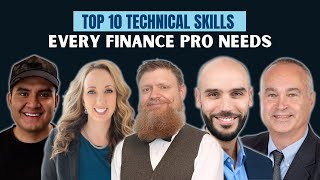
Finance experts pick the technical skills that matter most for FP&A professionals. Financial modeling, analytical thinking, and data understanding come up repeatedly as the foundations that separate strong analysts from the rest.
What is the number one technical skill that FP and a professional should master?
I think it's financial modeling. And when I say financial modeling, it's modeling shortly set because you need to link volumes with revenues, you need to link drivers with their impact on the finance. And when I say financial modeling, I see a lot of people talking about the three statements.
I was waiting for that to come.
Yeah, I don't say it's not useful, it's just that depending on where you work in the kind of company you work, the business unit you work for, you might not even see a balance sheet in your life. And cash flow, not all the time. I mean, when you work on the budget in one small business unit or one small product on one small department, you do not always have access to this. The cash flow is managed by the group. The balance sheet is managed by the accounting department of the group. So you barely have access to those. Where I think that you have value is definitely on the P and L and on the part that you are the best, that you are the partner of. So the three statements is important, but it's not needed. Absolutely. When you work in FP&A, because in many of the big companies that there are in the world, you will not even see the two other statements than the P and L. And so what I want people to know is how to make different links between the drivers so that your financial modeling will strongly depend on 2, 3 drivers that the business understands and they can play with and the others try to really understand how they are linked to make sure that your Excel skills can change them whenever the biggest drivers are changed.
Appreciate the answer. And I have a similar view to you, maybe a little different, but I tend to agree with you. The modeling is most important.
Attribution analysis, if you are able to break down like what's causing this into the actual attribution, the causation. Causational attribution analysis. Like you could do anything, it doesn't matter. What tool you're using, doesn't matter. Anything that wins, in my opinion.
I don't know if this is going to be called a technical skill, but here's the one thing that I see that a lot of people struggle with is learning the art of the sniff test. You do an analysis, especially a new guy, you do a lot of analysis and you produce something and then if it just doesn't make sense or something's off, you need to be able to realize and learn pretty quickly if it looks right or not or if you need to Go back and challenge some assumptions. Last thing you want to do is produce a report and have people say, yeah, that's not right.
I love that one. And I've been in that situation and I work with people that don't have that skill. And it's painful when you're like, hey, our total revenue last year was 100 million. You just boost a report of 2 billion and you didn't question why it's wrong. You know, like, I've seen that. And you're like, okay, you just don't have that skill. So, so important. I really like that one. I haven't had that one given as the number one, but I like that one.
Would analytics be considered a technical skill in this case? I'll take it because I would say just an analytical mindset and a problem solving mindset. Here's the situation. Do a deep dive. Figure it out what's going right, by the way, Solve problems that nobody else knows exist. That's the magic. When you see a problem that nobody else sees and not just point out the problem, come up with a solution for it. That's real value add. It's like, hey, we're doing great. You know, we're growing 25% a year. This is wonderful. But did you notice these two or three things that aren't wonderful?
Yeah. You know, we could improve margin 3% if we did X. Did you even know that was going on? Oh, that's a great idea.
Yeah, exactly. You know, there's upheaval in Brazil where we get 20% of our raw materials. It hasn't affected us. Now it's going to affect us in six months. We need to get an extra source, something like that. So.
100%. That's a great. I like that one. Great point. I actually think it's that that range.
You're getting comfortable using multiple data sets and ranges because. Because 80% is what you're gonna get.
They have to be able to look.
At the numbers and generate insights.
Understanding data.
I like it. Understanding data.
Gosh, man. I don't think there is any, to be honest. I actually think that there's like this huge transition that needs to happen from thinking that FP and A needs to be super technical. I think it's just, can they solve. Can they think through a problem and understand sides? Like, the technical skill that they need is the ability to learn about a concept really fast. So, like, if they're meeting with their marketing leader to learn that really quickly, I like it.
So being able to rapidly learn, having that curiosity and being able to scale quickly.
Modeling that you gotta be a good modeling because. And what I say is not that you have to have the most complex model and has all the coolest formulas. Your model has to be useful, right? It has to teach about this. And that's what I mean by modeling, right? Like because it can be wrong. They're always wrong. But if you're a good modeler, your modeler will teach you why you missed and what happens automatically.
I'll sum it up as George Box once said. All models are wrong. Some are useful. Make sure yours is useful.
That's a mantra I live by. Say that to my team at least once a week.
Love it.
Financial modeling and understanding.
I love that you added understanding. It's not enough to just model. You need to understand. I think that's a great distinction.