Finance Technology Enablement: Leveraging Tools for Optimal Results
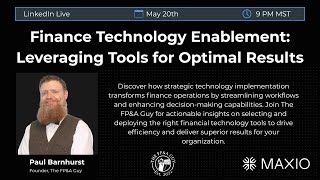
Paul Barnhurst walks through how to pick and use finance tools, including AI, to actually improve your processes. Part three of a Maxio-sponsored series with live Q&A.
Foreign welcome for anyone who's out there. We'll get started in about two minutes here. Got another minute or two before we go live. But if you're out there and you can hear me, if you've already joined, please let me know where you're coming from. I'd love to know where you're at today, what your name is. Like I said, we'll get started here at the top of the hour. So we got another minute or two. For anyone who's wondering, this is part three in the series. It's finance Technology Enablement Leveraging Tools for Optimal Results brought to you by Maxio. And so we'll give it another minute or here another minute or so before we get started. We're just a little early, but please, if you're out there, if you've joined us, let me know where you're coming from. I know we have some people on LinkedIn and we have some people out there on YouTube as well, so very excited. We'll get started here in just a moment. We're still just a little early. Alrighty, got just another minute or two here before we get going. Super excited. As I mentioned, this is part three in our series. Part one was about people. We'll recap that real briefly. Part two was about processes. Today is about technology as we all want a frictionless finance. So if you can hear me, if you're out there, just go ahead and in the chat, let me know where you're coming from and we'll get started here another minute or two. I'm a little early, but we're excited for you to start joining. So if you can hear me and you're out there, let me know where you're coming from. Would love to know your name, where you're coming from today. All right, we'll get started here in one more minute. Again, this webinar is brought to you by Maxio. It's a LinkedIn live webinar series, a three part series. Part one, we talked about people. Part two, we talked about process. Today we're going to discuss technology and how you can create a frictionless finance. So we'll give it another minute here before we get into things and I start to see some people saying where they're coming from. We have Machine, we'll have Mohammed joining us. We got Cairo, we got Italy, Bangladesh. So I start seeing rolling in. Looks like we got a global audience, very excited. Well, we'll go ahead and get started. So again, as I mentioned, this webinar is on finance technology. Now we live in an exciting time when it comes to tech. I don't think there's ever been a time in our history when things have been like this with AI. Yes, computers were huge, the Internet was huge, you know, the steam engine way back when. But what we're seeing today and the way it can impact FPA is pretty amazing. So let's go ahead and jump into things. So first, I just want to give a shout out to Maxio. This LinkedIn Live series is brought to you by Maxio. This, you know, Maxio removes friction from financial operations and billing by automating workflows like Revrec and SaaS metrics. Great SaaS companies pair their talented finance teams with Maxio, allowing them to focus on strategy and analysis rather than juggling spreadsheets. Make sure to follow Maxio for more great finance content. So again, Maxio has sponsored this series. A huge shout out to them. I really appreciate it. And if you're in the market for revrec, Sass billing, any other things, go ahead and check them out. And I see people letting us know where they're coming from. We got Bangladesh, England, Italy, the Midwest. Looks like we got a great, great turnout today. All right, so for anyone who doesn't know me, I'll do a real brief introduction. My name is Paul Barnhurst. Again, the FPA guy is the nickname I go go by. Some people call me the Bearded Wonder. That's my other fun nickname. I spent a great part of my career working in FPA for large companies such as American Express, Digi Shirt, Solera today. And I've been running my own business now for three years. I do content creation, I do training, I do podcasts, I do speaking series like this. I'm fortunate enough to be a Microsoft mvp. I've earned my Advanced Financial Modeler from fmi. I've also earned the F Pack from afp. So that's a little bit about me. You can follow any of my podcasts, FPA Tomorrow, Financial Modelers, Corner, Future Finance. Any of the three would love for you to give those a listen. Right. I see more and more people letting us know where they're coming from. We got someone from the Northeast, we got Sarah from Nigeria. Great. We have quite the quite the group out there. Continue to let us know where you're coming from. So today, here's what we're going to cover. We're going to spend a couple minutes doing a quick recap on what we talked about in week one and week two, which are available on my YouTube channel. If you subscribe to my newsletter, which you can find on my website, you can find it on my posts. You'll get a. A link to a summary about these events, link to the YouTube. You can also watch them on LinkedIn. We're going to talk about how you assess your tech, your tech stack, Some advice for selecting a tool, and then we'll wrap up with some key takeaways. All right, so I had a little bit of fun with this. This was all AI generated. So you can see that poor guy trying to use Excel as his entire company. Stack Stack. I love Excel as much as the next person, probably more. I think it's a fabulous tool, but there is a time and a place for it. You could do amazing things, especially if you use the entire Microsoft tech stack. But I don't think anyone would suggest a large company should use Excel for its entire tech stack. Right? Nobody wants to do their accounting entry. So there's some kind of fun things. Right? Your Excel file is so big, it crashes before you even open it. Biggest Excel file I ever dealt with was over a gigabyte. It was pretty crazy. You know, you have 47 tabs and one is literally named Do Not Touch. Final. Final. I think we all can kind of relate to those. Have a little bit of fun. But let's go ahead and recap real quick before we get back to tools. So this is the framework that kind of overarches this whole series. You start with making sure you have a healthy culture. You've established mission, values and behaviors for your finance and FP and a team. We shared a video by Brett Hampson on how he thinks about mission and vision and how it keeps us from being on that hamster wheel and working on things that really aren't adding value. Then we talk about surveying the landscape, assessments, benchmarks, maturity models. There are lots of things out there to help you say, how am I doing as a finance organization? You know, am I doing good compared to my peers? Am I doing terrible? So that you know kind of where you're at before you decide where you want to go, where you want to be at. We talked about attracting, retaining and developing talent. More important than ever today that you focus on making sure you find the right talent. You retain the talent, but you also develop the people you have. Some of the best people you're ever going to have are those you develop and then you want to have best in class. Processes and tools. When I say processes, I think of a process mindset, a culture of, hey, we should always be asking why do we do it that way versus well, that's the way it's always been done. And I see more people letting us know where they came from. I see a couple more from Nigeria, India, greater Toronto area. So great, great. Org. I originally was going to be from Toronto today presenting, but some things changed and I'm. I'm here at home today. So on process optimization, we shared a framework that has seven steps for optimizing your process. Not every process needs all seven. Right. Depends on the size, but it gives you a framework that you can work with. So kind of mapping and analyzing that process, redesigning, making sure you put appropriate resources to things, implement and execute a plan, and then last but not least, least monitor and optimize. So that's what we covered in week two of the series. So now let's really jump into the technology side. As I like to think about it, it's people first, processes second, then technology. And when I say processes, often when you put in technology, you have to overhaul your processes. I'm talking about a process mindset. Right? And so talented team plus optimized processes plus thoughtful technology is where magic happens. It enables you to accomplish more. And it reminds me, this is a quote I shared last week. New technology plus old processes equals RE equals less reliable, more expensive old processes. So it's a combination. All right. So when you think of the tech stack, I'm not going to read these. These are the main tools I thought of when I thought of finance. Right. You obviously got an erp. You may have an FPNA solution, close software, treasury spreadsheet software should be in there. A BI tool, AR spend. Right. This is for a larger company. That's probably the tech stack. Smaller company. Several of those may be done in a spreadsheet, but at some point, most companies will need all of those tools. So where this starts is assessing your tech stack, right? Inventorying all your tools. I still remember when we did that for one of the companies I worked with. Private equity came in. I think we found we had five different BI tools across the company and we streamline that down to one. Might have went to two. I think we went down to one. You know, we found we had a bunch of similar platforms for meetings. We had sales ones and ones in the business, and there's a lot of overlap between them. So, you know, obviously we're talking finance, but this is true. Crossed. Everything in a business is it's really good to inventory your tools. You can often save money just by realizing we're paying for tools. We're not using or we're paying for tools that do the same thing. And then make sure you list those pain points. You know, what's the problem? Is it too much data to work in an Excel spreadsheet? Is it your. You have disjointed billing platforms and your data is a total mess. I worked in a company between the business units I supported. When I was a director, I had responsibility for two different business units. I think we had five different billing platforms we used and none of them had the same customer names. It was a nightmare. And so that was a huge pain point for us, you know, and then look for, like I said, kind of under when you inventory your tools, look for those redundancies and then also gaps. You know, are you sticking a bunch of band aids on everything when a tool might save you time and money or using AI? And so those are a few things around assessing your tech stack. Once you've done that, then you need to find the opportunities. And I encourage everybody to start with your biggest pain points. And for most companies, one of the biggest pain points is the quality of our data. So make sure as you're looking at these processes, you think about how you can improve data. And then the third one I think is huge on this look list. Quick wins. With just the Microsoft Tech stack or even the Google Tech Stack, you can do a ton. You don't always need a new tool with, you know, Power Automate, with Power Bi with, you know, Google Sheets and Looker and all those different tools. Having that office platform at your fingertips can allow you to do a lot of things without necessarily going out and buying a new tool. And it can often allow you to do quick wins. Maybe automate a process as you wait for something to come into place. Maybe, you know, clean up some of your data, create some tables that help you with looking up data, whatever it might be. I know I learned Power Query that allowed me to do a lot of quick wins. At one company I was at, we were able to put a. A cube eventually in place that everybody in the company was using that was relatively inexpensive. Based on some of the learnings I did, we brought in someone to take a lot of what I did and convert it with Python and an SQL database integrator reporting. And over time, without spending a lot of money, we made huge progress on where we were to where we wanted to be because we were not in a position where our investors were willing to spend a substantial amount of money on the new platforms we all would have liked. And then Last but not least, make sure you're looking at how AI can help. You talked about that last week with processes. It also applies with technology. I think I learned of five new AI finance companies in the last two days. They're growing like crazy right now, and so there are lots of ways to bring AI into what you're doing. All right, so this is my list of 10 steps for selecting a tool. And it doesn't matter if it's an FPA tool, if it's an erp, whatever it may be, this is a good list. The smaller the tool, the less likely you'll need to go through every single one. But any large project, you need to think about these things. So, you know, it starts with having that project lead and really having a sponsor that can champion it. A problem statement. What does success look like? What's in and out of scope? Making sure you understand your existing processes, reports and templates. Have a list of your mandatory requirements. How many have ever sat in a sales demo and just been wowed? Like, oh, that's cool, that's cool, that's cool. And then you buy the tool and you realize it doesn't meet a lot of your basic needs because you didn't focus on the mandatory requirements. You got caught up in the wow factor, which is easy to do. And very closely related to that is where are you going to be as in a company in three years, in five years, in 10 years? Nobody wants to implement an ERP or an FPA tool or treasury management tool and turn around and do it again two years later. You want to think long term. When you're putting in big platforms that take months. It's one thing if it's a spreadsheet and you switch. All right, so I'm not going to spend a ton of time on each of these, but I just want to walk through each of them in more detail. When you say establish a project team, to me it starts with that sponsor, and that should be a senior leader, a cfo, a head of finance, you know, a vp. I wouldn't go lower than that. Ideally, cfo, head of finance, maybe fp, and a someone who will be passionate about the project. And that can. And if anyone has any questions, you know, feel free to put those in the comments. I'm keeping an eye on them as we go through this. So, you know, feel free to ask me any questions. And when I think of project success, I can think of, you know, putting a BI tool in place where, you know, we really didn't define what project success look like? And it took us about an extra year to get this platform in place. What we did is we just took all our existing reports, a bunch of Excel reports, and duplicated them in I think was MicroStrategy at the time. This is 15, almost 16 years ago now. Date myself and I remember we got done and nobody liked the reports. We didn't think about what, what, how does it impact process, what does success look like? You know, what, what should be improved? We just kind of tried to port exactly what we were doing in Excel and just throw it into the new tool. Didn't work well, it was a really good learning lesson once we really started to think, okay, what does this tool mean? What are, what's the objective? Why are we using it? How does it help the broader business to go beyond what they could have done with just Excel, with just a spreadsheet, then reports were able to be developed that really helped the business move forward. All right, so, you know, I have a couple steps in here. You know, when it comes to scope, I, I'd say with any project, think about phases. What are the different phases of your project? For example, if it's an FPA tool, you know, is it going to be financial planning only? Will it include operational? Will you be doing close in this tool or not? You know, if it's an accounting tool, will you be doing an AR and AP module with that? Will that come later? What are each of the phases? You know, what's the reporting that needs to be included? And so really think about that scope. What is in and what is out of scope? Because we've all heard the term scope creep. If anyone's ever, you know, worked in it, the joke is whatever you're given for a timeline and a budget, double it. Because if the tell is going to cost a million, it'll cost 2 million. If they tell you it's going to take six months, it will take 12 months. So the better you do defining and sticking to that scope, the better the chance is you'll be able to meet your deadlines. You know, a lot of this on the technology side, as boring as it is, and I get it's a little boring, is project management, right? If you're the one in charge of helping with the tool, you're going to be doing a lot of project management. I've, I've helped with some tools, I've helped with, you know, overhauling processes and there's aspects. I love some of the project management stuff. Not as much. I'm not going to Spend much time here because we talked quite a bit about it last week. But you know, think about your processes, your reports, your templates, what needs to change, what should you streamline? Can you get rid of reports? All those type of things and then next make a list of your requirements, you know, and here's an example. This is coming from fpa, but you could change this for whatever the tool is. I like to bucket it in kind of three areas. You have your mandatory requirements. If the tool does not have this, it's a showstopper. We're not going to move forward. A mandatory requirement could be integration with Microsoft Excel, it could be be integration with Tableau. It could be a number of different things. You know, certain audit logs, stock compliance, you know, certain security compliance. Next you have your. Nice to have. Yeah, I'd love to have integration with Slack or certain types of graphs or certain bank accounts in a Treasury management tool or you know, spreadsheet that can handle certain things. But I'd be fine without it. Like I can make do. So they're nice to have and then there's luxury, you know, things that may not really be necessary. Kind of the little bit of those wow factor. A lot of times they're nice, but probably not going to make a big difference. You know, like the fancy new ui. Hey, that'd be nice to have a really good ui, but I'd much rather have all my mandatory and nice to have services taken care of first. All right. And then as I mentioned, as you're doing this, think about the future. As I said at the beginning, nobody wants to spend three months, six months a year, 18 months putting in a tool only to rip it out. And the reality is most implementations fail and rarely do they fail because of the technology. They fail because we fail to manage the process, change management, implementation, all those type of things. You know, obviously if you plan to go public or you're planning on selling the company, you probably want to think different about your tech stack than if you're going to remain private forever, you know, so think about how you're going to grow. What size do you expect to be in five years if you're in hyper growth mode? That's going to be very different than a family business that hey, I might grow at the rate of, you know, inflation 2, 3% a year. I wish inflation was 2, 3%. I'd love for those days again. But you know, just as an example. So really, you know, think about that. And I know I've had those conversations whenever I help somebody with tool selection, it's like, okay, what's your plans? How big do you think you'll be in the future? And that allows me to go, okay, let's make sure. I think of tools that will be that, that will be able to manage their size or, hey, we're going to do a lot of M and A. So I need a tool that is easy to change, easy to add chart of accounts and roll things up or add new bank accounts or whatever it might be, depending on the tool or expense management. Right. Make sure you establish a budget for the project. I think there's three areas typically to think of. There's your implementation cost. Some tools won't require much here. Some could be millions of dollars depending on the size of your company. I've seen that. Then you have your software licenses. Does everybody need a license? How many people? How do they charge? They're really understanding the pricing model because those are constantly changing, especially with AI. Some of these new pricing models are based on, you know, kind of the value they provide. Do they solve the problem? And they get so much, you know, percentage of that. So there's a lot of different ways it can be priced. So make sure you understand what that means for you. And then you have ongoing maintenance and training. Do I need to train? Do I need a person to manage this tool? So often we forget some of those things. Then it surprises us down the line when you have to go back and, oh, I need 50,000 next year. Well, why? We already gave you 400,000 for that project. Well, we forgot about this and that. So try to be comprehensive. When you think about what the cost is, you're always probably going to miss something. But the more you think of each category and what it means, the better prepared you'll be. All right. Then we get into the RFP process itself. And I would encourage people to do an RFP for anything of material size one. You know, you can see the process. I'm not going to talk about the process. I want to talk a little bit more of some of the benefits. One, it forces vendors to sharpen the pencil. If they know they're in a formal rfp, they know they're competing against other and it helps maximize the value you receive for the price you pay. Two, you can do a proof of concept. Don't just let them show you their perfect environment where all the data works well and everything flows together perfect and nice and it looks simple. Like, I still remember, you know, when BI tools first came out, they always showed, hey, click of the button and you got your graphs and you're away and running. And I always thought, yeah, only if my data is in good shape. You know, let show me how you can do that with my data, not your perfect curated data. That's a click of the button. And so I think this is really important. I encourage that. You know, I started my career, I don't know how many knew this, but I started my career, I spent four years in procurement and so I was a contract specialist. So I had to write RFPs and help manage some of those processes for the government and learned a lot about the importance of the process and the importance of keeping it simple within reason. You know, it doesn't have to be a big huge production. It can be really simple. We only have a few minutes left, so I'm going to kind of wrap the key takeaways and then I'm going to open it up for any questions people have. So I'd mentioned this series has been Frictionless Finance. We've had people process technology and technology is an enabler if you're planning on putting in new tools to solve your problem. No, I mean, if you think it's really going to make, you know, make your life easier and solve all your problems, probably not. It's going to help you be more efficient and more effective. Technology is an enabler. Do your homework before buying or investing time in a tool and think about quick wins. Like I mentioned at the beginning in mine, when I learned how to use Power Query and Power Pivot, I got some huge quick wins that everybody in the business was using. Then we developed it into a cube again, I use Power Query and Power BI to start creating reports. Then we brought someone in who could write Python and automated a lot of the processes. But. But I got the Quick wins first and demonstrated that we could do more with just what we had before we started to invest and improve the platforms. And so it made a really big difference. And then remember, frictional and Frictionless finance is a journey, not a destination. So I'm going to open it up for questions. Before I do that, I'm going to let everybody know if, if any of you want to join my community, you can. It's the fpahub.com free for anyone who wants to join. It's designed for FP and A professionals, so I'd love to have you there. And we'll go ahead and I'll hang on for a few minutes for any questions anyone has about technology or have a question. For one of the prior sessions. I'M open to that too. I'll hang on probably till four or five after. So just give you about five minutes here to ask any questions you have. And while we're waiting for the questions, I'll just throw we some of the other places people mention they're coming from. We got San Jose, we got another person from Nigeria. So we have a very diverse group. I've seen the Middle East, I've seen Europe, I've seen the U.S. i've seen Asia, I've seen Africa. Always fun to see these global audiences. I love it. And as we're waiting for any questions again, shout out to Maxio. They they're one of those tools that can help you create a frictionless finance department. The more you can remove friction by people, processes and technology, the better off you will be. All right, I'll give it a couple more minutes for any questions. And I know sometimes the there's a little bit of delay so the questions can take a minute. So I'm going to just click over to LinkedIn and see if I see anything there as well. All right, not seeing any questions come in. I'll give it another minute here now. There we go. Yes, Bill, great question. So this has been recorded. It will be on YouTube. You can go to my YouTube channel and find all three in the series if you subscribe to my new newsletter, the Modern Finance Playbook, which if you go to my website, the fpnaguy.com you can subscribe to it there. I will be sending out in tomorrow's newsletter a link to all three in this series. You can also find the three on LinkedIn. So you can find them on YouTube. You can find them on LinkedIn. Maxio also has a copy of them as well. Pasiko Paul mentioning this is his first series. I hope you enjoy the other two. Yeah. I encourage you to also, you know, check out the others. I think it naturally flows, you know, people process technology. That's the way I always look at it. So thank you for those questions. We'll give it just one more minute and see if any other questions come in and then we'll wrap up here. So as we're waiting I'll tell a quick joke as we're waiting for questions to come in. Does anyone know where you should store your Excel error messages? What column in row you should put your Excel error messages in. Personally I like to store them in column fu row 2. So that is fu 2. Personally I like to store them in column fu row 2. So THAT is fu 2. There you go. All right. I love this comment from Job. We'll just throw this up here. He says thank you, Paul, for the insightful session. Exciting to see how finance technology is evolving towards smarter, more strategic decision making. Totally agree. And that's what it's about, helping the business make better decisions. Technology for technology's sake is not enough, but when used right, it can make a huge difference. And AI is transfer forming the way we work before our eyes. We're still in the early days, but what is it going to be like in 5, 10 years? Really exciting time. So thank you for that comment, I think. On that note, I'm not seeing any more questions come in, so we'll go ahead and wrap up. A huge thank you to everybody who joined me. Really appreciate you taking time out of your busy day and feel free to drop me a note at any time if I can ever help you. Check out Maxio. Again, a huge thanks to them for sponsoring this series and I hope everybody has a great day evening, you know, wherever they may be. I know we have people all over the world, so you're all in different time zones, but thank you so much for joining me. I really appreciate it.
More from Paul




Trust and Leadership Lessons for FP&A From 100+ Top Leaders with CFO Jon Laudie






